The Americas · Volume 22
Brazilian Amazonia
Tucupi, Jambu and the River's Own Kitchen
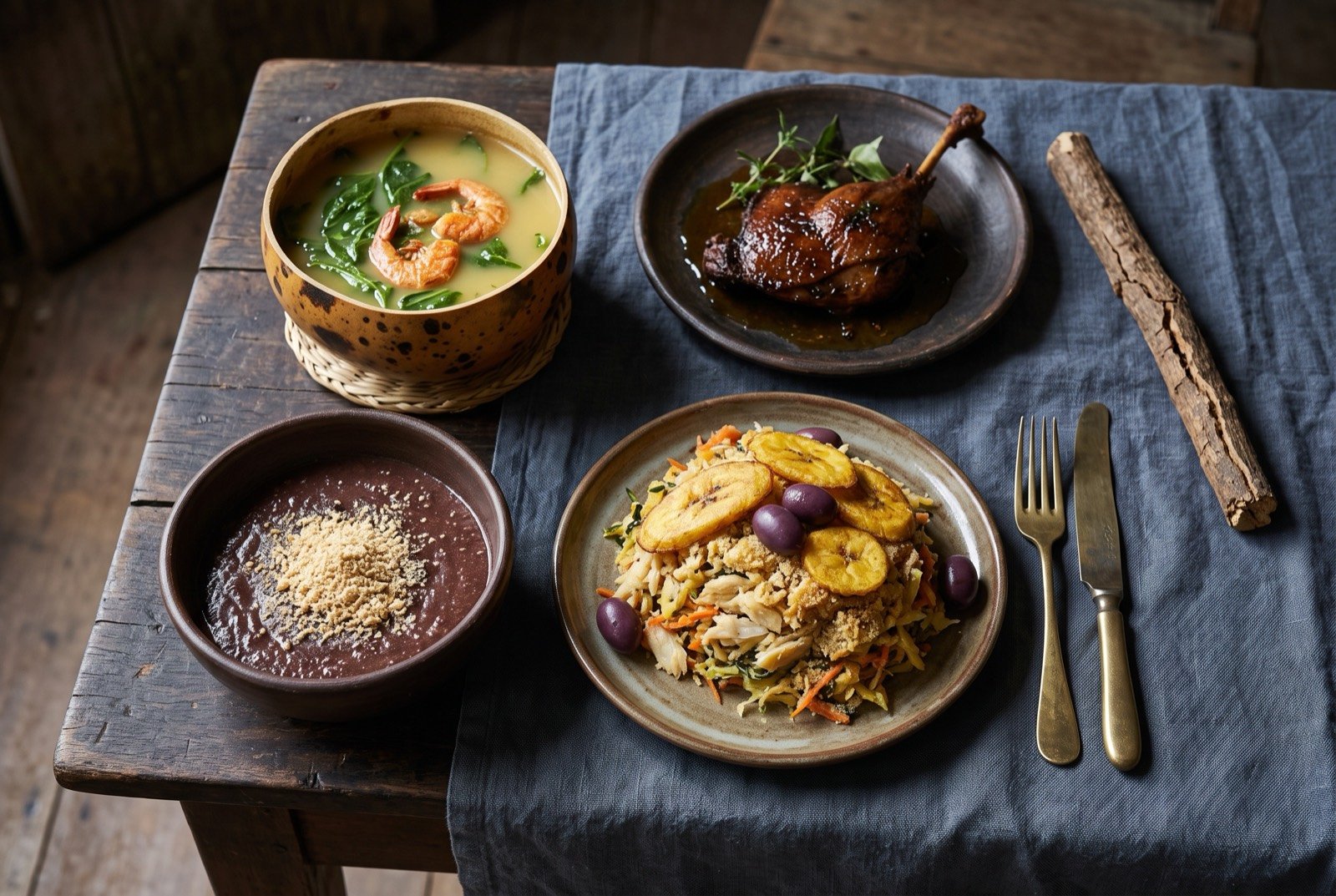
A river system, not a country, decides this volume's borders. Belém and the state of Pará, and the wider state of Amazonas and Manaus further upstream, share one ecology, cassava, river fish and a forest larder, but not one history: Belém built a globally recognised food identity on the back of Catholic festival and Portuguese-indigenous fusion, while Manaus's own table, more directly shaped by the indigenous nations still living in and around the city, has never been written up with anything like the same attention. This volume treats both honestly, at the depth the research actually supports for each, rather than pretending Manaus is simply Belém with a different postcode. It excludes Bahia, Minas Gerais, Rio de Janeiro and São Paulo entirely: their dendê coast, their cattle interior, their coffee-funded immigrant kitchens belong to mainland Brazil's own culinary region, mapped elsewhere in this atlas. Every dish as tradition built it, then what a modern chef would change.
Sources and review · What this chapter does not assert · How we research · Spotted something wrong?
A Sense of Place
Two cities anchor this volume, and they do not anchor the same cuisine.
Belém sits where the Pará River meets Guajará Bay, founded in 1616 with the construction of the Forte do Presépio, built by the Portuguese specifically to secure control of the Amazon's mouth. It is a coastal, estuarine city, close enough to the Atlantic that its food culture folds in salt-water trade, Catholic festival calendar and, from the late nineteenth century, the wealth and built environment of the rubber boom, which left the eclectic mansions, tree-lined squares and broad avenues still visible in the city centre today. Whether that wealth shaped the food culture as directly as it shaped the buildings is a claim this chapter has not found good evidence for and does not make.
Manaus sits roughly 1,300 kilometres further upriver, where the black water of the Rio Negro meets the pale silt-laden Solimões, a confluence so visually distinct the two rivers run side by side for kilometres without mixing. Manaus's food identity is less internationally documented than Belém's, has no UNESCO seal of its own, and is shaped far more directly by the indigenous nations who live in and around the city today: Amazonas is the Brazilian state with the largest Indigenous population, and Manaus itself counts 71,713 residents who self-identify as Indigenous, described in Amazonas press as the largest Indigenous urban population of any Brazilian state capital, home to 186 ethnicities and 99 languages. This is not a demographic footnote. It is the reason Manaus's caboclo cuisine, the mixed indigenous-riverine cooking of the whole basin, reads closer to its indigenous root than Belém's more codified, more branded, more internationally performed Pará table.
The defining logic, by place and community
| Element | Belém and Pará | Manaus and Amazonas (caboclo/riverine) | The indigenous nations proper |
|---|---|---|---|
| Fat | Light, palm oil where used at all | Fish fat, minimal added fat | Minimal, lean fish and game |
| Starch | Cassava worked three ways at once, tucupi, farinha, tapioca goma | Farinha as the true staple, piracuí as its dried-fish counterpart | Bitter and sweet cassava, seasonal fruit "wines" when fish is scarce |
| Aromatic base | Tucupi, jambu, cheiro-verde, pimenta-de-cheiro | The same base, less commercially codified | Jiquitaia, the Baniwa pepper-salt; black tucupi on the Rio Negro |
| Everyday protein | Dried shrimp, river fish, duck at festival time | Tambaqui, jaraqui, pirarucu, tucunaré, matrinxã; historically river turtle | River fish stunned with the timbó vine, hunted game, insects, honey |
Both places share the two flavours that make this cuisine genuinely unlike anywhere else on earth: tucupi, the boiled and fermented liquid pressed from bitter cassava, and jambu, a small-flowered herb whose active compound, spilanthol, numbs the mouth on contact. Nothing in European, Asian or African cookery does what these two ingredients do, and no substitute in a British kitchen comes close, a point this chapter's sourcing section does not soften.
The History in Layers
Belém: a river mouth, a rubber boom, and a very recent piece of paper
Belém's food identity is now backed by an unusually formal piece of international recognition. In 2015 UNESCO named Belém a Creative City of Gastronomy, one of only four Brazilian cities in the whole Creative Cities Network and the country's sole gastronomy designee. The stated basis, as reported consistently in Brazilian press rather than read from the dossier itself, since this chapter could not reach UNESCO's own submission text, names tucupi, jambu, açaí, pirarucu, cupuaçu, bacuri and maniçoba directly as the ingredients the seal recognises. The designation has been formally renewed in subsequent review cycles and has real, traceable downstream effects: a Federal University of Pará-affiliated food-technology institute, a "Boulevard da Gastronomia" opened in the historic centre in November 2023, and a dedicated Gastronomy Management Committee running producer training, with the gastronomy sector cited as employing 43,000 people in the city. In November 2025 Belém hosted COP30, and the local press's own coverage of that moment is worth reading closely, because it is not simple celebration: Exame, a national business title, ran a piece specifically asking whether Belém could sustain the culinary spotlight once the summit ended, treating the boom as fragile and possibly temporary rather than a settled achievement. That scepticism belongs in this chapter as much as the UNESCO seal does.
Belém's own festival calendar decides the food year
The Círio de Nazaré is Belém's organising ritual, and its food is inseparable from it. Tradition holds that a farmer, Plácido José de Souza, found a small image of Nossa Senhora de Nazaré on the banks of the Igarapé Murutucu around 1700; the first formal procession was organised in 1793 by the captain-major Francisco de Souza Coutinho. Today the main procession runs on the second Sunday of October, roughly 3.6 kilometres from Belém's cathedral to the Basílica Santuário de Nazaré, drawing an estimated 2 million participants, by local framing the largest Catholic procession in the world. IPHAN registered the Círio as national heritage in 2004; UNESCO inscribed it as Intangible Cultural Heritage of Humanity in 2013. It is, by every account, a Catholic festival, and its food is repeatedly and explicitly described in Pará sources as indigenous in origin regardless: "apesar de ser uma festa católica, os itens que fazem parte da ceia do Círio têm origem na cultura indígena," despite being a Catholic festival, the items making up the Círio meal have indigenous origins.
A specific piece of local historical writing on the Círio's food, covering 1900 to 1950, gives a genuinely useful, class-stratified structure this chapter prefers to the generic tourist-board version. Three distinct eating spaces existed side by side. The almoço do Círio, the family Sunday lunch, is anchored by maniçoba, started a full seven days earlier, and pato no tucupi, historically washed down with the local soft drink Soberano guaraná. The Barraca da Santa was an elite, charitable food stall run by society women; contemporary observer Osvaldo Orico called it a "restaurante de luxo" where "a grã-finagem local pagava gostosamente," local high society paid gladly, and a documented October 1941 menu there ran to turkey, roast suckling pig, mayonnaise, puddings and imported drinks, an elite table riding on the same wealth that built the rubber-boom mansions, even if no source draws that causal line explicitly. The Arraial de Nazaré, the popular street fair, sold "tabuleiros de tacacá e mingau," trays of tacacá and maize porridge, at prices that put the same festival within reach of every class in the city at once. This tripartite structure, home, elite stall, popular fair, is the honest shape of Belém's food year, not a single flattened "Círio means maniçoba" claim.
Tacacá belongs to more than one claimant, and this chapter does not settle it
Tacacá is Belém's single most identified dish, and its origin is genuinely disputed among the very people who study it. The folklorist Luís da Câmara Cascudo held that "a origem do tacacá é dos indígenas paraenses," that tacacá was born among Pará's own indigenous peoples. Against this, the independent food historian Francisco Gomes da Silva cites the German traveller Robert Avé-Lallemant, who in 1859, at Serpa, today Itacoatiara, firmly in the interior Amazon and in the state of Amazonas rather than Pará, recorded tasting a tapioca, tucupi, jambu, shrimp and pepper drink he called "a bebida nacional dos Mura," the national drink of the Mura, a people of the Solimões and middle Amazon. The Sateré-Mawé, a third and entirely separate people whose own relationship with guaraná is covered below, are also documented making tacacá themselves. This chapter states all three claims and adjudicates none of them. What can be said without dispute is that tacacá's modern commercial identity, sold hot from a fixed stall out of a cuia gourd, is overwhelmingly Belém's own, and that identity has just received a remarkable piece of formal recognition.
On 25 November 2025, IPHAN registered the "Ofício das Tacacazeiras," the profession of the women who make and sell tacacá, as Brazilian intangible cultural heritage, inscribed in the Livro dos Saberes. This registration is worth stating in some detail, because it is very recent and genuinely substantive. The profession is documented back to the nineteenth century, tied to Amazonian urban expansion and to women taking up street vending as household income compatible with domestic life. Research from the Federal University of Western Pará cited in the dossier puts the profession at roughly 70% female. Recipes and technique are transmitted matrilineally as closely guarded, family-specific knowledge, no two tacacazeiras' pots taste quite the same. Two period artworks, from 1937 and 1954, by Antonieta Feio and Andrelino Cotta, independently document tacacazeiras at their stalls, a material record standing alongside the oral one. The dish's own composition has shifted: earlier interior versions used saúva ants and matupiri fish rather than dried shrimp, which became standard only by the mid-twentieth century. Maria de Nazaré, known as Tia Naza, 71 and based in Manaus rather than Belém, a reminder that this heritage is not narrowly Pará's alone, is quoted in the dossier's coverage: "Tudo se criou aqui, vendendo tacacá," everything was raised here, by selling tacacá, two lawyers, two doctors and a journalist among her own children. Pará's senator Jader Barbalho put it more simply: "Tacacá é muito mais que um prato. É o sabor do Pará servido numa cuia." IPHAN's next obligatory step is a formal safeguarding plan covering promotion, business support and ingredient supply, meaning this registration is a beginning, not a finished protection.
Maniçoba: a subsistence food before it was a festival dish, and not an African one
Maniçoba's timing is not negotiable: the ground manioc leaf, maniva, must cook for at least seven days to clear its hydrocyanic-acid toxicity, the same cyanogenic chemistry that makes tucupi's own production a genuine safety process rather than a flavour step. With pre-cooked maniva now sold in supermarkets, home cooks can shorten this to five or six days; traditional preparation for the Círio begins a full fortnight ahead. Sidiana Macêdo, whose 2016 University of Pará doctoral thesis on Belém's food history underlies much of this chapter's strongest material, traces the dish to before Portuguese colonisation: the sixteenth-century chronicler Gabriel Soares de Sousa recorded indigenous peoples eating the boiled leaf "cozida em tempo de necessidade, com pimenta da terra," cooked in times of need, with native pepper, a subsistence food, not a festive one, originally combined with roasted, not sautéed, hunted game or fish. Portuguese cooking added the sofrito base and the cured meats and sausages that now make maniçoba resemble a feijoada. Macêdo is explicit that this resemblance is exactly that, a resemblance, and not evidence of African heritage: cassava itself reached Africa only through European colonisation, so any similarity to African leaf-and-meat stews is coincidental, not causal, and this chapter follows her rather than the popular "Amazonian feijoada" framing. Pará's own state legislature approved maniçoba as the state's Intangible Cultural Heritage on 10 May 2022, with Embrapa's cyanide-safety guidance specifically entered into the legislative record.
The African-descended layer in Pará is real, and it is not maniçoba
Historian Vicente Salles, in his standard work on Pará's Black population, documents that "a cultura do negro se espalhou no folclore, nos costumes e usos, na comida e cozinha," Black culture spread through folklore, custom, food and cooking. Macêdo names the dishes that actually carry this lineage: aluá, angu, bobó, mungunzá, caruru, vatapá paraense, moqueca, and the ingredient dendê. This is a real, separate strand from the indigenous strand maniçoba and tucupi belong to, and this chapter keeps the two apart rather than letting one "Amazonian mixture" narrative absorb both.
Cassava processing across three continents: one problem, three different answers
Tucupi's production is the technical heart of this whole cuisine, and it is worth stating precisely because bitter cassava's toxicity is real, not folkloric. Grated bitter cassava is pressed in a tipiti, a woven cylindrical squeezing device, separating the pulp from its liquid, manipueira, which carries the cyanogenic glycosides linamarin and lotaustralin. Left to hydrolyse, these compounds release hydrogen cyanide; Embrapa's own published safety protocol, developed after finding no standard production timing at all among commercial tucupi sold in Belém's own markets, some producers boiling ten minutes, others two hours, sets the safe minimum at 24 hours of fermentation followed by 40 minutes of cooking.
This exact problem, a starchy root whose everyday use requires deliberately detoxifying it, is solved independently on two other continents documented elsewhere in this atlas, and the three solutions genuinely diverge rather than converging on one answer. In the Guianas (this atlas's AM-16), the same pressed liquid is boiled and reduced into cassareep, a thick preserving syrup used to keep a whole pot of pepperpot indefinitely. In West Africa's cassava belt (this atlas's AF-02, Guinea, Sierra Leone and Liberia), it is the pressed pulp, not the liquid, that is fermented, over two to four days, before being toasted into gari. Amazonia keeps the liquid, ferments and cooks it only briefly, and uses it as a living broth base rather than a syrup or a dry staple. Three river-and-forest cultures, none in contact with the others when they developed these methods, solved the same chemistry with the same underlying logic, mechanical pressing followed by heat or fermentation, and arrived at three genuinely different foods. This is the clearest single illustration in this volume of the atlas's own argument: elevation is a matter of doing traditional things deliberately, and here, three separate traditions already did.
Manaus: the city with more indigenous residents than culinary reputation
Manaus's own defining fact is demographic, not culinary in the narrow sense, and it shapes the food anyway. Amazonas holds Brazil's largest Indigenous population, and Manaus itself, a major state capital, counts 71,713 residents who self-identify as Indigenous, more than any other Brazilian capital, spread across 186 ethnicities and 99 languages; 62.3% of the state's Indigenous population lives in cities rather than rural communities. This urban indigenous presence is the direct reason two of Manaus's own dishes now carry formal municipal heritage status. Jaraqui, a river fish rather than a prepared dish, was recognised by Manaus municipal law in November 2019, later extended to the whole state, explicitly for its role "forming the social, historical and gastronomic identity of the Amazonian population." X-caboquinho, a sandwich of French bread, sliced tucumã, fried ripe plantain, queijo coalho and butter, received the same municipal recognition the same year, though its own origin is disputed even locally: one account traces it to 1960s Parintins, carried to Manaus by students moving for school, others insist Manaus itself invented it. Manaus's contemporary elevated dining scene has its own reference point, entirely separate from Belém's: Felipe Schaedler's restaurant Banzeiro, open since December 2009, voted best regional-cuisine restaurant in Manaus five times by Veja and holding a Michelin Guide mention, doing grilled tucunaré and wood-smoked pirarucu.
The indigenous nations, named rather than generalised
This chapter follows the atlas's own rule against letting one voice speak for an entire people, and it is honest that indigenous-authored, first-person food writing was not found for any of the four nations below; what follows comes from indigenous-collaborative but non-indigenous-authored ethnography, chiefly Instituto Socioambiental's Povos Indígenas no Brasil project, working in partnership with indigenous organisations such as FOIRN, but written up by ISA's own researchers.
The Ticuna, Brazil's largest single Indigenous population, live along the upper Solimões. Fishing on the seasonally flooded várzea is central, using both fish enclosures and the poison-releasing timbó vine to stun fish in still water; a fermented manioc drink, pajuaru, is made specifically for communal work gatherings, and açaí mixed with manioc flour is an ordinary daily food rather than an occasional one.
The Baniwa, an Arawak-speaking people of the upper Rio Negro, are documented as the sole makers of manioc graters across their whole region, traded to every other ethnic group nearby. They make a version of tucupi genuinely distinct from Belém's, tucupi preto, black tucupi, darker, more reduced and more acidic, likened by Rio Negro sources to soy sauce, served over tambaqui and surubim with beiju flatbread and jiquitaia, a dried pepper-and-salt seasoning now sold commercially through the Arte Baniwa project. The wider agricultural system underlying this, built on bitter and wild manioc cultivated by more than twenty two indigenous peoples across three language families along the Rio Negro, was registered by IPHAN as national intangible heritage in 2010, one of the strongest, most specific pieces of institutional recognition anywhere in this chapter's research.
The Munduruku, centred on the Tapajós river system that runs mostly through Pará with territory extending into southern Amazonas, fish using timbó and gather forest fruit on a strict seasonal calendar, açaí, patauá, bacaba, uxi, pupunha, murici among others; in the rainy season, when fish grows scarce, thick fermented fruit "wines" become, with flour and hunted meat, the base of the diet. One dish is bound to a specific myth and a specific date: the matrinxã fish is held to have originated from transformed Munduruku women, and is fished only for a traditional September festival as a result.
The Sateré-Mawé, whose relationship to guaraná anchors the next section entirely, also make their own version of tacacá, one more claimant, alongside the Mura and Pará's own indigenous peoples, to a dish Belém now sells as unambiguously its own.
Guaraná: domesticated, not merely discovered
Guaraná's story deserves more than the ingredient-list treatment most food writing gives it, because the Sateré-Mawé relationship to the plant is a genuine act of domestication with its own cosmogony attached, documented in a peer-reviewed article in the Boletim do Museu Paraense Emílio Goeldi. In Sateré-Mawé telling, a woman named Oniawasap'i, tied to agriculture and to the sacred site Nusoken, transforms her murdered son's eyes into the guaraná plant, one eye becoming a different plant, the right eye "true guaraná." The Sateré-Mawé describe themselves as "filhos do guaraná," children of guaraná, and the myth ties the first Sateré-Mawé person's own birth to the plant's cultivation. This is not only myth: the Sateré-Mawé are credited as having genuinely transformed wild Paullinia cupana, native specifically to their own Maués-Açu river basin territory, into a cultivated shrub, making them, in the article's own words, the first indigenous people to appear in Brazilian history with their own processed, systematically commercialised product. A seventeenth-century colonial record corroborates this independently: the Jesuit chronicler João Felipe Betendorf, in 1669, recorded that the "Andirazes" already had the knowledge to produce guaraná sticks valued "como os brancos o seu ouro," as Europeans valued their gold.
The traditional cure is slow and deliberate: fruit is harvested and its seeds dried, husked and pounded to powder, mixed with water into a paste, then shaped by skilled artisans into rounded sticks and cured for months in a smokehouse to a chocolate-coloured patina. To drink, the stick is grated, traditionally with a specific ferruginous stone found in Sateré-Mawé riverbeds rather than the pirarucu-tongue grater later adapted for outside buyers, into a cuia of water. The resulting drink, çapô, is served by a designated woman, the aguadeira, typically an elder or the tuxaua's own daughter; drinkers leave the last portion, "o rabo," for the tuxaua. Guaraná's function historically ran well beyond refreshment: shared drinking is described as fusing the images of the tuxaua and the plant, consolidating collective decision-making, and eighteenth-century accounts record its role in pre-war councils, calling it the Sateré-Mawé's most precious possession, a technology for moving a community from "vingança... guerra" toward "encontro, reunião, compartilhamento," revenge and war toward meeting and sharing. This is worth stating plainly against the industrial soft drink of the same name: contemporary fair-trade branding of Sateré-Mawé guaraná is explicitly an attempt to revive the traditional cultivation and preparation, not a continuation of the ceremony, and in 2024 the guaraná of the Sateré-Mawé's Andirá-Marau territory became Brazil's first Geographical Indication ever awarded to an indigenous land. Because çapô's preparation is bound this closely to a specific community's own political and ceremonial life, this chapter treats it fully here and in the Flavour Arsenal below, but does not offer a restaurant "elevation" of it among the dishes that follow. Some things in this atlas's brief are better named and respected than reworked.
The Flavour Arsenal
Tucupi. The fermented, detoxified liquid pressed from bitter cassava, sour, savoury and faintly acidic, the base broth of tacacá and pato no tucupi and the single ingredient a UK cook cannot substitute their way around. Correct production, Embrapa's own protocol: 24 hours of fermentation followed by 40 minutes of cooking, minimum, to clear the cyanogenic compounds linamarin and lotaustralin.
Jambu. Acmella oleracea, a small-flowered herb whose active compound, spilanthol, produces a genuine numbing, faintly effervescent sensation on the tongue and lips, used medicinally by riverine and indigenous communities for toothache and mouth ulcers long before it became tacacá's signature. Brazilian academic chemistry has documented several extraction methods for spilanthol, including supercritical CO2 extraction as the cleanest and highest-yielding, but no source anywhere, in this chapter's research, describes a professional kitchen actually using any of them to dose jambu's numbing effect consistently from batch to batch. That gap is this chapter's own to fill, below.
Açaí, the real version. In Pará, açaí is not a dessert. It is a thick, unsweetened, dark cream, blended with water alone, eaten by the spoonful alongside dried fish, dried meat or shrimp, and topped generously with farinha, a savoury staple meal rather than a bowl of fruit and granola. Pará-based chefs and food writers state this contrast plainly and repeatedly, and one investigative report, citing food-culture activist Tainá Marajoara, a descendant of the Aruã people of Marajó, argues the exported version is now doing real damage to the tradition it claims to celebrate: as global demand rises, Pará's own people are reportedly no longer the largest consumers of their own staple fruit, and its price has begun to move like a commodity rather than a local food. That specific quote could not be verified against the original article, which blocked this chapter's own attempt to read it directly, and is presented here with that caveat rather than as settled fact.
Cupuaçu. A cacao relative with a sharp, tropical, faintly pineapple-like pulp, used in juice, mousse and ice cream, and, at an agricultural-research level, in "cupulate," a genuine Embrapa-engineered chocolate analogue made from cupuaçu's own fat and mass rather than cocoa butter.
Farinha de mandioca. Toasted cassava flour, the true starch staple of this whole cuisine, more central to the plate than rice. Production runs a full seven stages: harvest, a three-day soak that ferments and softens the root and loosens its peel, peeling, grating, pressing to expel the last of the plant's toxins, sieving, and a final dry toasting by a skilled torrador whose sole job is preventing the batch from burning while it sets its colour and crunch.
Pirarucu. A giant river fish, reaching 3 metres and 200 kilograms, salted and dried in thick sheets exactly as bacalhau is cured in Portugal, earning it the name "bacalhau da Amazônia." The species was placed on Brazil's own extinction-risk list in 1996 after industrial overfishing; a community-managed sustainable fishery pioneered from 1999 by the Mamirauá Sustainable Development Reserve in Amazonas has since grown managed populations by roughly 25% a year across more than 1,300 riverine families, a genuine and welcome recovery that this chapter states honestly as incomplete rather than solved: pirarucu remains on the risk list, because the successful model has not yet reached the whole Amazon basin.
Guaraná. Covered fully above. In the kitchen, treat the dried, roasted seed or its powder as a genuinely bitter, caffeine-rich flavouring closer to a fine coffee than to the sweetened soft drink carrying its name.
Piracuí. Dried, pounded river fish, roughly 70% protein by the sources that have analysed it, the indigenous and caboclo technique for turning a dry-season surplus catch into a shelf-stable flour for the leaner flood season, still made today around Manaus, Prainha and Santarém, folded into farofas, soups and fried bolinhos.
Jiquitaia. The Baniwa's own pepper-and-salt seasoning from the Rio Negro, dried and ground fine, now sold commercially through the Arte Baniwa producer project, a real, buyable piece of one specific nation's own pantry rather than a generic "Amazonian chilli."
Ariá. Calathea allouia, a small, crunchy, potato-like tuber eaten raw in salads, boiled in caldeiradas, or milled into flour, traditionally grown across Amazonian home gardens. Slow Food Brasil's own Ark of Taste entry, the most specific source found for this ingredient anywhere in this chapter's research, documents its cultivation today surviving in tiny quantity, under 20 kilograms a year, at the Raios de Sol community inside Manaus itself, and records older farmers describing it as "a potato that was greatly appreciated, but is now almost impossible to find around here." This is not a footnote about a minor tuber. It is a documented food disappearing from a major Brazilian city within living memory.
Camu camu, uxi, cupuaçu's smaller cousins. Camu camu, researched directly by Manaus's own Instituto Nacional de Pesquisas da Amazônia, carries more vitamin C by weight than acerola, previously considered the fruit's best natural source. Uxi, a strongly flavoured, oily-pulped native fruit, is most often eaten as a popsicle, a genuinely well-loved everyday treat across Amazonian cities rather than an exotic rarity.
The Technique Ladder
The argument, from inside
Six techniques, each explained by why it works, not only what it does.
Rung 1. Tucupi's detoxifying ferment
Bitter cassava's pressed juice carries cyanogenic glycosides that hydrolyse to hydrogen cyanide, genuinely poisonous raw. Embrapa's own protocol, developed after finding no consistent commercial practice at all in Belém's own markets, sets 24 hours of fermentation plus a 40-minute boil as the minimum for safety. This is a controlled fermentation-and-reduction process built on real technical trust in timing, developed by Amazonian communities long before any European fermented sauce reached this river, and it is the clearest single proof in this volume of the atlas's own thesis: elevation is a matter of doing traditional things deliberately.
Rung 2. Tipiti pressing
A woven cylindrical press, tightened by twisting or by hanging weight, mechanically separates grated bitter cassava's toxic liquid from its starchy pulp, the same underlying principle, independently arrived at, as the Guianas' matapi press and West Africa's gari-pressing sacks, discussed in full above.
Rung 3. Farinha's seven-stage production
Soak, peel, grate, press, sieve, and, last and least forgiving, a dry toast by a skilled torrador over intense heat, the stage that actually sets the finished flour's colour and crunch and the one step no machine has fully replaced.
Rung 4. Moquém smoking
A wooden rack, resting on forked stakes, held over low embers, an indigenous technique for smoking and slow-cooking fish and game to preserve it against spoilage; the word "moqueado" descends directly from the Tupi moka'e, toasted fish, and underlies both caboclo fish preservation generally and pato no tucupi's own ancestral, unroasted form.
Rung 5. Guaraná's cure
Pound dried seed to powder, work it into a paste, shape it by hand into sticks, and cure those sticks in a smokehouse over months to a hard, chocolate-coloured patina, a genuinely slow, deliberate flavour-concentration and preservation technology with no equivalent anywhere else in this atlas.
Rung 6. Pirarucu's salt cure
Scale and fillet into thick sheets, salt both sides heavily, and hang in a cool, ventilated space to exude water and cure, precisely the bacalhau method, now formalised industrially at the Mamirauá reserve's own dedicated curing facility, the first of its kind in South America.
The Ferment and Preserve Bench
Three preparations, each a genuine indigenous or riverine preservation technology, not a modern flourish.
Tucupi. Covered in full above: press, boil for the required 24 hours of fermentation plus 40 minutes of cooking, and use fresh rather than attempting to store it long-term, since this chapter found no evidence anywhere of a shelf-stable commercial version reaching Britain. A living broth base, made fresh, rather than a syrup made to keep.
Farinha de mandioca. The seven-stage soak, peel, grate, press, sieve and toast sequence described above turns a fast-perishing root into a shelf-stable staple that keeps for months, arguably the single most important preservation technology in this entire cuisine, since it is what makes cassava a store of value rather than a crop that must be eaten within days of harvest.
Guaraná sticks. Pound dried seed to powder, work into a paste, shape by hand, and cure in a smokehouse over months to a hard, chocolate-coloured stick that then keeps indefinitely, grated fresh into water only at the point of drinking. A genuinely slow preservation technology built by the Sateré-Mawé specifically, and, per the Geographical Indication Brazil awarded their territory in 2024, now formally recognised as theirs.
Sourcing in Britain
The two honest gaps, stated first. Tucupi and pirarucu, two of this cuisine's most load-bearing flavours, cannot currently be bought in the UK as food. No UK retailer, Brazilian grocer or specialist importer was found stocking tucupi in any form, and it is a raw, fermented liquid that does not travel well even where a US importer exists. There is no credentialed bottled substitute; a reader who wants the real flavour has to ferment fresh cassava juice at home following the safety timings set out above, a project rather than a purchase, and this chapter says so rather than suggesting a jar exists. Pirarucu itself is sold in Britain only through the ornamental aquarium trade, live juvenile fish for tanks, which is not a food source and should never be treated as one; the genuinely credentialed substitute, used by Brazilian cooks themselves once fresh pirarucu is unavailable, is bacalhau, dried salt cod, for the salted pirarucu de casaca specifically, since both are salt-cured, flaky and low in fat, with fresh monkfish the closer texture match for any dish using unsalted fish.
Açaí, get the right kind. Avoid Holland & Barrett's açaí range entirely for this cuisine: it is supplements and powders, not the fruit. Genuine unsweetened açaí pulp, exactly the form used in Pará, is confirmed and buyable: Grow Wild Açaí (growildacai.co.uk), a UK company selling wild-grown frozen açaí purée from £54 for 3kg, mainland England, Scotland and Wales delivery only, and Delícias UK (delicias-uk.com), stocking Brasfrut brand frozen açaí pulp at £1.85 per 100g. Both are genuinely unsweetened, checked directly against their own ingredient listings.
Cupuaçu. The same two retailers cover it: Grow Wild Açaí's frozen cupuaçu purée from £49, and Delícias UK's Brasfrut cupuaçu pulp at £1.65 per 100g.
Farinha de mandioca. Easily bought. Sous Chef (souschef.co.uk), a mainstream UK specialist retailer, stocks Yoki brand toasted cassava flour; Brazilian Corner (braziliancorner.shop) and Delícias UK both carry multiple brands including a raw, unroasted style, the closer approximation to Pará's wetter farinha d'água, though UK labelling does not reliably separate the two production styles and a cook wanting the authentic texture should expect to toast it further themselves.
Polvilho, for the tapioca goma. The wet, fresh hydrated starch Belém uses for tacacá's own goma is not sold in Britain in that form. What is genuinely and easily buyable is dried polvilho, both azedo, sour-fermented, and doce, sweet, through Delícias UK, roughly £3.20 to £3.80 per 500g. Hydrate and sieve it yourself, letting it settle and drain, to reconstitute the moist, granular goma a fresh preparation needs, a real technique rather than an invented workaround.
Jambu. Not sold as a fresh cooking green anywhere in Britain. Botanical Remedies (botanicalremedies.co.uk) sells dried, whole jambu herb from £3.35, marketed for tea rather than cooking, though its own copy correctly describes the tingling sensation a cook wants. The better route for a reader with this book's own assumed kit is to grow it: jambu seeds are available through Amazon UK and Magic Garden Seeds, and the plant is an easy annual on a warm windowsill or in a greenhouse, harvested fresh for its leaves and, especially, its numbing yellow flower heads.
Castanha-do-Pará. Brazil nuts, trivially available at every UK supermarket. Worth one honest caveat: the generic UK supermarket nut is wild-harvested from across the whole Amazon basin, not specifically Pará, whatever the name implies.
Camu camu. Widely available as a powder through Buy Whole Foods Online, Grape Tree and several other wellness retailers, roughly £8 to £20. No UK stockist of the frozen pulp itself was found; the powder is the only realistic route.
Guaraná. Buyable as a raw seed powder, but almost entirely through the UK sports-nutrition and wellness aisle rather than a food retailer, which is worth naming plainly to a reader expecting a spice jar rather than a pre-workout supplement.
Named shops. Brazilian Centre (produtosbrasileiros.co.uk), Stockwell, 284 to 286 Clapham Road, London SW9, with sister branches in Hackney and Stamford Hill, is the strongest single UK stockist, confirmed carrying farinha, açaí and fruit pulps directly. Mais Brasil Market, 208 Chapel Street, Salford, Manchester, is a genuine Brazilian family grocery, but no evidence was found that it stocks the more specifically Amazonian items on this list rather than general Brazilian pantry stock.
Priprioca, buriti, tucumã, bacuri, pupunha. Named honestly rather than papered over. Buriti and tucumã exist in UK retail only as cosmetic carrier oils, sold by Lush and specialist cosmetic-ingredient suppliers, entirely unconnected to their culinary role in Amazonia; do not cook with a skincare product. Bacuri and priprioca have no UK retail presence in any form, food, cosmetic or otherwise. Pupunha's own fruit is unavailable, though generic canned "palm hearts" sold at any UK supermarket are, unlabelled, drawn from the same species.
The single decision that matters most. Genuinely unsweetened açaí pulp over anything from a wellness aisle, and an honest acknowledgement, made to the reader directly rather than smoothed over, that tucupi and pirarucu simply cannot be bought here. Home fermentation for the first and bacalhau for the second are not compromises invented for this chapter; they are the same workarounds Brazilian cooks themselves reach for once the real thing is out of reach.
Voices and Sources
Belém and Pará. Sidiana da Consolação Ferreira de Macêdo's 2016 University of Pará doctoral thesis, A cozinha mestiça: uma história da alimentação em Belém, is the single strongest source behind this chapter, though it was consulted via her own institution's press office and a direct interview with the regional outlet DOL rather than the primary text itself, a gap worth a reader's own direct follow-up. Francisco Gomes da Silva, an independent Brazilian food historian, is the source for tacacá's contested origin. Historian Vicente Salles's O negro na formação da sociedade paraense anchors the African-descended layer. Embrapa Amazônia Oriental, via researcher Ana Vânia Carvalho, is the source for tucupi's food-safety protocol; Instituto Mamirauá, based in Amazonas, for pirarucu's conservation story. Pará's own regional press, Diário do Pará, O Liberal, DOL and Portal Amazônia, supplied most of the recipe and cultural detail; national outlets including Correio Braziliense and Agência Brasil were used only for basic, dateable facts.
Amazonas and Manaus. Instituto Socioambiental's Povos Indígenas no Brasil project, working with FOIRN and other indigenous organisations though written by ISA's own researchers, a distinction this chapter states rather than obscures, is the source for the Ticuna, Baniwa and Munduruku material. The peer-reviewed article "Guaraná, a máquina do tempo dos Sateré-Mawé," published in the Boletim do Museu Paraense Emílio Goeldi, is the strongest single academic source in this whole volume. Slow Food Brasil's Arca do Gosto entries carry the ariá, uxi and piracuí material. INPA, Manaus's own national Amazon research institute, is the source for camu camu's vitamin content. Amazonas press, A Crítica, BNC Amazonas and Agência Brasil's Amazonas coverage, supplied the jaraqui and x-caboquinho heritage material.
Modern elevation, where it actually is. Alex Atala, of D.O.M. and Instituto ATÁ in São Paulo, remains the reference point for putting Amazonian ingredients on a serious plate at all, working directly with Baniwa, Yanomami and Kĩsêdjê producer communities rather than merely sourcing from them at a distance. Paulo Martins, of Belém's Lá em Casa, 1946 to 2010, is credited as the precursor who first put tucupi and jambu on a fine-dining menu, though this chapter could not confirm any specific technique behind that reputation beyond an undetailed exchange with Ferran Adrià. Thiago Castanho, of Remanso do Bosque and, more recently, Puba, a Belém restaurant built entirely around cassava, was named the city's best kitchen in the 2025/26 Veja guide. Felipe Schaedler, of Banzeiro in Manaus, states plainly: "Sourcing ants, chillies, mushrooms and more from indigenous communities helps provide them with a steady income." Saulo Jennings, of Casa do Saulo in Santarém, works weekly with more than 400 riverine families and cooked for COP30's Leaders' Summit in November 2025. Onildo Rocha, of São Paulo's Notiê, is reported, on a single source this chapter could not independently corroborate in Portuguese, to have learned moquém directly from Amazonian communities and applied it as a genuine multi-day smoke-confit-grill process, the clearest documented case anywhere in this research of a named indigenous technique entering a contemporary kitchen by name.
Things this chapter has deliberately not asserted
- That tacacá originated specifically among Pará's own indigenous peoples, as popular branding and Câmara Cascudo both hold. A credible counter-claim exists, tracing the dish instead to the Mura people of the interior Amazon in Amazonas, via a nineteenth-century traveller's account, and the Sateré-Mawé make their own claim besides. This chapter states all three and settles none.
- That maniçoba is a dish of African heritage, despite its surface resemblance to feijoada. The strongest available scholarship, Sidiana Macêdo's, argues this resemblance is coincidental, since cassava reached Africa only via European colonisation, and this chapter follows her rather than the popular framing.
- That the rubber boom's documented wealth directly shaped Belém's food culture, beyond its clear effect on the city's built environment. The link is plausible, circumstantially suggested by the 1941 Barraca da Santa's imported-goods menu, but no source draws that causal line explicitly, and this chapter does not invent one.
- Tainá Marajoara's specific quotes on açaí's commoditisation, drawn from an article this chapter's own research could not fetch directly. The claim is repeated here because it is corroborated independently by other, directly read Pará sources on the savoury-versus-sweet split, but the direct quotation itself rests on a search-engine summary rather than the original text.
- That Onildo Rocha of Notiê personally learned moquém from an indigenous community, as reported by a single Western food-and-drink outlet. No Brazilian-language source was found independently confirming this specific claim, and it is presented here as the strongest available, not the settled, evidence for indigenous technique transfer into contemporary Brazilian fine dining.
- Any specific modernist technique behind Paulo Martins's historical reputation as a bridge between Belém's tradition and Ferran Adrià's, beyond the fact that some exchange of ideas between them is repeatedly claimed.
- Any UK stockist, named or otherwise, currently selling fresh tucupi, fresh or salted pirarucu as food, or fresh bacuri, priprioca or tucumã fruit in any form. None was found, and this chapter says so rather than implying otherwise.
- That other named Pará indigenous nations beyond the Tupinambá, and the Amazonas nations covered in depth here, hold the same depth of documented, distinct food practice this chapter has been able to give the Ticuna, Baniwa, Sateré-Mawé and Munduruku. This is a real gap in the sources this chapter could find, not a claim that no such practice exists.
- Any traditional recipe for river turtle, historically eaten across this whole region and now legally restricted to genuine subsistence use by local and traditional communities. None was sought or is given here.
Tucupi's detoxifying ferment
Bitter cassava's pressed juice carries cyanogenic glycosides that hydrolyse to hydrogen cyanide, genuinely poisonous raw.
Tipiti pressing
A woven cylindrical press, tightened by twisting or by hanging weight, mechanically separates grated bitter cassava's toxic liquid from its starchy pulp, the...
Farinha's seven-stage production
Soak, peel, grate, press, sieve, and, last and least forgiving, a dry toast by a skilled torrador over intense heat, the stage that actually sets the finished...
Moquém smoking
A wooden rack, resting on forked stakes, held over low embers, an indigenous technique for smoking and slow-cooking fish and game to preserve it against...
Guaraná's cure
Pound dried seed to powder, work it into a paste, shape it by hand into sticks, and cure those sticks in a smokehouse over months to a hard, chocolate-coloured...
Pirarucu's salt cure
Scale and fillet into thick sheets, salt both sides heavily, and hang in a cool, ventilated space to exude water and cure, precisely the bacalhau method, now...
The dishes
- Tacacá Belém, Pará, Brazil
- Pato no tucupi Belém, Pará, Brazil
- Maniçoba Belém, Pará, Brazil
- Pirarucu de casaca Belém, Pará, Brazil
- Açaí tradicional Belém, Pará, Brazil
- Caldo de piranha Manaus, Amazonas, Brazil
- X-caboquinho Manaus, Amazonas, Brazil
- Piracuí bolinhos Manaus, Amazonas, Brazil
Sources and review
- Researched
- No outside sources linked
- Reviewed
- Not yet reviewed from inside the tradition
- Cooked
- Not yet cooked and reported
Where this volume comes from
3 research briefs on file for this volume, researched to the rules on How we research. Published 3 September 2026. Last changed 8 September 2026.
The brief's own account of its sources
Belém and Pará. Roughly 80% of load-bearing citations are Brazilian: federal and state institutions (Embrapa, IPHAN, ALEPA), Pará university and research bodies (UFPA press office, drawing on Sidiana Macêdo's 2016 doctoral thesis, not read directly at source, strongly recommended for a direct fetch before final writing), Pará regional press (DOL, O Liberal, Diário do Pará, Portal Amazônia, Correio de Carajás), national Brazilian press for basic dateable facts (Correio Braziliense, Agência Brasil, Estado de Minas), an independent Brazilian food historian (Francisco Gomes da Silva), and a