The Americas · Volume 23
The Andean Amazon
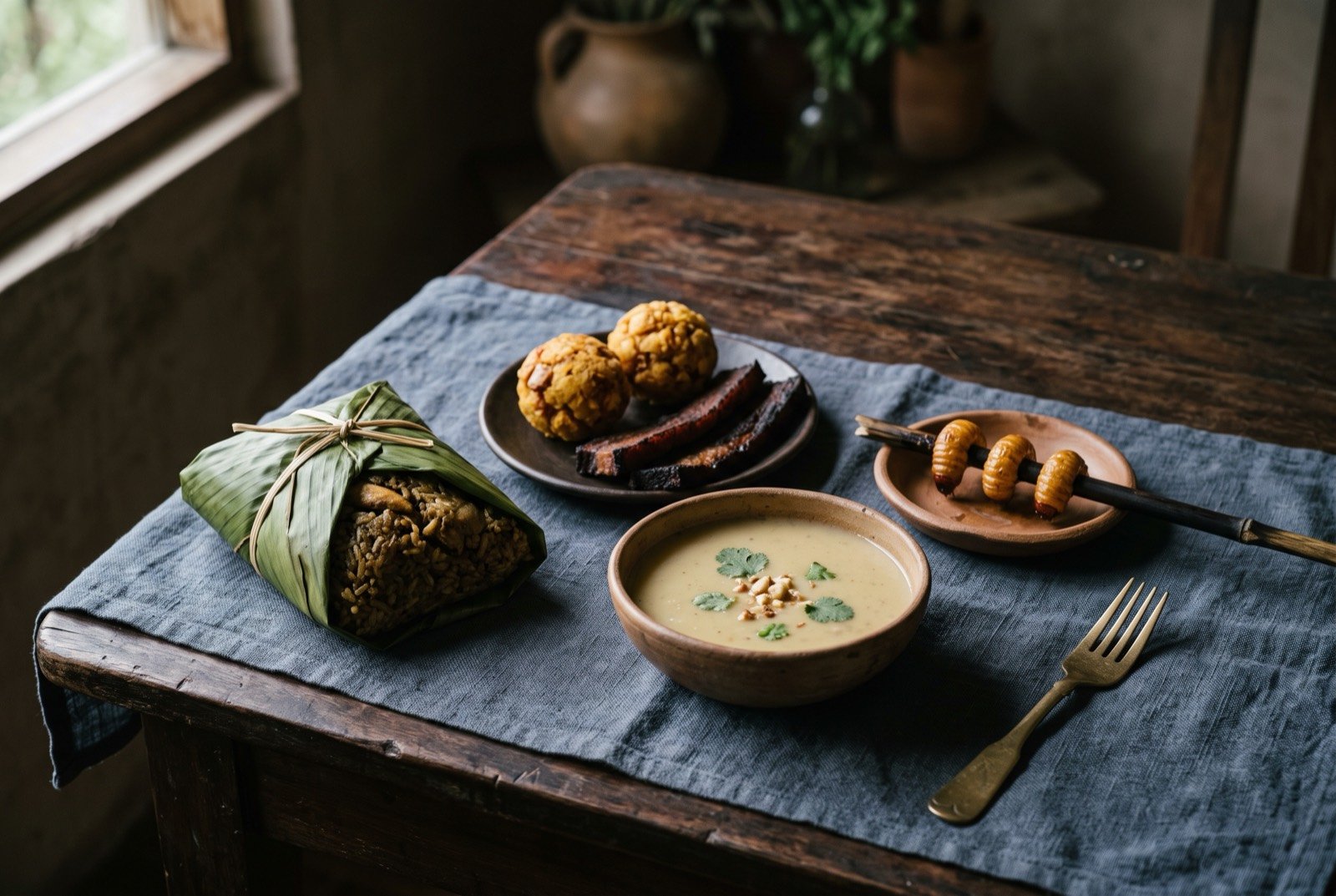
Peru's Loreto region, centred on Iquitos where the Amazon meets the Nanay and the Itaya, and Ecuador's Oriente, the six eastern provinces where the last folds of the Andes drop into lowland rainforest. Two western edges of the same river system, bound to each other by one wrapping leaf, one saliva-fermented drink, and one grub that goes by two different names on either side of a border the river itself does not recognise. Not a jungle footnote to the mountain volumes either side of it, and not a rehearsal for Brazilian Amazonia's own volume, still to come. A food world in its own right, with its own festival calendar, its own history of extraction, and, on the Peruvian side only, its own recent and genuinely contested relationship with prestige cooking. Every dish as tradition built it, then what a modern chef would change.
Sources and review · What this chapter does not assert · How we research · Spotted something wrong?
A Sense of Place
The Andean Amazon is not the Amazon generally. It is specifically the stretch where the basin meets the Andes' eastern slope, drained by the Marañón, the Ucayali, the Napo and the Pastaza before they ever reach the main river's Brazilian width, and it runs on two structural facts that do not apply further east.
The first is the river itself as the only road. Loreto has no land connection to the rest of Peru; Iquitos is the largest city on earth unreachable by road, everything in and everything out moves by boat or by air. The Ecuadorian Oriente is less extreme, but Tena and Puyo still function as riverine and forest towns first, provincial capitals second. This shapes the cooking directly: the larder is what the river and the forest floor actually hold, not what a market road brings in.
The second is the floodplain itself, which is not one ecology but two, and a kitchen answers to whichever one it sits on. Várzea, the seasonally flooded lowland along the main channels, floods for months at a time and gives its farmers a narrow planting window between waters; terra firme, the unflooded upland forest a short distance back from the river, carries the palm stands, the game and the permanent chagra gardens. A Kukama-Kukamiria fishing household on the Marañón and a Kichwa chagra household outside Tena are both, in a real sense, Amazonian, but they are drawing on different halves of the same ecology.
A table of the defining logic, read as fat, starch, aromatic and protein rather than as a list of dishes:
| Element | Peru's Loreto | Ecuador's Oriente |
|---|---|---|
| Starch | Rice (a colonial-era arrival, now dominant in juane), yuca, plantain | Yuca above all, especially as chicha; plantain |
| Fat | Pork lard and chicharrón, rendered fish and grub fat | Rendered game and fish fat; palm oil from chonta and ungurahui |
| Aromatic base | Sacha culantro, ají charapita, achiote, guisador (turmeric) | Ají, achiote, wild cilantro; guayusa as a stimulant rather than a flavouring |
| Wrapping vessel | Bijao leaf, universal | Bijao leaf, universal |
| Everyday protein | River fish: boquichico, gamitana, sábalo, paiche, carachama | River fish, carachama and bocachico by name; game where still legally and practically available |
| Festival drink | Masato (yuca), camu camu cocktails | Aswa/chicha de yuca and chicha de chonta |
A table of the peoples, since this volume answers to indigenous nationhood as much as to ecology, per the atlas's own scoping logic for Amazonia. On the Peruvian side: a majority mestizo ribereño (river-dwelling) population across Iquitos and the river towns; the Kukama-Kukamiria, "the great fishers" of the Marañón, Tigre, Urituyacu and Huallaga; the Bora of the Ampiyacu, a rubber-era displaced people rather than an original Loreto nation, discussed below; and a genuine Shipibo-Konibo presence in Iquitos itself that is migration from Ucayali, not a native Loreto tradition, brought by an estimated six hundred families relocating to cities over roughly the last thirty years. On the Ecuadorian side: Amazonian Kichwa, the largest group, organised around the chagra and the chicha it feeds; the Shuar, numerically Ecuador's largest Amazonian indigenous nation and the people who gave maito its name and its original unseasoned form; the Achuar, whose guayusa ritual is documented below in real depth; the Cofán (A'i) of Sucumbíos, whose diet is explicitly not built around insect protein the way their neighbours' is; the Siona and Secoya (Siekopai) of Cuyabeno, who process bitter rather than sweet yuca into casabe flatbread; and the Waorani of Yasuní, whose food culture remains the thinnest documented of any nation in this chapter, a gap named honestly below rather than papered over.
The History in Layers
An indigenous river world before any European ever saw it
Long before rubber or oil, the river system itself was the trade route: salt, ceramics, feathers and cultivated plants moved along the Amazon, the Marañón, the Ucayali, the Napo, connecting dozens of language families who nonetheless shared a starch (yuca), a wrapping technology (the bijao leaf) and a fermentation technique (saliva-inoculated chicha) that this chapter treats as the volume's real spine, more binding than any national border laid across the region centuries later.
The rubber boom: named plainly, not softened
This is the single darkest layer either country's Amazon carries, and it belongs in a Loreto chapter specifically because its human consequences are still living communities today. Julio César Arana's Peruvian Amazon Company, known locally as Casa Arana, ran its rubber extraction along the Putumayo river from the late nineteenth century into the early twentieth through forced indigenous labour, and the documented toll is a total of 6,719 people, Huitoto, Bora, Ocaina, Muinane and Andoque, displaced by the operation's own violence and by fear of losing workers across the shifting Peru-Colombia frontier. The forced march itself killed people, including children, drowned crossing rivers or taken by wild animals along the way. The Bora community of Pucaurquillo, on the Ampiyacu river near Pebas, exists today because its founders were forcibly moved downstream along the Putumayo to the Amazon confluence and then up the Ampiyacu, refugees from an atrocity rather than descendants of an original Ampiyacu people. This chapter could not find a documented Bora-specific food tradition distinct from the general Loreto pattern, a real gap named honestly rather than smoothed into invented specificity: what survives clearly in the record is the displacement, not (yet, in the sources this chapter could reach) a separately documented Bora table.
Missionary contact and the shape it gave the festival calendar
Catholic mission settlements along the Marañón and the Ucayali, and later across Ecuador's Oriente among the Cofán, Siona-Secoya and Waorani specifically, layered a saint's calendar over an existing subsistence one. Iquitos took San Juan Bautista as patron; food writing repeatedly tells a story in which juane's round, leaf-wrapped shape was given by the missions to evoke the saint's severed head, and in which rice, a colonial-era arrival prized for its keeping qualities in the new mission settlements, displaced an earlier yuca-and-river-fish version of the same wrapped, cooked-in-leaf technique. This chapter states that story exactly as it should be stated: repeated consistently across Peruvian food journalism, never once traced to a named historian, ethnographer or primary source in the research behind this chapter. Treat it as popular food writing's own account of itself, not as settled history.
Extraction's newer forms, and the twentieth century's real cost to the chagra
The rubber economy's violence was a beginning, not an ending. Aguaje, the palm fruit that is Iquitos's own street-life staple and, per the Yagua and Cocama-Cocamilla peoples, a sacred "tree of life," is harvested destructively because the fruiting female palm is traditionally felled rather than climbed: Iquitos's own daily demand runs to an estimated 21.9 tonnes, implying something on the order of 12,000 female palms felled every day to meet it, a figure independently corroborated by both a peer-reviewed ethnobiology study and the Slow Food Foundation's own Ark of Taste entry. Climbing techniques exist and are spreading, but the destructive default remains the norm. On the Ecuadorian side, guayusa's own transformation into a real fair-trade export crop, through Fundación Runa's cooperative model, carries a documented and quietly serious tension: the foundation's own cultivation manual recommends planting densities close to monocrop, which an academic study of Kichwa communities near Tena describes as measurably distant from the polycultural chagra guayusa actually comes from. A plant's success as a Western wellness commodity is, in this specific and sourced case, eroding the growing system that made it worth exporting in the first place.
The modern moment, and a genuinely uneven one either side of the border
Peru's Amazon has had, briefly, a real prestige-kitchen relationship with Lima, discussed in full below. Ecuador's Oriente, on the evidence this chapter's research could find, has not: what exists there is real, valuable community food-tourism infrastructure, named markets and named cooks, but nothing rising to an internationally recognised elevated cuisine the way Peru's Amazon-adjacent cooking has, however briefly, achieved through Lima. This asymmetry is itself a finding worth stating rather than smoothing away, and this chapter returns to it directly in the sourcing and modern-kitchen section.
The Flavour Arsenal
Bijao leaf, the volume's actual identity
Bijao is Calathea lutea, a broad-leafed, banana-leaf-like plant of the Marantaceae family native to humid ground near rivers across Colombia, Ecuador, Peru and Costa Rica, sold and used in three rough size grades. It is the one technology genuinely shared, unbroken, across the entire scope of this chapter: juane and patarashca in Loreto, maito and ayampaco across the Oriente, and, under other names again, hallaca wrapping on the Caribbean coast and tamale wrapping in Colombia's own interior. Passing the leaf briefly over a flame before wrapping is not decorative; it softens the leaf for folding and, sources on both sides of the border agree, releases the leaf's own aromatic oils into whatever it then encloses.
Ají charapita, camu camu and cocona, the sour-and-fierce trio
Ají charapita is a small, round, usually yellow Amazon chilli, ferociously hot and aromatic, grown in home plots across Loreto, San Martín and Ucayali up to 1,200 metres, and the first native Amazonian chilli to reach export markets. Camu camu is a small, intensely sour red fruit, among the most vitamin C-dense fruits known, used in juices and, per San Juan's own festival drinks list, cocktails. Cocona sits between the two, sweet-tart rather than purely sour, worked into the cocona-based dipping sauce that is tacacho con cecina's standard accompaniment.
Aguaje and ungurahui, the palm-fruit pair, and their destructive harvest
Covered in full above for aguaje's conservation problem. Ungurahui, a dark purple palm fruit prized for its oil, is thinner sourced in this chapter's research than aguaje, described in the material found as an "Amazonian olive oil," a comparison worth repeating carefully rather than as settled fact.
Sacha inchi, "the Inca peanut"
Plukenetia volubilis, native to and led in production by San Martín, with real presence in Loreto and Ucayali too, cultivated since pre-Hispanic times. Its oil, rich in omega fatty acids, is extracted artisanally by several named Amazonian peoples, including the Shipibo-Konibo, and used both in cooking and, historically, as fuel.
Chonta and palmito, shared by both kitchens under one name
The chonta or pijuayo palm (Bactris gasipaes) gives its fruit to Ecuador's Fiesta de la Chonta and its heart to both countries' tables, palmito in Peru, largely the same word in Ecuador. Ecuadorian sources overwhelmingly say "chonta," rarely "pijuayo," a genuinely useful marker of which side of the border a given piece of food writing comes from.
Cecina, and the distinction this chapter insists on
"Cecina" is not one dish across Peru, and getting this wrong would misrepresent both traditions. The Andean cecina of Ayacucho, Huancavelica and Apurímac is salted, air-dried beef, no smoke, cured over one to two weeks. The Amazonian cecina that goes into tacacho is a different animal entirely: pork, salted and then genuinely smoked, slowly, over regional hard or fruit woods chosen specifically not to bitter the meat. A national gastronomy body's own published cecina recipe, checked directly for this chapter, turned out to describe the Andean beef version; its quantities should not be borrowed for the Amazonian pork dish, and this chapter does not borrow them.
Guayusa, the Ecuadorian caffeinated leaf, and the guayusada correctly named
Ilex guayusa, a caffeinated holly leaf surviving today essentially only in cultivation. The ritual built around it is called, across every source this chapter's research could find, la guayusada, not "el levantada," a term that does not appear to exist in the documented record and should not be used. Among the Achuar of Sharamentsa, on the Pastaza near the Peru border, the guayusada runs from around 3am: women prepare the infusion, participants drink several gourd cups and typically induce vomiting as a stated method of bodily cleansing, then the group interprets the previous night's dreams together, a practice one Achuar source frames plainly as "good dreams and bad dreams, of luck and of ill fortune."
Cacao nativo, a story that belongs mostly to a neighbouring region, told honestly
The strongest documented native-cacao story on the Peruvian side belongs to Amazonas department, not Loreto specifically, centred on Bagua province and genetic research identifying distinct native lineages there; Loreto's own contribution is folded into a combined Amazonas-and-Loreto production figure that should not be mistaken for a Loreto-specific identity. Ecuador's own "Nacional" or "Arriba" fine-aroma cacao carries a far deeper documented pedigree than expected: genetic lineage traced to roughly 5,300 to 5,500 years ago and the Mayo-Chinchipe-Marañón culture, described in the sourcing as the oldest known culture of the western Amazon, sited in what is now Ecuador's own Zamora province, on the very Peru-Ecuador frontier this chapter covers. Neither of Ecuador's two flagship fine-chocolate export stories, Pacari or To'ak, is itself an Oriente story specifically; the Oriente's real contribution to Ecuadorian cacao is genuine and ancient, but it is not the part either brand's own marketing is built on.
Suri and chontacuro, one grub, two names
The larva of the black palm weevil, Rhynchophorus palmarum, developing in fallen or felled palm trunks including aguaje. Peru calls it suri; Ecuador calls it chontacuro, from Kichwa chonta (the palm) plus kuru (worm), also mukint in Shuar and Achuar usage. It is the same species and, beyond the name and the particular leaf or side dish each country's cuisine wraps around it, no genuinely distinct preparation tradition separates the two. A Peruvian academic study puts real numbers on Iquitos's own trade in it: roughly 3,500 units sold daily, weekends busiest, protein content in the skin running above 45 per cent dry weight.
The Technique Ladder
The argument, from inside
Five techniques, each explained by why it works, not only what it does.
Rung 1. Bijao-leaf wrapping
The leaf's waxy cuticle is both heat- and moisture-resistant, so a parcel sealed inside it traps the food's own released moisture as steam rather than losing it to the fire; briefly flaming the leaf before wrapping softens it for folding and, separately, releases its own aromatic compounds into whatever cooks inside it, a genuine flavour transfer rather than a purely functional step.
Rung 2. Saliva-inoculated fermentation, for masato and aswa alike
Human saliva carries the enzyme amylase, which breaks starch down into simple, fermentable sugars faster and more completely than the yuca's own enzymes or ambient wild yeast can manage alone; chewing a portion of the cooked mash and returning it to the batch is, mechanically, a real pre-digestion step that kick-starts fermentation, not simply a ritual gesture layered on top of an otherwise ordinary ferment.
Rung 3. Cecina's salt-and-smoke cure
Salt draws water out of the meat by osmosis, inhibiting the bacteria that would otherwise spoil it; the slow smoke that follows adds phenolic compounds from the wood smoke itself, which further suppress spoilage while building the dish's actual flavour, a genuinely different mechanism, and a genuinely different result, from air-drying alone.
Rung 4. Tacacho's double-cook
Roasting or frying the plantain first drives off moisture and starts real Maillard browning before the mash is ever touched; pounding the hot, cooked plantain together with lard and chicharrón while everything is still warm lets the rendered fat distribute all the way through the mash rather than simply coating its surface, the actual mechanism behind the dish's particular density.
Rung 5. Suri and chontacuro, self-basted by their own fat
Direct heat renders the grub's own considerable fat content as it cooks, and that rendered fat bastes and crisps the exoskeleton from the outside in, a genuinely self-basting protein that needs no added fat to develop a properly crisp finish.
The Ferment and Preserve Bench
Two preparations, the same fermentation mechanism, either side of the border, worth reading together rather than apart.
Masato. Yuca peeled, boiled and mashed; a portion chewed by the women preparing it and returned to the mass, the enzymatic step that actually starts fermentation, before the whole batch is combined and left to ferment, anywhere from a couple of days for a mild version to ten days or more, in a clay pot, for a stronger one. The Slow Food Foundation's own Ark of Taste entry documents this practice across six Peruvian Amazon regions, frames it as central to communal gatherings and hospitality, and names a real and current threat: declining transmission of the technique, driven by urban migration and competition from commercial drinks. This chapter's research could not establish masato as specifically Kukama-Kukamiria practice as opposed to a wider Loreto river-peoples tradition, and states it that way rather than narrower than the evidence supports.
Aswa, or chicha de yuca and chicha de chonta. The same technique, documented in real depth by the Kichwa community of Sarayaku, Pastaza, on its own website: cassava cooked around an hour, then chewed and mashed with a tool called the takana muku, a further forty minutes of work, before storage in clay vessels, ceremonial batches filtered through banana leaves laid inside the jar. Sarayaku names aswa's preparation as women's work specifically, "a space where women transmit their love and affection towards their loved ones," and lists five named varieties by their Kichwa names, including chunda aswa, chicha of the chonta palm, tied to that palm's own March-to-June fruiting season and to the Fiesta de la Chonta below. A diet-diary study near Tena found chicha de yuca the single most commonly logged drink of any kind, far ahead of guayusa, direct, quantified confirmation that this ferment is not a festival curiosity but the region's actual everyday drink.
Sourcing in Britain
This is, honestly, the thinnest UK sourcing landscape found anywhere in this atlas so far. Several of this volume's defining ingredients have no UK route at all, and this chapter says so rather than implying a workaround exists where none does.
Bijao leaf. No UK retailer, fresh or frozen, was found. Frozen "Mashan Bijao" and "Mashan Heliconia" leaves turn up repeatedly in North American grocery searches but ship nowhere near Britain. The honest substitute is frozen banana leaf, genuinely and widely stocked by Oriental Mart, Lakshmi Stores, Afro Asia and My Exotic Fruit among others, but a real compromise rather than a like-for-like swap: banana leaf is thinner and less heat-resistant than bijao, which is why it needs reinforcing, doubling the leaf or finishing in foil, for anything that spends real time in liquid, such as juane's hour-long boil.
Paiche. No UK importer of frozen paiche was found, unsurprising given both import certification requirements and the fish's own conservation sensitivity in parts of its range. For a substitute built around paiche's dense, steak-like flesh, pike, sold whole by specialist fishmongers including The Fish Society, is the closer texture match, though bony and considerably smaller; for parcel-cooked preparations such as patarashca, pangasius, sold cheaply and widely as fillets, is the more practical and far cheaper option, though a much softer fish.
Cecina. What is sold as "cecina" in UK Spanish delis is uniformly the Andean beef product, not this volume's smoked pork, and this chapter names that plainly so a reader does not buy the wrong thing by mistake. The honest route is home production: the reader's own dehydrator and a Big Green Egg run cool and long are genuinely suited to the salt-cure-then-smoke sequence the real Amazonian product demands.
Camu camu, sacha inchi and ají charapita, the one genuine good-news story. All three have real UK availability, mostly through the general health-food supplement channel as powders and oils (Grape Tree, Forest Whole Foods, Aromantic), but one retailer does far better than that: El Inti, The Peruvian Shop (peruvian-grocery-shop.com, ships to the UK) stocks camu camu, sacha inchi and ají charapita specifically in real Amazonian-Peruvian culinary framing, canned whole ají charapita, ground charapita powder, a camu camu and charapita sauce, rather than generic wellness packaging. Ají charapita is additionally growable from seed, a genuinely realistic project for this reader given his kit, from UK chilli specialists including Red Dragon Seeds and ChilliChump.
Cocona, aguaje and ungurahui. Largely unsourceable fresh, as expected. El Inti stocks cocona in a processed sauce form, worth using; aguaje and ungurahui returned no UK retail route of any kind, fresh, frozen or powdered, and this chapter names them as ingredients to understand rather than to cook with in Britain.
Yuca, plantain and palm hearts. Genuinely and easily available. Fresh yuca and plantain through any sizeable African, Caribbean or Latin American grocer, Niyis and Exotic Express confirmed specifically for this volume; tinned palm heart is mainstream UK retail, Green Giant's own supply chain running through Peru, Ecuador and Costa Rica, which makes it an honestly close match for this cuisine's chonta rather than a generic substitute.
Native cacao. Genuinely good UK availability at the craft-chocolate end, split into two distinct products worth naming separately: Solkiki, a Devon-based bean-to-bar maker, produces an actual eating and cooking chocolate from Marañón-valley Peruvian cacao; The Jasper Cacao Project and Ritual Cacao both sell Asháninka-grown Peruvian criollo cacao as ceremonial-grade paste, formulated for drinking rather than confectionery, and a reader wanting to cook with chocolate should reach for Solkiki's bar rather than either ceremonial product.
Guaraná and guayusa. Guaraná has real UK presence but is entirely Brazilian-sourced, worth naming here as regional trade context rather than as this volume's own ingredient. Guayusa has a genuinely strong UK presence, reflecting real Western "clean energy" tea uptake, through Athlete's Brew and MateMundo among others, almost always marketed as an energy tea with no connection at all to the guayusada's own dawn ritual, a real gap between the product on a UK shelf and the tradition it comes from, worth the chapter stating rather than leaving implied.
Turtle. Not something to source in Britain, and not hedged here. River turtle is CITES-listed and its trade tightly restricted across its range, and its role in this chapter is to be understood as a fact of Amazonian riverine food culture, and as a live conservation-crime problem, not to be sourced or cooked.
The single decision that matters most. Real bijao leaf cannot be bought in Britain at all, and this chapter does not pretend otherwise. Everything downstream of that, patarashca's flavour, juane's long boil, maito's whole point, depends on a compromise the reader should go in understanding rather than discovering mid-recipe.
Voices and Sources
Peruvian government and institutional sources: the Ministerio de Cultura's own BDPI database for the Kukama-Kukamiria; SERFOR and the Instituto Tecnológico de la Producción for turtle protection and managed taricaya-egg programmes; PromPerú for sacha inchi's historical use; the Slow Food Foundation's Ark of Taste, fetched directly for both masato and aguaje, genuinely strong, specific and honest about the threats each tradition currently faces.
Peruvian press with real reporting standards: Infobae's Peru desk, whose Belén market wildlife-trade investigation and its reporting on the motelo-recipe controversy are among the strongest single sources behind this chapter; Diario La Región, a genuine Loreto-based regional paper; Panamericana Televisión; El Comercio, used carefully, since its output splits between real reporting and recipe-aggregator content under the same banner.
Ecuadorian sources, prioritised throughout: El Universo, Ecuador's largest newspaper, for the maito-to-ayampaco distinction, naming Marcelo Noguera and Mama Zara Jaramillo Carvajal directly; three independent Ecuadorian outlets, Expreso, El Oriente and El Heraldo, corroborating the Puyo indigenous market and its named vendors' association president, Beatriz Malaber; Fundación Pachamama's own site and Primicias for the SACHA project and the Amazonía Gastronómica event; and, the strongest single source in the whole Ecuadorian half of this research, the Kichwa community of Sarayaku's own website, a genuine primary indigenous source, alongside a peer-reviewed academic chapter from Universidad Regional Amazónica IKIAM, based in Tena, whose diet-diary fieldwork underpins this chapter's honest correction of maito's real everyday frequency.
On the modern kitchen: Pedro Miguel Schiaffino built Malabar (2004) and ámaz (2011) around fifteen years of Amazon ingredient research before both closed in 2020; he now leads La Rosa Náutica's deliberately oceanic kitchen while keeping paiche on the menu specifically to support Despensa Amazónica, the nonprofit he co-founded with Tatiana Rivadeneyra and Andrea Ortiz de Zevallos, whose Canasta Amazónica project connects Watson Flores Sampaya's OSPPA Arahuana Fish fishing collective on the Puinahua river to named buyers including Maido, La Patarashca and Aqua Expeditions. Aldo Yaranga of La Patarashkita and Virgilio Martínez's Central, whose tasting menu runs one tier through Amazonian altitude, both engage with these ingredients at a real but partial level. On Ecuador's side, six named chefs, including Tata Rodríguez of La Chichería and Valentina Álvarez of Iche, took part in the March 2024 Amazonía Gastronómica event in Quito.
Things this chapter has deliberately not asserted
- That the citrus-cure technique behind any Amazonian river-fish ceviche originated in the Amazon. It did not: the technique's home is coastal Peru (AM-18), carried into the jungle as an export, and this chapter has deliberately not given it a recipe here.
- That juane's popular "huanar" origin story, a pre-Hispanic, rice-free, yuca-and-fish version of the dish given its round shape by Catholic missions, is settled history. It recurs consistently across Peruvian food journalism and was not traced to a named historian or primary source in this chapter's research.
- That the exact quantities given for juane and inchicapi, or the sugar ratio sometimes given for masato, rest on a Loreto-based source. They trace to Lima-based recipe aggregators and are presented here as indicative rather than as an authoritative regional recipe.
- That cazuela loretana can be given a confident, quantified recipe. It cannot, on the sourcing this chapter's research could find, and it is named here rather than detailed.
- That masato is specifically a Kukama-Kukamiria tradition as opposed to a wider Loreto river-peoples one, or that Slow Food's "Cocama-Cocamilla," named for aguaje reverence, is definitely the same people as the Kukama-Kukamiria named for masato and fishing. Both remain genuinely unresolved in the sourcing behind this chapter.
- That any documented Bora-specific food tradition exists beyond the general Loreto pattern. The Putumayo rubber-boom displacement history is well corroborated; a distinct Bora table is not, in what this research could reach.
- That maito is the Ecuadorian Oriente's most commonly eaten dish. The best quantitative evidence found shows it a minority preparation next to soup, rice and plain boiled staples, its "typical dish" status plausibly driven substantially by tourist demand.
- That "el levantada" is an established name for the guayusa dawn ritual. No source found uses it; "la guayusada" is the term this chapter has used throughout.
- That the Ecuadorian Oriente has achieved an internationally recognised elevated or fine-dining reputation comparable to what has happened, however briefly, with Peruvian Amazonian cooking via Lima. The evidence supports real, valuable community food tourism, not an elevation narrative, and this chapter has not implied one.
- That suri or chontacuro has been taken up at fine-dining level anywhere in Peru or Ecuador. Searched for specifically, twice, in the research behind this chapter, and not found.
- That Gastón Acurio has a well-documented personal engagement with Amazonian ingredients specifically, as distinct from his broader, genuinely well-documented advocacy for Peruvian biodiversity generally. This chapter searched for that connection directly and did not find it, a confirmed absence in the sourcing available, not proof that no such engagement exists.
- That Quique Sempere's restaurant Aura, in Quito, is currently open. Two independent directory listings mark it permanently closed; this chapter could not confirm when or why, and states the uncertainty rather than either assertion.
- That Ikíitu, in Iquitos, and its chef José Antonio Nogueira Paz, are confirmed facts rather than a lead. The single source found for this restaurant was a search snippet, not a page this research could directly verify, and it is named here as the strongest current lead toward a real Iquitos restaurant scene, not as an established fact.
- That any restaurant, in Lima, Iquitos or Quito, has published a documented, step-by-step reinterpretation of bijao-leaf wrapping, tacacho or juane at a fine-dining level. None was found.
- That sarapatera, turtle stew, can be given any kind of recipe treatment, traditional or elevated. River turtles are CITES-listed and nationally protected on both sides of this volume's border, their commercial sale is illegal, and a live 2025 controversy over a celebrity chef's own turtle recipe shows this is a current and contested issue, not settled history. This chapter names the dish and its two commonly confused species, motelo the tortoise and charapa or taricaya the true river turtles, and stops there.
Bijao-leaf wrapping
The leaf's waxy cuticle is both heat- and moisture-resistant, so a parcel sealed inside it traps the food's own released moisture as steam rather than losing...
Saliva-inoculated fermentation, for masato and aswa alike
Human saliva carries the enzyme amylase, which breaks starch down into simple, fermentable sugars faster and more completely than the yuca's own enzymes or...
Cecina's salt-and-smoke cure
Salt draws water out of the meat by osmosis, inhibiting the bacteria that would otherwise spoil it; the slow smoke that follows adds phenolic compounds from...
Tacacho's double-cook
Roasting or frying the plantain first drives off moisture and starts real Maillard browning before the mash is ever touched; pounding the hot, cooked plantain...
Suri and chontacuro, self-basted by their own fat
Direct heat renders the grub's own considerable fat content as it cooks, and that rendered fat bastes and crisps the exoskeleton from the outside in, a...
The dishes
- Juane Iquitos, Peru
- Tacacho con cecina Loreto, Peru
- Patarashca Loreto, Peru
- Inchicapi San Martín, Loreto and Ucayali, Peru
- Timbuche Loreto and Ucayali, Peru
- Ensalada de chonta Loreto, Peru and Ecuador's Oriente
- Maito, and ayampaco Ecuadorian Oriente, Ecuador
- Suri and chontacuro, roasted Loreto, Peru and Ecuador's Oriente
Sources and review
- Reviewed
- Not yet reviewed from inside the tradition
- Cooked
- Not yet cooked and reported
Where this volume comes from
3 research briefs on file for this volume, researched to the rules on How we research. Published 3 September 2026. Last changed 8 September 2026.
The brief's own account of its sources
Of the roughly 20 to 25 distinct sources actually drawn on for factual claims in this brief (as opposed to sources that turned up in search results but were not used): the clear majority are Ecuadorian. These include: three independent Ecuadorian press outlets on the Puyo market (Expreso, El Oriente, El Heraldo); El Universo (Ecuador's largest newspaper) on ayampaco with two named local sources; a peer-reviewed academic book chapter from Universidad Regional Amazónica IKIAM, an Amazonian university based in Tena, published through IFEA/IRD (Instituto Francés de Estudios Andinos, a genuine