Africa · Volume 18
Madagascar, Mauritius, Réunion, Seychelles & Comoros
The Indian Ocean Islands
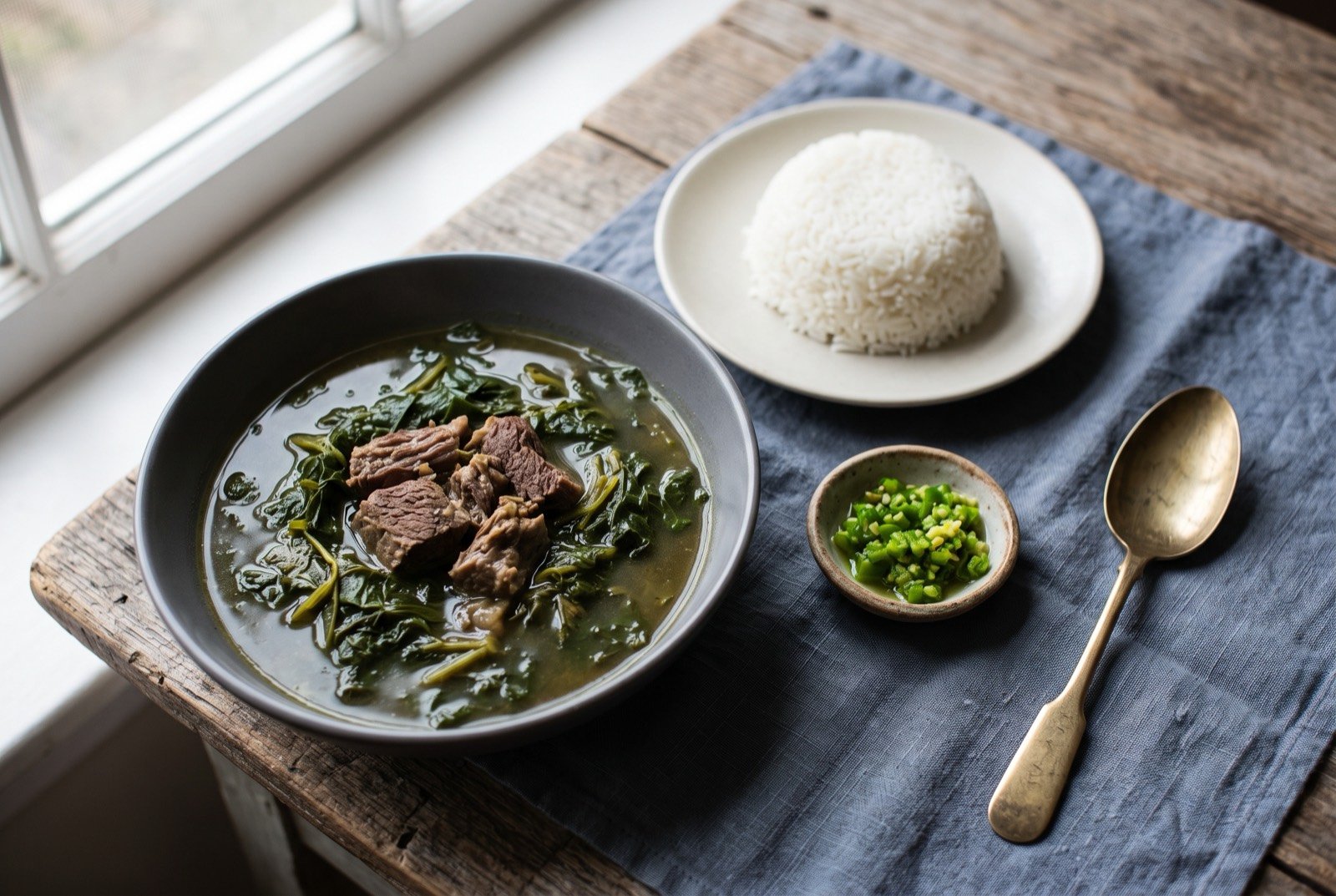
Five island groups that share an ocean and not a history, taken separately. The traditional canon as the islands actually cook it, a technique ladder built from Creole and Malagasy method rather than borrowed from France, and every dish as tradition built it, then what a modern chef would change.
Sources and review · What this chapter does not assert · How we research · Spotted something wrong?
A Sense of Place
One pot, three names, and the argument of the whole volume
Start with a single preparation, because it is the thread holding five separate food cultures together and it is almost never written about as one thing.
Take a basket of mixed edible leaves. Trim them. Drop them into a broth already scented with onion and garlic, often ginger. Boil. Serve with rice and a chilli condiment on the side, in the evening.
On Réunion that is bouillon de brèdes. In highland Madagascar, with zebu beef in the pot, it is romazava, and Malagasy people will tell you it is the national dish. In the Seychelles it is bouyon bred. Three islands, three Creoles, one piece of engineering, and the French botanical literature on brèdes states the identity outright: the bouillon preparation is what Madagascar calls romazava.
That is not coincidence and it is not borrowing between neighbours. Réunion, Mauritius and the Seychelles had no indigenous population at all. Every person on them arrived by ship, and for the first two centuries most arrived in chains, in very large part from Madagascar and from the Mozambique coast. The leaf bouillon is on those islands because the people who invented it were carried there. Cook it and you are cooking the one dish that crossed the Middle Passage of the Indian Ocean intact.
Everything else in this volume divides. This does not.
The structural warning, before anything else
These are five island groups, not one cuisine, and writing them as "Indian Ocean island food" flattens the most interesting thing about them. Madagascar was settled by Austronesians from Borneo and is an African and Asian civilisation with its own language and its own aristocratic cooking. The Mascarenes and the Seychelles were populated entirely by importation. The Comoros are Swahili, Muslim and Arab-facing, with a Malagasy undertow. A restaurant serving all five off one spice rack will be wrong about four of them.
The Malagasy highlands
Imerina and Betsileo, the terraced-rice civilisations of the plateau, where Antananarivo sits at about 1,280 m with irrigated paddy in the valley bottoms and zebu on the hills.
The fat is pork fat, plus zebu fat and groundnut oil. Not coconut. That is the defining boundary in Malagasy cooking. There is no thickener in the West African sense: the body comes from long-reduced meat juices and from pounded leaf, which collapses into a green paste. The aromatics are ginger, garlic, onion, tomato, spring onion, wild tsiperifery pepper, and sakay chilli paste applied at the table rather than in the pot.
The starch is rice, vary, at every meal including breakfast. The Malagasy verb for eating a meal is mihinam-bary, literally to eat rice, and everything else on the plate is laoka, the accompaniment. Vary amin'anana sy kitoza, a thick rice and greens porridge eaten with strips of salted dried beef, is a breakfast dish, and that placement is the clearest surviving Austronesian rice-porridge habit on the island. Nor is the cooking water wasted: ranovola is water added back to the toasted crust in the bottom of the pot, boiled and drunk, and it is the everyday Malagasy table drink.
The Malagasy coasts
The côtiers: Sakalava in the west, Betsimisaraka and Antemoro in the east, Antandroy and Mahafaly in the arid south, eighteen official ethnic groups culturally distinct from the plateau and historically in tension with it.
Here the fat is coconut, and the highland-versus-coast split runs exactly along it. The aromatics gain vanilla, cloves, turmeric, green mango and lime. On the wet east the starch is rice; in the arid south and west, cassava, sweet potato, millet and maize replace it. Both spice regions sit on this coast: SAVA in the north east grows the vanilla, and Analanjirofo, whose name literally means the place of cloves, grows the cloves.
Mauritius
An Indo-Mauritian majority speaking Bhojpuri, Tamil, Telugu and Marathi; a Creole population descended from the enslaved; a predominantly Hakka Sino-Mauritian community; a Franco-Mauritian minority.
Mauritius is the pulse island. Yellow split peas, called dholl; gros pois, butter beans; lentils; pigeon peas. The body of the cooking is pulse, not coconut and not reduced onion. The aromatics are fresh coriander, spring onion, thyme, curry leaf, ginger and garlic paste, green chilli, cumin, black mustard seed and turmeric. And it is the only place in this volume where wheat flatbread is a street staple: dholl puri and farata, sold from carts, eaten in the hand.
Réunion
A French overseas department, and the food is French in citizenship and not much else. A Creole majority of mixed Malagasy, East African, Indian, Chinese and European descent, plus Malbars who are Tamil, Zarabes who are Gujarati Muslim, and Yabs who are the poor-white highlanders of the Hauts.
The body of a Réunionnais dish is a roussi, a deliberately browned onion and tomato foundation. The aromatics are turmeric, called safran péi, plus garlic, ginger, thyme, combava and massalé. Réunion largely does not use coconut milk, and this is the most frequent error in British writing about these islands: a Réunion cari made with coconut milk is a Mauritian dish.
The Réunionnais plate is a fixed four-part grammar: rice, always; a cari or a rougail; grains, meaning Cilaos lentils or red beans or butter beans, as a compulsory second element; and a raw chilli rougail on the side.
The Seychelles, and what this chapter cannot tell you
Kreol Seselwa is a national language, and the population is overwhelmingly of African and Malagasy descent. Seychelles received almost no indentured immigration compared with Mauritius, which is why Seychellois cooking is the most African and Malagasy of the island cuisines and the least Indian. The fat is coconut, in quantity; the body is coconut cream and mashed starchy fruit; the souring agent is bilimbi, Averrhoa bilimbi.
Now the honest part. The research for this volume reached zero Seychellois-published sources on Seychellois cooking. Not one. Every account of kari koko, ladob, satini rekin or bouyon bred that could be found is an English-language travel blog, a listicle, a recipe round-up or Wikipedia. The Seychellois section of this chapter is therefore short, and it is short on purpose. It would have been very easy to write four confident pages off that material, and worthless.
What Seychelles genuinely has, and it is serious, is a state culinary heritage apparatus: Festival Kreol, fortieth edition in 2025; a Ministry cookbook launched February 2026, Sun, Sea and Spice, developed with elderly Seychellois women from the Living Heritage Grandma Savoir-Faire club; and recipes published through the National Heritage Research and Protection Section. That is where the next pass has to start.
The Comoros, and the same problem, worse
Ngazidja, Ndzuani, Mwali and Mayotte. Shikomori-speaking, a Sabaki Bantu language closely related to Swahili, and over 95 per cent Muslim. Pork and blood are absent by law and by faith, which separates Comorian from Malagasy cooking more sharply than any ingredient does, because the Malagasy highland canon is built on pork fat. The fat is coconut plus ghee and oil, the body is coconut milk and pounded leaf, and the spice cabinet is cloves, cinnamon, cardamom, nutmeg and vanilla: a Swahili and Arab cabinet, not an Indian one, with no fenugreek and no mustard seed.
The Comorian research is thinner still. The one Comorian-presenting website found describes mataba, the archipelago's most important dish, in a way that contradicts every other source in existence. There is one named Comorian chef in the record and he works in Paris. This chapter gives the Comoros one dish and says openly what it does not know.
Read the asymmetry in this chapter as information. Mauritius gets four dishes and Réunion three because those islands have a real food press writing in French. Madagascar gets two that carry four dishes' worth of argument. Seychelles and Comoros get one each. That is the state of the record, not a judgement about the food.
The History in Layers
Layer one: the Austronesians, and the crops they brought
Madagascar is the westernmost limit of the Austronesian expansion. The Malagasy language is Austronesian, closest to the Barito languages of southeast Borneo, and for decades there was no archaeological trace of that settlement at all.
That gap closed in 2016. Alison Crowther and colleagues excavated 18 sites across Madagascar, the Comoros and the East African coast and recovered over 2,500 seed remains. On Madagascar and the Comoros the assemblages were dominated by Southeast Asian crops: rice, mung bean and cotton. On the East African mainland, African crops dominated. The pattern appears in material of the 8th to 10th centuries CE, and Pierron and colleagues dated the African and Asian admixture event to roughly 830 to 1000 CE.
The surprise was the Comoros. Crowther's own reaction reframes the archipelago: the finding took the team by surprise, since Comorians speak African languages and do not look as though they have Southeast Asian ancestry. The Southeast Asian settlement of the western Indian Ocean was not confined to Madagascar.
What this layer put on the plate: rice as the total staple rather than as a side, wet-rice terracing, mung bean, the taro and banana complex, and, arguably, the leaf-bouillon-plus-rice meal structure that recurs across all five island groups.
Layer two: the Swahili corridor
The Comoros sit on the Swahili trade route, and Comorian cooking reflects Swahili and Austronesian influence alongside Middle Eastern, Indian, Portuguese and French. Islam arrived with that trade and now claims over 95 per cent of the population. What this layer put on the plate: the pilau, the clove and cinnamon and cardamom register, the skewer, the pickle, and a fast-and-feast calendar that governs when people eat as much as what.
Layer three: slavery, and the peopling of islands that had no people
Handle this plainly, because the food does not make sense otherwise. Richard B. Allen estimates the French traded as many as 243,000 African, Malagasy, Southeast Asian and Indian slaves between 1670 and 1810, and puts 165,000 to 173,000 people, mostly East African and Malagasy, imported into the Mascarenes between 1800 and 1848.
Here is the culinary point. Between 1769 and 1793 roughly 80,000 enslaved people were imported into Réunion and Mauritius, and about 45 per cent of that supply came from Sakalava slave traders in north-west Madagascar, who raided East Africa and the Comoros; the rest came largely from Portuguese Mozambique. Malagasy and Mozambican people are the demographic foundation of Creole Mascarene society, and that is why the brède, the leaf bouillon, the rougail and the pounded-leaf dish exist on islands that had no inhabitants at all three hundred years ago.
The Seychelles were settled from 1770, when the Thélémaque landed the first colonists on Sainte Anne on 27 August: 15 white men, 8 Africans and 5 Indians. Britain abolished slavery in 1833 and Mauritius abolished on 1 February 1835; France abolished in 1848, and Réunion's emancipation date, 20 December 1848, is still an official holiday there.
And then it did not stop. Réunion replaced slavery with a contract-labour system called engagés, running from 1848 until 1864, during which an illegal slave trade continued, moving people from Portuguese Mozambique and Zanzibar via the Comoros and labelling them engagés to evade the British anti-slavery blockade. Do not soften that.
Layer four: Indian indenture, and Mauritius as the test case
The 1833 abolition decision produced a replacement system almost immediately, and Mauritius was where it was tried first. The facts come from the Aapravasi Ghat Trust Fund in Moka, the Mauritian heritage authority.
The "Great Experiment" began when the Atlas arrived from India with 36 indentured labourers on 2 November 1834, before slavery was even formally abolished on the island. A contract ran generally for five years and specified wage rate, hours, type of work, rations, housing and medical care. Emigration from India was suspended between 1839 and 1842 because of the abuse the earliest contract workers suffered. The peak years were 1843 to 1865; the depot was built in 1849, and nearly half a million immigrants climbed its steps between 1849 and 1910, when indenture ended, after a voyage of eight to ten weeks. The ancestors of more than 70 per cent of today's Mauritian population arrived through it. Ninety-five per cent came from India, but Malagasy, Comorian and Chinese labourers were introduced specifically during the 1839 to 1842 suspension and again between 1855 and 1860. The depot was called Coolie Ghat until 1987, when it was renamed Aapravasi Ghat, Hindi for the landing place of immigrants.
What this layer put on the plate: wheat flatbread, so farata and dholl puri; the pulse repertoire; the South Indian vada that became gateau piment; briani; the grinding stone; curry leaf; black mustard seed. On Réunion it produced massalé, the Malbar and Zarabe communities, and the word cari itself.
One thing is missing from the record and it is the keystone. The ration scale is the literal origin of the Mauritian pulse-and-flatbread diet, and the Aapravasi Ghat document confirms rations were contractual without saying what they were. Until somebody works the immigration records at the Mahatma Gandhi Institute in Moka, "rice, dholl, ghee, salt fish and salt built the national diet" is an inference, and this chapter treats it as one.
Layer five: the Chinese shop
A first wave came from coastal Fujian in the early 1800s; the larger and lasting migration was Hakka from the Meixian region of Guangdong, from the late 1800s into the mid-1900s.
The mechanism is the shop, not the restaurant. Chinese traders opened small corner shops across Mauritius and extended credit, which embedded them in every village. A colonial officer wrote in 1892 that however isolated the spot, a boutique Chinois will meet you at the most unexpected place. That shop is the network that put soy sauce, noodles, dried mushroom and preserved vegetable into ordinary Creole and Indo-Mauritian kitchens, which is why mine frite is a national dish and not an ethnic one. The consequence for you: the wok is not a foreign tool in this cuisine. It has been in these kitchens for two hundred years, and it gave Mauritius and Réunion something no other African cuisine in this series has as an everyday domestic technique, which is fast, high-heat, small-batch cooking in a thin-walled vessel.
The vanilla layer, and Edmond Albius
Vanilla is an American orchid pollinated in Mexico by specific bees. Everywhere else it set no fruit, and that was the entire obstacle to a vanilla industry outside Mexico. It was solved on Réunion.
In 1841 a twelve-year-old enslaved boy named Edmond, born at Sainte-Suzanne on 9 August 1829, worked out how to hand-pollinate the vanilla flower, using a fine stick or needle to lift the rostellum and press the anther onto the stigma. He had been taught horticulture by the man who enslaved him, Ferréol Bellier Beaumont, and reportedly derived the method from a technique used on pumpkins.
Bellier Beaumont never freed him. Edmond gained his liberty only when France abolished slavery in 1848, taking the surname Albius then. He was never compensated and he died in poverty. Every vanilla pod in the world outside Mexico exists because of a technique invented by an enslaved child who was paid nothing for it. Say that plainly and do not decorate it.
The industry then moved to Madagascar, overwhelmingly to smallholders in SAVA, which grows about 70 per cent of the national crop and had around 70,000 producers as of 2021. Do not write about vanilla without writing about the labour, including documented child labour in the Malagasy vanilla sector.
The spice economy, and who actually eats it
Analanjirofo holds the highest concentration of clove plantations in Madagascar, and cloves contribute up to 60 per cent of farmers' income there, with national production at roughly 12,000 to 16,000 tonnes a year, about 70 per cent of it from that one region. Comorian exports are a monoculture in three crops: cloves make up about 71 per cent of total exports, perfume essences about 9 per cent and vanilla about 4 per cent, and together they account for roughly 80 per cent of exports and about 45 per cent of the workforce.
The honest conclusion. These islands grow the world's most expensive flavourings and are among the poorest places on earth, and the spices are almost entirely exported. A Comorian household eats cloves because they grow next door, not because cloves are cheap, and the vanilla that dominates SAVA barely appears in everyday Malagasy home cooking. Cook this food with that asymmetry visible.
The modern moment, which is happening now and is barely reported in English
The Institut International de la Gastronomie Créole was formally created in Saint-Denis, Réunion, on 4 November 2025: a non-profit association federating restaurateurs, hoteliers, food trades, training bodies and heritage professionals, to coordinate, structure and promote Creole cuisine internationally.
Six months later it staged the first Sommet et Festival International des Chefs Créoles at the Domaine Moca in Saint-Denis on 23 and 24 May 2026, with chefs from Réunion, Mauritius and Madagascar and delegations from Martinique, the Seychelles and the wider Creole diaspora. On the Saturday, the Rectorat de La Réunion, the Région, the Chamber of Commerce and the IIGC signed a letter of intent to create a state-recognised professional qualification in Creole gastronomy, delivered through the Lycée Hôtelier Christian Antou and the Centhor, with a first cohort possibly from the following academic year.
That is the first time in history this cuisine has been on a path to formal accreditation, and its president Jean-Charles Bertrand put the problem it exists to solve in one sentence: the cuisine is transmitted orally by parents and grandparents, and it is not taught in schools.
The Flavour Arsenal
Nine tenths of what makes this food taste like itself is here. If you buy three things, buy fresh curry leaf by the kilo, real vanilla pods by grade, and a combava.
The brèdes, which are the green spine of the volume
Brède is a generic Mascarene and Malagasy word for edible leaf, from Indo-Portuguese bredo, ultimately from Portuguese for Amaranthus blitum. The French blette shares the root, and the word has been in use in these islands since the seventeenth century. Over thirty named varieties are recorded. The working set is smaller.
| Creole name | Species | Character and handling |
|---|---|---|
| Brède mafane | Acmella oleracea | Numbing, tingling, citrusy. Spilanthol in the buds. The romazava green, and the one you cannot buy here |
| Brède morelle, martin | Solanum americanum, S. nigrum | Mild once cooked. Must be boiled first and the water discarded; alkaloid load raw |
| Brède chouchou | Sechium edule, chayote shoots | Strip the fibres before cooking. Faintly cucumber |
| Brède mouroum | Moringa oleifera | Grassy, faintly horseradish. The leaf a Mauritian chef took to the Bocuse d'Or |
| Brède songe | Colocasia esculenta, taro leaf | Calcium oxalate raphides raw, so cook it thoroughly |
| Brède manioc | Manihot esculenta | Cassava leaf. The ravitoto and mataba green. Pound, then cook long |
| Brède petsaï, pakchoi | Brassica rapa group | The Chinese layer in the leaf basket |
| Brède d'Angole | Basella alba | Mucilaginous |
| Brède patate, cresson | Ipomoea batatas, Nasturtium officinale | Sweet potato leaf; watercress, peppery |
The single most useful fact in that table: several of these are mildly toxic raw, and the traditional insistence on boiling them and cooking them in oil is a functional detoxification and nutrient-availability system, not a stylistic preference. That is Rung 3, and it is the intellectual centre of this chapter.
The trigeminal larder
These cuisines season with compounds that act on nerve endings rather than on taste buds, and a cook who does not know that will either under-use them or destroy them.
Brèdes mafana, Acmella oleracea, Malagasy anamalaho. The active alkylamide is spilanthol, closely related to the sanshools of Sichuan pepper. It produces tingling, mouth numbing and heavy salivation, it is concentrated in the flower buds rather than the leaves, and it is used in traditional dentistry as a local anaesthetic. It is fat soluble and survives cooking better than aroma compounds do but loses intensity, so late addition is the lever. The salivation it causes mechanically raises the perceived intensity of everything else in the bowl. And it cannot be replaced by chilli, which acts on a different receptor and delivers heat rather than vibration.
Black mustard seed, which is what makes vindaye work. Whole seed contains sinigrin and, held separately inside the cell, the enzyme myrosinase. Crushing in the presence of water brings the two together and generates allyl isothiocyanate, which acts on TRPA1 and TRPV1, the same channels as wasabi. It boils at 148 to 154°C and is only slightly water soluble but freely soluble in oil. That number explains the entire architecture of vindaye.
Combava, Citrus hystrix, the same species as makrut lime, is Réunion's signature citrus, used as zest and as leaf. Its peel oil is citronellal dominated, a different aroma class from lime or lemon and closer to lemongrass, and it is the one aromatic here for which a British larder has no equivalent. Curry leaf, caripoulé, is sesquiterpene led, so it goes into hot fat early rather than being scattered late, and dried curry leaf is the single most pointless jar in a British spice rack. Voatsiperifery, Piper borbonense, the wild Madagascan pepper sold with its little tail attached, is intensely floral and resinous, and cubeb is its only partial substitute.
Bilimbi, Averrhoa bilimbi, the Seychellois souring agent, extremely high in oxalic and citric acid, is used specifically to neutralise shark. Shark carries urea and trimethylamine oxide, which degrade towards ammonia after death; the boil purges and the acid converts the remaining volatile amines into non-volatile salts. It is the logic of Icelandic hákarl, arrived at independently.
Two more that are structural rather than trigeminal. Turmeric, safran péi, is definitional to the cari and is dealt with at Rung 2. Thyme is a French colonial arrival that became structural in both cari and rougaille, and because thymol and carvacrol are fat soluble it needs the oil phase and time. Ylang-ylang, by contrast, is a perfume crop, and no in-tradition evidence of Comorian culinary use was found: see the final section.
The blends
Massalé, Réunion, is a toasted blend ground fine, which is what distinguishes it from the raw turmeric that goes into a plain cari. The weighed home formula from a Réunionnais source:
| 5 tbsp | coriander seed |
|---|---|
| 2 tbsp | black peppercorn |
| 2 tbsp | cumin seed |
| 1 tbsp | black mustard seed |
| 1 tsp | grated nutmeg |
| 1 tbsp | cloves |
| ½ tbsp | fenugreek |
| 1 tbsp | chilli powder, optional |
| 10 | curry leaves, optional but recommended |
Dry pan over medium heat. Toast the coriander, cumin and mustard first, stirring constantly. Add everything else. When the seeds stop crackling, kill the heat and turn out to cool, then grind.
Note the ratio. Coriander is five twelfths of the seed volume. Massalé is a coriander-led blend, not a cumin-led one, and that gives it its gentle citrus and resin character next to a garam masala. Roast in order of size: coriander first because it takes longest, then cumin, pepper, cinnamon and cloves, then the small fast seeds, fenugreek and mustard, last. Every Réunionnais family has its own formula and they are guarded. Whether massalé should contain turmeric at all is genuinely contested and it is in the final section rather than settled here. The Comorian warm cabinet is a different thing entirely: cloves, cinnamon, cardamom, nutmeg, vanilla, and no fenugreek and no mustard seed.
Chilli, the pulses and the preserved fish
Sakay in Madagascar is a paste of chilli, ginger and garlic. Rougail in Réunion is raw crushed tomato, onion and chilli. Poutou in the Comoros is chilli, tomato, onion and lemon. Lasos piman in the Seychelles accompanies most dishes. The pattern is worth stating: across all five island groups the heat is applied at the table, by the eater, not built into the dish. That is a Malagasy and East African habit, not an Indian one, and it survived indenture intact.
The pulses are yellow split peas, gros pois, red and yellow lentils and pigeon peas called ambrevades, plus, on Réunion, Cilaos lentils grown in a volcanic caldera at altitude as the prestige pulse. Breadfruit, green banana, cassava, sweet potato, yam and taro carry the Seychellois and Comorian plate, where rice is largely imported. Green banana is essentially resistant starch with almost no free sugar, which is why it behaves like a potato and mashes to a dense savoury purée where a ripe banana would collapse into sweetness.
Salted snoek, Thyrsites atun, is what makes a Mauritian rougaille taste Mauritian rather than Italian. Salt cod is genuinely close and is what Comorian roti ya houma pampa uses anyway. Fish sauce is not a substitute: it adds water and the wrong salt curve.
Part Two
The Technique Ladder
First, an honest problem
Volume Three could hang its elevations off Ikoyi and Akoko. This volume cannot, and the reason is more interesting than a simple absence.
There is no Michelin star anywhere in these five island groups, and on Réunion that is not a judgement, it is a policy. Michelin does not inspect Réunion at all: when Réunionnais restaurateurs lobbied, the guide's answer was that the overseas departments are not part of its strategy. The island's own benchmark has had to be La Liste, whose 2025 top 1000 included five Réunion restaurants at an average of 75.5 out of 100, among them L'Ambéric at Le Tampon, which cooks over wood fire.
Three separate things exist and blurring them would be dishonest. One: a single Michelin star, in Paris, held by a Réunionnaise, Kelly Rangama at Le Faham, who is in the Voices section below. Two: the strongest technical scene in the region is Mauritian, and it is competitive rather than starred. At the Bocuse d'Or Africa final in Dakhla on 9 September 2022, on Mauritius's very first entry, Kritesh Halkory won outright and his commis Brady Ng Fuk Chong took Best Commis against seven African countries, and his declared local ingredient was brède mouroum, moringa leaf. A Mauritian chef choosing a brède as his signature ingredient on a Bocuse platter is the thesis of this book performed in one gesture. Three: the institution, which is six months old, and which is the live story English-language food media has not covered.
Beware one trap. Marcel Ravin, guest of honour at the 2026 summit and a starred chef in Monaco, is Martinican, not Indian Ocean. He is proof that Creole cooking holds stars. He is not a source for cari or rougaille.
The argument, from inside
The clearest diagnosis comes from the chefs themselves, and it is the honest answer to why this cooking degrades even at home. Jean-Charles Bertrand, president of the institute: the cuisine is passed on orally by parents and grandparents, and it is not taught in schools. David Banon, of Reflet des Îles: Réunion trains people for gastronomic and bistronomic kitchens, and chefs who specialise in Réunionnais cuisine are hard to find. Marcel Ravin, on where the technique lives: go to the gramounes, the old people, because that is where the memory is.
If the island itself cannot recruit a traditional cook, a takeaway in Wood Green certainly cannot. That is why the 2026 qualification matters, and why every rung below is stated as mechanism rather than as folklore.
Rung 1. Roussir the base, then obey the cari, rougail and civet grammar
Everything in Réunion and Mauritius starts with onion taken past soft to genuinely coloured. Then garlic and ginger to open it. Then the dry spice for no more than about a minute. Then a wet element to stop it.
Why it works. Onion browning is two reactions at once: caramelisation of its own fructose and glucose, and Maillard between those sugars and its amino acids, generating pyrazines and furans that no amount of later simmering will produce, while the thiosulfinates that make raw onion harsh break down. A pale base gives a sauce that is sweet and thin; a properly roussi base gives one that is savoury and long. The Réunionnais sensory test is better than any thermometer: roussir does not mean burn. If it smells acrid you have gone too far. If it smells sweet and caramelised you are exactly where you want to be.
Then the grammar, which is the real intellectual content of Réunionnais cooking and settles a hundred arguments in one table.
| Name | What defines it | Typical subject |
|---|---|---|
| Cari | Turmeric, plus garlic, ginger, thyme, onion, tomato. Turmeric is definitional | Fish, meat, egg |
| Rougail, as a cooked dish | Tomato, onion, chilli. No turmeric, no ginger, no thyme | Sausage above all |
| Civet | The rougail base plus a glass of wine, and usually cloves in place of turmeric | Game and pork; rabbit and squid |
| Cari massalé | Massalé in place of plain turmeric | Chicken, especially in Tamil households |
This is a rule with a consequence. If a British cook adds turmeric to a rougail, they have not made a spicier rougail. They have made a different dish, badly. Note also the trap that catches almost every English-language writer: in Réunion a rougail is most often a raw crushed condiment and rougail saucisse is the cooked dish, while in Mauritius rougaille in the feminine is the cooked tomato sauce itself and a whole category of main dish.
Rung 2. Bloom the turmeric in fat, then quench it, and never use curry powder
The most transferable chemical fact in this chapter. Curcumin is hydrophobic: poorly soluble in water, easily soluble in fat.
Stir turmeric into a watery pot and most of the curcumin never dissolves. It stays as suspended particles, which is why a badly made cari tastes dusty, looks flat yellow rather than glowing orange, and settles to the bottom of the bowl. Sixty seconds in hot oil extracts the curcuminoids into the fat, which then disperses through the dish and carries colour and flavour onto the tongue, because the tongue reads fat-soluble aroma differently from water-soluble.
But curcumin degrades with prolonged heat, so the window is narrow, and the traditional instruction to protect it immediately with a moist element, tomato or water or cooking juice or coconut milk, is a genuine control step and not a flourish. Bloom, then quench. That is the whole rung.
The corollary is a prohibition and the Réunionnais sources are blunt: never substitute commercial curry powder for safran péi. Curry powder is turmeric already cut with cheap bulking spice and usually already stale. It cannot be bloomed usefully because its volatile fraction is gone, and this is the commonest single failure in diaspora cooking of this food.
Rung 3. Boil the brèdes, cook them in oil, and understand that this is a safety system
Here is the finding that reframes half the dishes in this volume, and it comes from the French botanical literature rather than from any recipe.
Cooking brèdes with vegetable oil both increases micronutrient availability and reduces toxicity from the alkaloids and cyanogenic compounds present in some species.
Read that with the brède table open. Brède morelle carries solanine-type alkaloids, so it must be boiled and the water discarded. Brède songe is taro leaf and carries calcium oxalate raphides. Brède manioc is cassava leaf and carries cyanogenic glycosides.
So the boil is not laziness and the oil is not a flavour choice. They are two halves of one detoxification and absorption system, arrived at empirically over centuries and encoded as a cooking style. Three consequences follow, and they are the opposite of the modern British instinct to cook greens as briefly as possible in as little fat as possible.
- The blanch water goes down the sink for the alkaloid greens. Morelle in particular gets a first boil that is discarded. Nobody in Britain does this because nobody is told why.
- Fat is compulsory, not optional. In a Réunionnais bouillon it is oil; in Malagasy ravitoto it is the rendered fat of very fatty pork, doing the same job harder; in the Comoros and coastal Madagascar it is coconut. In every case the fat is the delivery vehicle for the fat-soluble micronutrients the leaf is being eaten for.
- Cassava leaf must be pounded before it is cooked, and the pounding is chemistry. Rupturing the cells liberates the linamarase enzyme onto the linamarin so the cyanogenic glycosides break down, and it destroys the leaf structure so the long cook yields a homogeneous paste. Pounding does two jobs, and the second is why the dish is called ravitoto, pounded leaves.
The coconut half of the fat rule. Where the fat is coconut milk rather than oil or pork, the rule reverses at the end. Coconut cream is a protein-stabilised fat emulsion: hold it at a hard boil and the protein denatures, the emulsion breaks, and you get oil slicks and curd instead of a smooth sauce. The Malagasy coastal instruction is explicit: the coconut milk goes in at the end, with about ten minutes of simmering after it.
Rung 4. Build the rougaille as a reduction, and treat tomato as a glutamate source
Rougaille is not a quick tomato sauce. It is thirty minutes minimum on low heat, and the difference between a good one and a bad one is almost entirely time.
Why it works. Ripe tomato is one of the richest common sources of free glutamate, and unlike most vegetables it also carries significant free nucleotides, which multiply against the glutamate rather than adding to it. Cooking it down does three things at once: it drives off water so the glutamate concentration rises; it breaks down pectin so the sauce coats rather than runs; and it converts the fresh green aldehydes, chiefly hexanal and cis-3-hexenal, that make an under-cooked tomato sauce smell of cut lawn.
The practical rule is structural: build the rougaille as its own component, reduce it properly, and only then introduce the protein. A rougaille built around the fish, everything in together, will always be watery. The Mauritian complaint that expensive king prawn restaurant versions lack the soul of a grandmother's rustic rougaille is, underneath, a complaint about reduction time.
Rung 5. Vanilla is a savoury seasoning, it lives in the pod wall, and it goes into the fat
The rung that will most surprise a British cook, and it is genuinely indigenous rather than a French import. Vanilla is a Réunion, Madagascar and Comoros crop, and cooks in all three have used it with shellfish and poultry far longer than the Paris dining rooms that made the idea famous.
A green vanilla pod contains no vanilla flavour whatsoever. It contains glucovanillin, vanillin bound to glucose and odourless, and it contains the beta-glucosidase that will cleave them apart, but the two sit in different cellular compartments. Everything in curing exists to bring them together under control.
The full Bourbon protocol, from a Malagasy curing source.
- Harvest June to early October, beans sorted on arrival by maturity, size and whether they are split.
- Killing, the échaudage. Batches of 25 to 30 kg in openwork baskets, plunged into water held at 63 to 65°C. Premium beans 2 to 3 minutes; small or split beans under 2 minutes. Drained, wrapped in dark cotton cloth, into sweating boxes for 24 hours.
- Sun drying, 6 to 8 days, on dark cloth on bamboo platforms raised 70 cm off the ground, the daily cycle being 1 hour in direct sun, then the cloth edges folded over them for 2 hours, then indoors.
- Shade drying, 2 to 3 months, beans laid 12 cm apart in a ventilated room.
- Conditioning, about 3 months, in closed boxes. Total: 5 to 8 months.
The kill does one thing: it stops vegetative growth and destroys cell compartmentation so enzyme meets substrate. The sweating is the reaction phase, the drying arrests it by dropping water activity, and the conditioning is a slow esterification and oxidation building the secondary aroma compounds that distinguish real vanilla from synthetic vanillin. Too hot a kill inactivates the enzyme and the bean never develops; too cool and the pod carries on living, and rots. A widely repeated alternative specification gives three 10-second immersions at 30-second intervals at 80°C. Both cannot be standard practice. See the final section.
The kitchen consequences, which are the point.
- Vanillin is only one of 171 identified aromatic components and is around 2.5 per cent of the cured pod by weight. The other 170 are what make a real pod taste of tobacco, prune, rum and leather rather than of ice cream. And almost all of that mass is in the pod wall, not the seeds, so scraping out the caviar and binning the pod discards most of what you paid for.
- Vanillin is a phenolic aldehyde and its companions are lipophilic, so it goes into the fat phase. Warm butter, cream, coconut milk or oil extracts it. A watery stock does not.
- Why shellfish specifically. Crustacean flesh carries glycine and betaine, which read as sweet, and its cooked aroma is heavy in pyrazines and sulphur compounds. Vanilla's own pyrazine and phenolic profile sits alongside those rather than fighting them, which is why lobster with vanilla works and lobster with cinnamon does not.
- Dose discipline. The failure mode in a savoury dish is never "too little", it is "pudding". One pod per four portions, infused and removed, is the ceiling.
And read the grade, because the retail vocabulary is marketing and the trade vocabulary is not. The governing norm is NF ISO 5565-1: four categories on visual and sensory criteria, each splitting into A for unsplit and B for split, so quality runs from A1 down to B4. Water content may not exceed 38 per cent for categories 1 and 2, 30 per cent for category 3 and 25 per cent for category 4, and vanillin runs between 1.6 and 2.4 per cent. In Madagascar trade language, Noire Gourmet or Extra non fendue is the best, supple, dark brown to black, 30 to 38 per cent moisture, minimum 14 cm; Noire TK is drier at 22 to 30 per cent; Rouge is brittle and over-sunned, under 16 per cent, and is industrial extraction grade.
Réunion's IGP "Vanille de l'île de La Réunion", granted August 2021, gives the most useful descriptors a cook will ever get: vanille sèche is supple and oily in appearance and bends without breaking; vanille fraîche is fleshy and glossy and rigid enough that it will not bend; vanille givrée is frosted naturally during maturation by vanillin crystals forming on the surface. Packaging must be sealed and hermetic and vacuum packing is forbidden. Take that as a domestic instruction: airtight glass, cool, dark, never the fridge, never vacuum. Frosting is vanillin crystals and is a very good sign; mould is fuzzy, grey green, and smells musty rather than sweet.
Rung 6. Drain the pulse hard and grind it dry
Mauritius is the pulse island, and its two great street preparations are the same problem solved twice. Both fail the same way, and the failure is always water.
Gateau piment is structurally a South Indian vada with a Creole chilli load, containing no flour and no egg. The binder is split pea starch and protein released by grinding a drained pulse: 500 g dholl gram or yellow split peas, soaked a minimum of 3 hours in hot water or overnight at room temperature, one source giving 5 hours minimum; drained until genuinely dry; milled very fine; mixed by hand, crushed rather than blended; and fried at a minimum of 180°C for 3 to 4 minutes. Excess water prevents the paste binding and makes the fritter absorb oil. 180°C is the correct figure because below it the fritter drinks oil before the crust sets, and above it the outside colours before the raw pulse inside cooks through. Hand-crushing leaves particle texture, which stops the finished fritter being a dense puck.
Dholl puri is the harder version, because you are rolling a gluten dough around a completely gluten-free filling. Grind, do not purée: a wet paste behaves as an incompressible fluid, concentrates the rolling stress under the pin and tears the sheet, which is also why the pea cooking water is diverted into the dough rather than left in the filling. Rest the dough 30 minutes: gluten needs relaxation or the sheet snaps back and thins unevenly, and unevenness is what bursts. Cook hot and fast: the residual filling water flashes to steam and inflates the bread, separating the two faces, which is what gives a dholl puri its soft double layer.
And correct the standard error: dholl puri is a stuffed flatbread, not a laminated one. Farata is the laminated one, rolled, oiled, coiled, rested and rolled again, so fat films between layers stop them fusing and steam forces them apart. Same physics as puff pastry, with oil and a coil rather than a butter block.
Part Three
The Ferment and Preserve Bench
Four things worth making, all of them traditional methods these cuisines already run on. Two come with an honest note about how little process detail the record supplies.
1. Sakay
The basic Malagasy condiment, and the reason Malagasy food is not a hot cuisine in the pot.
Pound 100 g of fresh red chilli, 40 g of ginger and 6 cloves of garlic in a heavy mortar with 1 teaspoon of salt until it is a coarse paste rather than a purée, then cover with a film of neutral oil in a jar and keep it in the fridge.
Why the mortar and not the blender. A blade emulsifies the capsaicin into a homogeneous slurry and heats it. A pestle leaves particle structure, and that is why a spoonful of sakay reads as bursts of heat over a mouthful rather than as a uniform burn. The traditional preparation is a fresh paste and this chapter does not assert that sakay is fermented. If you want a lactic version, make one and call it what it is.
2. Achards, the pan-island pickle
Present under one name or another on all five island groups: achards in Réunion and Mauritius, lasary in Madagascar, achard aux légumes in the Comoros.
Julienne 500 g of firm vegetables on a mandoline, because uniform julienne is what makes salt and acid penetrate evenly: carrot, green beans, cabbage, green papaya, chayote. Salt at 2 per cent by weight, leave 1 hour, and squeeze the water out hard. Warm 100 ml of neutral oil, bloom 1 tablespoon of turmeric and 1 tablespoon of crushed mustard seed in it for a minute, add 4 crushed garlic cloves and take it off the heat. Combine with the drained vegetables and 50 ml of vinegar, and jar it.
Two mechanisms, both borrowed from elsewhere in this chapter. The turmeric is bloomed rather than stirred in dry, so the pickle glows rather than looking dusty. The mustard seed is crushed in the presence of acid, which generates allyl isothiocyanate and gives you both sharpness and an antimicrobial. Keep it cold and eat it within two weeks. This is not a shelf-stable preserve and the sources do not present it as one.
3. Pwason salé, and what to do with the snoek you buy
Salted, sun-dried fish is the backbone of the Mauritian and Seychellois everyday plate. Buy it rather than make it, because salted snoek, Thyrsites atun, is genuinely available in Britain and is the fish the cuisine wants.
Then treat it properly. Soak, change the water at least once, and taste the soaking water before you decide how much salt the finished sauce needs. That is the whole technique and almost nobody does it.
If you want an approximation, salt firm white fish at 30 per cent of its weight for 48 hours in the fridge, rinse, and dry in a dehydrator at 40°C for 18 to 24 hours until leathery and translucent. That gives you the salt and the concentration. It does not give you the wind-dried oxidative character of snoek, and pretending otherwise would make the recipe sound better and the book worse. When buying: hard and dry rather than leathery, no ammonia, no rancid oil smell, no yellow slick.
4. Kitoza
Strips of beef or pork, salted, dried and sometimes smoked, eaten with vary amin'anana at breakfast in highland Madagascar.
And here is the honest problem: no source in either brief supplies a traditional process for kitoza. No salt percentage, no drying time, no smoking temperature, no wood. What follows is an English reconstruction from the description and it is labelled as one.
Cut beef silverside along the grain into strips 2 cm thick. Salt at 3 per cent by weight and leave 12 hours in the fridge. Pat dry. Then either dry in a dehydrator at 50°C for 6 to 8 hours until firm but still flexible, or, better, cold smoke over hardwood for 3 hours and then dry. Grill the strips hard and fast before eating, and serve them beside the rice porridge rather than in it.
Your Big Green Egg is the right tool for the smoked version, held as low as it will go with the vents nearly shut. The best traditional restaurant on Réunion cooks over wood and the most interesting new Mauritian kitchen grills its own game. Fire is not a modernist import into this cuisine. It is the oldest thing in it.
Sourcing in Britain
Verified August 2026. Where a supplier could not be confirmed, that is said rather than smoothed over.
The structural point first
For Volume Three the answer was the African grocer. For this volume it is not, and a reader who only knows one channel will fail. The supply chain runs through three: Mauritian specialist grocers, which are real, few and mostly London based, and which carry the brands; Sri Lankan and Tamil grocers, the best and cheapest source of curry leaf, split peas, gram flour and fresh turmeric, present in every British city with a Tamil population; and Thai and Chinese grocers, which are where combava and the tropical greens actually live.
And one gap stated plainly: Réunion and Madagascar have essentially no British retail presence at all. No UK retailer of Réunion products could be verified, not vanilla, not massalé, not achards, not saucisse fumée; nor any UK retailer of Malagasy pantry goods, no sakay, no lasary, no brèdes mafana. The reason is structural. Réunion is French, so its diaspora goes to Paris, Marseille and Lyon, not London. The UK Mauritian population was about 41,000 by the mid 2010s, concentrated in Greater London, the South East and the East of England, which is why the Mauritian channel exists and the Réunionnais one does not.
Verified online
- Mauritian Foods Online (mauritianfoodsonline.com), Unit 5, Edmonton Green Shopping Centre, London N9 0TZ, 0208 803 7191. The strongest verification and the default recommendation. Free UK-wide delivery over £40, a fresh Mauritian vegetables and leaves section, and the brands: A One, Ammas, Bois Cheri, Dalgety, Eagle Brand, Eski, Finest Cuisine, Hashnoor, Island Taste, Lazzat, Mayil, Tropical Sun.
- Mauritian Groceries (mauritiangroceries.co.uk), Unit 6, Arden Press Way, Letchworth Garden City SG6 1LH, 01462 683022. Ships UK and Ireland, free over £40, and carries salted snoek in 250 g and 400 g. No copyright year on the page, so the date stamp is weaker.
- Mauritius Flavours (mauritiusflavours.com), Camberley. Wholesale tilted, £30 minimum, the one to use if you want dhal puri in quantity.
- Ceylon Supermart (ceylonsupermart.com) and Koodai (koodai.co.uk), the two most useful Sri Lankan online grocers here, and critically fresh curry leaves by the kilo rather than by the 2 g sachet.
- Vanilla. Vanilla Bazaar (vanillabazaar.com) is the best verified UK range: 2 pods £5.50 to £6.75, 25-pod tins £13.75 to £15.75, 250 g tins £60 to £75, 500 g tins £110 to £140. Sous Chef carries Terre Exotique Bourbon from Madagascar at £6.99 for 2 pods and voatsiperifery 50 g at £11.99; Steenbergs sells organic Madagascan pods in a clear tube. The important advice is about format: if you are going to use vanilla as a savoury seasoning at all, buy a 250 g tin, not a two-pod sachet.
Physical shops
London has two Mauritian corridors. North London, N9 to N22: Mauritian Foods Online at Edmonton Green as the anchor grocer, Mauritius Paradise at Wood Green for cooked food, Le Chamarel at Turnpike Lane N8, Devi Deluxe at Palmers Green. Tooting, which is also the best Sri Lankan corridor: Mange des Iles inside Tooting Market for fish vindaye, dhal puri and gateaux piments, Saveur Tropicale on Broadway Market, Elaka Food City for Sri Lankan produce. Add Wembley, Ealing Road and West Croydon for the Tamil overlap. For fresh callaloo and tropical greens, which is your brèdes channel: Ridley Road in Dalston, Rye Lane in Peckham, Brixton Market, and online from Niyis or Manha Mini Market. For combava, the Thai specialists: Tuk Tuk Mart at £2.50 for 50 g of fresh leaves, Thai Food Online, Thai Food Direct, and Fine Food Specialist at £15.95 for 80 g frozen.
Elsewhere: Nilaani Super Market on Castle Road in Birmingham; Kamals Sri Lankan Foods on Meldon Road in Manchester, plus Moston Lane for callaloo and taro; Suganthey Stores in Leicester, where the fresh Sri Lankan leaves arrive on Fridays. In Glasgow, Bristol, Leeds, Cardiff and Newcastle, be honest: no Mauritian, Réunionnais or Malagasy grocer could be verified in any of them. Use the local Sri Lankan grocer for aromatics and pulses, the local African or Caribbean grocer for greens and salt fish, and order the Mauritian brand goods online.
The brèdes problem, and what actually substitutes
None of the canonical brèdes are reliably sold fresh in Britain. Ranked substitutions that work: fresh callaloo or tete, Amaranthus, closest in texture and holds a long simmer; sweet potato leaves and water spinach for the slippery character of brède songe; pea shoots for brède chouchou, genuinely close in tendril texture and cucumber note; watercress, which the French sources themselves suggest, plus radish or turnip tops for the peppery brèdes. Substitutions that do not work: spinach, which collapses to slime; kale, too fibrous and too brassica; frozen mixed greens. And nothing at all substitutes for mafana, which is why romazava cannot be made here.
The ranked list, and the kit
- Real vanilla pods, bought by grade and used pod and all. The one place a British cook can buy world-class quality without leaving the house.
- Fresh curry leaf, by the kilo. The dried jar is worthless. Freeze it on the stem and it behaves almost like fresh.
- Turmeric, bloomed in fat, and never curry powder.
- Time on the onion and time on the rougaille. Not an ingredient, and it outranks nine tenths of the ingredient list.
- Salted snoek, or good salt cod. Rougaille without it is a tomato sauce.
- Green leaves of the right kind. The brèdes are the subject of half these dishes, not the garnish.
- Combava, fresh or frozen, for zest. The one aromatic with no British equivalent.
- Whole spices for massalé, roasted in size order and ground at service.
- Yellow split peas ground dry. The decision that makes or breaks dholl puri.
- Mustard seed and vinegar, used cold.
- Voatsiperifery, cracked at service, and full-fat coconut milk, used in the right islands and withheld from Réunion.
- Fresh thyme, because dried has lost the fat-soluble phenolics that do the work.
- Fire, and restraint with the vanilla.
For kit: a heavy cast iron or steel tawa, at least 30 cm, non-negotiable for dholl puri because a non-stick pan cannot hold the heat; a tapered rolling pin; a heavy mortar or wet grinder, for sakay and for grinding split peas without heating them; a dedicated spice grinder; a wide heavy sauteuse, because a tall narrow pot steams where a rougaille needs to reduce; a probe thermometer for the 180°C fry; a mandoline for achards; a fine chinois for clarifying a vanilla-infused fat phase; and the Big Green Egg.
Quality markers. Vanilla should bend without breaking, be oily rather than dusty, and smell through thin packaging; frosting is vanillin crystals and is a good sign, while mould is fuzzy, grey green and musty. Ground turmeric should be deep orange, not mustard yellow, and smell resinous rather than of dust. Massalé should smell roasted and faintly bitter from the fenugreek, and if it smells of nothing through the packet it is dead. Curry leaf should snap crisply off the stem and combava should perfume your hands from a scratch. Pink peppercorns, also a Réunion and Madagascar product, are Schinus rather than a true pepper, related to cashew, with documented allergy cross-reactions. Say so if you serve them.
Voices and Sources
From inside the tradition
- The Institut International de la Gastronomie Créole, Saint-Denis, founded 4 November 2025, and its first summit on 23 and 24 May 2026. The most important development in this cuisine in a generation and almost unreported in English. Jean-Charles Bertrand, its president and the founder of Mafate Café, on why it exists: the cuisine is transmitted orally and it is not taught in schools. Nizam Peeroo, Mauritius, on the class problem: culinary snobbery exists, and a cuisine born of métissage, slavery and resistance has to be reclaimed by the people who own it.
- Kelly Rangama, Le Faham, Paris 17e, opened 1 June 2019, Michelin star January 2020, the first Réunionnaise woman to hold one. Named dishes include rouleau de tourteau au combava and légine with a boucané de volaille, both Creole payloads inside French technique: combava against crab works because its peel oil is citronellal dominated, a different citrus signature from lemon, and smoke against a very fatty white fish is a fat-soluble aroma delivery system.
- Christian Antou (20 May 1960 to 21 April 2013), known on Réunion as le pape de la cuisine réunionnaise. Orphaned as a teenager, restaurateur, then cookery teacher at the lycée hôtelier de Plateau-Caillou, founder of the association Goutanou, and the man who took Creole cooking onto French television. He died aged 52, and the lycée hôtelier now carries his name.
- Kritesh Halkory, winner of the Bocuse d'Or Africa final at Dakhla on 9 September 2022 on Mauritius's first entry, with Brady Ng Fuk Chong taking Best Commis. Declared local ingredient: brède mouroum.
- Gérald Richard, executive chef at Ferney Falaise Rouge, Grand Port, Mauritius, and the most useful working chef in the region here, because the Mauritian press got into his kitchen and reported the method. A ten kilometre sourcing radius, and no beef, lamb or pork: the meat is cerf and cochon marron, deer and feral pig from the neighbouring estate's hunt. Green papaya with smoked marlin; coconut-crusted grilled fish over green banana curry; a dry curry de cerf balanced by very slow cooking of the game; arouille, taro, pushed as far as dessert. His line on the compromise every such kitchen makes: there is potato on the menu, but only to reassure the people who balk at discovery.
- Lalaina Ravelomanana, Madagascar. In 2010 the first African chef admitted to the Académie Culinaire de France; in 2015 winner of Best Catering Buffet in the World at the International Catering Cup in Lyon, cooking sturgeon, a fish not native to Madagascar, learned specifically for the competition. Jacqueline Dalais of La Clef des Champs, Floréal, plays the equivalent role in Mauritius.
- Binali Ahamada, the one Comorian culinary voice this research could stand up, cooking at a Comorian national stand in Paris. His framing of the job is exactly right for this book: to tell the story of the food.
- Seychelles' heritage apparatus rather than its restaurants. Festival Kreol, fortieth edition in 2025; the Ministry cookbook Sun, Sea and Spice, launched February 2026 with elderly Seychellois women from the Living Heritage Grandma Savoir-Faire club; recipes published through the National Heritage Research and Protection Section, including work by Berthilda Walter. One of the paper's own pieces carries the honest observation that many Seychellois only eat traditional Creole food during the October festival.
- Selina Periampillai, London born to Mauritian parents, self-taught, ran the first Mauritian supper club in London and wrote The Island Kitchen: Recipes from Mauritius and the Indian Ocean (2019). The most useful British-based writer here, because the book is pan-Indian-Ocean rather than Mauritius only. Shelina Permalloo, who won BBC MasterChef in 2012, handed Lakaz Maman in Southampton to new management and listings now show it closed, so do not send anyone there.
- Jeannot Randroso, writing as Ikalapiso, behind the blog recette malgache and a 40 recipe collection. A genuine in-tradition voice, and self-published, which tells you the state of Malagasy cookbook publishing.
The gaps, named
No Seychellois-published source on Seychellois cooking was reached at all, and no Comorian source that survives scrutiny either. No Malagasy-language source was usable, and no Shikomori-language source was found. All the Madagascar material here is French or English, which is a real limitation on a chapter about an Austronesian civilisation with its own language.
There is no Michelin-level Indian Ocean restaurant in Britain, and there is a real community trade instead, clustered in north London and Tooting. And there is no Réunionnais community in Britain to build one, because Réunion is French and its diaspora goes to Paris.
One honest counterpoint. When outsiders adapt this food, the community argues about it in public and in Creole, which is healthier than silence. When three Parisians opened a Réunionnais street food place in the 11e serving rougail saucisse in a bun with Montbéliard sausages, the readers of a Réunion news site went at it for twenty eight comments. The most useful of them draws the line exactly where a cook would: the bun is fine, snacks have sold them for years, but a proper Creole rougail saucisse has no crème fraîche in it. The objection was not to the format. It was to the dairy.
Things this chapter has deliberately not asserted
The section that makes the rest of it trustworthy, and this volume needs a long one, because two of its five island groups are documented badly and one of its central ingredients is a global commodity surrounded by marketing.
- That Madagascar eats more rice per head than anywhere on earth. This sentence appears constantly and does not survive checking. Malagasy per capita rice consumption has been estimated at about 157 kg a year in 2018, supplying roughly 1,075 kcal per person per day, some 56 per cent of total calorie intake, and a more recent series gives about 150 kg in 2023. Very high, and not the highest in the world. The ranking site that puts the Comoros at 275 kg and Madagascar eighteenth of 176 countries is not a source this book would cite. Settled by FAOSTAT food balance sheets. What is true, and is enough: rice is the diet, the verb for eating a meal is built on the word for rice, and the country is still not self-sufficient in it.
- That langouste à la vanille is the national dish of the Comoros. Asserted by an English travel-guide publisher and a remittance company's content-marketing blog, and by essentially nobody else. Lobster is a restaurant and tourist food in one of the poorest countries in the world, and the everyday national dish is far more likely to be mataba or pilao. The pairing is chemically sound; the claim about it is not.
- What mataba actually is. Every source available describes pounded cassava leaf cooked with coconut milk. The one Comorian-presenting website found describes it as a national bread of banana or yam leaves cooked as a grilled cake. That contradicts everything else and I could not determine which is wrong. Settled by Al-Watwan, the Université des Comores, or a Shikomori-speaking cook.
- The entire Seychellois dish canon as presented anywhere in English. Kari koko, ladob, kat-kat banane, satini rekin, bouyon bred, lasoup tektek. Every source reached is a travel blog, a listicle, a recipe round-up or Wikipedia, and no Seychellois-published source was reached at all. The accounts agree with one another, which, given how such content propagates, is evidence of nothing. The satini rekin chemistry, that shark carries urea and trimethylamine oxide which degrade towards ammonia and that acid converts the remaining volatile amines into non-volatile salts, is sound independently of whether the dish is described correctly. The chemistry is asserted here; the dish canon is not.
- The vanilla killing temperature. A Malagasy curing source specifies 63 to 65°C for 2 to 3 minutes, under 2 minutes for split beans. Widely repeated Anglophone sources specify three 10-second immersions at 30-second intervals at 80°C. Both cannot be standard Bourbon practice. This chapter prints the Malagasy figures and names the disagreement. Settled by the CIRAD or INRAE technical literature, or by a SAVA preparer.
- Madagascar's share of world vanilla production, and its farmgate prices. One reference source, citing FAO for 2023, gives 3,113 tonnes and 42 per cent of world output; trade blogs routinely claim 78 to 80 per cent, which probably refers to the cured export trade rather than production. No percentage is printed here. Nor are prices: the reported 1.50 US dollars a kilo green against a 50 to 70 dollar cured export floor comes from trade blogs with a commercial interest.
- "Madagascar was settled by about thirty women." This is a maximum-likelihood estimate of the effective founding maternal population from mitochondrial data. It is not a headcount and it is not a boat, though the press reports it as thirty women in a canoe. The safe form, used here, is that genetic modelling is consistent with a very small founding maternal population arriving around 1,200 years ago. Nor is it settled whether the Ma'anyan or the Banjar are the Asian source population: Cox and colleagues in 2012 pointed at the Ma'anyan of southeast Borneo, Brucato and colleagues in 2016 argued for the Banjar, and the disagreement is printed rather than a side of it.
- Any etymology in this chapter. Rougail is derived by some from Tamil ūṟukāy, pickles, and by others from Malagasy ro-aka, a mixture or sauce, and neither source consulted is a linguistic authority. The obvious derivations of vindaye from Portuguese vinha d'alhos, of achard from achar, of cari from Tamil kari and of massalé from masala are strong inferences and none was verified.
- Whether massalé contains turmeric. A commercial French supplier lists it as a core component; an in-tradition Réunionnais home recipe contains none at all; a third gives the essential core as coriander, cumin, black mustard and fenugreek. The structural argument that a cari adds turmeric separately, so a turmeric-bearing massalé duplicates the job, is inference and not a sourced claim. The formula printed in the arsenal is the one without turmeric.
- Ylang-ylang as a culinary ingredient, and ravitoto as one of the seven royal dishes. Every source found treats ylang-ylang as a perfume crop and no in-tradition evidence of Comorian culinary use was found. The royal dishes claim comes from one Malagasy food publisher, with no corroboration and no list of the other six, and has the ring of a modern marketing formulation.
- That highland Madagascar does not use coconut. The clean highland-versus-coast split is stated in the reference literature, and yet the Malagasy recipe for the archetypal highland dish, ravitoto sy henakisoa, includes 150 ml of coconut milk. The boundary is a tendency, not a rule, and it is presented that way here.
- That you can make romazava in Britain. You cannot, because you cannot buy brèdes mafana, and mafana is not a garnish but the thing that makes the dish what it is. Every substitution offered here produces a good beef and greens dish. None produces romazava.
- The Michelin standing of two chefs, and one apprenticeship. Marcel Ravin is described by one Réunion outlet as a three-star chef in Monaco, while the French reference record describes three stars across two restaurants rather than three at one. Vinod Sookar is reported by a short Mauritian news item as having held a star for 32 years in Italy, and by nobody else reached. Pramod Gobin's reported apprenticeship with Olivier Roellinger rests on a single tourism publication. None is printed as established.
- The indentured labourers' actual food rations. The Mauritian heritage authority confirms contracts specified rations and does not state what they were. That ration scale is the literal origin of the Mauritian pulse-and-flatbread diet, and it is the single most important missing fact in this chapter. Settled by the immigration records at the Mahatma Gandhi Institute in Moka, or by Marina Carter's published work on Mauritian indenture.
- Christian Antou's bibliography, and two vanilla details. Antou is universally described as the authority on Réunionnais cooking and not one published book title could be verified, so this chapter cites the man, the teaching post and the association, and no book. The green-to-cured vanilla weight ratio, commonly given as five or six to one, was not stated in any source consulted, and Alain Senderens' homard à la vanille is placed by different sources at two different restaurants with no support for a specific year.
Volume Eighteen of Not Just Stew. Research briefs: vol18-tradition.md and vol18-modernist-sourcing.md. Sourcing verified August 2026. The Seychellois and Comorian sections are deliberately short, and the reason is stated in the text rather than hidden.
Roussir the base, then obey the cari, rougail and civet grammar
Everything in Réunion and Mauritius starts with onion taken past soft to genuinely coloured.
Bloom the turmeric in fat, then quench it, and never use curry powder
The most transferable chemical fact in this chapter.
Boil the brèdes, cook them in oil, and understand that this is a safety system
Here is the finding that reframes half the dishes in this volume, and it comes from the French botanical literature rather than from any recipe.
Build the rougaille as a reduction, and treat tomato as a glutamate source
Rougaille is not a quick tomato sauce. It is thirty minutes minimum on low heat, and the difference between a good one and a bad one is almost entirely time.
Vanilla is a savoury seasoning, it lives in the pod wall, and it goes into the fat
The rung that will most surprise a British cook, and it is genuinely indigenous rather than a French import.
Drain the pulse hard and grind it dry
Mauritius is the pulse island, and its two great street preparations are the same problem solved twice.
The dishes
- Romazava Madagascar, the highlands
- Ravitoto sy henakisoa Madagascar, the highlands
- Bouillon de brèdes, and the fricassée Réunion
- Cari poulet Réunion
- Rougail saucisses, with zembrocal Réunion
- Rougaille Mauritius
- Dholl puri Mauritius
- Gateau piment Mauritius
- Vindaye de poisson Mauritius
- Ladob Seychelles
- Mataba Comoros
Sources and review
- Reviewed
- Not yet reviewed from inside the tradition
- Cooked
- Not yet cooked and reported
Where this volume comes from
3 research briefs on file for this volume, researched to the rules on How we research. Published 26 August 2026. Last changed 8 September 2026.
The brief's own account of its sources
Roughly 62 distinct sources are cited above. The split is approximately: Local or in-tradition, about 34 sources, and these carry the load of Half One. Réunion: Imaz Press (four articles), Zinfos974 (three articles), L'Info.re, Vin Direct Réunion, the Lycée Hôtelier Christian Antou's own site, France Info Première Réunion, the Goutanou association, Département de La Réunion, Île de La Réunion Tourisme, Provanille, vanille-igp.re, Recettes Réunionnaises, Les Marmites de Fa, Atlas Culinaire.