Africa · Volume 17
Uganda, Rwanda & Burundi
The Great Lakes
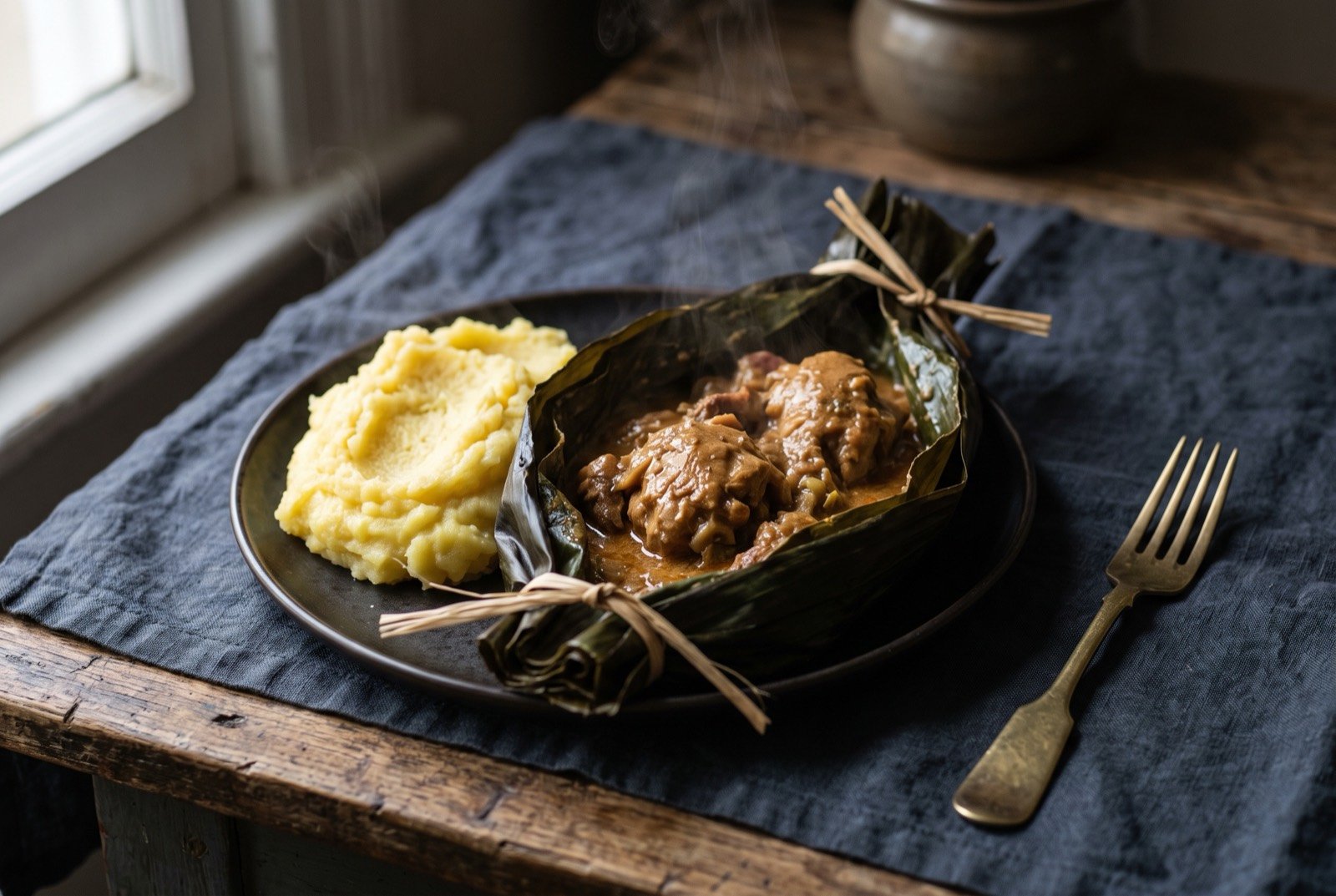
Uganda, Rwanda and Burundi, taken seriously. A cuisine with no frying tradition, no bread and almost no spice, which builds flavour out of steam, smoke, soured milk and pounded oilseed instead. The traditional canon as it is actually cooked, and every dish as tradition built it, then what a modern chef would change.
Sources and review · What this chapter does not assert · How we research · Spotted something wrong?
A Sense of Place
Three modern states, and a real map drawn by two things: where the banana grows and where the cow grazes. Everything else follows from those.
Volume Sixteen split East Africa along a line sixty miles inland from the Indian Ocean and found two cuisines that shared a passport and almost nothing else. Go west from that line, past the interior of Kenya and Tanzania, and you arrive somewhere that is not a variation on either. The Great Lakes kitchen has no bread. It has no porridge culture at its centre. It has essentially no frying tradition and no indigenous stock pot. What it has instead is a steamer, a churn and a mortar, and a set of ferments that do the work that spice does elsewhere.
That is the volume's first and most useful claim. This is the least grain-shaped major cuisine in Africa, because its staple is a perennial fruit that crops all year, needs no threshing and cannot be stored. A banana garden does not have a harvest. It has a Tuesday.
The banana core: Buganda, Busoga and the northern shore of Lake Victoria
The Baganda, Basoga, Baruli and Banyala live on warm, wet, deep red soils under bimodal rainfall, in permanent banana gardens, the olusuku, which can stand for fifty years or more without replanting. The starch is matooke, the steamed and mashed East African Highland banana, and in Luganda it is not the name of a dish. It is emmere, food. If there is no matooke there has been no meal, whatever else was on the table.
The fat here is groundnut and sesame, and historically almost none of either as a poured oil: the fat comes out of the seed itself, released by long cooking. The thickener is groundnut paste. The aromatics are onion and tomato, both recent, plus smoked and sun dried lake fish, dried mushrooms, and the smoke and vapour of the banana leaf, which is the real seasoning of the entire region.
This zone gives the volume its central technique. The Baganda cook almost everything in the same vessel at the same time, separated into leaf parcels, standing on a bed of cut banana stem. The pot is a steamer. Once you have understood that, most of what follows is one idea repeated.
The cattle corridor: Ankole, Kigezi, Bunyoro, Toro and the highlands
High, cool, terraced country at 1,500 to 2,500 m, running from western Uganda down through Rwanda into Burundi. Banyankole (Bahima herders and Bairu cultivators), Bakiga, Banyoro, Batooro, Banyarwanda and Barundi. Ankole longhorn cattle of the Sanga group, in five regional strains including the Bahima, Kigezi and Ruzizi types and the Watusi type associated with Rwanda and Burundi.
This is the only fat led cuisine in the volume, and the fat is clarified butter. Amavuta, omuzigo, ghee, and above all eshabwe, the whipped ghee sauce that is the most technically interesting thing in these three countries. There is no thickener in the sauce sense. Milk, ghee and bean liquor do the work. The aromatics are rock salt from Lake Katwe, wood smoke carried in the milk vessel, and very little else. The Bahima aesthetic is deliberately austere and it is not poverty. It is a position.
The starch is finger millet and sorghum as kalo, karo, ubugali or umutsima; sweet potato; and increasingly Irish potato in Kigezi and in Rwanda's northern volcanic districts.
The Rwandan central plateau and the Burundian hills
Extraordinarily dense smallholder farming on hillsides, bimodal rain, banana on the lower slopes and beans and sorghum above. Ghee where there are cattle, groundnut paste elsewhere. Onion, leek and celery leaf, the last of which is a genuine and unexpected Belgian residue in Rwandan cooking, and in the modern era akabanga, the chilli oil.
And beans, in quantities a British cook will not believe. Rwanda has the highest per capita bean consumption on earth, recorded at 32.9 kg per person in 2021. PABRA describes Rwandan and Burundian consumption in terms of people eating their own body weight in beans annually. In a food book that is not a statistic, it is a structural fact: the protein of this region is a legume, and the meat is an occasion.
Lake Tanganyika and the Imbo plain, western Burundi
Hot, low, palm growing lakeshore under the escarpment, with Congolese and Swahili coast influence coming through the port at Bujumbura. This is the one place in the volume where red palm oil is a normal fat rather than an import, and it is where the lake's own fish are the aromatic: ndagala, a small sardine-like fish eaten whole and dried, and mukeke, which is found only in Lake Tanganyika and is treated as the country's luxury fish.
I am going to be blunt about this zone rather than pad it. See the section at the end of this chapter on what could not be established. The Burundian material here is thin because the sources are thin, and I would rather it read as thin than as invented.
The Nilotic sesame belt: Acholi, Lango and West Nile
Drier savanna and open woodland, one long rainy season, shea trees in the Lango and Acholi parklands. Acholi, Langi, Alur, Lugbara, Madi and Kakwa.
This is the kitchen that will surprise a British cook most, because it is nothing like Buganda. The fat is sesame, simsim, and groundnut, plus shea butter, which appears here and nowhere else in the volume: the southern limit of the Sahelian shea belt from Volume Five runs straight through Lango and Acholi. The thickener is odii, sesame and groundnut pounded together to a paste. The acid is malakwang, a sour hibiscus leaf. The starch is sweet potato or kwon kal, millet bread.
Sour leaf against sesame against groundnut against sweet potato is a complete and very deliberate flavour architecture. Sour, fat, bitter, sweet, all four placed on purpose. The Ugandan formulation of it is better than anything I could write: sour and sweet usually go well together, which is why malakwang and sweet potatoes are a perfect match.
Teso, Bugisu and Mount Elgon
The Elgon massif and the Teso plains. Iteso, Bagisu, Bagwere, Basamia. Finger millet and sorghum, groundnut and sesame, and two things that exist nowhere else in the volume: malewa, the smoked and dried bamboo shoot of the Elgon slopes, and ajon, the Iteso millet beer, buried to ferment, roasted black, and drunk communally from one pot through long straws.
Karamoja and the northeastern edge
Semi-arid, transhumant, Karamojong, Jie, Dodoth and Pokot, with the milk, blood and meat complex and sorghum porridge. This zone is thinly documented and no technique in this chapter is built on it. I mention it so that its absence is a decision rather than an oversight.
The lakes as a single larder
Lake Victoria, Lake Albert, Lake Kyoga, Lake Kivu and Lake Tanganyika supply the umami of the whole volume in the form of dried and smoked fish. Three matter most: mukene, the small silver cyprinid of Lake Victoria, sun dried and pounded into sauces; nkejje, small haplochromine cichlids, traditionally sun dried; and sambaza, the Kivu equivalent, fried whole in Rwanda. Ndagala is the Tanganyika version of the same idea.
One introduction changed all of this and not for the better. Nile perch was put into Lake Victoria in the 1950s, and perch is too fatty to sun dry without going rancid, so it must be smoked instead. That single ecological decision converted a solar preservation economy into a firewood one, in an already deforested basin. It is the clearest example anywhere in this series of a fisheries policy rewriting a cuisine.
The History in Layers
The indigenous base, assembled from four directions
Historical linguistics gives the clearest picture of the deep past here, and David Schoenbrun's reconstruction of Great Lakes food vocabulary for roughly 1000 BCE to 500 CE identifies four food systems in contact rather than one tradition developing alone.
Central Sudanic and Eastern Sudanic speakers brought cereals and livestock. Tale Southern Cushites put cattle first and grain second. Great Lakes Bantu speakers ran an eclectic system of root crops, fishing and livestock. Schoenbrun's argument is that the Great Lakes Bantu inherited the roots and the fishing from Eastern Highlands Bantu speakers and acquired the cattle and the grain by contact, and that the flexibility of what resulted is exactly what allowed them to occupy such varied country. After about 200 CE the descendant communities specialised: inland Lake Victoria towards livestock, the Kivu Rift towards mixed farming.
The archaeology fits. The Urewe complex, roughly 500 BCE to 800 CE, with its dimple-based pottery and its early iron smelting, is the material signature of the period, and its economy is generally read as mixed farming, millet, sorghum and cowpea alongside cattle, goats and sheep.
So write it this way: the Great Lakes kitchen was not built on a single domesticated staple. It was assembled from four directions, and it kept the habit of assembly. That is why a Baganda pot cooks four unrelated things at once in four separate parcels, and why nothing in this cuisine is a one-pot reduction.
The banana, and a dating argument that is genuinely open
The banana is not African. It is Southeast Asian, and how and when it reached the Great Lakes is one of the live fights in African archaeobotany. This chapter is going to print the argument rather than pick a side.
Phytoliths from a swamp deposit at Munsa in western Uganda have been reported at 4560 to 3640 BCE, which is the fourth millennium BC and would make these the earliest bananas in Africa by a very long way. Phytoliths from Nkang in southern Cameroon date to the first millennium BC. Against both, at least one senior historian of Africa argues that the earliest acceptable evidence for banana cultivation on the continent is no earlier than the late sixth century AD, and the rejoinder followed immediately.
And the genetics point away from the archaeology. All East African Highland bananas appear to be genetically uniform, descended from a single ancestral clone introduced within the past 2,000 years and then diversified by somatic mutation under vegetative propagation. Roughly 200 named clones, and over 500 recorded local cultivar names, all of them one plant that mutated in place for two millennia while people selected the mutations they liked.
The safe form, and the form used here: bananas reached the Great Lakes at some point in the first millennium AD or earlier, the region then became a secondary centre of banana diversity, and the fourth millennium claims rest on phytolith evidence that a number of specialists reject.
The culinary consequence is not in doubt at all. A perennial, low labour, high yielding starch that fruits all year created the population densities of Buganda, Rwanda and Burundi, and it did it without a harvest season, without threshing and without storage. No granary, no mill, no bread. A steaming technology instead of a milling one, and a whole cuisine organised around the fact that the staple arrives fresh and must be eaten.
Cattle, and what the herd actually meant
Ankole cattle belong to the Sanga group and are usually described as having been brought into the region by herders 500 to 700 years ago. The inyambo, the extreme long horned royal strain of Rwanda, is a Watusi type; small herds are still kept, though their relationship to the royal herds confiscated in 1964 is not clear.
Two facts govern the cooking. First, these are not high yielding dairy animals. Rwandan per capita milk consumption of around 13 litres a year, that is about 0.035 litres a day, tells you that milk was never abundant. It was concentrated, ritualised and unevenly distributed. Second, the herd was a store of value and a social instrument, not a meat supply. Cattle were rarely slaughtered. What people actually ate was milk, soured milk, buttermilk, butter and ghee, and occasionally blood.
That is why the region's fat cuisine is a dairy cuisine and not a roasting one, and it is why the single most sophisticated technique in these three countries is an emulsion made out of butter.
The categories, and how they were hardened
A food book about Rwanda and Burundi cannot describe a herding tradition and a farming tradition and then move on, because of what was done with exactly that description.
What is reasonably established. Precolonial Rwanda and Burundi were kingdoms with a cattle clientship institution, ubuhake in Rwanda and ubugabire in Burundi. A patron granted cattle to a client; the client returned service, tribute and labour. The institution is generally dated from around the fifteenth century and was dismantled in the 1950s, with Rwanda's mwami persuaded to abandon it in 1954 and the system phased out by 1958. Scholars broadly agree that Rwandan clientship, for cattle and for land, was more exploitative than the Burundian equivalent, and that the two kingdoms had genuinely different social orders which colonial administration then flattened into a single model.
What is contested, and must be presented as contested. The neat equation that Tutsi were herders, Hutu were farmers and Twa were foragers is the version colonial administrators wrote down, and it is still reproduced in general reference works today, including the English Wikipedia article on ubuhake. Historians of the region have spent decades dismantling it. The categories were about cattle wealth, lineage and political relationship, not about occupation or descent in any biological sense. They were locally variable, they cut across clans that contained both, and they were permeable: a family that lost its herd could change category, and intermarriage was normal. The rigidity came later, and it came from outside.
What colonial rule did. German and then Belgian administrators arrived carrying the Hamitic hypothesis, a nineteenth century racial theory that attributed any sophisticated institution in the African interior to a supposedly superior pastoral people of northeastern origin. They used it to select an aristocracy and then they wrote it onto paper. A census of able bodied adult males was begun in 1930 and completed in 1932, registering 349,083 individuals, and ethnicity was placed on Rwandan identity papers by around 1930 to 1933.
What followed. Categories that could no longer be changed, an identity card that fixed them, and then in Rwanda the 1959 revolution, successive waves of expulsion and the 1994 genocide against the Tutsi; and in Burundi the mass killings of 1972 and the civil war that began in 1993.
How this chapter uses cattle. Not as an ethnic marker. As a marker of wealth, rank and obligation, which is what it was. And then it gets on with the cooking, which was never divided the way the identity cards were. Everyone in Rwanda eats ubugali and beans. Everyone drinks ikivuguto when there is any. The milk bar is a national institution, not a sectional one.
The Columbian Exchange
Maize, cassava, sweet potato, common beans, groundnut, chilli and tomato all arrive from the sixteenth century onward, and mostly overland from the Atlantic coast through the Congo basin rather than from the Indian Ocean side. Three of them restructured the cuisine.
The common bean became the region's principal protein and, in Rwanda and Burundi, the defining crop of the ordinary diet.
Cassava became the flexible famine insurance crop. Its flour became the elastic agent in kalo and the body of ubugali. Its leaves became isombe. It arrived with a toxicity problem attached, and the region developed or received the pounding-and-boiling protocol that deals with it.
The groundnut supplied the fat and the thickener the region otherwise lacked, because there is no oil palm on the plateau and no shea south of the Nile belt. Every groundnut sauce in this volume is post-Columbian in its raw material.
But here is the sentence that matters, and it is the one to keep. The technique of a pounded oilseed sauce is not post-Columbian. Sesame is African, and odii is the older idea. The groundnut did not bring a method with it. It arrived and was fitted into a grammar that already existed, exactly as maize was on the Ewe and Fon coast in Volume Four. The Americas supplied the plants. The Great Lakes supplied the cooking.
The colonial economy, and an expulsion
Uganda. Cotton was introduced as a cash crop in 1904 under the protectorate and coffee followed. The 1900 Buganda Agreement created a landed chiefly class and the framework within which peasant cash cropping developed. Ginning and trade were largely in the hands of a South Asian commercial community that had arrived from the 1890s with the railway.
The 1972 expulsion. In August 1972 Idi Amin gave Uganda's South Asian population 90 days to leave. About 80,000 people were affected, of whom 23,000 held Ugandan citizenship. Roughly 27,200 went to the United Kingdom, 6,000 to Canada, 4,500 to India and 2,500 to Kenya. GDP fell about 5 per cent between 1972 and 1975 and manufacturing output collapsed from 740 million to 254 million shillings.
The culinary consequence is peculiar and worth stating flatly. The food stayed. Chapati, samusa, mandazi and the whole South Asian influenced street repertoire are now completely Ugandan, and the rolex, a chapati rolled around an omelette with onion, tomato and cabbage, is their direct descendant and the national street food. Uganda kept the cooking and lost the cooks. It is also why Leicester, which absorbed a large share of the expelled community, has excellent East African Gujarati grocers and almost no Bantu Great Lakes ingredients, a distinction the sourcing section below insists on.
Rwanda and Burundi. Coffee was introduced by the Germans in the early 1900s and made compulsory under Belgian rule. Compulsory cash cropping on land that fed people, in the most densely farmed country in Africa, is the background condition for what happened next.
The Ruzagayura famine, October 1943 to December 1944. The name means, roughly, search and find little. Prolonged drought in early 1943 began it, and Belgian requisitioning of agricultural produce for the Allied war effort made it catastrophic. Tens of thousands died and several hundred thousand people fled, most into the Belgian Congo and some into Uganda. The published mortality figures do not survive arithmetic and are dealt with at the end of this chapter. It is the single most important event in the recent food history of Rwanda and Burundi and it is almost unknown outside the region. Scholastique Mukasonga's novel Kibogo is set against it and is the best way in for a general reader.
Suppression and revival of the food calendar
Umuganura, the Rwandan first fruits festival, is the clearest case in the volume of a state deciding what people may eat and when. Families were forbidden to eat from a new harvest until the elders had tasted it: the crop belonged to the ancestors before it belonged to the table. Sorghum and millet were the crops offered to the royal court. Both the German and the Belgian administrations suppressed it. It was revived in 2011 by the Institute of National Museums of Rwanda with the Ministry of Sports and Culture, and is now held on the first Friday of August, with umutsima and isombe as the ceremonial dishes. Burundi's royal umuganuro, tied to the sacred drums and to sorghum, is the equivalent, and it has a much harsher modern history.
The modern moment
Girinka, one cow per poor family, launched in Rwanda in 2006, gives an in-calf heifer to a poor household on condition that the first female calf passes to a neighbour. That is a direct policy reworking of the precolonial logic of cattle as a bond between households, which is a genuinely unusual thing for a modern agriculture ministry to have done on purpose.
Rwandan coffee shifted decisively to speciality after 1994, with roughly $10 million of USAID money into washing stations and farmer training between 2001 and 2006. Rwanda now produces 20,000 to 22,000 tonnes a year, 97 per cent arabica, across roughly 400,000 smallholdings, and exported $452 million worth between 2017 and 2023.
Akabanga, Rwanda's chilli oil, is made by Sina Gerard, who founded Urwibutso Enterprises in 1983 at the age of twenty, as a bakery. The name, in his own words, means something like the secret: if you put it on your food, you will understand the secret. The company now employs 280 full time and 600 part time and works with around 3,000 farming families. It is the only Great Lakes condiment with genuine international recognition, and this volume treats it as an ingredient rather than a curiosity.
Malewa is going global, in the Ugandan press's own framing, with dried Elgon bamboo shoots now exported to East African and diaspora markets. Ajon is being commercialised, moving from the shared pot into bottles, which is a live cultural argument in Uganda at the moment and not a settled one.
The Flavour Arsenal
Nine tenths of what makes this food taste like itself is in this section, and almost none of it is a spice. If you buy nothing else, buy real matooke, un-boiled ghee and dried silver cyprinid.
The fats, which are the region's actual argument
| Ingredient | Names | What it is | Character and use |
|---|---|---|---|
| Ghee, clarified butter | amavuta (Kinyarwanda, Kirundi), omuzigo (Runyankole), eshabwe when whipped | Butter from a week's accumulated cream, churned 90 minutes, washed four times, matured a month or more | Nutty, cheesy, faintly barnyard. The maturation is the flavour. Grades: ntsimbo (best, kept for the household), omwitsi (small herder, raw), and a premium matured six months or more. Not interchangeable with supermarket ghee, which is too clean |
| Groundnut paste | ebinyebwa, binyebwa (Luganda), ubunyobwa (Kinyarwanda) | Ground Arachis hypogaea, often raw and pinkish, not roasted | Pale, milky and green when raw; deeper and darker when roasted. Both are used, for different dishes. Getting the choice wrong is the commonest error in Western write-ups |
| Sesame paste | odii, odi (Acholi), simsim generally | Pounded sesame, alone or with groundnut | Darker, more bitter, more aromatic than groundnut, and a better emulsifier. The signature of the Nilotic north |
| Shea butter | moo yaa (Acholi) | Vitellaria paradoxa | Northern Uganda only, in dek ngor and northern sauces. The shea belt's southern limit runs through Lango and Acholi |
| Red palm oil | Elaeis guineensis | Burundian Imbo lowlands and Congo-facing dishes only. Not a plateau fat, and putting it into a Rwandan highland dish is a category error | |
| Cottonseed and sunflower oil | The modern everyday frying fats, and a direct legacy of the colonial cotton economy |
Salt and alkali, which are two different jobs
Lake Katwe rock salt, from a hypersaline crater lake in Kasese district in western Uganda, worked by hand for centuries, is named specifically as the salt for eshabwe. In Runyankole the brine made from it is rwabarire, and it is a named ingredient rather than "salted water", which tells you it is understood as a component.
Rock salt as a tenderiser is the second job and it is chemistry, not seasoning. Alkaline rock salt of the trona or natron type raises pH, which solubilises pectin and hemicellulose and collapses tough plant tissue much faster. It is added to pigeon peas in dek ngor and to dried bamboo shoots in malewa explicitly to speed the cooking. This is the same mechanism as the potash of Volume Four and the kanwa of Volume Three, used more sparingly and more specifically, and named as a tenderiser rather than a flavouring.
Wood ash is sprinkled into obushera. The Ugandan source describing the practice is honest enough to say the explanation is vague while the practice is fixed, and I am going to leave it exactly there.
The ferments, which do the work spice does elsewhere
| Name | Where | What it is | What it gives you |
|---|---|---|---|
| Ikivuguto | Rwanda | Spontaneously soured raw milk, 36 hours in a smoke treated wooden vessel or 2 to 3 days in an untreated one | Non-volatile lactic acid, yeast esters, and a faint woodsmoke that comes from the container rather than the milk |
| Amacunda and kimuri | Rwanda | The buttermilk and the butter off the churn | Thin, sharp, drinkable acid, and a cultured fat |
| Amavuta akuze | Rwanda | Aged butter, sometimes seasoned with onion and garlic | The dairy equivalent of a matured condiment |
| Obushera, bushera | Western and southwestern Uganda, Rwanda | Sorghum or millet, cooked to a slurry, malted flour stirred in, soured 1 to 6 days | Drunk sweet at one day and sour at four. A pourable acid with body |
| Omuramba, obutoko, enturire, ekitiribita, obuteire | Uganda | Named regional obushera variants | Evidence that this is a family, not a recipe |
| Ajon, malwa | Teso, eastern Uganda | Millet dough buried to sour, then roasted black | Roasted grain, melanoidins, and a shared pot |
| Urwagwa, urwarwa, tonto | Rwanda, Burundi, Uganda | Banana beer | The reason a dedicated beer banana exists |
| Ikigage, impeke | Rwanda, Burundi | Sorghum beer | Ceremonial, and tied in Burundi to the royal drums |
| Ubuki | Region-wide | Honey, and honey wine. The same word |
The Burundian fermented foods literature adds urubu, amateregua and isongo to that list. I have named them because they are named in the country's own scientific literature, and I have not described them, because I could not read the paper.
The preserved proteins
- Mukene, sun dried Lake Victoria silver cyprinid, Rastrineobola argentea, whole, pounded into sauce or fried.
- Nkejje, small sun dried haplochromine cichlids, named by the Buganda Kingdom's own account as a preferred partner for groundnut sauce.
- Ndagala, the Lake Tanganyika equivalent, Stolothrissa tanganicae.
- Sambaza, the Lake Kivu version, fried whole.
- Smoked catfish and Nile perch. Perch must be smoked rather than sun dried because of its fat content.
- Nsenene, Ruspolia differens, the long horned grasshopper, with a small season around May and the true season in November.
- Nswaa, winged termites, after the first heavy rains.
- Blood, historically mixed with ghee in the Ankole drought diet.
The dried small fish are the umami spine of the entire volume, and the mechanism is worth naming because it is the argument against the stock cube. Dried small fish carry inosinate in the hundreds of milligrams per 100 g. Onion, tomato and fermented dairy carry glutamate. Inosinate and glutamate together are supra-additive rather than additive, which is to say the effect is multiplicative. A bouillon cube gives you salt and glutamate and nothing on the other axis, which is precisely why a cube-built Great Lakes sauce has savour but no length.
The leaves, and the bitter axis
| Local name | Species | Character and handling |
|---|---|---|
| Malakwang, amalakwang (Acholi) | Hibiscus sabdariffa, roselle, and in some accounts H. cannabinus, kenaf | Sharply sour, slightly slippery, fresh or dried. Always boiled, drained and refreshed, which is a deliberate acidity control |
| Isombe (Kinyarwanda) | Manihot esculenta, cassava leaf | Deep green, mineral, faintly bitter. Must be pounded at least 10 minutes and then boiled properly. This is a safety step, not a texture step |
| Nakati (Luganda) | Solanum aethiopicum leaf | Bitter, distinctive, the classic bitter green of Buganda |
| Ntula, entula (Luganda) | Solanum aethiopicum fruit | The bitter African aubergine. The region's bitter axis in fruit form |
| Dodo (Luganda) | Amaranthus sp. | Sweet, spinach-like, the everyday green |
| Boo (Acholi) | Cowpea leaf | Mild and bean-like, often dried |
| Butikko, obutiko (Luganda) | Small wild mushrooms, and oyster mushrooms commercially | Named by the Buganda Kingdom account as a preferred partner for groundnut sauce, and the standard vegetarian luwombo filling |
| Malewa (Lugisu) | Mount Elgon bamboo shoot, dried and optionally smoked | Not a leaf, but it belongs here. Tastes of forest mushroom. Needs long alkaline cooking |
The starches
Matooke, East African Highland banana, Musa acuminata (AAA-EA), Mutika/Lujugira subgroup, sterile and vegetatively propagated, about 200 named clones in five clone sets: Nfuuka (changing), Musakala (lax bunches), Nakabululu (very compact bunches), Nakitembe (persistent neutral flowers on the rachis) and Mbidde (beer bananas). Mbwazirume, in the Nakitembe set, is the most widely grown cultivar, and its Luganda name means let the flies bite, after the biting flies of Kyaggwe county.
The Mbidde set, about fourteen cultivars, is bitter and astringent and is never eaten as food. Stop on that for a moment. This is a farming culture that bred separate cultivars for eating and for fermenting, and kept them distinct for centuries. That is a level of agricultural specialisation a British cook will not expect from a region routinely described as subsistence farming.
Beyond the banana: finger millet (Eleusine coracana), the prestige grain and the ceremonial one; sorghum, the drink grain and the ritual first fruit of umuganura; cassava, flour and leaf; sweet potato, the everyday second starch of the north and of Kigezi; the common bean, in overwhelming quantity; pigeon pea, lapena, the Acholi legume; Irish potato in the volcanic districts; maize for posho; and rice on the Rusizi plain.
The aromatics, deliberately short
Onion. Tomato. Garlic. Ginger. Green chilli, and akabanga oil. Leek and celery leaf in Rwanda, a real Belgian residue. Curry powder in Uganda, a South Asian one. That is close to the whole list, and the shortness is the point: the seasoning of this region is smoke, salt, dried fish, ghee and the banana leaf. Reaching for a spice rack here is a confession that you have not understood the vessel.
Part Two
The Technique Ladder
First, an honest problem
Volume Three could hang its elevations off Ikoyi and Akoko. Volume Four could not, and said so. This volume is thinner still, and pretending otherwise would waste the reader's time.
There is no Michelin guide covering Uganda, Rwanda or Burundi. Not a starless guide, not a Bib Gourmand selection, nothing. No restaurant in any of the three countries holds a star because no inspector has ever been sent. Any source claiming a star in Kampala, Kigali or Bujumbura is simply wrong, and several do.
There is no Great Lakes restaurant in Britain above the level of a community canteen, and I looked specifically. Compare the West African picture, where Ikoyi, Akoko, Chishuru and Akara hold Michelin recognition or serious critical standing between them. The East African equivalent does not exist in this country, and the reason is demographic rather than culinary: the Uganda-born population of England was recorded at 59,227 at the 2011 Census, and the Rwandan and Burundian communities are far smaller again. A restaurant sector needs a customer base. The West African one in Britain has one. This one does not.
What exists is worth naming precisely.
One: Meza Malonga in Kigali, and it is genuinely serious. Dieuveil Malonga, born in Linzolo in the Republic of Congo in November 1991, orphaned young, raised partly by his grandmother, moved to Germany as a child to join his sister. He trained in Germany and worked in three Michelin-starred German kitchens, Schote, Life and Aqua, plus the InterContinental Marseille, and competed on the French Top Chef in 2014. He opened Meza Malonga in Kigali in 2020, and it runs a ten course seasonal menu.
Be precise about the credentials, because the internet is not. He won the World's 50 Best Champions of Change award in 2022. He was one of ten global finalists for the Basque Culinary World Prize in 2018, and sixth on the Forbes Africa 30 Under 30 list in 2016. Meza Malonga appears in 50 Best Discovery, which is a directory and not a ranked position on The World's 50 Best Restaurants list. Do not print a ranking, because there is not one.
The Culinary Innovation Village at Musanze, opened in spring 2025, is the development that changes the picture. Seventeen acres on Lake Ruhondo in northern Rwanda, below the Virunga volcanoes, growing 134 varieties of plants, vegetables and herbs, with a spice and fermentation laboratory, a cooking school, a restaurant and an apprenticeship programme for African chefs. Seven years in the making. TIME listed it in World's Greatest Places 2025.
Sit with that for a second, because it is the most useful single fact in the chapter. The first serious fermentation laboratory in the Great Lakes is attached to a farm rather than to a city restaurant, and it exists specifically to recover old Rwandan ferments. That is not a fine-dining project borrowing a technique. It is a research programme aimed at the thing this region was always best at.
The honest caveat, and it matters. Malonga is Congolese and German-trained. Meza Malonga is a pan-African restaurant sited in Rwanda, not a Rwandan restaurant. Its larder runs to Nigerian uziza leaf, Cameroonian mbongo pepper and djansang, Mombasa shrimp, Tanzanian baobab, Egyptian black lemon and Ghanaian shito, alongside cassava leaf, sorghum, maize, honey, Rwandan coffee and crayfish from the restaurant's own lakeside farm. The ingredients are frequently Great Lakes; the seasoning grammar is West and Central African. Treat him as the region's best available proof of concept, not as its representative.
Two: Kampala, which has no equivalent room but does have deliberate reinterpretation. Kampala Restaurant Week ran from 3 to 13 July 2025, organised by Isaac Langoli of The Pearl Guide, with thirty restaurants and menus at 20,000 to 40,000 Ugandan shillings. The launch tasting was curated by Chef Ernest Kayondo, and his dish list is the single most useful piece of evidence in this entire section.
Three: Bujumbura, where I found nothing I would print. No named Burundian chef and no restaurant operating at anything describable as restaurant craft. The names that recur in search results come from pages that read as auto-generated. Burundi's contribution to this chapter therefore comes from ingredient and technique history and not from a restaurant, and that is stated here rather than buried.
The argument, from inside
Two people say this volume's thesis out loud without any prompting from a Western consultant, and neither of them is a starred chef.
Ernest Kayondo, Kampala. His Restaurant Week tasting included roasted chicken breast on pumpkin mousse with a white wine infused malakwang sauce, and loaded bacon with a red wine infused eshabwe and peppercorn sauce served with sweet potato croquettes.
Look at what he did. He took the two most technically distinctive sauces in Uganda, malakwang, which is sour hibiscus leaf plus nut paste, and eshabwe, which is whipped ghee, and he treated them as mother sauces to be enriched, exactly as a French kitchen treats a velouté. And the choices are mechanically correct rather than decorative. Malakwang is already an acid-and-fat sauce, so white wine deepens the acid without adding sweetness. Eshabwe is already an emulsion of butterfat in salt water, so a reduced red wine gives it the tannin and the glycerol body it lacks. Nobody imported that. A Kampala chef worked it out from the sauces he already had.
Dieuveil Malonga, Kigali, on how he trains cooks who have never been to cooking school:
The grandmothers always brought me to the farm first. I understood that for them, mise en place starts at the farm.
That is the ladder below in one sentence. Every rung is a Great Lakes technique done deliberately and measured, not a French or Nordic technique bolted on.
Rung 1. The banana leaf is a working component, not packaging. Wilt it, smoke it, and use it twice
Before any dish, understand the vessel, because it is one architecture and it produces most of the food in this volume.
The build, as described by Ugandan cooks and by Buganda Kingdom cultural officers. First the trivet: strips and chunks cut from the banana pseudostem or the bunch stem, in Luganda ebikolokomba, laid in the bottom of the pan to hold the leaf parcels clear of the water. They are wet, fibrous and slow to burn, so they also buffer the base of the pot. Then only enough water to make steam, topped up repeatedly through the cook. Then the leaves, midribs stripped, wilted first over a flame or in hot water, laid overlapping and crosswise. Then the food, folded in and tied with banana fibre worked like bandages and finished with a reef knot at the top. Then more leaves over everything, then the lid. Vegetables go in a separate bundle. Groundnut sauce can go in a third.
Why the parcel works. It is a low pressure, saturated steam chamber. Because the leaf is impermeable and the fibre tie is tight, the parcel runs at effectively 100°C with zero moisture loss and zero leaching: nothing dissolves out into cooking water because there is no cooking water in contact with the food. Hajat Zuliyati Bbosa of the Buganda Kingdom's Department of Culture and Youth describes it as cooking the food like a pressure cooker if not better, which is a good description of the result even though the physics is not quite pressure cooking.
Why the leaf must be wilted, and this is the step everyone skips. A banana leaf is a laminate of parallel veins in a parenchyma matrix under a heavy cuticular wax layer. Cold, the cuticle and the turgid cells resist folding and the leaf cracks along the veins. Heat drives off water, collapses turgor and softens the wax, and the leaf becomes a foldable, sealable, oil-and-water-tight sheet. Frozen leaves have already had their cells burst by ice crystals, so they fold beautifully and tear more easily. Either way, pass each sheet over a gas flame or a very hot dry pan for 5 to 10 seconds a side until it goes glossy and darkens.
And why you smoke it as well as wilt it. For luwombo the specification is stricter: young leaves of the ndiizi banana, the small sweet dessert variety, passed over an open flame or over burning dry banana leaves until they turn brownish yellow. Three things are happening at once. The sap is driven off. The leaf becomes flexible. And phenolic smoke compounds are deposited on a surface that will spend the next several hours in contact with a fat phase at 100°C.
Banana leaves also carry a real volatile load of their own that transfers into the food, and heating shifts that profile from malty and green towards resinous and roasted. I am describing the direction rather than quoting the percentages, for reasons given at the end of this chapter. There is a fourth mechanism too: wrapping meat in banana leaf before charcoal grilling intercepts dripping fat before it pyrolyses on the coals, which reduces polycyclic aromatic hydrocarbon formation. The mechanism is sound. The widely repeated figure attached to it is not something I could stand up, so it is not printed here.
The restaurant move. Toast one batch of leaves harder than you need, blitz them, sieve, and keep the powder. You now have the aroma of the vessel available as a finishing seasoning, which solves the specific problem that a plated luwombo loses the moment you take it out of its parcel.
Rung 2. Matooke is a low-amylose starch with a very high breakdown, and that dictates the entire mash
The definitive characterisation of matooke starch is Ugandan work by Ugandan scientists, and that is worth saying out loud because it is unusual. The senior author is Rev. Prof Florence Isabirye Muranga, born in Mayuge District in 1952, Makerere then Reading then a Makerere PhD in biochemistry, Director General of the Banana Industrial Research and Development Centre and Executive Director of the Presidential Initiative on Banana Industrial Development, which President Museveni established in 2007 after her research impressed him two years earlier. PIBID runs a banana farm and processing factory in Bushenyi and produces the Tooke range of matooke flours. If this chapter needs one authority on what matooke starch actually does, it is Muranga, and she is Ugandan.
Ssonko and Muranga characterised starches from five Ugandan cultivars, Enyeru, Mbwazirume, Nandigobe, Mpologoma and Bukumu. The numbers explain the whole method:
- Amylose 11 to 13 per cent, against 15 to 24 per cent for bananas generally.
- Granule diameter 16.31 to 21.98 micrometres, which is large, roughly twice a rice granule.
- Pasting temperature below 75°C.
- Peak viscosity 488.42 to 558.66 RVU, which is high.
- Breakdown 235.00 to 311.92 RVU, which is very high.
- Setback 61.21 to 104.33 RVU, which is very low.
- Maximum swelling power 12.43 to 14.27 g water per g starch at 90°C, solubility 12.52 to 14.19 per cent.
Read that as a cook and not as a chemist. High peak viscosity with a very high breakdown means the starch thickens fast and then falls apart fast under shear and continued heat. Very low setback means it will not re-firm as it cools, which is why matooke stays soft rather than going chalky like a cooled plantain mash.
Therefore: mash it while it is at peak, then stop shearing it, then let residual steam finish the job. Mash too early and the granules have not swollen. Mash too late, or too long, and you have shear-thinned the paste into wallpaper paste. The traditional interruption of the steam to squeeze the parcel and re-wrap it is a peak-viscosity intervention, not a folk habit, and the fact that it is done inside the leaf and off the heat is not decoration either: the gel is thixotropic while hot and sets on cooling, so working it cold gives a lumpy, gluey result that no amount of further mashing recovers.
Two corollaries follow. The first is that a potato ricer is the wrong tool because it over-shears, and so is a stand mixer. You want short, controlled passes with a heavy flat wooden paddle. The second is that matooke is uniquely badly suited to hot-holding, which is the dominant format for this food in Britain. With a breakdown of 235 to 312 RVU the starch continues to shear-thin and dehydrate under a heat lamp, so a mash that was correct at eleven in the morning is a dry, fibrous, grey-edged block by three in the afternoon. That is a physical fact about the ingredient and not a criticism of anybody's cooking.
Rung 3. The Great Lakes groundnut sauce is deliberately not fried out, and that is the whole point
This is the rung that will surprise anyone who has cooked mafé or tigadèguèna, and it is the most useful comparative insight in the volume.
Volume Three and Volume Five both fry the paste hard first. That drives Maillard reactions on the residual protein and sugars and generates pyrazines: the roasted, coffee-adjacent depth that makes a West African groundnut stew taste toasted. The Great Lakes method skips that step entirely. Neither of the in-tradition methods I have gives an initial frying of the paste, and the popular Rwandan home tutorial for ubunyobwa is titled, in Kinyarwanda, guteka ubunyobwa nta amavuta, nta gukaranga: cook the groundnut sauce without oil, without frying.
What you get instead is a sauce that is green, milky, sweet and nutty rather than roasted, and whose body comes from peanut protein and residual starch acting as an emulsifier for the peanut's own oil, released slowly by heat and stirring rather than dumped in at once by frying. The starting material is different too: the specified powder is raw and pinkish, not roasted.
The doneness signal is the same as West Africa's and the mechanism is real. Peanut paste is a coarse suspension of oil, protein bodies and starch. Under gentle prolonged heat with a constant water phase, the protein hydrates and partially denatures, the starch gelatinises, viscosity climbs, and free oil is progressively expressed from the ruptured cell fragments. It rises because the emulsion has reached capacity: the continuous aqueous phase can hold no more dispersed oil. Oil on top is the sauce telling you it is saturated and therefore finished. Push it further and you break it. Undercooked groundnut sauce tastes chalky and raw and coats the palate, which is the other end of the same scale.
Two consequences for buying. A no-stir groundnut paste has been emulsion-stabilised, which means it will not release its oil at the end of the simmer and you have lost your only doneness signal entirely. And for this cuisine you want a pale to mid brown, lightly roasted or raw paste, which is the exact opposite of the dark-roast advice in the West African volumes.
The restaurant move, and it is the best one in this chapter. Split the paste. Make 70 per cent of the sauce the traditional unfried way for its sweet, milky length, and separately dry-roast the other 30 per cent of the nuts hard, grind them, and stir that in at the last minute. You get pyrazines sitting on top of an unroasted base, which is a flavour neither tradition produces on its own, and which nobody in Europe is currently cooking. Then add smoked fish powder in the Malonga manner for the inosinate half of the umami synergy.
And the northern variant your reader will not expect: in Acholi and Lango cooking the nut paste is often odii, sesame rather than peanut, or a blend of the two. Sesame behaves differently again, higher in lignans, more bitter, and it emulsifies harder because sesame protein is the better emulsifier. Malakwang is traditionally made with odii, not with groundnut, and the versions that use groundnut are the compromise, not the original.
Rung 4. Eshabwe is a phase-inverted butterfat emulsion, and the whiteness is your only instrument
This is the region's hollandaise, it is made without eggs, and it is the dish with the clearest restaurant future of anything in these three countries.
The technique. Take mature, un-boiled ghee. Crush rock salt to a powder and dissolve at most half a small teaspoon into a cup of boiled water cooled to room temperature: that brine is rwabarire. Put the ghee in a pan with a sisal wrap, a bundle of coarse plant fibre, and stir them together. Add the brine in small quantities, stirring continuously, until the ghee begins to dilute and whiten. Keep going until it is white and the aroma changes. Add a little ordinary salt and keep stirring until it dissolves, because salt thickens eshabwe as well as seasoning it. Keep stirring until it thickens and develops small bubbles. The end point looks like thick plain white yoghurt. Squeeze out and remove the sisal wrap, then sieve.
Why it works. This is a phase inversion. Ghee at working temperature is a fat-continuous phase with a small amount of dispersed water. Adding brine slowly with high shear disperses water droplets into the fat until you cross the inversion point and the system flips to oil-in-water: fat globules dispersed in a salt solution. It is the same physics as a beurre monté or a mayonnaise, achieved with an electrolyte instead of an egg.
The colour change is the diagnostic and it is pure optics. Yellow ghee is transparent to light because it is a continuous fat phase. Once you have millions of micron-scale fat globules dispersed in water, the interfaces scatter light across the visible spectrum and the sauce goes opaque white. The whiteness is not a chemical change. It is refraction, and it is the only instrument you have.
Three things follow, and all three are counterintuitive to a British cook.
The salt is a functional ingredient, not a seasoning. Ions in the aqueous phase screen the surface charges on the milk-protein fragments and phospholipids that stabilise the emulsion. Unsalted water will not build eshabwe. That is why the tradition specifies a brine rather than water plus salt at the end, and it is why an unrefined salt with a residual calcium and magnesium fraction outperforms pure sodium chloride here.
The water must be cold. Warm water melts crystalline fat, the globules coalesce, and you get a broken pool of ghee. Everything stays below the ghee's crystallisation range.
The ghee must be mature and un-boiled, and this is the hard part in Britain. Ankole ghee is churned from soured, unpasteurised milk and is not heat-clarified to dryness. It keeps its milk-protein fragments, phospholipids and free fatty acids, and those are the emulsifiers. A commercial Indian-style ghee, clarified hard from pasteurised cream to remove all the solids, has had its emulsifiers stripped out. It will not turn white and it will not thicken, and the cook who fails at it usually concludes that eshabwe is just salty butter. It is not. They were handed an emulsifier-free fat and asked to build an emulsion. This is the single most important substitution warning in the volume.
And the sisal wrap is the clever part. A bundle of coarse plant fibre is an enormous, cheap surface area, and stirring against it shears the fat far more effectively than a spoon can. It is a whisk made of grass, and it was in use long before anybody in Europe had one made of wire.
There is a piece of applied craft knowledge attached that is usually reported as folklore. Eshabwe was made by elderly women in silence, in a quiet room, because talking was believed to ruin it. Take that seriously rather than smiling at it. An emulsion built by hand over a long period fails if attention lapses, and a cook who is talking stops stirring. A rule that enforces uninterrupted concentration is a functional quality control, and it is the same instinct that keeps a pastry chef quiet over a bombe.
Rung 5. Use highland dairy and cereal ferments as your acid, and stop reaching for lemon
Ikivuguto is Rwanda's traditional fermented milk, and it is produced by spontaneous acidification of raw milk by a microflora resident on the utensils, the containers and the environment around the cattle, rather than by a pitched culture. The organisms identified in the review literature are Lactobacillus fermentum, Lactobacillus acidophilus, Lactococcus lactis and Streptococcus salivarius, with Saccharomyces cerevisiae and Candida kefyr as the dominant yeasts. Note the authorship: Karenzi, Mukerabigwi and colleagues are Rwandan researchers publishing on their own food system.
Obushera is the Ugandan sorghum and millet equivalent, spontaneously fermented and predominantly lactic. Sixty-five per cent of Ugandan households germinate the grain for 2 to 3 days; fermentation runs from 1 to 6 days and ninety per cent of households drink it at 2 to 4 days. Over four days the lactic acid bacteria rise from about 5.0 to 11.0 log cfu per gram while coliforms fall from about 2.0 to under 1. Makerere researchers have shown obushera lactic acid bacteria inhibiting acid-tolerant, antibiotic-resistant, potentially virulent E. coli.
Why this is a technique note and not a drinks note. Three reasons, and they are the argument for putting soured milk on a plate rather than in a glass.
Acid type. Lactic acid is a weak acid with a pKa around 3.86 and, crucially, it is not volatile. Citric acid from lemon is sharp and forward and disappears as the dish cools. Acetic acid from vinegar volatilises off and takes over the nose. Lactic acid stays in the sauce and reads as depth rather than as sourness, which is exactly what you want against a fatty groundnut sauce or a mound of matooke.
Buffering. A fermented milk or cereal slurry brings its own buffer system, milk proteins and phosphates or cereal peptides, so the acid arrives with something to hold it. Add lemon to matooke and you get a spike. Add ikivuguto and you get a curve.
Aroma. The yeast fraction contributes esters and higher alcohols that lemon simply does not have.
The restaurant move. Make a mesophilic soured milk from the least-processed whole milk you can get, hold it at ambient for 24 to 48 hours, and then use it three ways: as the acid folded through matooke, as a cold sauce under grilled meat, and reduced into a sauce as a finishing dairy. Almost no British cook reaches for soured milk against a starch, and it is the single most transferable idea in this volume after the next one.
Rung 6. Smoke the vessel, not the food
This is the region's signature move and the one that will most surprise a British cook, because British and French practice smokes the ingredient.
Luwombo: the banana leaf is smoked before anything is wrapped in it. The stew is never exposed to smoke at all.
Ikivuguto: in eastern Rwanda the wooden milk vessels are smoked before use, with grass stems of the Poaceae family and with Combretum molle. Burning rods are placed in a small pot with one large and one small opening, and the interior is repeatedly wiped with bark cloth until it is smooth. The vessels have names, and naming them is the fastest way to see that this is an engineered system: inkongoro, the small wooden vessel used at milking; icyansi, also called igicuba, the large jar the milk ferments in; igisabo, the churn; uruhimbi, the warm clean ledge the jar stands on; umutemeri, the woven straw lid.
And the effect is measured, which is why this is a rung and not an anecdote. In an untreated vessel, uncovered, at room temperature on the uruhimbi, ikivuguto takes at least 2 to 3 days. In a smoke treated vessel it takes about 36 hours, and the reported result is a very good curd with a solid texture. Coagulum forms at around 4 hours either way. For reference on how fast the organisms work, Lactococcus lactis strain CWBI-B1466 reaches pH 4.6 in 8 hours, while Leuconostoc pseudomesenteroides CWBI-B1470 takes 14.
Why smoking the vessel beats smoking the food. Three mechanisms, and they stack.
Dose control. Smoke deposits on a hard, dry, porous surface, a charred vessel interior or a wilted leaf cuticle, and then partitions slowly into the food across hours. Smoking food directly deposits the whole dose in minutes and mostly on the surface, so you get a gradient: acrid outside, nothing inside. The vessel gives you an even, low, sustained dose.
Selective transfer. Guaiacol, syringol and the phenolic compounds that read as smoked are relatively lipophilic and transfer readily into a fatty medium such as milk or a groundnut sauce. The heavier, more acrid pyrolysis products and the particulates stay stuck to the vessel wall. The vessel is a filter. That is why smoked-gourd milk tastes of smoke without tasting of ash, and why directly smoked milk tastes of a bonfire.
Antimicrobial function. The soot layer is genuinely antimicrobial. Phenols and carbonyls suppress coliforms and spoilage organisms, which is how a raw-milk spontaneous ferment stays a controlled Lactobacillus and Lactococcus event for days rather than becoming a spoilage one. That is the same logic as the smoked luwombo leaf, which is being sterilised as well as softened. It is also why the smoked vessel ferments faster: a cleaner starting population reaches acidification sooner.
The restaurant move. Smoke your wrapping leaves in a stovetop smoker or over the Big Green Egg's dying coals, and separately char the inside of a cheap calabash or a wide unglazed earthenware bowl and use it to hold your soured milk for 24 hours before service. That will give you, in a British kitchen, a flavour that no Great Lakes restaurant outside Kigali currently puts on a plate.
A half rung, on plating, because it is a real problem
This cuisine's plate is a mound of pale mash next to a bowl of beige sauce, and that is a harder presentation problem than West Africa's, which at least has red. There are three legitimate answers and they are all evidenced.
Serve it in the vessel. Luwombo arrives in its parcel, and the parcel is the plating. This is the only cuisine in the series where the traditional service format is already restaurant-grade.
Make the starch a component rather than a bed. Malonga's plantain-stuffed ravioli is the honest answer to what you do with a staple that is a mash and not a grain: you make it a filling.
Use the region's own colour, which is the deep red of malakwang and hibiscus and the violent yellow of akabanga.
What is not legitimate is putting beige mash next to beige sauce on a white plate and calling it authentic.
Part Three
The Ferment and Preserve Bench
Four things worth making, all of them the traditional operations this cuisine already runs on. The first three are the ones that change your cooking. The fourth is here because you should understand it even though you are not going to make it well.
1. Ikivuguto, approximated, in a smoked vessel
The real thing is raw milk soured spontaneously by the microflora resident on the utensils, the vessels and the environment around the cattle. You cannot reproduce that in Britain and you should not pretend to. What you can reproduce is the mesophilic, Lactococcus led acidification that gives it its character, and the smoked vessel, which is the part that actually transfers.
Char the inside of a cheap calabash, or a wide unglazed earthenware bowl, with burning hardwood sticks until it carries an even black layer, then wipe it out with a clean cloth until it is smooth. Take 1 litre of the least-processed whole milk you can find, non-homogenised at minimum and raw if you have a vending machine near you. Inoculate with 2 tablespoons of live cultured buttermilk or a mesophilic cheese starter. Pour it into the charred vessel, cover, and hold at 20 to 22°C for 24 to 48 hours until it sets and separates slightly.
Why mesophilic and not yoghurt. The organisms identified in Rwandan kivuguto are Lactobacillus fermentum, Lactobacillus acidophilus, Lactococcus lactis and Streptococcus salivarius, with Saccharomyces cerevisiae and Candida kefyr as the dominant yeasts. A shop-bought yoghurt culture is thermophilic, runs at 42°C, and produces a different acid profile and none of the yeast esters. Greek yoghurt is not a substitute for this. Kefir is the closest off-the-shelf product because it carries both bacteria and yeasts. Cultured buttermilk is next. Scandinavian filmjölk or ymer, if you can find them, are mesophilic and closest of all in mouthfeel.
Churn a batch for two hours or more and you get kimuri, butter, and amacunda, buttermilk, which is what a Rwandan household does with the surplus.
Buy the safety caveat with the technique. This is a raw or lightly treated dairy ferment. Use clean vessels, keep it cold once it has set, and do not serve it to anyone immunocompromised, pregnant or very young.
2. Obushera
The Ugandan sorghum and millet ferment, drunk sweet at one day and sour at four, and the reason nobody in Kigezi has ever needed a lemon.
A note on the numbers. The Ugandan sources describe the operation and its timings precisely and do not weigh the flour, so the proportion below is mine and is labelled as mine. Everything with a time attached to it is theirs.
Boil 1 litre of water. Separately mix 150 g of fine millet or sorghum flour with 200 ml of cold, previously boiled and cooled water to a thick slurry. Pour the boiling water in, stirring rapidly, to make a smooth porridge, the enkoomba. Lift out any lumps by dropping in a couple of cooked plantain leaves left over from an earlier meal, the ekyishandiiko, and dragging them through: a wet, flexible, slightly oily leaf catches undissolved agglomerates by surface adhesion, and it is a strainer you can afford to throw away. Some cooks sprinkle in a little wood ash at this point, and the Ugandan account is honest that the explanation for that is vague while the practice is fixed.
Cool it. Stir in 2 tablespoons of germinated, malted flour. Cover, and after about 12 hours stir it and drink it. No sugar is added at any point.
Across the country, 65 per cent of households germinate the grain for 2 to 3 days to make that malt, and fermentation runs anywhere from 1 to 6 days, with 90 per cent of households drinking it at 2 to 4. Over four days the lactic acid bacteria climb from about 5.0 to 11.0 log cfu per gram and coliforms fall from about 2.0 to under 1, which is a ferment doing food safety as well as flavour.
Use it as a kitchen acid and not only as a drink. A sour four-day obushera, strained, is a pourable, buffered, non-volatile acid with cereal body. It goes into a groundnut sauce at the end, under grilled meat, and into a bean stew off the heat.
3. Cultured, half-clarified butter, which is the fat eshabwe needs
The most important thing on this bench, because without it dish four is impossible in Britain.
The Banyankole method upstream is worth knowing even if you are not going to run it. Fresh raw milk is sieved every morning and the cream skimmed and accumulated over about a week. It is churned, kuchunda, for 90 minutes. It is washed with clear water four times, which is the step that matters: residual lactose and casein are what make butter go rancid and what scorch during clarification, and washing four times is what allows an unrefrigerated fat to keep. Then it is matured for at least a month in carved wooden vessels, the kyanzi, or in dried calabash gourds, and the premium grade is matured six months or more. That maturation is where the butyric, cheesy top note comes from, and it is why fresh butter will not make good eshabwe.
The British version. Culture 1 litre of double cream with 2 tablespoons of live cultured buttermilk at 20 to 22°C for 24 to 36 hours. Churn it to butter in a stand mixer, drain the buttermilk and keep it for the ferment above. Wash the butter lightly in cold water, working it against the bowl, two or three times. Then melt it gently to around 60°C only, and hold it there so the water separates but you do not clarify off the solids. Skim rather than strain. Keep it cold and use it within about three months.
What you have made and why it is not ghee. You have made an incompletely clarified, cultured butterfat that still contains milk-protein fragments, phospholipids and free fatty acids. Those are the emulsifiers. A commercial Indian-style ghee has had every one of them removed, which is exactly what makes it a good high-heat frying fat and exactly what makes it useless for a phase inversion.
And if you can buy the real thing, buy the real thing. Ugandan Natural Cow Ghee, Muzigo, turns up at Owino and at Afrolink, and the honest merchant's note attached to it elsewhere is the best guide in print: your ghee may be melted, gritty, grainy, smooth or solid, and all of those are normal textures of traditionally made ghee. Grainy is good. It means the fat crystallised naturally rather than being tempered. It should smell faintly cheesy and lactic. A ghee that smells of nothing has been over-clarified and will not work.
4. The drinks, which you should understand rather than fake
Included because they are culturally load-bearing, because the mbidde clone set exists solely to supply them, and because you will be offered them.
Urwagwa, the Rwandan banana beer, is made by ripening green bananas in a warm pit under banana and eucalyptus leaves, sometimes with smoke, for several days to maximise sugar. The fruit is peeled, and then the juice is extracted by working the peeled fruit with spear grass in a wooden trough and squeezing. That grass step is the clever part: banana pulp is a pectin-rich gel and will not release juice under simple pressure, so shredding it against a coarse siliceous grass ruptures the cell walls mechanically without a press, and the fibre then acts as a filter bed during the squeeze. It is a basket press with the fibre supplied by the plant. The juice is filtered, diluted, pitched with ground sorghum or sorghum malt, which supplies both yeast and residual amylase, and fermented in a covered vessel in a warm place.
Ajon or malwa, the Iteso millet beer, is the most unusual sequence in the volume. Millet flour is mixed with water to a solid mass and buried underground for about a week to ferment, which is an anaerobic, temperature-buffered lactic fermentation that acidifies and pre-digests the grain. The sour mass is recovered and roasted at very high temperature until it turns black, which is the equivalent of kilning a dark malt: melanoidins and pyrazines, colour, roasted flavour, and enough water driven off that the mass will store. It is sun dried for two days, floated in a drum so the light material can be skimmed, given a starter on two consecutive days, and left a couple more. To serve, the black powder goes into a pot and hot water is added at intervals, and drinkers share it through long straws. That is a continuous infusion, exactly like adding water to a gourd of maté, and it is why a pot of ajon lasts an evening.
The social point is worth keeping. Ajon is drunk from one pot through a single shared straw, deliberately, as an expression of unity, with multiple straws a recent public health accommodation. The Iteso contrast this on purpose with the Baganda, who drink tonto from individual calabashes. Two peoples, two banana and millet ferments, and two entirely different theories of what a drink is for.
The fermentation times and strengths reported for both, and for the sorghum beers ikigage and impeke, are given at the end of this chapter as things I have not asserted. Distilling is a separate matter: Uganda Waragi is sold in Britain and you should buy it rather than make it, because distilling spirits at home requires an HMRC licence and is a criminal offence without one.
Sourcing in Britain
Verified August 2026. Where a supplier could not be fully confirmed, that is said rather than smoothed over.
And an honest warning that changes how you shop, compared with Volumes Three, Four and Five. The African retail geography of Britain is overwhelmingly West African, and specifically Nigerian and Ghanaian. Walking into a shop on Rye Lane or Moston Lane and asking for matooke, un-boiled ghee or mukene will usually fail. For this volume, plan to order online from the East African specialists below, and use your local African grocer only for the shared ingredients: groundnut paste, dried fish, cassava flour, chilli and greens.
The two that decide everything
Matooke is the ingredient this chapter lives or dies on, and in Britain "matoke" on a shelf can mean any of four different things: a true East African Highland banana air-freighted from Uganda or Rwanda, a green plantain, a green Cavendish, or a South Asian retail category where Gujarati shops sell "matoki" meaning green cooking banana generally.
A plantain has more amylose, more setback and a coarser cell structure, so a plantain matooke is grainier, drier and firms up as it cools. A green Cavendish has less starch and more sugar and turns to sweet slime. Neither failure is the cook's fault and both are indistinguishable to a customer who has never had the real thing.
- Fresh EAHB, air-freighted. Afrolink lists a box of matooke, 8 kg, £29.50, product of Uganda (out of stock at the time of checking, with an order-by-Tuesday-for-Thursday-or-Friday rhythm). Frepro lists a box at £24.99, reduced from £49.99, free shipping, sourced through Agrenes Uganda; note that its contact is a Gmail address, which is a small flag on a fresh produce order. The Finest Exotics lists Ugandan matoke at £7.80 in 1 kg, 2 kg and 5 kg, next working day before 3:30pm, and was showing "out of season, coming soon" when checked, which is itself a good sign that they are selling real seasonal fruit. Amazon carries a 6 kg box from the Chilli Mash Company at £34.98, shipped from Rwanda, at 3.7 stars from 68 reviews, and that rating is the honest fact to report: air-freighted green banana is fragile and a proportion of boxes arrive over-ripe.
- Peeled, vacuum-packed, frozen matooke from SMG Farm Fresh, Withington, Manchester. This is the only frozen peeled matooke I could find in Britain and it removes the single most tedious step in the dish, at some cost in texture, because freezing ruptures cells and the mash comes out softer and wetter. No price or pack size was shown on the page, so ring first.
- Avoid green Cavendish sold as matoke, and avoid any box already showing yellow at the tips. Matooke is picked hard green and any ripening in transit has converted starch to sugar irreversibly.
Quality markers. Hard, matt, angular in cross-section, deep green with no yellow. The fingers on an EAHB bunch are shorter and blunter than a plantain's, which is the fastest visual test. Cut one: dense ivory-white flesh, real resistance to the knife, and a sticky white latex that stains. Latex is a good sign. No latex means it has started ripening. Store cool, dark and airy, never in the fridge, which chills-injures the peel and turns it black. Use within 4 to 6 days.
The second is ghee, and it is the substitution warning of the volume. For eshabwe you need mature, un-boiled, Ankole-style ghee. Natural Cow Ghee (Muzigo), Produce of Uganda, is verified at Owino Supermarket at £24.99 and listed by Afrolink. Buy it when it is in stock, because both were out of stock at different points during this research.
For eshabwe specifically, avoid mass-market Indian-style ghee: KTC, Pura, East End, Heera. They are perfectly good frying fats. They have been clarified hard from pasteurised cream and the milk-protein and phospholipid emulsifiers have been removed. They will not go white. If you cannot get Muzigo, make the cultured half-clarified butter on the ferment bench instead. That is a real answer. A commercial ghee is not.
The East African specialists, verified trading
- Owino Supermarket, 195 London Road, Mitcham CR4 2JD, 020 8687 0370. Ugandan-owned and trading since 1998, and the single most important physical address in this volume. Local delivery to a named postcode list plus national delivery via APC, typically four working days. Verified lines include matooke, nsenene, apple banana, white sweet potato, mayuni yam, whole groundnuts, Numa Bushera Pure Millet Flour and the Muzigo ghee. This is the default recommendation.
- Pascheal's, 17 Upton Lane, London E7 9PA, 020 3488 3599. A Ugandan and East African grocery of over thirty years' standing, nationwide delivery, fresh weekly stock. Confirmed lines include matooke and Numa Bushera Pure Millet Flour 2 kg. The strongest East London option.
- Afrolink. Runs dedicated Uganda and East African category pages, which almost no other UK retailer does. Verified at the time of checking: Numa Power Fine Maize (Posho) Flour £12.00; Mutima Cassava Flour £7.50; dried catfish fillets 400 g £13.50; Angie Foods peanut butter 800 g £14.50; M.M plain ground paste 500 g £7.00; dried oyster mushrooms (obutiko) 40 g £8.00. Also Pamwa roast groundnut paste with simsim, Akabanga, and the Muzigo ghee. Site copyright reads 2023, so it is verified trading with a stale footer rather than a dormant shop.
- SMG Farm Fresh, Surcon House, 11A Copson Street, Withington, Manchester M20 3HE. An East African importer with a Manchester address, which makes Manchester the strongest non-London city for this volume.
- Niyis African Supermarket, Unit 8 Sentinel End, Reading RG2 0BF, is the best-verified nationwide African grocer in Britain and the default for anything not East African specific, including frozen pondu cassava leaves at 500 g. Standard shipping from £7.99, next day from £10.99.
Banana leaves, which are a solved problem
Frozen banana leaves are cheap and everywhere: Chang and Tiger Tiger from Oriental Mart, Chang 454 g from Alli Bhavan, Buenas 454 g from The Tasty Wok, Bua Luang 450 g from Duaba Afro Foods, and any Thai or Vietnamese supermarket, Longdan or Wing Yip. Around two to four pounds a pack.
These are Thai or Filipino Cavendish leaves, not Ugandan ndiizi leaves. They are thinner and less aromatic. It matters less than you would think, once you smoke them.
Buy frozen rather than dried: dried leaf is for lining and will not fold. Look for deep even green with no brown crumbling edges and no ice crystals in the pack, which indicate a thaw-and-refreeze. Sheets should be at least 30 cm wide unfolded. Thaw fully, wipe both sides with a damp cloth, then pass each sheet over a flame for 5 to 10 seconds a side. Frozen leaves are already cell-burst and pliable, but the flame step is what develops the aroma and it is the step everyone skips.
The genuine gaps, named
- Malakwang. I found no UK retailer of fresh or dried malakwang, and this is the volume's real sourcing gap. Substitute with sorrel, ranked in dish five.
- Ugandan rock salt. No UK retailer found. Use an unrefined mineral-rich salt: grey sel gris, Halen Môn, or a coarse unrefined rock salt. What matters functionally is the residual calcium and magnesium.
- Ikivuguto. No UK retailer. Make it, or use kefir.
- Dried silver cyprinid. The most reliable UK-shipping routes I found are eBay and Etsy marketplace listings, which are outside the normal retail food-safety chain. Buy small, inspect, and freeze on arrival. The honest alternative is better: niboshi, Japanese dried sardine, or ikan bilis, Malaysian dried anchovy, from any East or Southeast Asian grocer. They are technically excellent substitutes, vastly easier to buy well in Britain, and they deliver the same glutamate-plus-inosinate synergy. Katsuobushi works for the umami but brings a smoked-tuna aroma that is wrong here.
- Cassava leaf is easy: frozen ground pondu at 500 g from Afrimart (£3.29), Oranso Market in Leicester (£2.19), Duaba (Pika brand), Niyis, Mama Ebo and Afrobuy. Sold under the Congolese names, which is fine, because it is the same product.
And one geographical warning. Leicester has an excellent East African trade, the legacy of the 1972 expulsion, with roughly 11,000 Ugandan Asians still recorded there at the 2001 Census. It is Gujarati East African. Superb ghee for frying, superb pulses, and a shop culture that knows what "matoki" means. It is not a source of Bantu Great Lakes ingredients and the two should not be confused.
Kit worth owning for this cuisine
A tall stockpot or stacking steamer you can fit a wrapped bundle into, with a trivet, because the parcel must not touch the water: if it does you are boiling, and boiled matooke leaches starch and goes grey. A heavy flat-bladed wooden paddle, because a ricer over-shears and a silicone masher flexes and does nothing. A gas hob or a blowtorch for wilting leaves, non-negotiable for Rung 1. A balloon whisk and a wide shallow bowl for eshabwe. A probe thermometer, for holding butter at 60°C and a ferment at 20 to 22°C. A dedicated grinder for fish powder and leaf powder, kept away from the coffee. The Big Green Egg, which you already have, for muchomo and brochettes and for smoking leaves in the dying coals. And a calabash or a wide unglazed earthenware bowl you are willing to char, which is the cheapest item on this list and the one that will most change your food.
The ranked list: what decides great from grim
- Real East African Highland banana. Amylose at 11 to 13 per cent, very low setback and very high breakdown are what make matooke matooke. This is the one ingredient where the substitution changes the dish into a different dish.
- Mature, un-boiled ghee. Eshabwe is an emulsion and commercial ghee has had the emulsifiers removed. Get this wrong and the region's signature sauce is not merely worse, it is impossible.
- Fresh, lightly roasted or raw, unadulterated groundnut paste. A no-stir paste destroys the oil-rise doneness signal you are cooking to.
- Banana leaves, wilted and smoked before use. Two pounds a pack, and the difference between luwombo and a foil braise. The cheapest large improvement available anywhere in this book.
- Dried silver cyprinid, or an honest Asian substitute. The inosinate half of the synergy, and the only thing that gives a starch-and-vegetable plate savoury length without a cube.
- A real lactic acid source: soured milk, kefir or cultured buttermilk. Non-volatile and buffered, so it gives depth where lemon gives a spike.
- Finely milled millet or sorghum flour of the correct grind. Bushera and kalo are the plate, so a coarse health-food flour makes the failure total.
- A genuine sour green: sorrel or roselle. Malakwang is an acid-and-fat sauce and the acid must be in the leaf.
- Frozen cassava leaf, properly and lengthily cooked. Undercooked, this is a safety issue and not only a flavour one.
- Unrefined rock salt. Functional, not decorative: the divalent cations help eshabwe hold.
- Akabanga, or a homemade scotch bonnet oil. Capsaicinoids are lipophilic, so an oil extract carries the heat as a solution rather than a suspension, which is why one drop distributes through a whole sauce and does not mask flavour the way a vinegar sauce does.
- Onions, and time. As in every African volume in this series, every sauce here starts with more onion than a British cook expects and more time than they will give it.
Quality markers, quickly
Groundnut paste should smell of sweet raw nut, not of coffee and not of cardboard. Oil separated on top is good. Hexanal and nonanal from oxidised peanut oil read as cardboard and crayon, which is exactly the note people describe when a peanut sauce tastes off without being able to say why. Aflatoxin contamination in Ugandan groundnut products is documented across multiple studies, including a Makerere dissertation on retail groundnut paste specifically, so buy from retailers subject to UK food law rather than from informal imports. No figure is printed here, for reasons given below.
Dried small fish should be bright silver, dry, and brittle enough to snap. Yellowing is oxidised oil. A powdery white bloom, an ammonia note, or flex rather than snap means it has taken up moisture. Freezer, always, in a bag inside a bag.
Millet and sorghum flour should be talc-fine, pale, and smell faintly sweet and malty, never sour or musty. Both carry germ oil and go rancid faster than wheat flour, so buy one or two kilos, not five.
Voices and Sources
From inside the tradition
- Sophie Musoki, A Kitchen in Uganda. Ugandan food writer and photographer, who founded the site in 2014 explicitly because there was no online food media aimed at consumers on the African continent, and is generally described as Uganda's first food blogger. Three self-published e-books, one of which won a Gourmand World Cookbook Award in 2015, a Saveur blog award nomination in the food culture category, and the Our Food Stories podcast, whose stated purpose is recovering forgotten Ugandan ingredients and dishes. If this volume has one living authority on Ugandan technique, it is her, and her site blocks automated retrieval, which means the next pass on this chapter should be done by reading it by hand.
- Rev. Prof Florence Isabirye Muranga, Director General of the Banana Industrial Research and Development Centre and Executive Director of the Presidential Initiative on Banana Industrial Development. The definitive characterisation of matooke starch is her work, and the Tooke range of matooke flours is her programme. The numbers in Rung 2 are Ugandan science about a Ugandan staple, not a Western study of an exotic ingredient.
- Ernest Kayondo, Kampala. His Restaurant Week tasting in July 2025, with white wine infused malakwang and red wine infused eshabwe, is this series' whole argument delivered by a Kampala chef without prompting from anybody.
- Isaac Langoli, The Pearl Guide, organiser of Kampala Restaurant Week, on the pitch: it is more than a dining deal, it is a way of promoting Kampala as a rising culinary destination on the continent.
- Dieuveil Malonga, Meza Malonga, Kigali and Musanze. Congolese, German-trained, opened in Kigali in 2020, and built a training ladder inside his own kitchen because the cooking schools did not supply him: farm, then garde manger, then sauces, then fish, then meat, then teaching others. The Culinary Innovation Village at Musanze, seventeen acres, 134 plant varieties and a fermentation laboratory, is the most consequential development in Great Lakes cooking.
- Hajat Zuliyati Bbosa and Aisha Ndagire, Buganda Kingdom Department of Culture and Youth, quoted in the Ugandan press on the parcel and the tie, and Wamala Muwanga, writing in Entanda Ya Buganda, on the obubezo service ritual. These are the kingdom's own cultural officers describing the kingdom's own technique, and they are the best source in this chapter for how the pot is actually built.
- Amuna Foods, a Ugandan producer publishing Acholi recipes with real quantities and timings, and the source of the weighed malakwang method above.
- Karenzi, Mukerabigwi and colleagues, Rwandan researchers publishing on kivuguto and on the acetic acid bacteria of Rwandan fermented milk, and Charles Muyanja and Ivan Mukisa at Makerere on bushera and obushera. The best of this volume's science was done by people from the region on their own food system.
- Sina Gerard, Urwibutso Enterprises, founder of Akabanga, on the name: it means something like the secret, and if you put it on your food you will understand the secret.
- Nzigamasabo Aloys and Nimpagaritse, whose 2009 review of traditional fermented foods and beverages in Burundi is the only Burundian-authored scientific account of Burundian food I found. It is paywalled and I read it in abstract, which is why the names urubu, amateregua and isongo appear in this chapter without descriptions attached to them.
The gap, named
No claim in this chapter about Burundian cooking rests on a Burundian source, because I could not find one.
That is not a rhetorical flourish. Iwacu, Burundi Eco and the national press have not, as far as I could establish, published the kind of food journalism that Uganda's Daily Monitor and New Vision and Rwanda's The New Times publish routinely. Searches in French returned Western travel content, expatriate guides and recipe aggregators, several of which contradict each other on the same dish and several of which have the signature of automated generation. The one Burundian-hosted restaurant description I found mentions Lake Tanganyika fish and nothing else.
There is a second gap alongside it. The Kinyarwanda and Kirundi language press is almost certainly where the real food writing on Rwanda and Burundi lives, and none of it surfaced in English language search. The same is true in Luganda: there is a Bukedde article whose headline translates roughly as "what has killed matooke in Buganda", apparently about the decline of the olusuku, the banana garden, and a Luganda-language argument about why Buganda grows less matooke than it did is exactly the kind of thing this chapter should be quoting. It would not load.
So the honest summary is this. Uganda is well documented and much of it is documented by Ugandans, so the Ugandan material here is solid. Rwanda is adequately documented, chiefly through its scientific diaspora and its national press, and the milk complex is exceptionally well covered. Burundi is not documented in any language I could reach, and this chapter has written it thin rather than filling it from travel blogs. The people who could settle it are at the Université du Burundi, at ISABU, in the Burundian diaspora in Belgium and Canada, and in the French-language colonial-era Ruanda-Urundi holdings at Tervuren. Nobody has asked them, and until somebody does, a Burundian chapter cannot honestly be written.
Things this chapter has deliberately not asserted
The section that makes the rest of it trustworthy.
- That luwombo was invented in 1887 by Kawuuta, chef to Kabaka Mwanga II. This is repeated identically across Ugandan media, general reference works and every recipe page, always without a primary citation. It is entirely plausible: Mwanga II's court is well documented and 1887 falls within his reign. But a single named year for the invention of a dish is exactly the kind of claim that hardens through repetition, and this chapter therefore says only that Baganda tradition attributes it to Kawuuta in the late 1880s. It would be settled by the Buganda Kingdom archives, the Entanda Ya Buganda back catalogue, or Apolo Kaggwa's Luganda histories of Buganda, which are the correct primary source and are not digitised.
- The plural of oluwombo. Two sources give two different forms, empombo and ebiwombo. Luganda noun class morphology would decide this in a second and I do not have a speaker to hand, so this chapter uses the singular throughout and avoids the plural entirely. It is a small thing and it is exactly the kind of small thing that a chapter which gets it wrong is then quoted on.
- A single steaming time for matooke. The sources span 30 minutes to 2 hours, plus a controlled laboratory protocol at 1 hour 15 minutes at 100°C. All three are real and they are not describing the same thing: parcel size, cultivar, finger maturity and desired texture all move the number. This chapter gives the tested figure and says that domestic practice runs longer. Separately, the yield, temperature and two-minute squeeze in that protocol were read through a search index summary of the PDF rather than the PDF itself, which returned an error to direct retrieval. The numbers are internally consistent and come from a CIRAD and CGIAR standard operating procedure, so confidence is high, but they should be checked against the document before anyone builds a commercial process on them.
- A gelatinisation onset temperature for matooke starch. The figure of 65.7°C circulates widely and was visible only in a search summary of the Ssonko and Muranga paper, not in the abstract itself. The amylose, granule size, pasting, viscosity, breakdown, setback, swelling and solubility figures used in Rung 2 are verified from the abstract. The onset temperature is not, and it is not printed. The same applies to the pectin-solubilisation and firmness-loss figures for banana above 70°C, whose mechanism is sound and whose numbers come from a paywalled paper reached only in summary.
- The cassava-to-millet ratio in kalo. One Ugandan source gives three parts cassava to one part millet by weight. Others give the reverse, one part cassava to three or five parts millet, or as little as a quarter of a cup of cassava to a cup of millet. These are wildly different products. My guess is that both are real and regionally distinct, with the cassava-heavy version an economising urban form, but I could not establish that, so dish seven prints the ratio that came with a weighed method and tells you which way the dial moves.
- That ekyimeera means yeast. The Bakiga account of obushera says that "ekyimeera (yeast)" is added after cooling. The food science literature on the same drink describes germinated, malted flour being added at exactly that point. The gloss is almost certainly loose, printing "yeast" would be wrong, and the ferment bench above therefore specifies malted flour.
- Any specific figure for cyanogen removal from cassava leaves. I have the minimum ten minutes of pounding and the general shape of the protocol. The full texts of the two Bradbury and Denton papers are paywalled and I could not open either, so exact standing times, boiling times, water ratios and percentage cyanogen removal are not stated anywhere in dish nine. This is the one place in this book where an invented number could actually hurt somebody, so there is not one. What the chapter does say, and says twice, is pound then boil properly, and do not shorten the boil.
- Process parameters for the sorghum and banana beers. Malting days, mash ratios, souring, fermentation time, ABV and pH for ikigage and impeke are all unspecified here, because the Rwandan literature on them, which exists and is good, could not be opened. For urwagwa, sources give both 2 to 3 days and 4 to 5 days, and an ABV range of 5 to 15 per cent, which is so wide it is barely a specification. The variation is genuine and depends on dilution, and I could not pin down a standard household practice.
- The Ruzagayura mortality figures. The commonly cited range of 36,000 to 50,000 deaths is published alongside the claim that this represented a fifth to a third of the regional population. Those two statements cannot both be true: Ruanda-Urundi's population in 1943 was of the order of 3.5 million. Either the absolute figure is far too low or the proportion is wrong. This chapter therefore says tens of thousands died and several hundred thousand fled, and leaves it there until the French-language scholarship and the AfricaMuseum Tervuren materials have been read.
- The "ten cows" rule for Belgian ethnic classification in Rwanda. Universally repeated: that the Belgians classified anyone owning ten or more cattle as Tutsi. I could not find it in a primary colonial document or in a specialist historian's account, only in secondary and tertiary retellings, so it is not in this chapter. The census dates and the identity card are much better attested and are what the history section uses instead. Relatedly, the English Wikipedia article on ubuhake states flatly that Tutsis were primarily cattle-raisers and Hutus were farmers, and that intermarriage was forbidden. Both are the colonial version of Rwandan society and both are contested by the regional historiography. This chapter's history section is written against that page, not from it, and the specialist correction belongs to the Newburys, Vansina, Chrétien and Mamdani rather than to me.
- Malakwang's botany. Given variously as Hibiscus sabdariffa, roselle, and Hibiscus cannabinus, kenaf. These are different plants with different acidity and different leaf texture, and it is likely that both are used and both are called malakwang. This chapter says a sour hibiscus leaf, usually roselle, and does not choose.
- A named Rwandan wood for smoking the milk vessel, as a general practice. Rung 6 asserts Combretum molle and Poaceae grass stems for eastern Rwanda specifically, on the authority of an open-access review co-authored by Rwandan researchers, and the 36 hours against 2 to 3 days comes from the same place. A second research pass could not independently corroborate a Rwandan wood species and found the best-documented East African case to be the Kalenjin mursik gourd, lined with soot from African senna. So: the eastern Rwandan practice is stated because it has a source; a region-wide Rwandan or Burundian tradition of smoking the igicuba with a named wood is not, because it does not.
- The Ankole blood-and-ghee word. The Slow Food entry gives a transliteration that does not look like Runyankole and is probably corrupted in translation from Italian. The practice of mixing blood and fat is well attested across East African pastoral societies and is stated here. The word, as printed elsewhere, is not usable and is not used.
- The Akabanga recipe. One UK retailer describes it as 80 per cent yellow scotch bonnet extract with 20 per cent olive oil. Amazon describes it as piri-piri or bird's eye at 50,000 to 100,000 Scoville. The two disagree about the chilli variety and no Rwandan source settles it, so this chapter reports the disagreement and the Scoville range, which both agree is very high.
- Any aflatoxin figure in parts per billion for Ugandan groundnut products. Multiple studies exist, the problem is real and documented, and the full text of the most recent survey would not load. The risk is stated in the sourcing section. The number is not, because I do not have a verified one.
- That isombe reached Rwanda from the Congo. Widely stated, including by The New Times, and plausible, since cassava itself arrived from that direction. But it is asserted rather than demonstrated. The safe form, which is the form used here: cassava leaf cookery is shared with the Congo basin, where it is pondu or saka-saka, and it probably reached Rwanda and Burundi from that direction along with the plant.
- That the ndagala and mukeke method in dish eleven is a recorded Burundian tradition. It is not, and the dish says so at the top. Every source I have for the preparation of both fish is Western travel writing. The ingredients are certain, the method is reconstructed from documented neighbouring practice, and labelling it otherwise would make the recipe sound better and the book worse.
- That any restaurant in Uganda, Rwanda or Burundi holds a Michelin star. No Michelin guide covers the three countries at all, so no restaurant in them holds one, and any source claiming otherwise is wrong. Nor does Meza Malonga hold a position on The World's 50 Best Restaurants list: it appears in 50 Best Discovery, which is a directory. The number of African countries Dieuveil Malonga has travelled through is reported as 38, 46, 48 and 50 across four reputable outlets, which tells you it is a press-kit figure, so this chapter says most of the continent and moves on. All of that made this a better chapter rather than a thinner one, because every elevation in it had to justify itself mechanically instead of by pointing at somebody's tasting menu.
- The whole Burundian section, restated here because it is the largest single gap in the volume. See "The gap, named" above. There is no substantial, accessible, Burundian-authored account of Burundian cooking online in any language I could reach. This chapter has written Burundi thin and said why, rather than filling the space from Western travel content, and until somebody speaks to Burundians the honest version is the short one.
Volume Seventeen of Not Just Stew. Research briefs: vol17-tradition.md and vol17-modernist-sourcing.md. Sourcing verified August 2026.
The banana leaf is a working component, not packaging. Wilt it, smoke it, and use it twice
Before any dish, understand the vessel, because it is one architecture and it produces most of the food in this volume.
Matooke is a low-amylose starch with a very high breakdown, and that dictates the entire mash
The definitive characterisation of matooke starch is Ugandan work by Ugandan scientists, and that is worth saying out loud because it is unusual.
The Great Lakes groundnut sauce is deliberately not fried out, and that is the whole point
This is the rung that will surprise anyone who has cooked mafé or tigadèguèna, and it is the most useful comparative insight in the volume.
Eshabwe is a phase-inverted butterfat emulsion, and the whiteness is your only instrument
This is the region's hollandaise, it is made without eggs, and it is the dish with the clearest restaurant future of anything in these three countries.
Use highland dairy and cereal ferments as your acid, and stop reaching for lemon
Ikivuguto is Rwanda's traditional fermented milk, and it is produced by spontaneous acidification of raw milk by a microflora resident on the utensils, the...
Smoke the vessel, not the food
This is the region's signature move and the one that will most surprise a British cook, because British and French practice smokes the ingredient.
The dishes
- Matooke Buganda, Uganda
- Luwombo Buganda, Uganda
- Ebinyebwa Uganda, and as ubunyobwa across Rwanda and Burundi
- Eshabwe Ankole, southwestern Uganda
- Malakwang with odii Acholi and Lango, northern Uganda
- Katogo Uganda
- Kalo Ankole, and as ubugali in Rwanda and umutsima in Burundi
- Malewa Bugisu, eastern Uganda
- Isombe Rwanda and Burundi
- Ibiharage Rwanda and Burundi
- Ndagala and mukeke Bujumbura and the Lake Tanganyika shore, Burundi
Sources and review
- Reviewed
- Not yet reviewed from inside the tradition
- Cooked
- Not yet cooked and reported
Where this volume comes from
3 research briefs on file for this volume, researched to the rules on How we research. Published 26 August 2026. Last changed 8 September 2026.
The brief's own account of its sources
Rough count. This brief cites 149 distinct URLs. They break down about as follows. Local and in-tradition, roughly 30 sources. Ugandan press and institutions: New Vision (Kampala), Daily Monitor (Kampala, three articles), Bukedde (the Luganda-language daily), Nile Post, SoftPower News, The Independent Uganda, Lifestyle Uganda, Kampala Tourism Portal, the Government of Uganda Presidential Initiatives site, PIBID, Makerere University's repository and a Makerere dissertation on aflatoxin in groundnut paste.