East Africa and the Islands · Volume 17, The Great Lakes
Isombe
Rwanda and Burundi
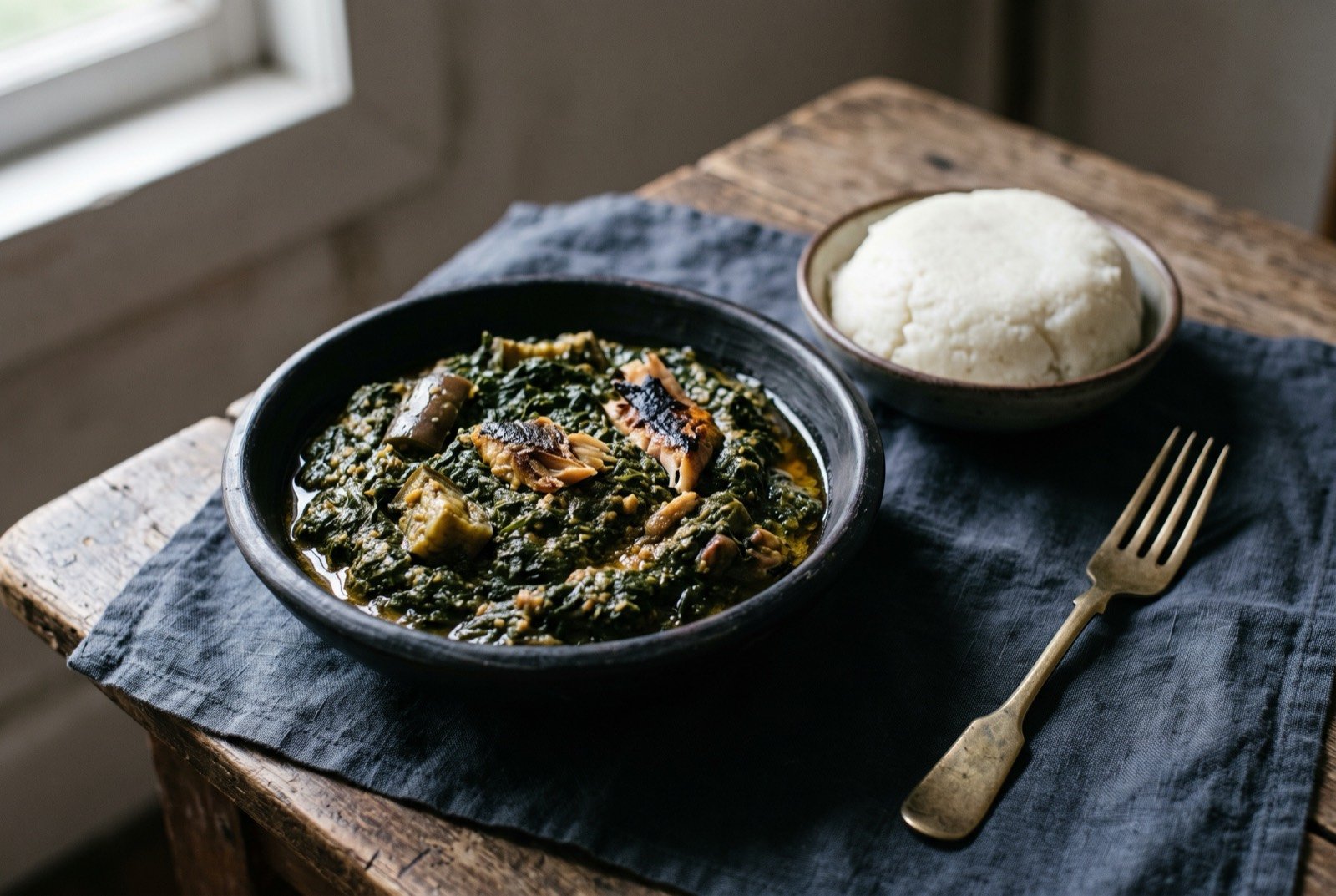
An illustration of the dish, not a photograph of it cooked.
- Time
- 1 hour 30
- Reviewed
- Not yet reviewed from inside the tradition
- Cooked
- Not yet cooked and reported
Isombe is not chopped greens and the pounding is not a texture step. It is a chemical operation and this chapter is going to state the mechanism plainly, because getting it wrong is dangerous rather than disappointing. Cassava leaves contain the cyanogenic glucosides linamarin and lotaustralin, and they also contain linamarase, the enzyme that hydrolyses them. The two are held in separate cellular compartments. Pounding ruptures those compartments and brings enzyme and substrate together, so the glucosides break down to hydrogen cyanide, which is then driven off by boiling. Current traditional practice, as characterised in the food chemistry literature, is pounding in a mortar for a minimum of 10 minutes until the leaves are well macerated, followed by proper boiling. So: cassava leaves that have been briefly chopped, or blitzed and simmered for ten minutes, are not safe food. Pound, then boil properly. Commercially frozen ground pondu has already been pounded, which handles the first half of the protocol, but it still needs a genuinely long simmer and not a warm-through. The exact figures for cooking times and percentage cyanogen removal are not printed in this chapter, and the reason is given at the end. The dish itself is region-wide: pounded cassava leaves cooked with aubergine, often with dried fish, and finished either with groundnut paste on the plateau or with red palm oil on the Burundian lakeshore. It is eaten with ubugali, rice or plantain, and it is one of the two ceremonial dishes of the revived umuganura.
As tradition built it
Serves 6. About 1 hour 30.
Ingredients
- 500 g cassava leaves, or one 500 g pouch of frozen finely ground pondu
- 2 aubergines, or 6 small bitter ntula, chopped
- 60 g dried small fish, or 100 g smoked fish, soaked
- 2 onions, sliced
- 3 tomatoes
- 150 g groundnut paste, or 3 tbsp red palm oil for the lakeshore version
- 1 leek, sliced, which is the Rwandan Belgian residue and is genuinely used
- to taste salt
- to cover water to cover
Method
- If starting from fresh leaves: pound them in a mortar for at least 10 minutes, with the chopped aubergine, until thoroughly macerated. If starting from frozen ground pondu, thaw it and proceed.
- Put the leaves in a pot with water to cover, bring to the boil, and simmer at least 45 minutes, uncovered for the first 20 so that volatiles leave the pan.
- Add the onion, tomato, leek and the soaked fish, and continue to simmer.
- Stir in the groundnut paste, slaked first with a little of the liquor, or the palm oil, and cook a further 20 minutes until it thickens and the fat shows.
- Salt at the end.
What a modern chef changes
A longer, safer cook that does not taste overcooked, and the acid and the colour put back
Rungs 3, 5 and 6
Method
- Do not shorten the boil. Shorten what the boil destroys. The safety requirement is a genuinely long cook and it is non-negotiable. What you can control is everything you add afterwards. Cook the leaf hard and long on its own with nothing but water, then build the rest of the dish around it in the last twenty minutes: onion, leek, tomato, fish and fat all go in late, so only the leaf takes the full punishment.
- Add the groundnut paste unfried and late. Rung 3. Isombe is a bitter, tannic, faintly gluey green, and the sweet milky note of an unroasted groundnut sauce is what balances it. Frying the paste first makes the dish taste of roasted nut over bitterness, which is two strong flavours arguing.
- Put the acid in at the table, not the pot. Rung 5. A spoonful of ikivuguto or thick cultured buttermilk beside the isombe does what a squeeze of lemon cannot: lactic acid is non-volatile and buffered, so it lifts the bitterness without flashing off and without turning the plate sour. This is a Rwandan habit and it is right.
- Char the vessel. Rung 6. Isombe carries a fat phase, and a fat phase is what smoke phenolics transfer into. Twenty minutes in a charred earthenware bowl before service does more for this dish than any amount of extra seasoning.