Central Africa · Volume 08, The Forest Larder
Poulet à la moambe
DR Congo, Kongo and Lingala worlds
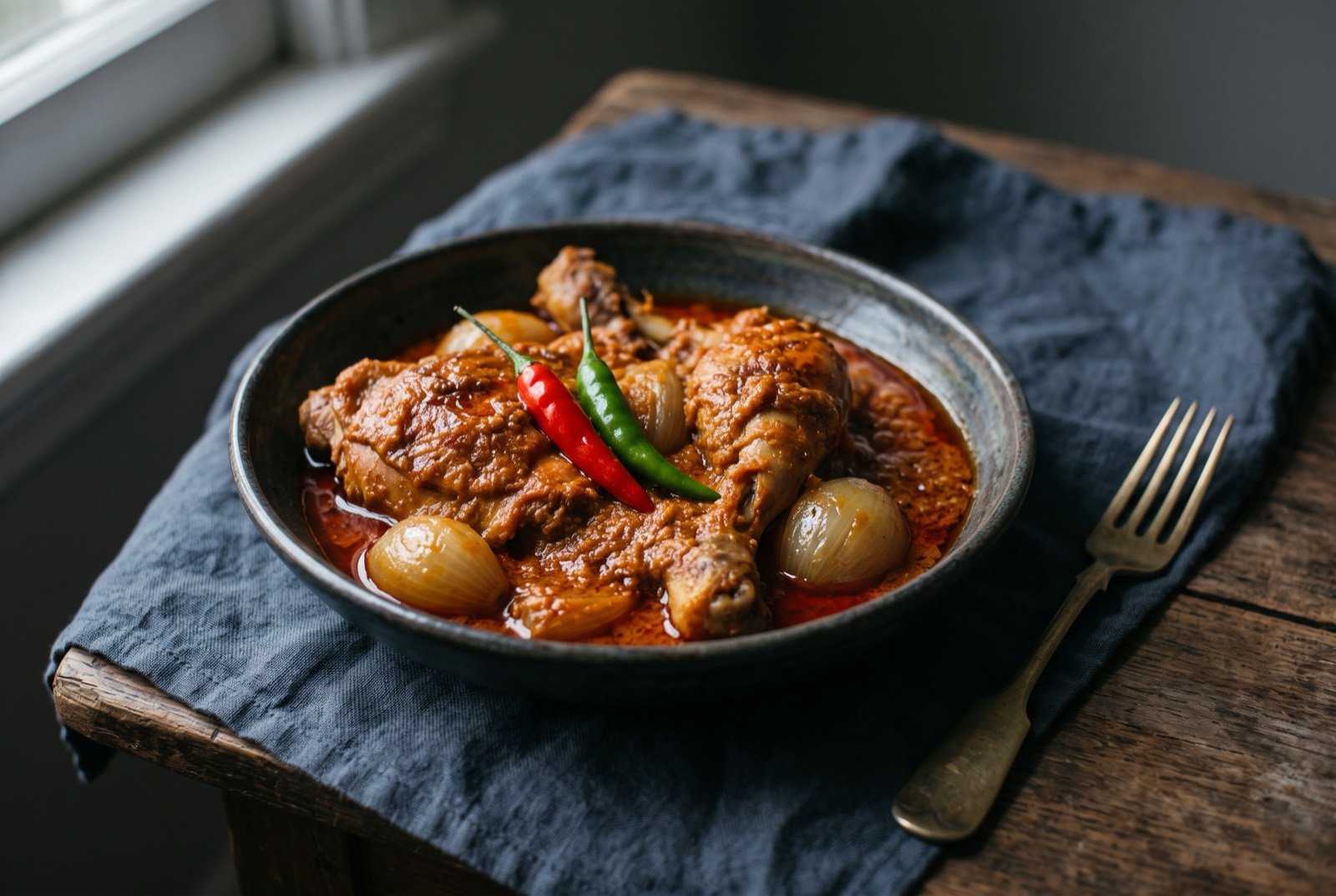
Illustration
- Time
- 2 hours 30
- Researched
- Researched from 103 sources in the brief
- Reviewed
- Awaiting a reader from inside the tradition
- Cooked
- Awaiting a cook report
Usually named as the national dish of the DRC, though nobody has produced an official instrument saying so, and Angola and Gabon make parallel claims for muamba de galinha and nyembwe. All three are right, because it is one technique. What to hold onto is Rung 4: this is a fruit pulp emulsion, and the whole dish is a decision about when to let it break.
As tradition built it
Serves 6. About 2 hours 30 from fresh nuts, about 1 hour from a tin.
Ingredients
- 10 kg fresh palm nuts, for about 5 L of juice, or 800 g tinned palm nut pulp
- 1.5 kg chicken, jointed
- 2 onions, quartered
- 1 tbsp garlic, crushed
- 2 bay leaves
- 2 whole chillies, left unpierced
- to taste salt
Method
- From fresh palm nuts: boil them about 1 hour, until the pulp gives. Pound in a large wooden mortar until skin and fibre separate from the nut. Add hot water, crush by hand to release the juice, sieve out fibre and nut fragments. From a tin: dilute in warm water to a loose cream.
- Reduce to 70 to 80 per cent of the starting volume, uncovered. From a tin this takes 30 to 40 minutes.
- Skim the surface oil as it rises and reserve it. In the Tabuku household that oil went to the cassava leaves. Nothing here is wasted.
- Add the quartered onions, garlic and bay leaves.
- Fry the chicken separately until coloured, return it to the sauce and simmer only 10 to 15 minutes. That short time is stated as deliberate: longer and the meat breaks up into the sauce.
- Add the whole chillies, left unpierced, for the last few minutes. Salt.
Notes
After the method of Jean Tabuku, described as a family chef of three generations in Kinshasa, who works from fresh nuts.
The success marker is not negotiable: a distinct layer of red-orange oil standing clear on the surface. No oil, not finished. Oil separated forty minutes ago and still boiling, gone too far. Serve with rice, pondu, fufu or plantain, and pili pili on the table.
What a modern chef changes
Smoked fish stock as the liquid, the break held back, the oil re-married at the pass
Rungs 3, 4 and 5
Method
- Build a smoked fish and dried shrimp infusion and use it instead of water. 200 g smoked catfish and 30 g dried shrimp held at 70°C for 40 minutes, never boiling, strained, chilled, the fat lifted off, reduced by a third. Rung 3, and the largest single improvement available here.
- Stop short of the break and hold the parts apart. Take the sauce to the point where the surface has just begun to show oil eyes, then off the heat. Skim what has risen into a jug and keep it warm but separate. From that moment no further carotene is being destroyed.
- Warm a second spoonful of raw red palm oil to 60°C at the pass and flood the surface. The same visual endpoint the tradition asks for, reached with control instead of hope, and the aroma arrives at the nose at serving temperature.
- Serve it with kwanga rather than rice. Rung 5: rice contributes nothing to the acid axis, and a loaf at pH 3.8 against a rich palm emulsion is the plate seasoning itself.