Africa · Volume 08
Gabon, Congo & the Congo Basin
The Forest Larder
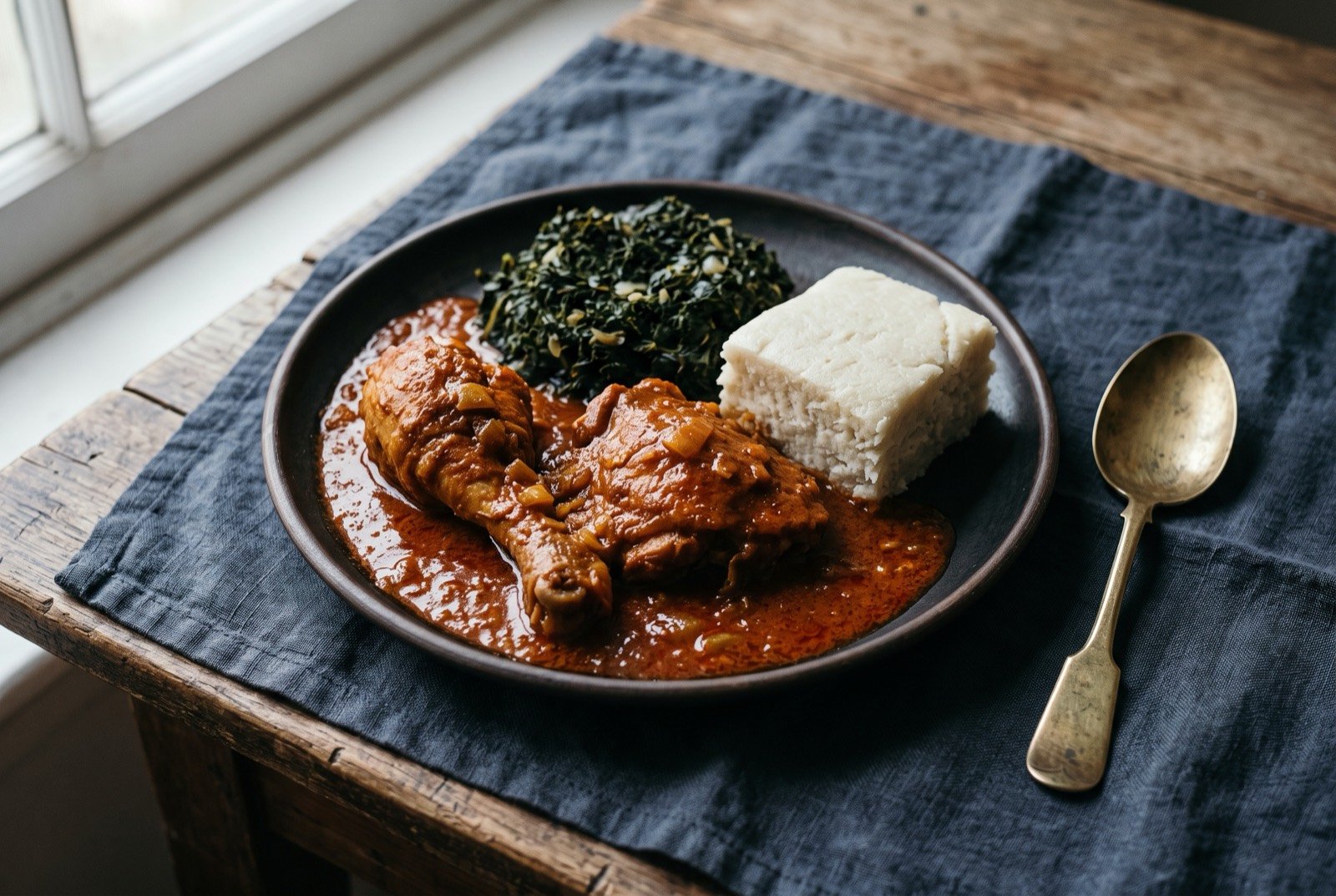
Gabon, the two Congos and the forest basin they share, taken seriously. The traditional canon as it is actually cooked, a technique ladder built from the inside rather than borrowed, and every dish as tradition built it, then what a modern chef would change.
Sources and review · What this chapter does not assert · How we research · Know this better? Tell us
A Sense of Place
Three states, one river system, and a cuisine best understood as a set of arguments about what to do with a poisonous root and a fatty fruit.
The previous seven volumes moved along a coast. This one turns inland and stops moving along anything except water. Gabon, the Republic of Congo and the Democratic Republic of Congo are not three national cuisines, and they are not one either. They are four or five culinary worlds organised by four variables: which fat (red palm oil, palm nut cream, groundnut, odika), which thickener (pounded cassava leaf, groundnut paste, cucurbit seed, the odika block, okra), which starch (the fermented cassava loaf, cassava or maize fufu, plantain, rice), and which protein logic (river fish smoked or salted, forest game, insects, goat, imported salt cod). Borders are the least useful of those variables. The river is the most useful.
The Kongo world
Kongo Central, the Kinshasa hinterland, Cabinda and northern Angola, in a forest-savanna mosaic on heavy cassava. The fat is red palm oil plus palm nut cream, mwamba; the thickeners are pounded cassava leaf and groundnut paste. The starch that defines the region is chikwangue, kwanga in Lingala and kikwaga in Kikongo, a retted, double-cooked, leaf-wrapped cassava loaf that is the most technique-dense object in this volume. Signature dishes: poulet à la moambe, pondu, chikwangue, madesu, makayabu. This is Kinshasa's world, and Kinshasa is where the British diaspora comes from.
The Lingala river world
The Congo mainstem and its great tributaries, the Ubangi, the Sangha and the Kasai, with Kinshasa and Brazzaville as terminals. Mongo, Ngombe, Ntomba, Nunu, Mbochi and Likouba peoples. The river is larder and highway at once, and the defining technique is not a sauce but a package: liboke, plural maboke, the leaf packet. The thickener is often no thickener at all, because a sealed packet concentrates its own liquor.
A British cook who thinks "smoked fish" thinks of one thing; this world thinks of twenty-two. In Kinshasa's Liberté and Gambela markets the smoked trade is dominated by Parachanna species at 27.6 per cent, Protopterus dolloi, lungfish, at 26.3 per cent, Clarias catfishes at 19.4 per cent and Channallabes apus at 19.1 per cent. The Lingala names are in daily use: ngolo, senga and libongo for the clariid catfishes, kongoyasika for arowana, ndjombo for lungfish, mboto for Distichodus.
The Teke plateau and the Luba south
Sandy plateau savanna runs through Congo-Brazzaville's Plateaux, the Kinshasa hinterland and Kwango: cassava dominant, palm wine everywhere. Teke chikwangue is a recognised type rather than a local accident, and the Teke are also one of four peoples central to odika production over in Gabon, which tells you the plateau is a corridor and not a periphery. Grand Kasai and the Katanga fringe run on maize as well as cassava, with nshima in Luba and bidia in Lulua, stiffer and more southern African than Kinshasa fufu, thickened with groundnut paste and squash seed. Insects are not marginal here: dikelele, crickets, and caterpillars in groundnut sauce are ordinary Kasai recipes. And the cassava leaf is not pondu. It is matamba, in Tshiluba.
The Gabonese forest
Gabon is 89 per cent forest, 238,770 square kilometres of it, at roughly four people per square kilometre. It is the emptiest country in this volume and has the most distinct larder: palm nut cream, called nyembwe rather than moambe, and odika, the solid Irvingia block, which is a fat as much as a thickener.
The Gabonese food map is provincial, and it is really a map of technique. Haut-Ogooué, Obamba and Teke: nguya, wild boar in odika, and evoura tcha ndimba, caterpillars in odika. Ngounié, Punu: koku mu teri, cockerel in squash seed sauce. Ogooué-Ivindo, Kota: soukouté, pounded cassava leaf with fresh fish and crushed raw peanuts. Woleu-Ntem, Fang: mezack e nkou, cassava leaves with peanuts, palm nuts and shrimp. Ogooué-Maritime: ngomba g'odika, porcupine in odika.
Here is the shortest proof that "cassava leaf stew" is not one dish. The same source lists the leaf preparations by language, mayagha in Nzebi, tsara in Nyanga, ekoa in Kota, mezack e nkou in Fang, and then states flatly that the Fang add sugar and palm oil, the Bakota cook them in banana leaves, and the Bapunu use palm or peanut oil. One leaf, one country, four incompatible recipes.
The river as a food highway
This is the geographic argument, and the numbers make it properly.
Brazzaville's markets are supplied by fish moving up to 1,000 kilometres downriver. In a December 2012 survey of four Brazzaville markets, 474 of 905 animal protein vending slots were freshwater fish, 52.4 per cent; of those, smoked fish held 345 slots, fresh 120, salted and dried nine. Now the prices per kilogramme, in FCFA: fresh 3,958, smoked 7,328, salted and dried 4,059.
The standard Western assumption collapses at that point. Smoked fish is not a poor substitute for fresh. It is the dominant product and it costs nearly twice as much. In household diaries smoked fish made up 59.3 per cent of freshwater fish meals and fresh only 6.7 per cent. In this cuisine, smoke is a flavour people pay a premium for.
Smoking happens at the fishing camps, for months-long preservation, then moves to the cities with agricultural produce. Of the Brazzaville smoked fish vendors interviewed, 91.2 per cent bought on credit from middlemen, averaging 2.58 trading partners each, and those relationships tracked ethnic origin in the producing areas: Mbochi, Teke, Moye, Gongulu. That is a nineteenth century commercial system with mobile phones. Robert Harms's River of Wealth, River of Sorrow is the standard account of the mainstem as a trading network in the era of the slave and ivory trades, including the fishing peoples of the Nunu and the fish-for-cassava exchange between river and bank.
Two capitals, facing each other
The Kinshasa eating day is one substantial meal around five in the afternoon, after a morning of sweet milk tea and a baguette with margarine. The malewa, an informal stall run by a housewife, fills the gap with a plate of rice or chikwangue with pondu and fish at minimal cost; the nganda, grilled meat and beer, fills the evening. Both are products of the Zairean collapse and the culture of Article 15, débrouillez-vous. The informal sector did not supplement the food economy here. It became it. In Brazzaville, Kolia Express sells saka-saka at about 2,000 FCFA against 5,000 to 8,000 FCFA for a burger and chips, on short local supply chains: a fast food format being colonised from inside by the local canon rather than displacing it.
The History in Layers
The indigenous foundation, which is the oil palm
Archaeobotany from three Inner Congo Basin sites, Iyonda, Mbandaka and Bolondo, across 82 flotation and 68 phytolith samples spanning roughly 400 BC to AD 2000, found Early Iron Age assemblages, about 400 BC to AD 650, of pearl millet, cowpea, oil palm, Canarium schweinfurthii and possible yams, all of West African savanna and forest-savanna origin. Pearl millet from Iyonda dates to about 420 BC to AD 140, Canarium endocarps to 430 to 1 BC, contemporary with the earliest regional pottery.
So the oil palm is not an ingredient the Congo Basin adopted. It is the ingredient the Congo Basin was built around, in the diet from the first Iron Age settlements and standing in the record next to the pottery. Linguistic work agrees: Bantu names for pioneer trees, Elaeis guineensis, Canarium schweinfurthii and Musanga cecropioides, have been used to argue that vegetation dynamics drove the Bantu Expansion itself. Jan Vansina's Paths in the Rainforests remains the standing framework. One result complicates the story: banana phytoliths appear only after AD 1400 at these sites, against a widespread assumption of much earlier arrival. It is one site cluster and this chapter does not print it as settled.
The Columbian Exchange and the cassava revolution
Cassava, maize, groundnuts, chilli and the American cucurbits all arrive on Portuguese ships. The date usually given for cassava here is 1558, and this chapter does not use it; what is safe is that cassava was established by the late sixteenth or early seventeenth century, and that by 1959 it occupied about 22 per cent of DRC cultivated land.
The structure of the takeover matters more than the date. Cassava arrived carrying a toxicity problem, and the answer was not a recipe but a whole technology: retting, drying, double cooking, and the leaf treated as a vegetable in its own right. Chikwangue is a New World root processed by an African fermentation logic that predates it, which is the argument Volume Four made about maize on the Ewe and Fon coast. The Americas supplied the plants; Africa supplied the cooking, and this is the most extreme case, because cassava is the only one of those plants that will hurt you if the cooking is wrong.
Then the part nobody expected. The DRC leads the world in eating cassava leaves as a vegetable, and per capita cassava consumption there is the world record at about 353 kg a year, equivalent to 145 kg as flour. Pondu, not the root, is the culturally weighted dish: a plant was imported for its tuber and the region decided its foliage was the better food. Groundnut arrived on the same ships and became the second great thickener, in places substituting so completely for palm cream that one word, mwamba, covers both. The Portuguese also brought salt cod, and Congolese heritage writing treats makayabu as a Lusitanian inheritance that became a Congolese identity. Today's makayabu is Norwegian.
The colonial layer, and it is the worst in this book
Volume Four's colonial story was a prohibition on palm spirit driven by a 91 per cent collapse in oil prices: revenue protection dressed as conservation, ugly in an ordinary administrative way. This one is not ordinary.
The Congo Free State existed from 1885 to 1908 as the personal property of Leopold II of Belgium, not as a Belgian colony, and was run as an extraction operation on wild rubber and ivory. The system was quota based, enforced by armed auxiliaries against villages, with hostage taking, mutilation and killing as instruments of collection. The severing of hands, taken as proof that ammunition had been spent on people rather than game, is the detail that reached Europe and is why the system ended: Roger Casement's consular report of 1904 and the Congo Reform Association's campaign forced Belgium to annex the territory from its own king in 1908. The demographic cost is enormous and genuinely contested, and this chapter prints no number.
Where this touches food, and it does, is in what the rubber quota did to subsistence. Wild rubber is a forest vine. Collecting it to a quota meant men absent from fishing, hunting and clearing for long periods, at exactly the moment when cassava needed the labour of processing. A staple requiring days of retting, pounding, drying and double cooking assumes a working household. Remove the labour and you do not just get hunger, you get shortcuts, and the shortcuts in cassava processing are the ones that poison people. That is why this chapter treats retting time as a moral question as well as a technical one.
Then the palm. Huileries du Congo Belge was founded by William Lever to exploit Congolese palm under agreement with the Belgian colonial state. Leverville, now Lusanga, was founded in 1911 at the confluence of the Kwilu and the Kwenge, racially segregated by design with a cordon sanitaire between European managers and Congolese workers' housing. Yangambi, the INEAC research station, was established in 1933, eventually covering nearly 25,000 hectares with over 10,000 employees. When the 1964 Simba rebellion forced European technicians out, it lay largely idle for two decades, because Congolese personnel had been deliberately underused and nobody was trained to run it. Unilever abandoned the sites in the 1990s, and Jules Marchal's Lord Leverhulme's Ghosts is the documentary account.
Hold both facts at once. The oil that makes moambe orange and gives nyembwe its apricot and violet aroma is the oldest food in the region, in the ground with the first pottery. It is also the commodity that funded Sunlight soap, extracted under a labour regime Marchal documents in detail. Neither story cancels the other, and a cook who knows only the first is not really cooking this food.
Twentieth century ruptures
Konzo, an irreversible spastic paraparesis caused by cyanide exposure from insufficiently processed bitter cassava, was first described by Trolli in 1938 in Kwango, and it is not history. In three villages in Boko Health Zone, Bandundu, prevalence was measured at 2.5, 4.1 and 7.5 per cent: 4.6 per cent combined, 61 cases among 1,315 residents. There, roots were soaked in river hollows for two nights or less and dried for one to two days, against a recommended three to four, and the flour carried a mean cyanide content of 50 ppm. That is the shortcut, driven by drought, labour scarcity and hunger, and it is why the technical sections of this chapter are written the way they are. Separately, Cassava Bacterial Blight in the early 1970s caused total crop failure and famine in parts of the DRC, and insect consumption rose from the late 1970s as bushmeat became scarcer: caterpillars and palm weevil larvae are old foods whose share of the plate grew for modern reasons.
The bushmeat question, handled straight
Gabon is the best documented case, at roughly 15,236 tonnes a year in 2005, and the split is the interesting part: urban consumption about 4.75 kg a person a year against rural 47.45 kg, with rural people at 15 per cent of the population accounting for about 63 per cent of consumption.
The species matter, because the popular image is wrong. From 81,041 market observations in 2002 the most traded were brush-tailed porcupine, 21,963 individuals; blue duiker, 21,334; bay duiker, 7,809; Peters's duiker, 5,353. Not primates, and around 70 per cent of hunted mammal species in the region are not IUCN-threatened. The price signal runs against assumption too: large rodents sell at around 10,000 FCFA while beef is 1,300 FCFA per kilogramme. Bushmeat is more expensive than beef, and in Pointe-Noire interviewees described it as a status good and as obligatory when honouring important guests. Congo-Brazzaville operates a closed season from 1 November to 30 April.
So it is a rural protein base and an urban luxury simultaneously. The urban trade is the conservation problem; the rural consumption is the food security fact. It is not a cuisine of monkeys. It is a cuisine of duiker and porcupine, in odika sauce or a leaf packet. And what is displacing it in Kinshasa is not chicken. It is caterpillars, mushrooms, palm weevil larvae and salt cod from Norway.
The modern moment
Zaire, in Kinshasa, opened 2025, owned by Noushka Teixeira with Samuel Bobo as head chef, serves ravioli of kilebu, ballotine of sole in safou butter, yam gratin and caterpillar sauce. Teixeira's sentence is the political argument of this volume: "We Africans have a tendency to tell ourselves that everything foreign is better, but that's because we've never bothered to truly exalt our own products." Archi Dimosi, 34 and self-taught, plates a vol-au-vent with sweet potato pastry and mbinzo sauce, and notes that Congolese culinary schools "mostly teach how to make Western dishes." Across the Pool, Madzou Moukassa won the World Cooking Championship in Saint Petersburg in March 2024 with chicken à la muambe, against 300 competitors.
Safou butter and caterpillar sauce on a fine dining plate is the closing image of this chapter. The same two ingredients that anchor the village table, treated with French technique by Congolese cooks in Kinshasa, not by Europeans and not in Europe.
The Flavour Arsenal
If you buy nothing else, buy unrefined red palm oil, frozen ground cassava leaf and a tin of palm nut pulp. Those three decide more than everything else combined.
The palm, which is four separate ingredients
| Product | Names | What it is | How to use it |
|---|---|---|---|
| Red palm oil | mafuta ya mbila (Lingala), ngazi | Expressed mesocarp oil, heavily carotenoid | Everyday fat, but treat the last spoonful as a finishing condiment |
| Palm nut cream | mwamba, moambe (Lingala, Kikongo), nyembwe (Myene), muamba (Angola) | Whole mesocarp pulp in water, a fat-and-fibre emulsion, not an oil | The base of the region's most famous sauce |
| Palm wine | tutu (Gabon), vin de palme | Fermented sap | Drunk, not cooked with |
| Palm weevil larvae | mpose (Lingala) | Larvae from felled palms | Fried with chilli over charcoal, sold at Marché Liberté |
The second row is the one that matters. Moambe is not palm oil. It is the pulped flesh of the palm fruit suspended in water, and it behaves like a nut butter emulsion, not like a fat. Getting that wrong is why British attempts taste like an oily chicken stew rather than a sauce.
Cassava, which is two ingredients with opposite chemistry
| Form | Names | Character | Use |
|---|---|---|---|
| Leaf | pondu, mpondu (Lingala), saka-saka, matamba (Tshiluba), mayagha (Nzebi), ekoa (Kota) | Fibrous, faintly bitter, deep green | Pounded to a mash, cooked long, enriched with palm oil and groundnut |
| Retted loaf | chikwangue, kwanga, kikwaga, bobolo, miondo, agnizock (Fang), pita | Sour, elastic, set, sliceable, around pH 3.8 | The acid counterweight on the plate |
| Flour and fufu | luku, fufu, cossettes | Bland, absorbent | The vehicle |
One is a green vegetable eaten in enormous quantity: a Kinshasa household of seven or eight eats roughly 4 kg of cassava leaves a week, and cassava leaves rank first among leafy vegetables across every socio-economic group in the DRC. The other is a multi-day fermented starch gel. They share a plant and nothing else.
The forest thickeners and greens
Odika (Irvingia gabonensis, and the bitter I. wombolu) is the ingredient that will make a British cook realise this is not a variant of West African cooking. Gabonese names: odika, pain d'odika, ndok, ndimba, andok in Fang. Kernels are sun-dried a few days, grilled, then crushed in a mortar to a paste that solidifies into storage blocks; to cook, you scrape powder off the block and warm it until it melts. Why it sets like chocolate: Irvingia kernels are extremely high in fat, largely myristic and lauric acids, solid at ambient temperature, so "wild chocolate" describes behaviour and mouthfeel, not flavour.
And here is the contrast this volume exists to draw. Volume Three used the same genus as ogbono, ground to a powder and used as a slime thickener in a draw soup. Gabon uses it as a melting fat and flavour base, in a block that keeps about a year while the made sauce keeps three to four days. Same seed, completely different technology. The producing communities named by Slow Food are the Bapunu, Mitsogo, Vili and Teke.
Fumbwa (Gnetum africanum) is a gymnosperm liana, related to conifers rather than to any leafy vegetable a British cook has met: fumbwa in the DRC, koko in Congo-Brazzaville, nkumu in Gabon, eru in Cameroon, afang in Nigeria. Mildly bitter, extremely tough, always cut to a chiffonade of threads. The number that dictates the technique: 36.7 per cent crude fibre on the analysed sample, against 16.6 per cent protein. That is not a leaf, that is a rope. Roughly 80 per cent of the trade is handled by rural women, and it is wild harvested and under real pressure.
Mbika is a category, not a species: pumpkin, melon and other cucurbit seeds, roasted and ground. Ngai ngai is roselle leaf, Hibiscus sabdariffa, the acid axis of the cuisine, classically paired with tomson, horse mackerel; note that this is the leaf, not the calyx, and hibiscus tea is not a substitute. Bitter African aubergines are standard in the Brazzaville formulation of pondu.
The aromatics, and the preserved proteins
Bush garlic, Scorodophloeus zenkeri, is the one to seek out: bark and seed rich in sulphur compounds, doing a garlic-like job with a resinous edge garlic does not have. Gabonese nutmeg, Monodora myristica, is the calabash nutmeg Volume Four called pèbè, and maniguette, Aframomum melegueta, runs through the whole region. A Gabonese inventory also lists ofula, an indigenous salt, lantsourou, an indigenous stock cube, mufire, a Gabonese garlic, and andou, a chilli powder; all from a single source, none cross-checked, so this chapter names them and asserts nothing.
Pili pili is both the bird's eye chilli and the condiment made from it: 500 g of chillies, three onions, three garlic cloves and 150 ml of groundnut oil, with a fried version, pili pili ya kukaanga, as the other format. The discipline is the interesting part, and Alexandre Mazzia, who grew up in Pointe-Noire and runs 45 chilli varieties in a three star kitchen in Marseille, states it best: chilli as a set of distinct flavours layered two or three at a time, not one heat level dialled up.
Makayabu, salted dried cod or saithe, has astonishing economics. The Republic of Congo imported approximately 11,234 tonnes in 2024 for 6.7 million people; the DRC imported about 1,540 tonnes for over 100 million. That gap is DRC taxation and consequent smuggling, not appetite, and a September 2024 decree classified salted fish as an essential product for reduced taxation. Ndakala are small dried fish, nicknamed "the thousand fish". Mbinzo are caterpillars, largely emperor moth species, and dikelele are crickets; both are ordinary market goods in Kinshasa and both now appear on fine dining menus there.
Part Two
The Technique Ladder
First, an honest problem
Volume Three could hang its elevations off Ikoyi and Akoko. Volume Four could hang them off nothing, and said so. This volume sits in an odd third position, and the temptation to blur it is strong.
There is a three Michelin star chef whose palate was built in the Congo Basin. Alexandre Mazzia was born in 1976 in Pointe-Noire and spent his first fourteen or fifteen years there while his father worked as a timber trader. AM par Alexandre Mazzia in Marseille took one star in January 2015, two in January 2019 and three in January 2021. He serves 44 small courses over two hours, and his stated vocabulary is three words: spices, smoke, chilli, traced back to a child on the beach at Pointe-Noire watching fishermen grill the catch. He does not run a Congolese restaurant. He runs a Congo-formed one, and this chapter will not collapse the distinction. What transfers is technique: smoking over vine shoots, beech and olive wood; ferments held in oil or brine; dried and powdered ingredients everywhere; cassava as a crisp and a coating.
There is a chef cooking Kinshasa consciously and technically, and he has no star. Hugues Mbenda, born in Kinshasa, trained at Apicius and Taillevent, runs Kin in Marseille. Michelin Guide listed, no star; Gault et Millau 13 out of 20. His line should sit at the head of this chapter: "Je ne fais pas une cuisine africaine, mais une cuisine de création." I do not cook African cuisine, I cook a cuisine of creation.
His plates are the models to study. Cassava chips with burnt onion cream, char against starch. Okra tempura, which is the right answer to mucilage, because a high heat dry batter sets the exterior before the pectin-rich interior can weep. Cassava risotto, the root treated as a grain and agitated for starch release. And the one to study hardest: roast fish with a spinach coulis infused with smoked fish, and plantain gnocchi, which is pondu logic taken apart into green, smoke and starch and reassembled.
And there is a Congolese-born chef who cannot hold a star because no guide covers his country. Dieuveil Malonga, born in Linzolo near Brazzaville and raised by a grandmother who ran a roadside restaurant, runs Meza Malonga in Kigali and Meza Lab in Musanze: a farm, a training centre and an explicit African spice and fermentation laboratory. The framing is what matters: fermentation as Bantu practice industrialised at restaurant scale, not as an imported Nordic idea. That is Paule Beke's argument from Volume Four, arriving independently by way of Rwanda.
In Britain there is very little. Joyce Kudia's Biléyi is the only Congolese-concept kitchen at credible modern-casual level that could be verified, and its trading status could not be confirmed. There is a Congolese retail street, West Green Road in Tottenham, and good diaspora restaurants on it. There is no British Kin.
So the ladder is built from mechanism, from Mbenda and Mazzia's technique, from the Kinshasa cohort, and from the francophone technical literature on cassava and palm, which is far better than anything in English on this region. Not one rung is a French or Nordic technique bolted on.
Rung 1. Cassava is two ingredients with opposite chemistry, not one starch
This is the rung everything else stands on, and the one British cooks get wrong before they have started.
Bitter cassava's toxin is linamarin, a cyanogenic glucoside, destroyed when the plant's own enzyme, linamarase, hydrolyses it. And linamarase is destroyed at about 72°C.
Read those two sentences again, because between them sits a trap that has crippled people. Boiling removes roughly 90 per cent of the free hydrogen cyanide within 15 minutes and denatures the enzyme before it can convert the bound glucoside. A vigorously boiled cassava product can smell safe, taste fine, test low for free cyanide, and still carry intact linamarin which is then hydrolysed in your gut.
The traditional answer is not heat. It is time at ambient temperature with the enzyme intact. Retting with water changes over three to five days removes about 98.6 per cent of total cyanide. The lactic ferment driving it, bikedi, runs lactic acid bacteria to 73.3 per cent of the flora, dominated by Lactobacillus coprophilus, and takes pH from 7.2 down to 3.8 over 96 hours, with cyanide falling from 414 to 93 ppm in that stage alone.
The modern applied version is the wetting method, out of Congolese and Australian collaboration. Put dry cassava flour in a bowl and mark the level on the inside. Add water with mixing until the level of the wet flour returns to the same mark. Stand it two hours in the sun or five in the shade, so hydrogen cyanide gas escapes. Then make fufu as usual. It is free, needs no equipment, and works because it gives the enzyme the hours boiling never allowed it.
What a cook does with this. The sour retted loaf and the sweet boiled root are not the same food and cannot be substituted. Buying a chilled or frozen kwanga is buying a completed multi-day ferment for about three pounds: the most technique-dense object in the cuisine and the cheapest thing in the shop. And do not attempt a retted cassava ferment at home on the strength of a paragraph. The failure mode is neurological and permanent, and a shop has already done it properly.
Rung 2. Pound the leaf, and then cook it long anyway
Two logics collide over pondu, and both are right about something.
The safety logic says the long cook is unnecessary. Boiling pounded cassava leaves removes all cyanogens in about ten minutes. Nothing about the two hour simmer is required for safety.
The nutritional logic says the long cook is expensive. Boiling pounded leaves for 30 minutes reduces protein by 58 per cent and methionine by 71 per cent. There is a documented alternative, the mild method: pound, stand two hours in sun or five in shade, then wash three times. Residual total cyanide after each step, across four cultivars, runs 28 per cent, 12 per cent, 1 per cent, and the leaves keep their colour and texture.
And yet the long cook is not a mistake, because it was never about safety. It is about breaking down an extremely fibrous leaf so palm oil and groundnut can emulsify into it. Hemicellulose and pectin solubilise with time at temperature; lignified cell wall does not. You need both fine mechanical breakdown to shorten the fibre bundles and an extended cook.
Why pounding and not chopping, which is the question everybody asks. A blade cuts fibre into short, straight, abrasive lengths and leaves the cell walls on either side of the cut intact. A pestle crushes and bruises, rupturing cells across the whole mass without shortening the fibres into grit. The result is a pulp whose cells are open, so fat and water get in and cell contents get out, but whose fibre has not been reduced to sand. That is why pounded pondu goes velvety and processed pondu goes stringy at the same cooking time. The mortar is not nostalgia. It is a different physical operation.
The pounding also does the safety work, because rupturing cells is exactly what brings linamarin into contact with linamarase. Pound, rest, then cook: Rung 1 explains the sequence.
The ratio to work to: 1.2 kg of fresh or frozen leaves reduces to about 600 g of ready-pounded leaf. Urban Kinshasa buys it pre-pounded by the ball or the bag, and frozen ground leaf is produced for export, principally to the Congolese diaspora in Belgium. Buying it already ground is not a compromise. It is what Kinshasa does.
Rung 3. Extract the smoke, do not dump it
Smoked and dried river fish carry the umami load of the region: free glutamate concentrated by drying, plus nucleotides, plus phenolic smoke compounds.
Home and takeaway practice is to break a whole smoked fish into the pot at the start of a two hour cook. Three things follow, all bad. The fine aromatic phenolics volatilise off, because guaiacol, syringol and the cresols steam-strip out. The bones, skin and grit shed into the sauce. The partly oxidised fat emulsifies into it. You get harshness and no perfume, which is the flavour people wrongly conclude smoked fish has.
The glutamate, meanwhile, does not volatilise. The two things you want are on different timescales, so treating them as one ingredient guarantees losing one. Build a strained infusion, split it, and add half early for depth and half in the last two minutes for aroma. Mbenda's spinach coulis infused with smoked fish is that principle at restaurant level, and it is the biggest single improvement available to every green and every stew here.
A caveat stated plainly. Traditionally direct-smoked fish can carry elevated polycyclic aromatic hydrocarbons including benzo[a]pyrene, which is a further argument for controlled extraction and for buying from a UK importer subject to EU-derived limits. No UK-specific enforcement figure for African smoked fish was found in the research behind this chapter, so treat it as a general precaution, not a documented British incident.
Rung 4. Break the palm emulsion on purpose
If you cooked abenkwan in Volume Three or sauce graine in Volume Four, you already know this technique. Moambe, mwamba, nyembwe, muamba, abenkwan and sauce graine are one piece of engineering with six names. The Akan, the Baoulé, the Kongo, the Myene and the Angolans all arrived at the same operation: boil the palm fruit, pound to shear the oil-bearing cells from the fibre, extract into hot water, sieve out fibre and nut, reduce.
Three volumes, one technique, different aromatics. Volume Three ran it with kplo, smoked fish and okra; Volume Four with soumbara and crab; this one with bay, garlic and whole unpierced chillies, and in Gabon with sorrel and smoked chicken. The engineering is identical and the flavour is not, which is the point: the aromatics are the cuisine, the technique is the continent.
What it is. The cream comes from the mesocarp, the fruit pulp, not the kernel: a fat-and-fibre emulsion, not an oil. The pulp's insoluble fibre and protein stabilise it up to a point, beyond which coalescence wins and the oil separates. Boiling the fruit first is not optional, because it deactivates lipase, which otherwise raises free fatty acids fast and turns the pulp rancid, and it softens the mesocarp so pounding shears fibre from the oil-bearing cells.
The doneness cue, given identically by every credible source in the region, is visual: the sauce is finished when the red oil comes to the surface. That is a phase separation test, and it is the most transferable instruction in this chapter.
The elevation is a decision about when, not a new technique. The separated oil is where the carotenoids and the ripe violet and apricot aroma sit, because carotenoids are lipophilic. So stop short of the break, hold the sauce there, and finish the plate with a spoonful of separately warmed red palm oil. Volume Four made the same case from the carotene side: 59 per cent beta-carotene loss at 200°C over two hours against 15 per cent at 150°C.
And know what you are buying. Manual spindle presses recover about 55 per cent of available oil with 18 to 35 per cent lost to fibre; a powered screw press reaches 77 to 90 per cent. Domestic hand extraction sits at the low end, which is why 10 kg of fresh nuts buys only about 5 litres of sauce, and why a tin of good palm nut concentrate is a shortcut to a genuine ingredient rather than a compromise.
Rung 5. Run acid and alkalinity as deliberate opposing forces
Nobody outside the region is using this, and it is the most distinctive thing in the volume. The Congo Basin runs two fermentations of the same plant in opposite directions at the same time.
Bikedi, retted cassava root, the base of chikwangue and fufu, is lactic: lactic acid bacteria at 73.3 per cent of flora, Lactobacillus coprophilus dominant, pH falling from 7.2 to 3.8 over 96 hours.
Ntoba mbodi, fermented cassava leaves wrapped in papaya leaves for two to four days, is alkaline: dominated by Bacillus subtilis and Bacillus pumilus, flora shifting from 65 per cent lactic to 95.9 per cent non-lactic, pH rising from about 6.5 to 8.5. Cyanide falls from 1158 to 339.6 mg per kg in 48 hours, a 70.7 per cent reduction, and cooking takes the residue to zero within one minute.
A sour ferment and an ammoniated, natto-adjacent ferment, side by side in one kitchen, out of one plant. The region's preparations span pH 3.8 to pH 8.5, a four and a half unit range inside a single meal culture, and nobody in Britain is plating that contrast deliberately.
Why exploit it. Perceived saltiness and umami both rise as pH falls, and bitterness perception falls with them. Acid is a seasoning multiplier, not just a brightener. A pondu that tastes flat almost always needs lime or ngai ngai, not salt. Reaching for salt when the problem is acid is the commonest seasoning error in diaspora cooking of this region, and it is the error Volume Four diagnosed in flat attiéké. The chikwangue on the plate is itself carrying acid at pH 3.8, so the loaf is not a neutral vehicle, it is a seasoning component. Serve a rich moambe with rice and the plate has no acid axis at all. Serve it with kwanga and the plate seasons itself.
Rung 6. The leaf packet: a sealed vessel that is also the serving dish
Liboke is Lingala for packet, plural maboke, and the word names both technique and dish. It is the technical centrepiece of the river world and it deserves better than being filed under "en papillote".
What it is mechanically. A sealed steam vessel at atmospheric pressure. Nothing evaporates, so the fish poaches in its own liquor plus whatever water went in, the internal atmosphere sits at saturation, holding the contents at or just under 100°C and stopping the surface drying, and there is no reduction step because there was never any loss. That is Volume Four's sealed clay canari argument, and the difference is what the vessel is made of.
First, the leaf contributes. The cutin layer on a banana or Marantaceae leaf keeps the seal, and the leaf's own volatiles come off under heat and give a green, faintly tea-like aroma to the fish. The forest default across the basin is Marantaceae, Megaphrynium macrostachyum and Haumania liebrechtsiana; banana leaf is the urban default.
Second, and this has no European equivalent, the vessel is the plate. A liboke is not decanted. It arrives sealed, is opened at the table, and the packet holds the sauce. Kinshasa guides make the craft point explicitly: liboke "requires expertise to seal hermetically." A leaking packet is a failed dish, and it fails in a way an opened casserole cannot, because the loss is invisible until service.
The timing is genuinely contested. One Congolese cook gives 180°C for one hour to one hour thirty; another about 20 minutes at 200°C for the same named dish. Those are not reconcilable, and the difference is almost certainly packet mass and fish thickness. Specify by thickness, not by clock, and there is a method for it in dish five.
One thing that is not a rung but belongs here. Fufu, kwanga, pondu, moambe and rice are all soft, wet and warm, and traditional service is soft on soft. Both Mbenda and Mazzia put exactly one brittle element into every plate. Palate fatigue is driven substantially by textural monotony, and a crisp resets it between spoonfuls without changing the flavour argument.
Part Three
The Ferment and Preserve Bench
Four things worth making, all of them methods this cuisine already runs on.
1. Ntoba mbodi, the alkaline leaf ferment
The most interesting ferment in this volume and the one nobody outside the region has copied.
Cassava leaves are wrapped in papaya leaves and fermented two to four days. The flora shifts from 65 per cent lactic to 95.9 per cent non-lactic, dominated by Bacillus subtilis and Bacillus pumilus, and pH rises from about 6.5 to 8.5. Cyanide falls from 1158 to 339.6 mg per kg in 48 hours, a 70.7 per cent reduction, and cooking takes the residue to zero within one minute.
That is the same bacterial genus behind natto and behind the fermented locust bean of Volumes Three and Four. The Congo Basin runs a Bacillus ferment on a leaf while running a lactic ferment on the root of the same plant, in the same kitchen, in the same week.
A caution. The ferment alone is not a detoxification and the cooking step is not optional. Use frozen ground cassava leaf that has already been blanched, ferment it for flavour rather than for detoxification, cook it properly afterwards, and do not eat it raw at any stage.
2. The smoked fish extraction, kept permanently
Referenced in most of the elevations above, and the single technique that changes the most dishes.
200 g smoked catfish and 30 g dried shrimp or crayfish, covered with cold water, brought to 70°C and held there 40 minutes, never boiling. Strain through a chinois, then muslin. Chill, and lift the solidified fat off the top. Reduce by a third and freeze in ice cube trays. It keeps three months.
Why not boil it. The desirable smoke aromatics, guaiacol, syringol and the cresols, are volatile and steam-strip out of a boiling pot. The glutamate does not. Boiling therefore selects against exactly the compounds you wanted, and emulsifies the oxidised fat into the liquid. And dry the spent fish rather than binning it: a dehydrator at 60°C until brittle, then milled with dried chilli, gives the finishing dust used on the ntaba above.
3. Mikate, the yeasted fritter
The one live ferment here you can make on a Tuesday. 500 g of plain flour, 300 ml warm water, 7 g dried yeast, 50 g sugar, a pinch of salt. Activate the yeast in 3 to 4 tbsp of warm water at no more than 38°C for 10 minutes, until foamy. Mix to a soft, supple, slightly sticky dough and prove 1.5 to 2 hours until doubled. Shape into small balls with oiled hands or two spoons and fry at 170 to 180°C for 5 to 7 minutes, turning.
Fry them in palm oil, with cane sugar and vanilla in the dough, if you want the Kinshasa version rather than the French diaspora one. The palm oil does what it does everywhere in this cuisine, carrying colour and a fruity, faintly savoury note into a sweet thing. Eaten at breakfast and sold at the nganda.
4. Pili pili, in both formats
On the table at every meal in Kinshasa, and a preserve rather than a garnish. The raw format: 500 g of hot chillies, 3 onions, 3 garlic cloves and 150 ml of groundnut oil, blended coarse, keeping refrigerated under a film of oil for two weeks. The fried format, pili pili ya kukaanga: the same aromatics fried until the raw edge goes and the whole thing darkens, then cooled and jarred. Deeper, less bright, keeps longer.
Follow Mazzia's discipline rather than the ratio: two or three chillies of genuinely different character, a fruity scotch bonnet and a clean-cutting bird's eye at minimum, rather than 500 g of one thing. And buy whole dried chillies rather than ground powder from unbranded sources, because the same UK survey that found dye adulteration in palm oil also found it in chilli spices, where dye masks pigment loss from poor drying or fungal damage.
Sourcing in Britain
Verified August 2026. Where a supplier could not be confirmed, that is said rather than smoothed over.
The most serious warning in this chapter
Red palm oil is adulterated with Sudan dyes, it is documented, and it is UK-specific. In February 2019 the Food Standards Agency issued alert FSA-PRIN-20-2018: Surya Foods recalled Mother Africa Pure Red Palm Oil 2.0 litre, batch VT261017A, and Mother Africa Zomi Palm Oil 1.0 litre, batch VT 171117SZ, for containing Sudan IV, described as potentially genotoxic and possibly carcinogenic. A peer-reviewed survey of 30 palm oil samples found four brands positive for Sudan IV at 150 to 24,000 nanograms per millilitre. The quality marker that protects you: real red palm oil is opaque and turns paler orange when melted and diluted. A palm oil that stays translucent and uniformly pillar-box red at any dilution is a red flag.
It also goes off fast. Unrefined red palm oil has been measured at 8.3 to 14.5 per cent free fatty acids as oleic, against a 2 per cent EU ceiling for edible oils, with Rancimat induction times at 130°C of only 0.16 to 1.74 hours. Free fatty acids are pro-oxidants, so the fattiest, most traditional-tasting bottles go off fastest. Buy small, keep it dark and cool, use it within three months of opening, and discard anything that smells of crayons, old paint or putty.
Where to buy
- Niyis African Supermarket (niyis.co.uk), Reading. The strongest verified nationwide operator: next-day before 11am from £4.99, free over £120, ships frozen with ice packs, fresh leaves Wednesdays. Frozen pondu 500 g at £2.99, showing sold out when checked. The default recommendation.
- Duaba Afro Foods (duabaafrofoods.co.uk), London N15. The single most important link in this chapter: chikwangue, 400 g at £3.00, verified in stock, next-day dispatch, chilled delivery across the UK, eat within three to four days. It is the only verified UK source of ready-made fermented cassava loaf dispatching nationally. Also frozen pondu and smoked fish.
- 2Tees Foods (2teesfoods.co.uk), Andover: frozen pondu 500 g at £1.99. Gemini Foods (geminifoods.co.uk), East Tilbury: verified trading with a large frozen range, but UK-wide shipping is not stated on the site.
- Not nationwide: UK Afrifoods delivers to London only. Not confirmed: Alphanso Foods carries a "launching soon" banner, and Abiglobal Foods, Flourish African Mart, African Delight Foods, AZ African Food Store and Kennorest Trading have live-looking pages that were not individually verified.
West Green Road, N15, South Tottenham, is the Congolese street of Britain, and Eden Store at number 60 is named by Congolese cooks specifically for pre-made kwanga and fumbwa; Belle Congolaise at 105 is on the same road. Dried caterpillars turn up here and in Peckham, where Taste of Congo sits on the Old Kent Road, and Deluxe Manna on High Cross Road N17 carries ntaba as smoked lamb and kwanga. Outside London, Global African Ltd on Manchester's Moston Lane explicitly stocks West, East and Central African goods, which makes it the best single bet in the city for this chapter. No named African grocery could be verified in Cardiff or Sheffield, and the North East is genuinely underserved: order from Niyis or Duaba.
A structural note. Several of the best Central African online grocers, carrying frozen chikwangue and the full Congolese range, are Dutch and Belgian, because those countries have far larger Congolese populations, and post-Brexit they are not practical for frozen goods. That is not a gap in the research. It is why British readers work harder than Belgian ones.
The ranked list: what decides great from grim
- Red palm oil. Carries the aroma, colour and identity of the region, degrades fastest, and is the one thing here faked with a carcinogenic dye.
- Cassava leaf, frozen and properly ground. Dark green with mid-green flecking, no ice glaze. A grey-brown block has thawed and been refrozen; that is chlorophyll degrading to pheophytin and it will taste dull.
- Palm nut pulp concentrate. Ghana Fresh, Trofai, Praise. Palm fruit pulp and water and nothing else: thick enough to hold a spoon mark, dull terracotta, fibrous. Avoid "palm soup base" with added starch, salt, MSG or tomato.
- Smoked fish. Rigid, resonant when tapped, deeply bronzed, clean woodsmoke. Reject white bloom, a sour or ammoniacal note, or a soft tacky surface.
- Chikwangue. Dense, elastic, faintly sour, off-white to pale grey, in leaf. The sourness is the point, at around pH 3.8. A bland, sweet-smelling loaf has been under-fermented.
- Groundnut paste. 100 per cent roasted groundnuts, branded and sealed. The highest aflatoxin risk item here: of 85 artisanal Gambian samples, 9.4 per cent carried detectable aflatoxin B1, 5.9 per cent exceeded the EU limit and one hit 38.76 ppb, against an EU limit of 4 micrograms per kilogramme.
- Dried crayfish or shrimp. Whole, pale coral-pink, sweet and marine. Grey powder is old and stales everything it touches.
- Fumbwa. At 36.7 per cent crude fibre its whole character is texture. Dried should be dark green and brittle; yellowing means age.
- Salt cod. Thick loin pieces, white to pale ivory, firm. Great with 30 hours of soaking, inedible with three.
- Safou. Rare, unfakeable, and the one ingredient that proves this is a distinct cuisine rather than a West African variant. No UK supplier could be verified.
Then, briefly: pili pili and scotch bonnet, where one chilli against a considered blend of three is the gap between home and restaurant seasoning; plantain bought to a chosen ripeness, the same fruit at four stages being four ingredients; ngai ngai, the answer when a pondu tastes flat; cassava flour, never tapioca starch, which makes glue; and frozen banana leaf, the difference between a liboke and a foil parcel.
The kit that decides the rest: a heavy wooden mortar and pestle, for the reason in Rung 2; a chinois, because the smoke-extraction rung depends on straining an infusion clean; a dehydrator or an oven holding 50 to 60°C; frozen banana leaves, passed over a flame before folding; a charcoal grill or Big Green Egg, because Mazzia's palate came from an open fire on a Pointe-Noire beach; and, unfashionably, pH strips, because in a cuisine spanning pH 3.8 to 8.5 by design, reading where your sauce sits turns guesswork into technique.
Why the British takeaway version tastes the way it does
A business model problem, not a cuisine problem. Hot holding is the primary killer. UK guidance requires hot food held at 63°C or above, and four to eight hours at 63°C is a slow continuous extraction: volatile aromatics strip off, carotenoids degrade, greens over-soften past the point where structure returns anything, and chilli perception dulls as the fats absorb the capsaicinoids. Nothing in this cuisine is designed to be held. Pondu is genuinely better on day two, but reheated once, not held for eight hours.
Then economics, then substitution. The good ingredients are expensive against the ticket price a British African takeaway can command, and when the ticket cannot carry the ingredient the ingredient gets thinned: palm oil becomes coloured vegetable oil, palm nut pulp becomes peanut butter (which makes a legitimate different dish, muamba nsusu, and not moambe), smoked fish becomes stock cubes, and cassava leaf becomes frozen chopped spinach. That last substitution alone is the main reason British pondu tastes of nothing, because spinach has neither the fibre structure to survive a two hour cook nor the faint bitterness the dish is organised around. Ifeyinwa Frederick of Chuku's has made the structural point publicly: African food in Britain has occupied two tiers, cheap takeaway and community restaurant, with no third tier to fund proper sourcing.
And a note on the word "elevated". Adejoké Bakare of Chishuru has publicly rejected it for her own cooking, and this chapter respects that. The argument is not that this food needs rescuing. It is that hot-holding economics are destroying it in transit.
Voices and Sources
From inside the tradition
- Hugues Mbenda, Kin, Marseille. Born in Kinshasa, trained at Apicius and Taillevent. Michelin Guide listed, no star, Gault et Millau 13 out of 20. The most technically useful reference in this volume, because his dishes read as deconstructions of specific Congolese dishes rather than as generic fusion. His line: "Je ne fais pas une cuisine africaine, mais une cuisine de création."
- Alexandre Mazzia, AM par Alexandre Mazzia, Marseille. Born Pointe-Noire 1976, first fourteen or fifteen years in Congo, three stars since January 2021. Spices, smoke, chilli; forty-five chillies. He does not cook Congolese food, and he is the strongest available argument that a Congo Basin palate is a world-class starting point.
- Noushka Teixeira and Samuel Bobo, Zaire, Kinshasa, opened 2025. Ballotine of sole in safou butter, ravioli of kilebu, caterpillar sauce. Teixeira's sentence is the volume's thesis: "We Africans have a tendency to tell ourselves that everything foreign is better, but that's because we've never bothered to truly exalt our own products."
- Archi Dimosi, Kinshasa, 34, self-taught. Vol-au-vent with sweet potato pastry and mbinzo sauce. On the training gap: Congolese culinary schools "mostly teach how to make Western dishes."
- Madzou Moukassa, Brazzaville. Won the World Cooking Championship in Saint Petersburg in March 2024 with chicken à la muambe, against 300 competitors. Founder of 2M Services, a gastronomy institute with over 200 students.
- Dieuveil Malonga, born Linzolo near Brazzaville, now Meza Malonga in Kigali and Meza Lab in Musanze. His fermentation laboratory is framed as Bantu practice industrialised, not as a Nordic import, which is the argument Volume Four heard from Paule Beke.
- Jean Tabuku, Kinshasa, a family chef of three generations, the source of the 10 kg to 5 litres figure and of the instruction to return the chicken for only 10 to 15 minutes.
- Gisèle Mbeku, Congolese cook, whose liboke ya malangwa method is the one used here.
- Nadine Pembele, Congolese cook in the United States, on fumbwa and on what diaspora sourcing costs: real smoked catfish takes her two to three weeks to get.
- Anto Cocagne, Gabonese chef in Paris, author of Goûts d'Afrique and Mon Afrique, the most visible advocate in French media for nyembwe and odika. Her biographical detail could not be read directly.
- Joyce Kudia, Biléyi, the only Congolese-concept kitchen at modern-casual level verified in Britain. Her ntaba, slow-smoked then grilled, is the source of this chapter's two-stage goat. Her current trading status could not be confirmed.
The gap, named
No Gabonese equivalent of the Kinshasa modernist cohort could be verified in credible press. Named Libreville restaurants exist, including L'Odika and La Maison de l'Odika, named for the ingredient. A Gabonese chef movement with documented philosophy and documented technique does not appear in the sources reachable for this chapter.
Gabon has the most distinctive larder in this volume: odika, nyembwe, atanga, nkumu, a provincial map of cassava leaf preparations that differ by people rather than by border. It is also, on the evidence available, the least documented of the three national cuisines here in world food media. Which is precisely why this volume exists.
Things this chapter has deliberately not asserted
The section that makes the rest of it trustworthy.
- How many people died in the Congo Free State. The outline is not seriously disputed: from 1885 to 1908 the territory was Leopold II's personal property, run on rubber and ivory quotas enforced by armed auxiliaries, with hostage taking, mutilation and killing as instruments of collection, and Casement's 1904 report forced Belgian annexation in 1908. The figure most often quoted, around ten million, is an estimate derived from later population reconstructions and it is genuinely contested among historians. The briefs behind this chapter do not source it, and a food book has no business settling a demographic argument it cannot audit.
- That cassava reached the Congo Basin in 1558. Repeated everywhere, sourced nowhere reachable. The Portuguese reached Kongo in 1483 and Brazil in 1500, so a mid sixteenth century arrival is plausible, but a precise year for a plant introduction is a red flag. This chapter writes "by the late sixteenth or early seventeenth century".
- What "moambe" means. Three incompatible readings survive. One source states mwamba means peanut sauce or peanut butter in Lingala; another says that in western DRC mwambi or mwambe names the sauce of palm oil or peanuts; a Lingala dictionary entry for mwambe returns only the numeral eight. Laman's Dictionnaire kikongo-français of 1936 would probably settle it.
- That "nyembwe" means palm oil in Myene. Plausible, widely repeated, unconfirmed against any Myene lexicon.
- That odika is "the fruit of an acacia". A Gabonese encyclopaedia entry says so. Irvingia is Irvingiaceae, not Fabaceae. This is simply wrong and must not be reproduced. It is named here so a reader who meets it elsewhere knows to discard it.
- That safou has 1.5 times more fat than avocado. From a single unsourced travel guide. Reported pulp lipid content in Dacryodes edulis varies widely by provenance, which is the more interesting fact. The chapter says the flesh is very high in fat and gives no multiple.
- A canonical retting time for chikwangue. One field source says appreciably longer than three days, another citing 2016 work says up to fourteen, and konzo fieldwork records villages retting for two nights or less. The honest statement, and the one made here, is that retting time is the main quality variable and the main risk factor.
- A cooking time for liboke. One Congolese cook gives one hour to one hour thirty at 180°C, another about 20 minutes at 200°C for the same named dish. Not reconcilable, so the chapter specifies by thickness and core temperature.
- A boiling time for dried fumbwa. Five minutes in one account, twenty in another. Dried Gnetum varies enormously in age and toughness, so the chapter gives a texture endpoint rather than a clock.
- That bushmeat provides near 80 per cent of protein in Central Africa, or that six million tonnes are extracted annually from the Congo Basin. Both circulate from the same conservation organisation and both derive from extrapolations off small samples. The 80 per cent claim also sits oddly against the Brazzaville market data used here, where freshwater fish held 52.4 per cent of animal protein vending slots. The chapter uses the Gabonese per-capita figures and prints neither continental headline number.
- That mbinzo sells at 200 dollars a kilogramme in Kinshasa. One media figure. If accurate it prices caterpillars above almost all animal protein in the city, which needs a second source and does not have one.
- That moambe is the national dish of the DRC. Universally asserted, never with an official instrument behind it, and Angola and Gabon make parallel claims. This chapter writes "usually named as the national dish", which is defensible.
- That makayabu is a Portuguese inheritance, and that the word derives from bacalhau. Two Congolese heritage sources make the case and neither could be read directly, only their headlines. The etymology is neat enough to be suspicious for that reason.
- The Gabonese seasonings ofula, lantsourou, mufire, andou and "Elondje". All from one Gabonese encyclopaedia entry, none botanically cross-checked. Mufire is most likely Scorodophloeus zenkeri or Afrostyrax lepidophyllus, but that is inference. They are named here without botany.
- That bananas arrived in the Inner Congo Basin only after AD 1400. That is what the phytolith record from Iyonda, Mbandaka and Bolondo shows, and it contradicts the assumption of much earlier arrival. It is one site cluster, presented here as a recent result that complicates the standard story, not as a settled finding.
- A fresh-nut to sauce yield for palm. The 10 kg to 5 litres figure comes from a single Kinshasa household account, and no source states an equivalence between tinned pulp and fresh nuts. The tinned quantities used here bracket a working range by inference.
- That smoked chicken is what defines Gabonese nyembwe. Two Gabonese-facing sources specify it; Congolese moambe accounts use fresh bird. Whether smoking is the defining regional difference or one common option is unresolved.
- That the nganda began as fishermen's bivouacs. A lovely etymology asserted by one guide and corroborated by nothing. Trefon's and De Boeck's work on informal Kinshasa would be the place to settle it.
- Three things about the restaurants. Mazzia's three stars are confirmed in operation to April 2025 with no evidence of loss, but the live 2026 listing could not be read. Mbenda's tasting menu is described in one source as six courses at 55 euros and in another as seven at 80, so the chapter gives neither as fact. And Joyce Kudia's Biléyi is absent from Boxhall's own current vendor listing while delivery-platform listings persist, which is weak evidence either way.
- That any UK enforcement action exists over polycyclic aromatic hydrocarbons in African smoked fish. The health point is real and general and the precaution in Rung 3 stands. No British incident or enforcement figure was found, and none is claimed.
- That the caterpillar dish here, made with mushrooms, is mbinzo ya mayebo. It is not. Dried caterpillars have no verified nationwide UK source and the mushroom base is a substitution. The chapter says so in the recipe, on the principle by which Volume Four refused to call a papaya-set cheese wagashi.
Volume Eight of Not Just Stew. Research briefs: vol08-tradition.md and vol08-modernist-sourcing.md. Sourcing verified August 2026.
Cassava is two ingredients with opposite chemistry, not one starch
This is the rung everything else stands on, and the one British cooks get wrong before they have started.
Pound the leaf, and then cook it long anyway
Two logics collide over pondu, and both are right about something.
Extract the smoke, do not dump it
Smoked and dried river fish carry the umami load of the region: free glutamate concentrated by drying, plus nucleotides, plus phenolic smoke compounds.
Break the palm emulsion on purpose
If you cooked abenkwan in Volume Three or sauce graine in Volume Four, you already know this technique.
Run acid and alkalinity as deliberate opposing forces
Nobody outside the region is using this, and it is the most distinctive thing in the volume.
The leaf packet: a sealed vessel that is also the serving dish
Liboke is Lingala for packet, plural maboke, and the word names both technique and dish.
The dishes
- Poulet à la moambe DR Congo, Kongo and Lingala worlds
- Poulet nyembwe Gabon, Myene name
- Pondu, or saka-saka DR Congo and Congo-Brazzaville
- Chikwangue, or kwanga Kongo Central and everywhere downstream
- Liboke ya malangwa The Congo river world
- Fumbwa DR Congo and across the basin
- Sauce odika Gabon, and no equivalent anywhere else in this atlas
- Makayabu Kinshasa and Brazzaville
- Ngai ngai na tomson Congo
- Mbinzo ya mayebo Kasai and Congo-Brazzaville
- Ntaba, the nganda grill Kinshasa and Brazzaville
Sources and review
- Researched
- Researched from 103 sources in the brief
- Reviewed
- Awaiting a reader from inside the tradition
- Cooked
- Awaiting a cook report
Where this volume comes from
4 research briefs on file for this volume, researched to the rules on How we research. Published 26 August 2026. Last changed 8 September 2026.