Africa · Volume 07
Cameroon
The Hinge of the Continent
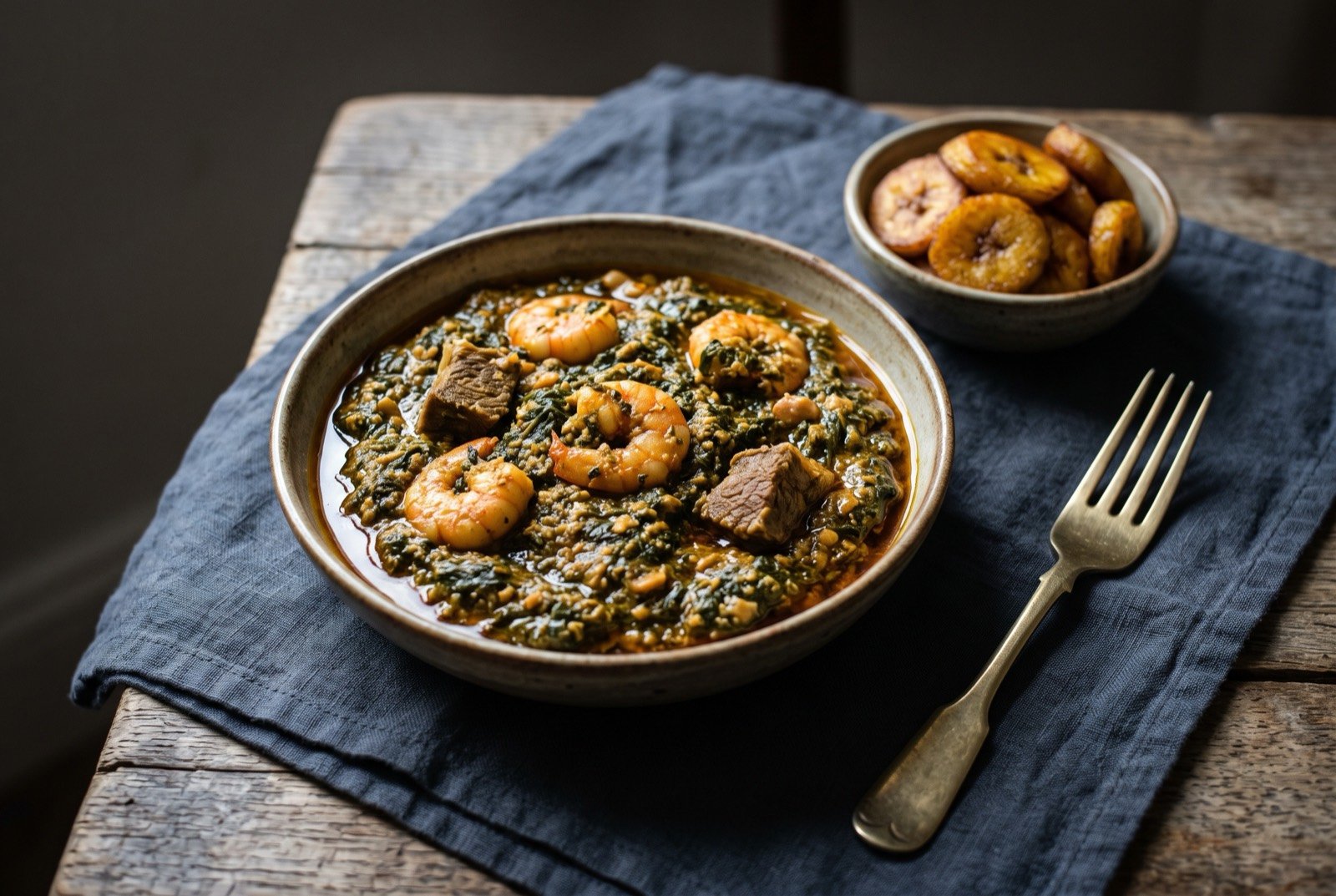
Cameroon, taken seriously. Not one cuisine with regional accents but the seam where West African and Central African culinary grammar overlap, visible dish by dish. A technique ladder built from the inside, and every dish as tradition built it, then what a modern chef would change.
Sources and review · What this chapter does not assert · How we research · Know this better? Tell us
A Sense of Place
Six volumes of this atlas have worked east along the West African coast. This is the volume where the coast stops being West Africa, and where a tourist board phrase, "Africa in miniature", needs replacing with something narrower and more useful. Cameroon is where two culinary grammars overlap, and the overlap is legible in the pot.
The West African grammar contributes groundnut and melon seed as thickening bodies, palm oil as the primary fat, a pounded starch with a soup beside it, and in the north the Hausa grill vocabulary.
The Central African grammar contributes a forest seed and bark aromatic set with no West African equivalent (djansang, olom, mbongo, pebe), leaf-wrapped steamed parcels as a major cooking method rather than a snack format, palm nut pulp rather than merely palm oil as a sauce body, and fermented cassava treated as a bread rather than a granule.
And one thing that belongs to neither. In the Grassfields, mineral alkali is used to saponify palm oil into a stable yellow emulsion. There is no close parallel to achu soup anywhere else in West or Central Africa: a genuine local invention, and the most technically interesting sauce in this book so far.
There is a deeper reason the seam sits here. Consensus places the Proto-Bantu dispersal centre in the border region between southeastern Nigeria and southwestern Cameroon, with divergence from Niger-Congo around 5,000 to 4,000 years before present. Only three crops reconstruct securely into Proto-Bantu: yams, cowpeas and Bambara groundnuts, alongside heavy use of wild oil palm and wild yams. Pearl millet does not appear in southern Cameroon until roughly 350 BC.
So the Cameroonian larder began as forest gathering plus yam plus oil palm, and everything else arrived later. That single fact explains the flavour arsenal below, and it explains why the aromatics of this cuisine are gathered rather than farmed.
The Grassfields
The Northwest and West: a volcanic plateau running roughly 1,100 to 2,000 metres, cool at night, fertile andosols. The Bamileke chiefdoms (Bandjoun, Bafoussam, Dschang, Baham, Bangangte), the Bamoun of Foumban, and the Nso, Kom, Bafut, Mankon, Nkwen, Awing, Aghem, Tikar and Ngemba.
The plateau is too high and too cool for good oil palm. Palm oil here is a traded commodity, carried up from the Littoral and the Mungo lowlands, and it is the one region in this volume where palm oil is genuinely precious. That is not colour. It is the reason the Grassfields developed a technique for making a small quantity of palm oil coat an entire pot, which is exactly what an emulsion does.
The dishes are achu with yellow soup, nkui, kondre, kati kati, njama njama with corn fufu, koki corn, and the "born house" plantain cooked with palm oil and bitter leaf for a new mother.
The Sawa coast and the Littoral
The Duala, Bakweri on the slopes of Mount Cameroon, Bassa inland in Sanaga-Maritime, Bakossi, Oroko, Malimba, Pongo and Batanga. Mangrove estuary, the Wouri and Sanaga deltas, and at Debundscha some of the wettest slopes on the continent. Fish, prawn, crab and smoked river fish are foundational.
The country is named after a shellfish. Fernão do Pó, around 1472, named the Wouri Rio dos Camarões, river of prawns, after an abundance of the mud lobster Lepidophthalmus turneranus. Cameroon is the only country on earth named for a crustacean, and crustaceans, as dried crayfish, remain a spine of its cooking.
Ngondo, the Sawa worship of water oracles, was inscribed on the UNESCO Representative List at 19.COM in December 2024. Coastal dishes: ndole, mbongo tchobi, ekwang, kwacoco with banga soup, sanga, and the urban poulet DG.
The forest interior
Centre, South and East: the Beti-Fang cluster (Ewondo, Eton, Bulu, Fang, Bene), the Maka, Kaka and Gbaya, and the Baka forest foragers. Dense equatorial forest, low population density, and forest gathering still material to the diet. The thickener is groundnut paste, ndo'o (Irvingia) kernel or ngon (egusi) seed, the aromatics olom and djansang, the starch cassava as bobolo, plus plantain and macabo.
And here is the seam in one sentence. The Beti cook Gnetum africanum with groundnut paste and call it okok. The Manyu, one internal border away, cook the same leaf with palm oil and no nut and call it eru. One species, two thickening logics, one country. Dishes four and five are that sentence, cooked.
The anglophone southwest forest
Manyu, Meme and Ndian: Kenyang and Banyang, Ejagham, Oroko, Bakweri, Bakossi. Continuous with the Cross River zone of Nigeria, and the same culinary province as Efik and Ibibio cooking across the border. Eru is afang in Calabar; ekwang is ekpang nkukwo.
Eru is a real economy and not a folk detail. Across 22 surveyed villages, roughly 1,014 harvesters, 79 per cent of them women, produced an average 2,344 tonnes a year over 2007 to 2009, and 81 per cent of traded volume went to Nigeria. Around 45 per cent of harvesting technique was judged unsustainable, and 97 per cent of harvesters reported walking further to find the vine than a decade earlier, which is what a gathered ingredient looks like when demand meets a forest.
The Muslim north
Adamawa, North and Far North: Fulbe, Kanuri, Kotoko, Hausa, Mandara, Mafa, Toupouri, Massa, Mundang. Sudano-Sahelian and Guinea savanna, the Benue and Logone floodplains, the Lake Chad basin. Cattle country. Fat is groundnut oil, shea butter and clarified cow butter; thickeners are okra, baobab leaf, dried tomato and fermented locust bean; the aromatic is yaji, the Hausa groundnut and chilli grill paste; the starch is millet and sorghum couscous.
This region is culturally continuous with northern Nigeria and Niger and not with Douala, and this chapter will not pretend it is a regional accent of a coastal cuisine. Kilishi is claimed by Niger, Nigeria and Cameroon alike, and kossam, the fermented milk, is the drink that goes with dried meat.
The History in Layers
The forest foundation
The deep layer is forest and yam, not grain. The archaeological signature is stone axes and adzes suited to processing trees (oil palm) and tubers (yams), and early Bantu farming operated at a scale so small that it was unlikely to have caused simultaneous environmental change. The drying and fragmentation of the forest around 2,500 BP is more plausibly what enabled the expansion than any agricultural or metallurgical advantage.
For a cook, this is the most important paragraph in the history. Djansang, ndo'o, olom, mbongo pods, pebe, four corners and country onion are all gathered forest products and none is a cultivated spice. The Cameroonian flavour vocabulary is a foraging vocabulary that never converted to agriculture, which is why the eru and bush mango value chains are still measured in what women carry out of the forest, and why these ingredients reach Britain in small irregular lots at high prices per gram.
Taro (Colocasia esculenta) is the exception and an old import, Southeast Asian in origin and in Africa since antiquity. The Grassfields built its keystone dish on a borrowed tuber, which is worth remembering the next time anyone tells you a national dish must be made of indigenous things.
The Columbian Exchange
Portuguese trade follows do Pó's naming of the Wouri, and with it the American crops. Maize and cassava both arrive in the sixteenth century, initially as slave-ship provisions. Groundnuts, tomatoes, chillies and sweet potato come in the same window, though the circumstances of their introduction are even more clouded.
Cassava displaces yam as the coastal and forest staple, and arrives with, or acquires, a fermentation protocol. Bobolo, miondo, water fufu and garri are detoxification technologies before they are foods. Chikwangue in Congo, bobolo in Cameroon: one object across a very wide belt, which is the point Christian Abégan makes when he tracks the cassava continuum across borders.
Maize becomes the Grassfields grain, giving fufu corn, koki corn and the maize couscous that carries nkui.
Groundnut becomes the thickening body of ndole, nnam owondo and okok, sitting alongside the older forest-seed thickeners rather than replacing them. In most of West Africa the groundnut won; in most of Central Africa the forest seed held. In Cameroon both systems operate in the same kitchen on the same afternoon, and in the case of eru and okok, on the same leaf. That is the clearest reason to write a Cameroon volume at all.
Chilli enters an aromatic system that already had Piper guineense, Xylopia aethiopica, Aframomum and Monodora. That is why Cameroonian food is aromatic first and hot second, and why a cook who reaches for more scotch bonnet when a pot tastes flat is solving the wrong problem.
German Kamerun, and the partition
The German protectorate of 1884 to 1916 builds the plantation belt on the volcanic slopes of Mount Cameroon and in the Mungo: oil palm, cocoa, rubber and later bananas. German expeditions reach the Bamileke plateau in 1902 to 1904 and find a cultivated territory with paths, markers and established trade with Nso and Bamoun. This is the moment four culinary regions are forced into one administrative container, and the moment Cameroon acquires a cash-crop economy oriented outward. The Nkafu Policy Institute frames that export specialisation explicitly as colonial heritage rather than strategic choice.
After 1916 the territory is split between a French mandate and a British one administered from Nigeria, and the canon still carries the line. The anglophone Northwest and Southwest give you achu, eru, ekwang, kwacoco, njama njama, garri, water fufu, kati kati, and a Cross River-facing vocabulary shared with Calabar. The francophone Littoral, Centre, West and North give you ndole, mbongo tchobi, sanga, nkui, kondre, poulet DG, folere, brochettes, and a forest spice vocabulary shared with Gabon and Congo. Any account that treats Cameroon as one cuisine misses that the dish names themselves carry the partition, and this is not a settled historical curiosity: the anglophone question is a live and violent political matter, handled below as fact rather than as flavour.
Penja pepper, a colonial crop that became a terroir
Black pepper, Piper nigrum, was introduced to the Penja valley by Antoine Decré, who ran a banana plantation there. The first export, 40 kg of white pepper, went out in March 1958. It took OAPI geographical indication protection on 10 November 2015, covering 17 African states, and subsequently EU protected geographical indication status, and by May 2016 it was fetching around 321 euros a kilogram.
A late-colonial planter's sideline became Africa's flagship geographical indication and Cameroon's most exported flavour, at a moment when the country's own forest spices have no protection, no standardised trade name and, in several cases, no published Latin name.
The ruptures
The Cameroon War, sometimes called the Bamileke War, 1955 to 1964, with clashes continuing to 1971. The UPC, founded in 1948 by Ruben Um Nyobè and Félix-Roland Moumié, was banned by France in July 1955. French forces created the Cameroon Pacification Zone, placed populations in surveilled camps, and used heavy artillery and napalm to destroy villages. The Bamileke region accounted for roughly 80 per cent of civilian deaths, and Sanaga-Maritime, the Bassa heartland, saw heavy repression too.
The casualty estimates diverge enormously and this chapter reports the range rather than picking a number: 61,300 to 76,300 civilian deaths per the British embassy in 1964, 20,000 for 1960 alone per General Max Briand, around 10,000 for 1955 to 1959 per Bernard Droz, and 100,000 to 400,000 for 1959 to 1964 per the lawyer Julie Owono. Meredith Terretta considers the highest figures unreliable, and neither government kept accurate records.
The two peoples whose cooking anchors half this chapter, the Bamileke and the Bassa, are the two the war fell on hardest. Village destruction, forced regroupment and scorched earth broke agricultural continuity in exactly the zones that produced achu, nkui and mbongo tchobi. Any account of these dishes as unbroken tradition has to reckon with that.
The anglophone crisis, 2016 to the present. The Northwest and Southwest, which is to say the achu, eru and ekwang heartland, are in sustained conflict. Separatists enforce weekly Monday ghost-town strikes and lockdowns of three days to two weeks; in one period from late April to mid-May 2023, 12 of about 20 days were lockdown or ghost-town days. Over 231,000 people are internally displaced, close to 10 per cent of the zone's population, plantations have shut, and maize prices ran 50 to 70 per cent above the five-year average.
The cuisine at the centre of this chapter is currently being cooked under blockade. That is the plainest way to put it and there is no reason to put it any other way.
The modern moment
Inside Cameroon, the most organised effort is the Diaspora Kitchen festival, conceived by Ama Tutu Muna, former Minister of Arts and Culture, whose first edition ran 9 to 10 March 2023 at Mouanko. Abroad there is one significant restaurant and a great deal of absence: Pierre Siewe's Table Penja in Paris, Georgiana Viou cooking with Cameroonian mbongo spice in Nîmes, Olivier Thimothée serving ndole at Waly-Fay.
Which produces the tension this chapter writes toward. Mbongo, a burnt bark and pod blend from Bassa country, has become a French restaurant seasoning. Its own region's fishermen are almost entirely outside the sector that uses it.
The Flavour Arsenal
Buy four things from this chapter: crude red palm oil, country onion, njangsa and unwashed bitter leaf. Everything else is negotiable and those four are not.
The forest seeds and barks, which are the Central African half of the grammar
These have no West African equivalent, and they are why a Cameroonian pot does not smell like a Nigerian one even when the dish looks identical.
| Common name | Local names | Botanical | Part | Flavour | Preparation and dose |
|---|---|---|---|---|---|
| Njangsa, djansang, akpi | djansang, akpi, essessang, wama, okhuen, bofeko | Ricinodendron heudelotii | Kernel | Hazelnut to bitter almond; an oily chocolate aroma with a bitter finish | Dry roast 3 to 5 minutes to fragrance, then pound or blend. 2 tbsp per sauce for four, added 15 minutes before the end |
| Pebe, mpebe, calabash nutmeg | pebe, African nutmeg, ehuru | Monodora myristica | Seed | Nutmeg-adjacent but more piquant, with a medicinal fennel edge | Toast, crack, grind. 3 seeds in a kondre for four to six |
| Country onion, bush onion, rondelle | country onion, rondelles | Afrostyrax lepidophyllus | Seed and bark | Overwhelmingly garlic and onion. The essential oil is dominated by sulphur compounds | Roast lightly, grate straight into the pot. Small dose, and late. Rung 5 |
| Garlic tree, olom, hiomi | olom (Beti), hiomi (Bassa), bois d'ail | Scorodophloeus zenkeri | Bark and seed | Intensely garlic, woody and bitter when charred | The bark is what gets burnt for mbongo; the seed is ground as a condiment |
| Four corners, essèssè | quatre-côtés, aidan | Tetrapleura tetraptera | Four-winged pod | Sweet, molasses-resinous, sharpens with roasting | Roast, break, grind. Achu spice, nkui, banga soup, and associated with pork |
| Mbongo pod | mbongo, tchobi spice | Aframomum citratum, per most French sources, and disputed | Dark ovoid pod, black seeds in white pulp | Vegetal, lemony, camphorous, without the peppery bite of grains of paradise. Fugitive | Ground very fine and used fresh. In mbongo tchobi it is charred, not merely roasted |
| Kinghe, Ethiopian pepper, grains of Selim | poivre de Guinée, hwentia | Xylopia aethiopica | Dried pod | Musky, resinous, anise and camphor | Roast, grind. Achu spice, northern yaji |
| Bush pepper | uziza | Piper guineense | Seed and leaf | Sharper and more floral than black pepper | Achu spice |
| Penja pepper | poivre de Penja | Piper nigrum | White, black, green, red | Musky, floral, very long finish | Table and finishing pepper. Not indigenous |
| Botton, oil bean | ukpaka | Pentaclethra macrophylla | Seed | Nutty, faintly fermented | Achu spice component |
| Ndo'o, bush mango | andok, mangue sauvage, ogbono | Irvingia gabonensis (sweet, wet season) and I. wombulu (bitter, dry) | Kernel | Rich, resinous, slightly bitter | Ground and pressed into dika bread. Prized for drawability |
| Nkui bark | nkui, kwi | Triumfetta pentandra | Bark | Neutral. A texture agent, not a flavour | Soaked 15 minutes, rubbed out, beaten to mucilage |
A species confusion that matters at the till. Afrostyrax lepidophyllus (Huaceae) and Scorodophloeus zenkeri (Fabaceae) are unrelated plants whose seeds both smell overwhelmingly of garlic, both are sold as "country onion" or "garlic tree", and both have essential oils rich in sulphur compounds. Do not assert which one a given recipe means unless the source says, and this chapter does not.
The alkali, which is the Grassfields' one great invention
Kanwa, also akanwu, sold as "limestone" or sel gemme, is trona: Na₂CO₃·NaHCO₃·2H₂O, mined from salt lakes and dry lakebeds. Nikki is a different material with a similar function: potassium carbonate and bicarbonate leached from the ash of burnt plantain peelings. It is the older and wholly local product, and the Cameroonian cook Keng distinguishes the two where most sources do not.
The alkali does four separate jobs: it emulsifies (achu soup, via the soap reaction in Rung 1), it tenderises by hydrolysing pectin, it holds chlorophyll green against acid-driven conversion to olive-brown pheophytin, and it thickens okra soups.
It is also not benign. Kanwa is a crude mineral. It carries sand, and in poorly sourced product it carries heavy metals, and there is a real Nigerian toxicology literature on trona and palm bunch ash. A pea-sized piece for a large pot, dissolved, settled, and the clear liquor decanted off the grit.
The greens
| Name | Botanical | Notes |
|---|---|---|
| Ndole, bitter leaf, metet | Vernonia amygdalina | Leaf and dish share a name in Duala. Bitterness sits in saponins and sesquiterpene lactones plus alkaloids and tannins, all water soluble. De-bitter to a target, not to zero |
| Eru, okok, afang, okazi | Gnetum africanum and G. buchholzianum | A gymnosperm, not a leafy vegetable. G. buchholzianum yields more leaf per vine and traders prefer it. Shredded hair-fine |
| Waterleaf | Talinum fruticosum and T. triangulare | Succulent, very high water, collapses fast. Cooked with eru to supply the moisture eru is not given directly |
| Njama njama, huckleberry | Solanum scabrum | The Grassfields daily green. Boiled, then fried with onion and tomato |
| Zom | Solanum nigrum complex | The Beti green, used in sanga |
| Folong | Amaranthus | The everyday substitute. Kpem is pounded Manihot esculenta leaf, Beti and Bassa |
| Manjuweli, scent leaf | Ocimum gratissimum | The finishing herb in banga soup |
| Achu leaves | Xanthosoma sagittifolium and Colocasia leaves | A pot lid during the achu boil, and the wrapper for ekwang |
The starches
- Achu, country coco: Colocasia esculenta, in varieties including 'country coco', 'mangua' and 'Ibo coco'
- Macabo, malanga: Xanthosoma sagittifolium, red and white, grated raw for ekwang and kwacoco
- Achu banana, ambochu: green plantain, pounded with the taro
- Bobolo, miondo, water fufu: fermented cassava in three geometries. Garri: toasted fermented cassava granules, the anglophone partner to eru
- Fufu corn: maize flour, roughly 1 part flour to 2 parts water, mixed cold then stirred hot 5 to 10 minutes
- Couscous de mil: millet or sorghum, northern, and the carrier for nkui
Part Two
The Technique Ladder
First, an honest problem
Volume Three could hang its elevations off Ikoyi and Akoko. Volume Four could not, and said so. This volume is in the same position, and the position is starker.
There is no Michelin-starred Cameroonian restaurant anywhere in the world, and no Cameroonian chef on the star list, as of August 2026.
The gap is structural rather than a matter of quality, and it is worth setting against the neighbours. Nigeria has starred rooms in London and Paris, Senegal and Mali have MoSuke, Benin has Rouge, Congo has Kin in Marseille. Cameroon, whose grammar sits at the hinge of West and Central Africa, has one chef in the Michelin Guide selection in Paris and essentially nothing else at that altitude.
Two things exist and it would be dishonest to blur them.
One: Pierre Siewe at Table Penja, Paris. Cameroonian, from a restaurateur family, trained at The Savoy and then under Yves Camdeborde, the founding figure of French bistronomie. He describes his cooking as métissée, blended, and is explicit that it is not fusion. He told Yonder in October 2024 that he is pas du tout dans la course aux étoiles.
His dishes are the transferable part. Octopus with sauce mbongo, the single most useful technique transfer in this volume: the burnt seed black sauce of the Bassa used as a plating sauce against something firm, sweet and chewy. Bresse chicken with lemongrass, okra and baobab powder, where baobab does the job a French kitchen would give a vinegar. Chocolate with fresh green Penja.
Two: Christian Abégan, not a restaurant chef in the conventional sense and the best voice in this volume. His position is that African culinary heritage needs codifying, through collaboration between scientists, anthropologists and chefs. His most useful line: it is possible to make sushi with any kind of fish, including fish caught in Cameroon. Technique travels, and the DNA of the dish stays. That is the licence this chapter needs, offered from inside the tradition without anybody prompting it.
And in Britain, honestly: nothing at that level. Nobody is doing for ndole what Akoko did for egusi, so there is no reference point and no pressure. Nigerian food in London got better in part because Ikoyi, Akoko and Chishuru created a ceiling everyone else could see.
So the six rungs below are built from mechanism, not from anybody's tasting menu. Every one of them is a Cameroonian technique done deliberately and measured. Nothing here is imported from Copenhagen and nothing here needs to be.
Rung 1. Use crude, high free fatty acid red palm oil, and never refined
This rung is load bearing in the literal sense: get it wrong and one of the eleven dishes below becomes physically impossible. Two mechanisms stack.
First, carotenoids. Crude red palm oil carries very high alpha and beta carotene, which is where the colour and a good part of the aroma live, and carotenoids are heat labile. The Malaysian Palm Oil Council's figures are precise and directly usable as a cooking rule: heating red palm oil at 200°C for two hours loses 59 per cent of beta-carotene, dropping to 150°C cuts that loss to 15 per cent, and at 170°C, 46 per cent of alpha and 40 per cent of beta-carotene survive three hours. Beta degrades faster than alpha.
The rule that falls out of that: bloom your palm oil, never rip it. Every hour a palm oil sauce sits over heat it travels from orange-red toward brown-grey and from fruity toward waxy.
Second, and this is the one nobody tells you, free fatty acids. Achu yellow soup emulsifies because crude red palm oil carries a high free fatty acid load. Alkali converts those acids into sodium palmitate and sodium oleate, anionic surfactants made in situ in the pan. That soap is the actual emulsifier. The peer-reviewed account of achu says exactly this: the limestone reacts with acids in the palm oil to produce sodium palmitate and oleate, responsible for both the yellow colour and the distinctive taste. Keng's Kitchen puts the same chemistry in kitchen language, and it is the clearest explanation of an emulsion I have read from any home cook in any cuisine: the part of the kanwa that likes water joins the broth, the part that likes oil joins the oil, and that stops them separating.
Refined, bleached, deodorised palm oil has had its free fatty acids stripped by neutralisation during refining. It physically cannot make achu soup. If your yellow soup will not come together, the failure is very probably not your technique but your bottle. That mechanism is a sound inference rather than a sourced statement; see the final section.
Rung 2. Control the alkali, do not just add it
Amateurs throw a lump of kanwa in the pot. The discipline is: dissolve, settle, decant, dose by volume, and know which of the four jobs you are asking it to do.
Dissolve a thumb-sized piece in half a cup of water and let it stand until the grit falls out. Use only the clear liquor and throw the sediment away. Kanwa is a crude mined mineral and the sediment is where the sand and, in poor product, the heavy metals live.
Then dose deliberately. The working ratio at the lean end, across three independent Cameroonian sources, is roughly 10 g of trona to 120 ml of palm oil, and those sources spread widely on how much stock joins them, from about 1 part oil to 12 parts stock at the leanest to far richer.
The window is narrow and the failure modes are named. Too little alkali or too little shear and the soup stays orange-brown and separates; the fix is more limestone and another pulse of the blender. Too much rendered fat and the oil breaks free and floats, which Cameroonians call oil stand for achu soup; the fix is upstream, in lean cuts. Too much alkali and it tastes of soap, because it is soap.
And know when not to use it. For tenderising beans or cow skin, food-grade bicarbonate is refined, consistent and safe. For the emulsion it will not do: it is a much weaker base and decomposes to carbon dioxide on heating rather than delivering sustained alkalinity.
Rung 3. Calibrate bitterness rather than eliminating it
Home cooks wash bitter leaf until it is safe. Restaurants wash it to a target. Takeaways buy it pre-washed and end up with wet green nothing.
Vernonia amygdalina carries its bitterness in water-soluble compounds: saponins, sesquiterpene lactones, alkaloids and tannins. Because they are water soluble, repeated rinse-and-squeeze cycles are a genuine extraction process and each cycle removes a measurable fraction. Two to three rinses with a hard squeeze between each is the standard. The traditional technique adds mechanical rupture and chemistry: rubbing the leaves hard between the palms with water and often with salt, sometimes limestone, because salt abrades and draws osmotically and alkali hydrolyses the lactones.
Under-wash and nobody finishes the dish. Over-wash and you have made spinach.
Why this matters more in ndole than anywhere else. Ndole is a groundnut emulsion and groundnut is roughly 50 per cent fat. Bitterness and tannin astringency both increase perceived cut through fat, as a tannic red does against a fatty steak. Wash the bitter out and the dish reads as cloying, because you removed the only thing balancing half a kilogram of nut fat. Then more chilli and bouillon go in, which adds heat and salt and restores no cut at all.
The restaurant move, which nobody does at home, is to wash in graded batches: one batch at three washes and one at a single wash, blended to a target at the end. That gives you a dial instead of a hope.
And an honesty flag. Not one source consulted gives a number of washes, a water volume, a salt concentration or a measurable target. Every source says "wash until the bitterness reduces". The single technique standing between a British reader and Cameroon's most famous dish is undocumented. See the final section.
Rung 4. Treat the seed thickeners as three separate tools
The diaspora shorthand is "African seed, makes it thick", and that collapses three genuinely different mechanisms into one.
Njangsa (Ricinodendron heudelotii) is a fat-phase thickener and a flavour carrier. The kernel is roughly half oil by weight and rich in protein. Ground into hot liquid it behaves like a nut butter: it releases oil that coats and emulsifies and delivers colloidal protein at the same time. It thickens by dispersed oil and ground solids, not by starch or gum. Egusi thickens by protein coagulation, setting into curds when heated. Cocoyam thickens by starch gelatinisation, okra by soluble mucilage.
These behave differently under heat, under alkali and on reheating, which is why substituting one for another gives a dish that is technically thick and sensorially wrong. Njangsa cannot be replaced by egusi in mbongo tchobi, and egusi cannot be replaced by njangsa in eru.
And the point that makes this a rung rather than a note. Fat-phase thickeners carry aroma, because aroma partitions into fat. Njangsa makes a dish rounder and more aromatic; cocoyam starch makes it thicker and blander, because starch does not solubilise volatiles. A restaurant separates the thickening decision from the flavour decision.
Rung 5. Add the sulphur aromatics last, and never boil them
This is the biggest single quality gap between a good Cameroonian pot and a bad one, and almost nobody articulates it.
Country onion (Afrostyrax lepidophyllus) and garlic tree (Scorodophloeus zenkeri) are, chemically, sulphur compound spices: their essential oils are dominated by sulphur-containing volatiles, which is why they smell of onion and garlic despite having no botanical relationship to either.
Organosulphur volatiles are small, highly volatile and thermally labile. They are the class of compound that makes raw garlic pungent and boiled garlic sweet and flat. Boil them for an hour and you have thrown away the thing you paid a lot of money for, and you will not know, because what remains still smells vaguely savoury.
So they go in during the last few minutes, or into a finishing oil, or split across two stages: a little early for depth, the bulk at the end for lift. This is the technique that most reliably makes a diaspora ndole, mbongo or eru taste like the version cooked in Douala, and it costs nothing but sequencing.
Rung 6. Stack the umami synergistically, then salt down
The bad version seasons with three stock cubes at the start; the good version builds glutamate and nucleotide from ingredients and then needs much less salt. The glutamate and 5'-ribonucleotide synergy is one of the best evidenced effects in flavour science: together the perceived intensity multiplies rather than adds, because inosinate binds an allosteric site on the T1R1/T1R3 receptor and increases its affinity for glutamate. The effect is order-of-magnitude, not marginal. Cameroonian cooking already has both halves on the shelf. Dried crayfish and smoked fish supply nucleotides from fish muscle and, being dried and cured, concentrated free glutamate as well. Long-cooked meat liquor and fermented products supply glutamate.
Build the synergy deliberately and then reduce the added salt and cubes. A pot with toasted crayfish, hard-smoked fish and a genuine meat broth needs a fraction of the seasoning, and tastes cleaner because the sodium is not doing all the work.
Toast the crayfish before grinding. Dry roasting drives Maillard on the surface proteins and generates pyrazines that raw ground crayfish does not have. Three minutes, and the cheapest upgrade in this chapter.
And if you use bouillon, and Cameroonian cooking does, buy the plain cube plus separate MSG rather than the flavoured cube. The flavoured versions carry salt, sugar, hydrolysed vegetable protein and a chicken-fat aroma that flattens everything under it. Build the stack, correct with a little pure MSG, salt last.
A note that is not a rung. Cameroonian cooking is not an acidic cuisine, and fresh acid at the pass is the one thing restaurant technique adds that the tradition does not routinely do. Siewe's baobab powder is the template: a dry acidulant, roughly a tenth of its weight in tartaric and citric acid, used where a French kitchen would use vinegar. Applied at the pass, never cooked in, because cooked acid goes flat and, in a palm oil dish, destabilises the emulsion Rung 1 built.
Part Three
The Ferment and Preserve Bench
Four things worth making, three of them traditional preparations this cuisine already runs on.
1. Bobolo and miondo
The fermented cassava that is the Sawa and Beti bread, and the plate-mate for ndole and mbongo. Numbers from a controlled study.
- Peel, wash and cut the roots into 2 to 5 cm chunks.
- Steep in water at 38°C, roots to water 1:3 by weight and volume.
- Ferment 43 hours at room temperature. Optionally inoculate with 7.9 g of fermented cassava flour as a starter: aerobic fermentation with a starter gave the best sensory result, and the Campo variety performed best.
- Mash the softened roots by hand, pulling the fibres out.
- Press the water out in jute bags.
- Mill the paste and press again.
- Portion at 300 to 320 g, wrap in Megaphrynium macrostachyum leaves. Banana leaf will do in Britain and is not the same.
- Boil about 45 minutes.
Bobolo is the thick log and miondo the slender stick, the same paste in two geometries. Water fufu is the anglophone Southwest reading, served soft rather than set.
The steep is a lactic and mixed fermentation that softens the parenchyma, drops the pH and lets endogenous linamarase hydrolyse the cyanogenic glucosides linamarin and lotaustralin, and pressing then carries the liberated cyanide away with the water. Fermented cassava is a detoxification protocol that happens to taste good.
2. Nikki, and how to handle kanwa
Nikki is the older and wholly local alkali: potassium carbonate and bicarbonate leached from the ash of burnt plantain peelings. Burn dried plantain skins to a clean white-grey ash, steep in water, settle overnight, decant the clear liquor.
Kanwa is mined trona and it is bought. Either way the handling is the same and it is not optional: dissolve a thumb-sized piece in half a cup of water, let the grit settle ten minutes, decant the clear liquor and throw the sediment away. There is a real toxicology literature on trona and palm bunch ash at chronic high intake, and a specific caution in pregnancy. Small doses, occasional use, always the clear liquor. It is hygroscopic and will deliquesce into a puddle if you leave the jar open.
3. Achu spice, roasted whole and sieved
The named failure mode of Cameroonian cooking abroad, stated by Cameroonian sources rather than by me: pre-blended commercial achu spice has inadequate aroma against freshly roasted whole components. That is the restaurant argument in one line, and it applies equally to mbongo mix. Roast the whole components about 10 minutes, cool, grind, and sieve through a chinois or muslin. Make a fortnight's worth, no more, and keep it airtight and dark.
The peer-reviewed component list is: country onion (Afrostyrax lepidophyllus), bush pepper (Piper guineense), black pepper (Piper nigrum), mpebe (Monodora myristica), botton (Pentaclethra macrophylla), four corners (Tetrapleura tetraptera), kinghe (Xylopia aethiopica) and chilli (Capsicum frutescens).
A household list recorded from a Cameroonian cook adds sickle bush, sweet root, country carrot and bambala groundnut. Three or four components of the Grassfields' defining spice blend have no published Latin name anywhere I could find. See the final section.
4. Folere, and the toasted crayfish powder
Folere is the hibiscus infusion, Fulfulde in name and northern in provenance, now drunk everywhere. 2 cups of dried calyces to 1.5 litres of boiling water, boiled on medium until deep red, with chopped ginger, a sliced orange, pineapple peelings, a cinnamon stick and mint. Sweeten after brewing, then strain. The pineapple peel is the interesting part: it brings acid and a faint fermented lift that no source describes in those terms.
And the powder. Toast whole dried crayfish in a dry pan 3 minutes, until they smell sweet and toasty rather than sharp, then grind, and do the same with hard smoked fish. Keep both airtight in the freezer: dried crayfish is high in unsaturated marine lipid and goes rancid on a warm shelf within weeks. This is Rung 6 in a jar, and it is what lets you cut the bouillon cubes by two thirds.
Sourcing in Britain
Verified August 2026. Where a supplier could not be confirmed, that is said rather than smoothed over.
The retailers that were actually verified
- Niyis African Supermarket (niyis.co.uk, Reading RG2 0BF). The strongest verification here. Standard 2 to 4 days from £7.99, next day from £10.99 before 11am, free over £120. Stocks frozen bitter leaf, 500 g.
- Nxtion Food Market (nxtionfoodmarket.com, 237 Abbeydale Road, Sheffield S7 1FG). UK-wide at £7.99 per 20 kg, exceptional for heavy goods.
- The AfroBox (afrobox.co.uk). Fresh produce: taro leaf, eddoes, cassava, plantain, smoked fish. Genuinely useful for ekwang and achu.
- Afrobuy (afrobuy.co.uk, Manchester). Frozen bitter leaf 500 g at £1.99, the cheapest verified UK price found.
- Afro Bloom (afrobloom.co.uk, Renfrew). Next day nationwide if ordered by noon. Stocks kilishi. The best option for Scottish readers.
- AfroBasket, AfriPantry (multi-vendor, split shipments by design) and MyAfricanShop also ship nationally. UK Afrifoods (58 Ridley Road, E8 2NR) is excellent and its own FAQ says it delivers to London addresses only.
Unconfirmed, and worth a phone call first. Cameroon Cuisine (camerooncuisine.co.uk) appears to be the only dedicated UK Cameroonian online grocer and carries njangsa; Afro Cash and Carry Food lists frozen eru; Inside Afrika lists unwashed dried bitter leaf under a Cameroonian 237Farmers tag. All three blocked verification. Confirmed dead: achuhouse.com. Afrilege, the best specialist Cameroonian seed catalogue found anywhere, is American and not British.
In person: Rye Lane in Peckham, Ridley Road in Dalston, Cheetham Hill in Manchester, Soho Road in Birmingham, Duke Street in Glasgow, Abbeydale Road in Sheffield, Narborough Road in Leicester. This sector churns hard, and the free way to check a shop still exists is the FSA register at ratings.food.gov.uk.
The buying warning that matters most
Multiple eBay, Etsy and Amazon listings sell alligator pepper (Aframomum melegueta) labelled as "mbongo spice". Mbongo is Aframomum citratum: same genus, different fruit, different aroma. Alligator pepper is peppery and camphorous; mbongo is citrus and cardamom. Substituting one for the other gives a sauce that is hot and wrong rather than dark and aromatic. Buy on the botanical name, or from a Cameroonian seller who calls it mbongo and nothing else. And do not buy mbongo that is already black in the bag, because somebody else did the burning months ago and the smoke aromatics have gone.
The ranked list: what decides great from grim
- Crude red palm oil. The only ingredient whose chemistry is load bearing: strip the free fatty acids by refining and the achu emulsion becomes impossible.
- Country onion and garlic tree. The sulphur volatiles that make a Cameroonian pot smell Cameroonian, and the first thing lost to pre-grinding and long boiling.
- Bitter leaf, unwashed. Without controllable bitterness, ndole is a bowl of nut fat with nothing holding it up.
- Mbongo spice, whole and burnt to order.
- Njangsa, whole. The oil-phase thickener that makes sauces round rather than merely thick, and the seed that goes rancid fastest once ground.
- Dried crayfish, whole and toasted, and 7. hard smoked fish: the two halves of the umami synergy, and the second is structurally different from supermarket hot-smoked mackerel, which dissolves instead of seasoning.
- Kanwa, food grade and decanted. Four jobs, and no clean substitute for the one that matters.
- Fresh cocoyam. Achu and ekwang are texture dishes first, and flour gives neither the elasticity nor the aeration.
- Groundnuts, raw and blanched. Boiled and blended makes an emulsion; peanut butter makes a sauce that splits and tastes of sugar.
Quality markers
- Red palm oil should be deep orange-red, opaque, and semi-solid at British room temperature, separating into a soft crystalline lower phase and a clearer upper one. Palm oil is roughly half saturated and behaves that way below about 24°C. A bottle that is uniformly clear and liquid at 18°C is refined and will not make yellow soup.
- The adulteration risk is real and specific. Sudan I to IV dyes are illegal industrial azo colourants used to make cheap vegetable oil look like palm oil. They are genotoxic carcinogens, not permitted in food in the UK or EU, and RASFF notification rates have stayed roughly steady for nearly twenty years. Buy from a UK retailer with a named importer on the label, and be suspicious of unnaturally vivid uniform red.
- Groundnuts: buy nuts, not imported paste. Aspergillus flavus and A. parasiticus produce aflatoxin B1, a Group 1 carcinogen, and West African groundnut supply chains carry a well documented problem. Formal UK retail is tested; informal import is not.
- Njangsa and pebe: whole, never ground. A rancid high-oil seed smells of paint or crayon; a stale one smells of nothing at all, which is almost as bad. A fresh country onion rondelle punches with garlic the moment you break it, and if you have to sniff hard, it is dead.
- Cocoyam: firm, heavy for its size, no soft spots, no grey-blue at the cut. Wear gloves to peel and grate it.
- Dried crayfish: whole, heads on, pale pink to orange, dry enough to rattle in the bag. Ammonia means protein breakdown. Dried Asian shrimp from a Chinese or Thai supermarket is often better handled and cheaper than stale crayfish, and is an honest substitution.
Voices and Sources
From inside the tradition
- Christian Abégan, Yaoundé. Roughly forty years promoting African culinary heritage, author of Le Patrimoine Culinaire Africain, and World Food Programme Chef Advocate for West and Central Africa. His argument that African culinary heritage needs codifying through collaboration between scientists, anthropologists and chefs is the intellectual centre of this volume. His refusal to argue about which country owns which dish, on the ground that cooking is the transformation of what is locally available, is the right answer to a question this atlas is repeatedly asked.
- Pierre Siewe, Table Penja, Paris. Cameroonian, trained at The Savoy and under Yves Camdeborde. Octopus with sauce mbongo, chicken with baobab powder as a finishing acid, chocolate with fresh green Penja. In the Michelin Guide selection; the distinction could not be confirmed and is not asserted here.
- Keng's Kitchen, Oroko, Southwest. The most technically rigorous cook-writer found for this cuisine, and the only one who explains the emulsification chemistry of achu soup in her own words. The ekwang, kwacoco, banga and eru specifications here are hers.
- La Vie Bami, a Bamileke kitchen, whose kondre carries the best spice specificity in the francophone material; Alice Pégie Cuisine, for the mbongo tchobi ratios and the account of the burn; Cooking With Claudy and Precious Core for ndole and kati kati.
- Grimaldi, Leke, Leke Nkeabeng and van Andel, International Journal of Gastronomy and Food Science 13 (2018), on achu. Peer reviewed, fieldwork based, fifteen women across three regions. The single best source behind this chapter.
- The Diaspora Kitchen cohort, convened by Ama Tutu Muna: Antoine Belinga, Emile Engoulou, Armand Ewolo, Sandrine Ebogo, Rose Lore Lissouck, Bernadette Ngali, Blasius Khan, Simon Pierre Bimai and Eric Medjo, alongside Abégan. Almost none has documented technique in English or in the indexed francophone press beyond event listings. That is a reporting gap, not a talent gap.
The gap, named
I could not verify a single Cameroonian restaurant in Britain with a confirmed trading status. One address in Hackney carries directory pages updated in 2026 and neither platform would confirm; one London supper club appears dormant; one dedicated Cameroonian online grocer would not load. Cameroon in Britain is a home kitchen and community catering cuisine, not a restaurant cuisine, and the country whose grammar sits at the hinge of the continent has, in the country with the best West African restaurant scene outside Africa, essentially no presence at all. Which is why this volume exists.
Things this chapter has deliberately not asserted
The section that makes the rest of it trustworthy.
- What mbongo actually is, botanically. Three readings survive checking and they are mutually exclusive. Two French spice sources give Aframomum citratum, dark ovoid pods, lemony and camphorous. Afrik.com describes a Cameroonian pepper resembling nutmeg, which points at Monodora myristica, a different family. Wikipedia's Bongo'o entry attributes the colour to a blend of garlic tree powder, four corner spice, calabash nutmeg, country onion and njangsa, with no single mbongo species at all. This chapter writes it as a blend whose principal pod is usually identified as A. citratum, and says so. A voucher-backed market survey in Sanaga-Maritime would settle it.
- What "burning" the mbongo mix actually means. Sources use brûler, burn, and describe an all-day process; Wikipedia says only roasted until it darkens. Nobody gives a temperature, a duration or a target appearance for the bark. The method in dish two is a reconstruction and labelled as one: the technique the chapter most needs and is least entitled to specify.
- Whether djansang and akpi are the same thing. One Cameroonian and one Ghanaian source are explicit that they are one seed with two national names, both Ricinodendron heudelotii, but some Cameroonian retailers sell them as two lines and home cooks treat them as distinguishable. The possibility worth investigating is that "akpi" denotes a grade or preparation rather than a species. This chapter treats them as one seed and flags the doubt.
- How many washes de-bitters bitter leaf. Every source says "wash until the bitterness reduces". Not one gives a number of washes, a volume of water, a salt concentration or a measurable target, which is a remarkable gap for the technique standing between a British reader and Cameroon's most famous dish. The graded-batch method in dish three is a workaround for the absence of a specification, not a specification.
- That achu is UNESCO listed. It is not. A UNESCO ICH page exists for "Achu: an expression of the traditional culinary art of Cameroon", associated with the Representative List 2026 cycle, and the page as read indicated not inscribed. That cycle would normally be decided in December 2026, after this chapter was written. At most: nominated. Ngondo, the Sawa water oracles, is confirmed inscribed, at 19.COM in December 2024.
- Where poulet DG comes from. The directeur général etymology and the "originally for people of importance, now democratised" framing are universal in French sources and trace to a single Jeune Afrique piece that could not be retrieved. No source reached names an inventor, a restaurant, a city or a year, and dates such as "Yaoundé in the 1980s" appear to be unsourced.
- The kilishi numbers. The one detailed source gives figures of a precision that raises suspicion of machine generation, and contains a factual slip elsewhere. They are coherent, plausible, and rest on a single source, so they are printed in dish ten as that source's specification. The food-engineering literature on kilishi drying and infusion exists and was not read for this chapter.
- What three or four components of achu spice are, and that a Bamoun repertoire is documented. The peer-reviewed achu spice list and a household list from a Cameroonian cook overlap but do not match, and "sickle bush", "sweet root", "country carrot" and "bambala groundnut" are not botanically identified anywhere that could be found: several components of the Grassfields' defining blend have no published Latin name. Separately, Foumban and the Bamum sultanate are well documented culturally, but no documentation of a distinct Bamoun cooking repertoire, as against generic Grassfields cooking, could be found, and a Muslim court cuisine sitting between the Bamileke plateau and the Fulbe north is too interesting an idea to invent.
- That ndole is officially the national dish, that limestone in achu soup does anything for a hangover, and that sanga is one settled dish. Every source repeats the first and none gives a date, a mechanism or an official designation; attribution differs between the Sawa broadly and the Duala specifically. The hangover claim is reported in the 2018 paper as a local belief, not a finding, and blogs have laundered it into a health claim. And sanga is built from zom and palm nut juice with sugar in one long-established Cameroonian source and described as maize with cassava leaf in much anglophone writing; those are different dishes, which is why sanga is named here and not given a recipe.
- The free fatty acid explanation for why refined palm oil fails at achu. The soap chemistry is standard, and the peer-reviewed 2018 account does state that limestone reacts with acids in palm oil to produce sodium palmitate and oleate. But the specific claim that refined oil fails because neutralisation stripped its free fatty acids is a sound inference and not a sourced statement, and the 2025 paper that appears to make it could not be obtained, so its figures are not quoted. A side-by-side trial of crude against refined oil at identical alkali doses would settle it, and would be an original contribution.
- That any Michelin-starred kitchen anywhere is cooking this food. There is not one, as of August 2026, and no Cameroonian chef on the star list. One sits in the Guide selection in Paris and his specific distinction could not be confirmed. The elevations here are built from mechanism and from the Cameroonian cooks named above. That constraint made this a better chapter, not a thinner one, because it forced every rung to justify itself chemically rather than by pointing at somebody's tasting menu.
Volume Seven of Not Just Stew. Research briefs: vol07-tradition.md and vol07-modernist-sourcing.md. Sourcing verified August 2026.
Use crude, high free fatty acid red palm oil, and never refined
This rung is load bearing in the literal sense: get it wrong and one of the eleven dishes below becomes physically impossible.
Control the alkali, do not just add it
Amateurs throw a lump of kanwa in the pot.
Calibrate bitterness rather than eliminating it
Home cooks wash bitter leaf until it is safe.
Treat the seed thickeners as three separate tools
The diaspora shorthand is "African seed, makes it thick", and that collapses three genuinely different mechanisms into one.
Add the sulphur aromatics last, and never boil them
This is the biggest single quality gap between a good Cameroonian pot and a bad one, and almost nobody articulates it.
Stack the umami synergistically, then salt down
The bad version seasons with three stock cubes at the start; the good version builds glutamate and nucleotide from ingredients and then needs much less salt.
The dishes
- Achu with yellow soup Grassfields, Northwest
- Mbongo tchobi Bassa, Sanaga-Maritime
- Ndole Duala and the Sawa coast
- Eru with waterleaf Manyu and the anglophone Southwest
- Okok Beti, the forest interior
- Ekwang Oroko, Bakweri and Bakossi, Southwest
- Kwacoco with banga soup Bakweri, the coast
- Kondre Bamileke, West
- Nkui Bamileke, West
- Kilishi Northern Cameroon, and contested with Nigeria and Niger
- Poulet DG Douala and Yaoundé
Sources and review
- Researched
- Researched from 90 sources in the brief
- Reviewed
- Awaiting a reader from inside the tradition
- Cooked
- Awaiting a cook report
Where this volume comes from
4 research briefs on file for this volume, researched to the rules on How we research. Published 26 August 2026. Last changed 15 September 2026.