Central Africa · Volume 07, The Hinge of the Continent
Mbongo tchobi
Bassa, Sanaga-Maritime
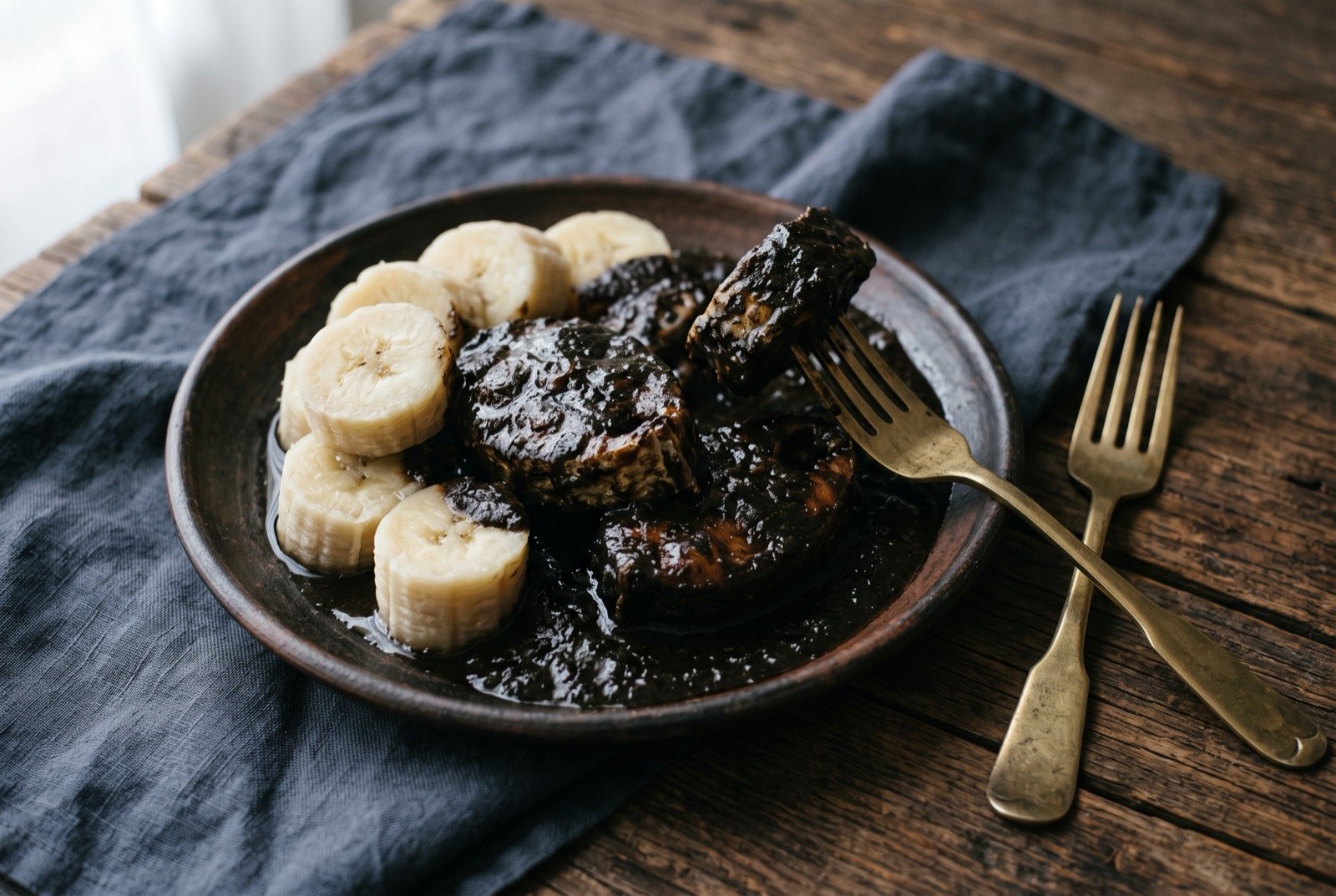
Illustration
- Time
- 1 hour
- Researched
- Researched from 90 sources in the brief
- Reviewed
- Awaiting a reader from inside the tradition
- Cooked
- Awaiting a cook report
The black is the point and the black is burnt. Every in-tradition source agrees that the colour comes from a spice mixture deliberately carbonised rather than merely toasted, and that the traditional process is long. Into the burn go mbongo itself and hiomi, the bark of a garlic tree, with njansang dry roasted separately, and fresh tomato, ginger, onion and garlic joining afterwards. Two honest caveats before you light anything. No source consulted gives a temperature, a duration or a target appearance for the bark, so the method below is a reconstruction and stays labelled as one. And the botanical identity of "mbongo" is disputed between at least three readings. Both go in the final section.
As tradition built it
Serves 4. About 1 hour, plus the burn.
Ingredients
- 1 kg catfish steaks (machoiron, Chrysichthys), or any firm catfish
- 50 g njansang (djansang)
- 25 g mbongo blend, burnt and ground
- 1 onion
- 100 g tomato
- 2 tbsp groundnut or palm oil
- to taste salt, pepper, water to loosen
Method
- Scald the catfish with warm water and rub it to remove the grey slime coat.
- The burn, reconstructed. Put the whole mbongo pods and the garlic tree bark into a dry heavy cast iron or carbon steel pan over moderate heat, or straight onto embers. Take them past brown to genuinely black and brittle, turning frequently.
- Dry roast the njansang separately, in a bare pan, 3 to 5 minutes, only until fragrant.
- Pound or mill everything together and sieve fine.
- Blend the onion and tomato. Combine the njansang powder, the purée and the mbongo blend into a homogeneous black marinade.
- Salt the fish steaks, coat them in the marinade, and cook in the hot groundnut or palm oil with the marinade, covered, 30 minutes on low, loosening with water as it tightens.
Notes
After Alice Pégie.
Serve with plantain, macabo, cassava or rice.
What a modern chef changes
The burn split into two vessels, the char treated as a plating sauce, and the sulphur held back
Rungs 4, 5 and 1
Method
- Split the burn into two lots and burn one harder. Take half the bark to black and brittle and the other half only to dark brown, and grind them separately. Now you have a colour lot and an aroma lot and you can dial the ratio at the end.
- Treat the njansang as the body and dose it as a thickener. Rung 4. It is roughly half oil by weight and thickens by dispersing that oil, not by starch, so it goes in about 15 minutes before the end and the sauce goes velvety rather than merely thick.
- Hold the garlic tree bark aside in a finishing oil. Rung 5. Warm 2 tbsp of the cooking oil to 60°C off the heat, stir in a teaspoon of the less-burnt bark powder and a grating of country onion, infuse 10 minutes, spoon it over at the pass.
- Borrow Siewe's protein swap if the fish is not right. Octopus with sauce mbongo is the one documented restaurant transfer of this technique. If you cannot get good catfish, a slow-cooked octopus leg is a better answer than a bad one.