Central Africa · Volume 07, The Hinge of the Continent
Ekwang
Oroko, Bakweri and Bakossi, Southwest
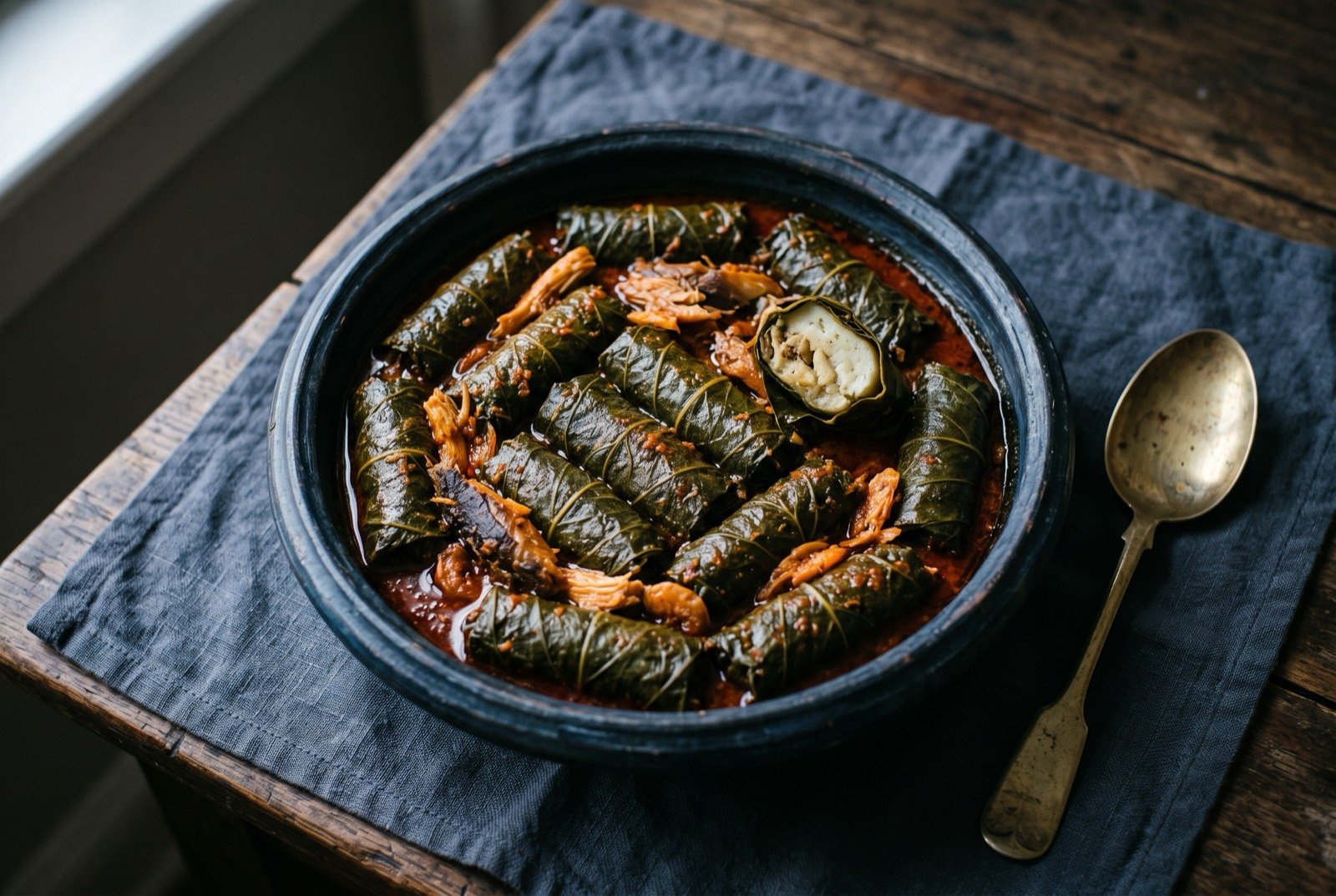
Illustration
- Time
- 2 hours
- Researched
- Researched from 90 sources in the brief
- Reviewed
- Awaiting a reader from inside the tradition
- Cooked
- Awaiting a cook report
Why parcel size is technical and not merely traditional. Keng's Kitchen argues, with a proverb attached, that oversized rolls are not ekwang but kwacoco, and the consequence is real: the leaf and paste do not cook through, calcium oxalate raphides survive, and the eater gets "coco scratch", the burning itch in throat and mouth. Ekwang's finger-sized parcels are a food safety mechanism transmitted as a rule about good manners.
As tradition built it
Serves 6. About 2 hours including wrapping.
Ingredients
- 10 large macabo cocoyams (Xanthosoma), 5 red and 5 white
- 4 bunches cocoyam leaves, or collard greens blanched briefly and chilled
- 2 large smoked catfish, deboned
- 1 whole smoked hard chicken
- 100 g dried crayfish
- 375 ml crude red palm oil, about 1½ cups
- 500 ml water to start, plus more
- to taste bush pepper, country onion, blended habanero, salt, chicken broth
Method
- Wear gloves. Raw cocoyam carries calcium oxalate raphides and peeling it barehanded is genuinely painful.
- Grate on the largest face of the grater. Not a microplane, not a food processor.
- Beat the paste until it is fluffy and aerated. Then re-aerate it periodically while you wrap, because it slumps as it sits.
- Season with the African aromatics only: bush pepper, country onion, blended habanero, crayfish. No tomato, no onion.
- Cut the leaves into palm-sized pieces. Wrap about a teaspoon of paste per piece and roll tight.
- Grease the pot with palm oil. Lay the parcels in a crisscross pattern. Halfway up, add the smoked catfish, the smoked chicken and the crayfish. Finish the layers on top.
- Start with 2 cups of water. Simmer on medium until the white parcel tips turn greyish, which is the starch setting. Then add water to cover the top layer and reduce it by half.
- Add the palm oil, the chicken broth and the seasoning, and cook about 25 minutes on medium-low.
- Do not stir the pot. To move seasoning around, tilt the whole pot side to side.
Notes
After Keng's Kitchen, the Oroko way.
What a modern chef changes
Aeration measured, heat made even, and the oil split
Rungs 1 and 5
Method
- Treat the aeration as a target, not a vibe. The paste should hold a soft peak and visibly gain volume as you beat it. Beat, wrap ten parcels, beat again. A slumped paste gives a dense parcel that takes longer to cook through, which is the same problem as an oversized one and brings the same raphides with it.
- Get a pot that can do this. Ekwang cannot be stirred, so every bit of heat correction a stir would provide is unavailable. Use a wide, heavy pot of at least 6 litres. Thin aluminium burns the bottom layer while the top is still raw, and you cannot tell until you unwrap it.
- Split the palm oil. Rung 1. A little to grease at the start, two thirds at step 8, and the last third stirred through the pot liquor off the heat at the very end.
- Grate the country onion in at the end. Rung 5. Traditionally it goes into the paste and sits through an hour of steam. Keep half back.