Africa · Volume 09
Chad, CAR & the Sahel Margin
Where Desert Meets Forest
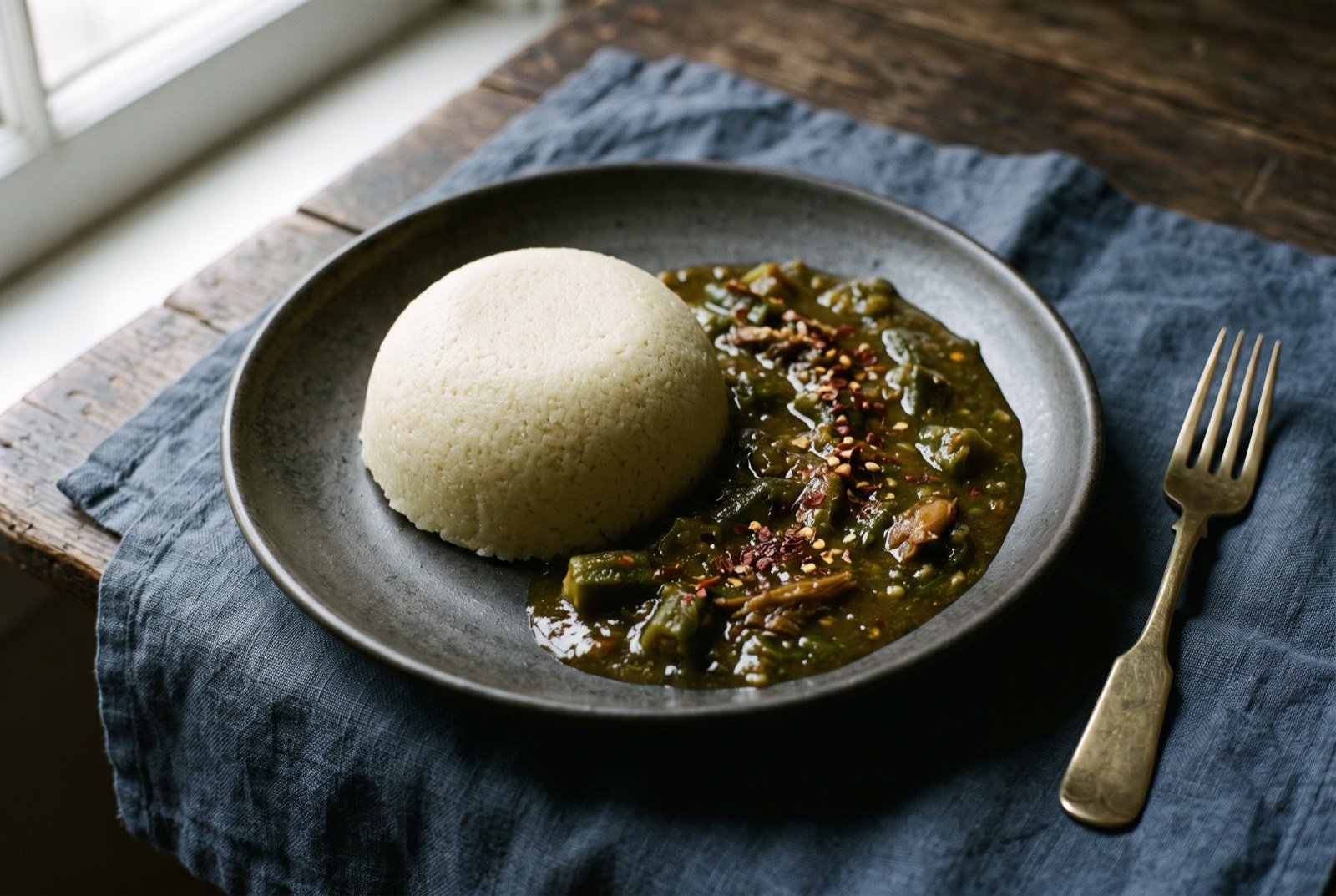
Chad and the Central African Republic, taken seriously. Two countries, five food worlds, and the sharpest ecological seam in African cooking: the line where butterfat gives way to shea and shea gives way to red palm oil. The canon as it is actually cooked, and every dish as tradition built it, then what a modern chef would change.
Sources and review · What this chapter does not assert · How we research · Know this better? Tell us
A Sense of Place
Two national borders that explain nothing, and one food frontier that explains almost everything.
The Chad and Central African Republic border is not a line between two national cuisines. It is the line where the cooking fat changes and the starch changes with it. North of it, food is bound with butterfat and sesame and thickened with dried leaf and dried okra, and the daily starch is a millet or sorghum ball. South of it, food is bound with red palm oil and groundnut paste and thickened with pounded leaf and ground seed, and the daily starch is a cassava ball. The eating gesture is identical on both sides: tear a piece, press a hollow with the thumb, dip.
Five food worlds, and the two borders cut across all five.
The Saharan and Kanem world
Teda and Daza, the peoples French sources call Toubou, plus Kanembu, Kanuri and Zaghawa. This is the world of the ouaddis, the interdunal pools of Kanem.
The fat is butterfat: the FAO nutrition profile for Chad names din bagar, Chadian Arabic for cattle fat, as the northern cooking fat, and sets it explicitly against shea butter in the south. The sauces are characteristically short, reduced and unthickened. The aromatics are dried onion, dried chilli, dates and, above everything, dihé. The starch is pearl millet, the dominant cereal of the Saharan and north Sahelian zones, worked into a ball the Kanembu call biri.
The Lake Chad world
Buduma, Kanembu, Kotoko, Kanuri, and the Hausa and Kanuri traders who move fish south into Nigeria. Here the aromatic is fish, in the way that dried shrimp is the aromatic in southern Nigeria. Two named products carry the basin. Banda is adult fish, scaled, gutted, cut into pieces and hard-smoked to something close to carbonised. Salanga is small fish given a short unsalted ferment and then sun-dried. They are not variants of one another and they are not interchangeable, and almost every English-language account treats them as though they were.
The Chadian Arab and Ouaddaï world
The Sudan-facing belt: Chadian Arabs including the Baggara cattle Arabs, plus Ouaddaïans, Maba, Tama and Zaghawa.
The most important structural fact about Chadian food is almost never stated: Chad's east is culinarily Sudanese. The Chadian sauce names are the Sudanese mullah family in French orthography. Moula loubiya is bean leaf; moula hidjilidj is the leaf of Balanites aegyptiaca, the desert date; and tagalia, charmout, asida and kisser each have a Nile-side cognate. The east thickens with dried okra powder, the Sudanese weika, ferments Senna obtusifolia into kawal, and bakes a sourdough sorghum flatbread on an iron plate. The starch comes in two forms rather than one: the ball, esh or asida, and the flatbread, kisser.
The Sara south
Sara and its constituent groups, Ngambaye, Gulay, Mbay, Kaba, Ngama and Sar, plus Mundang and Massa. Sudanian savanna, cotton country, higher rainfall.
The fat is shea butter. The thickening is deliberate and extreme: this is the belt where slipperiness is an aesthetic rather than a side effect. Its signature is tan koul, abbreviated in Chadian writing to TK and glossed as sauce longue. A Chadian blogger at La fenêtre étoilée describes it as extremely viscous and says eating it cleanly takes years of practice. Petit Futé gives its composition as hibiscus flowers, shea seeds and wild eggplants, thickened with a specific bark. No source names the bark, and this chapter will not guess. This is also where bili bili, the sorghum beer, is drunk, which is to say the non-Muslim south.
The Ubangi and CAR forest-savanna
Gbaya, Banda, Mandja, Ngbaka, Yakoma and the Sango riverine peoples, Zande in the east, Aka foragers in the Lobaye and Sangha, Mbororo Fulani in the north.
The fat is red palm oil and groundnut paste, called karako in Sango, and the thickeners are that paste, squash seed paste, okra and pounded leaf itself. The aromatics are koko (Gnetum africanum), the anise-scented wood called dongo ti kèkè, bitter eggplant, smoked fish and caterpillars. The starch is cassava in every form the plant permits: gozo, the flour ball, chikwangue, steamed and leaf-wrapped, mangbere, steamed paste, and kpangaba, the boiled root. The national dish is ngunza, pounded cassava leaf with groundnut paste and palm oil, which the French Wikipedia article puts on the tables of almost the entire population, at 95 per cent.
The Aka forest table
The fifth world, and the one where "cuisine" is the wrong frame. The best quantified recent study of BaYaka forager children's diet in the Congo Basin, published in 2023, found 42.8 per cent forest foods and 55.5 per cent agricultural foods, where two decades earlier agricultural foods were 22.2 per cent. That shift is the story, and it is about markets rather than taste. By eating time, fruits run at 39.6 per cent and tubers at 29.1, while terrestrial game is 1.4 per cent. That last figure is worth sitting with, given how completely outside perception of these peoples is organised around hunting.
Two moments turn the forest year: the honey peak in the late dry season and the caterpillar window in the late wet season. Both leave the forest, because Aka-harvested caterpillars and koko move into the Bangui market and into the sauces of farming peoples. The Aka are, among other things, the supply chain for two of the country's signature flavours.
The two capitals
N'Djamena. Petit Futé gives the economics: street restaurants open early and shut by nightfall, meals around 5,000 FCFA, while upscale places open later at around 20,000 FCFA a head with alcohol. Eating is right-handed, often seated on a mat without cutlery, in a Muslim-majority country. The cheapest hot protein is marara, offal and principally tripe, at 500 to 1,000 FCFA, and per Tchadinfos quoting a restaurateur named Haoua it is called out to passers by as "Marara, hot water!" The same outlet runs the counter-argument, quoting the health official Ponari Doun Samuel on parasite risk from undercooked intestine and the nutritionist Dr Goudja Gassara on purines and gout. A beloved cheap street food under official caution, reported together by a Chadian outlet, is the most alive food journalism either country has produced recently.
Bangui. The best account is by the Central African blogger Odilon. Lunch is the main meal, dinner is leftovers and fruit, people share from common bowls, and la mère mange en dernier, the mother eats last, having finished the cooking. Restaurant culture is minimal: eating out is an event, and each guest pays their own share. The street foods are brochettes, makaras (fried dough), boiled eggs and kandas, leaf-wrapped steamed parcels of meat, fish or termites.
The History in Layers
The indigenous foundation
Pearl millet and sorghum, with cowpea, okra, hibiscus, Vigna beans, sesame, watermelon and the wild grasses of the ouaddis. In the forest south, yams, oil palm and Gnetum. The Sao civilisation of the Chari and Logone floodplain, ancestral substrate of the Kotoko, is the deep archaeological layer around the lake.
One food here is wholly indigenous, non-Eurasian and non-American, and has no equivalent anywhere else in Africa. That is dihé, an aquatic cyanobacterium harvested from alkaline pools and eaten as a sauce. Its only real parallel worldwide is the tecuitlatl of the Valley of Mexico.
The trade layers
Kanem emerged as a commercial power around 900 CE, controlling trans-Saharan routes between North Africa and the Chad basin: salt, copper, tin, hides, kola, ivory, camels and gold. Islam was formally adopted around 1067 CE under Hu, opening relationships with Muslim merchant networks, and a Kanem king founded a school in Egypt in 1324. Kanem held the Fezzan oases by the late thirteenth century for no more than half a century, and collapsed between 1390 and 1400 under Bulala pressure.
The culinary consequences are direct. The tea and spice trade, green and red tea, cardamom, cloves, cinnamon and ginger in Chadian coffee and karkanji, arrives along these routes; the date enters the northern pastry repertoire; and the whole Chadian Arabic sauce vocabulary arrives from the Nile side rather than the Saharan side. Chad's kitchen faces east, and the dish names give it away.
The Columbian Exchange, and why the dates matter here
Roger Blench's lexical study of cassava diffusion is the best guide, and the dates are much later than most food writing assumes. Portuguese introduction established cassava on the West African coast by the 1600s, but it "only began to penetrate the interior in the eighteenth and nineteenth centuries", and the documentary anchors are late: Barth in the 1850s records Fulɓe cultivating cassava at Yola, and Nachtigal in 1870 observes cassava leaf being used in Borno. The lexical root ngale dominates the Chad, CAR and Sudan region, suggesting eastward diffusion from the Lake Chad area through Kanuri speakers.
So ngunza, the dish something like 95 per cent of Central Africans eat, is built on a South American plant that reached the Chad basin roughly a century and a half ago. The most national dish in the volume is one of its youngest. That is not a debunking. It shows that a cuisine can absorb a plant completely inside six generations when the technique is already there waiting for it.
The colonial economy as a machine for converting food into fibre
Chad and cotton. The French organised limited production from 1910 and pushed exports hard from 1920, treating cotton as the colony's only exploitable resource and as the instrument for imposing a cash economy. From 1928 the company Cotonfran held the concession under a contract obliging villages to hold production quotas and obliging Cotonfran to buy at least 80 per cent of output. The system ran on forced labour and on the explicit subordination of food crops to cotton, and production rose from 17 tonnes in 1929 to 80,500 tonnes in 1957. The consequences in the record are food consequences: a wealth divide between labourers and the chiefs and middlemen above them, decreased food production leading to famines in some regions, and the Bébalem massacre of 1952 after cotton-grower protests.
CAR and the concessions. The French leased vast tracts of Ubangi-Shari to private European companies. Overseers compelled men and women to gather wild rubber, hunt for ivory and skins, and work plantations, and Africans unable to cultivate their own fields because of those labour demands faced food shortages and famine. Later the colonial state forced cotton and coffee, and forced food crops to supply French troops and labour crews.
In both territories the colonial economy was a machine for converting food-growing labour into fibre, and the famines were a structural output rather than an accident. Any account of "traditional" twentieth-century eating here is an account of a cuisine practised under cash-crop compulsion.
Lake Chad: the received story is wrong
The lake covered about 25,000 km² in the 1960s and was the sixth largest in the world. The droughts of the 1970s and 1980s cut it to about 2,000 km². Most accounts stop there.
But a 2020 Scientific Reports study found the extent had been stable for the previous twenty years, with groundwater storage increasing, and a 2024 study in the same journal puts it at 18,800 km² in 2022 including vegetated inundated areas. Abdallah Mahamat-Nour of the University of N'Djamena, a co-author of the 2024 paper, gives roughly 14,000 km² in 2013 and 24,500 km² in 2024.
The problem is not disappearance. It is volatility. A 2024 PLOS Climate study makes the point: communities historically hedged across rain-fed farming, river irrigation and rice, and those three "could not fail simultaneously" in the past, whereas erratic rainfall plus armed conflict now constrain all three at once.
What the conflicts did to the food, stated factually
Both countries have been through prolonged armed conflict: Chad's civil wars from the late 1970s, the Central African Republic's collapse from 2012. This chapter will not use that as atmosphere. Where it changed what people eat, here is how.
It broke the fish chain. Drought interrupted the breeding migrations of the northern-basin Alestes baremoze and A. dentex, and those populations have disappeared completely from parts of the basin. By the mid-1970s catches were dominated by Tilapia zilli and Clarias, which tolerate very low oxygen, and the composition of banda shifted towards immature fish. In 1976 to 1977 roughly 20,000 tonnes of banda passed through checkpoints, and prices tripled between 1974 and 1977: a sack of banda from ₦30 to 40 up to ₦70 to 150. Insurgency around the lake since 2014 disrupted both the fishing and the trade again.
It broke the forest chain. The routes that carry smoked fish, koko, caterpillars and cattle out of the Lobaye into Bangui are the routes armed groups have interrupted since 2012. A cuisine whose signature aromatics are gathered by forest specialists and sold on by traders stops working when the traders stop moving.
And it broke the record. There has been no sustained field food ethnography in either country for a long time, which is why this chapter leans on FAO grey literature, a handful of bloggers and peer-reviewed food science, and says so.
The Flavour Arsenal
If you buy four things, buy whole pearl millet, green dried okra powder, a small vacuum-packed dried fish and a good locust bean ferment.
The savour
| Name | Where | What it is | Flavour | How to use it |
|---|---|---|---|---|
| Kawal | Eastern Chad, Darfur | Fermented Senna obtusifolia leaf, buried two weeks in a sealed pot | Butyric, cheesy, ammoniacal. A meat proxy | Crumbled into a stew base, or ground and sprinkled over a finished mullah |
| Néré | South, and national | Fermented Parkia biglobosa seed, the dawadawa of Volumes Three and Five | Sulphurous, meaty, melts into a broth | The FAO nutrition profile records poorer Chadian families substituting it for meat outright |
| Salanga | Lake Chad | Small Alestes fish, short unsalted ferment, sun-dried | Clean, saline, savoury, not smoky | A seasoning. Ground to powder and infused below 80°C |
| Banda | Lake Chad | Adult fish, gutted, cut, hard-smoked and dried | Dense smoke, collagen, structure | An ingredient. Simmered whole and flaked in at the end |
| Charmout | Chadian Arabic | Dried meat | Concentrated, faintly gamy | Rehydrated into a sauce of the same name, and into tagalia |
| Rob, gariss, mish | Baggara pastoralists | Back-slopped and fed-batch soured milks | Round lactic sourness, diacetyl, peptides | Rob is used as a sauce for porridge, which is the point most outside accounts miss |
Dihé, which deserves its own heading
Arthrospira platensis, until recently Spirulina platensis, is a filamentous cyanobacterium that blooms in the alkaline, mineral-rich interdunal pools of Kanem. The filaments run about 0.3 mm long.
It is harvested only by Kanembu women. Slow Food and Face2Face Africa both report that men are barred from the water on the belief that their presence would render the lake barren; those accounts may share an upstream source, so this chapter attributes the belief rather than asserting it.
The method is a drying technique as much as a harvest. Skim the blue-green biomass from the surface into clay jars or baskets, 4 to 8 kg per woman per day; filter through cloth; then sun dry the filtered biomass directly on the sandy shore in thin beds. The sand is not incidental: it is a drainage bed, wicking water downward while the sun works the top. When semi-dry, cut into squares, carry to the village, and finish the drying on mats. The result is a hard, dark green, brittle cake, and harvest peaks with the June to September rains.
It is food, not a supplement, and the flavour is not mild. The cake is crumbled and worked smooth in a mortar, reconstituted, cooked for 1 to 1.5 hours, and built into what Abdulqader, Barsanti and Tredici call simply la souce, a fish or meat and vegetable broth. The characteristic note is a bitter aftertaste, and any account that sells you dihé as mild has not eaten it.
Abdulqader and colleagues recorded roughly 40 tonnes a year at Lake Kossorom in 1997, worth more than US$100,000 locally, moving through the markets of Massakori, Massaquet and N'Djamena and across the borders, and by 2007 FAO-supported work had generated around 50 million CFA francs, roughly EUR 75,000, for 500 women. EU-supported processing now grinds the algae, moulds the paste on racks and solar dries above 40°C, and the tablets retail in Western health shops at up to EUR 20 a pack.
A food eaten in Kanem for centuries is now more legible to a European supplement buyer than to a Western food writer. That is the sentence this chapter exists to make unnecessary.
The leaves
| Local name | Language | Botanical | Character | Use |
|---|---|---|---|---|
| Koko | Sango | Gnetum africanum | Dense, chewy, resinous and mineral. Closer to cooked seaweed than to spinach | Shredded to a hair-fine chiffonade, simmered with groundnut paste and onion |
| Ngunza | Sango | Cassava leaf | Bitter until cooked out; then dark, dense, faintly nutty | Pounded in a mortar, then long-boiled |
| Mouloukhié | Chadian Arabic | Corchorus olitorius, jute mallow | Intensely mucilaginous, mild, grassy | The Egyptian and Sudanese molokhia cognate. Marker of eastern Chad's Nile orientation |
| Hidjilidj | Chadian Arabic | Balanites aegyptiaca leaf | Bitter, saponin-edged | Moula hidjilidj, also called koumranga |
| Lê ti ngago | Sango | Bitter eggplant, Solanum aethiopicum group | Sharply bitter, firm | With game, beef or fish, alongside dongo ti kèkè |
| Weika | Chadian and Sudanese Arabic | Dried ground okra | Green, tannic, thickening | 3 to 4 tablespoons into a meat broth, whisked hard |
Note the jute mallow. Corchorus olitorius is molokheya in Cairo, adémè in Togo, ewedu in Lagos and mouloukhié in N'Djamena. Eastern Chad is where the Nile Valley reading of it and the West African reading meet in one country.
Seeds, fats and thickeners
Groundnut paste is the standard Central African enricher, appears in half the CAR canon, and is also the chapter's real food safety risk, dealt with in the sourcing section. Squash and pumpkin seed is the Central African analogue of egusi: lightly toasted and ground, it is a fat-and-protein binder whose protein sets on heating and traps whatever it is mixed with, while its oil renders out and gives the sauce its characteristic broken, oil-slicked surface.
Shea butter is the southern Chad and northern CAR fat, waxy and faintly cocoa-ish, and it is also used simply to dress cooked beans. Red palm oil is the CAR fat, and everything Volume Four said about carotenoid heat sensitivity applies unchanged.
Two Central African aromatics recur in the sources and neither has a botanical identification anywhere I can find. N'guiriki is a market spice powder said to produce a glutinous, delicious sauce. Dongo ti kèkè, "bois d'anisette", is an anise-scented wood used by the Sara, Kaba, Ngama and Ngambaye, and its distribution follows the Chad, Cameroon and Sudan border zone, which makes it a direct bridge between northern CAR and southern Chad. Both are named here without botany.
Grains, and one agronomic fact
Pearl millet in the north, red sorghum in Mayo-Kebbi, rice in Tandjilé, and N'Djamena eating all of them interchangeably. The fact worth knowing is berbéré, the transplanted dry-season sorghum, called muskuwaari in northern Cameroon: grown on residual moisture in heavy vertisol clays after the floods recede, with seedlings transplanted rather than sown, and the reason the basin gets a second harvest. CIRAD and IRD have published on it, neither research pass on this volume could obtain the texts, and so this description is deliberately general.
Two insects belong in the pantry rather than in a novelty box. Makongo, also woko, are caterpillars, Imbrasia and related saturniids, harvested July to September in the Lobaye and eaten fresh, dried, grilled or in sauce. Kinda gozo are grasshoppers, and the name translates roughly as "make the manioc fall", because the dish is good enough that people eat extra manioc with it. That is better food criticism than most restaurant reviews.
Part Two
The Technique Ladder
First, an honest problem
Volume Three could hang its elevations off Ikoyi and Akoko. Volume Four could not, and said so. This volume has less than Volume Four had.
There is no identifiable fine-dining tradition for Chadian or Central African cuisine anywhere in the world as of August 2026, and no verifiable Chadian or Central African restaurant in the United Kingdom. That is not a gap in the research. It is the finding, after searching in English and French across Michelin, the Basque Culinary World Prize roll, TripAdvisor, Petit Futé, Yelp and Companies House.
It goes further. N'Djamena's restaurant sector, per the Petit Futé directory, is almost entirely foreign: Beyrouth (Lebanese, described as the best in the capital), Le Shanghai, Restaurant La Cave (French bistronomy), Chez Mame Diarra (Senegalese, described as undoubtedly the best in N'Djamena), Au Bout des Doigts (Italian). Chadian food appears in two or three listings and is presented as outdoor casual eating rather than gastronomy.
The most expensive restaurant meal in Chad's capital is Lebanese or French. Chadian food is what you eat at home. That sentence carries this chapter, and it means the six rungs below are inferential rather than reportorial. I would rather say so than inflate a scene that does not exist.
Four people are worth naming, and only one is Chadian.
Priscille Lopiamadji Mbaïwodji, Chad. The only person I could verify campaigning for Chadian gastronomy at a professional level, and the promoter of Festimets, the Festival des mets traditionnels du Tchad, first edition 25 to 30 April 2023 at the Institut Français du Tchad, under the theme "Preserving culinary heritage, our cultural identity". Two cookbooks launched alongside it, and the second is this chapter's epigraph: Tchad, en quête d'une identité culinaire, Toumaï editions, January 2023. Chad, in search of a culinary identity, said by a Chadian, in Chad, in 2023.
Fatmata Binta, Sierra Leonean Fulani, based in Accra. The most transferable figure here because she cooks the pastoralist line rather than a national cuisine: her Dine on a Mat concept has guests eating communally from mats by hand, and her larder is precisely the Sahel margin, fonio, millet, moringa, baobab and dawadawa. She won the Basque Culinary World Prize in 2022, the first African chef to do so. She is proof that a herder's grain-and-sour-milk cuisine can carry a dining room without being dressed up as French.
Omer Al Tijani, Sudanese, London, who published The Sudanese Kitchen in 2025 through the Almas Art Foundation: over 100 recipes with difficulty ratings and, crucially, sourcing guidance. He is blunt that sourcing Sudanese ingredients here, dried okra included, feels like "sourcing something illegal". Because eastern Chad and Sudan share the mullah family, kisra, kawal and charmout, his book is currently the single most useful published work for half of Chad's kitchen, and this chapter says so.
So the ladder is built from mechanism. Every rung is a documented technique of this region's own preservation and fermentation systems, done deliberately and measured. One fabricated claim about a Central African restaurant in Marseille is dealt with in the final section.
Rung 1. Mill your own grain, to order, from toasted whole grain
Pearl millet is 7.0 to 7.9 per cent fat, and its lipase is concentrated in the pericarp, the aleurone layer and the germ. The moment the grain is broken with moisture present, that lipase starts hydrolysing triglycerides into free fatty acids. The measured consequences in stored untreated flour:
- Unpleasant off odour and bitter taste by day 10, with the sensory score down to 5 out of 9.
- Free fatty acid value rising from 20.11 per cent to 32.43 per cent over 30 days.
- Heat treatment of the grain at 18 per cent moisture, 80 seconds at 900 W inactivated lipase by 84.3 per cent, from 112.6 down to 21.3 μmol per hour per gram, held free fatty acids at 20.80 to 22.25 per cent over the same period, and extended acceptability from 10 days to 30.
This is why most British attempts at boule taste faintly bitter and soapy, and why the cook blames the grain. The grain is fine. The flour is a fortnight old and has been sitting in a warm shop in a paper sack.
Buy whole millet grain, toast it, mill it in small batches, freeze what you mill. There is a second dividend: dry-toasting the intact grain drives Maillard and Strecker chemistry and generates pyrazines that raw milling cannot produce. You lose a defect and gain an aroma in one step. Nothing else in this chapter changes the food as much.
Rung 2. Back-slop a kisser starter, and let the mould do its half
Pyrosequencing of Sudanese kisra dough, published in Annals of Microbiology in 2020, reframes the whole bread. Bacteria: Lactobacillus at 81.7 per cent and Pediococcus at 14.1 per cent of reads. Fungi: Rhizopus at 85.45 per cent, principally Rhizopus arrhizus, with Aspergillus flavus also present. The comparison ferment, hulu-mur, is structurally different: acetic acid bacteria at 17.9 and 6.3 per cent, and a fungal community of Alternaria at 71 per cent.
Kisser is not a sourdough. It is a koji-and-sourdough hybrid. Rhizopus is strongly amylolytic, the same genus used in tempeh and in Chinese jiuqu. Its amylases liberate fermentable sugars from sorghum starch, the Lactobacillus converts those to lactate, and the residual maltose is what browns the sheet on the griddle in under a minute.
A properly back-slopped starter therefore gives three things a rushed batter cannot: acidity, aroma complexity from the mould, and a sugar reserve for Maillard browning at very short contact times. A quick batter has neither, so it must be cooked longer to set, and longer cooking dries it into cardboard. Two honest caveats. A. flavus is the aflatoxin producer, which argues for a controlled, warm, regularly refreshed ferment rather than for romanticising a wild culture left alone. And the widely repeated claims that fermentation reduces sorghum phytate and tannins and raises protein digestibility are well supported in the general sorghum literature but are not findings of that paper.
Rung 3. Separate your two dried fish, and build a stock from the small one
The biggest technical point in the volume, and the one British writing gets wrong most consistently.
Salanga is small fish, principally Alestes baremoze and A. dentex. The FAO fermented fish review specifies fermentation 3 to 6 hours without salt, drying 3 to 7 days, with a finished product light brown and dry-firm, and estimated annual production around 10,000 tonnes. Banda is adult fish, scaled, eviscerated, cut into pieces, then smoked and dried; a second FAO source describes it as burnt, smoked and dried, which is not a slip but a hard, high-heat char-smoke giving a very dark, very dry product with an exceptionally long shelf life. Their flavour chemistry differs in kind. Salanga is dominated by free amino acids and nucleotides from autolysis, glutamate and inosinate with a light salt load; banda carries all of that plus guaiacol-family smoke phenolics and a hard, collagen-set texture.
So salanga is a seasoning and banda is an ingredient. Salanga behaves like katsuobushi or a Sicilian salted anchovy and belongs ground and steeped. Banda behaves like a smoked ham hock and belongs simmered whole and flaked in at the end. Treating banda as a seasoning wastes it; treating salanga as an ingredient makes food that tastes of dust.
The procedure. Grind salanga-type fish to a powder and infuse below 80°C for 20 to 30 minutes, then strain through muslin: you extract glutamate and inosinate without boiling out volatiles or driving trimethylamine into the sauce. Simmer banda-type fish whole, separately, and flake it in at the end. Rinse and soak dried fish first; surface salt and oxidation products come off in the water and the interior glutamate does not. Diaspora practice is to boil both together for an hour, which is where the ammonia reputation comes from, and it is a procedure problem rather than an ingredient problem.
Rung 4. Treat mucilage as a hydrocolloid, and decide when the acid goes in
This region has two named sauce categories answering the same question: how do you get a dry starch ball down without a drink? Sauce longue lubricates mechanically, with mucilage; sauce courte lubricates with fat and seasons by reduction. A Chadian meal often carries one of each, by design.
Okra's draw comes from pectic polysaccharides, principally a rhamnogalacturonan, and two published facts govern its use. Ascorbic acid reduces okra pectic polysaccharide viscosity, and so do prolonged heat and shear: if you want the draw, acidify at the end and off the heat; if you want a slack, spoonable sauce rather than a rope, add your lime or tamarind early and let it work. The same okra gives two textures depending on when the acid goes in. That is a plating decision, not an accident. And okra polysaccharides have measurable emulsification and stabilisation performance, which makes a groundnut-and-okra sauce a polysaccharide-stabilised emulsion, buildable the way you would build a sauce with lecithin: shear the fat phase into the mucilage first. Adding everything at once and boiling hard shears the polysaccharide, breaks the emulsion, and leaves oil on top and grit underneath.
Now the regional part. Northern Chad and Sudan use okra dried and ground, as weika; the southern tan koul belt uses fresh mucilage and wants the ropes. Drying and grinding physically shears the chains and dehydrates the matrix, so on rehydration you get a shorter, more even, more soup-like viscosity rather than long elastic strands. That is a chosen texture, not a poverty adaptation, and weika is also how you eat okra in March. The making, per Anny Gaul: string whole pods on thread like a necklace, hang to dry completely, cut off the tough tops, halve, and grind, at roughly 50 pods to a third of a cup of powder. The using: 3 to 4 tablespoons into a meat broth, whisked with the mifrak, the splayed wooden hand-mixer, stirring regularly for 10 to 15 minutes, to a target that thickens but stays liquid. If you dry your own, keep the dehydrator under 60°C.
Rung 5. Adopt the kilishi two-stage dry for every protein you dry
A borrowing that needs declaring. Kilishi is documented as a Kanuri and Hausa technique, and the Kanuri are a Lake Chad basin people spanning Nigeria, Niger and Chad. Chad's own dried meat, charmout, is named everywhere and specified nowhere. So this rung takes a fully documented basin process and applies it to a Chadian ingredient, and says so.
- Lean beef, goat or lamb sliced into sheets 0.5 to 1 cm thick, about 15 cm long, up to 6 cm wide.
- First dry, 2 to 6 hours, to roughly 40 to 50 per cent moisture.
- An infusion slurry of about 50 per cent defatted groundnut cake paste, 30 per cent water, 10 per cent garlic, 5 per cent bouillon, 2 per cent salt, plus pepper, ginger and onion. The dried sheets absorb up to almost three times their own weight.
- Second dry, 2 to 3 hours, to 20 to 30 per cent.
- Roast over glowing embers about five minutes.
- Final moisture 10 to 12 per cent, falling to about 7 per cent in storage; sealed, stable at room temperature for about a year.
Read the mechanism and it is a modern kitchen procedure invented several centuries early. The first dry concentrates the meat and opens the protein matrix; the slurry penetrates because the substrate is thirsty, which is the whole trick and the reason the intermediate dry exists; the second dry sets the glaze; and the ember roast is a five-minute Maillard and pyrolysis event on a surface now loaded with both protein and reducing sugar. Marinating wet meat and drying once gives you neither penetration nor a browning surface. Transfer it wholesale, with a dehydrator, scales you can leave a rack on, and a torch for the last five minutes.
Rung 6. Run a house fermented dairy line, and treat it as the acid
Gariss is fermented camel milk, produced without heat treatment and without added starter, in tanned goat-skin bags called siin, agitated by the camel's own movement, and run as a fed-batch fermentation with fresh milk added as product is drawn off. It is documented at 2.8 to 5 per cent fat, 10 to 11 per cent total solids, pH 3.6 to 5.9, and where no starter is available a few black cumin seeds (Nigella sativa) and an onion bulb go in instead. Rob is cow, sheep or goat milk back-slopped from the previous day, fermented overnight and churned in the morning, at pH about 4.5 fresh, and used diluted as a drink, sweetened as a dessert, and as a sauce for porridge. Mish is spiced fermented milk with black cumin and fenugreek added after souring, keeping up to 21 days, and samn is ghee.
And then the technique nobody outside the region uses. The vessel is smoked before the milk goes in. The related Somali-region dhanaan is fermented in containers smoked for 20 to 30 minutes over embers of Olea afana wood, then fermented 48 to 72 hours at 25 to 35°C. Smoke phenolics are antimicrobial and they are also the flavour signature: you are seasoning the ferment through its container. Do not confuse this with dukhan, the acacia smoke bath, which is a Sudanese cosmetic treatment rather than a food process.
The transferable insight is that a fed-batch, continuously topped-up, agitated ferment at ambient Sahel temperature is a chef's technique. It is a kefir line run as a solera, and it is what finishes a boule: lactic acid at pH 4.5 brings casein-derived peptides and diacetyl and lands soft and round, where citric acid lands sharp and alone. A boule napped with smoked, salted, soured milk is a finished dish. A boule with a wedge of lemon beside it is a tourist's idea of the same dish.
Part Three
The Ferment and Preserve Bench
Four things worth making. Two are honest approximations that this chapter refuses to call by the original name.
1. Kawal, and its honest substitute
The real process, from the National Research Council's account of Sudanese leaf and seed fermentations: harvest fresh Senna obtusifolia leaves in the rainy season, when the plant is flowering and fruiting; pound to a paste; pack into an earthenware zeer buried to the neck in shade; cover the paste with fresh sorghum leaves, weight with stones, seal the mouth with mud; every 3 days open, remove the leaves, remix thoroughly by hand and reseal; after 11 to 15 days take out the strongly smelling black mass; mould into small balls and sun dry 5 days.
None of that is folklore. Burying the zeer to the neck holds the mass at a stable soil temperature where surface daytime swings are enormous; the mud seal, the leaf layer and the stones create a semi-anaerobic headspace that favours Bacillus over spoilage moulds; and the three-day remixing redistributes the organisms through a mass far too viscous to mix itself.
You are not going to make this in Britain. Senna obtusifolia is not sold here as a food, and this chapter will not tell you to forage a plant the literature calls reputedly toxic on the basis that fermentation fixes it. Buy into the same chemistry instead: dawadawa or iru, which is what poorer Chadian families use as a meat substitute anyway, or hikiwari nattō or cheonggukjang. And make the powder, because that is the use nobody thinks of: dry the ferment at 55°C until brittle, grind, and keep it sealed in the freezer. A quarter teaspoon over a finished sauce is exactly how Sudanese cooks use kawal powder over a mullah.
2. The kisser starter
The one live culture here you can genuinely keep. Mix 50 g white sorghum flour with 50 ml water in a clean jar and leave at 28 to 32°C. Refresh daily, discarding most and feeding equal weights, until it smells clearly of yoghurt and hay and doubles predictably. Give it a week. Then hold it in the fridge, and refresh twice before you bake. Use at 9 parts flour to 2 parts water to 1 part starter, fermented 18 to 24 hours.
You are cultivating a pair. The Lactobacillus and Pediococcus make the acid; the Rhizopus makes the sugar they feed on and the griddle browns. Keep it warm, keep it fed and keep it short: A. flavus is in the wild version of this community, and a warm, vigorous, competitive culture is the defence against it.
3. The fed-batch soured milk line
Rob and gariss, run in stainless. Ten minutes a day.
Smoke the vessel first. Twenty to thirty minutes of hardwood smoke in the empty, dry, lidded vessel, following the documented dhanaan practice. Acacia is the right wood and Oasis Market sells Sudani hatab at £7.00. A stovetop smoking box will do it. Wipe out the ash; do not wash it.
Then run it as a solera. Warm 500 ml whole milk to 30°C, add 2 tablespoons of live kefir or of yesterday's product, hold at 28 to 32°C. Draw off daily, top up with fresh milk, stir. That is the fed-batch structure of gariss, which runs continuously in a siin bag agitated by the camel carrying it.
The targets are documented. Rob sits at about pH 4.5 fresh; gariss at pH 3.6 to 5.9, 2.8 to 5 per cent fat, 10 to 11 per cent total solids. For mish, spice after souring: black cumin and fenugreek added to soured milk and left two days or more gives a product documented at up to 21 days. With no starter at all, the traditional insurance is a few black cumin seeds and an onion bulb, which is a microbial inoculation dressed as seasoning. Goat's milk is closer than cow's to what a pastoralist would recognise.
4. The Lake Chad fish bench
Salanga-style: a short unsalted ferment and a hard dry. The FAO specification is 3 to 6 hours of fermentation without salt, then 3 to 7 days of drying. Without salt you rely on the fish's own gut and muscle enzymes plus surface microflora to begin proteolysis, then arrest it fast by dropping water activity in hard Sahelian sun, and the window is short precisely because nothing is holding the spoilage organisms back.
Britain does not have that sun and this chapter will not pretend otherwise. What you can do safely is the concentration without the ferment: small whole fish, gutted, brined at 5 per cent for 20 minutes, then dried at 40 to 45°C for 12 to 18 hours until hard and resonant. That does not give you the autolytic ferment, and the deep savoury note will be lighter than it should be. If you want the real thing, buy it: Japanese niboshi and Italian salted anchovies deliver the same free amino acid load, and they are honest substitutions.
Banda-style: hard smoke. A cold smoke first, then a hot smoke at 90 to 100°C with the vents open until the pieces are hard and ring when tapped, then a finish in the dehydrator. Acacia tastes like the place; generic barbecue chips taste like a barbecue.
And the drinks, which do not get a bench slot
Bili bili, the sorghum beer of the non-Muslim south, runs through malting, mashing, souring, straining, boiling and fermentation at ambient temperature, with two successive fermentations: a souring stage dominated by Kluyveromyces marxianus at 65 per cent of isolates, then an alcoholic stage dominated by Saccharomyces cerevisiae at 76.6 per cent of strains. The souring drops pH to around 3.5 to 4.0 before boiling, and in a village brewery with no sanitation and no hops that acid is the entire antimicrobial defence, which is also why bili bili is drunk within a day or two. The germination times, final pH figures and the alcohol range of 2.75 to 4.0 per cent by volume come from work on northern Cameroonian practice, not Chadian, and this chapter says so rather than passing them off.
Karkanji needs a disambiguation almost every English source misses. In Chad it names two things: the hibiscus-calyx drink, and a sauce made from hibiscus leaves cooked with meat or fish and thickened with peanut paste or sesame flour. If you have only met the drink, you have met half of it. The drink, per Alice Pégie: one large handful of dried calyces, 300 g of ginger root, 100 g of sugar, one cinnamon stick and 10 cloves in about 2 litres of water. Boil with the ginger chopped, simmer covered 10 minutes, add the sugar, dissolve, cook gently 5 minutes more, cool naturally. Three hundred grams of ginger to two litres is the whole point: an aggressive, throat-warming dose, and it is what makes Chadian karkanji drinkable hot, which is often how it is served.
Sourcing in Britain
Verified August 2026. Where a supplier could not be confirmed, that is said rather than smoothed over.
The honest headline
There is no Chadian or Central African restaurant in Britain, and no Chadian or Central African grocer. What exists is a general African grocery trade that is overwhelmingly Nigerian, Ghanaian and Caribbean in its stock, plus a Sudanese trade that covers the eastern half of this chapter well. You will buy this cuisine out of two adjacent larders and a wholefoods aisle.
Verified trading, August 2026
- Oasis Market (oasismarket.co.uk), copyright 2026, with a dedicated Sudanese Grocery category running to 170 items. Free over £59.99, otherwise £5.99, 2 to 4 days. This is the eastern-Sahel larder and the most important entry in this list. It carries Sudani dried ground okra, and Sudani hatab, acacia smoking wood, at £7.00, which is genuinely hard to find. Lead with this one.
- Surulere Foods (surulerefoods.com), copyright 2026, nine dried fish lines in stock, free delivery over £79.99. The dried fish and stockfish specialist: stockfish head 1 kg £22.49, premium stockfish 1 kg £39.49, Papa's Choice trimmings 100 g £6.49, Ades boneless fillet 350 g £10.99.
- Niyis African Supermarket (niyis.co.uk, Reading warehouse), copyright 2026 with blog posts dated August 2026. Free over £120 for the rest of the UK, next day before 11am, click and collect at Reading.
- CC Continental Supermarkets (cccontinental.com, three Leeds branches), copyright 2026, nationwide from £3.99. The only verified retailer covering the African and South Asian larders in one basket, which here means fenugreek, nigella and African flours together.
- Ofoodi UK (ofoodiuk.com), copyright 2026, dedicated dried fish category, no walk-in shop and click and collect by appointment only. AfriPantry (afripantry.co.uk), copyright 2026, UK-wide but multi-vendor, so split shipments and variable quality.
- Healthy Supplies publishes production batch dates, exactly the behaviour you want from a grain supplier, though its organic fonio was out of stock in all sizes on 25 August 2026.
Not confirmed, and not to be used
Ogbongeh (dried catfish, 1.2 kg, £14.99) has live e-commerce and current stock but no 2026 copyright: treat as trading and verify. Buy Wholefoods Online, Sous Chef, John and Biola, SoukWalla and Sudansoug could not be verified, some blocked and some returning metadata only. SoukWalla is the frustrating one, because search results show ready-made kisra, 10 pieces, and the shop, price and shipping are all unconfirmed. UK Afrifoods carries a 2022 copyright and delivers only within London, Afroko is an unreliable directory whose London guide includes an address in London, Ontario, and Mandola in Notting Hill is reported closed while zombie listings persist.
Corridors, in person
London: Ridley Road in Dalston, Rye Lane in Peckham, Deptford High Street, and Shepherd's Bush Market, which usefully puts Levantine shops in the same walk for dried limes and hibiscus. For the Sudanese side, Toteil in Acton is the anchor and the right place to ask where the community shops. Elsewhere: Cheetham Hill in Manchester, Soho Road in Birmingham, CC Continental and Kirkgate in Leeds, Narborough Road and Belgrave Road in Leicester, Easton in Bristol, City Road in Cardiff, and Solly's African Village in Glasgow, which publishes no address or hours, so ring first. Two negative findings, stated rather than papered over: the Grainger Market trader list in Newcastle names no African, Caribbean or Middle Eastern trader, so go to Westgate Road; and no named African grocery could be verified in Sheffield or Liverpool, where the corridors are Spital Hill and Burngreave, and Lodge Lane and Granby. This chapter will not invent a shop name to fill a gap.
The ranked list: what decides great from grim
- Freshly milled pearl millet. Bitter, soapy flour is why most British boule fails, and it is measurable: off odour by day 10, free fatty acids up by more than half in a month.
- A living kisser starter. Without the Rhizopus and Lactobacillus pair you have a pancake, not a bread, and it will not brown.
- Salanga-type small dried fish, vacuum packed. The savoury backbone of every sauce, and the difference between depth and salt.
- Banda-type smoked fish. Smoke phenolics, collagen and body that no cube imitates.
- Fresh, un-rancid groundnut paste. Bad nut paste ruins a dish twice, once on flavour and once on aflatoxin.
- Green, live dried okra powder. Brown weika has neither draw nor emulsifying power, so the sauce splits.
- Dawadawa, or a nattō-family stand-in for kawal. The region's own umami, and the one flavour British versions never have.
- Real fermented dairy at the right pH. Lactic acid with peptides and diacetyl, not a wedge of lemon.
- White, fresh sorghum flour, because tannic or stale sorghum makes kisser astringent and grey.
- Goat or mutton rather than lamb, because long-cooked sauces want mature meat and connective tissue.
- Samn or food-grade shea rather than neutral oil. The fat is a flavour, not a medium.
- Acacia or another defined hardwood for smoking. Generic smoke tastes like a barbecue; the right wood tastes like the place.
Quality markers, and one real safety issue
Pearl millet should be uniform grey-green to slate, with no dust at the bottom of the bag and no musty or crayon smell. Avoid bagged millet flour without a date, and avoid supermarket "millet flour" that does not state the species, because most is proso rather than pearl. Sorghum flour should be pale, fine and sweet-smelling; grey or khaki means age.
Dried okra powder. Good weika is green to grey-green. Brown means it was dried too hot or is old, and the mucilage is degraded. The test: it should thicken cold water within a minute or two. If it does not, it is dead and you are buying green dust. Cornflour, xanthan and guar thicken but do not emulsify, and the sauce will not hold its fat.
Dried fish. Small fish should be dry and hard rather than leathery, pale straw to grey rather than bronze or orange, which signals lipid oxidation, and smell cleanly marine, never ammoniacal. Smoked fish should be hard, resonant when tapped, deep amber, and smell of woodsmoke first and fish second. Buy vacuum-packed and dated, never from an open sack, and store it in the freezer. Smoked mackerel substitutes for the fatty smoke note and a smoked ham hock for the collagen role; liquid smoke gives guaiacol without protein and reads instantly as fake.
Groundnut paste, and this is the real safety issue. Buy 100 per cent peanuts from a retailer with turnover. Aflatoxin is not theoretical: a Gambian survey of 85 peanut butter samples found aflatoxin B1 in 8 of them, 9.4 per cent, with a top reading of 38.76 ppb, against an EU limit of 2 µg/kg for AFB1 and 4 µg/kg total for direct human consumption, and homemade paste recorded the lowest contamination only where mouldy and discoloured nuts had been sorted out first. UK retail peanut butter is subject to EU-derived limits and routine testing; informal imported paste is not. Any bitterness, mustiness or acrid back-note means rancidity or mould, and you throw it out.
Fat and dairy. Live kefir, thick labneh or full-fat live natural yoghurt, because if it does not say live cultures it is a dairy dessert. Plain ghee for the samn role, unrefined food-grade shea butter rather than cosmetic grade, which is not food safe, and cold-pressed light sesame oil for finishing, never toasted dark East Asian sesame oil, which will make Sahelian food taste Chinese.
The kit that matters
A grain mill, burr or a high-powered blender with a dry jug, which sidesteps the day-10 rancidity cliff and is the highest-value purchase here. A heavy iron griddle, 40 cm or more, for kisser. A wooden paddle and a deep, heavy, straight-sided pot for the boule. A dehydrator with a dial, kept under 60°C for okra. Scales you can leave a rack on, because the kilishi process is defined by moisture targets you hit by weight loss rather than by looking. A pH meter, thirty pounds, which turns three guesses into three controls. And a proving box holding 28 to 35°C for the starter and the milk line.
Voices and Sources
From inside the tradition
- Priscille Lopiamadji Mbaïwodji, Chad. Promoter of Festimets, first edition 25 to 30 April 2023 at the Institut Français du Tchad. The only person I could verify campaigning for Chadian gastronomy professionally, and the source of this chapter's epigraph by way of a book title: Tchad, en quête d'une identité culinaire, Toumaï editions, January 2023.
- Omer Al Tijani, Sudanese, London. The Sudanese Kitchen, Almas Art Foundation, 2025. Over 100 recipes with difficulty ratings and sourcing guidance, and the single most useful published work in English for the eastern half of Chad's kitchen. On sourcing in Britain: it feels like "sourcing something illegal". On kisra: "some recipes are like rituals. They bring you home."
- Odilon, Central African blogger on the Mondoblog network. The best first-person account of Central African eating I found anywhere: lunch as the main meal, the shared bowl, the mother eating last, and eating out as an event rather than a habit.
- The Chadian Mondoblog writers, at La fenêtre étoilée and dorsouma235, who are the reason this chapter can say anything at all about tan koul and the everyday southern repertoire.
- Aristide Boukare, writing on gastronomy for the Central African platform Acewala. His pieces on koko, ngunza, makongo and makara are the closest thing to Central African food journalism currently online.
- Alice Pégie, whose Chadian boule de mil and Chadian karkanji give the only real weighed quantities available for either.
- Anny Gaul, food historian of the Arab world, on weika and the mifrak.
- Haoua, restaurateur, quoted in Tchadinfos on marara, alongside the health official Ponari Doun Samuel and the nutritionist Dr Goudja Gassara, who make the counter-argument.
- Fatmata Binta, Dine on a Mat, Accra, Basque Culinary World Prize 2022. Not Chadian, but the only chef anywhere cooking the pastoralist grain-and-sour-milk line at that level.
- Aitambodou and Tayrah, the two named dihé workers in the EU's account of the Kanem processing project. Almost nobody else who touches this food is named anywhere.
The gap, named
There is no Chadian or Central African chef with a documented philosophy and documented technique, in either country or anywhere in the diaspora, that I could verify. There is no restaurant. There is no Michelin star. There is no cookbook in English.
That is worth stating rather than hiding, and it makes the point of the series. This is the least documented food region on the continent, the documentation that exists is mostly FAO grey literature and a handful of bloggers, and the internet's apparent abundance on the subject is largely machine-generated: roughly two thirds of the English-language results carry the signatures of synthetic content, with no bylines, no fieldwork and "2026 ranked" restaurant lists for cities with almost no reviewable restaurants. One of them fabricated a chef, a restaurant and an award.
The living record right now is on video, in French and Sango and Chadian Arabic, made by cooks who have never been asked.
Things this chapter has deliberately not asserted
The section that makes the rest of it trustworthy.
- That daraba is Chad's national vegan stew. That version, okra, sweet potato, spinach and peanut butter with no meat, is in every English-language blog and both Wikipedia articles, and it has a single-source lineage. The French Wikipedia article on Chadian cuisine calls daraba simply a stew based on okra; Chadian press uses moula daraba be éche, which frames it as a mullah, and mullahs in this family normally carry meat or dried fish; and sweet potato is a suspiciously Anglophone ingredient for a Chadian okra sauce. This chapter prints it with the protein optional. It would be settled by a Chadian-authored recipe in French or Chadian Arabic.
- What bark thickens tan koul. Petit Futé says sauce longue is thickened with a specific bark. No source names the species. Candidates by regional analogy are Grewia species (the West African kelekele is a classic mucilage bark) and baobab bark or leaf, and there is no evidence for either, so this chapter names none. It would be settled by a Sara-language plant name plus a botanical identification from an ethnobotanical survey of Logone Oriental or Moyen-Chari.
- What n'guiriki and dongo ti kèkè are, botanically. N'guiriki is described as a market spice powder producing a glutinous, delicious sauce, and there is no botanical identification anywhere. It could be a Grewia, an Irvingia (bush mango kernel, the classic ogbono thickener) or a hibiscus-family seed, and if it were Irvingia gabonensis that would be a significant finding, because it would link the Central African Republic directly to the Nigerian ogbono tradition. Dongo ti kèkè is equally unidentified; candidates include Uvaria species, Xylopia aethiopica (peppery rather than aniseed) and Clausena anisata (genuinely aniseed-scented). Both are named in this chapter without botany, which is as far as the sources support.
- Whether salanga is salted. The FAO fermented fish review specifies no salting, and that is the specification printed here. But a separate FAO source describes a general Lake Chad salting practice without tying it to salanga, and a second research pass on this volume described salanga as split, lightly salted and sun-dried. Both practices may coexist, with unsalted the older and salt used where affordable. This chapter prints the unsalted specification with the caveat attached and does not print "salted salanga" flatly.
- Whether marara is cooked or raw. Tchadinfos describes it as cooked, in a few minutes, and warns about undercooking. A recipe source gives it as a salad: 300 g of tripe boiled 1 to 2 minutes, then dressed raw with onion, tomato, cucumber, chilli, lemon and oil. Both are plausible, and a near-raw citrus-dressed offal salad would explain the health warnings better than a hot dish would. This chapter describes marara without settling it and gives no recipe for either version. Street observation in N'Djamena would resolve it, and it is worth doing properly.
- Whether kisser is a sourdough or a soured-milk batter. Two credible sources describe it incompatibly, and one is built on a named Chadian informant, Halima Cherif, who describes crêpes made from fermented milk. This chapter gives the FAO sourdough specification, which is the one with a real institutional source, and flags the milk version rather than collapsing the two. Both may be current, with the milk version the richer or more festive one, but that is a guess.
- What tagalia is, and whether "jarret de boeuf" is a dish name at all. Chadian blogging gives tagalia as dried okra with charmout; English Wikipedia, citing work on Sudanese foods, gives mullah tagalia as a red minced-beef stew cooked until the oil breaks. Probably two related mullahs sharing a name across the frontier, and unresolved, so it gets no dish slot. Separately, my reading of "jarret de boeuf", stated as a reading, is that it is the French rendering of the shank cut used in doulouf rather than an independent dish, and that English sources have promoted a cut into a dish. A Chadian menu or a Chadian cook would settle both.
- The national dihé figures and the "world's largest producer" claim. Abdulqader and colleagues measured approximately 40 tonnes a year at Lake Kossorom specifically, and that is the figure printed here because it is measured and citable. A separate source states more than 250 tonnes a year nationally and calls Chad the world's largest producer at the lowest cost. Those may be compatible, one lake against one country, but the 250 tonne figure is undated and unsourced, and the "world's largest producer" claim is doubtful given industrial spirulina production in China, India and the United States.
- That men are barred from the dihé waters. Two sources report the belief that a man's presence would render the lake barren, and those two sources may share a common upstream, since their phrasing is close. This chapter attributes the belief rather than stating it, because it is exactly the kind of attractive detail that gets quoted onward until it is unattributable.
- That natron from the Kanem pans is a culinary alkali, or that any Chadian fermented-milk vocabulary exists beyond din bagar. Natron is highly likely by analogy with West African kanwa and with the alkaline treatment of beans and okra across the Sahel, and Chad's mining sector still lists it, but no source establishes the culinary use. Likewise the papers on dairy production in N'Djamena and on the Chadian milk sector could not be obtained, so this chapter uses the documented Sudanese terms and does not invent Chadian ones. The same applies to berbéré, the transplanted dry-season sorghum: confirmed to exist and to be the subject of CIRAD and IRD research, with all three substantive sources blocked to fetching, so the description here is general on purpose.
- That palm butter or moambé sauces are central to Central African cooking. English Wikipedia lists muamba de galinha and palm butter soup for the CAR, but muamba de galinha is an Angolan dish name and the general palm butter article contains no method at all. None of the in-tradition Central African sources leads with a palm butter sauce; they lead with peanut paste and squash seed. This chapter follows the Central African evidence, which may be wrong for the far south and the Oubangui riverine zone.
- The kanda ti nyma ratios, and the kawal numbers. Two sources give incompatible meat-to-seed ratios, 600 g to 400 g and 600 g to 1 kg; neither is Central African, the second appears on a page that also renders the beef as "600 Kg", and no Central African authored quantified recipe was found for the dish at all. Separately, the kawal figures used here, the 11 to 15 day ferment, the three-day remixing, the 0.5 unit pH movement, the 15 per cent volatile fatty acid load and the 20 per cent protein, all come from the National Research Council's account and are cited to it, while a second research pass working from four different kawal papers could not retrieve numbers at all and recommended writing the ingredient qualitatively. Treat them as one source's figures rather than a settled specification.
- That Emmanuel Mobélé, Tî Nzoni in Marseille, or Clarisse Dambou exist. A single article dated 4 June 2025 asserts all three, plus a Le Monde profile and a January 2026 Basque Culinary World Prize shortlisting. No part of it corroborates: the restaurant name returns only that article, it is absent from Marseille listings, and no such name is on the official Basque roll. It reads as content-farm output, and it is named here specifically so that it stops travelling.
- That Chishuru holds a Michelin star in the 2026 guide. Adejoké Bakare's star was awarded in 2024 and that date is confirmed; the live guide page could not be loaded to confirm the star is still held, and trade coverage referring to "Michelin-starred Chishuru" is suggestive rather than a citation. On the same principle, no restaurant in N'Djamena or Bangui is named here beyond the Petit Futé directory listings, because every "best restaurants" list encountered for both capitals came from a source I believe to be synthetic.
Volume Nine of Not Just Stew. Research briefs: vol09-tradition.md and vol09-modernist-sourcing.md. Sourcing verified August 2026.
Mill your own grain, to order, from toasted whole grain
Pearl millet is 7.0 to 7.9 per cent fat, and its lipase is concentrated in the pericarp, the aleurone layer and the germ.
Back-slop a kisser starter, and let the mould do its half
Pyrosequencing of Sudanese kisra dough, published in Annals of Microbiology in 2020, reframes the whole bread.
Separate your two dried fish, and build a stock from the small one
The biggest technical point in the volume, and the one British writing gets wrong most consistently.
Treat mucilage as a hydrocolloid, and decide when the acid goes in
This region has two named sauce categories answering the same question: how do you get a dry starch ball down without a drink?
Adopt the kilishi two-stage dry for every protein you dry
A borrowing that needs declaring. Kilishi is documented as a Kanuri and Hausa technique, and the Kanuri are a Lake Chad basin people spanning Nigeria, Niger...
Run a house fermented dairy line, and treat it as the acid
Gariss is fermented camel milk, produced without heat treatment and without added starter, in tanned goat-skin bags called siin, agitated by the camel's own...
The dishes
- La boule Chad, all five zones
- Kisser Chadian Arab and Ouaddaï east
- Daraba Chad, widely eaten
- Moula kawal Eastern Chad and Darfur
- La souce dihé Kanem, Chad
- Doulouf Chad, and the Arab and Ouaddaï register
- Gozo Central African Republic, national
- Ngunza Central African Republic, national
- Koko na nyama Ngbaka and general CAR
- Kanda ti nyma Central African Republic
- Maboké Central African Republic, shared with the Congo
Sources and review
- Researched
- Researched from 142 sources in the brief
- Reviewed
- Awaiting a reader from inside the tradition
- Cooked
- Awaiting a cook report
Where this volume comes from
4 research briefs on file for this volume, researched to the rules on How we research. Published 26 August 2026. Last changed 8 September 2026.