Central Africa · Volume 09, Where Desert Meets Forest
Kisser
Chadian Arab and Ouaddaï east
Illustration
- Time
- Hands on 20 minutes · Waiting 24 hours
- Researched
- Researched from 142 sources in the brief
- Reviewed
- Awaiting a reader from inside the tradition
- Cooked
- Awaiting a cook report
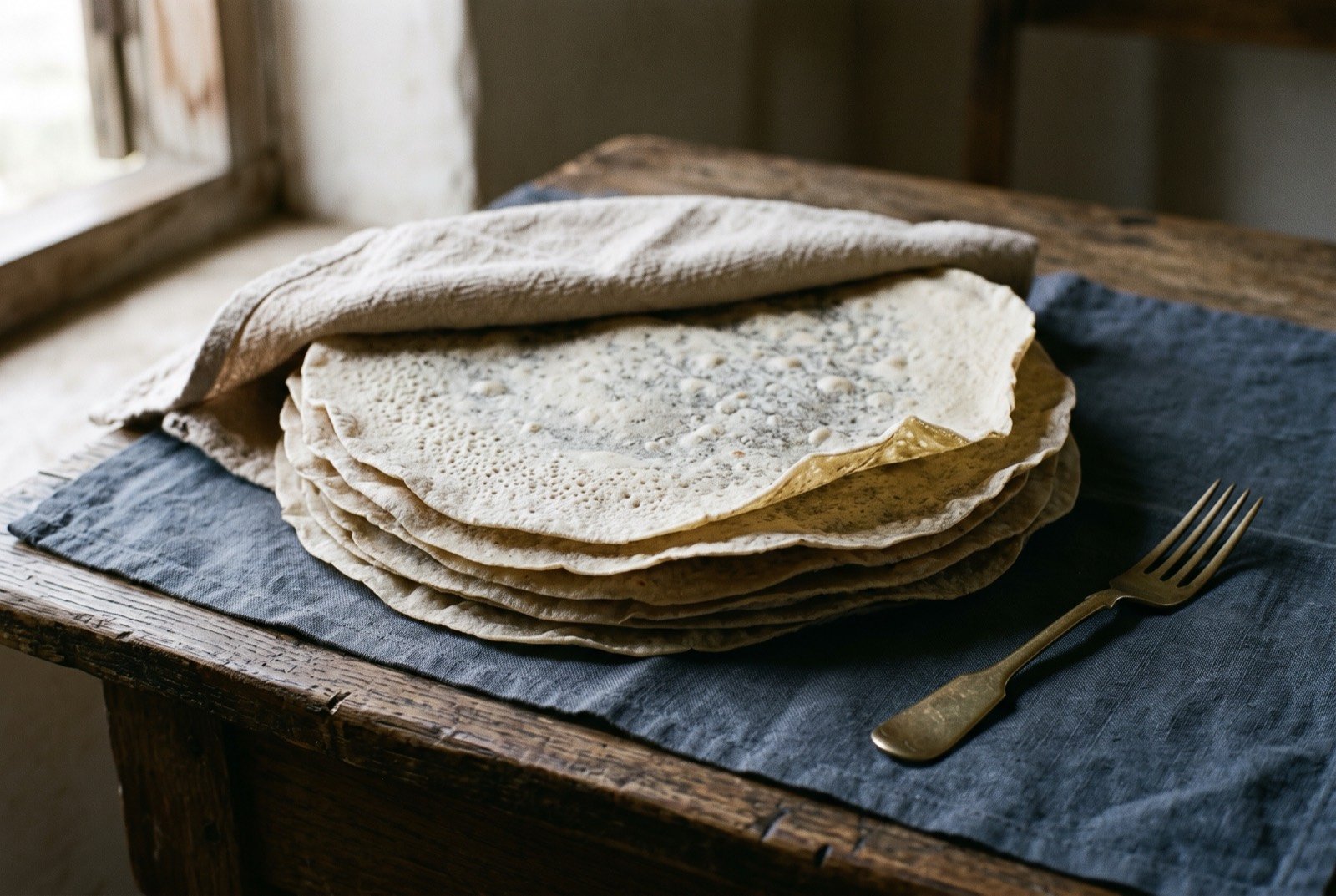
The second starch of eastern Chad, and the one that shows which way the region faces: a thin, single-sided, sour sorghum sheet baked in under a minute on an iron plate.
As tradition built it
Makes about 12 sheets. 20 minutes work, plus 18 to 24 hours ferment.
Ingredients
- 450 g white sorghum flour
- 100 ml water, for the stiff paste
- 50 g starter, batter reserved from the previous batch
- 600 ml water to let down, roughly 600 ml
- to taste salt
Method
- Mix the white sorghum flour, starter and water to a stiff paste: 9 parts flour to 2 parts water to 1 part starter.
- Ferment 18 hours at ambient, covered. The practical window is 18 to 24 hours; a cold British kitchen goes to the long end, a proving box at 30°C to the short.
- Thin the batter with the water to let down, until it pours like single cream. Salt it.
- Get a heavy iron plate or a large carbon steel griddle properly hot. Pour about 100 ml and spread it immediately very thin with a flat slat: in Sudan the tool is the gargaribah, and a long offset palette knife does the job.
- Bake about 30 seconds. One side only. Lift.
- Stack under a cloth. Eat the same day or the next.
Notes
Ratio from the FAO's sorghum and millet recipe annex, the only credible institutional specification available.
What a modern chef changes
A back-slopped starter run properly, a hotter plate, a temperature you control
Rungs 2 and 1
Method
- Build the starter and keep it alive. Refresh daily with equal weights of sorghum flour and water at 28 to 32°C. You are cultivating a Rhizopus and Lactobacillus pair, not just an acid: the mould's amylases liberate the sugars, the bacteria make the acid, and the leftover maltose is your browning substrate.
- Judge readiness on smell, and keep the ferment short and warm rather than long and cold. Yoghurt and hay means ready, raw grain means not yet, a solvent note means gone too far, and a pH meter reading 4.0 to 4.2 beats all three. A. flavus is in the wild mycobiome here and it is the aflatoxin producer, so a vigorous, warm, regularly refreshed culture is the defence. This is the one place in the chapter where control beats tradition on safety grounds.
- Get the plate hotter than feels sensible. The design depends on very short contact time. If the sheet needs more than 45 seconds to set, the plate is too cool and you will dry the bread before it browns. Use a 40 cm griddle.