The Horn · Volume 12, The Nile Foodways
Aseeda, and asida jeer
Sudan and South Sudan
Illustration
- Time
- 30 minutes
- Researched
- Researched from 124 sources in the brief
- Reviewed
- Awaiting a reader from inside the tradition
- Cooked
- Awaiting a cook report
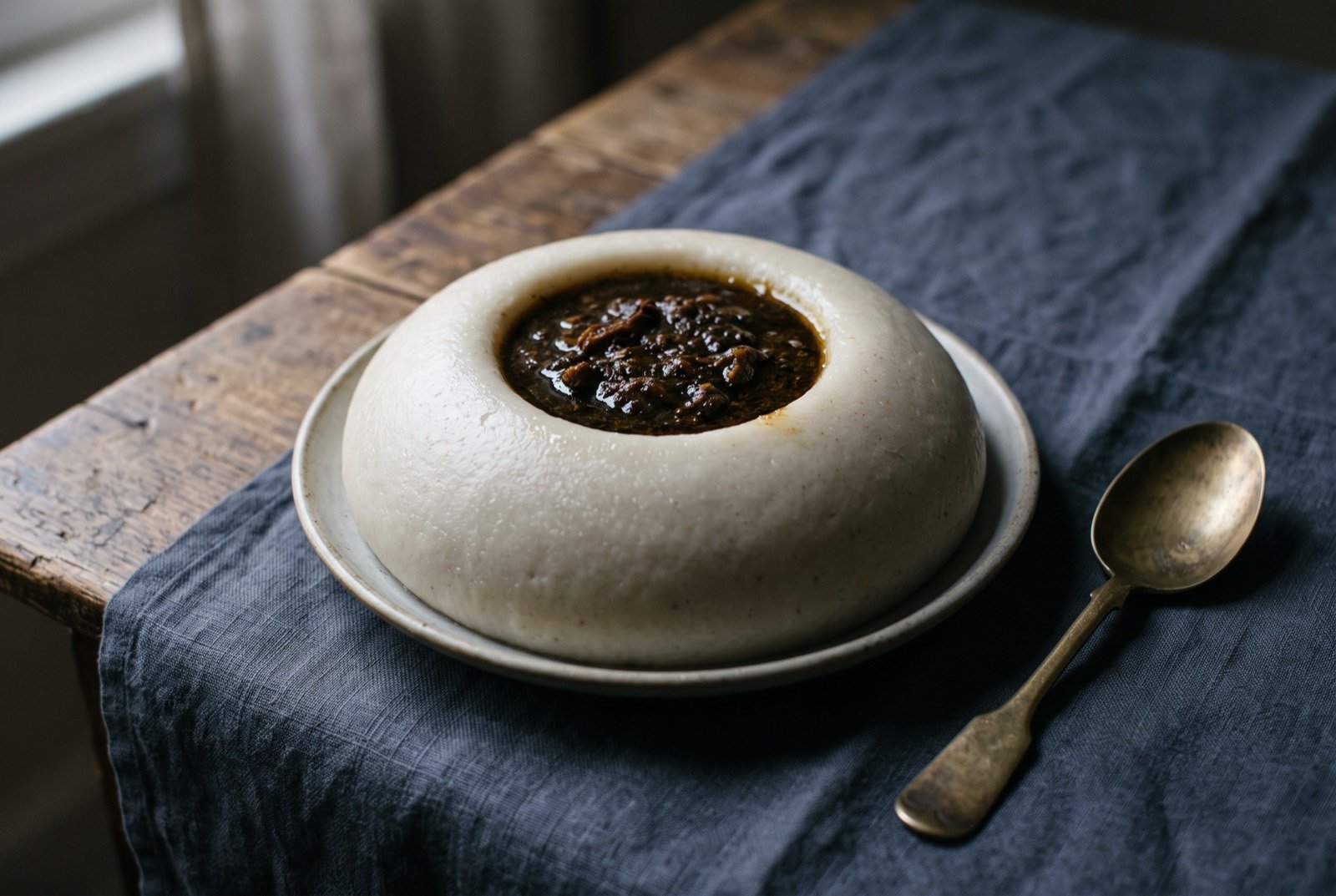
Kisra is thin, brittle and sour; aseeda is a smooth firm dome that sets as it cools, with the stew poured into a well pressed into its crown. The plate is already a study in contrast, and the restaurant job is to fix the ratio and the serving temperature rather than to invent a presentation.
As tradition built it
Serves 4. About 30 minutes.
Ingredients
- 200 g (about 1 cup) fermented sorghum flour, or damirga, fermented pearl millet flour
- 1 L water
- 60 g (about 1/2 cup) plain wheat flour
- 1 tsp salt
Method
- Bring the water and the salt to a boil in a heavy, wide-based, straight-sided pot. Mass and surface area both matter, because sorghum aseeda seizes.
- Rain in the fermented sorghum flour, stirring continuously with a mufraka or a heavy wooden spurtle, until the paste thickens.
- Beat in the plain wheat flour vigorously, in one addition.
- Turn out warm into a wetted mould, and press a well into the crown. It sets hard as it cools.
Notes
After a Darfuri account, which gives the ratio by volume.
Understand what that second addition does, because it is the whole technique. The first flour has gelatinised and is holding the pot as a thick suspension, so every particle of the second charge is separated from every other by gelatinised starch and hydrates without lumping. It is the reasoning of a beurre manié, arrived at from the opposite direction.
The court version, asida jeer, started from sorghum pounded and filtered in a large clay zheer of water into a fine white flour, and the whiteness was read as purity and health. That is wet-milling and settling, which is to say a sorghum starch extraction, and it is the most technically ambitious thing recorded in the Darfuri court kitchen.
What a modern chef changes
Make the white flour yourself, slake before heat, and fix the serving temperature
Rungs 1, 3 and 5
Method
- Make jeer. Slurry 300 g of sorghum flour in a litre of cold water, let the coarse fraction fall for 60 seconds, decant the milky suspension, let that settle for 30 minutes, pour off the water and dry the pale sediment. You have separated a fine starch-rich fraction from a coarse bran-rich one, which is Rung 3 applied to a flour instead of a sauce. The court called the result purity. It is particle size.
- Slake, do not rain. Mix the fermented flour to a smooth slurry with 300 ml of cold water before it meets heat, then pour that into the remaining 700 ml at a bare simmer. No lumps, half the stirring. This is the same cold-slake principle that placali, tô, funge and ugali all arrived at independently.
- Measure the sourness. Fermented sorghum flour varies enormously between batches. Taste the slurry cold: flat, and it wants a spoonful of your ajin; aggressive, and it wants none. Rung 1.
- Serve at a fixed temperature. Aseeda stiffens as it cools, so eating temperature is a specification rather than an accident, and hot starch paste is gluey and masks its own aroma.