The Horn · Volume 12, The Nile Foodways
Kisra rhaheefa
Sudan, everywhere
Illustration
- Time
- Hands on 20 minutes · Waiting 8 hours
- Researched
- Researched from 124 sources in the brief
- Reviewed
- Awaiting a reader from inside the tradition
- Cooked
- Awaiting a cook report
Kisra is made before dawn, by women, at a scale that is hard to picture from Britain: as of 1995 the then-undivided Sudan was estimated to consume 20,000 to 30,000 short tons of sorghum flour a year as kisra, a figure that is single-sourced and flagged in the final section. The full traditional preparation has a step almost every Western recipe omits: the grain is soaked for an hour, ground on a saddle quern up to three times, sun-dried, and only then mixed with water and salt and fermented overnight. Three passes through the stones is a particle-size decision, and it is why village kisra has a finer sheet than anything out of a bag.
As tradition built it
Makes 8 to 12 sheets, serves 4. Overnight, plus 20 minutes.
Ingredients
- 250 g sorghum flour
- 500 to 750 ml water
- 3 to 4 tbsp live yoghurt, ideally near its expiry date
- 1 tsp fine salt
Method
- Whisk the sorghum flour into 500 ml of the water with the live yoghurt, to a batter slightly thinner than pancake mixture.
- Cover and leave overnight in a cool dry place, 8 to 12 hours. It is ready when it is sharply sour, not merely tangy.
- Slacken with as much of the remaining water as it needs, and season with the fine salt.
- Heat the widest flat pan you own, lightly greased. Half a cup per sheet, spread in one pass with a gargariba or a long offset palette knife.
- 1 to 2 minutes a side on a domestic pan. On a proper doka at full heat it is about thirty seconds and no turn at all.
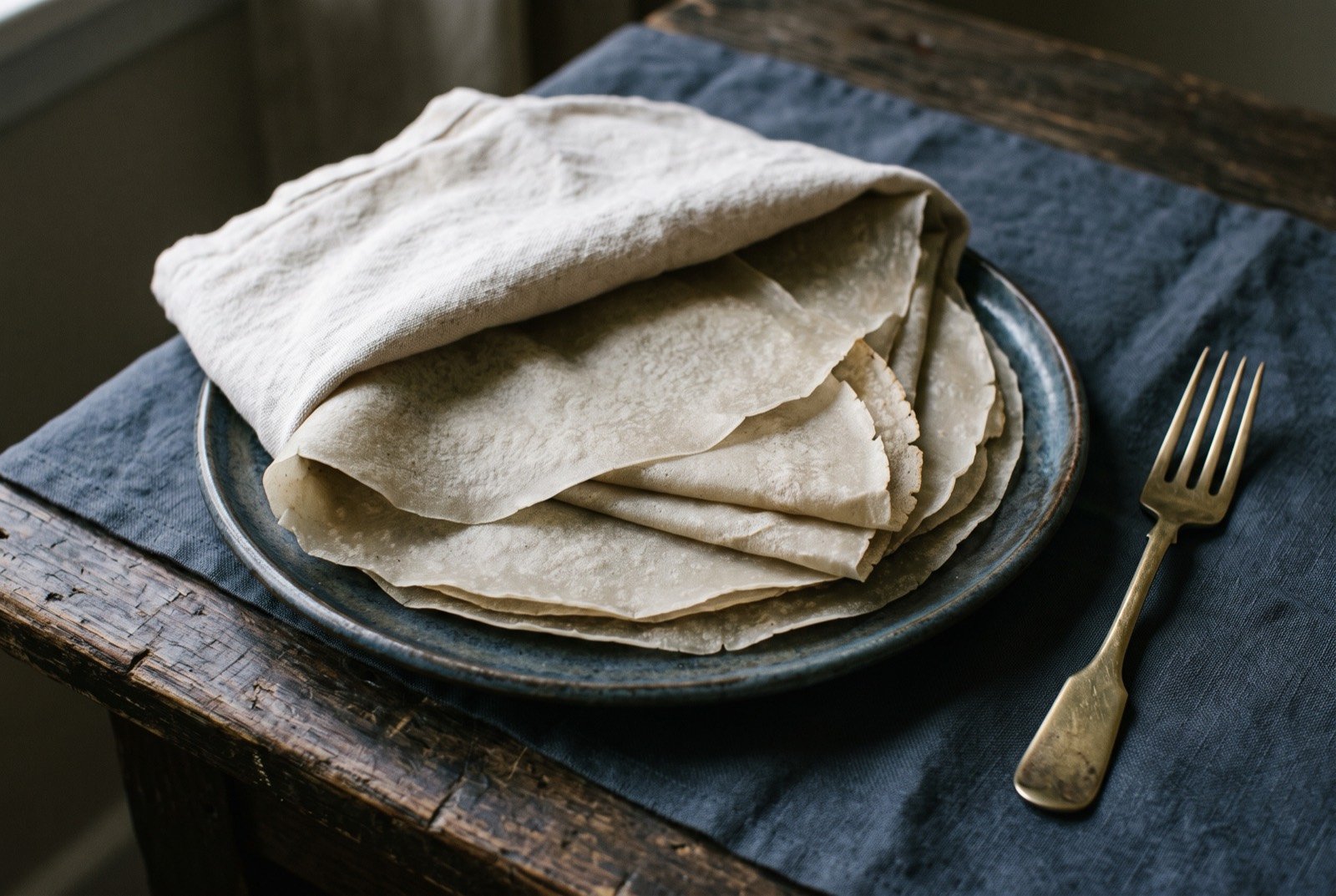
- Stack under a cloth. Allow 2 to 3 sheets per person.
Notes
After Omer Eltigani, whose diaspora version is given here because it is the one that works in a British kitchen and because he is explicit about the substitution.
What a modern chef changes
A defined starter, a measured pH, one pass on a wide plate, and never the fridge
Rungs 1 and 5
Method
- Keep a live ajin culture rather than starting from yoghurt every time. Hold back 10 per cent of each batch and feed it. Yoghurt is a stand-in for a mother you do not yet have.
- Put it on a clock with a defined starter. Bacteria alone take you from 19 hours to 6, at pH 3.47; add Saccharomyces cerevisiae and it is 4 hours at pH 3.75. The yeasted version is the better-smelling one because of the esters, the bacterial version the sharper one. Choose deliberately, and hold the batter near the 37°C the Sudanese laboratory work uses.
- Buy a plate wide enough. One ladle, one pass, full diameter. Rung 5, and it is the difference between kisra and a thick pancake.
- Never chill it. Retrogradation runs fastest just above fridge temperature. Warm and wrapped for a short defined window, or frozen flat with paper between the sheets and reheated from frozen.