Africa · Volume 12
Sudan & South Sudan
The Nile Foodways
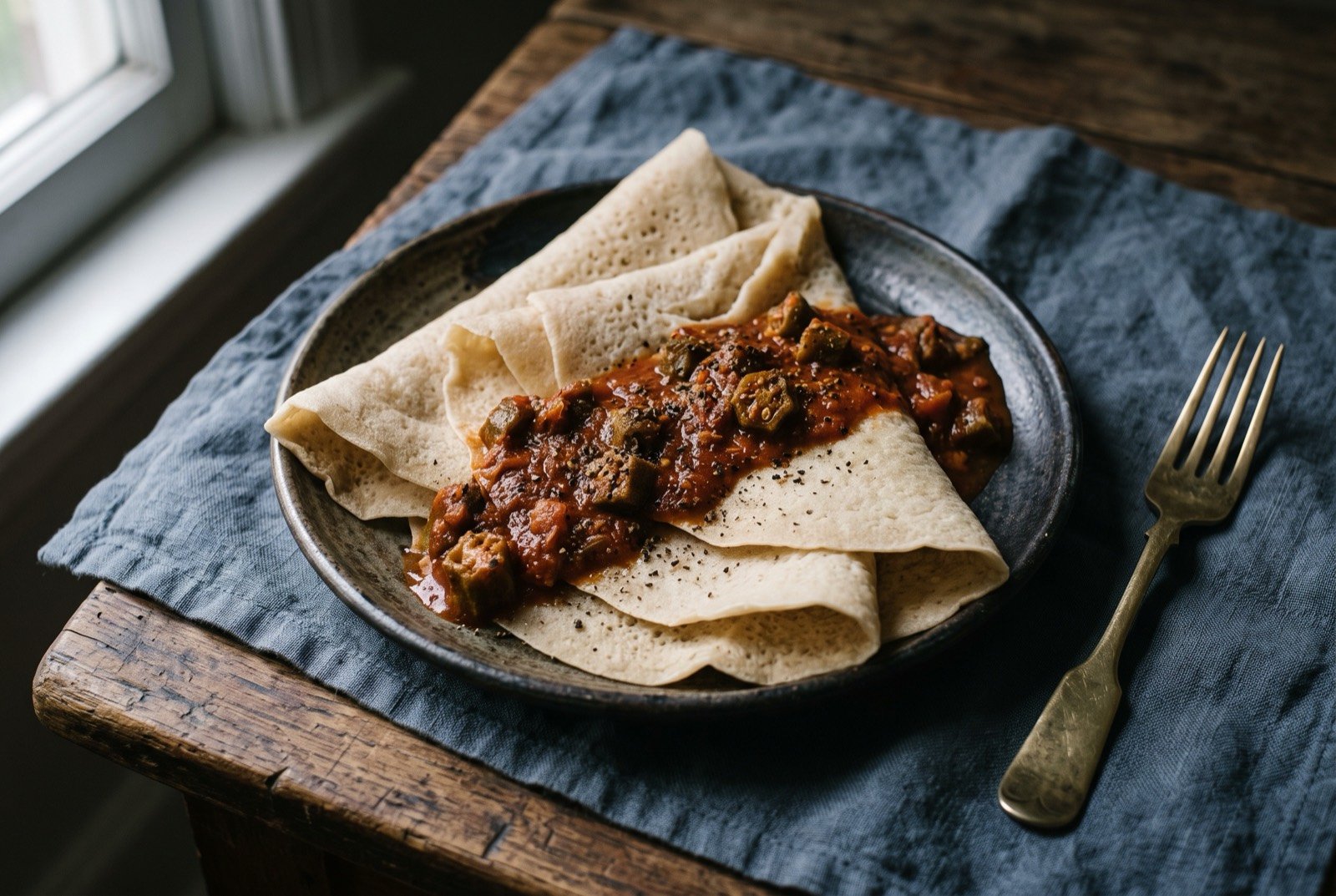
Sudan and South Sudan, taken seriously. Two countries, one river, and the most elaborate indigenous fermentation repertoire on the continent. The traditional canon as it is actually cooked, a technique ladder built from Sudanese food science rather than borrowed, and every dish as tradition built it, then what a modern chef would change.
Sources and review · What this chapter does not assert · How we research · Know this better? Tell us
A Sense of Place
Two countries, one river, and a food system that makes no sense at all if you organise it by the border.
The line drawn in 2011 separates a sorghum north from a cattle south, which is roughly true, and it does so by cutting through every gradient it touches: the okra line, the groundnut line, the alkali line, the dried fish line. So this chapter organises by what a cook reaches for. Fat, thickener, aromatic, starch. These are two separate countries with two separate repertoires that overlap along the White Nile, and South Sudan is not an appendix to Sudan. Sudan has also been at war since April 2023, and where that has changed what can be cooked or bought, this chapter says so factually and moves on. It is not atmosphere.
The riverine north
Nobiin and Kenzi Nubians, Dongolawi, Ja'aliyin and Shaigiya, on a ribbon of irrigated silt in absolute desert from the Second Cataract down to Khartoum. Date palm is the defining tree, Nile fish the defining protein. Fat is clarified butter, samn, and sesame oil. Thickener is wheat and maize flour and dates rather than okra. Aromatics are cumin, black pepper, garlic and lime. The starch is wheat and maize bread more than sorghum, which is the first surprise for anyone arriving expecting kisra everywhere.
The Nubian bread trio is a separate tradition from the central plains: kabid, maize dough on the hotplate, marked with a cross for blessing; shiddi, a maize flatbread that is the local kisra; and sallabiyya, thin wheat bread. Alongside them sit turmus, lupin debittered by soaking three days in the Nile itself, which is the standard repeated-soak debittering with the water changes done continuously and for free; turkin salt-cured fish; and the date drinks dakkai and nebit. This is also the fassiekh and terkin heartland, terkin being the Dongolawi speciality.
The central clay plains
The Gezira, the Butana, the Blue and White Nile: riverine Arabic-speaking Muslims, and the group whose practice most English-language writing silently treats as "Sudanese food". Omer Eltigani's own culture guide says so and flags it as a limitation of his own work, which tells you something useful about the source.
Fat is sheep fat and samn, with peanut oil arriving in the twentieth century. Thickener is weika, dried okra powder, above everything. Aromatics are cardamom, black pepper, coriander seed, garlic and dried lime. Starch is kisra, aseeda and gurasa. The signature is the entire mullah family, plus ful medames as an urban breakfast and iftar institution.
The western savanna
Kordofan, Darfur and the Nuba Mountains: Fur, Zaghawa, Masalit, Baggara Arabs, Kababish camel nomads and the many Nuba peoples. This is the fermentation laboratory and it is the reason this volume exists.
The ecology is qoz sand, gum arabic acacia, baobab, sorghum and pearl millet, roselle, sesame and groundnut, with wild legumes coming up on the seasonal watercourses. The fat is sesame oil, groundnut oil, rendered animal fat and, uniquely, fermented fat. The aromatic is not a spice at all: it is the ferments themselves.
Dirar attributes roughly 80 per cent of Sudan's "marginal" fermented foods, the ones built on bones, intestines and fat, to Kordofan and Darfur, and notes that the whole repertoire is produced in the late rains, July to October, to cover the other nine months. Kawal specifically is made by Fur and Nuba producers.
Read that as a calendar. Three months of rain produce the leaf, the seed and the oil press cake, and the ferments carry that protein through nine dry months. This is not a cuisine that ferments for flavour and gets preservation as a bonus. It ferments in order to eat in March, and the flavour is what it learned to love on the way.
The Red Sea Hills and the east
The Beja (Hadendoa, Bisharin, Beni Amer) and the Rashaida, in near-rainless hills with camels and goats, and the Gash and Baraka deltas at Kassala. The fat is camel and goat milk fat. The aromatic is ginger above all.
The signature is jabana, one of the most completely named pieces of kit in African cooking. Sudan's national intangible cultural heritage inventory lists the whole apparatus: al kanun, the charcoal stove; qallaya, the roasting pan; funduk, the mortar, typically decorated with metal discs that produce rhythmic sounds during grinding; sharaghragh, the cylindrical water vessel; and jabana itself, the clay flask that names the drink. The spices are ginger, cinnamon and cardamom.
The method: green beans roasted until shiny and oily; the grounds infused with ginger, cardamom and cinnamon; brewed in the stoppered flask about five minutes over coals; poured from about 30 cm without breaking the flow, the grounds left behind. In the Beja and Bedouin version the ginger is crushed in the mortar first and the toasted beans ground with it. That co-milling is the technical point. The ginger's moisture and oleoresin coat the grounds and the two extract together, which is not the same drink as coffee plus ginger. The filter is a straw stopper in one account and a loofah plug in another; both are plausibly regional and this chapter does not pick.
The cattle floodplain
The Sudd, Jonglei, Unity, Upper Nile and Bahr el Ghazal: Dinka (Jieng), Nuer (Naath), Shilluk, Murle, Anuak. Everything is governed by the flood. Wet-season villages sit on high ground from May to September; dry-season camps move down into the toic, the swamp meadow. Cattle must be watered every one to two days and sheep and goats every one to four, and that single hydrological fact organises the year. The fat is milk. The thickener is nothing at all. The idiom is porridge and milk, not stew, and this is where a British cook has to put down the assumption that a cuisine is a set of sauces. There is no thickener here because there is no stew architecture here. The starch is sorghum and pearl millet worked into walwal, and its steamed form akof.
Evans-Pritchard remains the anchor: the Nuer practise cattle husbandry and agriculture and also fish, hunt and gather; cattle have more than nutritive interest for them; and food is most abundant from the end of September to the middle of December.
The green south west
Western Equatoria, the Zande country and the Yei and Kakwa belt: Azande, Moru, Kakwa, Bari, Pojulu, Madi, on the ironstone plateau with real rainfall and a forest margin. This is Congo-basin agriculture, not Sahelian, and the correct cross-reference is Volume Eight rather than Khartoum. Fat is groundnut paste with palm oil at the margins. Thickener is groundnut paste and alkali-softened greens. Starch is cassava, maize, sweet potato and yam. The governing technique is kombo, wood-ash lye, and the okra dish swala, also called mula kombo ta bamia, is named as a Kakwa speciality from Yei.
The Egypt hinge
Ful medames, tamiya, mahshi, basbousa and shawarma run down the Nile from Cairo and are strongest in Khartoum, Omdurman, Wad Madani and Port Sudan. Sudanese tamiya is reported as chickpea where Egyptian ta'ameya is fava, though that is not a hard rule and the final section says why. What is not in doubt is the dill, which is the Nile signature in the fritter rather than the Egyptian parsley habit, and the sesame oil, which is what makes a Sudanese ful Sudanese.
What the war has changed for a cook
Two things, because they change what you can buy. Sharmout has no formal UK import route: the dried meat that seasons a whole family of stews moves in personal luggage, and there is a suitcase trade rather than a wholesale one. And Khartoum's restaurants cannot be verified, because persistence of a listing is not evidence of trading. The famine figures belong in the history section below, where they can be given properly rather than used as colour.
The History in Layers
Sorghum was domesticated here
Volume Three argued that the Americas supplied the plants and West Africa supplied the cooking. Here the grain itself is local.
Ceramic sherds from site KG23 in the southern Atbai of eastern Sudan, a 120,000 square metre site occupied roughly 3500 to 2500 BCE, carry sorghum impressions where the grain was used as clay temper. Dorian Fuller and Frank Winchell cast those impressions with vinyl polysiloxane dental mould and read them under a scanning electron microscope. About half showed the attached torn rachis that is diagnostic of domestication. The mixture of wild and domesticated signatures in one assemblage is what indicates a gradual, independent African domestication, separate from Egypt and from Mesopotamia.
Sorghum is not a crop Sudan adopted. It is a crop Sudan made, and the thirty-odd fermented sorghum products Dirar counted are the accumulated interest on five thousand years of working with it.
Kush, Meroe and Christian Nubia
Trade brought cumin, aubergine, onion and cucumber, and the Christian Nubian period from the fourth to sixth centuries added wheat, barley, lentils, chickpeas, teff, fava beans, leavened bread, honey and wine through Greek and Coptic contact. The famous Kushite "Table of the Sun" comes to us from Herodotus, writing about a place he never visited, and this chapter does not use it as evidence; the best hard evidence for the medieval Nubian diet is the archaeobotanical study of food-crop storage in the Kingdom of Dongola.
Islam, the Baqt, and the pilgrimage road
The Baqt treaty of 652 CE blocked invasion and licensed gradual Arab commercial and marital penetration instead. Arabian merchants brought rice, honey, mint, coriander, cinnamon, ginger, cloves, aubergine and lime. From the twelfth century the Sudan Road carried West African pilgrims eastward across the country.
Here is an argument worth developing, because it explains the shape of the whole repertoire. Kisra, sharmout, kawal and kejeik are pilgrim technology as much as household technology. All four are dry or salted or sour, all four are light for their protein content, and all four are stable in a 40°C afternoon. A country that is also a road ferments and dries, because the alternative on a three-month walk is not eating.
The sultanates: Funj and Darfur
Sennar and Al Fashir, which became the Darfur capital in 1790. The royal kitchen was directed by the Mayram, the sultan's wives or sisters, who were simultaneously political advisers, and girls entered training at eleven or twelve to work towards Mayram status. The recorded court dishes are asida jeer, from wet-milled white sorghum flour; the mullah family built on meat powder, caramelised onion, spice and ground okra; hibiscus-leaf and baobab mullahs; mullah kawal; and a whole lamb stuffed with a whole chicken, boiled eggs and vegetable rice.
This is the chapter's best structural claim. Court and village used the same grammar: a dried protein powder, a caramelised onion base, an okra bind. What changed at court was the refinement of the flour and the theatre of the presentation. That is an unusual thing to be able to say about a court cuisine, and it is why the elevations in Part Two are refinements of village technique rather than replacements for it. Al Fashir got there first, four centuries ago, by doing exactly that.
The Columbian Exchange
Maize, cassava, groundnut, sweet potato, tomato, common beans, chilli, pumpkin and potato arrive from the Americas by way of Egypt, the Red Sea and West Africa. Two consequences dominate.
The groundnut becomes structural. It is known across the Arabic-speaking world as ful sudani, Sudanese beans, and it ends up in salatat dakwa, salatat aswad, mullah rob, agashe, marara and effectively every South Sudanese greens dish.
The tomato becomes the mullah's base, and the sequencing matters. Okra preceded tomato in the Nile Valley, so weika-thickened stews are older than tomato-based ones. When you meet a Sudanese stew with no tomato in it at all, such as mullah sharmout or mullah kawal, you are not looking at an incomplete version of the red one. You are looking at the older one.
The Turco-Egyptian layer, and the mullah and tabeekh split
The Turco-Egyptian period, 1820 to 1885, naturalises mahshi, moussaka, adas, feta, pastries and yahni, which becomes the Sudanese tabeekh. Rocket and purslane spread with it, and tabeekh rijla, purslane and lamb, is in Eltigani's book.
That distinction is the cleanest way to make the Egypt hinge legible on a plate. Eltigani's own definition of mullah is the stews characterised by being more watery than comparable stews. The wateriness is a specification, not carelessness, because kisra has to absorb it. Tabeekh is dry because bread does not.
The Gezira scheme
Pump-irrigated cotton trials ran from 1911. The tripartite agreement of 1919 split returns between the government at 40 per cent, the Sudan Plantations Syndicate at 25 per cent and tenants at 35 per cent. The scheme opened in 1925 at 300,000 acres, gravity-fed from the Sennar Dam, and later reached close to two million acres, reorganised into straight canals and square plots in blocks of about 15,000 acres. Tenants were required to grow cotton on 10 feddans within 30-acre holdings.
The rotation tells the story. It began as three years of cotton, grain and fodder; after the yield collapse of the early 1930s it became cotton, two fallow years, then durra. Across the period, food crops fell from 33 per cent to 25 per cent of irrigated land. The most fertile land in Sudan was legally obliged to grow a fibre, and the sorghum that fed Khartoum increasingly came from rain-fed and later mechanised schemes elsewhere, which is a structurally more fragile arrangement.
Ruptures
The tukul kitchen. As settlement grew, a dedicated round kitchen structure emerged, described in one Sudanese account as a physical representation of female expression, sanctuary, culinary creativity and domestic dominance in an outwardly patriarchal society. Almost everything in Part Three was developed in that building, by women, before dawn.
The September Laws of 1983, which criminalised merissa, the opaque sorghum beer Dirar counted at more than forty steps, the clear beer assaliya, the date wines, and distilled aragi. An entire branch of the fermentation repertoire went underground overnight. The wars and the 2011 secession then put an international border through the middle of a food system.
And Dirar's rescue project itself. Six years of fieldwork interviewing elderly rural women in the 1980s is a rupture response: he was recording a repertoire he expected to disappear, and the reason this chapter can give you the pH of a leaf ferment is that he did.
The present, stated as figures
Since April 2023 Sudan has been the world's largest displacement crisis and the world's largest hunger crisis. The IPC Famine Review Committee reported in October 2025: famine, IPC Phase 5, in El Fasher town in North Darfur, with about 260,000 people remaining, roughly 130,000 of them children, and 30 per cent in Phase 5; famine in Kadugli town, South Kordofan; the western Nuba Mountains at Phase 4. El Fasher sorghum prices rose 300 per cent between June and July 2025 and reached forty times the national average by August, and Kadugli sorghum rose 437 per cent between May and August. Nationally, over 21 million people were in IPC Phase 3 or above.
One detail belongs in a cookbook rather than in a report. Among the things recorded being eaten in El Fasher was ambaz, oilseed press residue. Ambaz is the substrate of sigda. The same material that a functioning Kordofani household ferments for three to seven days into a protein condiment is, in a besieged city, eaten unfermented. That is the clearest possible statement of what these techniques are for, and it is why this volume treats them as technology rather than as heritage.
The response has been organised largely by neighbours. By mid-2024, more than 350 communal kitchens were reported operating, assisting 500,000 families with at least one meal a day, on two models: the older takaya and structured kitchens run by neighbourhood Emergency Response Rooms.
The Flavour Arsenal
If you buy three things for this chapter, buy sorghum flour, weika and unstabilised peanut butter. If you make three things, make ajin, kawal and shata.
The fermented condiments, which are the point of this volume
Dirar's survey counts roughly sixty fermented items, roughly thirty of them sorghum products and about twelve of those sorghum breads, plus four categories of fermented fish and a dozen fermented meat and offal products. Those figures reach us through summaries rather than the book itself, so treat them as approximately right rather than as citable.
| Name | Where | What it is | pH and character | How to use it |
|---|---|---|---|---|
| Kawal | Fur and Nuba, Kordofan and Darfur | Fermented Cassia obtusifolia (sicklepod) leaf, dried into balls | pH moves less than 0.5 units. Volatile fatty acids: n-butyric 8 per cent, acetic 5, n-propionic 2. About 20 per cent protein, rich in sulphur amino acids | As the main protein flavour of a stew, at the sharmout dose, not as a background note |
| Sigda | Western savanna | Fermented sesame press cake | pH 6.0 falling to 4.0. Total acid 6 per cent by day 5. Sour, nutty, dense | In vegetable stews. The acid ferment of the three |
| Furundu | Western savanna | Fermented roselle (Hibiscus sabdariffa) seed | Final pH 6.2, with both volatile fatty acids and lactic acid. Sits between the other two | Sold and used as a meat substitute |
| Sharmout | National, strongest in Darfur | Sun-dried beef or lamb strips | Concentrated, meaty, clean | Pounded to powder and used as the protein seasoning, not as pieces of meat |
| Fassiekh | Nile, strongest in the north | Salted fermented whole tiger fish, Nile perch, tilapia, kawara, kass | Salt from roughly 10 to 25 per cent by protocol. Intensely savoury | Small quantities, dissolved into a base |
| Kejeik | The Sudd and the White Nile | Large split sun-dried fish, trodden flat and matured | About 85 per cent water removed | Rehydrated into a mullah. The southern umami spine |
| Terkin, also maloha, turkin | Nubian and Dongolawi | Salt-cured fish, given as a paste in one source and as layered salted fish in another | Not established | Not established. See the final section |
| Miris | Kordofan and Darfur | Fermented stomach fat sheath, that is, caul or omentum | Not established | The flavour base of a nearly meatless stew |
| Rob | National | Milk soured overnight, then churned | Sour, buttery | The finishing acid of mullah rob |
| Gariss | Kababish camel nomads, Darfur | Camel milk fermented in a skin bag on a walking camel | pH 3.77 ± 0.03 over 118 samples | Drunk. Also the model for a perpetual culture |
Two entries matter more than the rest.
Kawal is not a sour ferment. It is an alkaline-to-neutral, Bacillus-driven, proteolytic ferment, in the same structural family as natto, as dawadawa and iru from Volume Three, and as Japanese hishio. The pH barely moves because the substrate has high buffering capacity, ammonia nitrogen accumulates, and the butyric and propionic acids are exactly why it smells the way it does. The literature's sensory summary is the one to hold: a pungent odour that persists on the hands, and a smell similar to sun-dried meat strips. Kawal is a vegetable that has been made to smell like meat.
Sharmout is a powder, not a piece of meat. Sun-dried, pounded, and used at the scale a Western cook uses stock rather than beef. A whole family of Sudanese stews rests on the idea that meat's job in a sauce is to season it, and that is why they taste more concentrated than their weight of protein suggests.
The classification is the other half of the argument, because Dirar sorts these ferments functionally: his vegetable meat substitutes are kawal, furundu and sigda, plus kerjigil and teshnuti; his sour-milk substitutes are rob-heb from watermelon seed, rob-ful from peanut and um-zummatah from watermelon juice. That is a cuisine that has thought systematically about what a fermented protein is for. The last five are named in his category lists and nowhere else reachable, so this chapter names them and does not describe them.
Thickeners and alkalis
Weika, dried okra powder, is the central thickener of the northern repertoire. Pods are strung together like a necklace and hung to dry completely, then topped, halved and milled, and about fifty finger-sized pods give roughly one third of a cup of powder. Three independent dose figures survive: 3 to 5 tablespoons per serving for four; in mullah sharmout, one fifth of the sharmout weight; and in a diaspora tagalia, 1 teaspoon to 400 g of lamb mince. That range is exactly what separates a tagalia, barely bound, from a waika, frankly ropy. Both are correct dishes, so decide which one you are cooking before you measure.
Okra mucilage is a high molecular weight acidic polysaccharide, a rhamnogalacturonan complexed with protein, and sun-drying concentrates it rather than destroying it. Rehydrated and heated it forms an entangled, weakly cross-linked network that is shear-thinning and elastic rather than simply viscous, which is the stretch a Sudanese cook is working towards. It is also earthy and peppery, so it seasons as well as binds. The associated tempering step has a name, taqliyya, called gadha here: garlic and coriander browned in oil, slaked with a ladle of the stew liquid, returned to the pot at the end, after the mucilage has set.
Kombo, and a naming trap. In Sudan, kambo is a potash added to the sigda ferment at 3 to 20 g per kg, the dried leachate of ash from sorghum seed head stems, largely potassium bicarbonate. In South Sudan, Dr Noela Mogga defines kombo as a strong alkali solution, an alternative name for lye, made by filtering water through wood ashes, whose function is to soften tough cellulose in leafy greens; her domestic substitute is half a teaspoon of bicarbonate of soda to one cup of water, and she places it in a pan-African family with Magadi in Kenya, atrun rock salt in Sudan and achu salt in Cameroon. Kombo is not a ferment, and this chapter files it with kansui, lye water and nixtamalisation lime.
Hydroxide ion saponifies the pectin methyl esters in the middle lamella, so cell walls separate at low temperature rather than needing long cooking, and it holds chlorophyll green by preventing its acid-driven conversion to pheophytin. The price is thiamine and vitamin C destruction, which is exactly why the technique co-occurs with milk, groundnut and offal in the same meal. The nutrition goes back on the plate it came off.
Aromatics, fats and the three acids
The spice box is short and used whole: cardamom (habahan) and black peppercorn into the mullah base and sieved out, cumin (kammun) and coriander seed (kuzbara) as the gadha partners to garlic, ginger (janzabil) ground with the coffee beans, and cinnamon, cloves and fennel behind them. Sesame oil, sirij, is the finishing fat, described from inside the tradition as essential in Sudanese households, and it is not dark toasted East Asian sesame oil. Samna is the other fat. Shata is crushed chilli with garlic, oil, salt and acid, and with peanuts it becomes dakwa. Salsa naashifa, dried tomato powder, is dosed in mullah sharmout at about one eighth of the sharmout weight.
Three acids, three different curves. Lime is citric plus a volatile terpene aroma and is the Sudanese acid of choice, more than vinegar. Tamarind, aradeib, is tartaric plus sugars, so it lands rounder. Karkade brings hibiscus acids plus anthocyanins, so colour and astringency arrive with the sourness. Pick one per dish and measure it, rather than layering all three and calling the result brightness.
The wild larder, and the grains
| Local | Botanical | Use |
|---|---|---|
| karkade | Hibiscus sabdariffa calyx | The national drink, hot or cold. The seed becomes furundu |
| lalob, heglig | Balanites aegyptiaca, desert date | Bitter kernel, the flavouring in Bor walwal; also an oil and a documented famine food |
| thaau | desert date paste | Boiled into the walwal cooking water in South Sudan |
| nabag | Ziziphus spp. | Fruit. 8,890 tonnes a year recorded in production |
| gongolez, tabaldi | Adansonia digitata, baobab | Tart powder. A documented Darfuri court mullah was built on it |
| aradeib | Tamarindus indica | Souring agent and drink |
| doum | Hyphaene thebaica | Fruit and fibre |
| gum arabic | Acacia senegal (hashab), A. seyal | Sudan has supplied roughly 80 per cent of world production |
Gum arabic is the one Sudanese ingredient already in every British kitchen without anybody knowing it: it is E414. Hashab grade is pale amber to almost white, glassy nodules that dissolve cleanly; seyal is darker and behaves differently. It is an outstanding emulsifier and film former, and it is the honest modernist bridge out of this cuisine into a restaurant kitchen. Stable emulsions, glossy glazes and clean sorbets made with a genuinely Sudanese material is a better argument than any amount of borrowed Nordic technique.
| Local | Identity | Notes |
|---|---|---|
| dura, durra | Sorghum bicolor | The staple. Cultivars named repeatedly in the kisra literature are feterita and tabat |
| dukhn, dukhun | Pennisetum glaucum, pearl millet | The western and southern grain. Lipase-rich, which is why damirga exists. Sold in Britain as bajra flour |
| damirga | fermented pearl millet flour | A rancidity-control technology, and the base of a distinct aseeda |
| jeer | refined, wet-milled white flour | Given as millet in one source and as wet-milled sorghum in another. Court grade |
Damirga is engineering. Pearl millet flour goes rancid unusually fast because milling exposes lipase to a high-lipid germ, and the traditional fermented-flour process is documented specifically as a rancidity-reduction technology rather than a flavour one. The full text of that study was not reachable, so this chapter names the mechanism and does not quote its numbers.
Part Two
The Technique Ladder
First, an honest problem
There is no Michelin-starred, no World's 50 Best listed and no James Beard recognised Sudanese or South Sudanese restaurant anywhere on earth, on the evidence available in August 2026. The checks were specific: the Michelin Guide's own "Best African Restaurants in London" selection, the James Beard 2026 semifinalist list, the Michelin Abu Dhabi and Saudi Arabia selections for 2025 and 2026, and the 2026 Gourmet Traveller awards. Nothing surfaced in any of them.
That is not proof of absence, and it is flagged as such. But it is the defining fact of this chapter. Sudan has what is arguably the most elaborate indigenous fermentation repertoire on the continent, and not one restaurant on the international stage is built on it.
There is a second absence, and it changes how part of this chapter has to be written. I could not find published, informed British critical commentary on Sudanese restaurant cooking in the UK. So where this chapter explains why a British Sudanese plate can taste thinner than it should, that explanation is reasoned from Food Standards Agency regulation, from bean and starch chemistry and from a documented supply gap, and not from anybody's review, because there are none.
What exists instead is a short list of named people rather than a movement, set out in the Voices section at the end: Omer Eltigani in London, whose The Sudanese Kitchen (2025) is documentation work rather than service cooking; Monzir Hamdin in Sydney, whose platform is broadcast rather than a restaurant; and Dr Noela Mogga, whose Taste of South Sudan is the most substantial English-language South Sudanese food resource in existence. The most verifiable Sudanese restaurant in Britain is Sudanese House Cafe in Manchester, with Toteil trading in Acton. Every Khartoum restaurant is unverifiable.
So the ladder below is built from the science, and the science is exceptionally good. Dirar's six years of fieldwork, the Khartoum food chemistry literature, the starter-culture work in the Pakistan Journal of Nutrition and the gariss compositional study in the Journal of Ethnic Foods all exist, all are measured, and nobody has put any of it on a plate. The argument of this series is that every restaurant technique in these cuisines has an indigenous ancestor, and Sudan is the volume where that is least arguable, because the ancestor is written down, with pH values, by a professor at the University of Khartoum who spent six years asking elderly rural women how they did it. One caveat: Dirar's 1993 book is out of print and not online, almost every English-language claim about Sudanese fermentation traces back to it at two or three removes, and only two of his own chapters are freely readable.
Rung 1. Control the sorghum sour instead of letting it happen to you
Kisra's fermented batter is ajin, refreshed by backslopping a portion of the previous batch. Two ratios circulate and they are two moments in one process rather than a contradiction, although no source states the dilution step between them. The stiff-dough ratio, from FAO: 9 parts flour, 2 water, 1 starter, about 18 hours, baked half a minute a side. The batter ratio, from Sudanese laboratory work: flour to water at 1:2 plus 10 per cent starter, at 37°C, for about 12 hours, over which pH falls from 5.5 to about 3.4, driven by Lactobacillus fermentum, L. reuteri and L. amylovorus, with Candida krusei on a dry starter.
The restaurant move is a defined starter, and the numbers are decisive. With L. fermentum, L. brevis and L. amylovorus, fermentation falls from 19 hours to 6. Add Saccharomyces cerevisiae and it falls to 4. Final pH is 3.47 with the bacteria alone and 3.75 with bacteria plus yeast. Acidity stops being a lottery and becomes a dial.
Why it works, three ways at once. Acidification plus phytase degrades phytate, freeing the iron and zinc it had chelated, and the low pH degrades or binds condensed tannins; the nutritional argument is real, but the reason it matters at the pass is flavour, because tannin is what makes red sorghum taste drying and astringent. Second, sorghum's kafirins polymerise through disulphide bonds on wet cooking and go chalky and poorly digestible, and acid plus the reducing environment of a mixed culture mitigates that cross-linking: that is the mechanism behind the commonest complaint about sorghum in Britain, which is that it tastes of cardboard. Third, the yeast contributes ethyl and acetate esters the bacteria do not, which is the difference between a sour pancake and a fragrant one.
Buy a pH meter. The whole ferment repertoire is defined by pH: ajin to about 3.5, sigda to 4.0, furundu to 6.2, kawal barely moving at all.
Rung 2. Kawal, sigda and furundu are three different pH values, and that is a seasoning system
The three western Sudanese ferments are usually described together as though they were three flavours of one thing. They are three chemically distinct agents.
Kawal is Bacillus subtilis led, with Lactobacillus plantarum, Propionibacterium sp. and Staphylococcus sciuri, plus Candida krusei and Saccharomyces sp. pH moves less than 0.5 units, substantial ammonia nitrogen accumulates, and the volatile fatty acids run n-butyric 8 per cent, acetic 5, n-propionic 2. Sigda is Streptococcus and Pediococcus led, pH 6.0 falling to 4.0, total acid 6 per cent by day 5, residual starch gone within 48 hours. Furundu is Bacillus led at a final pH of 6.2, carrying both volatile fatty acids and lactic acid.
Choose between them the way a French kitchen chooses between anchovy, miso and vinegar. Bacillus subtilis is aggressively proteolytic, so kawal delivers free glutamate and a broad amino acid spectrum, reading as savoury depth plus the mouthfilling quality often labelled kokumi, carried on alkaline ammoniacal top notes that need an acid partner or they read as sharp. That is why kawal turns up alongside lime and soured milk and never alone. Sigda seasons and sours at once, and furundu sits between them, which is why it is sold as a meat substitute rather than as a condiment.
And then the variable nobody is exploiting. Ammonia is volatile, so kawal cooked in from the start is a different dish from kawal added at the end: a long simmer drives the ammonia off and leaves only the amino acids; a late addition keeps the alkaline lift. That decision is free, it is a legitimate restaurant variable, and dish five below uses both at once.
On dose: the literature is consistent that kawal substitutes for powdered sharmout, which means it is the main protein flavour of the stew and not a seasoning behind one. A teaspoon does nothing. This is a 50 to 100 gram ingredient.
Rung 3. Separate the thickener from the flavour base
The most useful structural sentence in the volume comes from inside the tradition: whole or hard ingredients are sieved out of the finished mullah. A mullah is a seasoned liquid, plus a thickener, plus a protein powder. It is not a stew of pieces, and that is the structural difference from a Levantine or North African stew.
The base has published quantities: 500 to 750 g lamb on the bone; one whole onion; 4 to 6 cardamom pods, cracked; 6 to 8 peppercorns; salt; covered with boiling water a couple of inches above the meat, brought to a gentle boil, the creamy foam discarded, simmered covered 45 minutes to 1 hour, and sieved.
The red mullahs add a second move. Red onion is caramelised until it reaches a deep burgundy colour, then mashed to a rough semi-paste rather than a smooth one. And the doneness cue has a name: al wish, "the face", the moment the oil rises and breaks the surface. That is the same cue as Indian bhuna and Persian sorkh kardan, and a named cue is one you actually watch for.
Why separating matters, and it cuts both ways. Okra's polysaccharide degrades under prolonged high heat and shear, so a stew thickened at the start is thin at hour three, and perceived sliminess is a function of concentration and shear rate rather than of dose alone: weika dumped into a boiling pot gives rope, while weika hydrated cold and whisked in off the boil gives a controlled nappe at the same weight. The other half matters equally. The Maillard and caramelisation reactions that give the tagalia its pyrazines and its colour need low water activity and high temperature, and neither is achievable once a hydrocolloid slurry is in the pan. Combining the steps does not save time. It destroys both.
So: build the tagalia dry and dark to al wish; build and sieve the stock separately; hydrate the weika cold; whisk it in off the boil; and finish with the gadha, added last so the aromatics are not boiled flat.
Rung 4. Cook the ful for texture, not to a clock
Beans soften when heat dissolves the pectin of the middle lamella so adjacent cells slide apart. Four things fight that.
Hard water. Calcium and magnesium are divalent, so each ion grabs two carboxyl groups at once and bridges pectin chains into insoluble, heat-stable calcium pectate. Much of southern and eastern England has hard water, and this is why ful cooked in London tap water stays chalky at the core however long you simmer it.
Acid. Pectin breakdown accelerates as pH rises and stalls as it falls, so lime or tomato added early leaves the beans permanently gritty.
Alkali, in the right dose. Bicarbonate raises pH and accelerates pectin dissolution, but too much runs the walls past softening into collapse and tastes soapy. The working dose is about a quarter teaspoon per pound of dried beans, rinsed after the soak.
Salt, which actually helps. Sodium ions exchange with the calcium and magnesium locked into the pectin and weaken those bridges. The traditional advice not to salt beans is wrong.
Then the one that cannot be cooked around: the hard-to-cook defect. During storage, phytase degrades the bean's own phytate and releases the calcium and magnesium it had chelated; those ions migrate into the middle lamella and cross-link it into heat-stable pectates. Once that has happened, no amount of extra cooking reverses it. Bean provenance and stock turnover is a technique, not a purchasing footnote, and on this ingredient the date beats the brand. Combine hard water with slow-moving stock and the dish most likely to be ordered is the dish most likely to be bad. The restaurant finish is a texture decision: mash a proportion of the beans, not all, then fat, then acid, then correct the salt, in that order.
Rung 5. Understand why kisra goes leathery, then hold it correctly
Kisra is spread paper thin on a doka or sajj, given in the literature as an iron plate 60 x 40 cm, and cooks through in about thirty seconds. Then it starts going wrong. As the sheet cools the gelatinised starch retrogrades: amylose recrystallises fast and amylopectin slowly, water is expelled, and the sheet moves from pliable to leathery. The operationally critical fact is that retrogradation is fastest just above refrigeration temperature. The fridge is therefore the worst possible place to hold kisra, and it is exactly where a British kitchen puts it. Freezing takes the sheet below the zone and slows recrystallisation far more effectively than chilling ever will. The sensory target is precise: dry enough to shatter at the edge, pliable enough to fold around stew.
One mechanical point about the pan rather than the batter. The griddle must be wide enough that one ladle spreads to full diameter in a single pass, because a second pass over setting batter gives a ridged, thick, uneven sheet and no skill recovers it. On a 24 cm crepe pan the sheet comes out thick, and thick kisra is bread rather than the brittle pliable sheet the whole plate is designed around. This is the clearest case in the volume of a technique lost to an appliance rather than to a generation.
Rung 6. Run a perpetual culture, and add the acid off the heat
Sudan and South Sudan already run perpetual dairy cultures and nobody has industrialised the idea. Rob is milk fermented overnight and then churned, and note which way round the products go: butter is the product and buttermilk is the by-product, the reverse of the British assumption.
And then gariss, the best set piece in the volume. Camel milk ferments in a siin, a tanned goat-skin bag, and fresh milk is added as portions are drawn off, so the culture never stops. To start a fresh container with no mother culture, the recorded practice is a few seeds of black cumin and one onion bulb. The agitation is not done by hand: two skin bags are tied to the saddle of a dedicated camel, so the milk is gently shaken as the animal walks. Mean composition over 118 samples gives total solids 7.35 ± 0.22 per cent, fat 2.58 ± 0.08 and pH 3.77 ± 0.03; skin-fermented gariss outperformed plastic and steel, reaching a lowest pH of 3.61, and camels watered every 14 days gave milk producing higher solids and fat than those watered every 10. The name means pinching, or stinging.
This is the Sudanese solera, it is the most obviously restaurant-transferable idea in the repertoire, and it costs a jar and a feed schedule.
Why the acid goes in off the heat. Soured milk carries lactic acid plus diacetyl, which reads as buttery, and acetaldehyde, which reads as fresh. Both are volatile and both are gone if the culture is boiled. Worse, casein at low pH approaches its isoelectric point and curdles into a grainy break if the stew simmers after it goes in. So it goes in below simmer, or it is stabilised with a little starch. That single rule is the difference between a mullah rob and a broken one, and both published versions of the dish quietly obey it.
Part Three
The Ferment and Preserve Bench
Four things, and an honest position on each. None of the first three can be bought in Britain, and no UK retailer of kawal, sigda or furundu exists on the searching that went into this volume. That is a supply chain failure rather than a cooking failure, and the answer is to make them. The parameters are Dirar's; where a second published account disagrees, both are given.
1. Kawal
Cassia obtusifolia leaf, harvested at flowering and fruiting during the rains.
- Pound the leaves to a paste.
- Pack into an earthenware zeer buried to the neck in the ground, in shade. That is thermal buffering, not storage convenience: it holds the ferment at a stable temperature through a Kordofan day.
- Cover with green sorghum leaves, weight with stones, and seal the lid with mud.
- Every three days, open the vessel, remove the sorghum leaves, and remix the paste thoroughly by hand. That is a deliberate reinoculation and an oxygen pulse, and it is what keeps Bacillus in charge rather than letting the pot go anaerobic and sour.
- 11 to 15 days in total. Call it roughly a fortnight; the sources give 11 to 15 days, 15 days flat, and "two weeks", which is probably a genuine range.
- Remove the strongly smelling black mass, mould into small balls, and sun-dry for 5 days. Stores indefinitely.
Two of those steps translate: the zeer becomes a large glazed earthenware crock held at a stable temperature, and the five days of sun becomes a dehydrator at 45 to 50°C.
The step that does not translate is the leaf. Cassia obtusifolia is not sold in Britain, and the honest position is that you cannot make kawal here, because you cannot buy the substrate. This chapter will not nominate a British leaf as a substitute, because no source supports one and inventing a botany would be worse than admitting a gap. If you can obtain the leaf, the process above is complete and reproducible. If what you want is the flavour direction rather than the article, the nearest thing in your cupboard is iru or dawadawa from Volume Three, the same Bacillus subtilis proteolysis on a different substrate. It is a different ingredient and it is not kawal, and saying otherwise would make the recipe sound better and the book worse.
2. Sigda
Take sesame seedcake, the residue after oil pressing, and grind it to a paste with warm water, optionally with kambo potash at 3 to 20 g per kg. Pack into an earthenware vessel sealed with a cotton cloth and a close-fitting lid to minimise access of air, and hold 3 to 7 days at about 30°C, remixing occasionally, adding water if it dries, and resealing each time. Mould into balls and dry.
Pediococcus and Streptococcus dominate at the start, Pediococcus is gone after day 2, and Debaryomyces and Torulopsis appear late. By day 5 total acid reaches 6 per cent and pH has fallen from about 6.0 to 4.0, with the cake's small residual starch fraction consumed to zero inside two days.
It is built the other way round from kawal. Air is deliberately excluded, the starch is spent within 48 hours, and lactic acid takes the pH to 4.0: preservation by acid on a substrate that is mostly protein and oil and would otherwise be rancid within days in a Kordofan summer. Kawal, by contrast, is opened and remixed every three days precisely to keep the oxygen up. Two ferments, one region, opposite strategies, both correct. The traditional substrate is press cake, which is not retailed here; partly defatted sesame flour is the nearest material, so treat this as an experiment with a documented protocol rather than a shopping list.
3. Furundu
Made from the seed of the roselle whose calyx Sudan exports as karkade. The circularity is the best argument in the chapter: the same plant supplies a global export drink and, from the waste stream of that drink, a household protein. Sigda does the same with the waste stream of sesame oil. That is not thrift. That is a design principle.
Two published methods, and they are irreconcilable. Dirar's: crushed karkade seeds ground to a paste with warm water, sigda-fashion, 3 to 7 days, principal organism a Bacillus sp., final pH 6.2, carrying both volatile fatty acids and lactic acid. The laboratory version, from Yagoub and colleagues: seeds cooked at 100°C for 25 minutes, drained, cooled and packed, then fermented 9 days at about 33°C, dried at 60°C for 24 hours and milled.
That second method comes with the most cookable number in the volume:
| In vitro protein digestibility | |
|---|---|
| Raw seed | 77.75 per cent |
| Cooked seed | 69.84 per cent |
| Fermented 6 days | 82.94 per cent |
| Fermented 9 days | 68.92 per cent |
Stop at six days. Digestibility rises as microbial proteases open the protein up, then falls as the microbes consume the freed amino acids and insoluble aggregates re-form. It is a genuine optimum rather than a plateau: nine days is worse than raw. Karkade reaches Britain as calyces and the seed is not retailed separately, which is the same gap as sigda's.
4. The two perpetual cultures: ajin and rob
Ajin, the sorghum sour: a jar, a fixed backslop ratio, a fixed holding temperature and a pH meter. Hold back 10 per cent of each batch and target about pH 3.4 to 3.5. With a defined bacterial starter you are at 6 hours; with bacteria plus Saccharomyces cerevisiae, 4 hours at pH 3.75. Feed it the way you would feed a sourdough, because it is one, except that it is a batter and the grain has no gluten to protect.
Rob, the milk sour: whole milk, a spoon of the previous batch, held overnight at a stable warm temperature. Then the decision that marks this as a different tradition from a European one. Churn it, and the butter is the product while the buttermilk is the by-product. That buttermilk is the rob that finishes mullah rob, and it goes into a stew below simmer, never into a boiling one. Behind it stand the extreme versions: kush-kush, sun-dried granular cheese from the curds; gariss, camel milk in a continuously replenished skin bag; biruni, unchurned milk ripened for up to ten years; and mish, reported here without embroidery because Dirar reports it without embroidery. The last two reach us single-lineage and are flagged accordingly.
What a British kitchen takes from all of that is one idea: a maintained culture on a feed schedule with a known pH, used as a finishing acid, added off the heat. That is the Sudanese solera and it costs a jar.
Sourcing in Britain
Verified August 2026. Where a supplier could not be fully confirmed, that is said rather than smoothed over.
The gap that has to be stated first
There is no UK retailer of kawal, sigda or furundu, and Cassia obtusifolia leaf is not sold here. Sharmout has no formal UK import route and moves through a suitcase trade in personal luggage. Anybody claiming to sell British kawal should be interrogated hard.
This matters more than it sounds. The Bacillus-derived free amino acid depth that makes a Sudanese mullah taste like itself is not available in this country, so it gets replaced by a stock cube. That is the honest reason a British mullah tastes thinner than a Sudanese one, and it is a supply chain failure rather than a cooking one.
The triangle
There is no network of dedicated Sudanese shops in Britain. The practical route in every city is a triangle: Arab and Levantine grocers for ful, tahini, samna, whole spices, dried limes and hibiscus; African and Caribbean grocers for dried okra, dried and smoked fish, sorghum and millet; Ethiopian and Eritrean shops for teff, spices and the nearest thing this country has to a griddle culture.
Verified trading in 2026, ships UK wide
- Oasis Market (oasismarket.co.uk). The key find, and the only UK retailer found with a dedicated Sudanese Grocery category. Verified lines: Sudani Weika Dried Ground Okra 100 g, £3.19, origin Sudan, in stock; hibiscus 500 g; Algazaltain tea from £1.69 for 25 bags to £6.99 for 450 g; Al-Wafi Tahini Halva 450 g £2.99 and 900 g £9.39. Free delivery over £59.99, £5.99 below, 2 to 4 days. Lead with this one.
- Surulere Foods (surulerefoods.com). The best verified UK source for the kejeik role. All nine stockfish lines in stock at checking, from Ade Stockfish Cod Fillet 100 g at £3.99 to Premium Stockfish 1 kg at £39.49, with Africa's Finest Fillet 200 g at £7.49 the useful middle. Free shipping over £79.99, next day if ordered by 2pm.
- Shipton Mill (shipton-mill.com). Gluten Free Sorghum Flour, product 817, £2.20, in 750 g and 16 kg, tested at or below 20 mg/kg gluten. Free delivery over £30, dispatch 3 to 5 working days.
- The Asian Cookshop (theasiancookshop.co.uk). California Garden Premium Fava Beans 400 g, £1.69, the reference tin.
- Sous Chef (souschef.co.uk) for dried limes, single origin tahini, ghee and reputable chilli. Niyis (niyis.co.uk), Reading, nationwide, free over £120. DamasGate (damasgate.store), halal grocery, though it is meat and bakery led and fava, dried limes and hibiscus could not be confirmed in stock.
Flagged rather than dropped
R&R Teff for teff and Ethiopian spices, the nearest functioning UK analogue to a Sudanese supply chain, though its shipping is not stated. Real Foods, Stirling Health Food Store and Buy Wholefoods Online all list sorghum flour, seen in search but not verified on the page. UK Afrifoods is London delivery only and its site still reads 2022; World Food Shop trades but its East African collection returned zero products; Manha Mini Market lists okra powder at £2.49, sold out; Albasha sells "premium Sudanese" hibiscus from an unestablished base country. On Etsy, the seller Sudanico offers Sudanese okra powder explicitly for mullah and tagalia, which is a genuine route to authentic pantry items with unverifiable continuity. And do not print Sudansoug as a UK source: it looks like the perfect Sudanese shop, selling Bara sesame oil, dokhon millet, gum arabic, abrey and tabldi, and it is in Newark, New Jersey. It is still the best single reference list anywhere of what a complete Sudanese pantry contains.
Cities, and where to walk
Three names are worth going to in person. Bristol Sweet Mart, 71 St Marks Road, Easton, is the outstanding entry on this whole list: family run, enormous Middle Eastern, South Asian and African range, active 2026 listings. Ridley Road Market in Dalston is the best single London street for dried fish and okra, with Green Valley at Marble Arch for the Levantine half of the triangle. And Spital Hill and Burngreave in Sheffield, the Somali, Yemeni and East African quarter, is the best bet in that city by a distance. After that, work the triangle: Soho Road in Birmingham, Wilmslow Road in Manchester, Harehills in Leeds, Allison Street in Glasgow, City Road in Cardiff, Narborough Road in Leicester, Lodge Lane in Liverpool, the West Road in Newcastle. Individual shops on those streets could not be verified and change often, so go and look. Kandaka Cafe, 328 Edgware Road W2 1DY, is the Sudanese anchor in London and its trading status could not be verified; ring before you go.
The ranked list: what decides great from grim
- Sorghum flour. Kisra and aseeda are both built on it, and tannin-heavy or rancid flour poisons the plate with astringency and cardboard. Look for sweet white sorghum; avoid anything red or brown that smells drying, and anything with a crayon note, which is lipid oxidation. Sorghum is high in fat for a cereal and goes rancid faster than wheat, so buy small and freeze anything over a month old. A 70:30 sorghum to pearl millet blend is a traditional Kordofan substitution and it works. Wheat flour does not: it gives you a chapati.
- A live ajin culture. Without controlled acidity, kisra is a bland pancake and the cuisine loses its spine.
- Unsweetened, unstabilised peanut butter. It carries dakwa, tagalia and agashe, and sugar or palm oil wrecks all three at once. It should separate in the jar, which is the proof there is no stabiliser, and taste faintly bitter rather than sweet.
- Recent-harvest dried fava beans. Old beans will not soften at any cooking time. On this ingredient the date beats the brand.
- Dried ground okra, weika. Mid to dark green, clean and grassy, fine and free running. Brown or grey powder is old or milled from woody pods and tastes of hay, and clumped weika will not disperse. Whole dried okra rings ground fresh are genuinely better than any pre-milled powder.
- Fresh chilli for shata, pounded with salt: heat plus green top notes, where dried powder gives dull heat and nothing above it. And limes, because bottled juice reads flat and metallic and there is nowhere for it to hide.
- Fresh, unroasted sesame oil, pale gold, in dark glass. It is polyunsaturate rich and rancid sesame smells of paint and old crayons, the commonest single off note in this cuisine. Never dark toasted East Asian sesame oil.
- Dried or smoked fish: hard, dry, pale, clean smelling. Reject any ammoniacal smell and any orange or reddish surface bloom, which is halophilic bacteria.
- Whole cumin and coriander seed, which should smell oily when crushed between the fingers. Buy named brands and never loose from an open bin: chilli and paprika powders carry a long documented history of Sudan dye and lead chromate adulteration.
- Karkade. Deep near-black burgundy calyces, brittle and sharp. Anthocyanins bleach in light, so a jar on a sunny shelf is a dead jar. Caribbean dried sorrel is literally the same plant.
- Real samna, golden and granular when cold, because vegetable ghee tastes of candle. And bone-in goat or mutton, shoulder or neck, because boneless diced leg gives you string in thin liquid.
- Food grade gum arabic, hashab grade, pale and glassy. Not a flavour, but what lets a kitchen do restaurant things with a Sudanese material.
One safety note that changes a purchasing decision
Peanut butter is where the cheap answer and the safe answer point in different directions. A Khartoum study of 60 duplicated samples of traditionally processed peanut butter found aflatoxin B1 in 100 per cent of samples, with area averages of 63.9, 54.5 and 101 ppb across Khartoum, Khartoum North and Omdurman, against a UK tolerance cited in the same paper of 10 ppb. So the freshly ground unstabilised paste this cuisine wants carries a genuine risk from an unknown jar of unknown age, and the easy fix ruins three dishes. The right answer is a controlled supplier, not a compromise ingredient.
Kit worth buying
A 40 cm flat griddle, cast iron, carbon steel or an Ethiopian electric mitad, wide enough that one ladle spreads to a full sheet in a single pass, which is non-negotiable, plus a long offset palette knife to spread with. A mufraka or a heavy wooden spurtle, and a heavy wide straight-sided pot, because sorghum aseeda seizes. A granite mortar for shata. A grain mill and a separate blade grinder, so sorghum and whole okra rings are ground to order. A pH meter, a fermentation chamber so ajin runs to a 4 to 6 hour schedule, a dehydrator, which does at 45 to 50°C what five days of Kordofan sun does, and a glazed earthenware crock standing in for the zeer. And a pressure cooker for the ful.
Voices and Sources
From inside the tradition
- Hamid A. Dirar, University of Khartoum. The Indigenous Fermented Foods of the Sudan (CAB International, 1993), built from six years of fieldwork with elderly rural women and documenting roughly sixty fermented items. He is the reason this chapter can give you a pH for a leaf ferment. The book is out of print and not online; two of his own chapters are freely readable through the US National Research Council's 1992 volume, and those are what this chapter uses as primary. Abdalbasit Adam Mariod, also of Khartoum, wrote Traditional Sudanese Foods (Cambridge Scholars, 2023), the other academic in-tradition text and the one to buy before a second edition of this chapter.
- Omer Eltigani, also published as Omer Al Tijani, London. The Sudanese Kitchen (Almas Art Foundation, 2025), over 100 recipes, from an archive begun in 2016 and a six-month expedition through Sudan from December 2018. His method is itself a story: recipes gathered from aunties and from online diaspora communities, which broadened the range of oral food histories beyond one gender, class or region. On reception: people assume Sudanese food is going to be like Lebanese, and do not realise it is a fusion. On the kitchen's gendering: it is very much a women's domain, and he rejects that wholeheartedly. He frames the book as a small act of resistance against erasure.
- Dr Noela Mogga, Taste of South Sudan. The most substantial English-language South Sudanese food resource in existence, and the source for kombo, swala and tamiya here.
- Monzir Hamdin, Sydney. Winner of My Kitchen Rules Australia 2022 and a recurring cook on SBS. His agashe with shata dakwa is the most restaurant-ready published Sudanese dish found anywhere. On why he cooks it: food is a way you can talk to people about their homeland.
- Anyier Yuol, Sydney, born in a Kenyan refugee camp to South Sudanese parents, whose account of the South Sudanese canon in diaspora is one of very few in English.
- Dallia Abdelmoneim, writing on ful for Al Jazeera, and the source for dish seven, including the two facts that make it Sudanese: the sesame oil, and that it belongs to iftar.
- Women's Literacy in Sudan, Sudanese Tokul, Sudanow, Sudan Memory and the ICH Sudan national inventory, which between them supply the Darfuri court record, the fassiekh protocols, the aseeda ratio and the complete jabana vocabulary.
- Mujahed Salah at Al Mufraka, Abu Dhabi, and Amr El-Sheikh at DAKWA, Oman, as the clearest examples of Sudanese cooking presented on its own terms rather than widened into a general grill menu.
- El-Frazdug Khalfallah Alian Assoul and Adam Sulieman Mustafa, cooking Sudanese food in exile in Uganda. Assoul's line is the one to keep: if you eat alone, you must find someone and tell him to come and share with you.
The gap, named
No Michelin star, no World's 50 Best entry and no James Beard recognition exists for Sudanese or South Sudanese cooking anywhere on earth, as of the checks run in August 2026. And there is a second gap behind it: no published, informed British critical commentary on Sudanese restaurant cooking in the UK. No reviews, no scene writing, no argument.
That makes the same point Volume Four made about Togo, only more sharply. Sudan holds what is very probably the richest indigenous fermentation repertoire on the continent, it is documented to a standard most African cuisines cannot match, and it has never once been cooked at the level the documentation would support. That constraint made this a better chapter, not a thinner one, because it forced every elevation to justify itself mechanically rather than by pointing at somebody's tasting menu.
Things this chapter has deliberately not asserted
The section that makes the rest of it trustworthy.
- That kombo is a fermented condiment. The brief this volume started from listed it among the ferments. It is not one. Dirar's kambo is a potash added to sigda at 3 to 20 g per kg; Mogga's kombo is a wood-ash lye for softening greens; and a third usage names a dish of spinach, peanut butter and tomatoes, which is probably metonymy from the alkali to the dish it is used for. This chapter treats it as an alkali. What would settle the naming: a Juba Arabic, Bari or Kakwa lexicon entry, or a direct question to a South Sudanese cook.
- Which of the two furundu methods is correct. Dirar gives crushed seeds ground to a paste, sigda-fashion, 3 to 7 days, final pH 6.2. Yagoub and colleagues give whole seeds boiled 25 minutes at 100°C, then fermented 9 days at about 33°C with a digestibility peak at day 6. These may be a household method and a laboratory model of it, or two genuine regional traditions. Both are printed above and neither is preferred.
- The kisra ratio, and the missing dilution step. FAO gives 9 flour to 2 water to 1 starter over 18 hours; the Sudanese laboratory work gives 1 flour to 2 water plus 10 per cent starter, 12 hours at 37°C. My reading is that these are the stiff-dough and thinned-batter stages of one process, and no source found states the dilution step. That reading is presented as a reading.
- Kawal's exact fermentation length and its exact microbiology. The length is given as 11 to 15 days, as 15 days flat, and as "two weeks", which is probably a genuine range and is printed as one. The microbiology is reported two ways by the same author: the 1985 account names Bacillus subtilis and a Rhizopus sp., while the 1992 chapter names a six-organism list with no Rhizopus at all. This chapter prints the 1992 list as the fuller and more recent, and notes the discrepancy rather than resolving it.
- That Cassia obtusifolia is toxic raw. It is routinely described that way, and the sources cited for that description do not obviously support "toxic" as opposed to "bitter and heavily laden with antinutrients", which is a materially different claim. This chapter does not print the word toxic without a toxicology citation.
- That the dish sold as mullah miris today involves any fermentation, or that terkin is one product rather than three. Dirar's one-line definition of miris, fermented stomach fat sheath, is all that is reachable: no vessel, no duration, no temperature, no salt, while diaspora recipe sites present mullah miris as a straightforward sheep fat stew with no fermentation whatever. Miris is therefore named in the arsenal and given no recipe. Similarly, Dirar classes terkin or meluha as a fermented sauce or paste while the Nubian ethnography describes turkin as fish layered with salt: different products, no reachable method for either.
- Whether rahifa is a dish name or an adjective. Kisra rhaheefa is given as the thin sheet against kisra aseeda as the porridge, but Arabic rahifa simply means thin, so this chapter uses the phrase as its sources do without claiming it names a separate bread. Likewise Sudanese tamiya is not asserted as a chickpea dish by national rule: the chickpea-versus-fava distinction with Egypt is widely reported and the recipes here follow it, but the same South Sudanese source notes fava, red lentil and black-eyed pea variants.
- That Dinka and Nuer routinely drink cattle blood mixed with milk. Popular writing asserts this constantly. The Evans-Pritchard chapter reachable for this volume does not mention blood at all, and the veterinary overview goes no further than a one-word listing. This is exactly the sort of claim that gets repeated because it is exotic, it would take primary ethnographic authority to settle, and if bleeding is a seasonal or scarcity practice rather than a daily one then that distinction is the whole point. It is not printed here.
- Walwal's three to four day dough fermentation. The most interesting detail in dish nine appears in exactly one place, a South Sudanese cook's social post, and the encyclopaedia entry on the dish mentions no fermentation at all. It is printed, attributed and flagged, because a single good in-tradition source beats silence, but it is one source.
- Three attractive claims from one history page: that Indus Valley contact around four thousand years ago introduced slow-cooking and spicing to Sudan; that Malaysian yam, rice, bananas and sugarcane arrived on ancient trade routes; and that the Kushite "Table of the Sun" is a documented feast menu. The last comes from Herodotus, writing about somewhere he never went. None of the three is used as evidence above. Nor is a South Sudanese dish called "kop", which the starting brief named and which nothing in any search returned.
- The kisra consumption figure, 20,000 to 30,000 short tons of sorghum flour a year as of 1995, and Dirar's headline counts, roughly sixty fermented items, thirty sorghum products, twelve sorghum breads, and 80 per cent of the marginal ferments belonging to Kordofan and Darfur. All reach us through summaries rather than the primary text, and are printed as approximations rather than as citable figures. So are the Darfuri court custom of hiding rings in cooling aseeda and the extreme dairy claims, that biruni is ripened up to ten years and that mish is fermented to the point that maggots live in it. Those last two are extraordinary claims from a serious scientist, reported without sensationalism and without elaboration, pending the 1993 text.
- Which filter belongs in a jabana, and whether jeer is millet or sorghum. The filter is a straw stopper in one account and a loofah plug in another, both plausibly regional; note also that the loofah account describes Bedouin practice in Egypt's Eastern Desert and should not be silently transposed onto Kassala, and that the word jebena is shared with Ethiopia and Eritrea for a ceremony that is not the same one. On jeer, one source gives refined millet flour and another describes asida jeer as wet-milled sorghum. The technique is the same either way and the grain is not settled.
- Dirar's diffusion hypothesis, that Sudanese sorghum food culture spread west and east across Africa. The archaeobotany supports northeast African domestication of the grain, not the diffusion of dishes, and the two claims are kept apart above. Likewise, nothing is asserted about kerjigil, teshnuti, rob-heb, rob-ful or um-zummatah beyond their names, because they appear only as one-line entries in Dirar's category lists.
- That any restaurant anywhere is cooking this food at starred level. There is none, as of August 2026. And a related set of statuses could not be established: Kandaka Cafe and The Mandola in London, both historic Sudanese addresses, neither confirmed trading; Z Zoul Cafe, placed in San Francisco by one source and in Charlotte, North Carolina, by others, so no city is printed; Africa on a Plate in Omaha, an opening announcement only; and every restaurant in Khartoum, where listings persist and trading cannot be verified during the war.
- A general source-hygiene note. Searches on Sudanese food return an unusually high proportion of AI-generated and search-optimised content, plus mirror sites reappearing under different names. Nothing from that category has been used as a factual basis anywhere in this chapter. Where a generalist blog is a source, it is a source for a physical technique, such as the way agashe skewers are overlapped on the grill, and never for a historical claim.
Volume Twelve of Not Just Stew. Research briefs: vol12-tradition.md and vol12-modernist-sourcing.md. Sourcing verified August 2026.
Control the sorghum sour instead of letting it happen to you
Kisra's fermented batter is ajin, refreshed by backslopping a portion of the previous batch.
Kawal, sigda and furundu are three different pH values, and that is a seasoning system
The three western Sudanese ferments are usually described together as though they were three flavours of one thing.
Separate the thickener from the flavour base
The most useful structural sentence in the volume comes from inside the tradition: whole or hard ingredients are sieved out of the finished mullah.
Cook the ful for texture, not to a clock
Beans soften when heat dissolves the pectin of the middle lamella so adjacent cells slide apart.
Understand why kisra goes leathery, then hold it correctly
Kisra is spread paper thin on a doka or sajj, given in the literature as an iron plate 60 x 40 cm, and cooks through in about thirty seconds.
Run a perpetual culture, and add the acid off the heat
Sudan and South Sudan already run perpetual dairy cultures and nobody has industrialised the idea.
The dishes
- Kisra rhaheefa Sudan, everywhere
- Aseeda, and asida jeer Sudan and South Sudan
- Mullah ahmar, the red mullah, also called tagalia Central clay plains, and Chad too
- Mullah sharmout West Darfur, and a Ramadan dish
- Mullah kawal Kordofan, Darfur and the Nuba Mountains
- Mullah rob Sudan
- Ful medames, Sudanese The Egypt hinge
- Agashe with shata dakwa Khartoum, and the Sudanese answer to suya
- Walwal Nuer and Dinka, the cattle floodplain of South Sudan
- Swala, or mula kombo ta bamia Kakwa, from Yei in South Sudan
- Kajaik, or mullah kajek The Sudd and the White Nile
Sources and review
- Researched
- Researched from 124 sources in the brief
- Reviewed
- Awaiting a reader from inside the tradition
- Cooked
- Awaiting a cook report
Where this volume comes from
4 research briefs on file for this volume, researched to the rules on How we research. Published 26 August 2026. Last changed 8 September 2026.