The Horn · Volume 12, The Nile Foodways
Walwal
Nuer and Dinka, the cattle floodplain of South Sudan
Illustration
- Time
- 40 minutes
- Researched
- Researched from 124 sources in the brief
- Reviewed
- Awaiting a reader from inside the tradition
- Cooked
- Awaiting a cook report
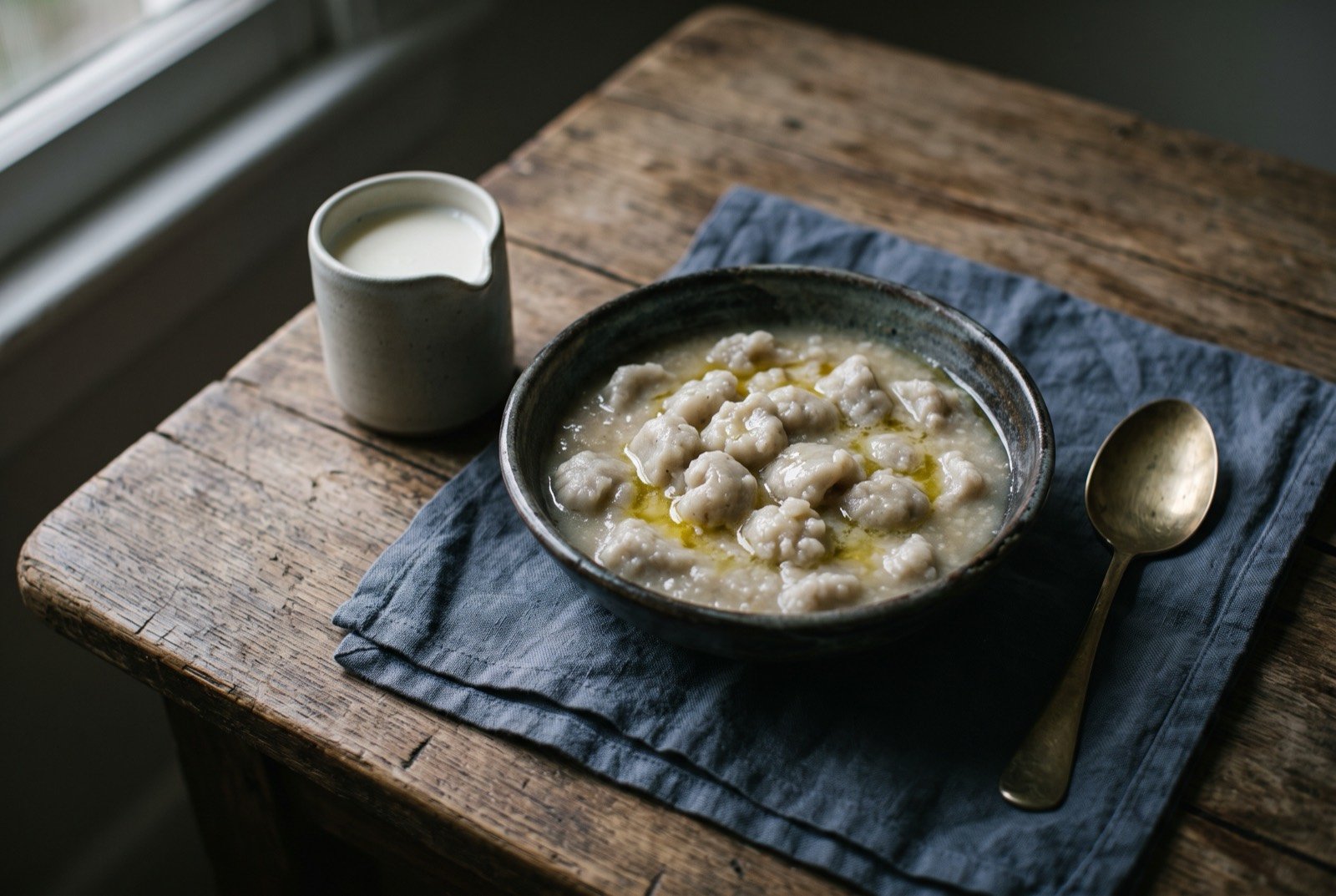
The staple of the Sudd, known to the Nuer as walwal and also as abyei, with a steamed dry form called akof. In Bor it is described as a sorghum couscous served with a thin yoghurt and flavoured with lalob, the bitter kernel of Balanites aegyptiaca, the desert date. Take the "not a couscous" point seriously, because it is a technique distinction rather than a point of pride. Couscous is rolled outward from moistened semolina around a nucleus; walwal is torn and rolled from a fermented dough, so the pearl is a piece of dough rather than an accreted grain.
As tradition built it
Serves 4. Three to four days of fermentation, plus 40 minutes.
Ingredients
- 300 g white maize flour
- 200 g sorghum flour
- about 350 ml water
- 2 tbsp thaau or lalob (desert date) paste
- 1.2 L water, for cooking
- 2 tbsp ghee or samna
- to taste sugar to taste; milk or thin yoghurt to serve
Method
- Mix the white maize flour and the sorghum flour with water to a thick dough, no wheat. The source gives no weights and no hydration, so 350 ml is a starting point and not a specification: you want a dough that holds a shape and does not slump.
- Cover and ferment three to four days at ambient temperature.
- Break off pieces and roll and separate them by hand into small balls the size of pearl couscous. It takes a long time and there is no machine for it.
- Boil the cooking water with the thaau or lalob (desert date) paste dissolved into it.
- Drop the balls in and cook until done through and the liquid has thickened around them.
- Finish with the ghee or samna and sugar to taste; milk or thin yoghurt to serve, or without.
Notes
From one South Sudanese cook, and single-sourced, which the final section says plainly.
What a modern chef changes
Fix the hydration, control the ferment, steam a proportion as akof, keep the dairy cold
Rungs 1 and 6
Method
- Weigh the dough and record it. The single source gives no weights, so establish your own and be consistent. A fixed baker's percentage is the difference between a dish you can serve and one you can only make.
- Control the ferment rather than counting days. Three to four days at ambient in Jonglei is not three to four days in a British November, and a day count is a proxy for an acidity nobody measured. Hold it at a fixed temperature and go by pH, to the ajin benchmark of 3.4 to 3.5. Rung 1.
- Steam a proportion instead of boiling all of it. Not an invention: akof is the tradition's own steamed dry form of the same pearl. Boiled walwal is soft and absorbent, steamed akof drier and separate, and serving both gives the bowl a contrast it already contains and rarely shows.
- Serve the milk cold and separate, and weigh the lalob. Rung 6: the thin yoghurt is a finishing acid whose diacetyl and acetaldehyde do not survive the pot, and lalob is genuinely bitter.