Africa · Volume 10
Ethiopia & Eritrea
The Highland Ferment
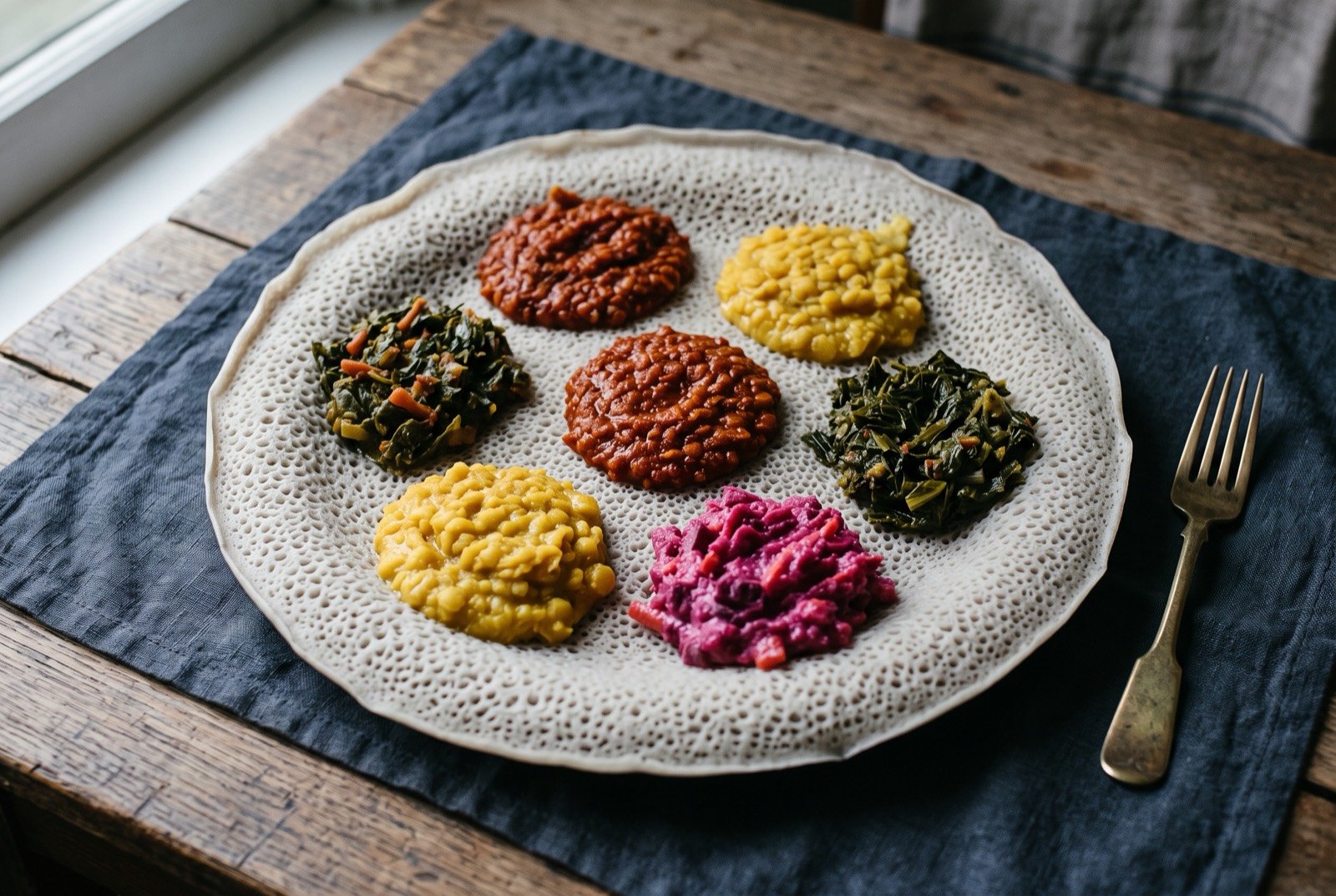
Ethiopia and Eritrea, taken seriously. This is the most internationally legible cuisine in the atlas and therefore the one most often flattened into injera and a stew. A technique ladder built from the inside, a fermentation treated as engineering rather than folklore, and every dish as tradition built it, then what a modern chef would change.
Sources and review · What this chapter does not assert · How we research · Know this better? Tell us
A Sense of Place
Two countries, one plateau, and a cuisine best understood as a set of arguments about acid.
Do not organise this volume by nation. The Ethiopia and Eritrea border is a line drawn in 1993 through a single Tigrinya-speaking culinary world, and drawn again in blood between 1998 and 2000. The useful axes are the four this chapter uses throughout: what the fat is, what the thickener is, what the aromatic is, and what the starch is.
There is a second reason to resist the national framing, and it is the corrective that matters most here. Pure teff injera is an aspirational, urban and relatively wealthy product. In the lowlands injera is commonly made with sorghum; in the highlands, with barley. A great deal of what outsiders take to be the everyday food of a hundred and thirty million people is the food of the plateau, on a good day, in a house that can afford it.
The teff and injera highlands
Peoples: Amhara and Tigrayan in Ethiopia, Tigrinya in Eritrea. Ecology: the 1,800 to 2,500 m plateau, the only place where Eragrostis tef is a viable staple rather than a luxury.
This is the world the volume's spine describes: injera, the wat family on a dry-cooked onion base, spiced butter, berbere, the Orthodox fasting calendar, the jebena coffee ceremony. The vocabulary runs in parallel and this chapter always gives both. Amharic wat is Tigrinya tsebhi; key wat is zigni; injera is taita, and Oromo buddeena; niter kibbeh is tesmi. Tigray keeps a barley sub-world of its own: tihlo, roasted barley dough balls eaten with zigni, plus ambasha and hibist breads, and hilbet.
The Eritrean variation, which is not a subset
Eritrea shares the grammar and differs in three specific, teachable ways, and treating Eritrean cooking as Ethiopian cooking with a different flag is both rude and technically wrong.
One: tomato is structural. Silsi tsebhi, a tomato, onion and berbere sauce, is a foundational preparation in its own right, not a variant of anything. Two: less butter, more oil. Eritrean zigni is documented as using less spiced butter than the Ethiopian equivalent, producing a lighter dish. Three: an Italian layer Ethiopia largely lacks. Pasta al sugo e berbere, lasagne and cotoletta alla milanese are Eritrean food now, not foreign food in Eritrea, and espresso is drunk in Asmara bars alongside the jebena ceremony, in the same room, without any sense of contradiction. Hilbet, the whipped fava, lentil and fenugreek cream, is more Eritrean and Tigrayan than Ethiopian, and is recorded as particularly popular in Akkele Guzay and Agame.
The enset belt
Peoples: Gurage, Sidama, Wolaita, parts of Oromia. Here the staple is not a grain. Ensete ventricosum, the false banana, supports over twenty million people and is nicknamed the tree against hunger. The pseudostem and corm are scraped, the starch-bearing pulp separated from the fibre, and the pulp buried in a leaf-lined pit to ferment anaerobically for weeks to months, giving kocho, the bulk starch baked as a dense flatbread; bulla, the refined fraction, whiter and lighter and traditionally given to children and the elderly; and amicho, the corm simply boiled.
This is a genuinely different fermentation culture from the injera one: solid state, anaerobic, months long, and functioning as a store of value. A pit of kocho is a savings account, which is exactly why the crop earned its nickname. This is also the home of kitfo. Kitfo is Gurage, not Amhara, and traditionally eaten with kocho and a horn spoon; the injera plating of kitfo in London and Washington is a diaspora restaurant convention and this chapter says so.
The barley and butter uplands
Peoples: Oromo, particularly Arsi, Bale, Wallaga and Shewa. Fat: dhadhaa, Oromo butter. A porridge and toasted-flour culture rather than a stew culture: marqaa, a barley porridge finished with dhadhaa, plus chukko, chechebsa, ancootee and marmaree, wheat flour rounds dipped in clarified butter.
Buna qalaa belongs here and it is the best argument that the coffee ceremony is not one thing. The name means slaughtered coffee: whole sun-dried cherries have their tips nicked open, traditionally with the teeth, so butter can penetrate, and they are roasted in butter in a clay kelo, served with hot milk in a wooden kori, and eaten rather than drunk. It is practised by the Guji and embedded in the Borana Gadaa system, marking births, naming ceremonies, weddings, reconciliations and the end of mourning.
A caution, stated rather than buried. The Oromo and Harari material available to this chapter is thinner than the highland material by a wide margin. Where that is true this chapter names the dish and declines to invent a recipe.
The Muslim east
Peoples: Harari, Oromo of Harar, Somali, Afar. Aromatic: fenugreek and cumin, and specifically no berbere. The walled city of Harar and the eastern lowlands face the Red Sea and the Indian Ocean rather than the plateau. The key dish is abish, also called hulbat marakh, fenugreek broth, traditionally made without butter and without berbere, with injera torn into it rather than laid under it. Sambusa, fatira and the wheat pastry family belong here, and so does the Somali canjeero, a related but distinct sorghum flatbread.
Addis and Asmara
Addis is where the cuisine is becoming a purchased thing rather than a made thing. Injera's share of Ethiopian household food expenditure rose from 0.8 per cent between 1996 and 2000 to 4.7 per cent by 2011 as urban households stopped baking and started buying, and the parallel with what happened to bread in Britain is exact. Asmara is where the jebena and the espresso machine sit in the same bar, and where the brewery built in 1939 as Melotti still runs.
The History in Layers
The indigenous foundation
Teff is one of a very small handful of crops domesticated in the Ethiopian highlands and effectively nowhere else. The dates are contested and this chapter gives a range rather than a number: Christopher Ehret places cultivation, on linguistic grounds, at least several millennia before Christ, J.A. Ponti proposed 4000 to 1000 BC, and the hard archaeobotany is narrower and later, with teff grains at Mezber in Tigray at around 1600 BC as the oldest secure find.
Note what teff physically is, because everything follows from it. The seed is roughly 1 mm across. It is milled whole, because there is no practical way to fractionate a grain that size, so every gram of flour carries germ, bran and endosperm together. That is why it is nutritionally dense, why it goes rancid fast, and why the traditional ferment works at all.
The griddle question, which complicates the origin story
You will read that injera is three thousand years old. The evidence does not support the sentence, and the real evidence is better. The earliest ceramic griddle plate in northeast Africa comes from Mahal Teglinos in eastern Sudan at the end of the third millennium BC, and in the Ethio-Eritrean highlands pre-Aksumite sites including Ziban Adi and Mezber give griddles from around 1000 BC or earlier, but griddle plates only became common during the first millennium AD. Matthews argues that griddle technology probably diffused from the Near East rather than arising indigenously alongside African cereal domestication, and that flatbreads of Near Eastern grains may have preceded teff and sorghum ones. Richard Wilding, working on Aksumite mitads, concluded that teff was not used for injera until the late fifth or sixth century AD.
So the grain is very old and indigenous, the griddle is old and possibly imported, and the marriage of the two that produces injera is late antique rather than prehistoric. One item is genuinely ancient and undisputed: Aksumite royal inscriptions translated by A.J. Drewes record a third-century AD royal diet including honey wine, which puts tej among the oldest documented items anywhere in this atlas. Later, from 1270, the serata gebr, the Solomonic royal banquet protocol, describes menus of bowls filled with wot and injera, which is the earliest clear textual attestation of the wat-on-injera architecture as a formal courtly system rather than a peasant convenience.
The Columbian Exchange, and the fact that reorganises everything
Sixteenth-century European visitors describe Ethiopians serving spicy stews on injera, but the heat came from cress, not chilli. That is the most important sentence in this section: the architecture predates the ingredient that now defines it.
Chilli arrived by sea, via the Portuguese and via India, in the very late sixteenth or early seventeenth century, and the documentary chain is unusually clean. 1589, the Spanish Jesuit Pedro Paez arrives. c.1618, Paez writes that some chilli seeds came at the same time as other seeds from India, and that there is now plenty, and the people like it very much. 1770s, James Bruce records cayenne in Ethiopian cooking. 1848, Walter Plowden records the word berbere itself. 1867, Henry Dufton confirms it in general use. So berbere as we know it is at most about four hundred years old, and the word is attested only from the mid nineteenth century. Maize, which colours tella as asharo, and the potato and tomato that structure atkilt and Eritrean silsi, arrive on the same tide.
Here is the argument. The most distinctive cuisine in Africa is built on an indigenous grain, an indigenous fermentation, an indigenous shrub for bittering beer, an indigenous cardamom relative, an indigenous stimulant, and one imported American fruit that arrived in the seventeenth century and reorganised everything on top of a structure already there. The Americas supplied the heat. The highlands supplied the cooking. Volume Four made the same argument about maize on the Ewe and Fon coast, arriving at it independently from the other end of the continent.
Italy, Eritrea and the occupation
You will be told Ethiopia was never colonised. True in the sense that it was never made a European colony, misleading in the sense usually implied. Italy held Eritrea as a colony from 1890, and occupied Ethiopia from 1936 to 1941. Print the qualified version or do not print it. Eritrea therefore carries a full colonial food economy: pasta, tinned tomato, coffee bars, the Asmara Brewery. The period also has a darker food history, the gastrofascist project of settler menus and racialised eating in Italian East Africa between 1935 and 1941, which a serious chapter should not skip past on the way to the lasagne.
The ruptures, and why American teff exists
1974, the Derg overthrows Haile Selassie, and the first significant wave of Ethiopian political refugees reaches Britain. 1983 to 1985, famine: Ethiopian teff production collapsed, and Ethiopian restaurants in the United States switched to other grains. This is the moment the diaspora injera problem is born, and it is worth holding on to, because the rice-flour injera served in a British restaurant tonight has a causal line back to a crop failure forty years ago. 1987, Tedla Desta opens the first injera bakery in Alexandria, Virginia, and takes teff seed to a seed company in Enid, Oklahoma. 1990s, Wayne Carlson of Caldwell, Idaho founds The Teff Company: American-grown teff is a direct product of the famine. 1991, the Derg falls. 1993, Eritrean independence. 1998 to 2000, the border war. 2020 to 2022, the Tigray war, with severe disruption to the Tigrayan agricultural heartland.
Teff, patents and sovereignty
Ethiopia banned raw teff grain export outright, and only in May 2015 permitted flour exports under tight controls through a small number of licensed exporters. That policy is about domestic price protection, and it is the direct reason most teff sold in Britain is not Ethiopian. Then the patent fight: in 2003 the Dutchman Jans Roosjen filed a European patent claiming teff flour products, including their use in injera; Ethiopia challenged it, proceedings began in June 2014, and in November 2018 a three-judge Dutch court ruled the patent lacked inventiveness and invalidated it. A grain domesticated in Ethiopia, whose export the Ethiopian state restricted to protect its own people's food prices, was patented in Europe and had to be un-patented in a Dutch court. That is the modern history of this cuisine in one sentence.
The Flavour Arsenal
Nine tenths of what makes this food taste like itself is here. If you buy nothing else, buy korarima, koseret and a berbere that has actually been through a wet stage.
The aromatics with no European equivalent
Botanical identifications follow the 2025 ethnobotanical review of Ethiopian spices and condiments, cross-checked against Harry Kloman's spice rack. Where those disagree, this chapter says so.
| Amharic (Tigrinya) | Botanical | Flavour | Use |
|---|---|---|---|
| Korarima | Aframomum corrorima | Not cardamom. Camphor and eucalyptus over a resinous base, cooling finish. Closer to grains of paradise | Dry roast, husk, grind the seeds. Niter kibbeh, doro wat, kitfo, coffee. By the teaspoon |
| Koseret, kesse | Lippia adoensis var. koseret | Citrus and verbena over dried oregano, slightly soapy. A verbena, not a mint | Crumbled dried into simmering butter |
| Besobela | Ocimum sp., see the final section | Sacred basil. Aniseed and clove, drier and more medicinal than Genovese | Into berbere and niter kibbeh |
| Tosign | Thymus schimperi | Ethiopian thyme, higher in thymol, harsher | Niter kibbeh, berbere, tea |
| Tikur azmud | Nigella sativa | Nigella: oniony, peppery, faintly bitter | Berbere, mitmita, duba wot |
| Nech azmud | Trachyspermum ammi | Ajwain. Thyme and camphor from thymol, hotter than cumin | Berbere, mitmita, niter kibbeh |
| Abish | Trigonella foenum-graecum | Fenugreek: burnt sugar, celery, maple, bitter | Berbere; the whole substance of Harari abish and Eritrean hilbet |
| Timiz | Piper capense, some sources P. longum | Ethiopian long pepper: piney, resinous, slower and more numbing than black pepper | Three whole pieces per doro wat |
| Tena adam | Ruta chalepensis | Rue. Bitter, resinous, like grapefruit pith. Toxic in quantity | A sprig in coffee; seed in berbere |
| Gesho | Rhamnus prinoides | Bitter, tannic, resinous | Sun dried into tella and tej. The hop analogue |
The two azmuds are the most common naming error in English-language Ethiopian recipes. Nech azmud is ajwain, whose character is thymol, a phenol. Tikur azmud is nigella, neither cumin in the Bunium sense nor black sesame. Ordinary cumin substitutes for neither: different compound class, built on cuminaldehyde.
Berbere, which is not a dry blend
Traditional berbere passes through a wet, sun-dried paste stage, and that is what separates the real thing from anything in a jar. From a survey of 125 Ethiopian producers: fresh garlic, ginger, onion, basil and rue pounded in a mortar into a wet mash; dried red pepper pounded into it; the whole wet mass sun dried, a stage called delez berbere; then mixed with dry spices and milled. That stage allows enzymatic and photo-oxidative change during the slow dry, and lets the fresh aromatics penetrate the chilli particles rather than sit alongside them. Every commercial jar skips it and compensates with garlic powder, onion powder and dried ginger, which is honest and is not the same molecule set. The recipe is on the ferment bench.
The proportions matter more than the ingredient list. Scaled from Daniel Mesfin's household formula, chilli is roughly 55 per cent by weight, garlic and ginger together roughly 37 per cent, everything else about 8 per cent. Most Western berbere is chilli plus paprika plus a supermarket spice cupboard with no fresh allium in it at all. Note also that Ethiopian thyme appears in 36.8 per cent of surveyed samples and is absent from almost every Western reconstruction, and that the named Ethiopian landrace is Mareko Fana.
And one number changes how you cook. Across those samples, sodium runs from 857 to 15,936 mg per 100 g: an eighteen-fold spread between one bag and another. A recipe written for one berbere is actively dangerous with a different one, and that single fact drives Rung 5.
Mitmita, awaze and the finishing condiments
Mitmita is not hot berbere. It is a shorter blend dominated by whole hot chilli including the seed, with korarima, clove and salt, used as a table condiment and raw-meat dressing rather than a cooking spice: finer, hotter, more orange, far more aromatic at the front. Aster Ketsela Belayneh's published formula is 3 lb chilli flakes, 1 lb cardamom and 1 lb salt, which is 25 per cent cardamom by weight, far beyond any Western version.
The rest of the shelf: awaze, berbere and mitmita let down to a paste with tej, the table condiment and the dressing for gored gored; mekelesha, the finishing blend of black pepper, korarima, cinnamon, cumin and cloves added in the last minutes so its top notes survive; senafich, ground mustard, served with raw meat to cut fat; kochkocha, a green chilli, garlic and ginger relish; and afrenje, a warm chilli-free blend, which is a useful reminder that the cuisine is not monolithically hot.
Niter kibbeh, and the fasting fat
Amharic niter kibbeh, Tigrinya tesmi; the fasting equivalent is yeqimem zeyet.
Ethiopian butter is cultured butter from soured milk, not sweet cream butter. Ergo is incubated at 25 to 30°C for 24 hours to pH 4.3 or below, then churned for 1 to 4 hours, with 20 to 25 litres yielding about 1 kg of kibe at 81.2 per cent fat. That lactic tang carries into the spiced butter, and is one concrete reason British unsalted butter tastes flat by comparison.
The infusion is a two-stage extraction, not ghee with spices thrown at it. Fresh aromatics go in while the butter still holds water, so the water-soluble compounds from onion, garlic and ginger are taken up first; as the water boils off, the fat-soluble ones transfer into the fat, korarima's sesquiterpenes, eugenol from besobela and cloves, thymol and its relatives from koseret and tosign. Removing the milk solids then gives a fat that keeps for months unrefrigerated, which is what let a household hold its cooking fat through the fasting seasons and the rains.
For the fasting repertoire the fat changes completely. The traditional oils are nug, from Guizotia abyssinica, and flax. Nug is hard to find in Britain; cold-pressed flaxseed oil is the correct substitution, bought and kept refrigerated and used within weeks.
The onion, which is not an aromatic
In this cuisine the onion is structure. There is no roux in a wat, no cream, no starch, no tomato paste, no reduced stock. The collapsed onion mass, called kulet once berbere and spiced butter have gone in, is simultaneously the fat carrier, the thickener and the sweetness. Under-onioned wat is not less flavourful; it is a structurally different object, thin and gritty and unable to hold spice in suspension. This gets its own rung.
Shiro, which is a flour and not a spice
Shiro powder is a manufactured product, and it goes through the same wet-then-sun-dried stage berbere does: clean, wash, sun dry, roast, de-hull, split, winnow, pound with a fresh spice mash, sun dry again, mill. The base legume is not what English-language sources say: peas dominate at 66 per cent of producers, chickpeas 41, fava 23, grass peas 12. Protein runs 21.5 to 32.9 per cent and sodium 889.9 to 3,736.1 mg per 100 g, so Rung 5 applies here too. Mitin shiro carries somebody else's berbere and salt; nech shiro is plain, and it is what a kitchen that wants control buys.
The drinking ferments
Tella, Tigrinya suwa, is the household beer, and it runs through six named stages: bikil, barley malted by soaking 24 hours, germinating 3 days and sun drying; tejet, bikil and gesho fermented 2 days; ye tella kita, a flatbread of millet, sorghum and teff baked and added; tenses, anaerobic 5 to 7 days; asharo, roasted maize flour that sets the colour; and difdif, anaerobic 10 to 20 days, then watered and filtered. A documented recipe gives 1 kg gesho, 0.5 kg bikil, 5 kg kita, 10 kg asharo and 30 litres water, yielding 25 to 28 litres over 22 to 34 days at 4 to 6 per cent alcohol, with a shelf life of only 5 to 7 days. Tej, Tigrinya mies, is honey to water at 1:3 with boiled gesho, primary 2 to 3 days and secondary 8 to 21, finishing at 7 to 11 per cent, drunk from a round-bottomed flask called a berele. The gesho quantity is standardised nowhere in the literature, which is itself worth saying. Gesho is Rhamnus prinoides, a bittering agent and a documented antimicrobial that steers the ferment: a hop analogue that is not a hop, and one of the six indigenous pillars listed above.
Part Two
The Technique Ladder
First, an honest problem
Volume Three could hang its elevations off Ikoyi and Akoko. This volume cannot. There is no Michelin-starred Ethiopian or Eritrean restaurant anywhere in the world that this chapter's research could verify, as of August 2026. The most distinct cuisine on the continent, and one of the world's great fermentation cultures, has essentially no representation at starred level. Three separate things exist instead and it would be dishonest to blur them.
One: Guide listings without distinction, and one Bib Gourmand. Michelin runs a dedicated Ethiopian cuisine filter in its US Guide, which is itself the story: the category exists and the stars do not. Das Ethiopian in Washington DC took a Bib Gourmand in 2021, confirmed by two dated sources, though whether it holds it now is unconfirmed here. LeYou and Lalibela are Guide-listed with no distinction confirmed.
Two: a James Beard semifinalist. Darmyelesh Alemu of Beteseb, Silver Spring, was named a 2026 semifinalist for Best Chef: Mid-Atlantic on 23 January 2026 and did not advance. As far as this chapter can establish, that is the highest formal recognition an Ethiopian chef cooking Ethiopian food has received in the United States.
Three: chefs who trained in starred kitchens and turned that training back on their own food. Elias Taddesse cooked in New York under Alain Ducasse and Paul Liebrandt, studied at the Institut Paul Bocuse, and broke away because it was time to tell his own story rather than execute French cuisine for other people. Syndicated outlets call him a Michelin star chef: that means he has worked in starred kitchens, neither of his restaurants holds a star, and this chapter will not repeat the headline as written. Marcus Samuelsson opened Marcus Addis in Addis Ababa around the turn of 2024, and his anchor line is the one this chapter borrows: "The roots are the berbere, we use injera, we use the roots of Ethiopian cooking." Romeo and Milka Regalli at Ras Plant Based run an entirely vegan menu that is not a concession to Brooklyn but the Orthodox fasting repertoire at restaurant level, and their framing is the sentence this volume most wants kept: a hundred and fifty plus vegan days a year is not anything new to Ethiopia.
And Britain? There is no British equivalent. An excellent neighbourhood scene, and essentially zero fine dining in this cuisine. That absence is this chapter's provocation, not its excuse, and the six rungs below are built from mechanism and measurement rather than from anybody's tasting menu. Every one is a traditional Ethiopian or Eritrean technique done deliberately.
Rung 1. Run the absit step, and hit the numbers
Injera is not a one-stage batter. It is a two-stage, mixed-culture sourdough with a cooked-starch intermediate. After the primary ferment you take 8 to 10 per cent of the fermented dough, combine it with roughly three parts water to one part dough, boil it, stirring, for about 10 minutes, cool it to about 46°C, and stir it back in. Secondary fermentation then runs 30 minutes to 4 hours.
Why it works, and this is the technical heart of the volume. Teff has no gluten, so there is no viscoelastic network to trap carbon dioxide and a raw batter lets the bubbles escape and bakes flat. Absit does three things at once. The gelatinised starch raises viscosity sharply, giving the only gas-retaining matrix available, so bubbles are held as discrete channels. Boiling liberates fermentable sugars, giving the surviving yeast a fast late feed in the two hours before baking. And it sets the target viscosity for eye formation, measured at 1.1 to 1.4. Batter without absit gives fewer eyeballs and a soft, powdery bread.
Absit is the functional analogue of the tangzhong water roux and of the boiled potato in a rye starter, arrived at independently on a highland plateau centuries before anyone wrote it up.
The diagnostic, and the single most useful number in this chapter: count the eyes on one square centimetre. The optimised process yields 16.06 to 16.46 per cm². Under ten and your absit is wrong or absent.
Rung 2. Ferment to a chosen endpoint, not to a clock
Primary fermentation runs 24 to 96 hours, most commonly 48 to 72. The controlled optimisation study gives 64 hours at 25°C, producing 95.56 per cent carbon dioxide in the headspace. The endpoint in the finished bread is pH 3.40 to 3.42, moisture 60.44 to 60.82 per cent, extensibility 1.45 to 1.55 N and rollability 4.68 out of 5.
Temperature is the variable, not time. Yeasts favour 20 to 30°C; lactic acid bacteria favour 18 to 22°C. Ethiopian highland ambient sits at 17 to 25°C, exactly in the overlap, which is why the ferment behaves at home. A kitchen swinging from 16°C overnight to 24°C by afternoon is running a different organism population every batch. And there is a specific defect worth naming: excessive aeration pushes the bacteria toward acetic acid at the expense of ethanol, which is why some injera tastes of vinegar rather than yoghurt. That is an oxygen and temperature problem, not a time problem, and leaving it longer makes it worse.
Name your endpoint rather than apologising for it. Aflegna, Tigrinya bekuo, is 12 to 24 hours: thick, sweet, dark red underside, poor keeping, and a legitimate style rather than a failure. Standard injera is 48 to 72 hours. Komtata is a long, aggressively sour ferment, traditionally redirected into fit-fit rather than thrown away.
The diagnostic: a pH meter, targeting 3.4. One further payoff: fermentation degrades phytic acid by 49 to 66 per cent, with the phytate to zinc ratio falling from 63 to 19 after 120 hours. The ferment is what makes the grain nutritionally functional in the first place.
Rung 3. Cook the onion dry, and cook enough of it
A very large quantity of onion, minced to a coarse paste, cooked in a heavy dry pan over low heat, alone, with no fat and no added water, until it has released its moisture, that moisture has evaporated, and the mass has collapsed and browned. Only then does fat go in.
The quantities, and the sources conflict in a way this chapter will not paper over. Fariyal Abdullahi, for four chicken thighs: 2.5 lb of red onions, alone, stirred every 30 minutes, for approximately five hours, with splashes of water only to stop it catching. Her rationale is unambiguous: ninety per cent of the flavour comes from the caramelisation of the onions. Samra Cooks, for a whole chicken: 2.5 lb of onions plus 0.5 lb shallots and two tomatoes, over low heat for one hour. A third documented figure sits between them at 900 g for eight to ten thighs, dry-cooked 25 to 30 minutes.
One hour against five for the same weight of onion is not a rounding error. It is two different dishes. Five hours gives a dark, jammy base; one hour gives a golden one that leans harder on the berbere and the simmer. Both cooks hold their version to be authentic and this chapter believes both. My reading is that the traditional charcoal-and-clay method sits between them, because a dist over embers cannot be pushed.
Why the dry stage works. Onion is about 89 per cent water. In fat, that water is trapped under an oil film and the pan stalls at 100°C; dry, it evaporates freely and the surface climbs past 140°C into Maillard territory. You are making an onion reduction, not a soffritto. Fat added early coats the pectin and blocks collapse, so you never get the emulsified body that lets a wat cling to injera. And the onion is the only thickener and the only emulsion base. The order also protects the spice: berbere into a wet pan clumps, into a hot dry pan scorches, into a fat-slicked collapsed onion mass blooms. Hence the invariable sequence, onion dry, then niter kibbeh, then berbere, then liquid, with mekelesha only at the end.
The diagnostic: onion should equal or exceed the protein by weight. If your finished sauce needs anything to thicken it, you used too few onions. And note that alicha is the same technique minus the berbere, with turmeric instead: not mild wat, but a parallel family.
Rung 4. Treat spice as a fat-phase extraction on a clock
Two operations at opposite ends of the temperature scale, governed by one principle.
The berbere bloom: under one minute, in hot fat. Capsaicinoids, capsanthin and capsorubin partition into fat and not water, so a fat bloom puts colour and heat into the medium that coats every surface in the dish. But the same chilli mass carries residual sugars and free amino acids that pyrolyse fast at frying temperatures, producing the acrid burnt-paprika note. Sixty seconds is the window.
The niter kibbeh infusion: 45 to 50 minutes, never at a rolling boil. That window extracts sesquiterpenes, eugenol and the thymol relatives into the butterfat while staying below the temperature at which the top notes volatilise off. Boil it and you have made brown butter with dust in it.
The diagnostic: a finished wat should be dark brick red and glossy, with visible fat separation at the edge. Dull brown means the berbere burned; matte and dry means it never met enough fat.
One consequence explains most of what is wrong with British Ethiopian takeaway food. Held at 60 to 70°C on a steam table for a service, the volatiles that were deliberately extracted below simmer boil off, the berbere keeps cooking from bloomed to scorched, the fat separates and re-emulsifies badly, and the onion purée breaks down into something sweet and slack. A wat that was excellent at the pass is a different dish two hours later, which is why the same kitchen can be superb at seven and grim at ten.
Rung 5. Salt against your specific berbere, by measurement
Everyone else seasons by recipe. Cooking this cuisine seriously means seasoning by assay. Sodium in surveyed berbere runs from 857 to 15,936 mg per 100 g, an eighteen-fold range; shiro runs from 889.9 to 3,736.1 mg, a four-fold range. A recipe that says half a cup of berbere and a teaspoon of salt is meaningless across brands, and following one faithfully with the wrong bag produces something inedible.
Then compound it with the bread. Injera arrives at pH 3.40, so every mouthful carries a substantial acid load, and acid and salt are mutually enhancing on the tongue. A wat seasoned on its own tastes over-salted off sour injera, and a wat seasoned for very sour injera tastes flat off fresh, mild injera. The plate is a system and the seasoning is a property of the system, not of the pot.
The diagnostic is two habits. Taste the berbere neat on a wet fingertip before you cook with a new bag, and cut the salt if it reads salty. Then season the wat while eating it off a torn piece of the actual injera you will serve. Those two habits will do more for your Ethiopian cooking than anything else in this chapter.
Rung 6. Rebuild the plate's textural architecture
A beyaynetu is a set of purées and braises on a soft, damp, sour bread. Every element is soft and everything sits at roughly the same temperature. In the communal context that is a virtue, because it is what makes the plate scoopable with one hand and shareable with five people. Under restaurant scrutiny it is a liability, and every serious modern practitioner solves it the same way: they add crunch and temperature contrast, and they leave the stews alone.
The worked examples point one direction. Ras Plant Based's awaze-spiced cauliflower wings put a crisp fried shell against wet stews. Samuelsson's shiro fritters convert a purée into a crust with a molten centre, exploiting the fact that roasted legume flour sets on cooling. His teff biscuit sets a dry, friable crumb against injera's damp sponge, and his fried capers are a salt-and-crunch top note on a soft tartare. Taddesse's berbere-glazed fried chicken is crust plus lacquer.
The chemical footnote makes this a technique rather than a preference. Injera at 60 per cent moisture is a hydration sink, and anything crisp placed on it has minutes before capillary action softens it. Crisp elements must be plated off the injera, which is precisely why the modern versions abandon the single communal platter for composed plating. The plating change is not aesthetic vanity. It is moisture management.
And one more idea from the same source, the most transferable in the diaspora repertoire: Taddesse finishes cornbread with qibe and black cumin rather than butter. Replace the neutral finishing fat with the aromatic one. It costs nothing, and it works on food that has nothing to do with Ethiopia.
Part Three
The Ferment and Preserve Bench
Four things worth making. All four are the traditional preparations this cuisine already runs on, and all four are things you cannot buy properly in Britain.
1. Ersho, the injera starter
You cannot buy this in Britain. Beg it. Any Ethiopian or Eritrean restaurant that makes its own injera has it, and a small jar of the yellow liquid off the top of a working batter is the single highest-value ingredient in this chapter.
Two definitions circulate and blurring them is how the technique gets garbled online. Traditionally, ersho is not a fed sourdough starter: it is the clear yellow liquid that accumulates on the surface of a fermenting teff batter and is collected from the previous batch, roughly 96.4 per cent water, pH about 3.5, titratable acidity 3.1 to 5.7 per cent, dosed at about 16 per cent by weight of the flour. An alternative documented practice uses 10 per cent of previously fermented dough instead. In the diaspora, a household with no previous batch builds a fed starter over five days: a cup of warm water and a cup of teff flour on day one; a half-cup feed on day two when it bubbles; on day three a fresh full mix carrying over a tablespoon or two of the old; a half-cup feed on day four; ready on day five. The second is an adaptation of the first, not the same thing. Switch to the traditional decant the moment you have a batch of your own to decant from.
Do not use commercial baker's yeast as a substitute. It gives gas without acid, so you get a bland pancake with holes in it. The sourness is not a by-product. It is half the dish, and it is what makes the wat's salt and chilli read correctly.
Why a British first batch behaves badly, in five mechanisms rather than one folk explanation. One, the inoculum is missing. The traditional ferment is seeded by the flour, the water and the vessel, and the literature is candid that traditional threshing contaminates teff seed with soil and faecal material. The ferment is a controlled acid-driven selection event that outcompetes what came in on the grain: Enterobacteriaceae start at 4.17 log cfu per ml and fall to non-detectable within 18 hours as the pH crashes from about 6.65 to 3.49. Cleaned, hygienically milled, long-shipped teff carries a fraction of that load. Two, the flour is not the same flour: Ethiopian household teff is stone-milled to order and used fresh, while imported flour is roller milled and often months old, with different damaged starch content, a documented determinant of ferment rate. Three, the variety is not the same variety, because Ethiopia restricts raw grain export. Four, temperature and water: British kitchens swing, and chlorinated tap water suppresses the early ferment, so let it stand overnight. Five, kit: a domestic frying pan cannot hold 235 to 255°C across 50 cm, and without a heavy domed lid the top never sets into a lattice.
2. Berbere, with the delez stage
You can buy berbere in Britain. You cannot buy a delez-stage berbere in Britain, and the difference is the difference between fruity and dusty.
Makes about 400 g. Two days, of which about 45 minutes is work.
| 250 g | dried red chillies, stemmed and mostly deseeded (guajillo or Kashmiri for colour, árbol or cayenne for heat) |
|---|---|
| 90 g | fresh garlic, and 90 g fresh ginger, peeled |
| 40 g | red onion, and 15 g fresh basil leaves |
| 10 g | rue leaf, if you can get it, and no more |
| 2 tsp | nech azmud (ajwain), and 2 tsp fenugreek seed |
| 1 tsp each | korarima seed, cloves, cinnamon, tosign, tikur azmud |
| 20 to 30 g | salt, adjusted to taste and written down |
| 60 ml | water |
- Pound the garlic, ginger, onion, basil and rue together in a heavy mortar into a wet mash. Not a blender: a blade shears rather than crushes and will not release the same compounds. Fifteen minutes, and it is the step the whole preparation exists for.
- Pound the dried chillies into that wet mash, in batches, with the water, to a coarse, damp, deep red paste.
- Dry it. Spread 5 mm thick on dehydrator trays at 50°C for 12 to 18 hours, until it snaps rather than bends. The sun does this in Ethiopia over a day or two; the dehydrator is the honest British equivalent and it is more controllable.
- Toast the remaining whole spices separately, about a minute each, and grind. Never toast pre-ground spice: the surface-to-mass ratio means it burns before it blooms.
- Grind the dried paste, combine with the ground spices and the salt, and sieve. Write the salt quantity on the jar. Rung 5 begins here.
Store airtight, dark and cool, and use within three to four months, after which you are left with heat at the front and dust at the back.
One warning belongs in any chapter about buying red spice. Berbere is chilli-and-paprika dominant, which puts it in the most adulterated spice category in the world. Sudan dyes, industrial colorants used in shoe polish and waxes, are illegally added to fading paprika and chilli to restore a saleable red. They are carcinogenic and unapproved for food, with 39 European notifications and 12 US FDA import alerts documented between 2014 and 2024. The dose is the point: berbere is eaten by the half-cup, at up to twenty times a standard spice reference serving. Buy from named UK businesses with traceable supply, prefer organic certification, and be suspicious of any berbere that is an implausibly vivid, uniform scarlet. Real berbere is a deep, slightly dull brick red with visible particle variation.
3. Niter kibbeh, and its fasting counterpart
Makes about 600 ml. About an hour of attention across half a day.
| 1 kg | unsalted cultured butter, 82 per cent fat or higher |
|---|---|
| 1 | onion quartered, 6 garlic cloves crushed, 30 g ginger sliced |
| 2 tsp each | korarima seed and fenugreek seed, ground |
| 1 tbsp each | koseret and besobela, crumbled |
| 1 tsp each | tikur azmud, nech azmud, turmeric, tosign |
| 4 | cloves |
- Melt the butter with the onion, garlic and ginger over low heat, 10 to 15 minutes. The butter still holds water at this stage, and that water is what extracts the alliums.
- Take it off the heat and rest it 3 to 4 hours. This is a documented step and the one people drop. Extraction continues at falling temperature and nothing is being destroyed.
- Return to very low heat, add all the dried spices, and simmer 45 to 50 minutes, never at a rolling boil. A bare tremble and no more. The target colour is light golden, not brown.
- Let the milk solids settle, then strain through muslin, leaving the solids and any water behind.
- Properly clarified it keeps refrigerated about six months. Leave milk solids in and you have made a compound butter that will go rancid in weeks. Clarification is not fussiness. It is the shelf-life mechanism, and it is what let a household hold its cooking fat through the rains.
Substitutions, from the specialist sources and worth reproducing exactly. Korarima can be replaced with green cardamom, never black: Amomum subulatum is smoke-dried and will make your niter kibbeh taste like a barbecue. Koseret can be approximated with oregano, mint and lemon verbena at roughly 1:2:3, and oregano alone is not enough, because you get the pungency without the citrus-mint lift and the butter reads as Italian. Besobela can be replaced with dried Thai holy basil. Fenugreek can be omitted and it drastically changes the flavour, so do not.
Yeqimem zeyet, the fasting version, is the same spice set infused into nug oil, or in Britain cold-pressed flaxseed oil, held at 60°C for 45 minutes rather than simmered, kept refrigerated and used within weeks. What does not work is vegetable oil with spices stirred in cold: there is no fat-crystal structure to carry the aromatics and no dairy notes at all, and it is the most common corner cut in British Ethiopian cooking and the most damaging.
4. Ayib, ergo and metata ayib
Ergo, spontaneously soured milk, is the parent of everything: whole milk held at 25 to 30°C for 24 hours in a smoked vessel, the smoking not decoration but a measurable retardant of pathogens, with pH falling sharply to 4.3 or below. Ayib, the fresh curd, is what the plate needs.
Makes about 500 g. 36 hours, mostly waiting.
| 4 L | whole milk |
|---|---|
| 3 tbsp | live natural yoghurt, as a starter |
- Warm the milk to 30°C, stir in the yoghurt, cover, and hold at about 30°C for 24 to 48 hours until it has soured to pH 4.0.
- Churn or whisk hard to remove the fat and reserve it. What is left is arera, the sour defatted milk.
- Heat the arera gently to 70°C, no higher, until the curd precipitates cleanly from the whey. Above 80°C you get an undesirable cooked flavour and the whole point of the ingredient is lost.
- Drain in muslin and press lightly. In Bekelech's kitchen it is pressed under heavy stones.
Expected yield is a minimum of 1 kg from 8 litres, at 79 to 81 per cent moisture, 13.4 to 16 per cent protein and only 1.8 to 2.0 per cent fat. That low fat is the point: ayib's job is to be cool, bland and low-fat against berbere heat and niter kibbeh richness. A salty substitute destroys the contrast the entire plate is built on, which is why feta is the wrong answer and drained unsalted cottage cheese is the right one.
Metata ayib is the extraordinary one, included because almost nobody outside Ethiopia knows it exists. Ayib is fermented spontaneously for 20 days with mustard seed, coriander seed, ginger, garlic, basil seed and rue seed worked into it, finishing at pH 4.0 with a titratable acidity of 10.43 per cent, 43 g of protein and 28.7 g of fat per 100 g, with coliforms undetectable. It keeps up to a year semi-solid and over ten years in dry form. A spiced, fermented cheese with a decade of shelf life, in a country that is supposed to have no cheese tradition.
Sourcing in Britain
Verified August 2026. Where a supplier could not be fully confirmed, that is said rather than smoothed over.
The one that decides everything
The teff, and whether it is actually teff. Buy wholegrain, always: the grain is so small that bran and germ are most of it, and stripping them removes the iron and calcium that justify the price. Nech, white or ivory, is the premium grade and carries social status in Ethiopia; key or quey, red-brown, is cheaper and more assertive; sergegna is mixed. Brown is more forgiving for a first injera.
Rancidity is the real risk and nobody warns about it. Wholegrain teff carries its lipids and the native lipase that attacks them, and the tiny grain gives an enormous surface-to-volume ratio that accelerates hydrolytic and then oxidative rancidity. Buy in 1 kg units you will use within about three months and keep them in the freezer or fridge, airtight. Rancid teff makes injera that is bitter and soapy in a way people routinely misdiagnose as over-fermentation, so smell the flour before every batch and bin it if it smells of old crayons.
Sorghum and barley are legitimate regional injera grains, not compromises. Wheat is not a substitution, because gluten changes the gas-retention mechanism and makes absit unnecessary, which is why so much diaspora injera is stretchy, bland and pale. Rice flour is worse: no gluten and no absit discipline gives a papery sheet.
Verified nationwide, August 2026
- Haderana, 185 Park Avenue, London NW10 7XH. The best UK source and the one to lead with. Ethiopian and Eritrean specialist with a working retail site, stocking berbere, shiro, hilbet, beso, flours, coffee and kitchenware, and stating worldwide shipping. Footer read © 2026 when checked.
- Sous Chef. Thin range, reliable fulfilment: Greenfields Berbere 75 g at £3.20, and organic wholegrain brown teff flour.
- Healthy Supplies carries the Tobia Teff range in 1 kg, though brown teff was showing out of stock when checked.
- Seasoned Pioneers, Spice Mountain and Steenbergs all carry berbere, and Steenbergs' organic certification is meaningful here for the adulteration reason given on the bench.
- Shipton Mill, gluten-free brown teff flour at £2.80, seen in the search index rather than fetched.
Named, but not confirmed
R&R Teff Ltd sells teff flour, berbere and koseret tea, but its copyright reads 2017 to 2025. Mesob Grocery has resolving product pages and a homepage reading "Website Coming Soon". Al-Dimashqi lists Azeb Teff Injera but returned a 403. Azeb Injera Ltd and Tsehay Teff Injera are UK injera producers with no confirmed nationwide shipping, and they are the right people to telephone if you want teff injera in quantity. Tobia Teff's own website returns a default server page, so buy the brand through third parties. World Food Shop's Ethiopia collection currently shows zero products, and African Stores is a directory rather than a retailer. Kibeb, Brundo, Injera For You, Red Fox Spices, Fassica and Shega Foods are American and Berbere Market is Canadian, however British their search results look.
Where the shops are
Ethiopian and Eritrean grocery retail in Britain is overwhelmingly London-concentrated, and outside London the restaurants are the suppliers. Treat the restaurant list as a sourcing list.
In London, Haderana in Park Royal is the one genuine specialist, Delina in Shepherd's Bush sells teff, shiro and berbere alongside classes and coffee ceremonies, and Zeret Kitchen, 216 to 218 Camberwell Road SE5 0ED, sells take-away injera in quantity, stored under wicker mesob baskets. Owner Tafe Belayneh converted an English café to Ethiopian cooking, and a Camberwell café working as a neighbourhood injera bakery is the most chapter-worthy fact in the London scene. Work Uxbridge Road W12, Kingsland High Street E8, Holloway Road N7, Tottenham High Road N15, Harrow Road W9 and Brixton SW9.
Beyond London: Asmara Bella, 37 Port Street, Manchester, chef-owner Samrawit Tekle, is the strongest documented Eritrean kitchen outside the capital. Birmingham has Red Sea and Blue Nile, Leeds Abyssinia and Massawa, Bristol Zara Habesha, Sheffield Mesob, Liverpool Ge'ez, Newcastle Zula, Glasgow Massawa. For component spices, Leicester is the best city in Britain: Narborough Road and Belgrave Road sell whole fenugreek, ajwain, nigella and cardamom at a fraction of specialist prices. Cardiff is the weak point and this chapter says so rather than inventing: no verified Ethiopian or Eritrean specialist grocer or restaurant was found in the city, the nearest verified operation is Habesha Restaurant in Newport, and Lula's, which searches attach to Cardiff, is reviewed in Cherwell, the Oxford student paper, so do not place Lula's in Cardiff.
The kit
An electric mitad, or mogogo, changes everything: a 16 to 18.5 inch non-stick electric griddle with a domed lid and adjustable temperature so you can hit 235 to 255°C. The critical UK warning: almost every mitad sold online is a US-market 110 volt unit and will not work on British mains, and a transformer at that wattage is impractical, so buy a 230 volt unit and check the plate before you pay. Failing that, a 30 to 35 cm crêpe pan with a domed lid, because a flat lid drips condensate onto the eyes and collapses them. Then a wide, low-sided 28 cm pan for wat, since you are dry-evaporating 900 g of onion and a stockpot will steam it; a probe thermometer for absit at 46°C; an infrared thermometer for the plate; pH strips in the 3 to 5 range, the one bit of laboratory kit that visibly improves a home cook's injera; a granite mortar, not optional for a delez berbere; a dedicated spice grinder; and a 4 to 5 litre fermentation vessel with a way to hold 25°C, measured rather than assumed.
The ranked list: what decides great from grim
- The teff, and whether it is actually teff. Everything sits on this bread.
- The ersho. Acid is half the flavour architecture and commercial yeast cannot make it.
- The onions, by weight. The only thickener, body and emulsion base in the wat family.
- The berbere. Its salt swings eighteen-fold between brands, so it silently decides the seasoning of everything.
- Niter kibbeh, and whether you made it or substituted oil. The carrier that makes a wat smell Ethiopian rather than generically spiced.
- Korarima. The one aromatic with no true substitute.
- Fenugreek, whole and freshly ground. The savoury bitter spine; stale and ground, it collapses into flat bitterness.
- Koseret. The herbal-citrus lift, and the note most often missing from British versions.
- Shiro, and whether the legume was properly roasted. Unroasted shiro gives a beany paste, not a nutty purée.
- Ayib, or a genuinely bland fresh curd. Its whole job is to be cool and neutral against berbere heat.
Quality markers
- Teff flour: hay, cocoa and hazelnut, fine and silty rather than gritty. Crayon or putty means rancid.
- Bought injera: count the eyes, looking for near sixteen per square centimetre on the top surface only, with a smooth matte underside. It should roll tightly without cracking and smell lactic, not vinegary. Read the ingredients list every time: if wheat or rice appears before teff you are buying a different product, which is fine as long as you are not paying teff prices for it.
- Berbere: distinct components rather than homogeneous dust, with a sweet-fruity top, a resinous middle and a bitter-savoury back. If it smells only of hot paprika, it is a chilli powder with ambitions.
- Korarima: large brown-black pods, sticky dark seeds, camphorous with a citrus edge. Rattling pale seeds mean it is old.
- Red onions: firm and heavy for size. Sprouting onions have converted their sugars to support the shoot and will not concentrate properly.
Voices and Sources
From inside the tradition
- Bekelech Bere-Wak, Bekelech Kitfo, Addis Ababa. The most detailed working account of raw meat practice available in English: the two qualifying cuts, the lekema butchery room and its hooked knife, 25 to 30 kg processed daily, and 200 kg of butter clarified over close to five hours to a light golden target. Price context, which says as much about Ethiopian food inflation as any statistic: from 50 santim at opening in 1965 to about 800 birr in 2023.
- Fariyal Abdullahi. The five-hour onion, and the sentence that justifies Rung 3: ninety per cent of the flavour comes from the caramelisation of the onions.
- Samra Cooks. The one-hour onion, the twelve-piece butchery, the pierced eggs and the finishing spice sequence used in dish two.
- Elias Taddesse, Mélange and Doro Soul Food, Washington DC. The most transferable idea in his repertoire is also the simplest: qibe as the finishing fat in place of butter.
- Marcus Samuelsson, Marcus Addis. The best worked example of restaurant-level translation this research found: house-made teff pasta, kitfo restructured as a two-protein tartare, ayib used as a pizza cheese, and shiro three ways, as porridge, fritters and a base purée. His hotel affiliation is reported inconsistently and this chapter does not assert it.
- Romeo and Milka Regalli, Ras Plant Based, Brooklyn. Milka was born in Addis Ababa and raised in the Bronx; they met at Awash Ethiopian, where she taught him her family's recipes. Their awaze-spiced cauliflower wings are the idea that has now spread across the diaspora.
- Tafe Belayneh, Zeret Kitchen, Camberwell, and Samrawit Tekle, Asmara Bella, Manchester. The two most substantial documented owner-chefs in Britain.
- Yohanis Gebreyesus, author of Ethiopia: Recipes and Traditions from the Horn of Africa. His training, his current restaurant and any awards could not be verified here and are not asserted.
- Harry Kloman, Mesob Across America. An outsider, named as one, and the most rigorous English-language archive on Ethiopian food, working from Amharic cookbooks and named Ethiopian informants.
- The Ethiopian food scientists, named as a group because the technical spine of this chapter is theirs: Bultosa, Neela and Fanta, Alemayehu, Ashagrie, Girma and Mengesha. This is one of very few cuisines in this atlas where the people who cook the food are also the people who have measured it.
The gap, named
There is no serious British critical writing about Ethiopian and Eritrean food. The Londonist guide dates from 2015 and was last updated in 2018; The Infatuation's July 2025 guide is descriptive rather than analytical. Nothing found here examines why British versions of these dishes underperform, or holds any kitchen to a technical standard. That absence is part of the mechanism: without informed criticism there is no external pressure toward quality. The structural pressures set out across Part Two, the rice-flour injera, the hot-holding, the substituted fat, the dry-blend berbere, the shortened onion base, the economics of an all-you-can-scoop platter and the absence of any professional training pathway, are this chapter's argument, built from verified technical sources and documented substitution economics. They are not reportage of anybody else's published critique, because there is not one.
And a sharper gap. There is no fine-dining Ethiopian or Eritrean restaurant in Britain at all, while the Eritrean-born population of the UK was 24,812 at the 2021 census, up from 17,705 in 2011 and 6,561 in 2001, and Britain received more Eritrean asylum seekers than any other nationality in 2006 to 2008 and again in 2014. The Ethiopian-born population was 15,494 in 2011, 10,517 of them in Greater London. The community is here, it is growing, and the professional kitchens are in Washington and Brooklyn.
Things this chapter has deliberately not asserted
The section that makes the rest of it trustworthy.
- That injera is three thousand years old. The folkloric date of around 100 BC comes from Stewart and Getachew in 1962 and cannot be confirmed in the historical record. Wilding's work on Aksumite mitads points to the late fifth or sixth century AD for teff injera specifically, and Matthews argues griddle technology may have diffused from the Near East and been used first for barley. The grain is ancient and indigenous; the specific bread is late antique at the earliest.
- The mitad temperature. Peer-reviewed papers give 90 to 95°C, propagated by citation through the review literature; the injera stove literature gives 180 to 250°C; the one controlled study found optima at 235±5°C and 255±5°C. These cannot all be right, and a wet batter cannot set in two minutes at 95°C, so the low figure is almost certainly a batter measurement rather than a plate measurement. This chapter uses 235 to 250°C at the plate and flags the conflict rather than pretending it is settled.
- Whether the eyes come from carbon dioxide or from steam. The optimisation study measured 95.56 per cent carbon dioxide in the headspace and correlated it with eye count; Lyons and D'Andrea attribute the eyes to steam leavening during the bake. The honest reading is that both operate, with dissolved gas nucleating bubbles, steam expanding them and gelatinising starch setting the walls, but the relative contribution has not been measured and this chapter does not claim it has.
- Whether ersho is traditionally a fed starter. No Ethiopian source was found describing a discard-and-refresh starter as traditional practice inside Ethiopia, and the evidence points to ersho being decanted liquid from the previous batch with the fed build a diaspora invention. But that is an argument from absence, and it would be settled by direct testimony from cooks in Addis or Asmara. The chapter gives both and labels which is which.
- One hour or five hours for the doro wat onions. Two Ethiopian cooks give the same weight of onion and timings differing by a factor of five. Both are held by their cooks to be authentic and neither is wrong. This chapter prints both, gives an intermediate figure from a third source, and says which produces which result rather than picking a winner.
- That the twelve pieces of doro wat represent the twelve apostles. Widely stated in the diaspora and by in-tradition sources, and no historical source for it was found. Twelve may simply be the standard butchery count for a hen, with the symbolism a later reading. This chapter treats it as a living tradition, which it certainly is, and not as verified history.
- That teff is the world's smallest grain, and that injera explains Ethiopia's iron intake. No comparative seed-weight study was found for the first, so this chapter says "roughly 1 mm across" and leaves the superlative alone. On the second, the myth is much less interesting than the truth: 86 to 97 per cent of the iron in household teff injera is extrinsic iron from soil contamination, not from the grain. Intrinsic teff iron is about 4.4 mg per 100 g dry matter, while measured injera iron ranged from 14.5 to 160.4 mg per 100 g, tracking aluminium levels that betray soil, and phytate to iron ratios indicated low bioavailability once soil iron was excluded. This chapter states the phytate reduction, which is solid, and makes no anaemia claim.
- The number of Orthodox fasting days, and three botanical identifications. Fasting days are 180 for laity and up to 252 for clergy in one source and 250 flatly in another, and the totals depend on how you count the variable-length Apostles' Fast and the 104 weekly fasts. Besobela is Ocimum basilicum in the 2025 ethnobotany review and O. lamiifolium or O. americanum elsewhere; timiz is Piper capense in Kloman and P. longum elsewhere; mitmita's chilli is Capsicum annuum in the review and C. frutescens in most culinary sources. None is resolved here.
- That Ethiopia was never colonised. True in the sense that Ethiopia was never made a European colony, false in the sense usually implied. Italy held Eritrea from 1890 and occupied Ethiopia from 1936 to 1941. The chapter prints the qualified version throughout.
- Kaldi and the dancing goats, and coffee's origin. The Kaldi story first appears in Antoine Faustus Nairon's 1671 Latin treatise in Rome, where the herder is unnamed and located in Arabia, not Ethiopia; the name appears to be a twentieth-century invention popularised by William H. Ukers in 1922, and scholars treat it as probably apocryphal. It is not Ethiopian folklore. It is a European invention about Ethiopia. Separately, the 2024 Nature Genetics genome paper dates the hybridisation that produced Coffea arabica to more than 600,000 years ago in the forests of what is now Ethiopia and South Sudan. That is a claim about the plant, not about coffee drinking, and no date for the earliest documented drinking was verified here. The two are kept strictly separate.
- Whether the teff you buy in Britain is Ethiopian, and the current Michelin status of anything. UK retailers sell teff labelled in Amharic and described as Ethiopian while trade coverage lists Spanish-grown teff, so this chapter tells readers to buy wholegrain teff and does not tell them where it was grown. Das Ethiopian's 2021 Bib Gourmand is verified by two dated sources; whether it holds it in the current Guide is not, because the Guide blocks automated checking. LeYou and Lalibela are listed with no distinction confirmed, and no starred Ethiopian or Eritrean restaurant could be found anywhere. Elias Taddesse has worked in starred kitchens; neither of his restaurants holds a star.
- The Oromo and Harari material, and raw meat safety. The available sources gave two Oromo dishes with real method and a list of names without it, and two regional sources were inaccessible, so the abish recipe follows a documented description rather than a weighed household recipe and no quantities have been invented to fill the gap. On kitfo, Ethiopian practice depends on same-day slaughter of locally reared animals and a dedicated butchery room; no FSA position on raw minced beef was verified here, and what British restaurants actually serve was not established. The chapter gives the method and standard tartare precautions, and does not tell you it is equivalent.
Volume Ten of Not Just Stew. Research briefs: vol10-tradition.md and vol10-modernist-sourcing.md. Sourcing verified August 2026.
Run the absit step, and hit the numbers
Injera is not a one-stage batter. It is a two-stage, mixed-culture sourdough with a cooked-starch intermediate. After the primary ferment you take 8 to 10 per...
Ferment to a chosen endpoint, not to a clock
Primary fermentation runs 24 to 96 hours, most commonly 48 to 72.
Cook the onion dry, and cook enough of it
A very large quantity of onion, minced to a coarse paste, cooked in a heavy dry pan over low heat, alone, with no fat and no added water, until it has released...
Treat spice as a fat-phase extraction on a clock
Two operations at opposite ends of the temperature scale, governed by one principle.
Salt against your specific berbere, by measurement
Everyone else seasons by recipe. Cooking this cuisine seriously means seasoning by assay. Sodium in surveyed berbere runs from 857 to 15,936 mg per 100 g, an...
Rebuild the plate's textural architecture
A beyaynetu is a set of purées and braises on a soft, damp, sour bread.
The dishes
- Injera / taita Ethiopia and Eritrea, the highland plateau
- Doro wat / dorho tsebhi Amhara and Tigrinya, and the feast dish of both countries
- Shiro wot / tsebhi shiro Ethiopia and Eritrea, everywhere
- Misir wot Ethiopia and Eritrea
- Beyaynetu Ethiopia and Eritrea
- Zigni / key wat Eritrea, and Ethiopia
- Hilbet Eritrea and Tigray, particularly Akkele Guzay and Agame
- Kitfo Gurage, southern Ethiopia
- Derek tibs Ethiopia and Eritrea
- Tihlo Tigray and highland Eritrea
- Abish / hulbat marakh Harar and the Oromo of eastern Ethiopia
Sources and review
- Researched
- Researched from 149 sources in the brief
- Reviewed
- Awaiting a reader from inside the tradition
- Cooked
- Awaiting a cook report
Where this volume comes from
4 research briefs on file for this volume, researched to the rules on How we research. Published 26 August 2026. Last changed 15 September 2026.