The Horn · Volume 10, The Highland Ferment
Kitfo
Gurage, southern Ethiopia
Illustration
- Time
- 30 minutes
- Researched
- Researched from 149 sources in the brief
- Reviewed
- Awaiting a reader from inside the tradition
- Cooked
- Awaiting a cook report
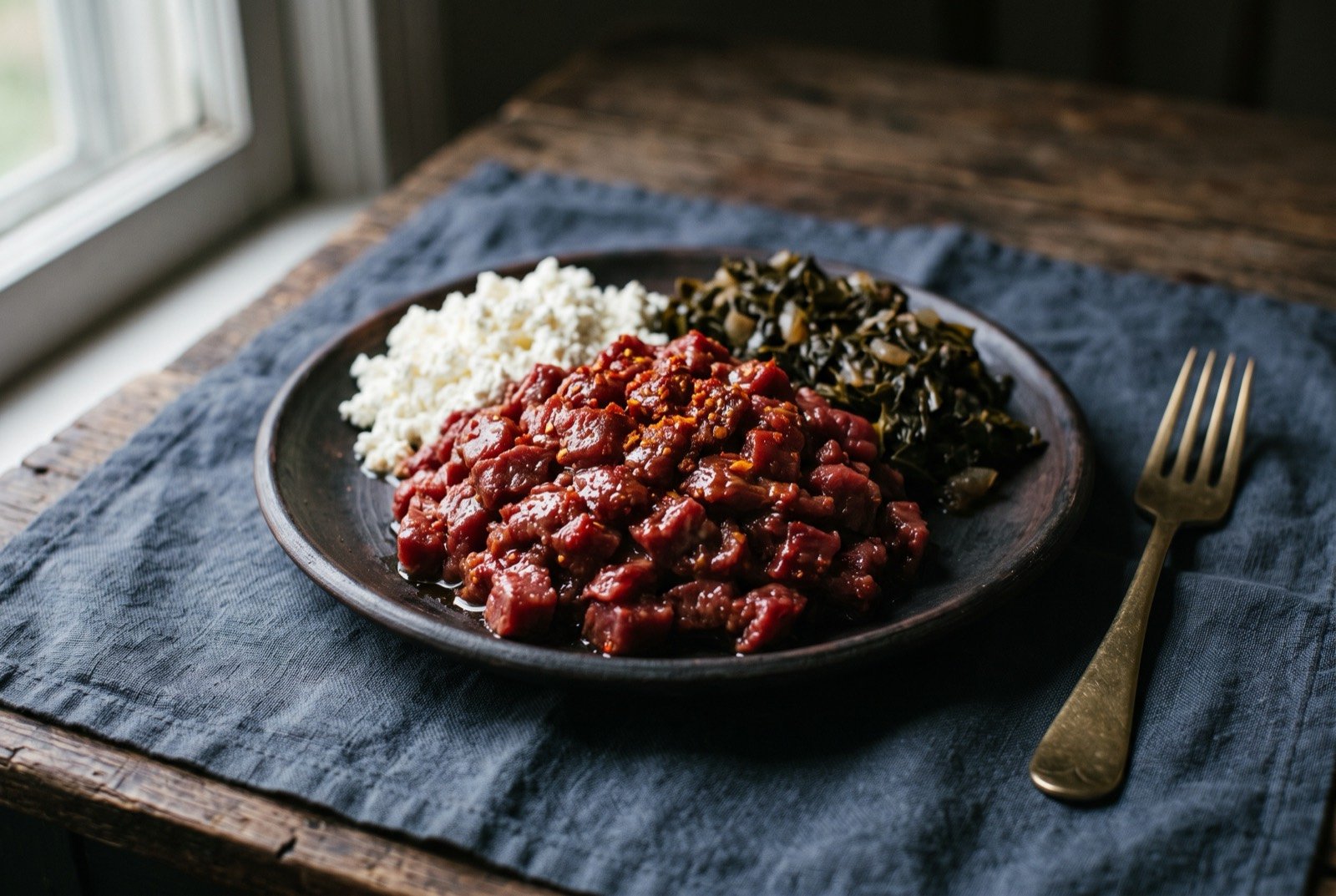
The commonest mistake made about kitfo, in London as much as anywhere, is to call it Ethiopian steak tartare. It is not seasoned raw meat. It is raw meat emulsified with warm spiced butter, and the butter, held just above body temperature, coats every strand and carries the mitmita into it. The texture is closer to a rillette. The discipline behind it is the entire food-safety strategy. At Bekelech Kitfo in Addis only two cuts qualify: neqel, the back leg muscle, and mehal ageda, the centre section of the ox. There is a dedicated butchery room, the lekema, and a hooked knife of the same name used to strip every trace of fat and tendon, and 25 to 30 kg are processed per session, daily, bought and used the same day from locally reared animals. Three degrees are named and they are technical terms: tere is raw, leb leb, literally "half", is left a few minutes longer so it half cooks, and yebesele is fully cooked. Throughout, the hands never stop moving, because the moment they do the meat overcooks against the pan. A British caveat, stated rather than buried. UK food safety practice around raw minced beef differs from Ethiopian practice, which depends on same-day slaughter of locally reared animals. This chapter has not verified the current FSA position or what British restaurants actually serve. Use whole-muscle beef from a butcher you know, mince it yourself the day you buy it, keep everything cold and sterile, and offer the leb leb version to anyone pregnant or immunocompromised.
As tradition built it
Serves 4. 30 minutes, plus chilling.
Ingredients
- 600 g beef topside, tenderloin or sirloin, all fat and silver skin removed
- 100 g niter kibbeh
- 2 to 3 tsp mitmita, to taste
- 1 tsp each dried ground koseret and dried ground coriander
- to taste salt
- to serve ayib, gomen kitfo and kocho or injera, to serve
Method
- Chill the trimmed beef topside, tenderloin or sirloin 20 to 30 minutes until firm, then hand-mince it with a sharp knife to cubes of 6 mm or smaller. A machine mincer crushes and smears; a knife cuts.
- Warm the niter kibbeh gently, 1 to 2 minutes only, never boiling, with the dried ground koseret and dried ground coriander in it, then let it cool slightly. Hot butter denatures the surface proteins and turns the dish to warm mush.
- Work the warm butter through the meat with your hands, continuously, until every strand is coated and the mass is glossy and cohesive.
- Season with mitmita and salt, worked through the same way.
- For tere, serve at once with ayib, gomen kitfo and kocho or injera. For leb leb, set the bowl over the barest heat and keep the hands moving 3 to 5 minutes until the outside changes colour and the interior stays rare.
What a modern chef changes
The temperature of the butter as the controlled variable, and the missing textures added
Rungs 4, 6 and 5
Method
- Take the butter to 42°C and hold it there. This is the whole dish in one number. Below about 35°C the niter kibbeh will not mobilise its aromatics or coat properly; above about 50°C it starts cooking the surface. Rung 4 at the bottom of the temperature scale rather than the top.
- Grind the mitmita to order. Its whole value is at the front of the nose, and whole chilli, korarima, clove and salt ground thirty seconds beforehand is a different ingredient from a jar opened last spring.
- Add fried capers, or something like them. Samuelsson's move, right for a mechanical reason: the dish is uniformly soft and rich and needs a salt-and-crunch top note. Fried shallot or crumbled dirkosh work equally. Rung 6.
- Salt against the mitmita, not by recipe. Mitmita carries salt in the blend and the proportion varies as widely as berbere's does. Rung 5.
Notes
Gored gored is the distinction to get right and it is not a portion size. It is cubed rather than minced, and dressed with awaze rather than emulsified with butter, giving a more robust, chewy texture, served with green chilli. Kitfo is minced and enriched; gored gored is cubed and dipped. Tere siga is raw meat served as slabs cut at the table and dipped in awaze, senafich or mitmita, eaten at Meskel, Genna and Enkutatash, and dulet is the offal version.