The Horn · Volume 10, The Highland Ferment
Beyaynetu
Ethiopia and Eritrea
Illustration
- Time
- 2 hours
- Researched
- Researched from 149 sources in the brief
- Reviewed
- Awaiting a reader from inside the tradition
- Cooked
- Awaiting a cook report
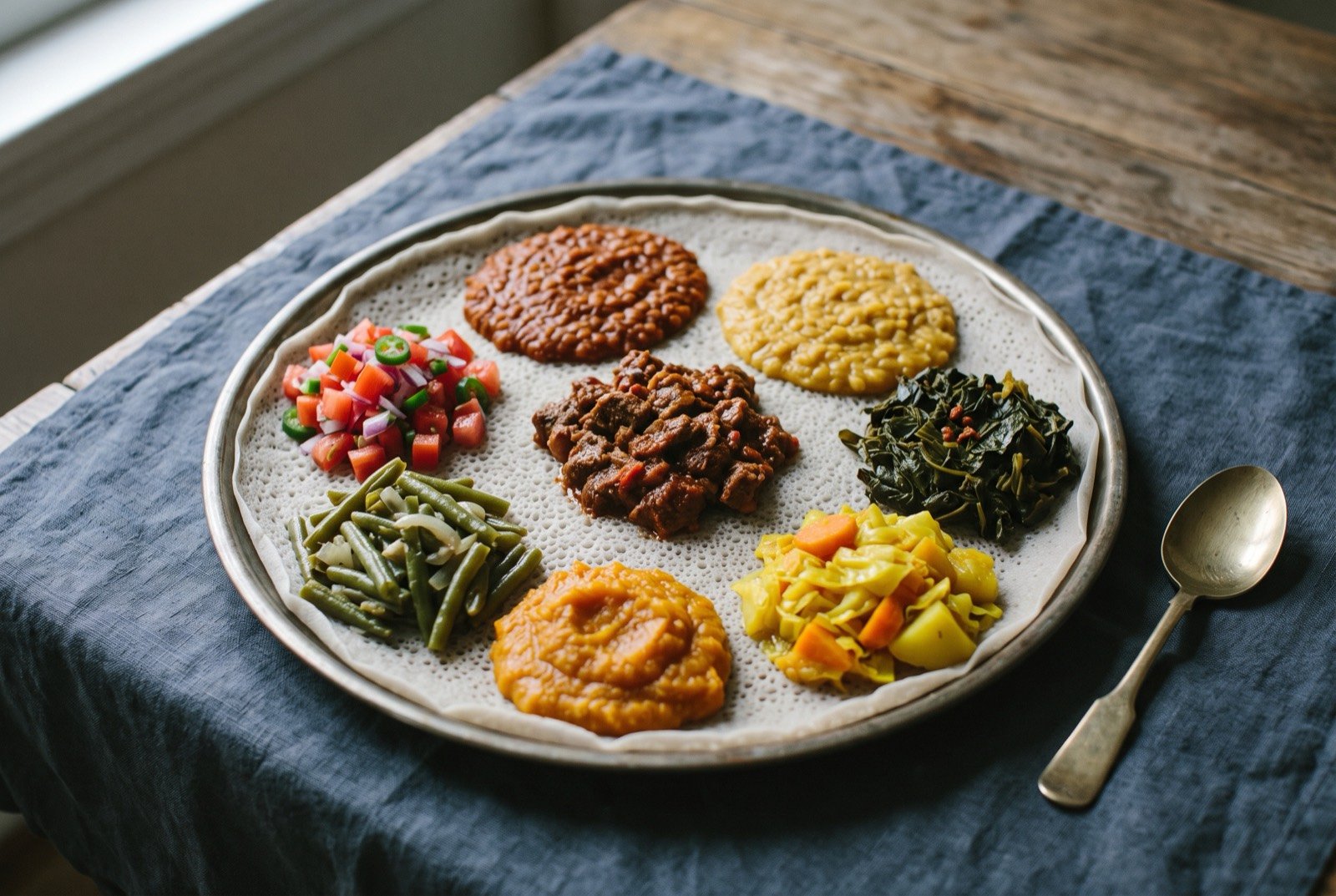
The Ethiopian Orthodox Tewahedo fasting calendar imposes 180 mandatory fasting days a year on the laity, and up to 252 on clergy and the strictly observant: Great Lent at 55 continuous days, Advent at 40, the Apostles' Fast at 10 to 40, the Assumption at 15, Nineveh at 3, plus every Wednesday and Friday outside the fifty days after Easter. All animal products are excluded, and there is one meal a day, typically nothing before three o'clock. That is not a vegan trend and not a menu invented for a market. It is a liturgically enforced, technically mature vegan cuisine roughly fifteen hundred years old, with its own fat strategy (nug and flax), its own umami strategy (fermented legume flours and long-reduced onion) and its own richness strategy (legume purées standing in for dairy). The dish is a single injera on a mesob with five to twelve small mounds round the edge and one in the centre.
As tradition built it
Serves 4 to 6. About 2 hours run in parallel.
Ingredients
The method as the tradition gives it, ingredients named but not yet weighed. Quantities follow as we verify them, lead dishes first.
- 1/2 batch misir wot, as dish four
- 400 g yellow split peas, for kik alicha
- 500 g spring greens or cavolo nero, for gomen / hamli
- 1 small cabbage, 3 potatoes, 3 carrots, for atkilt wot
- 300 g green beans and 2 carrots, for fosolia
- 500 g pumpkin, for duba wot
- 3 tomatoes, 1 red onion, 1 green chilli, for timatim salata
- 800 g onions in total, across the alichas
- turmeric, ginger, garlic, oil, salt
Method
- Kik alicha. Simmer the yellow split peas until collapsing, 40 minutes. Separately cook 250 g onion dry, add oil, turmeric, garlic and ginger, then fold in the peas to a loose golden purée. No chilli at all.
- Gomen / hamli. Chop the spring greens or cavolo nero and cook them long and slow with onion, garlic, ginger and green chilli until they collapse and sweeten, 40 minutes. In Eritrea this is hamli, steamed tender and finished with oil, garlic and onion.
- Atkilt wot / tikil gomen. Small cabbage, potato and carrot cut chunky, with turmeric, onion, garlic and ginger. Always alicha, never berbere. The one dish on the platter with bite left in it.
- Fosolia. Green beans and 2 carrots in strips, cooked briefly with onion and turmeric.
- Duba wot. Pumpkin cooked down with onion, ginger and tikur azmud.
- Timatim salata. Raw tomatoes, red onion and green chilli, dressed with oil and a little lemon, rested 20 minutes.
- Assemble. Injera on the base, misir wot and gomen at opposite points so the colours read, kik alicha beside the misir wot, salata last so it does not weep into everything.
Notes
A working seven-element platter. Each element is a small dish; the assembly is the dish.
Note what kik alicha is for. Its role is thermal, not decorative: it is the cooling element that lets you keep eating the misir wot. Take it off the plate and the whole thing becomes monotonous within four mouthfuls.
What a modern chef changes
Composed rather than heaped, temperature staged, and the crisp element given somewhere to live
Rungs 6, 3 and 5
Method
- Stop putting everything at the same temperature. Gomen warm, misir hot, kik alicha barely warm, salata cold. Temperature contrast is the second axis a beyaynetu lacks, and it does more work than any garnish.
- Add exactly one crisp element and plate it off the bread. Awaze-spiced cauliflower, blanched, coated and fried at 180°C. Rung 6, and not a Western import: it is Ras Plant Based's dish, from inside the tradition.
- Cook every onion base dry, including the alichas. Sweating seven of them in oil to save time is exactly what makes a diaspora beyaynetu taste flat and samey. Rung 3.
- Season the platter against itself, not element by element. Rung 5 at plate level: elements seasoned in isolation stack into something aggressively salty by the fourth mound.