The Horn · Volume 10, The Highland Ferment
Shiro wot / tsebhi shiro
Ethiopia and Eritrea, everywhere
Illustration
- Time
- 45 minutes
- Researched
- Researched from 149 sources in the brief
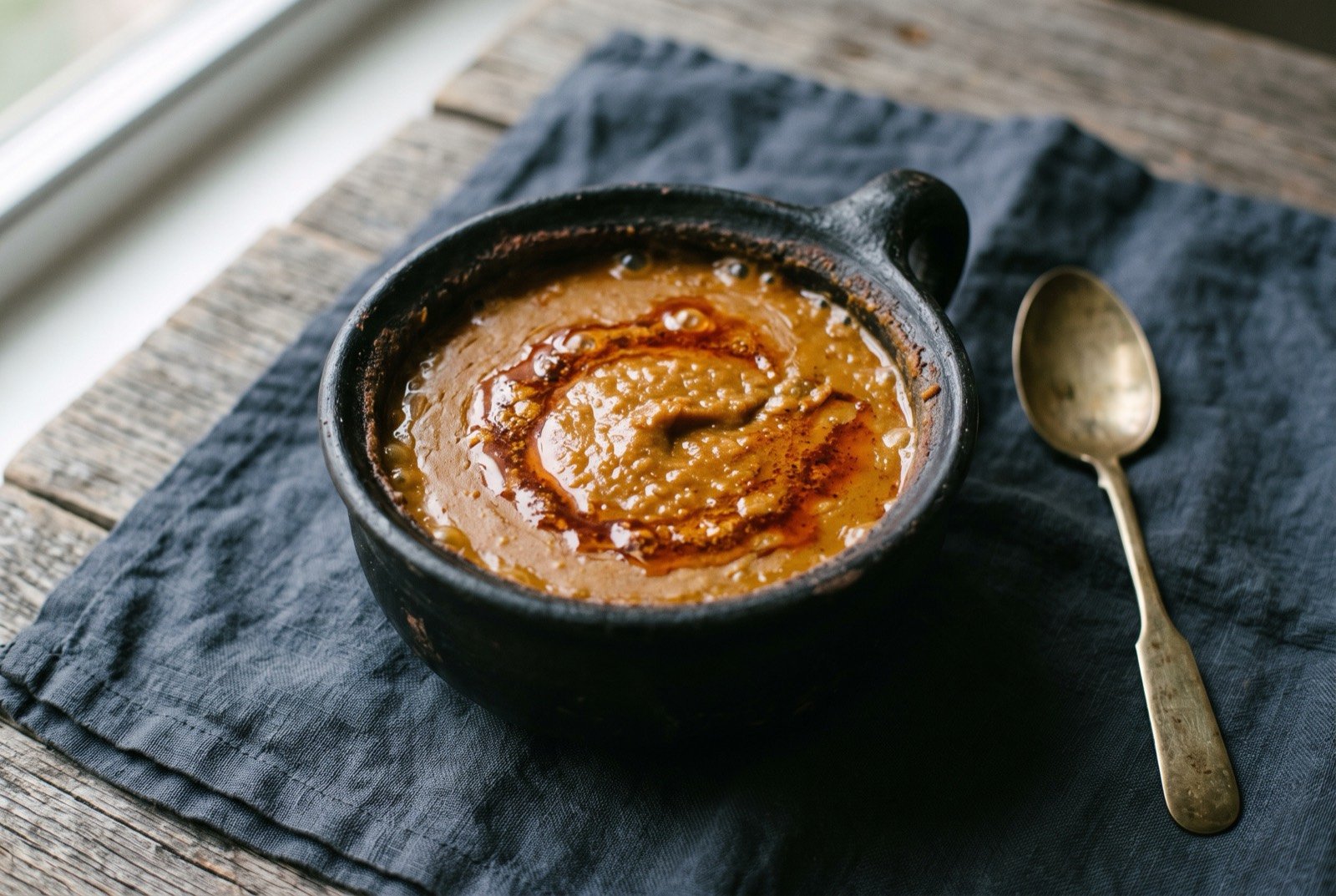
Shiro is what this cuisine actually runs on, and Western coverage neglects it almost entirely in favour of doro wat. It is a roasted, spiced legume flour cooked into kulet, and functionally it is a legume-flour velouté: a starch-and-protein thickener that sets on cooling and behaves like a panade. Understand that and shiro becomes the most versatile object in the repertoire, holding as a fritter, piping as a purée or glazing as a sauce, on hydration alone. Tegabino is the thick version, served bubbling in the small black clay dist it cooked in.
As tradition built it
Serves 6. 45 minutes.
Ingredients
- 360 g shiro powder, mitin or nech
- 3 large onions, minced fine
- 240 ml oil, or niter kibbeh if it is not a fasting day
- 5 tsp garlic, minced
- 1 tbsp berbere
- 2.4 L water
- 2 tsp salt, adjusted against your shiro
- 1 tbsp niter kibbeh, to finish
Method
- Cook the large onions dry in a wide pan until collapsed and golden, then add the oil and garlic and simmer gently.
- Add the berbere and simmer 8 minutes on low with a dash of water to stop it catching.
- Add the water and bring to a simmer.
- Add the shiro powder gradually in a thin stream with continuous stirring, exactly as you would polenta. Dumped in, it lumps irreversibly.
- Cook about 25 minutes on low, until thick but still runny, then season with salt to taste and finish with niter kibbeh off the heat.
Notes
After the larger of the two documented allaboutETHIO methods.
For tegabino, use a third less water, cook it in a small clay pot, and take it to the table still spitting.
What a modern chef changes
Nech shiro for control, the flour hydrated cold, and one batch taken three ways
Rungs 5, 3 and 6
Method
- Buy nech shiro and build your own spicing. Mitin carries somebody else's berbere and salt, and shiro sodium runs from 890 to 3,736 mg per 100 g. Rung 5.
- Slake the flour cold. Whisk it into 400 ml of cold water, then rain that into the simmering base. You will not lump and you will halve the stirring, on the same cold-slake principle placali, tô and ugali all reached independently across this atlas.
- Do not skip the dry onion because it is a fasting dish. The fat changes; the structure does not. Rung 3. Shiro built on onion sweated in oil is thin and beany.
- Take one batch three ways. Rung 6, Samuelsson's template made explicit: a third loose as a sauce; a third spread 2 cm deep, chilled 2 hours, cubed and fried at 180°C for 90 seconds for a crust and a molten centre; a third blended to pipe, put under a roasted cauliflower. Only the water content changed.