The Mediterranean · Volume 01, Butter, Egg Pasta and the Roman Hinge
Baccalà alla Vicentina
Veneto
Illustration
- Time
- 5 hours
- Researched
- 14 sources cited
A terminological note worth stating plainly: in the Veneto, what is called baccalà, dialect bacalà, is in fact almost always stoccafisso, air-dried cod, not true baccalà, salt-cured, despite the name. Both baccalà mantecato alla veneziana and baccalà alla vicentina are, technically, made from stoccafisso.
As tradition built it
Serves 4. 3 days' soaking, then about 5 hours.
Ingredients
- 800 g stoccafisso, whole
- 1 onion, finely chopped
- 400 ml whole milk
- 100 ml extra virgin olive oil
- 4 anchovy fillets
- to taste flat-leaf parsley, chopped
- as available white polenta, to serve
Method
- Soak the stoccafisso in cold water 3 days, changing the water every 4 hours.
- Drain, skin and bone it, and cut into pieces.
- Soften the onion gently in a little of the oil.
- Add the fish, milk, remaining oil, anchovies and parsley.
- Cook at the barest simmer, 4.5 hours, shaking the pan periodically rather than stirring, so the fish breaks down without being beaten to shreds.
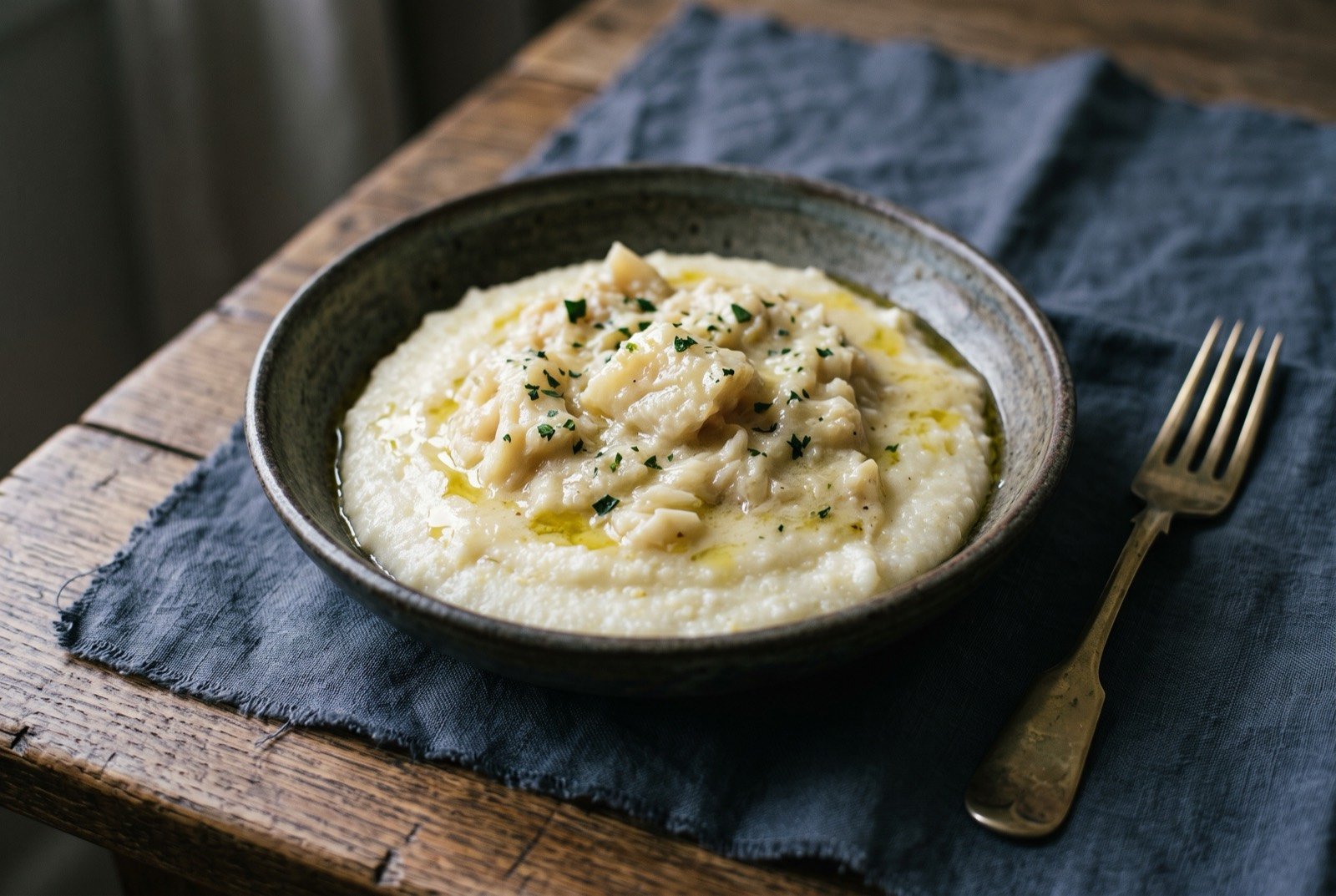
- Serve hot over soft white polenta.
What a modern chef changes
A held low temperature instead of a watched simmer, and the emulsion understood as an emulsion
Rungs 1 and 2
Method
- Cook it in a water bath rather than on the hob. A stovetop barely-there simmer is hard to hold for 4.5 hours without either scorching the base or letting it go cold. A sous vide bath at 82°C for the same duration gives you the identical gentle, fat-and-milk-braised result with no risk of either failure.
- Recognise the "shake, don't stir" instruction for what it is. It is already an emulsion-forming action, working the fish's own gelatine and the milk and oil into a loose, creamy suspension rather than a broken one. Treat it with the same temperature discipline as baccalà mantecato: keep the fish, milk and oil close in temperature throughout, and finish by transferring everything to a wide pan and shaking hard over very low heat for a final 2 minutes to properly bind it, rather than serving it straight from the braise.
- Reduce a portion of the braising liquid separately to a light glaze and spoon it over at the pass, so the plate reads as a considered sauce rather than a wet stew.