Europe · Volume 01
Northern & Central Italy
Butter, Egg Pasta and the Roman Hinge
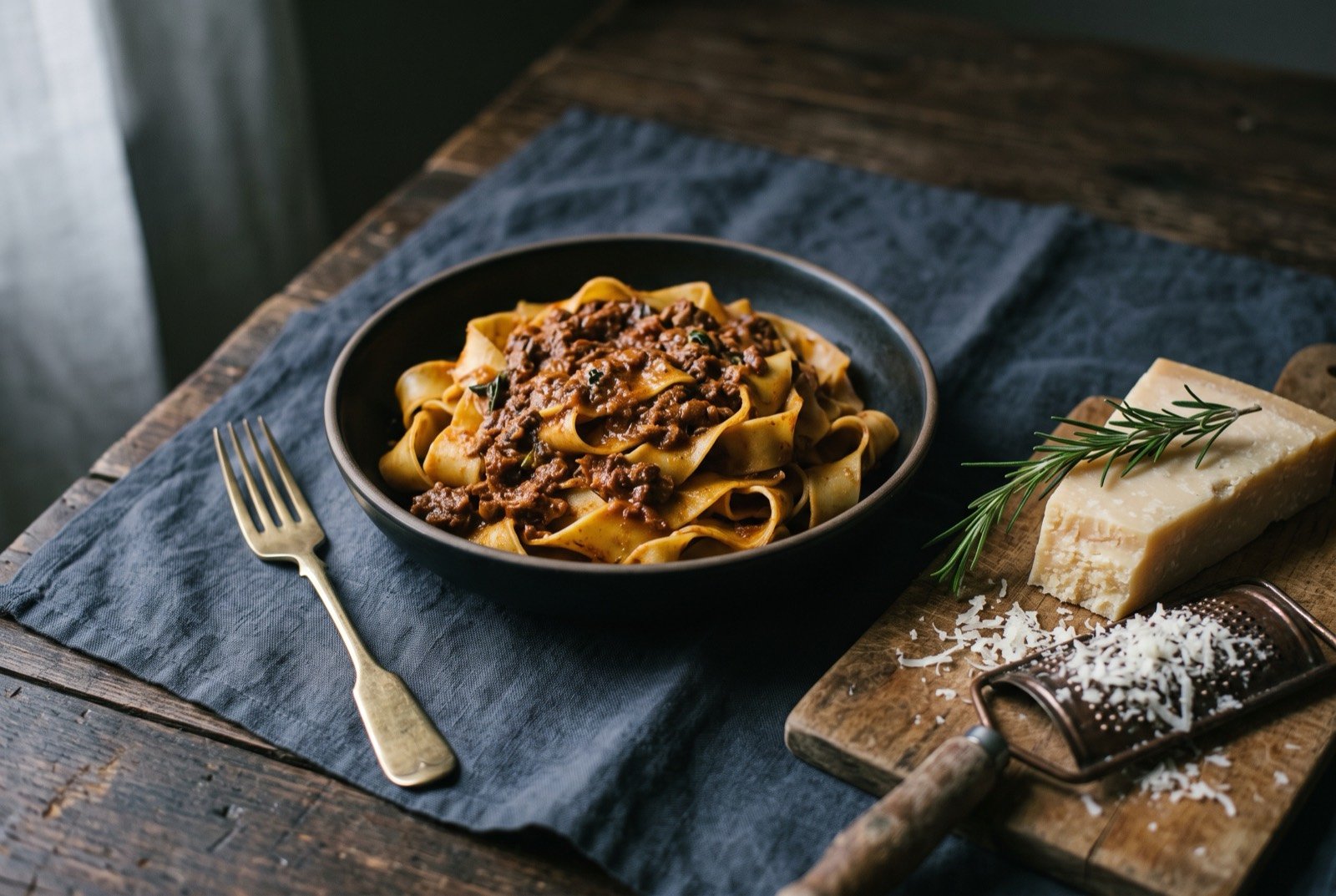
Piedmont, Lombardy, Veneto, Liguria, Emilia-Romagna, Tuscany, Umbria, the Marche, Lazio and Rome, taken seriously. Not one food culture in ten regional costumes, but a chain of distinct ecologies and political histories that happen to share a peninsula, and every dish as tradition built it, then what a modern chef would change.
Sources and review · What this chapter does not assert · How we research · Spotted something wrong?
A Sense of Place
Ten named places, and the volume's actual argument is that they resolve into four working grammars, read as fat, starch, aromatic and protein rather than as a shelf of regional specialities.
The Alpine and Po-plain north: butter and rice
Piedmont is landlocked and Alpine-fringed, and it cooks with butter, garlic and Barolo as a braising medium. Its court cuisine, the House of Savoy in Turin, absorbed French technique from the eighteenth century, while the Langhe and Monferrato countryside kept a poorer cured-meat-and-offal tradition underneath it: the two Piedmonts, courtly and rustic, sit inside the same regional border without being the same food culture.
Lombardy is the rice plain, and Milan is its mercantile capital. Butter, not oil. Rice as much as polenta. Saffron and bone marrow for richness. There is a genuine Habsburg Austrian residue here, from the early 1700s until 1866, in the michetta roll, the cornetto and the contested cotoletta, which this chapter comes back to below.
Veneto was built by the Venetian maritime trading empire, and its historic fat and aromatic base ran on Levant spice, pepper, cinnamon, cloves, currants, applied to preserved fish rather than fresh. Its now-defining starch, maize polenta, only arrived after the Columbian Exchange in the mid sixteenth century, which means the dish most people now think of as ancient Veneto peasant food is, on the timescale this book works in, comparatively recent.
Liguria breaks the pattern entirely. A narrow coastal strip where olive oil, not butter, is the fat; wheat and chestnut flour and basil the starch and aromatic base; the vegetable garden and small-boat fishing the protein base. It was shaped by Genoese maritime trade rather than Venice's spice route, and it tastes like a different country from its northern neighbours because, in food terms, it more or less is one.
Emilia-Romagna and Tuscany: two opposites, one Apennine seam
Either side of the Apennines the split reads as cultural, but it is ecological and political before it is cultural. Emilia-Romagna occupies the flat, water-rich Po valley along the Via Emilia, Italy's richest agricultural belt, and its food economy is built on surplus and craft transformation: turning abundant milk and pork into products engineered to travel and last, Parmigiano Reggiano, prosciutto, culatello, mortadella, aceto balsamico. Tuscany is hillier, drier and historically poorer in the countryside even as its cities, Florence, Siena, Lucca, accumulated enormous mercantile and banking wealth. Its rural cooking is built on thrift under a wealthy urban canopy: bread, beans and olive oil developed by a peasantry that for centuries worked land it mostly did not own, under the mezzadria sharecropping system that persisted into the twentieth century.
The contrast the two regions present, rich stuffed pasta and cured pork against austere bread-and-bean cooking, is therefore not really a contrast of poverty against wealth. It is a contrast of where the wealth sat: distributed into farm-level food transformation in Emilia-Romagna, concentrated in mercantile cities in Tuscany while the contado stayed frugal.
The hinge: Umbria, the Marche, Lazio and Rome
This is where the north and centre grammar starts to blur into something with real southern affinities, and this chapter treats that blurring as a finding, not a problem to smooth over. See the boundary discussion below.
Umbria is landlocked, hilly, historically poor and monastic, its defining triad pork, in the norcineria tradition, truffle, from Norcia and Spoleto, and olive oil. The Marche runs two food cultures at once: an inland hill cuisine close to Umbria's, and a fishing coast built on a town-by-town brodetto tradition that never settled into one recipe. Lazio and Rome sit atop a pastoral sheep-farming hinterland, the Agro Romano, feeding a genuinely urban, working-class capital cuisine whose defining strand is not court cookery but cucina povera, and specifically the quinto quarto, the fifth quarter: the offal, trotters, tail and head left over once an animal's four noble quarters were sold, which slaughterhouse workers took as part payment and turned into what are now Rome's signature dishes.
Read end to end, the volume's grammar moves from butter and rice in the Alpine north, through olive oil on the Ligurian coast, into the surplus-and-craft richness of the Emilian plain, the bread-and-bean thrift of Tuscany, and finally into the pork, pecorino and offal economy of the Roman hinterland, which is exactly where this volume's own internal logic starts to strain.
The History in Layers
The shared pre-Roman substrate
Etruria, spanning Tuscany, northern Lazio and western Umbria, was Etruscan territory from roughly the tenth to the first century BC. Tomb frescoes, principally the Tomba Golini I at Orvieto, depicting banquet preparation, plus Greek and Latin testimony, show established farmers and herders: pigs, sheep and poultry, geese were sacred to them, wheat and barley, especially farro, as the dietary base, legumes and vegetables, olive oil as the standard condiment, and wine. Pork remains found without leg bones in burial contexts suggest cured hams were already being made, and tomb imagery shows dough being rolled on a board, an early ancestor of the sfoglia. None of the underlying sources for this are peer-reviewed archaeology papers, so treat any claim of a continuous line from Etruscan diet to a specific modern dish as an inference, not documented continuity.
The Po valley's status as heavy-pig country is separately attested from the Etruscan and Roman period, with bone evidence of pigs slaughtered at advanced age and weight, alongside evidence of ham curing and trade.
What Roman antiquity actually leaves behind
This is one of the most actively mythologised areas in the whole volume, and it deserves saying plainly: the modern "Roman" table is not a continuation of ancient Roman cuisine. The De re coquinaria, traditionally attributed to the first-century gourmet Marcus Gavius Apicius, survives only as a much later compilation, plausibly assembled between the age of Tiberius and the fourth century AD, with internal inconsistencies marking it as composite rather than single-authored. Multiple Italian sources make the point explicitly that dishes now labelled "alla romana" are a modern branding exercise, and that ordinary Roman cucina povera and papal or noble banquet food were always two different worlds.
Pecorino Romano is the one product with a genuine ancient throughline. Varro, Columella, Virgil and Pliny the Elder all describe a cheesemaking method close to the modern one, and the upper Agro Romano is plausibly where the cheese's archetype originated. What this chapter deliberately does not assert is that any specific modern dish, carbonara, amatriciana, cacio e pepe, coda alla vaccinara, descends from an identifiable ancient Roman recipe. No source found in the research for this volume supports that, and several explicitly rebut it.
Transhumance, and a pig that could never take part in it
Sheep farming in Lazio has a documented history stretching back millennia. Italian transhumance in its classic historical form ran between the Agro Romano and the Sibylline and Apennine mountains, and structurally the same practice, sharing the same tratturi, the drove roads, extended into Abruzzo, Puglia, Molise, Campania and Basilicata, described in the sourcing for this volume as "especially widespread in southern Italian regions." Lazio's pastoral economy was, in other words, not a self-contained central Italian system but one end of the same infrastructure that fed Puglia and Abruzzo, a fact this chapter returns to below.
By contrast, pig-rearing in Emilia-Romagna is not transhumant: pigs cannot undertake seasonal pastoral migration the way sheep and cattle can, and pig-keeping in the Po valley developed instead as sedentary, forest- and farmyard-based husbandry from the Neolithic, reinforced during the medieval period by free-range woodland acorn-pasture pig-keeping and by the dietary habits of Lombard, Germanic, settlers, who valued pork more heavily than Roman custom had. The later industrial-scale pig farms of Emilia and Lombardy grew directly out of the dairy industry, using whey and other by-products of Parmigiano Reggiano and Grana Padano production as feed, a structural link between the region's cheese and its cured pork worth holding onto.
Medieval comune economies and craft guilds
Bologna, "la dotta," the learned, from 1118, and "la grassa," the fat, acquired about a century later, built its food culture on the Alma Mater Studiorum, founded 1088 and held to be the oldest university in the Western world, which drew students from dozens of nations with their own servants and spending money, and on water-powered silk milling and organised agricultural trade. Bologna's Corporazione dei Salaroli, the guild controlling salt and meat preservation, dates to 1242, later joined by the Arte dei Lardaroli; on 24 October 1661 Cardinal Farnese issued a formal edict regulating mortadella production, arguably one of the earliest food-product regulations anywhere. A Roman-era funerary stele in Bologna's archaeological museum, showing piglets grazing on one side and a mortar and pestle on the other, is taken by local historians as the earliest visual link to mortadella, and Pliny the Elder and Varro both mention an ancient cured sausage called farcimen myrtatum, flavoured with wild myrtle. Contested and not adjudicated: whether "mortadella" derives from mortaio, mortar, or murtatum, myrtle. The consortium's own source presents both without choosing, and so does this chapter.
Norcia's fame as the source of itinerant pork butchers, the norcini, across Italy is medieval in origin. A folk-etymological alternative derives the toponym from the Etruscan goddess Nortia, but the linguistically supported derivation is from the Latin Nursia, and this chapter treats Nortia as colour, not as the certain origin. Norcia's own confraternity of curers was formally recognised by papal bull under Paul V in 1615, elevated to an archconfraternity by Gregory XV in 1623.
The Papal States and imported elite cuisine
Rome's high-end cuisine under the Papal States was frequently the work of imported talent, not home-grown Roman tradition. The single most important document is Bartolomeo Scappi's Opera, 1570, the most complete and methodical culinary treatise of its century, over a thousand recipes, written by Pius V's private chef. Scappi, however, was from Dumenza in Lombardy, trained cooking for Cardinal Marino Grimani in Venice, and served a succession of popes, Paul III, Pius IV, Pius V. Papal high cuisine in Rome was cosmopolitan and largely northern-Italian-authored, running on a separate track from the working-class cucina povera that actually defines Roman food today, and it connects Rome's elite culinary history to the wider centre-north courtly tradition, Ferrara, Venice, Florence, rather than to Naples or Sicily's own distinct court traditions, a fact this chapter uses directly in the boundary section below.
French and Austrian court influence in the north
Treccani, Italy's national encyclopedia, describes eighteenth-century Italian aristocratic cuisine becoming "infranciosata," Frenchified: butter-based or oil-based sauces replacing medieval acid-and-spice-and-breadcrumb sauces, French culinary vocabulary entering Italian kitchens, meat consumption falling, spice use falling sharply. This is presented as a pan-Italian aristocratic-court phenomenon, not exclusive to Turin, though Turin and the Savoy court are repeatedly named as a centre of it, especially in pastry.
Austrian rule over Lombardy began in the early 1700s; over the Veneto only from 1815, after the Congress of Vienna, as the joint Kingdom of Lombardy-Venetia, until 1866. Attributed Austrian legacies include the michetta roll, the cornetto and, contested, the cotoletta alla milanese. Contested, not adjudicated: Italian popular tradition holds the Wiener Schnitzel is a Viennese variant of the Milanese dish, supposedly carried to Austria by Field Marshal Radetzky after a long Lombardy-Veneto posting. The Austrian counter-claim reverses this, that Milanese cooks learned it from Austrian army cooks during the occupation. Historian Heinz-Dieter Pohl checked the imperial archives in 2007 and found the aide-de-camp supposedly attributing the recipe to Radetzky does not exist in the archives; the anecdote first appears in print only in 1869, in an Italian gastronomic guide, not a contemporary 1850s source; and breading-and-frying technique is independently attested in Austrian cookbooks from 1719, predating Radetzky's Milan posting entirely. The Radetzky note is, on the strongest evidence found, a later invention. One genuine difference survives in how the two dishes are made today: cotoletta alla milanese is bone-in veal, Wiener Schnitzel more often thin-pounded, boneless and sometimes pork.
Venice's maritime trade empire
Venice's Levant trade brought pepper, cinnamon, cloves and dried currants into the Veneto's kitchen from the medieval period, and the hinterland's early adoption of stockfish is attributed to these same trade contacts. Venetian gastronomic literature codifying this includes the anonymous fourteenth-century Anonimo Veneziano cookbook, Maestro Martino in the fifteenth century, and Bartolomeo Scappi in the late sixteenth. The Council of Trent's 1563 imposition of roughly two hundred days a year of meat abstinence is credited with cementing stockfish and baccalà as the staple of the poor Venetian household kitchen from that point on.
The Querini stockfish story, widely repeated: the Venetian navigator and senator Pietro Querini was shipwrecked on the Norwegian island of Røst in 1431 or 1432, sources give both dates; he observed the islanders' technique of air-drying cod into stoccafisso, and on his return brought roughly sixty dried stockfish plus the technique back to Venice and Vicenza. This is broadly treated as documented Venetian maritime history rather than folk legend, but the exact date should be treated as approximate.
The Columbian Exchange: maize, tomato, beans, and a disease that followed the grain
Maize arrived in Italy after the sixteenth century; a first Veneto sowing date of 1554 is cited. It took hold overwhelmingly in the Veneto and Friuli, entering via Venice into the reclaimed marshland of the Polesine and Friuli, then spreading in the 1500s onward into the Bergamo area, the Milanese, and Piedmont. By the 1700s and 1800s polenta was the cheap, dominant staple of the rural poor across the whole northern plain, in the worst cases the only food available, with peasants reportedly eating up to two to three kilograms of polenta a day in the Veneto specifically. This over-reliance is directly linked to the spread of pellagra, the "three Ds," dermatitis, diarrhoea, dementia, first noted in the Veneto region and becoming endemic there and across north-central Italy from the mid-1700s. The underlying mechanism, niacin deficiency from a maize-monotony diet not treated with nixtamalisation, is not stated explicitly in the sourcing for this volume, only the correlation between polenta dependence and the disease.
Tomato arrival in Tuscan kitchens is dated to roughly the mid-1700s, associated particularly with the countryside around Florence, Siena and the Maremma, underpinning pappa al pomodoro. One popular claim, that Pope Clement VII, a Medici pope, introduced the bean to Tuscany, and that Caterina de' Medici personally carried beans to the French court, rests on a single weak source and should not be printed as fact, for the same reason the wider Caterina myth below does not survive checking.
The Caterina de' Medici myth, actively debunked
This is one of the single most important myths to puncture for the whole volume. The popular claim, repeated constantly in English-language and even much Italian tourist writing, is that Caterina de' Medici "brought Italian Renaissance cuisine to France" in 1533 when she married the future Henri II, and that this same lavish court cuisine is the ancestor of today's Tuscan home cooking. Italian food historians have specifically and directly rebutted this. Gambero Rosso's own historical column states plainly that the legend is a French-originated myth, not an Italian claim borne out by documents: there is only one contemporary document that connects Caterina to food at all, a chronicle of a 1575 wedding feast noting she ate so many artichoke-bottom tarts she nearly made herself ill. The idea that she personally imported sauces, offal cookery, olive oil, crêpes, spinach, beans, peas, artichokes, orange-glazed poultry, pasta, sorbets and ice creams to France is a later invented list with no contemporary documentary basis, corroborated by the Accademia dei Georgofili, an old Florentine agricultural learned society. What is separately true and defensible is that there was real, broader Italian culinary influence on France in this period. The Caterina-as-personal-vector story is the part that does not survive scrutiny, and this chapter says so rather than repeating it with a polite hedge.
Separately, the Medici court did host genuinely lavish Renaissance banquets, but this was elite, urban, court-specific food, not what rural Tuscans ate, and the modern cucina povera style crystallised later and separately. This chapter does not blur the Medici banquet tradition and the bread-and-bean peasant tradition into one continuous lineage; the sources treat them as two different worlds that happened to share a territory. The food historian most associated with taking Italian peasant and popular food history seriously as a subject in its own right, rather than treating Artusi's bourgeois cookbook as the whole story, is Piero Camporesi, who wrote about the material and often desperate conditions of popular diet.
Unification and standardisation: Pellegrino Artusi
Pellegrino Artusi, born in Forlimpopoli, Romagna, and later a Florentine-based bourgeois merchant, published La scienza in cucina e l'arte di mangiar bene in 1891, self-financed after publishers rejected it. It grew from 475 recipes in the first edition to 790 in the definitive one, ran through roughly 111 editions and over 1.5 million copies sold, and is repeatedly credited as the first work to gather and codify recipes from across Italy's regions into a shared national culinary language, at a point when Italian cuisine was still overwhelmingly fragmented into orally transmitted local traditions. Multiple sources frame it explicitly as an act of cultural and political unification: written to teach cooks a common Italian language, to make regional culinary heritage legible across a newly unified but culturally fragmented country, and to push back against the prevailing Francophile prestige cuisine of the Italian upper classes. Artusi is described as a moderate liberal and convinced patriot who deliberately purged French loanwords from his recipe vocabulary as part of the same post-unification linguistic project.
Artusi was Romagnol by birth and Florentine by adult residence, so the book sits, biographically, exactly on the Emilia-Romagna and Tuscany seam this chapter covers, and his recipe for ribollita's ancestor appears under the title "zuppa di magro dei contadini," see the dishes section below. This is the standardisation moment worth holding in mind through the rest of this chapter: it postdates the individual regional traditions by centuries and should be treated as the point at which regional dishes started to be written down in a shared national reference, not as their point of origin.
The EU-01/EU-02 boundary question, addressed directly
This volume's own internal logic strains hardest at its southern edge, and it is worth stopping to say exactly where and why, rather than letting the strain pass silently.
Umbria and the Marche belong unambiguously here. Nothing in the research for this volume pulls them toward the south in any serious way. Their food grammar, pork, olive oil, truffle, hill-farmed legumes, monastic influence, and on the Marche side a fishing coast that reads as its own thing rather than a southern one, is coherently central Italian, and their administrative and dialect geography agree. "Italia centrale" is consistently defined in Italian reference sources as Tuscany, Umbria, the Marche, Lazio and Abruzzo, which makes the whole hinge sub-region textbook central Italy administratively and geographically.
Lazio and Rome are the genuine hinge, and the evidence pulls in both directions with real force on each side.
Pulling south: Lazio's sheep-farming and transhumance system ran on the same tratturi network as Abruzzo, Puglia, Molise, Campania and Basilicata, sharing winter pasture in the Tavoliere delle Puglie and summer pasture in the Abruzzese highlands, structurally the northern edge of the southern transhumance system rather than a separate central one. Rome's working-class cucina povera grammar, heavy on cured pork, pecorino over cow's-milk cheese, and offal-centred dishes, reads closer to the south's cucina povera than to the butter-and-rice, dairy-forward grammar of Lombardy or the Veneto. The sub-region sits squarely in Italy's olive-oil zone rather than the butter zone, usually read as a south or centre-south marker. Dried durum-wheat pasta dominates over the egg pasta that is the northern-Italian norm, one of the stronger single data points for reading Rome as culinarily southern despite being geographically central. The Oliva Ascolana DOP zone itself crosses from the Marche into the province of Teramo, formally in Abruzzo, direct administrative evidence that this sub-region's food geography does not respect the conventional centre/south line. And Pecorino Romano, the cheese most associated with Roman cuisine, is now overwhelmingly produced in Sardinia rather than Lazio, production having shifted there from the late nineteenth century onward.
Pulling north and centre: the single strongest, least impressionistic piece of evidence found for this volume is dialect geography. The historic Lazio/Campania border, a state border until 1870, closely tracks the linguistic boundary between the dialetti italiani mediani, the median Italian dialects, including Romanesco, Umbrian and Marchigiano varieties, and the dialetti italiani meridionali, the southern Italian dialects. Linguistically, Rome and its region sit with the centre, and the real cultural fault line is Lazio's own southern edge, the border with Campania, not the Tiber or the Apennine watershed. Rome's papal and elite culinary history, via Bartolomeo Scappi above, also runs through the centre-north rather than the south.
This chapter keeps Umbria, the Marche and Lazio and Rome here, but says plainly that Rome is not culinarily continuous with Tuscany or Emilia in the way the "north/centre" label implies. It is the point where centre and south touch, and its food is legible only if you understand it as a pastoral, offal-eating capital built on a working-class cucina povera economy that has more in common with Naples in spirit than with Bologna, even while its language, its administrative status and, per the dialect boundary, its deepest cultural line place it with the centre. This chapter does not resolve that tension into a tidy single answer. It states it the way the evidence states it, because the tension is real and it is what makes Rome's food interesting rather than a footnote to "central Italy."
The Flavour Arsenal
Cheeses
| Cheese | Zone | What matters |
|---|---|---|
| Grana Padano | Po plain | Origin traced to the Abbey of Chiaravalle, 1135, Cistercian monks, originally caseus vetus, a preservation method for surplus milk. Three ageing tiers: 9 to 16 months, over 16 months, and Riserva, over 20 months. Consorzio founded 1954. |
| Parmigiano Reggiano | Parma, Reggio Emilia, Modena | Origins twelfth century, Benedictine and Cistercian monasteries. Disciplinare: only fresh or dried forage, no silage, no GMO feed, minimum ageing 12 months, full character around 24, can age to 36, 48, 60 months or beyond, minimum wheel weight 30 kilograms. |
| Gorgonzola | Joint Lombardy and Piedmont DOP zone | Blue veining originally accidental, cave moulds, now deliberately induced with Penicillium roqueforti. DOP since 1996. The DOP zone is genuinely joint, not purely Lombard despite the popular association. |
| Pecorino Romano DOP | Lazio, plus overwhelmingly Sardinia, plus Grosseto | Ancient throughline, Varro, Columella, Virgil, Pliny, but production shifted to Sardinia from the late nineteenth century onward. Ageing: minimum 5 months for table use, 8 months for grating. Coagulated with lamb rennet sourced within the zone. |
Taleggio, Lombardy's other famous washed-rind cheese, is a genuine gap in the sourcing behind this chapter: no strong in-tradition source for it turned up in the research, and this chapter would rather say so than invent detail.
Cured meats and pork
Prosciutto di Parma DOP's disciplinare was revised in 2023: minimum ageing raised from 12 to 14 months, maximum salt reduced from 6.2 to 6 per cent. The often-quoted four-hundred-day minimum ageing figure originated as a food-safety threshold from health-authority studies on inactivating pig diseases, not as a flavour target. Culatello di Zibello DOP, from eight comuni in the Bassa Parmense along the Po, is made from the thigh muscle only, stuffed into the pig's natural bladder, documented since the fifteenth century, tied to Pallavicino family banquets. It is salted one to six days, then aged a minimum of ten months in cellar, its character attributed to winter Po river fog, a genuinely place-dependent product.
Prosciutto di Norcia IGP comes from five comuni above 500 metres, Norcia, Cascia, Preci, Poggiodomo, Monteleone di Spoleto, salted in two stages with sea salt over roughly two and a half months, then washed, dried and coated in sugnatura, a lard and rice flour paste, aged a minimum of 12 months, commonly 24. Ciauscolo IGP, a spreadable salame from the Ascoli Piceno, Ancona and Macerata provinces, is double or triple ground pork, roughly half fat, with an earliest documentary reference in an eighteenth-century notarial deed from Visso.
Guanciale, cured pork jowl and throat, fat-dominant, is a distinct product from pancetta, cured belly with lean running through the fat. Guanciale has a lower melting point than pancetta and renders to a near-liquid amber base essential to carbonara, amatriciana and gricia; the EU amatriciana disciplinare explicitly excludes pancetta by name, which is worth knowing before you reach for the wrong one.
Salam d'la duja, from the Piedmontese rice belt around Vercelli and Novara, is a soft cured sausage preserved fully submerged in lard inside a sealed terracotta jar, the duja, documented as part of the panissa and paniscia tradition from at least 1738. This is a genuine, distinctively Piedmontese in-fat preservation method, an indigenous ancestor-technique in exactly the sense this whole series argues for, not an imported one, and it earns a full entry in the ferment and preserve bench below.
Two native breeds are worth knowing before you buy. Mora Romagnola, a dark-coated, almond-eyed pig from Romagna, collapsed from roughly 22,000 head in 1949 to as few as 15 animals under one breeder as industrial farming displaced it with Large White; it has been recovering since the 1980s and became a Slow Food Presidio in 2006. Chianina cattle, from the Val di Chiana between Siena and Arezzo, were a draught animal until well into the twentieth century, bred specifically for meat only from 1931, and their numbers fell from roughly 400,000 head in the 1960s to under 30,000 by the early 2000s with mechanisation and the end of mezzadria. Both are the correct raw material for two of this chapter's dishes below.
Rice and grain
Rice cultivation in the Po plain is attributed to Arab introduction into Sicily in the ninth century, then established in the reclaimed Pianura Padana lands under Benedictine monastic drainage. Carnaroli was bred in 1945 by a farmer named De Vecchi, crossing the Vialone and Lencino varieties, grown mainly in Pavia, Vercelli and Novara. Vialone Nano was bred in 1937 at the Experimental Rice Cultivation Station of Vercelli, today strongly associated with Lomellina and, via risi e bisi, with Verona and Vicenza in the Veneto, which is cited as having grown rice for roughly 500 years. Farro, emmer wheat, is the shared Etruscan-era staple grain across the Tuscany, Umbria and Lazio zone.
Olive oils
Riviera Ligure DOP, the Taggiasca cultivar, was introduced in the late seventh or early eighth century by monks of San Colombano from the Lérins monastery in Provence, who founded a monastery in the Valle Argentina. It remained marginal until Benedictine monks at Taggia began selecting hardier plants and building dry-stone terraces, maixei, to prevent erosion.
Chianti Classico DOP oil is documented from the mid-seventh century BC, Etruscan, and a 1716 edict by Grand Duke Cosimo III de' Medici formally delimited the production zone, an unusually early geographic-indication act, recognising oil and wine quality together. Umbria DOP oil is subdivided into five named hill districts, Colli Assisi-Spoleto, Colli Martani, Colli Amerini, Colli del Trasimeno, Colli Orvietani, sub-zoning cited above as evidence of Umbria's centre-north agricultural grammar.
Truffle, hazelnut and named products
White truffle of Alba, Tuber magnatum Pico, is concentrated in the Langa, Monferrato and Roero districts, scientifically classified in 1788 by Piedmontese doctor Vittorio Pico, whose surname gives the species its epithet. Its international fame is a deliberate twentieth-century marketing achievement: the Fiera Nazionale dates to 1929, and from 1949 hotelier Giacomo Morra began sending the season's finest specimen as a diplomatic gift to prominent foreigners. Black truffle of Norcia and Spoleto, Tuber melanosporum, is called locally the diamond of Umbrian cuisine.
Piedmontese hazelnuts, Tonda Gentile Trilobata, IGP-protected since December 1993, are tied directly to gianduia's origin: Turin's pastry masters, short of cocoa, extended it with the cheaper local hazelnut, the resulting product dated to Carnival 1865. Radicchio rosso di Treviso, a chicory, not a lettuce, has its more concrete origin claim in a Belgian nurseryman, van de Borre, transmitting Belgian chicory-forcing technique to Venetian growers; the prized tardivo variety is harvested only after two frosts, then immersed roots-down in spring-water tanks at 12 to 15 degrees Celsius for forced whitening. Its inter-town rivalry with Chioggia is a real feature of Veneto food culture this chapter has not chased down in full, and says so rather than inventing a settled account.
Ligurian salted anchovies, acciughe sotto sale, from Monterosso, are caught at night by small rowing boats using light and circular nets, decapitated, gutted, drained 24 hours, then barrel-layered under coarse salt with a reducing weighted press, ready after roughly 60 days, traditionally packed into terracotta jars sealed with a slate disc.
Part Two
The Technique Ladder
The argument, from inside
This is not a volume short of starred kitchens: Enrico Crippa holds three Michelin stars at Piazza Duomo in Alba, the Cerea brothers three at Da Vittorio, Massimo Bottura three at Osteria Francescana. The temptation with a list like that is to treat fame as the same thing as a clear technical model, and it is worth resisting that temptation openly.
Bottura's own press describes his method as "deeply knowing tradition, seeking to take the best of the past and bring it into the future, while obsessively pursuing technical perfection and product excellence." Read that honestly rather than as marketing: his cuisine is self-consciously conceptual and often deconstructive, a tortellini dish reworked as broth and pasta separated on the plate, a Parmigiano course built as five different textures and ages of the cheese. He is best understood as an artist working with Emilian raw material and Emilian dishes as subject matter, not as a chef quietly formalising an indigenous technique. That is a legitimate project. It is a different project from the one this ladder is built on.
The clearer models are Enrico Crippa, whose cooking is an intensification of Piedmont's own market-garden culture rather than French technique laid over it; Matteo Baronetto at Del Cambio, whose stated aim is to codify a contemporary Piedmontese cuisine that respects the past while working in the present; Errico Recanati at Andreina in Loreto, whose cucina neorurale treats embers and live fire as the Marche's own primary cooking technology, refined rather than replaced with French-style stoves; and Chiara Pavan and Francesco Brutto at Venissa, whose "cucina ambientale" is built primarily from what the Venetian lagoon itself produces. None of them are importing a foreign technique. Every rung below is built the same way, from a traditional technique of this volume's own cuisines, done deliberately and measured, and explained by its mechanism rather than asserted by reputation.
Rung 1. Treat mantecatura as a controlled emulsion, not a stirring step
Mantecatura is, physically, the creation of a stable hot emulsion. The rice, or the fish, or the pasta, is pulled off heat just short of done, and cold fat, traditionally butter, and grated cheese are beaten in vigorously, with the pot moved in small sharp strokes so the contents wave rather than sit still. Chemically this is starch, fat and protein forming a temporary emulsion; using cold fat rather than warm is what stops it from splitting.
Baccalà mantecato, essentially a mayonnaise built from fish rather than egg, works on exactly the same principle: well-boiled stockfish is flaked and worked with olive oil, often cut with a neutral seed oil, and a little of its own cooking water, every component kept at a similar, lukewarm temperature throughout, since fish too hot or oil too cold is what makes the emulsion split, impazzire, madden, in the Venetian term. A high-power blender or stand mixer stabilises this emulsion more reliably than hand-whisking, provided the temperature-matching discipline is still respected. This is one of the clearest cases anywhere in this volume where modern equipment does exactly what the traditional technique was already trying to achieve, only more consistently.
What a cook does with this rung. Chill the fat properly. Pull off heat a beat earlier than instinct says. Beat by hand or in a stand mixer rather than folding gently, since the vigorous motion is what builds the emulsion, not a garnish step at the end.
Rung 2. Control the fat's temperature deliberately, whether rendering slow or frying hot
Guanciale renders differently from pancetta because its fat is structured differently, and the whole point of a good carbonara or amatriciana base is rendering it gently enough to liquefy without scorching, so the fat carries flavour into the sauce rather than bitterness. Bagna cauda works the same low end of the same scale in a different direction: thinly sliced garlic heated in oil at the lowest possible flame so it dissolves into a velvety cream, never fried, because frying it browns and turns it bitter. Both are confits, not sautés, and the distinction is not pedantry, it is the difference between a finished dish and a burnt one.
The same rung runs the other way too. Oliva Ascolana's fried, stuffed olives need the opposite discipline, a genuinely hot oil held at a stable temperature so the coating crisps fast without the olive itself overcooking or the oil soaking in. Treating "fat" as a single variable that only ever needs to be controlled downward is a mistake; the skill is choosing the right end of the scale for the job and holding it there.
Rung 3. Bruise or tear rather than shear, wherever a raw aromatic is the point
The World Mortar Pesto Championship's own technical note is precise: the basil leaf under the wooden pestle is not sliced but progressively bruised by a rotary grinding motion against the mortar's walls, which produces a different result to a blade. The oil is added in a thin stream to emulsify into a smooth, homogenous sauce, and the oil is what encapsulates the essential oils released from the crushed basil and stops rapid oxidation. The stated failure mode with a standard blender is specific: the spinning blades heat up, and heat is the enemy, since a warm basil-and-oil mixture oxidises fast, turning bitter and losing its bright green for a dull, opaque colour.
What a cook does with this rung, using a high-power blender rather than a mortar. Chill the jug and blades beforehand. Pulse in short bursts rather than running continuously. Work over an ice bath if you can manage it. The variable being managed is heat, not blade speed, and treating it as a heat problem rather than a chopping problem changes how you use the machine.
Rung 4. Reduce toward clarity and restraint, not toward thickness
Two very different dishes share this discipline. Bologna's official ragù, deposited at the Bologna Chamber of Commerce in 1982 and formally revised on 20 April 2023, is deliberately restrained: for six people, 400 grams of coarsely ground beef against 200 grams of tomato paste or passata plus a tablespoon of concentrate, a ratio that produces something closer to a meat sauce lifted by tomato than the thick, tomato-heavy "bolognese" sold in Britain. The Accademia's own covering language is explicit that the deposited recipe "does not claim to be the only possible one," and compares correct execution to musical performance from a score, a useful frame for how these institutions actually work: they fix a reference point, not a single correct answer.
Amatriciana's official ratios, registered as an EU Traditional Speciality Guaranteed under Regulation (EU) 2020/395, are even more precise: guanciale 18 to 30 per cent of the sauce, tomato 69 to 81 per cent, extra virgin olive oil 0.5 to 1 per cent, boiled vigorously only 10 to 20 minutes to a creamy consistency, not reduced to a paste. Both dishes fail the same way when a cook over-reduces: what should read as a sauce carrying meat or guanciale starts to read as a stew carrying tomato, and the restraint that makes either dish recognisably itself disappears into thickness.
Tortellini in brodo runs the same principle in a different register: a genuinely clear, meat-based broth, built from beef shin, half a hen, a bone and aromatics, gently simmered rather than boiled hard, skimmed rather than left cloudy. The classic dish is tortellini in this broth, not with a sauce, and a broth pushed too hard loses exactly the clarity that is the point.
Rung 5. Cook over live ember with nothing engineered between the food and the fire
Bistecca alla fiorentina's convention is specific and consistent across trade practice: Chianina beef, T-bone, roughly three centimetres thick, dry-aged around five days, brought to room temperature a full two hours before cooking since cold meat stiffens the fibres and prevents even cooking, then cooked over live embers, ideally oak, with no open flame at all, the grill held four to five centimetres above the coals, seven minutes a side, seasoned only after cooking. There is no single formally ratified disciplinare for this the way there is for Bologna's ragù or tortellini; the rules are strong, consistent trade convention, not a notarised civic document, and that distinction is worth keeping rather than treating bistecca's rules with the ragù's institutional authority.
Errico Recanati's cucina neorurale at Andreina treats this as the region's entire stove, not an occasional steak tool: his own teaching material covers grilling vegetables over fire, not only proteins, which reframes what live-fire cookery is for in this volume's terms. A Big Green Egg run direct at high heat with a bed of genuinely glowing, flame-free coals maps almost exactly onto this technique, and the season-after-not-before rule, and the two-hour resting-to-room-temperature step, are both testable, specific departures from how most home cooks actually grill a steak.
Rung 6. Let stale bread do structural work, not bulk work
Pane Toscano DOP, granted in 2016, requires only type 0 soft wheat flour, water and exclusively natural leaven, no commercial yeast, and critically, no salt. It is deliberately made to keep for six to seven days without moulding, thanks to that sourdough fermentation, and that is the entire reason it works in three of Tuscany's most emblematic dishes: ribollita, bread reboiled repeatedly with the day's vegetables until the pot is empty; pappa al pomodoro, ripe tomatoes and stale bread simmered gently for hours until the bread breaks down and thickens the dish into a porridge; and panzanella, the same bread soaked cold with tomato, cucumber and onion. This is arguably the single most important structural fact connecting Tuscany's whole savoury repertoire: three of its most emblematic dishes are, structurally, the same underlying practice, stale bread plus vegetables, legumes or tomato, applied hot, applied cold and applied as a reboiled stew.
What a cook does with this rung. This only works with genuinely stale, saltless bread. Fresh, salted supermarket bread changes both the texture, it will not break down the same way, and the seasoning balance of the whole dish, since the bread is meant to arrive unsalted into a dish seasoned separately. If you cannot get true pane sciocco, bake a plain, unsalted sourdough loaf specifically to go stale for this purpose rather than reaching for whatever bread is in the cupboard.
Part Three
The Ferment and Preserve Bench
1. Aceto Balsamico Tradizionale di Modena DOP
One of the most consistently mis-explained facts in English-language food writing, worth stating precisely. DOP Tradizionale is made only from cooked grape must of specific Modena-province grape varieties, Lambrusco, Ancellotta, Trebbiano among others. No wine vinegar, no caramel, nothing but must inoculated with a bacterial mother culture and time. It ages a minimum of 12 years, an extravecchio tier can run past 25, inside a batteria, a graduated set of barrels of decreasing size made from at least two different aromatic woods, oak, chestnut, cherry, mulberry, juniper, acacia are all named, the liquid periodically transferred down the series as it concentrates through evaporation, in a traditional loft, an acetaia, whose seasonal temperature swings the disciplinare treats as essential to correct maturation. The everyday supermarket bottle, IGP rather than DOP, is a categorically different product: wine vinegar, cooked or concentrated must, and caramel colouring, grapes grown anywhere, minimum ageing only 60 days. The two should never be described as the same product at different grades.
2. Salam d'la duja
Piedmont's own indigenous in-fat preservation method, and this volume's clearest example of a technique that does not need importing from anywhere. A soft cured sausage, submerged fully and sealed inside a terracotta jar, the duja, filled with lard, documented as part of the panissa and paniscia tradition from at least 1738. The submersion excludes air entirely, which is what allows the sausage to stay soft and cure slowly rather than drying hard the way an air-cured salame does. A British kitchen can approximate this with a sealed stoneware crock and rendered pork lard, kept somewhere cool and dark; the principle, total submersion, is the whole technique.
3. Guanciale and Pecorino Romano curing
Guanciale is dry-cured, salted and aged a minimum of 30 days by the amatriciana disciplinare's own definition. Pecorino Romano is rennet-coagulated using lamb rennet sourced within the DOP zone, salted dry or in brine, and aged a minimum of 5 months for table use or 8 months for grating. Both are the load-bearing cured products behind three of this chapter's eleven dishes, and buying a properly aged version of each, rather than a younger or generic substitute, is one of the highest-leverage single purchases a UK cook chasing this volume's food can make.
4. Ligurian salted anchovies
Salting fish is archaeologically attested from the fourth millennium BC, with the first written sources on the modern salting method found in medieval maritime-city statutes. The traditional method at Monterosso: fish caught at night by small rowing boats using light and circular nets, decapitated, gutted, drained 24 hours, then barrel-layered under coarse salt with a reducing weighted press, ready after roughly 60 days, traditionally packed into terracotta jars of about 1.5 kg sealed with a slate disc. A proper cured anchovy of this kind, rather than a thin, oily tinned version, changes both bagna cauda and pesto meaningfully, since it is doing real savoury work in both, not just adding saltiness.
Sourcing in Britain
Verified August 2026. Where a supplier could not be fully confirmed, that is said rather than smoothed over.
The ranked list: what decides great from grim
- Guanciale, not pancetta. The single most consequential substitution error in this entire volume. Guanciale comes from the jowl, carries a different fat structure, a more pronounced, slightly sweeter cure, and renders differently in a hot pan. Stocked by Mediterranean Direct, Affetto Italiano and The Ham and Cheese Company.
- Parmigiano Reggiano DOP against Grana Padano. The two are frequently treated as interchangeable in UK kitchens, but Parmigiano uses a wholly natural whey starter culture and bans silage feed outright, where Grana Padano's producers may adjust their starter culture and silage feed is permitted; Parmigiano ages a minimum of 12 months with no maximum, Grana Padano a minimum of 9 and a maximum of 24. Stocked by Lina Stores and Vallebona. Always check for the DOP mark and a stated ageing in months.
- Carnaroli rice against arborio. Carnaroli, the higher-starch, structure-holding variety, is available from Vorrei. Arborio, the widely available supermarket standard, is a genuine risotto rice, not a fake, but holds less structure. A real compromise, not a cheat, if Carnaroli is unavailable.
- Genuine Aceto Balsamico Tradizionale di Modena DOP. Categorically different from the everyday IGP bottle in every UK supermarket, see the ferment bench above. A recipe calling for the traditional product will not work with the everyday one, which is far more acidic and thin.
- Culatello di Zibello DOP. The most prized cut of Parma-style ham, aged a minimum of 15 months, Slow Food Presidio status. Available from Mammafiore UK.
- San Marzano DOP tomato, the standard reference tomato for this volume's sauces too despite its home further south. Sold through Gustiamo; genuine tins carry both the EU's DOP stamp and the Consorzio Agro Sarnese-Nocerino's own logo, a tin with only one is not verified DOP.
- Vialone Nano, the Veneto's own preferred risotto variety, more delicate than Carnaroli, from Sacla' and Melbury & Appleton.
- DOP Genovese basil, the small-leaf variety the Consorzio's own pesto recipe specifies. Not widely stocked outside specialist Italian delis; a good Italian supermarket basil is a workable substitute, supermarket basil grown for looks over aroma is not.
- Pecorino Romano DOP against generic pecorino. Given its now-overwhelmingly Sardinian production, buying it by the DOP mark rather than assuming any pecorino will do matters more than the geography suggests.
General importers and delis
Lina Stores, Soho, trading since 1944, imports directly and makes fresh pasta on site. Vorrei, wholesale-facing but sells retail, strong on flour and rice. Gastronomica and A Di Maria & Son round out the more established UK-facing Italian suppliers found in this research. Treat this as a starting list, not an exhaustive one, since UK Italian food retail is fragmented and changes regularly, and meat and dairy import terms between the EU and UK are not static; check current shipping status directly before ordering rather than assuming a retailer's listing is current.
Voices and Sources
From inside the tradition
- Enrico Crippa, Piazza Duomo, Alba, three Michelin stars. Runs a biodynamic vegetable garden growing over 400 varieties, and his cooking intensifies Piedmont's own market-garden culture rather than laying French technique over it.
- Matteo Baronetto, Del Cambio, Turin, one star, restaurant founded 1757. Trained under Gualtiero Marchesi. His stated project is to codify a contemporary Piedmontese cuisine that respects the past while working in the present.
- Enrico and Roberto Cerea, Da Vittorio, Brusaporto, three stars since 2010, founded 1966 by their parents. Their own description: food is above all memory, tied to the great tradition of Lombard cuisine, refined with a touch of innovation.
- Errico Recanati, Andreina, Loreto, one star, third generation. His cucina neorurale treats live fire as the Marche's own primary cooking technology, not a rustic throwback.
- Chiara Pavan and Francesco Brutto, Venissa, Mazzorbo, one star plus a Michelin Green Star. Their "cucina ambientale" is built primarily from what the Venetian lagoon estate itself grows.
- Fabio Picchi, Cibrèo, Florence, founded 1979, died October 2022. His method: quality, fresh, seasonal produce, simple Tuscan dishes revised through a refined sensibility, and deliberate rediscovery of near-extinct traditional products.
- Luciano Monosilio, Luciano Cucina Italiana, Rome, nicknamed the king of carbonara. Tempers his eggs over a bain-marie and builds the sauce like a hollandaise for an airy, silky texture.
- Salumeria Roscioli, Rome, awarded best carbonara by Gambero Rosso in 2008. Their guanciale comes from a single small producer in the Conero the family reportedly spent five years finding.
- Cristina Bowerman, Glass Hostaria, Trastevere, Michelin star since 2010, the only woman to hold one in the capital. Reinterprets Roman tradition through an internationally trained lens.
The UK diaspora
- Giorgio Locatelli. Locanda Locatelli held a Michelin star for 22 uninterrupted years before closing when the lease expired; he opened a new restaurant at the National Gallery in May 2025.
- Angela Hartnett, Murano and the Café Murano group. Draws specifically on Emilia-Romagna and Liguria, where she trained, sourcing proudly British where it improves rather than dilutes the dish.
- Jacob Kenedy, Bocca di Lupo, Soho, opened 2008. The menu labels every dish's region of origin across all twenty regions of Italy, and the kitchen makes its own pasta, bread, sausages and pickles in house.
- Russell Norman, died November 2023, founder of Polpo, the Venetian-style bacaro credited with popularising cicchetti and the modern London Negroni culture around them.
The gap, named
Taleggio has no strong in-tradition source behind it in this chapter, despite being one of Lombardy's most famous cheeses, a genuine gap this chapter would rather name than paper over with a thin paragraph. Agnolotti del plin's filling has no gram-for-gram ratio in any source consulted for this chapter, only an ingredient list, unlike almost every other filled pasta here. Ada Boni's La cucina romana and Livio Jannattoni's histories, the standard printed in-tradition references for Roman home cooking, were not consulted directly for this chapter, and would likely strengthen or correct several dish entries, especially coda alla vaccinara, which this chapter does not include as a full recipe for exactly that reason.
Things this chapter has deliberately not asserted
- That Caterina de' Medici personally introduced any specific dish, technique or ingredient to France. The Italian food-history sources behind this chapter treat this as actively debunked, not merely unproven, and this chapter says so plainly rather than repeating the legend with a polite hedge.
- That the carbonara shepherd or charcoal-burner origin myth is true, or that carbonara predates the first decades of the twentieth century in any documented form. Luca Cesari's dated, citation-based history explicitly calls this "antistorico." The Renato Gualandi and Riccione 1944 account is the best-documented candidate found, not a settled fact.
- That the "mastro Zefirano 1487" or "L'Ombelico di Venere" origin stories for tortellini are documented history. Both are dated twentieth-century literary inventions, 1931 and 1908 respectively, and the wider Bologna-versus-Modena paternity dispute is presented as contested civic mythology, not resolved.
- That either side of the cotoletta alla milanese versus Wiener Schnitzel priority dispute is settled. Both national claims are presented, alongside Heinz-Dieter Pohl's 2007 archival finding that the Radetzky attribution note does not exist in the imperial archives, as the strongest single documented fact, without declaring a winner.
- That any specific modern Roman dish, carbonara, amatriciana, cacio e pepe or coda alla vaccinara, descends from an identifiable ancient Roman recipe. No source found for this chapter supports that, and several explicitly rebut it; the "alla romana" label on many modern dishes is a modern branding exercise, not evidence of continuity.
- That pecorino is a percentage-allocated ingredient of the officially registered Amatriciana Tradizionale sauce. The disciplinare text lists no percentage for pecorino among the sauce components; it most likely belongs to the cheese dressing the finished pasta, but this needed a direct check against the full EUR-Lex text that this chapter's sourcing did not complete.
- That guanciale reliably replaced pancetta in carbonara before 1960, or that any single gram ratio for carbonara is "the" correct one. The documented print history shows pancetta as the norm into the 1950s and cream persisting into the late 1980s; modern ratio sources converge on a range, not a single canonical figure, unlike amatriciana's officially ratified numbers.
- That either the Pisa salt-tax story for Tuscan unsalted bread, or the Perugia salt-war story for Umbrian and Marche unsalted bread, is verified against a primary medieval source. Both are widely repeated popular accounts, and their structural similarity, a tax-defiance narrative applied to two different regions and two different antagonists, should make a reader treat neither as more than local tradition.
- That Rome's boundary status between this volume and the next has a single correct answer. This chapter keeps Lazio and Rome in Northern and Central Italy, but explicitly as a judgement call weighing real evidence on both sides, not as a settled geographic fact.
- Precise gram-for-gram ratios for cacio e pepe, or for the agnolotti del plin filling. No source consulted for this chapter gave numerical figures for either; this chapter has not invented numbers to fill either gap.
Volume One of the Mediterranean, Not Just Stew. Research briefs: EU-01-tradition.md and EU-01-modernist-sourcing.md. Sourcing verified August 2026.
Treat mantecatura as a controlled emulsion, not a stirring step
Mantecatura is, physically, the creation of a stable hot emulsion.
Control the fat's temperature deliberately, whether rendering slow or frying hot
Guanciale renders differently from pancetta because its fat is structured differently, and the whole point of a good carbonara or amatriciana base is rendering...
Bruise or tear rather than shear, wherever a raw aromatic is the point
The World Mortar Pesto Championship's own technical note is precise: the basil leaf under the wooden pestle is not sliced but progressively bruised by a rotary...
Reduce toward clarity and restraint, not toward thickness
Two very different dishes share this discipline.
Cook over live ember with nothing engineered between the food and the fire
Bistecca alla fiorentina's convention is specific and consistent across trade practice: Chianina beef, T-bone, roughly three centimetres thick, dry-aged around...
Let stale bread do structural work, not bulk work
Pane Toscano DOP, granted in 2016, requires only type 0 soft wheat flour, water and exclusively natural leaven, no commercial yeast, and critically, no salt.
The dishes
- Bagna cauda Piedmont
- Risotto alla Milanese Lombardy
- Baccalà alla Vicentina Veneto
- Pesto alla Genovese Liguria
- Tortellini in Brodo Emilia-Romagna
- Tagliatelle al Ragù Emilia-Romagna
- Ribollita Tuscany
- Bistecca alla Fiorentina Tuscany
- Oliva Ascolana del Piceno The Marche, crossing into Abruzzo
- Carbonara Lazio and Rome
- Amatriciana Lazio, at the historic meeting point of Lazio, Abruzzo, the Marche and Umbria
Sources and review
- Researched
- 14 sources cited
- Reviewed
- Not yet reviewed from inside the tradition
- Cooked
- Not yet cooked and reported
Where this volume comes from
3 research briefs on file for this volume, researched to the rules on How we research. Published 28 August 2026. Last changed 8 September 2026.
The brief's own account of its sources
This section quantifies, as honestly as the three underlying passes allow, what tier of source this brief actually rests on. The three passes used slightly different tier labels; they are harmonised here without pretending to more precision than the underlying research supports.