The Mediterranean · Volume 01, Butter, Egg Pasta and the Roman Hinge
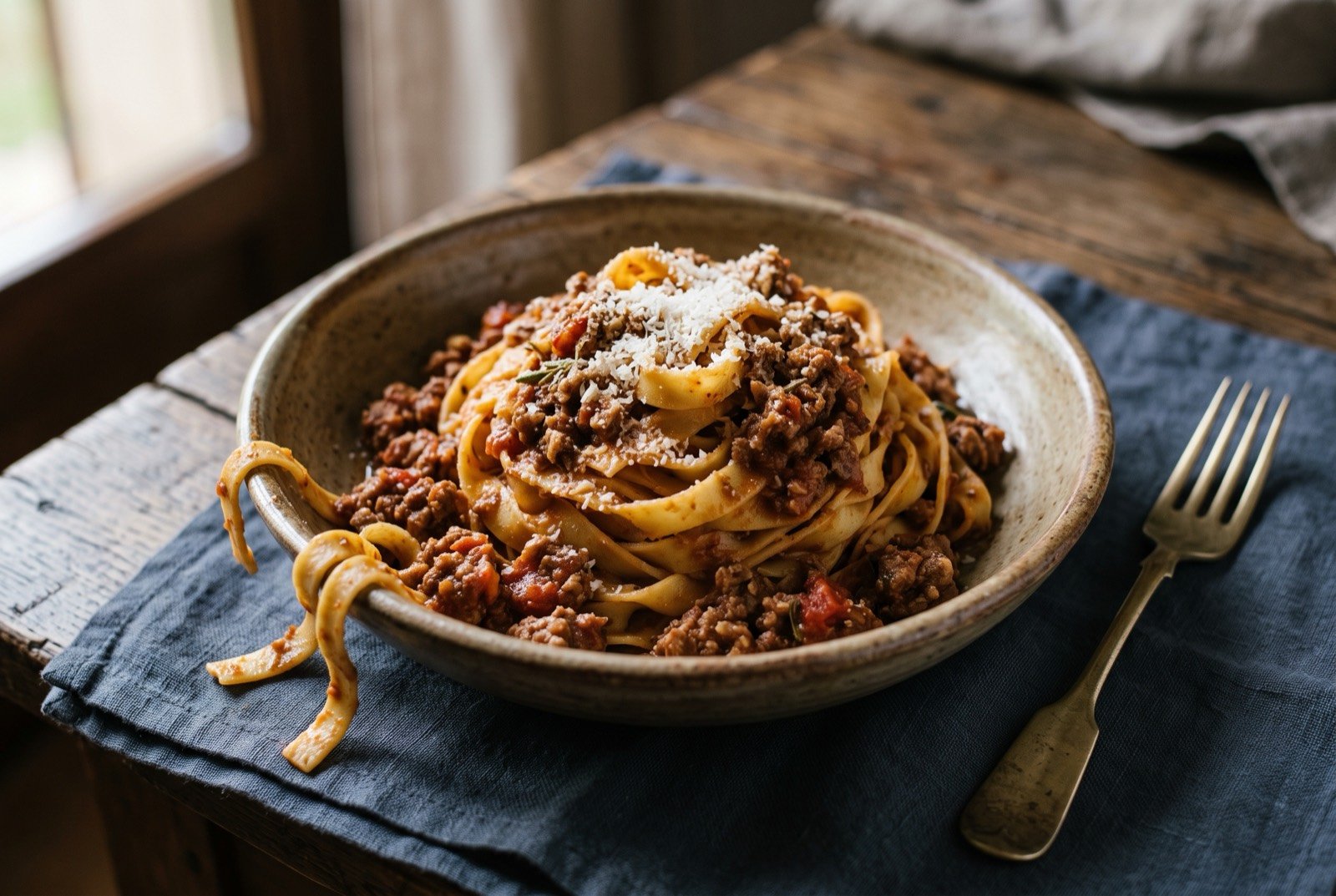
Tagliatelle al Ragù
Emilia-Romagna
Illustration
- Time
- 3 hours
- Researched
- 14 sources cited
Worth flagging clearly: the "official" ragù recipe is not a static, centuries-old document. The Accademia Italiana della Cucina deposited it at the Bologna Chamber of Commerce on 17 October 1982, and formally revised and re-deposited it on 20 April 2023 after a dedicated study committee. The Academy's own language states the recipe "does not claim to be the only possible one," comparing correct execution to musical performance from a score. Tagliatelle's own measurement is similarly civic rather than ancient: on 16 April 1972, Francesco Majani and Alcino Cesari deposited an official width, 8 mm cooked, roughly 7 mm raw, said to correspond to the 12,270th part of the height of the Torre degli Asinelli, a deliberately whimsical piece of civic branding, not a claim of ancient culinary precision.
As tradition built it
Serves 6. About 3 hours.
Ingredients
- 400 g beef, coarsely ground
- 150 g fresh pork pancetta
- half an onion, about 60 g
- 1 carrot, about 60 g
- 1 celery stalk, about 60 g
- 1 glass red or white wine
- 200 g tomato paste or passata
- 1 tbsp concentrated tomato paste
- 1 glass whole milk, optional
- a little, as needed light meat or vegetable broth
- 3 tbsp extra virgin olive oil
- to taste salt and pepper
- 600 g tagliatelle
Method
- Finely chop the onion, carrot and celery.
- Warm the oil in a heavy pot, sweat the vegetables gently until soft.
- Add the pancetta and beef, brown well, breaking it up.
- Add the wine, let it evaporate.
- Stir in the tomato paste and concentrate.
- Add a little broth, season with salt and pepper, then simmer gently, uncovered, for at least 2 hours, topping up with broth as needed, never letting it dry out or reduce to a paste.
- Stir in the milk near the end if using, to soften the acidity.
- Cook the tagliatelle, dress with the ragù, finish with Parmigiano.
What a modern chef changes
The official ratio held under discipline, and a two-stage build
Rung 4
Method
- Hold the meat-to-tomato ratio deliberately restrained, as the deposited recipe specifies. This is not the thick, tomato-forward "bolognese" sold in Britain; if your sauce is turning a deep, uniform red rather than staying a rich, meat-flecked brown, you have added too much tomato relative to the deposited proportions.
- Build in two stages. Brown the meat properly first, in batches if your pot is crowded, so it genuinely sears rather than stews in its own liquid, then only add the vegetables and liquid once every piece has real colour.
- Reduce toward restraint, not thickness. Rung 4: the two-hour simmer should concentrate flavour while staying loose enough to coat the pasta, not tighten into a stew. Top up with broth rather than letting it reduce past that point.
- Roll your own tagliatelle to the deposited width if you can, 7 mm raw. A wider, fresher noodle carries this restrained sauce differently from a thin dried pasta, holding more of it in the fold of each ribbon.