The Mediterranean · Volume 01, Butter, Egg Pasta and the Roman Hinge
Carbonara
Lazio and Rome
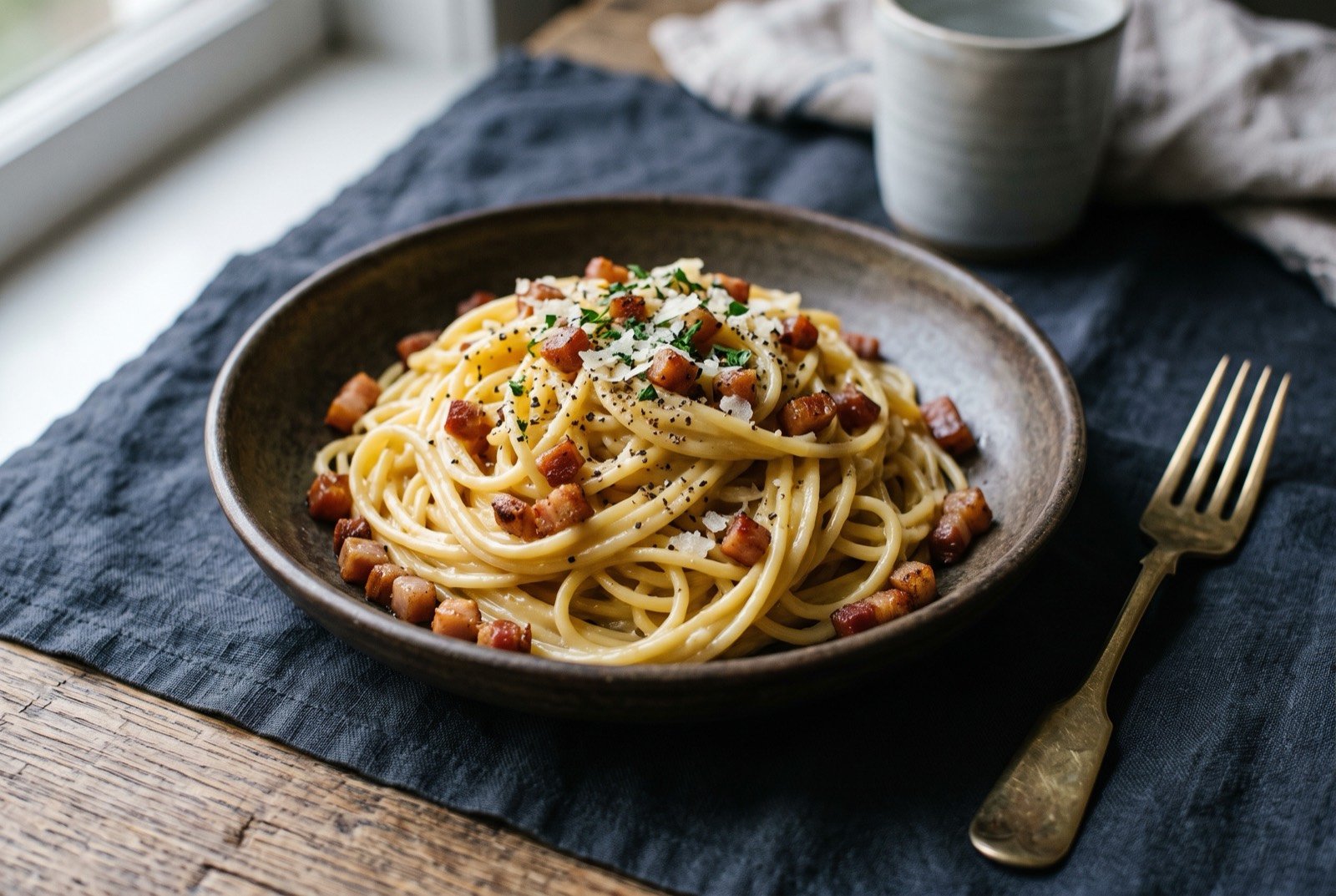
An illustration of the dish, not a photograph of it cooked.
- Time
- 20 minutes
- Researched
- 14 sources cited
- Reviewed
- Not yet reviewed from inside the tradition
- Cooked
- Not yet cooked and reported
The most important myth-correction in this whole volume, and unusually well sourced. Food historian Luca Cesari's dated, citation-based history explicitly calls the shepherd or charcoal-burner origin story "antistorico," historically false: there is no documented predecessor to carbonara before the first decades of the twentieth century. The earliest written recipe found anywhere is from 1952, in a Chicago restaurant guide describing the dish at an Italian restaurant there. The earliest Italian print appearance, August 1954 in La Cucina Italiana, lists spaghetti, egg, pancetta, not guanciale, Gruyère cheese and garlic, none matching the now-canonical recipe. Only from 1960 does guanciale first appear replacing pancetta in print, and cream persisted in printed recipes into the late 1980s. The recipe only stabilises into its now-canonical form, egg yolk, Pecorino Romano, guanciale, black pepper, no cream, from the 1990s. A specific, named account, not a settled fact, credits the dish's actual crystallisation to Renato Gualandi, a Bolognese chef hired to cook for Allied troops at newly liberated Riccione in September 1944, who described improvising with American bacon, cream, cheese and powdered egg yolk.
As tradition built it
Serves 4. About 20 minutes.
Ingredients
- 400 g spaghetti or rigatoni
- 150 g guanciale, rind and outer aged layer trimmed
- 4 egg yolks, plus 1 whole egg
- 100 g Pecorino Romano, finely grated
- a generous grind black pepper, coarsely ground
Method
- Trim the guanciale's rind and its outer, often slightly rancid, aged layer with a serrated knife, then dice.
- Render it gently in a cold pan set over low heat, so it renders slowly rather than fries, until crisp at the edges and its fat has run clear.
- Whisk the yolks, whole egg and half the pecorino together off the heat.
- Cook the pasta until just short of al dente.
- Off direct heat, toss the pasta with the rendered guanciale and its fat.
- Add the egg mixture, tossing continuously and loosening with a little starchy pasta water, until it turns to a glossy cream rather than scrambling.
- Finish with the remaining pecorino and a generous grind of black pepper.
Notes
After Rome's Luciano Monosilio, widely nicknamed the king of carbonara.
What a modern chef changes
The egg treated as a genuine emulsified sauce, built like a hollandaise
Rungs 1 and 2
Method
- Temper the eggs over a bain-marie first, warming the yolk and egg mixture gently and gradually off direct heat before it ever meets the hot pasta, exactly as you would temper eggs for a custard. This removes the single biggest source of scrambled, split carbonara: raw egg meeting a pan still carrying real heat.
- Build the sauce like a hollandaise, not a pan sauce. Drizzle the rendered, still-warm guanciale fat into the egg-and-cheese base gradually, whisking continuously, the way you would incorporate butter into a hollandaise, rather than tipping the pasta into the pan and hoping the sauce comes together around it. Rung 1.
- Render the guanciale properly, starting it in a cold pan over low heat rather than a hot one, so the fat has time to liquefy fully before the meat has any chance to crisp too hard or catch. Rung 2.
- Use starchy pasta water as the stabiliser, not the seasoning. Add it gradually to loosen the emulsion to a coating consistency, judging by texture rather than a fixed quantity.