North Africa · Volume 15, Harissa and the Ottoman Line
Macroona imbakbaka
Tripolitania, Libya
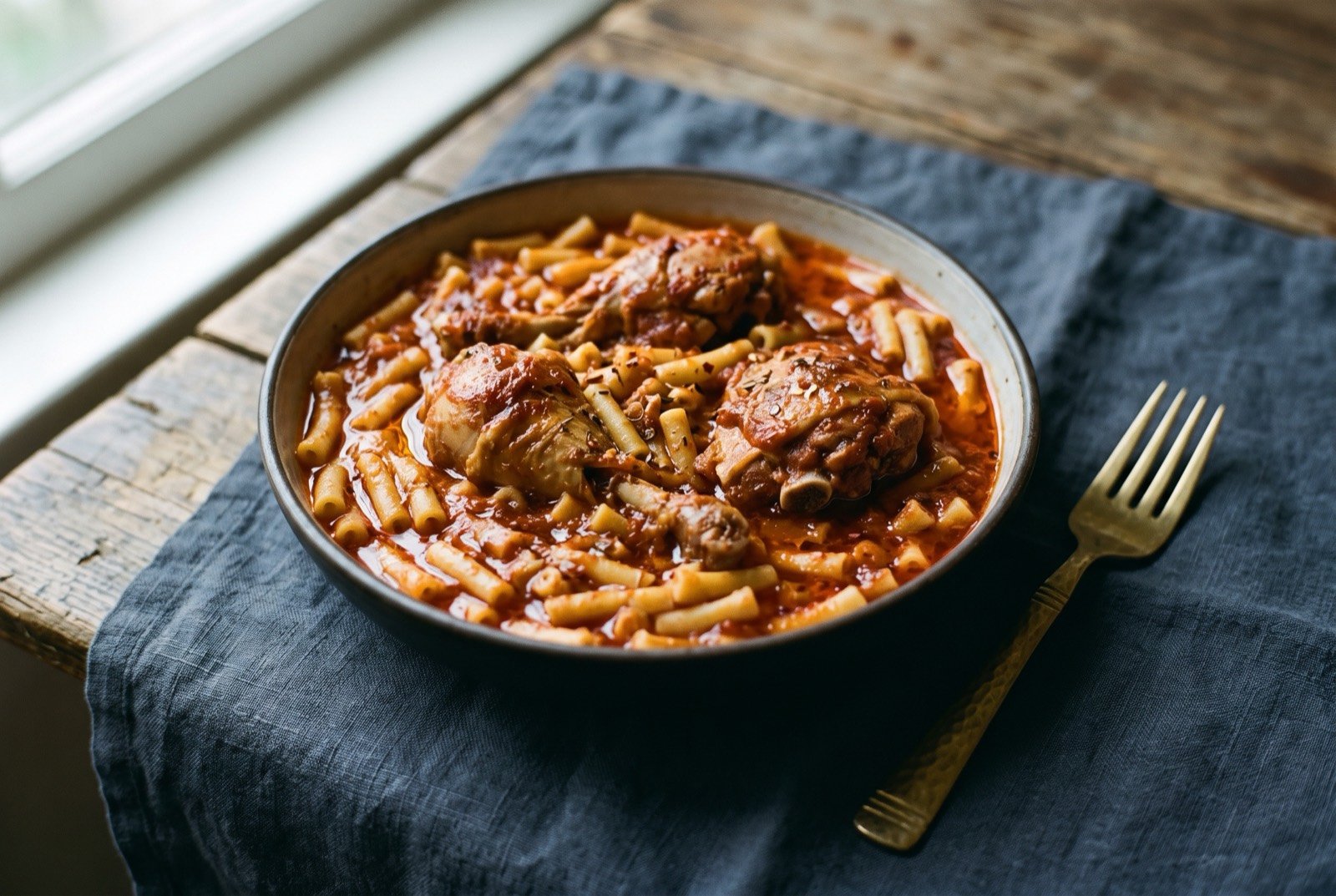
An illustration of the dish, not a photograph of it cooked.
- Time
- 50 minutes
- Reviewed
- Not yet reviewed from inside the tradition
- Cooked
- Not yet cooked and reported
Start with the history, because the dish makes no sense without it. By 1939 there were 108,419 Italians in Libya, 12.37 per cent of the population. On 21 July 1970 they were given until 7 October to leave, and roughly 20,000 went. The pasta stayed. Imbakbaka is what happened next, and it is not an Italian dish cooked badly. The pasta is never boiled separately. It is broken short and finished in the sauce, absorbing it and thickening it with its own shed starch: Maghrebi one-pot logic applied to an Italian ingredient, which is why it tastes nothing like a ragù. Cinnamon and clove sit in the spice mix in a way no Italian cook would recognise. Tunisia made the same move independently, boiling pasta well past al dente and putting harissa in the sauce, and Jeff Koehler frames makrouna arbi as distinctly Tunisian rather than derivative. Treat this as inheritance, not novelty.
As tradition built it
Serves 6. About 50 minutes.
Ingredients
- 450 g pasta: ditalini, or spaghetti broken into 5 cm lengths
- 1 chicken, cut and quartered
- 1 onion, diced, and 2 garlic cloves
- 160 ml tomato paste (about two thirds of a cup)
- 5 tbsp olive oil
- 1 tbsp salt
- 1½ tbsp bzaar
- 1 tsp cayenne
- 2.6 L water, used in stages
Method
- Sweat the onions in the oil over medium-high heat, then brown the chicken.
- Add the tomato paste, bzaar, salt and cayenne, and cook 3 to 4 minutes.
- Add 1.65 litres of water, bring to the boil, cover and simmer 25 minutes.
- Break the pasta into 5 cm segments. Add the remaining 950 ml of water and bring back to the boil.
- Crush the garlic straight into the pot at this point, not earlier.
- Add the pasta and stir every 2 to 3 minutes until it is fully cooked and the sauce has thickened around it.
Notes
After a Libyan source.
What a modern chef changes
The paste taken to colour, the bzaar ground fresh, and the salt understood
Rungs 2, 3 and 6
Method
- Fry the tomato paste to a colour, not to a clock. Rung 2. Two thirds of a cup of double concentrate is doing all the structural work here. Push it around the pan until it darkens from bright red to deep brick and the oil separating from it runs orange, which may take five minutes rather than the stated three or four. That colour change is Maillard browning of the paste's sugars and amino acids, and it is the difference between depth and the taste of raw tin.
- Grind your own bzaar. Rung 3. One documented Gheryan family version is 1 heaped tablespoon of turmeric, 1 tablespoon of ground caraway, 2 teaspoons of ground coriander and 1 teaspoon of seven spice, and its own author says every family varies it. In a dish with this much tomato and this long a cook, tired spice disappears entirely.
- Season the sauce above what tastes right on its own. Rung 6, and this is the insight that makes or breaks the dish. In Italian cooking the pasta is seasoned from the inside by heavily salted boiling water. Here it never meets salted water at all, so every gram of salt in the finished mouthful arrives through the sauce, by absorption, in the last fifteen minutes. A tablespoon of salt in the pot looks alarming and is correct: if the sauce tastes right before the pasta goes in, it is under-seasoned for the finished dish. Hold back the last 200 ml of water to set the consistency, and serve at once, because it keeps tightening while hot.
Notes
Part Four