North Africa · Volume 15, Harissa and the Ottoman Line
Mloukhia tounsia
Tunisia
Illustration
- Time
- 7 hours
- Researched
- Researched from 123 sources in the brief
Egypt uses fresh or frozen chopped jute mallow, cooks it for minutes, keeps it vividly green, finishes it with a coriander and garlic taqliya, and pours it over rice. Tunisia buys the same leaf dried and milled to a powder, mounts it in oil, cooks it uncovered for seven hours until it is near black, and eats it with bread. Dried against fresh, hours against minutes, black against green, bread against rice. Identical plant, opposite decision at every fork.
As tradition built it
Serves 6. About 7 hours.
Ingredients
- 100 g mloukhia powder (about 5 heaped tbsp)
- 200 ml oil
- 3 L boiling water
- 500 g beef, in pieces for long cooking
- 1 onion, chopped, and 1 fresh tomato, peeled
- ½ tbsp tomato concentrate
- 2 bay leaves
- 1 heaped tbsp ground coriander
- 1 tsp ground caraway
- 4 garlic cloves crushed, plus 1 more to finish
- ½ tsp salt
Method
- Work the mloukhia powder into the oil to a smooth, completely lump-free paste. Take your time. Every lump you leave now will still be a lump in seven hours.
- Add the boiling water gradually, stirring continuously.
- Add the beef, onion, tomato, concentrate, bay, coriander, caraway, the four garlic cloves and the salt.
- Cook uncovered on very low heat for approximately 7 hours, stirring regularly so it does not catch.
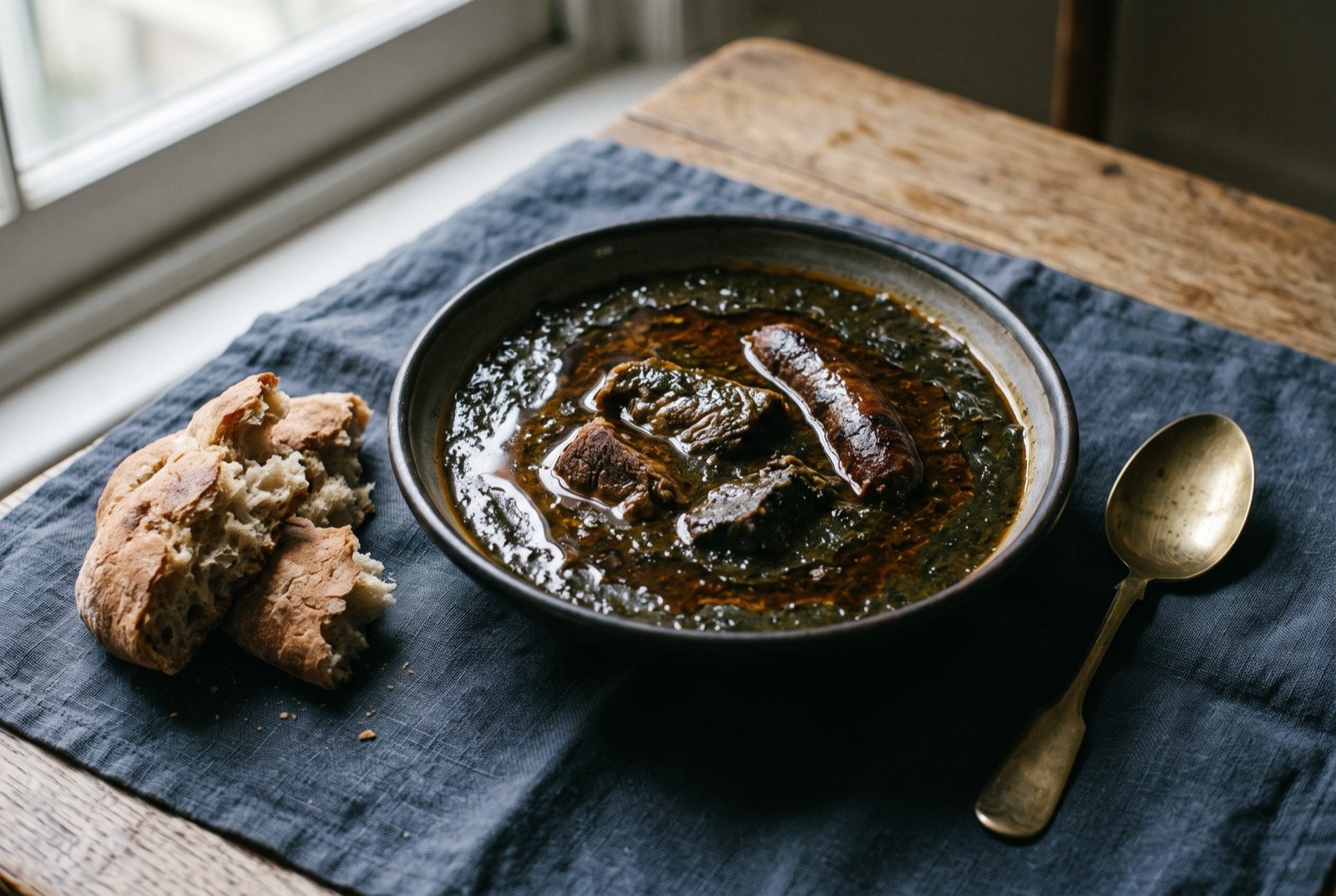
- The doneness signal is visual and absolute: the oil rises to the surface and the sauce turns dark, glossy and coating. Crush the last garlic clove in at the end. Serve with bread, not rice.
Notes
The pressure cooker route, from the same source: 1.5 litres of boiling water, then three successive 15 minute pressure cycles with depressurisation and stirring between each, then uncovered on low until the consistency is right, about 4 hours in total.
Why it is built this way. A 2:1 oil-to-powder paste is a roux in which fat is the continuous phase, so the dried mucilaginous polysaccharide hydrates evenly instead of clumping. The seven uncovered hours then drive off water, break the mucilage so the sauce is unctuous rather than slimy, and Maillard the leaf towards black.
What a modern chef changes
Surface area instead of time, a real temperature, and split garlic
Rungs 3, 6 and 2
Method
- Change the pan before you change anything else. Those uncovered hours are evaporative work, and evaporation is governed by surface area, not duration. A wide, shallow, heavy pan with twice the liquid surface of a stockpot reaches the same oil-broken endpoint sooner, because you are removing water faster rather than cooking the leaf longer. Watch for the signal, not the clock.
- Hold a real 95°C rather than a nominal low. Below about 90 the water loss stalls and you are keeping it warm for an afternoon; above a simmer it catches and the burnt note goes right through. A probe for the first half hour tells you where your smallest burner actually sits.
- Split the garlic and split the oil, and toast the seeds. Rungs 6 and 3. Four cloves at the start are structural; the clove at the end is aromatic, and it is the one you can smell. Cook in the workhorse oil, finish with green Tunisian oil poured on cold. And toast and grind the seeds: over seven hours only the heaviest fraction survives, so stale spice reaches the plate as nothing at all.