North Africa · Volume 13, The Oldest Kitchen
Molokhia
Cairo, and the whole eastern Mediterranean, and Yorubaland
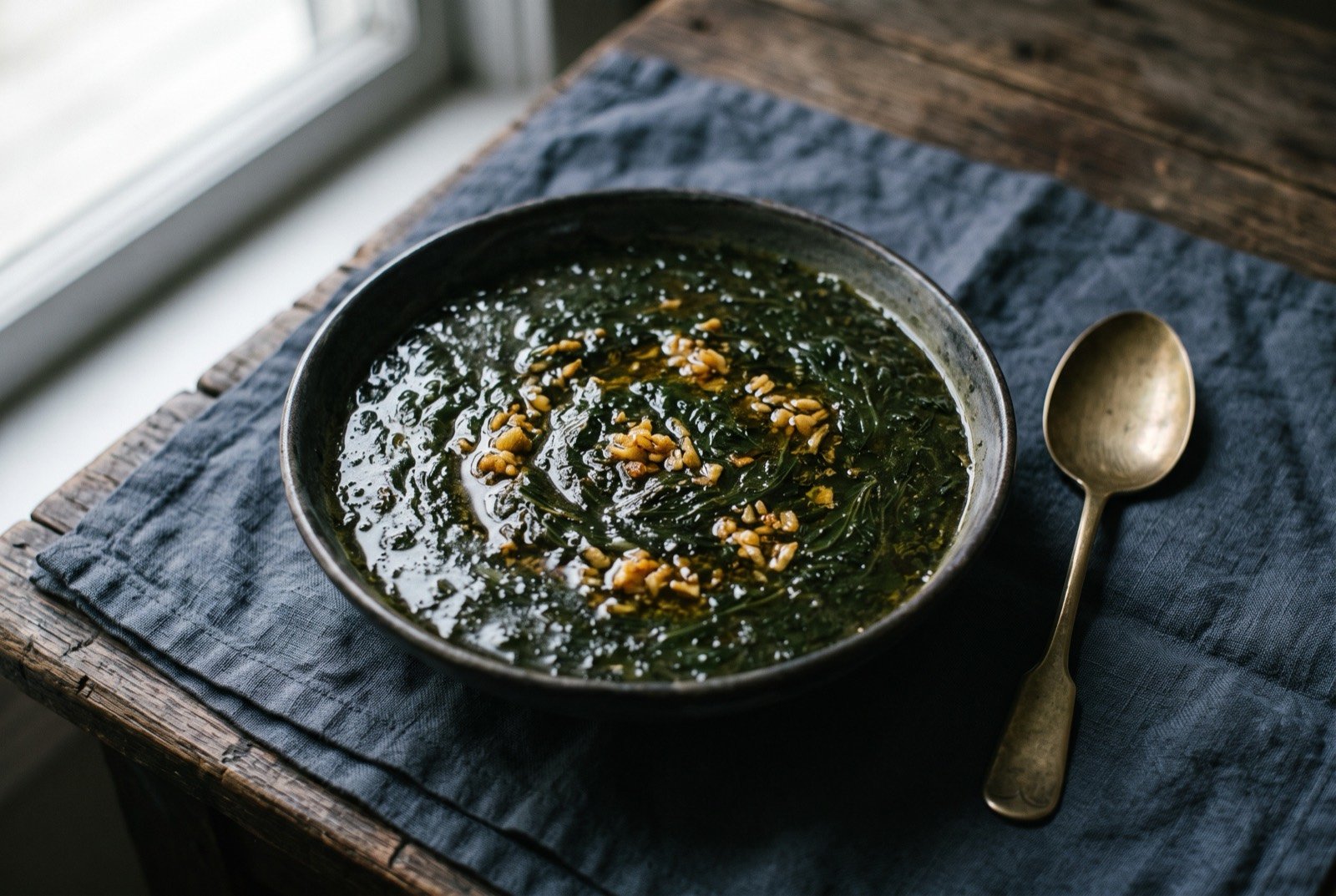
An illustration of the dish, not a photograph of it cooked.
- Time
- 1 hour 15
- Reviewed
- Not yet reviewed from inside the tradition
- Cooked
- Not yet cooked and reported
The dish that connects this volume to Volume Four, and the connection is botanical rather than thematic. The Egyptian version is the fastest and most fragile of the four grammars, and it is built on a stock rather than on a condiment. Its history is unusually well documented: the Fatimid caliph al-Hakim banned molokhia in 1004 CE, and people were beaten and paraded for selling it in 1009 and 1014. The popular explanation is that he thought it an aphrodisiac; the better sourced one, from Paul Walker's Caliph of Cairo, is sectarian, since the plant was associated with Mu'awiya ibn Abi Sufyan, a figure abhorrent to the Shi'a Fatimids. The Druze still do not eat it.
As tradition built it
Serves 4 to 6. About 1 hour 15.
Ingredients
- 1.4 kg bone-in chicken
- 1.4 L water
- 1 onion, plus garlic, 2 bay leaves, coriander seed, allspice, cardamom
- 800 g minced molokhia, fresh or frozen
- 10 garlic cloves, minced or pounded
- 1 tbsp ground coriander
- 3 tbsp ghee or butter
- to taste salt
Method
- Bring the bone-in chicken and water to the boil for 5 minutes and skim the scum off properly. Add the onion, garlic, bay leaves, coriander seed, allspice and cardamom, and simmer covered 45 minutes. Strain, and reduce to about 950 ml.
- Bring the stock to a bare simmer, nowhere near a boil. Add the minced molokhia.
- Hold it below boiling, uncovered, stirring, until the leaf melts into the broth, about 15 minutes. Do not cover it. Do not let it boil. Season with salt to taste.
- Off the heat, make the tasha: garlic cloves into hot ghee or butter 15 to 30 seconds to lightly golden, then ground coriander for 30 seconds more.
- Pour it into the pot. Gasp. Serve immediately with vermicelli rice, chicken, lemon wedges and aish baladi. Rabbit is the prestige version and shrimp the coastal one.
Notes
Synthesised from three Egyptian sources, at the ratio given by Am What I Eat, the thickest of the three.
What a modern chef changes
A stock worth suspending things in, a blade instead of a blender, and the heat off before the leaf goes in
Rungs 1, 2 and 3
Method
- Build a stock that can carry a dish with no flavour of its own. Rung 1. An old boiling fowl rather than a supermarket chicken, or rabbit, or duck. Or invert the dish as Impala does and braise a shoulder of cull yaw in the jute leaves, so the greens become a braising medium over an animal high in collagen, glutamate and nucleotides. Strain through muslin and a chinois, because molokhia on a cloudy stock reads muddy however good the leaf is.
- Kill the heat completely before the leaf goes in. Rung 2. Not low, off. The residual heat of a litre of stock will melt the leaf over fifteen minutes and removes any chance of a boil. This single change most reliably takes a home molokhia from olive drab to green.
- Chop, never blend. A mezzaluna is the practical British makhrata. A blender shears the polymer and gives a uniform slick purée, a different and worse dish that happens to contain the same ingredients.
- Treat the tasha as a thirty second operation with a stopwatch, and do not hold the finished pot. Rung 3. Coarse ground coriander, fresh firm garlic, and the pan deglazed with a spoonful of the soup. Every minute the pot then spends warm is mucilage degrading and chlorophyll converting to pheophytin.