North Africa · Volume 13, The Oldest Kitchen
Aish baladi
Egypt, everywhere
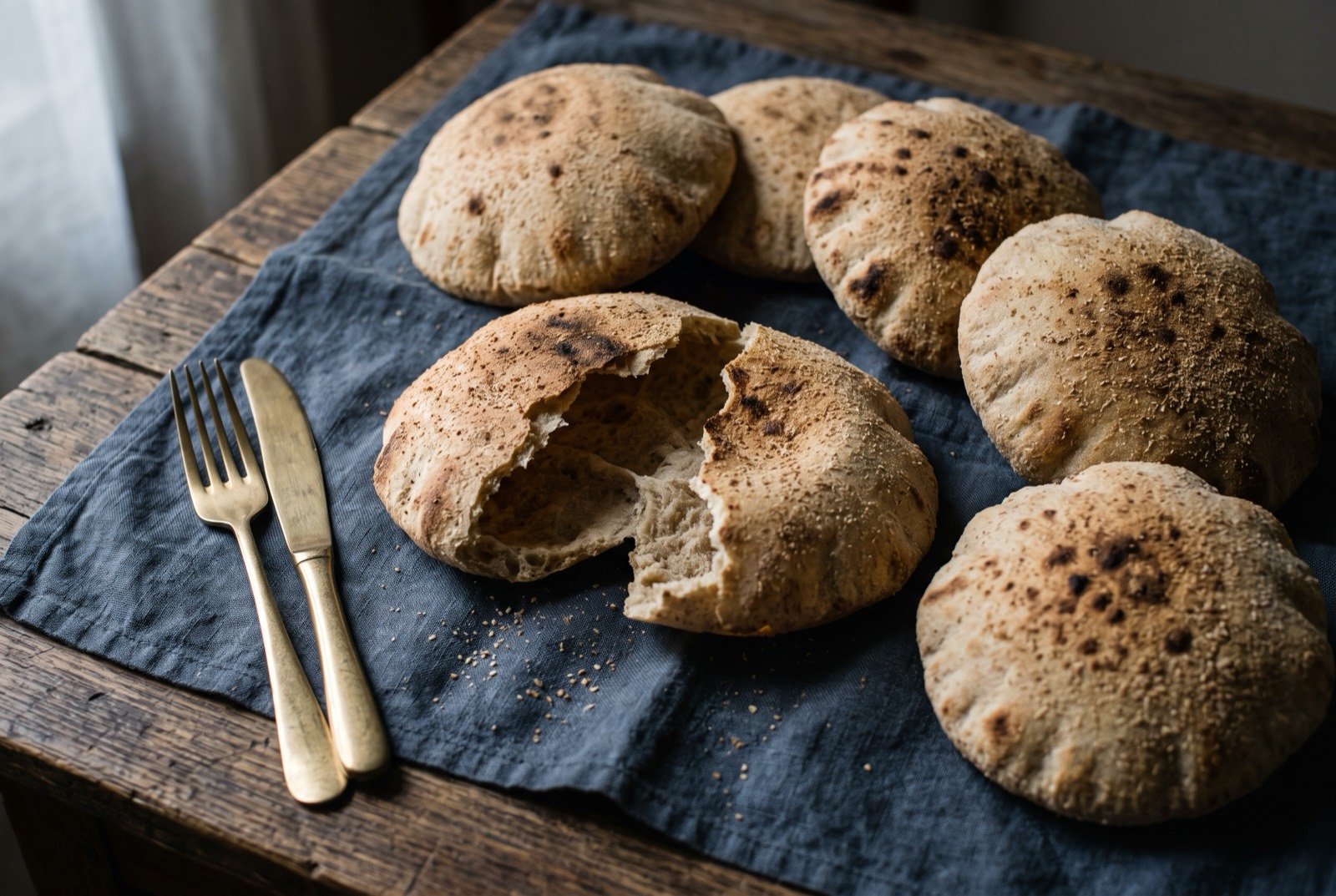
An illustration of the dish, not a photograph of it cooked.
- Time
- 32 hours
- Reviewed
- Not yet reviewed from inside the tradition
- Cooked
- Not yet cooked and reported
Egyptians do not call bread khubz. They call it aish, which means life, and once you know that the politics of the loaf stop being metaphorical. The flour is 82 per cent extraction, a legally defined rate: a high extraction near wholemeal, coarser and browner than a European 75 or 80 per cent flour, and it holds a great deal of water. That matters, because the water is what makes the pocket.
As tradition built it
Makes 8 loaves. 24 hours for the starter, then about 8 hours.
Ingredients
An outline, not yet a recipe: the tradition's method with its ingredients named but not weighed. Quantities are being added from sources inside the tradition, lead dishes first.
- 3.5 cups unbleached bread flour, for the starter
- 1.5 cups wholewheat flour
- white bread flour, to bring the dough together
- ½ to 1 cup water at 40°C
- 1.5 cups finely ground bran, for the proving bed
- 1 tbsp salt
Method
- Make the starter with the unbleached bread flour and water at 40°C, and ferment it 24 hours in the refrigerator. This is flavour, not leavening.
- Mix the main dough with the wholewheat flour, white bread flour and salt. It should be wet and slack, not a tidy bread dough. Cold prove 6 hours or overnight.
- Divide and shape into thin discs. Prove them on finely ground bran, not flour: the bran stops sticking and coats the base so the loaf releases cleanly onto a screaming hot surface. Rest about 20 minutes.
- Preheat the oven and a baking stone to 260°C for at least 45 minutes.
- Bake 2 to 4 minutes, until fully puffed and lightly charred in spots.
Notes
After Chez Nermine, whose operative line is that baladi bread needs intense bottom heat to puff and form its pocket.
What a modern chef changes
Measure the surface, not the oven, and bake one dough to two endpoints
Rung 6
Method
- Use a steel, and measure it with an infrared thermometer. The mechanism is thermal, not chemical. A steel delivers more energy per second into the base than a stone, and domestic ovens lie about air temperature and say nothing at all about surface temperature. Underheat is the only real failure mode.
- Do not over prove. The balloon is held by the gluten film, and over proved dough is too weak to hold it. If the disc is slack and blistered before it goes in, you are already too late.
- Bake half the batch to a second endpoint. Four loaves out at full puff; four left lower down until dry, brittle and biscuit coloured. The dried ones are the base for fatta and the shell for hawawshi, and in Egypt that second life is a different product rather than a use for stale bread.
- Be honest about the flour. A British strong white and wholemeal blend is not 82 per cent extraction baladi flour. The nearest honest approach is a high extraction stoneground flour with the coarse bran sieved back in by weight, and the loaf will still be good and not quite right.