North Africa · Volume 13, The Oldest Kitchen
Mahshi and wara enab
Everywhere, and above all at home
Illustration
- Time
- 1 hour 20
- Researched
- Researched from 135 sources in the brief
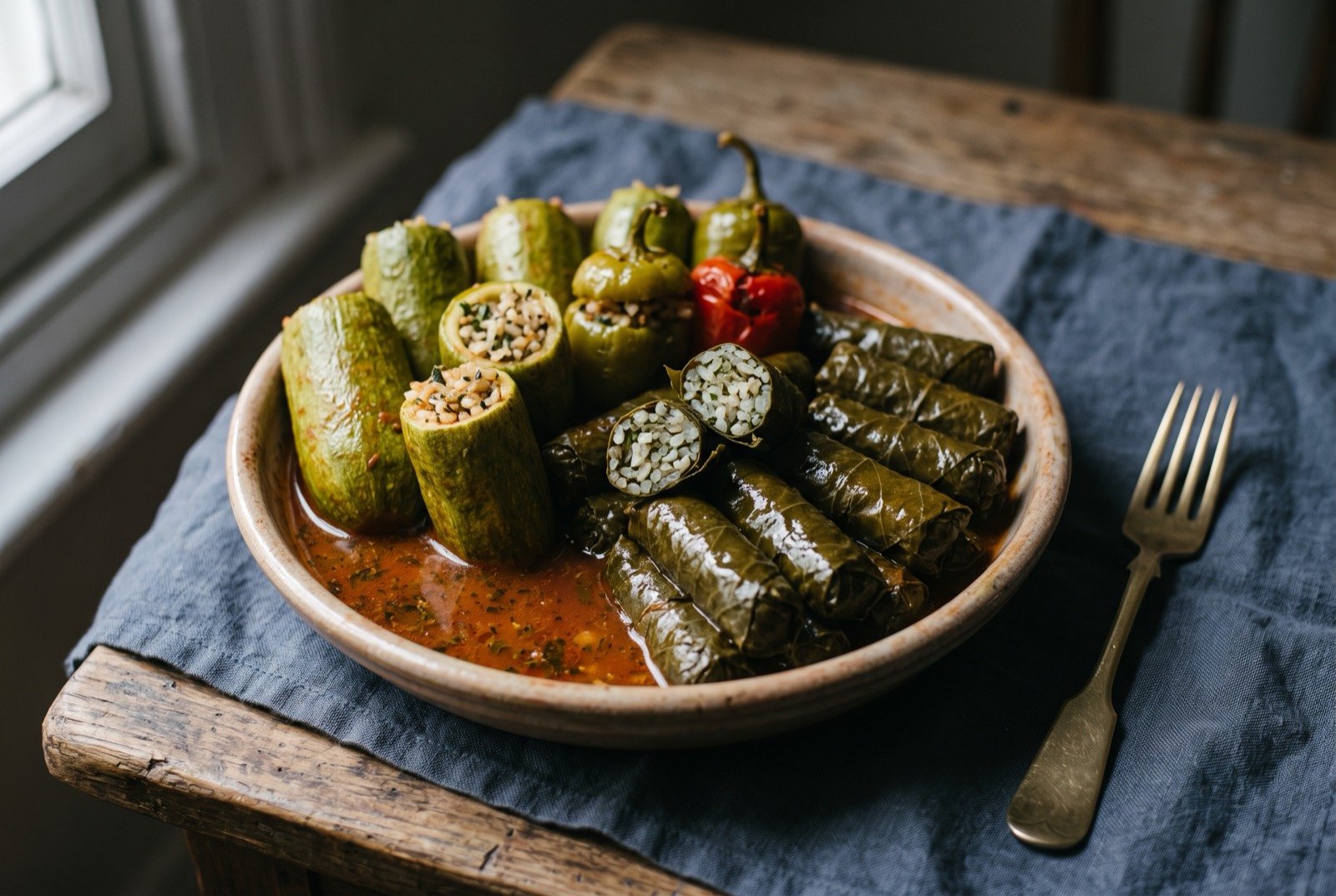
Egyptian mahshi is distinguished from Turkish or Greek dolma by two things: the herb quartet, in which dill and dried mint are the tell, and the fact that the Egyptian version is markedly tart and served hot, not as a cold oil preserved meze.
As tradition built it
Serves 6. About 1 hour 20 for stuffed vegetables, 2 hours for vine leaves.
Ingredients
- 2 cups Egyptian short grain rice
- 1 cup parsley, chopped
- half a cup fresh coriander, chopped
- a third of a cup dill, chopped
- 1 tbsp dried mint
- 1 onion, chopped
- 2 tbsp tomato paste
- 450 g tinned tomato sauce
- 3 tbsp olive oil
- half a tsp salt
- half a tsp black pepper
Method
- Sauté the onion, tomato and Egyptian short grain rice together for 2 minutes only. The rice must be barely started; it finishes inside the vegetable.
- Stir in the parsley, fresh coriander, dill, dried mint and the salt and black pepper, and cool completely before stuffing anything.
- Core the vegetables and fill to about half a centimetre below the rim. No further. The rice roughly doubles, and overfilling splits the vegetable and empties the filling into the pot.
- Pack them into a pot and pour in 600 ml of hot stock with the tinned tomato sauce and a teaspoon of tomato paste, until it comes halfway up the layers and no higher. Boil, then simmer 40 minutes.
- For wara enab, blanch the leaves in 1.5 litres of water with 1 tbsp olive oil, in four batches of 3 to 4 minutes, keeping the trimmed stems. 1.5 teaspoons of filling per leaf, rolled tight. Bed the pot with herb stems, onion rings, tomato slices and the reserved stems, put a small inverted plate on top of the packed rolls, add 600 ml warm stock with 1.5 tbsp lemon juice, and cook 75 to 90 minutes on low. Finish by pouring 2 tablespoons of very hot ghee over the top.
Notes
After Amira's Pantry. One batch of filling covers roughly 1.8 kg of marrow or aubergine, 3 kg of peppers, or 225 g of vine leaves.
Cabbage behaves differently: cover the rolls completely with boiling broth, 10 minutes covered on medium high, then crack the lid for 15 to 20 minutes. Cabbage leaf is thick and needs full contact heat; vine leaf is thin and would disintegrate under the same treatment.
What a modern chef changes
Real stock instead of a cube, the plate understood as a press, and acid arriving twice
Rungs 6, 1 and 5
Method
- Replace the bouillon cube with the stock you made for the molokhia. Rung 1. Every Egyptian home recipe specifies a cube because the dish needs savour the vegetable cannot supply. It is the easiest upgrade in the chapter and costs nothing but planning.
- Understand the inverted plate as a press, and weight it. Rung 6. It holds the rolls under the liquid so they cook evenly, and applies enough pressure to stop the expanding rice pushing the roll apart. A small plate with a filled ramekin on it beats a plate alone.
- Pack to a density, not to a feeling. 1.5 teaspoons per leaf and half a centimetre below the rim are real numbers. Weigh the first three, then trust your hand.
- Bring acid in twice, at different volatilities. Rung 5. The lemon in the cooking liquid does structural work over a long cook and has stopped being aromatic by the end. The raw squeeze at the table, and the hot ghee poured over, have not.