North Africa · Volume 13, The Oldest Kitchen
Feseekh, and the one recipe in this atlas you must not cook
Menoufia and the Delta, for Sham el-Nessim
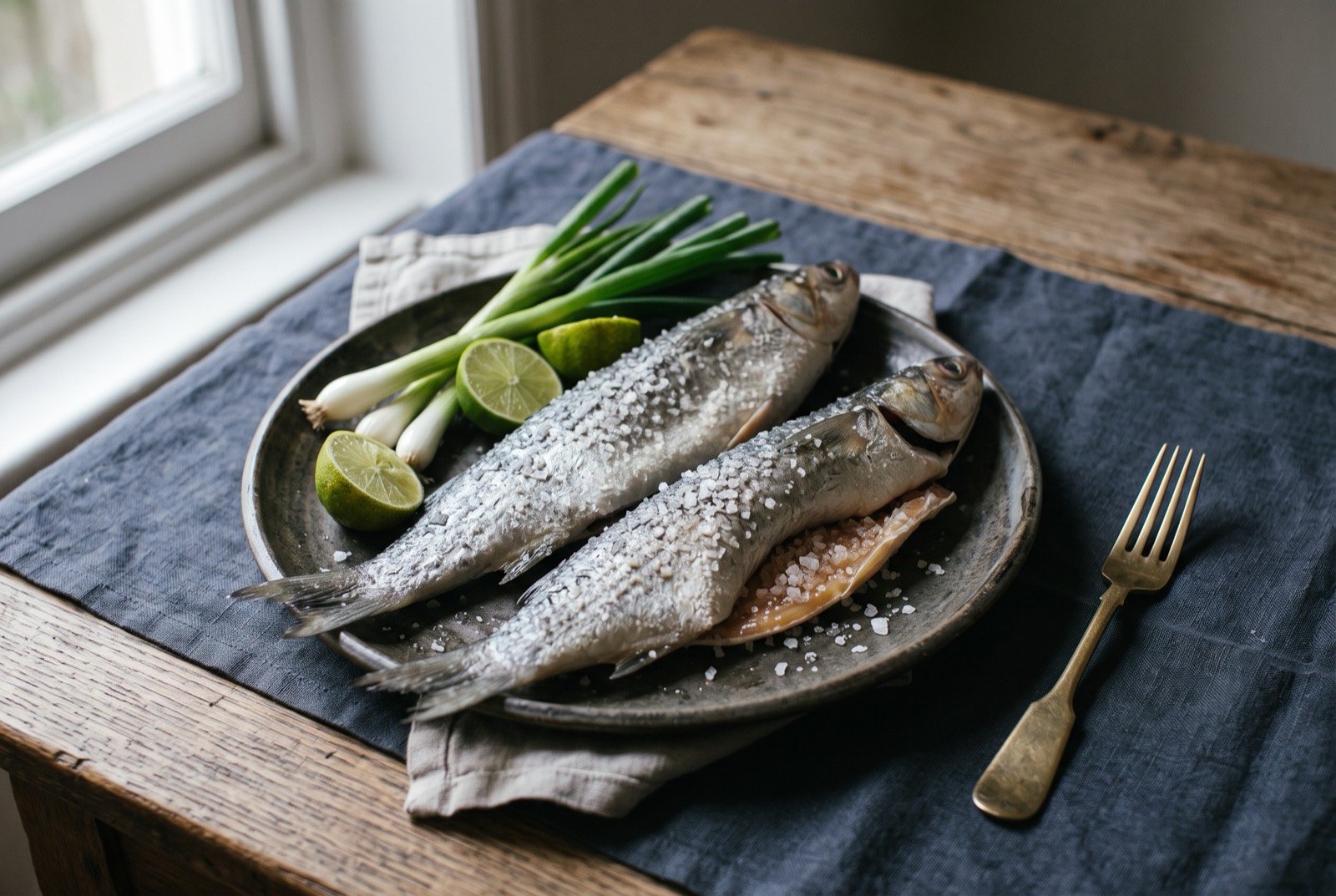
Illustration
- Researched
- Researched from 135 sources in the brief
Feseekh is salt fermented grey mullet, Mugil cephalus, eaten in spring at Sham el-Nessim. It is made by hereditary specialists called fassakhin, working out of shops called fasakhany, and it is on Slow Food's Ark of Taste. It also kills people in Egypt most years, and this chapter is going to be plain about that.
As tradition built it
Ingredients
- under 20 mg N/100 g TVB-N of the raw fish. Over 50, reject it
- 10 to 15 per cent coarse pickling salt, minimum, by weight of fish
- 6 to 10 per cent final salt concentration, sometimes up to 30
- 30°C, up to 24 hours the ripening hold
- below 0.97 water activity of the finished product
- pH 6.0 to 6.5 finished product
- 4°C or below storage, and 3.3°C in reduced oxygen packaging
Method
- Wash the fish in potable water.
- Eviscerate. Guts and gills removed. This is the single critical control point.
- Ripen at around 30°C for up to 24 hours, until soft and swollen. This is the high risk step, and it is what makes feseekh feseekh rather than salt fish.
- Ferment, layered into barrels with the salt, 3 to 15 days.
- Store cold. Shelf life is 2 weeks at 6 per cent salt and up to 3 months above 10.
Notes
Why you must not do this. The hazard is Clostridium botulinum type E, a psychrotrophic, non proteolytic strain whose spores live in fish intestines and gills. It grows at refrigeration temperatures and produces no spoilage smell. The fish can be lethal without smelling any worse than feseekh normally smells, and feseekh normally smells extremely bad. There is no sensory test available to you, and that is the whole problem in one sentence.
The uncontrolled ripening at around 30°C is the danger window, because it permits growth before salt has penetrated the tissue. A 2022 study isolated C. botulinum from 40 per cent of examined uneviscerated feseekh products in Egyptian markets. All documented outbreaks have involved uneviscerated mullet, shad or sardines; no botulism outbreak has been associated with eviscerated fish. Atlas Obscura records eighteen deaths in 1991, and the Egyptian Ministry of Health issues warnings annually. A secondary hazard: fermentation beyond sixty days raises biogenic amines, with documented histamine as high as 579 mg/kg against an illness threshold around 80.
The British Columbia Centre for Disease Control's control measure is to heat all feseekh dishes to an internal 85°C, because the toxin is heat labile. Egyptians do not do this, because feseekh is eaten cold and raw, and that guidance was written for Canadian regulators rather than for Egyptian practice. Both things are true at once and this chapter will not reconcile them by pretending.
If you are in Egypt at Sham el-Nessim, the Egyptian consumer guidance is the useful version. Reject soft or mushy fish, overly reddish specimens, broken skin or bloating. Buy from an established fasakhany and never from a street seller, because street sellers economise on salt and salt is the entire preservation system. It should not be eaten by children under three, by pregnant or nursing women, or by anyone with hypertension. Symptoms needing immediate hospital attention are lethargy, vision problems, nausea, muscle weakness, and difficulty swallowing or breathing, and they can appear twelve hours to several days later. VACSERA, the state vaccine and serum authority, holds the antitoxin.
The safe traditional dish is renga bel tahina. Renga is smoked herring, a different process and a far lower risk, and it is the everyday Sham el-Nessim option in most households: the fillet flaked and folded into tahini loosened with lemon, eaten with spring onions, lettuce, aish baladi and termis. The sources used for this chapter give the method and not weighed quantities, so none are printed here.
What a modern chef changes
The aged fish tradition kept, as seasoning rather than as a course
Rungs 1 and 5
Method
- Use batarekh instead, and use it as salt. Cured pressed grey mullet roe is the same tradition, the same fish and, in antiquity, the same export, and it carries the aged fish glutamate with none of the botulism risk, because it is a cure rather than a controlled putrefaction. Grated over a white bean purée it is exactly what Impala does with bottarga, and it is how you put Egypt's oldest preserved flavour on a British plate safely.
- Sardinian or Sicilian bottarga is a legitimate substitute rather than a compromise, being grey mullet roe cured by the same logic in the same sea. Egyptian batarekh is scarce in Britain.
- Salt packed anchovy is the everyday version of the same move, giving aged fish glutamate for a fraction of the money.
- Keep the lemon raw and late. Rung 5. Every dish in this family is a salt and acid balance, and the acid is what makes a very strongly flavoured thing edible in quantity.