North Africa · Volume 13, The Oldest Kitchen
Koshari
Cairo, and Suez before it
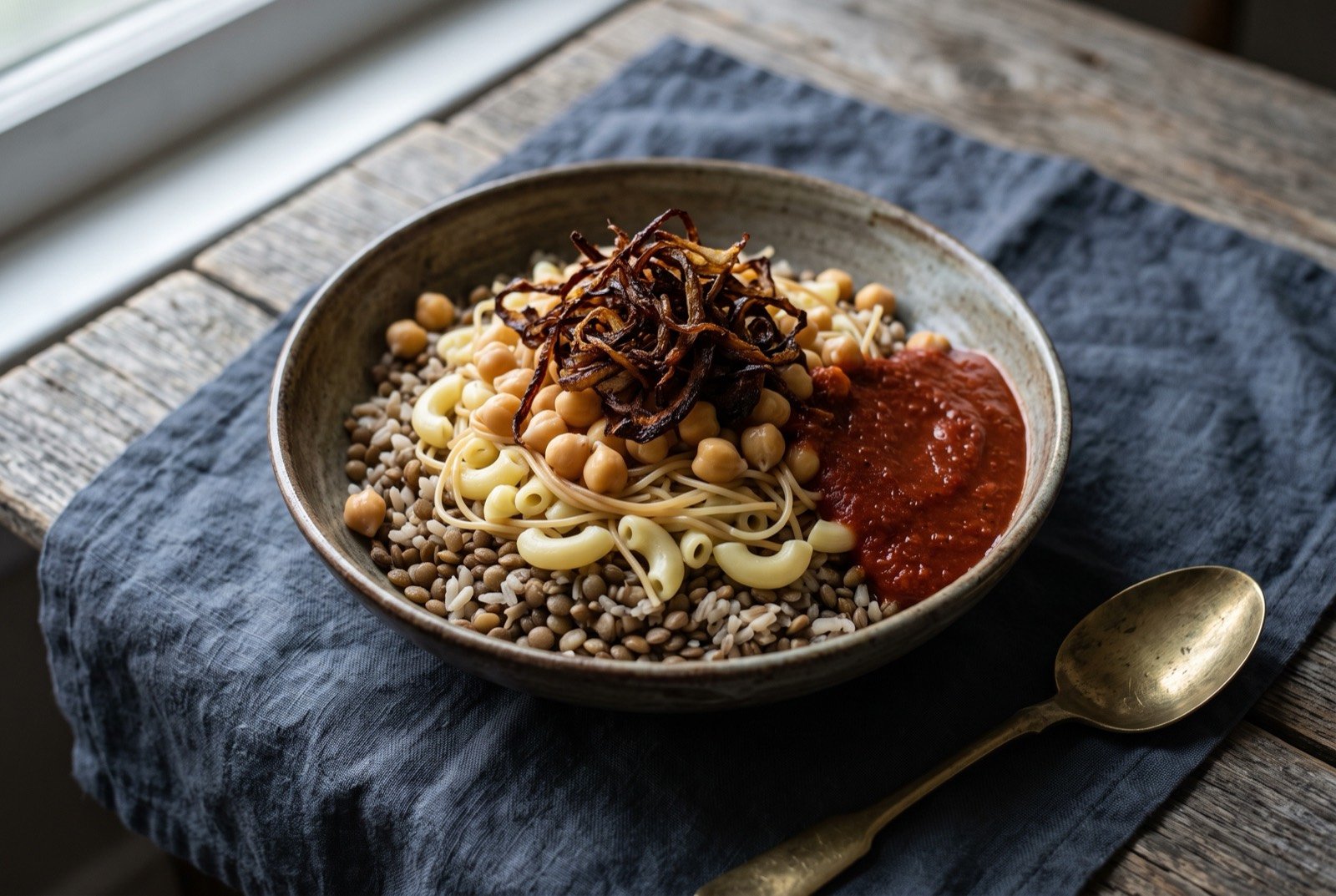
An illustration of the dish, not a photograph of it cooked.
- Time
- 1 hour 15
- Reviewed
- Not yet reviewed from inside the tradition
- Cooked
- Not yet cooked and reported
Koshari gets a false ancient pedigree more often than any other dish here, so it is worth setting out what is documented. In the 1840s, an East India Company official near Suez describes locals eating lentils and rice cooked with ghee and flavoured with pickled lime or stewed onions. In 1853 to 1856, Richard Burton describes the breakfast meal of the people of Suez as Egyptian lentils, rice, butter, onions and pickled lemons. In 1941 two koshari recipes appear in Abla Nazira's Usul al-Tahi, the hard documentary date for its arrival in the respectable middle class kitchen. In 1945 Abou Tarek opens. And after 1953, a cookbook prepared by King Fuad's chefs shows koshari as only rice, lentils and onions, with pasta added afterwards as a cost measure when rice prices rose. What is contested is the parentage, and four accounts circulate with no primary evidence supporting any one decisively: Indian khichri arriving with British colonial troops after 1882; a pre-colonial Red Sea and hajj route, argued by Sami Zubaida, who notes that Ibn Battuta had already transliterated khichidi as koshari; an Italian contribution of pasta and tomato, argued by Anny Gaul; and an Egyptian Jewish kosher etymology. The 1840s and 1850s Suez sightings both predate 1882, which is the strongest objection to the pure military story. Mennat-Allah El Dorry's position is the honest one: exact origins remain unknown, but the ingredient evolution is traceable.
As tradition built it
Serves 4. About 1 hour 15.
Ingredients
- 90 g Egyptian short grain rice
- 100 g brown lentils, soaked 1 hour
- 90 g vermicelli
- 75 g elbow macaroni
- 400 g cooked chickpeas
- 280 g onions or shallots, sliced thin
- 237 ml oil, for the onions
Method
- Fry the onions or shallots first, and slowly. 280 g of thinly sliced onion into 237 ml of oil over medium heat for 20 to 30 minutes, until deep golden and crisp. The long slow fry drives out moisture before colour develops, which is what gives a shard that stays crisp under a wet sauce. A fast hot fry gives a limp greasy onion that collapses on contact.
- Cook the Egyptian short grain rice, brown lentils, vermicelli and elbow macaroni separately, each to its own doneness.
- Make the three sauces. Note the vinegar in the tomato salsa as well as in the daqqa: Egyptian koshari sauce is sharp, not sweet, and that is what separates it from an Italian sugo.
- Layer: lentils and rice, then macaroni and vermicelli, then the cooked chickpeas, then the fried onions on top.
- The sauces go on at the table, salsa then daqqa then shatta. Asking for a few extra spoonfuls when you want more but not a second serving has its own word, kemala.
Notes
Component quantities after Chez Nermine, assembled in the classical layered form rather than her one pot method.
Daqqa: 6 garlic cloves minced, 120 ml vinegar, 120 ml water, 1 tbsp ground cumin, 2 tbsp shallot infused oil.
Salsa: 240 ml passata, 1 tbsp tomato paste, 2 tbsp vinegar, 2 garlic cloves, 2 tbsp oil, 1 tsp each cumin and coriander.
Shatta: 1 tbsp red pepper flakes, 3 garlic cloves, 2 tbsp tomato paste, 60 ml of the salsa.
What a modern chef changes
Nothing meets anything until it is ordered, an onion purée under the shards, and the vinegar kept volatile
Rungs 6, 5 and 3
Method
- Hold every component separately and assemble to order. Rung 6. This is the dish, not restaurant fussiness. Fried onions on a wet tomato sauce go from crisp to leathery in under twenty minutes, and once the components have pooled in one tray the textural architecture has collapsed to a single wetness. If you are cooking for eight, plate it eight times.
- Add an onion purée under the fried onion. Michael Mina's move at Orla, and the technically interesting one. Fried onion gives crunch and bitterness and no body; a sweet, viscous sautéed purée underneath gives a binding sauce that fried onion cannot. He is adding a rung, not replacing one.
- Keep the acid volatile. Rung 5. Make the daqqa fresh and cold and never let it near heat, and if you must hold the salsa hot, hold it without its vinegar and stir that in at the pass. Grind the cumin and coriander the same morning, because the three sauces are almost entirely those two spices.
- Widen the range rather than narrowing it. Khufu's serves a koshari salad: the whole thing cold, with quail eggs and crisped chickpeas. That sounds like a gimmick and is not, because serving cold means every component can be cooked to its own optimum and held separately, which is exactly what a steam table koshari cannot do.