Africa · Volume 13
Egypt
The Oldest Kitchen
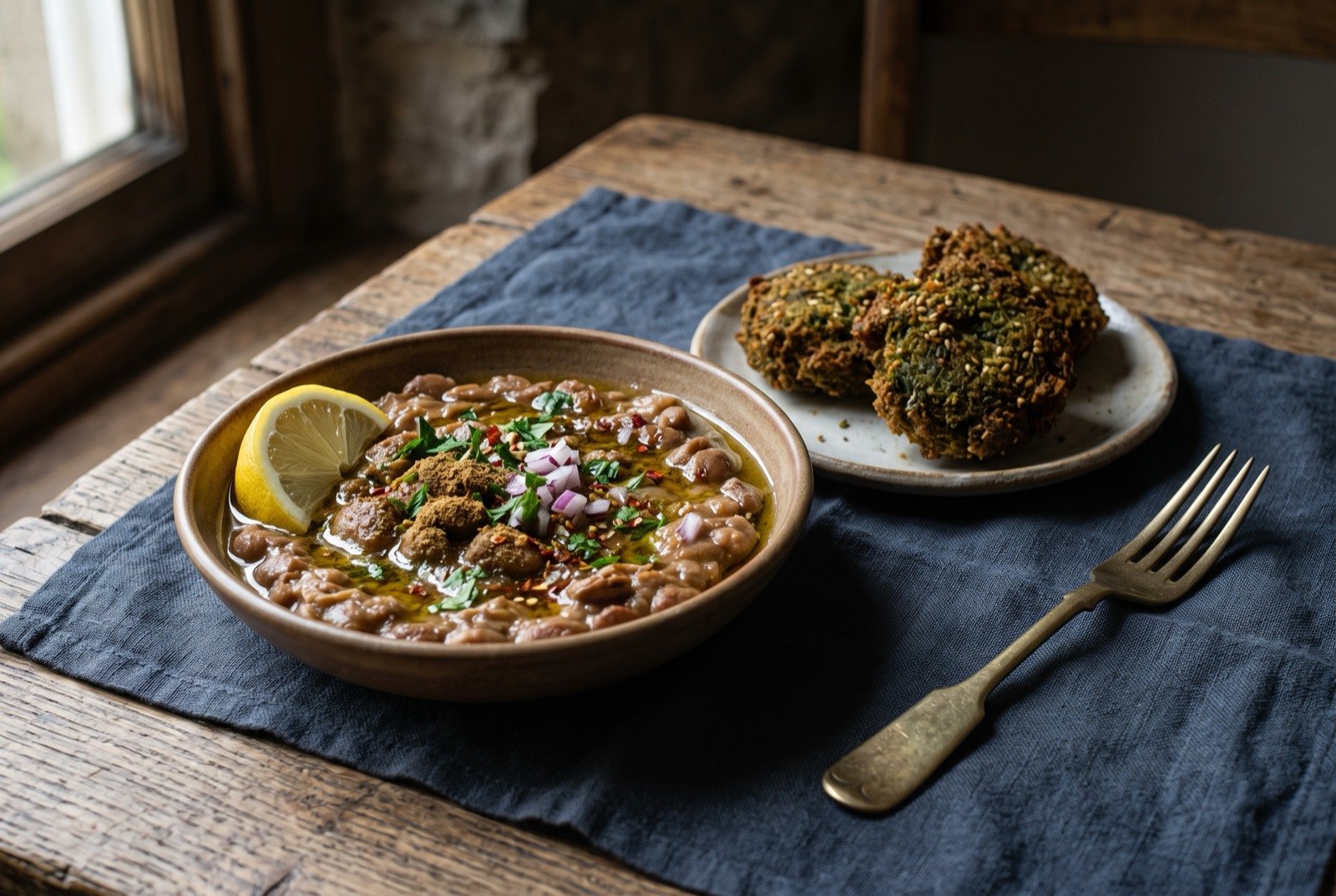
Egypt has the longest documented record of cooking on earth, and very little of what that record actually says matches what is written about it. This volume works from the evidence: what is genuinely continuous, what is nineteenth century, and what is folklore. Every dish as tradition built it, then what a modern chef would change, once as tradition built it, once rebuilt.
Sources and review · What this chapter does not assert · How we research · Know this better? Tell us
A Sense of Place
Egypt is usually written as one cuisine. It is not, and the axes that divide it are the useful ones: which fat (buffalo ghee, olive oil, corn or cottonseed oil, sheep tail fat), which thickener (mucilage, pulse starch, bread, rice), which aromatic (garlic with ground coriander, cumin, dill, mastic and cardamom, fennel), and which starch (aish baladi, short grain rice, macaroni, cracked wheat). Suzanne Zeidy and Rawah Badrawi, whose Egypt: Recipes and Stories from an Ancient Land (2026) is the most substantial new in-tradition reference, arrive independently at a five part topographic division after three years of fieldwork: Sea, Desert, River, Mountain, Cairo.
The Delta and Cairo: the garlic and coriander heartland
Irrigated alluvium, buffalo and cow dairy, fava and rice. This is the Egypt most people mean, and its signature is a single operation: garlic pounded with ground coriander seed, bloomed in hot ghee, and poured into a finished dish at the last second. It is called taqliya, or ta'leyya, or, in most Egyptian mouths, tasha. It goes into molokhia, bamia, ful, lentil soup, the mahshi liquid and fatta, and it is the one move that separates Delta cooking from Levantine cooking, which otherwise shares most of its larder.
The fat is samna baladi, buffalo ghee, for anything festive and for every tasha; corn or cottonseed oil does the everyday frying. The bread is aish baladi at 82 per cent extraction, and the rice is a short grain japonica that sheds surface starch and clings. The dishes are ful medames, ta'ameya, molokhia, mahshi, bamia, fatta, koshari, feteer meshaltet, and, specifically in Daqahliya, roz meammar. Damietta gives the country its cheese.
Alexandria: a cuisine that is also a memory
Until the 1950s and 1960s Alexandria held very large Greek, Italian, Syrian, Armenian and Jewish communities, and its food still carries their grammar although almost none of them are left. Olive oil rather than ghee. Vinegar and garlic rather than tomato. Fennel. Feeno, the soft roll, whose name is the Italian fino.
The dishes diverge sharply from Cairo's: kebda Iskandarani, the vinegar marinated liver; sayadeya, fish and rice built on scorched onion; hawawshi made between two discs of raw dough rather than stuffed into a split loaf; koshari with yellow lentils, curry powder, a fried egg and chips. And fatta with vinegar and garlic and no tomato at all, which the Egyptian chef Alaa El-Sherbiny says plainly is the older form: in the past fatta was eaten with vinegar and garlic, not with sauce, and the people of Alexandria still eat it that way, with mutton, which suits the treatment better than beef.
The houses have founding dates, recorded by the Egyptian writer Dina Al-Mahdy: Athineos and Délices from 1900, Zephyrion at Abu Qir in the 1920s, Benjamin from 1932 (ful and falafel, Naguib Mahfouz among the regulars), Abu Gharib the liver sandwich house from 1936, Qadura in Bahari from 1950. Founding dates and no closing dates, in a city whose cosmopolitan population left within a decade. Alexandrian food is the one regional cuisine in this book that is partly an act of remembering.
Upper Egypt, the Sa'id, and Nubia
Hotter, drier, less dairy rich, organised around sun drying rather than refrigeration. Vegetables are dried, powdered and rehydrated back into sauces, a completely different thickening logic from the Delta's fresh mucilage. Cumin runs forward, and karkadé, dried hibiscus calyx, is the drink. The breads are shamsi, sun risen, and the Nubian kabed, maize flour baked on a mud hearth until the edges crisp and the centre stays molten.
The Nubian position is a displacement story. Nubians were moved upstream and resettled after the High Dam, and the cook Hamad Gabir is blunt: Nubians resettled away from the Nile adopt the food around them, and he says this is destroying the Nubian culinary culture. Moheieddin Saleh gives the other half, that most Nubians eat what they grow on their farms or along the banks of the Nile. Take the river away and the cuisine follows it.
The deserts, the oases and the Canal
Siwa, isolated for millennia on artesian springs, farms date palm and olive as close to a monoculture as Egypt gets, with olive oil often emulsified with date and lemongrass as the tea. The dish to know is ashengoot, the Siwan wedding dish: goose simmered for hours in aromatic broth with eggs, served wrapped in flatbread with a date and olive oil emulsion and spring onions. From the Western Oases comes sekouti, rice cooked in burnt onion juice, the same idea as coastal sayadeya arrived at hundreds of kilometres inland.
In Sinai, the Zeidy and Badrawi fieldwork identifies fennel as the marker, which appears nowhere in the general literature and is worth having, and the bread is libba, baked directly in hot sand. Port Said and the Canal Zone give Mediterranean fish and batarekh, cured pressed grey mullet roe, which Badrawi argues rivals Sardinian bottarga and which is the same product, the same fish and, in antiquity, the same export.
The calendar as a region: Coptic fasting
Coptic Orthodox Egyptians fast 210 to 240 days a year, roughly two thirds of the calendar, on a strictly vegan regime. That is not a region but it functions like one, generating a parallel repertoire of oil and pulse cooking that cuts across every zone above: bissara, shorbet ads, sprouted fava, tahini and pickles. Any account of Egyptian food that treats it as a footnote has missed a third of the working year.
The History in Layers
Bread and beer: what the archaeology actually shows
This is the volume's claim and the one most likely to attract lazy overclaiming, so it is built here from the evidence rather than from the brochure.
The grains. Emmer wheat (Triticum dicoccum) and barley. For thousands of years no other cereals were cultivated in Egypt. Delwen Samuel, the definitive worker on this material, found that bread used emmer exclusively, while brewing used emmer and barley, separately or mixed.
The oven. The bedja was a conical clay pot functioning as an individual portable oven: dough in, pot into hot ash, heated lid on top, an enclosed baking chamber per loaf. Moulds excavated at the pyramid workers' town at Giza match Old Kingdom tomb depictions, and Mark Lehner's AERA team reconstructed the process experimentally in 1994. Loaves baked this way were distributed as wages.
The correction that matters. Almost every popular account says the Egyptians made beer by soaking bread in water. Samuel's work, published in Science in 1996 from optical and scanning electron microscopy of desiccated loaves and pottery residues dated 2000 to 1200 BC, shows that this is wrong. The degree of starch fusion in the beer residues, taken with the quantity of chaff, cannot come from lightly baked bread crumbled and fermented.
What the evidence shows instead is a two part process: a portion of well heated malt or grain, ground, mixed with a portion of unheated malt, then strained to remove husk before fermentation began on the sugar rich liquid. And the deeply channelled and hollowed granules are the signature of enzymatic degradation during germination, which proves deliberate malting and overturns the assumption that nobody would sprout grain in a climate that dry.
Read that again and notice what it is. A gelatinised fraction, an enzyme active fraction, a conversion step, a lauter. That is a mash, it is recognisably the logic of modern brewing, and it is far more sophisticated than the folk version it replaces.
The scale. The brewery at Abydos, misidentified by T. Eric Peet a century ago, was rediscovered by magnetic survey in 2018 and excavated by an expedition led by Matthew Adams of NYU with Deborah Vischak of Princeton and Egyptian researchers from the Ministry of Tourism and Antiquities. It dates to circa 3150 BC, the reign of Narmer, essentially the moment of Egyptian state formation: eight production areas, each holding about forty earthenware vats, with a capacity of roughly 22,400 litres per batch, which Adams describes as enough to give every person in a 40,000 seat stadium a pint.
And the yeast. Seamus Blackley, Serena Love and Richard Bowman revived dormant yeast from 4,500 year old ceramic vessels at Boston's Museum of Fine Arts and Harvard's Peabody Museum. The ancient microbes would only propagate on emmer flour, not on modern laboratory media, which is itself an argument that grain and organism co-evolved. Blackley fermented at 34°C, the average Nile daytime temperature, built himself a bedja, and got there after roughly seventy five loaves. Ancient Egyptian had 176 words for bread.
What "the oldest kitchen" can honestly mean
Here is the discipline this chapter is trying to hold. Continuity of ingredient is not continuity of dish. Emmer, barley, fava, jute mallow and salted fish are all genuinely ancient in Egypt. Ful medames, ta'ameya, koshari and hawawshi are not, or are not demonstrably so, and the documentary record for three of those four puts them in the nineteenth or twentieth century.
The honest version of the claim is narrower and stronger than the tourist version. What is genuinely continuous is the grain and pulse base, with emmer and barley from the predynastic period and fava in the region by the late Neolithic; bread as wage and as the word for life, since aish means life and Egyptians do not use khubz; the state's control of grain, unbroken from the Narmer era brewery through the pharaonic redistributive economy, Muhammad Ali's nineteenth century monopoly, Nasser's reforms of 1956 and today's roughly 19,000 licensed bakeries; salted and fermented fish, with a product resembling mish suggested in the tomb of Hor-Aha at Saqqara around 3200 BC; and jute mallow, a food and fibre plant here since antiquity.
That is a genuinely extraordinary list. It does not need padding with pharaonic falafel.
Trade, and the wallpaper of the Egyptian kitchen
Rice is an introduction, not an indigenous Egyptian grain. Red Sea and hajj traffic carried South Asian rice and pulse dishes into Egypt over centuries, and Anny Gaul notes that Ibn Battuta transliterated khichidi as koshari, which puts the word in Arabic a very long way before the British. Mastic, cardamom and cinnamon in Egyptian meat cookery are Levantine and Indian Ocean imports.
The tomato arrives in the Ottoman period. Gaul spent years trying to trace the route for Nile Nightshade and concluded it cannot be pinned down. What it did once it arrived is the interesting part: she names tasbika, a ubiquitous Egyptian stewing technique built on tomatoes, and quotes an Egyptian reader calling the tomato the wallpaper of the Egyptian kitchen, always there and never noticed. Her argument is the one this series keeps running into. National culinary identity is not fixed, it changes over time, and humans have agency in shaping that change. A plant that arrived three hundred years ago is now experienced as ancient heritage, and that is how cuisines work.
The colonial economy, and the ruptures
Muhammad Ali's agricultural monopoly and the shift to cotton monoculture turned Egypt into a wheat importer, and it has never stopped being one. 1869, the Suez Canal opens and migration into Alexandria and Cairo accelerates: Greeks, Italians, Syrians, Armenians, Jews. 1882, the British occupation, with Indian troops and Indian traffic behind it; falafel first appears in Egyptian literature after this date. The Italian layer, per Gaul: pasta and tomato enter koshari as cheap portion extenders in the Italian communities, who were the second largest immigrant group in Egypt before the Second World War after the Greeks. 1941, Abla Nazira's Usul al-Tahi, roughly a thousand pages, written with Bahiya Uthman as a training manual for domestic science teachers and given as a standard wedding present, containing two koshari recipes. Gaul reads it as a nation building and class project: continental technique translated into formal Arabic, aimed at producing the modern Egyptian housewife.
1952 to 1953. The Free Officers coup and the abolition of the monarchy. A cookbook prepared by King Fuad's chefs shows koshari as rice, lentils and onions only, and after 1953 pasta was added as a cost saving measure when rice prices rose. The national dish acquired its final form as a direct consequence of the revolution's economics.
1956, Suez. The Jewish communities of Cairo and Alexandria are expelled, some families given twenty four hours; Claudia Roden's among them, resettling in London. The Greek and Italian communities contract sharply under nationalisation in the same period.
1956 is also when Nasser formalises the bread subsidy, and the numbers that follow are the political spine of Egyptian food. Price fixed at 5 piastres, under one US cent, since 1989, against a production cost of roughly 34 piastres. Loaf weight cut from 150 g to 130 g in 1990, later standardised at 125 g. Egypt consumes 180 to 210 kg of bread per person per year, among the highest rates in the world, and by 2010 about 40 per cent of wheat consumption was imported, including 90 per cent of the wheat for baladi bread, at an estimated 1.5 to 1.8 billion US dollars a year.
1977, 18 to 19 January: the bread riots. Seventy nine people killed, and the price rise reversed within two days. Every Egyptian government since has understood the loaf as a political instrument first and a food second.
The modern moment
Khufu's, at Al Haram in Giza, was named number one in Middle East and North Africa's 50 Best Restaurants 2026, announced on 3 to 4 February 2026, the first Egyptian restaurant to top that list, having placed fourth in 2025 and taken the Resy One To Watch Award at The World's 50 Best the same year. The executive chef is Mostafa Seif, who won Top Chef Middle East in 2018 and whose family ran a street food cart in rural Egypt. His account of the concept is restrained and worth taking at face value: maternal home cooking as the foundation, rebuilt in a fresher, lighter style.
Then look at the rest of the Egyptian entries, because the shape of the list is a finding in itself.
| Rank | Restaurant | City | Cuisine |
|---|---|---|---|
| 1 | Khufu's | Giza | Modern Egyptian |
| 20 | Reif Kushiyaki | Cairo | Japanese robatayaki |
| 25 | Kazoku | Cairo | Japanese |
| 32 | Zooba | Cairo | Egyptian street food |
| 37 | Sachi | Cairo | Mediterranean with Japanese influence |
Three of Egypt's five entries are Japanese or Japanese inflected. Cairo's fine dining money has flowed overwhelmingly into imported formats. The country with the longest continuous culinary record on earth has exactly one restaurant operating at the top international tier on its own cuisine, and one fast casual chain. That is the tension this chapter is written into.
On 10 December 2025, koshari was reported by Egyptian and regional press to have been inscribed on UNESCO's Representative List of the Intangible Cultural Heritage of Humanity. The research for this chapter did not check that against UNESCO's own record, so it is reported here as press reporting and flagged again at the end.
The Flavour Arsenal
A small larder used with unusual precision. Almost everything that makes this food taste like itself is in the next four tables, and the first matters most.
The taqliya axis
Garlic and ground coriander seed, bloomed in hot fat, added at the end. Not stirred in dry, not added at the start, not left to simmer. Four in-tradition ratios, and the spread between them is real household variation rather than error.
| Source | Garlic | Ground coriander | Fat | For |
|---|---|---|---|---|
| Amira's Pantry | half a tbsp crushed, 2 to 3 large cloves | 1.5 tbsp | 2 tbsp ghee | 400 g molokhia, 2 to 3 cups broth |
| Am What I Eat | 10 cloves, minced or pounded | 1 tbsp | 3 tbsp butter or ghee | 800 g molokhia, 4 cups broth |
| Suzy Karadsheh | 5 large cloves, minced | 1 tsp | 1 tbsp oil, ghee or butter | 400 g molokhia, 6 cups stock |
| Chez Nermine, for liver | an eighth to a quarter cup, minced | 1 tbsp | in the frying oil | one batch of liver |
Coriander runs from 1 teaspoon to 1.5 tablespoons per 400 g of leaf, a roughly fivefold difference, and garlic varies by a factor of two. The Egyptian sources sit at the heavy end and the Americanised one at the light end, which is probably the whole story, but this chapter is not going to pretend a consensus dose exists.
The timing is the same in all of them. Garlic into hot fat for 15 to 30 seconds to lightly golden, then coriander for a further 30 seconds, then straight into the pot. Amira's warning is the operative one: garlic and coriander taken too dark will make the molokhia bitter. There is a ritual attached, recorded by Karadsheh: after the tasha hits the pot the cook must gasp and inhale the aroma, or the molokhia will not come out right. It is called the shah'a, and it is a timing device, because it happens at exactly the moment the pan has to be emptied.
The spice cupboard
| Name | What it is | Character | Dose and use |
|---|---|---|---|
| Kozbara nashfa | Ground coriander seed | Warm, citrus peel, faintly soapy floral from linalool | 1 tsp to 1.5 tbsp per 400 g molokhia. The single most Egyptian spice, more than cumin |
| Kammoun | Cumin | Earthy and warm, from cuminaldehyde | Heavy by British standards. 1 tbsp per kg fava in ful; 2 tbsp per 500 g dry bean in ta'ameya |
| Mestika | Mastic, Pistacia lentiscus resin | Pine resinous, cooling | Ground with salt or sugar to stop it clumping. Into the meat boiling stage of bamia with cinnamon and cardamom |
| Shatta | Chilli paste or flakes | Sharp, direct | Sits on the counter, not in the pot. Post-Columbian |
| Habbat al-baraka | Nigella seed | Should smell of oregano and onion when crushed | The Fayoum oasis grade is the prized one |
| Karkadé | Dried hibiscus calyx | Deeply tart, magenta | Upper Egyptian and Nubian. A drink |
The herb quartet, and the leek
| Name | Plant | Note |
|---|---|---|
| Baqdunis | Flat leaf parsley | The bulk herb |
| Kozbara khadra | Fresh coriander leaf | Not interchangeable with the seed |
| Shabat | Dill | The Egyptian marker herb, in mahshi and ta'ameya |
| Na'na nashef | Dried mint | Never fresh. More menthol forward, less grassy, and it survives long cooking |
The standard mahshi ratio is 1 cup parsley to half a cup coriander to a third of a cup dill to 1 tablespoon dried mint. And then korrat, leek: two leeks per 500 g of split fava in ta'ameya. This is the distinguishing ta'ameya ingredient and almost no non-Egyptian source names it.
The greens, and the link back to Volume Four
Molokhia is Corchorus olitorius, jute mallow. It is the identical species Volume Four calls adémè and kplala and the Yoruba call ewedu. Not a relative, not an analogue. In Britain you can buy it from a West African grocer as ewedu or a Middle Eastern one as molokhia and get the same bag; Abi Global Foods sells one frozen product marketed simultaneously to both, which is the thesis on a label.
The grammar, though, is completely different, and this is the most instructive comparison in the atlas.
| Egypt | Yorubaland and the Attiéké Coast | Levant | Tunisia | |
|---|---|---|---|---|
| Leaf form | minced to near paste | pounded or blended smooth | often whole leaves | sun dried, ground to powder |
| Liquid | rich meat or poultry broth | water, with locust bean and potash | broth, thinner | none, a sauce not a soup |
| Aromatic | garlic and ground coriander in ghee | iru, no garlic and coriander temper | garlic and coriander, sometimes | garlic, bay, tabel |
| Heat rule | never boil, never cover | a brief boil is normal | brief simmer | simmered 4 to 6 hours |
| Target | suspended, silky, green | drawn, elastic | thicker, leaves visible | thick dark sauce |
| Eaten with | rice, aish baladi, chicken or rabbit | amala or eba, with gbegiri | rice, lemon | bread with nigella and fennel |
Four cuisines, one species, four incompatible targets. Volume Four's alkali and mucilage discipline carries across the Sahara exactly as you would expect, because the polysaccharide is the same polysaccharide: mild alkalinity strengthens the network, acid and prolonged high heat destroy it. What does not carry across is the aromatic, and that is the point. Egypt reaches for garlic and coriander in ghee where West Africa reaches for fermented locust bean. Same plant, same physics, two entirely different arguments about savour. The other mucilage plant is bamia, okra, and Egypt treats it far more roughly.
The preserved larder
Egypt's deepest and oldest flavour reserve, and at restaurant level it works best as seasoning rather than as a centrepiece.
| Name | What it is | Note |
|---|---|---|
| Feseekh | Salt fermented grey mullet | Sham el-Nessim. Genuinely dangerous. See dish ten |
| Renga | Smoked herring | A different process, far lower risk, the everyday option |
| Batarekh | Cured pressed grey mullet roe | Egypt's bottarga, the same tradition. Port Said and Alexandria |
| Mish | Fermented cheese aged a year or more | Made from areesh, perpetual, seeded with old mish. Sharp and pungent |
| Gebna Domiati | The everyday white cheese | Salt goes into the milk before the rennet, unlike feta. No starter culture. Brittle rather than elastic |
| Torshi | Pickles | Turnip stained pink with beetroot, carrot, green chilli, lime, cucumber, in salt and vinegar brine |
| Termis | Lupini beans | Leached over days to remove alkaloids, then brined. Part of tasaly, the spring nibble category |
There is an Egyptian saying about mish that tells you what kind of ferment it is: tiny worms often breed in it but are not dangerous. And an idiom built on it, that the worms of the mish arise from it, meaning a problem that is insoluble and does not matter.
Fats, and the substitution that ruins everything
Samna baladi, clarified buffalo or cow butter, is the taqliya fat and the finishing fat. It is also the most expensive thing in an Egyptian kitchen after real stock, which is why it is the first thing replaced. The industrial replacement is samna sina'i, vegetable ghee, and swapping one for the other is the single most damaging substitution in the entire diaspora repertoire. The tasha's target aromatics are fat soluble and dairy derived. Hydrogenated vegetable fat does not merely taste worse, it removes the delivery mechanism.
Part Two
The Technique Ladder
First, an honest problem
There is no Michelin Guide for Egypt. No restaurant selection, no stars, no Bib Gourmands. Michelin publishes a hotel selection for Cairo and nothing else, and the MENA region guides cover Dubai, Abu Dhabi, Qatar and Saudi Arabia and stop there. Any article promising Michelin starred restaurants in Cairo is algorithmically generated.
So this chapter has one restaurant at the top international tier cooking Egyptian food, Khufu's, and one in Britain, Impala, and it builds its elevations from mechanism rather than by pointing at a tasting menu. As with Volume Four, that constraint makes the chapter better, because every change has to justify itself.
One thing needs saying before the rungs, because it is the volume's title and it is not a rung. The bread and beer complex is not a ladder rung. It is the substrate. A 5,000 year old malting protocol and a conical clay oven are not refinements you bolt onto a home kitchen; they are why the cuisine has the shape it has. Their one transferable lesson, that Egyptian baking is a problem of very intense heat from below applied very briefly, reappears in Rung 6.
The argument, from inside
Meedu Saad cooks at Impala in Soho, which took five stars from Time Out. He is of Egyptian heritage and ran the kitchen at Kiln for seven years. His charcoal is hand fanned down to soft white coals for controlled, low flame cooking, learned from the chef Toshi Akama in Tokyo, and his wood fired oven is modelled on the shared community ovens of Egypt, the furn baladi, the same oven that cooked the overnight bean pot for medieval Cairo. He is not importing a Nordic technique. He is running an Egyptian oven with a Japanese fire discipline and a French pass.
The dish that proves it is shoulder of cull yaw from Exmoor, braised with jute leaves. Cull yaw is an older ewe: high collagen, high free glutamate, high nucleotides. He is using molokhia not as a soup but as a braising medium over an intensely savoury animal, which is the exact restaurant answer to molokhia's central problem. Rung 1 is that problem stated.
Rung 1. The stock is the dish, because the leaf has no flavour
Molokhia's viscosity comes from a high molecular weight hydrocolloid polysaccharide. It contributes mouthfeel, suspension and coating, and almost no flavour. Worse, it works against you: raising the viscosity of a liquid slows the mass transfer of volatile aroma compounds into the headspace above it, so a thick molokhia releases less aroma per second than a thin broth of identical composition. The dish therefore has to be over flavoured relative to a thin soup, or it reads as green water with a slippery texture. That is what a bad molokhia is, and it is why "bland" is the standard complaint.
The restaurant answer is a real stock: an old bird, rabbit, duck, or Impala's inversion. The home and takeaway answer is water and a cube, and that single difference accounts for most of the gap. The same logic runs through mahshi cooked in bouillon, fatta moistened with bouillon and bamia stewed in bouillon: the thing carrying the dish has been replaced by something that carries salt and glutamate, and the cook compensates with more salt, which is the wrong axis. Build one good stock a week and use it in four dishes. That is the whole rung.
Rung 2. Mucilage discipline: chop, do not blend; simmer, never boil
The mucilage is a polymer. Sustained boiling and high mechanical shear both degrade the chains and drop the viscosity. And prolonged heat in the presence of the leaf's own acidity converts chlorophyll to pheophytin, taking the colour from bright green to olive drab. Two independent failures arriving together.
The Egyptian household rule is stated as two negatives, from Am What I Eat: do not cover the pot, and do not let the molokhia come to a boil. The consequence of breaking either, in her words, is that the leaves separate from the broth. A rolling boil shears the hydrated network, and the resulting convection lets the denser leaf particulate drop out of suspension, leaving clear broth on top and green sludge below; covering traps steam, raises the effective surface temperature and does the same. So the restaurant method and the household method are identical: bring the stock to a bare simmer, kill the heat completely, fold the leaf in, and let it melt over roughly fifteen minutes.
Chopping is the other half. The makhrata, a two handled semicircular rocking blade, cuts the leaf. A blender shears the mucilage and gives a uniform slick purée. Egyptian households keep this tool despite owning food processors, and that is a technical judgment, not sentiment: it is the one place in this cuisine where the traditional implement is doing physics rather than carrying nostalgia. Mincing matters because the mucilage sits in specialised cells inside the leaf, and rupturing the cell walls releases the polysaccharide into the broth as a dispersed hydrocolloid. Leave the leaves whole, as the Levant does, and the broth stays thin and the slipperiness is experienced leaf by leaf instead of as body.
One caveat. Dried and fresh behave oppositely: dried needs long slow hydration to develop silkiness, while fresh and frozen need speed. And Alexandria disagrees with the whole rule. See the final section.
Rung 3. The tasha is a controlled Maillard event with a hard stop
Garlic and ground coriander in samna, taken to golden and not one shade past, then shocked into the pot at the very end. The Egyptian instruction is blunt: do not look away from the pan at any point during this step.
Garlic. Allicin and the related thiosulphinates are harshly pungent and water soluble. Heating them in fat converts them to a family of far mellower, more savoury polysulphides, and the Maillard reaction between garlic's amino acids and sugars adds roasted depth on top. Push past golden and you generate acrid pyrazines and bitter degraded sulphur compounds, and that is irreversible.
Coriander seed. Linalool and the terpene fraction are fat soluble, and only fully express into a lipid phase. Dropping ground coriander into a water based soup wastes most of what you paid for. Grind it coarse rather than fine, so the aromatics release over twenty to thirty seconds instead of scorching instantly.
The shock into the pot is a thermal brake. The temperature drops the instant the fat hits the liquid, arresting browning at exactly the right point. Anything clinging to the pan gets deglazed with a spoonful of the soup and returned.
This is the highest variance step in Egyptian cooking, which is why it is the first thing lost in a diaspora kitchen. Claudia Roden's diagnosis is exact: there had not been cookbooks in Egypt, everything was just handed down. When a kitchen loses the one person who knows what golden and not brown looks like, nothing written down recovers it. Bamia adds a refinement worth stealing: Amira splits the tasha, half stirred into the stew for depth and half fried fresh and spooned over the individual bowls for volatility. Cooked in and raw fried are doing two different jobs.
Rung 4. The two favas are handled in opposite directions
Egypt cooks one species two ways that contradict each other, and both are texture problems rather than flavour problems.
Ful medames wants the bean fully surrendered. The correct bean is ful hammam, bath beans, a small brown fava, and the name is the technique in one word: cooked overnight in the embers of public bathhouse furnaces and sold to street vendors the next morning. Long, low, gentle heat fully hydrates and gelatinises the starch without rupturing the skins. Then the pot is worked, the beans partially crushed with a fork during simmering, so the finished dish carries whole beans, crushed beans and a starch thickened sauce at once. The other piece of household engineering is the 3 tablespoons of red lentils and 3 tablespoons of rice per kilo of dried beans: they disintegrate completely and their released starch thickens the liquor into a body that clings, which is why properly cooked ful is unctuous rather than watery.
Ta'ameya wants the bean never cooked at all. Split, skinned fava is soaked and ground raw, and the raw starch and undenatured protein are the binder. They gelatinise and set for the first time inside the fryer, producing a light, open, almost aerated crumb. Cook the beans first and the starch has already gelatinised and retrograded and the protein is already denatured, and what you get is a dense bean croquette.
Fava also behaves differently from chickpea. Fava starch gelatinises at a lower temperature and the ground paste is wetter and stickier, so it holds entrained air, which is why Levantine falafel leans on bicarbonate where Egypt leans on mechanical whipping. The Egyptian fritter is larger, flatter, greener and lighter. The fry window is 163 to 177°C: hotter and you set a crust over a raw core, cooler and the patty drinks oil. Two more rules, both counterintuitive: grind coarse, not smooth, because the chaos in the grind is what makes the crunch, and do not compact when shaping.
Rung 5. Acid is architecturally separate, and it goes on last
Egyptian dishes do not usually build acid into the base. They ship it alongside. Dakka on koshari is garlic, cumin and vinegar, poured at the table. Ful gets lemon at the table. Shatta and vinegar sit on the counter. Torshi is a plate component, not a garnish. So the discipline follows directly: season the base so it is complete without acid, then apply acid at the pass, where it stays volatile and bright.
The failure mode is structural rather than aesthetic. Cook vinegar into a tomato sauce and hold it hot for two hours and the acetic acid volatilises off. Perceived sharpness collapses, the residual sugars dominate, and the sauce reads flat and sweet, and adding more at the end does not fully recover it because you have also lost the aromatic top notes. Michael Mina states the same principle as a plating philosophy: high acid, high sweet, high spice and high fat, all held simultaneously. You cannot hold four axes at once if one has been boiling off since lunchtime.
Rung 6. Structure is built by keeping things apart
This is the rung most of the Egyptian canon is quietly organised around, and once you see it you cannot stop seeing it.
Koshari is a texture dish before it is a flavour dish: soft, chewy, slack, firm, wet, sharp, shattering. The moment those components sit together, moisture equilibrates, and fried onions on a wet tomato sauce go from crisp to leathery in under twenty minutes. That is the entire difference between a great koshari and a grim one, and it is a service design problem, not a recipe problem. Roz meammar does the same thing vertically: the cream goes on top unmixed, forming an insulating fat cap, under which the rice steams in milk and above which the exposed proteins and lactose brown into a crust. Mahshi cooks its rice inside the vegetable rather than in the pot, which is why the rice goes in barely started and the vegetable is filled to half a centimetre below the rim and no further. And aish baladi is the oldest instance, its pocket two skins separated by steam because a thin, wet, high extraction disc hits a surface above roughly 260°C and flashes its surface moisture faster than the gluten film can vent it.
And the corollary is a warning. Hot holding is the primary killer of this cuisine, and the three dishes most often held are the three that tolerate it worst. Ful above 70°C keeps hydrolysing, greys and goes pasty. Koshari components pooled in one tray equalise to a single wetness within twenty minutes. Molokhia held hot keeps degrading its mucilage and converting chlorophyll to pheophytin, while an open bain marie strips aroma volatiles continuously into the extraction hood, so the customer gets the aromatic profile of hour three rather than hour one.
What Britain mostly gets is not the cuisine failing. It is a format failing the cuisine. Impala is the proof: put the same tradition into a kitchen with a fire, a butcher, a stock pot and a pass, and it competes at the top of London.
Part Three
The Ferment and Preserve Bench
Four things from the Egyptian larder. One you can make well, one you can make honestly, one you should buy, and one that has no substitute at all.
1. Torshi
The pickle plate that goes with hawawshi, kebda and every ta'ameya sandwich in Egypt: turnip stained pink with a slice of raw beetroot, carrot, green chilli, whole lime and cucumber, in a salt and vinegar brine.
The sources used for this chapter give the composition and not the ratio, so no brine strength is printed here. What is worth stating is the intent. Egyptian torshi is vinegar led rather than a long lactic ferment, which makes it sharp and clean rather than funky, and that is deliberate: it exists to cut fat and to supply the plate's acid at the moment of eating, which is Rung 5 arriving as a side dish. The lime goes in whole and softens over weeks into something bitter and floral that is better than the rest of the jar. Keep a jar going permanently.
2. Mish
Fermented cheese aged a year or longer at room temperature. It starts as areesh, a fresh curd cheese, drained and rinsed, layered with salt in an earthenware jar, then filled with a pickling solution of buttermilk, sour skimmed milk, whey and peppers, seeded with a portion of old mish as a starter, and sealed. It is perpetual: portions are removed and fresh material added indefinitely, so a household jar can be older than the household. Yellowish brown, sharp, salty and genuinely pungent.
No household quantities appear in the sources used here, and this is not a ferment to improvise, because the starter is the previous batch and you do not have one. Buy it: Greenfields sells a Spicy Egyptian Mish in 450 g jars, and Oasis and EPUK carry Egyptian brands.
A product resembling it is suggested in the tomb of Hor-Aha at Saqqara, around 3200 BC, which makes it one of very few things in this chapter with a plausible claim to real antiquity.
3. Dukkah
Not a ferment, but the most useful preserve in the Egyptian larder and the one most often bought in a worse form than you can make. After Suzy Karadsheh, and it makes about a cup: half a cup hazelnuts, 3 tbsp almonds, 4 tbsp white sesame seeds, 3 tbsp shelled pistachios, 1 tbsp fennel seeds, 1 tsp ground cumin, 1 tsp ground coriander, half a tsp cayenne, salt.
Toast the hazelnuts and almonds in a dry pan until golden. Toast the sesame separately, because nuts and seeds have wildly different sizes and oil contents and will not reach colour at the same rate: sesame goes from pale to burnt in about forty seconds. Combine and pulse briefly to coarse, never fine. The name is from daqqa, to pound, and the texture is definitional, neither powdered nor paste like. A heavy mortar beats a blender, which releases the nut oils.
It keeps two weeks and then it does not. You have ruptured a large surface area of unsaturated nut and seed oils and warmed them, so oxidation is fast. Make it small and often. Rancid hazelnut is the single commonest reason a dukkah tastes of cardboard.
And a correction. The hazelnut and pistachio dukkah sold in British delicatessens is an affluent late version. Edward William Lane in 1860 describes dukkah as a food of the poor, and an 1895 Egyptian Arabic dictionary defines it simply as ground spices eaten with bread. Cairo market blends were parched wheat flour with cumin and caraway, sold in paper cones, with nuts optional and often absent. The phrase is "eeish we du'ah", bread and dukkah, and it means what you fall back on when there is nothing else.
4. Batarekh, which you should buy
Cured pressed grey mullet roe, salted, dried and preserved in oil. Egypt's bottarga, associated with Port Said and Alexandria, and one of the oldest continuously traded foods in the Mediterranean.
Included here because it is the safe route to the flavour feseekh delivers dangerously, and because it is the best single thing you can do with the Egyptian preserved larder in a British kitchen. Grate it over a white bean purée, over ful, over pasta with olive oil and lemon, or over roz meammar. It is salt, glutamate and age at once.
Egyptian batarekh is scarce in Britain. Sardinian or Sicilian grey mullet bottarga is a legitimate substitute and is genuinely the same tradition, exported out of Egypt in antiquity and made now by the same logic in the same sea. Salt packed anchovy is the cheap everyday version of the same move. And do not attempt feseekh, for the reasons set out in dish ten.
Sourcing in Britain
Verified August 2026. Where a supplier could not be confirmed, that is said rather than smoothed over.
Online, verified currently trading
- MyJam Food (myjam.co.uk). Over 14,000 items, with dedicated Egyptian grocery and molokhia collections. Free shipping over £70. Live pricing and active cart confirmed. Start here.
- Oasis Market (oasismarket.co.uk). Over 555 Egyptian grocery lines, the deepest single Egyptian range found: baladi bread, molokhia, roumi cheese, fava, spices, sweets. Free delivery over £75. Caveat: no published physical address, contact is a mobile number and email only.
- Halalo marketplace, seller Egyptian Products in the UK (halalo.co.uk). States it is the exclusive UK distributor of Al Fouad salted fish, Koueider and Katilo. Nationwide delivery at £6.99, fresh orders Monday to Thursday, reviews as recent as March 2026. This is the salted fish and batarekh route, and it is genuinely hard to find elsewhere.
- Hodmedod's (hodmedods.co.uk). British grown pulses, and their Maris Bead whole fava is explicitly sold and cooked as ful hammam. Arguably the freshest ful in Britain and better than most imported tinned product. Partial flag: their delivery terms page did not load during research, so confirm nationwide shipping before relying on it.
- Greenfields (greenfieldsstore.com). Green Minced Moloukhia frozen 400 g and Spicy Egyptian Mish 450 g.
- Abi Global Foods (abiglobalfoods.co.uk). Frozen Egyptian Molokhia marketed simultaneously to Egyptian and Nigerian ewedu customers, which is this chapter's thesis printed on a label.
- Ofoodi African Store (ofoodiuk.com). Fresh jute leaves, listed under all three names. Perishable and non-refundable.
- Sous Chef (souschef.co.uk). Not Egyptian specialist, but the reliable route to tahini, pomegranate molasses, orange blossom water and Middle Eastern cookware.
- Kilburn Meat Village, London, proprietor Hisham Abany. Fresh Egyptian halal meat and delicatessen.
Do not rely on: Zambahola is not currently trading, showing an "Under Renovation" holding page set to noindex. Yallacook is unconfirmed, claiming nationwide chilled delivery but with no independent evidence of fulfilment, no reviews and no stated base of operations. Green Oranges trades and stocks Hana frozen molokhia but is rated Poor, 2.4 out of 5, on Trustpilot. 24shopping.shop is unverified.
Physical shops
In London the spine is Edgware Road and Lisson Grove, with a second cluster on Uxbridge Road and Shepherd's Bush: Green Valley on Upper Berkeley Street, Al Abbas on Uxbridge Road, and Sinbad on Edgware Road, which is Iranian led and excellent for pulses and dried limes. Ridley Road in Dalston and Green Street in Newham for fresh jute leaves, sold as ewedu. For eating: Koshari Street (56 St Martin's Lane), Koshary El Tahrir (Marble Arch), Ahl Cairo (Lisson Grove), and Impala (13 to 14 Dean Street).
Elsewhere, hunt the corridor rather than the shop. Manchester: Rusholme and Cheetham Hill, with Worldwide Foods on Rusholme the strongest single shop. Birmingham: Alum Rock Road and Coventry Road, with Azad Supermarket the largest. Leeds: Harehills, where Farbod Supermarket is the Middle Eastern specialist and CC Continental carries jute leaves. Bristol: Stapleton Road and Easton, where Alfu International has three branches. Glasgow: Pollokshields and Victoria Road, with Babylon Supermarket on Commerce Street. Cardiff: City Road and Cathays, with ZemZem Continental Market at 12 to 14 Wyeverne Road, and Wally's Delicatessen in the Royal Arcade as the likeliest source of bottarga. Liverpool: Lodge Lane. Leicester: Narborough Road and Evington Road, not Belgrave Road, which is South Asian. Newcastle: Westgate Road. In Sheffield the corridors are London Road and Abbeydale Road, but no specific Middle Eastern grocer could be confirmed as currently trading, so no name is printed.
The ranked list: what decides great from grim
- The stock. The mucilage supplies body and no flavour and actively slows aroma release. Whatever the leaves are suspended in is the entire dish.
- Samna baladi. The tasha, the mahshi and the rice deliver their aroma through this fat. Vegetable ghee removes the delivery mechanism.
- The molokhia, and critically its form. Fresh beats frozen beats dried.
- Split skinned fava, uncooked. The one thing that makes ta'ameya ta'ameya rather than falafel.
- Whole cumin and coriander, ground fresh. The tasha and the dakka are almost entirely these two.
- Fresh, firm garlic. Sprouting garlic turns bitter the instant it browns, and the tasha has no margin.
- Ful hammam beans, small and brown. Large favas give mush, not medames.
- Egyptian short grain rice. Koshari and mahshi need a grain that clings; basmati is engineered to refuse.
- Fried onions, made and not bought. Bagged onions are stale oil in a bag.
- Unrancid tahini, and lemons added late. Egyptian acid is architecturally separate and must stay volatile.
Quality markers
- Frozen molokhia should be bright grass green and free flowing, not a solid block, with no grey or olive edges and minimal ice in the bag. A solid block plus heavy ice means it thawed and refroze and the mucilage is already damaged. Dried must smell green and hay-like, not dusty.
- Samna baladi should be deep yellow to faint amber, granular when cold, and smell nutty and faintly cheesy. It oxidises to a waxy, stale crayon note.
- Tahini should be pourable at room temperature, pale sand rather than brown, and taste bitter-sweet rather than acrid. Rancid tahini smells of old crayons and lemon will not save it.
- Cumin: buy it whole, for two independent reasons. Ground cumin loses its volatile oil within weeks, and cumin is the most notorious adulteration target in the spice trade. Over 675 products were recalled in the United States from late 2014 for undeclared peanut protein attributed to cumin, and in January 2015 the UK Food Standards Agency found almond protein in a British brand's ground cumin, later identified as mahleb, a Prunus spice whose DNA and proteins closely resemble almond. If you cook for allergy-sensitive guests, whole seed is a real safety control.
- Coriander seed should smell of orange peel and hay when crushed, and Egyptian runs smaller and more citric than Indian. Grind it coarse for the tasha. Dried mint must still be green; grey-green dried mint is dead.
- Whole dried fava should be small, uniform, dull matte brown, no chalky bloom, no weevil holes. Split fava should be pale ivory-yellow, and anything sold as "falafel mix" is chickpea flour and seasoning and can never give the texture. Brown lentils should be uniform, because broken ones cook faster and turn the pot to mud.
Kit
The makhrata, the two handled semicircular molokhia blade, is the one genuinely non-substitutable tool in this cuisine, and a mezzaluna is the working British equivalent. A mahshi corer, long and narrow bladed, because an apple corer is too short and too wide and will breach the wall. A falafel scoop, which exists to deposit an uncompacted patty. A tagen, the shallow lidless Egyptian earthenware dish. A baking steel and an oven that reaches 260°C. A probe thermometer, because ta'ameya lives inside a fifteen degree window. A heavy mortar for the tasha and the dukkah. A chinois and muslin. And a controllable charcoal setup: a kamado or a well managed two zone kettle gets you most of the way to Impala's hand fanned white coals.
Voices and Sources
From inside the tradition
- Mennat-Allah El Dorry, Egyptian archaeobotanist and chair of Coptic Studies at the American University in Cairo. Her position on koshari's origins is the model for this whole chapter: exact origins remain unknown, but the ingredient evolution is traceable through historical records.
- Anny Gaul, historian of the modern Egyptian kitchen, University of Maryland. Nile Nightshade: An Egyptian Culinary History of the Tomato. The source for the tomato, the Italian layer in koshari, and the reading of Abla Nazira as a nation building project.
- Delwen Samuel, archaeobotanist, whose 1996 Science paper on emmer starch microstructure demolished the beer-from-bread story and established deliberate malting. The most important technical source in this volume.
- Nazira Nicola, Abla Nazira, 1902 to 1992, with Bahiya Uthman. Usul al-Tahi, 1941, the authority Egyptian households actually defer to. This chapter was written without a copy and is worse for it.
- Suzanne Zeidy and Rawah Badrawi, Egypt: Recipes and Stories from an Ancient Land (2026). Three years of fieldwork, organised by topography rather than course. The most important new in-tradition reference.
- Nermine of Chez Nermine, Egyptian-American, unusually precise on technique, and the source here for ful, ta'ameya, koshari, kebda and aish baladi. Amira of Amira's Pantry, the best source found on household ratios, and the source for mahshi, wara enab and bamia. Suzy Karadsheh, born in Port Said, the source for dukkah and the shah'a. Bellies En-Route, a Cairo food tour company run by Egyptians, whose honesty about the limits of the folklore is unusual and welcome.
- Claudia Roden, born in Zamalek, expelled with her family in 1956, resettled in London. Her diagnosis of why the technique is fragile is the sharpest sentence in the research: there had not been cookbooks in Egypt, everything was just handed down.
- Mostafa Seif, executive chef of Khufu's, Al Haram, Giza, number one in MENA's 50 Best 2026 and Top Chef Middle East 2018. His family ran a street food cart in rural Egypt.
- Meedu Saad, Impala, 13 to 14 Dean Street, London W1D 3RS. Seven years running the kitchen at Kiln, now with Super 8. Charcoal hand fanned to soft white coals, a wood oven modelled on the Egyptian community oven, and a shoulder of Exmoor cull yaw braised with jute leaves that is the best single idea in the research for this volume.
- Chris Khalifa, founder of Zooba, Cairo, the first Egyptian fast casual operator to open in New York. Ramy Amir, Koshary Kitchen, London, opened 2016 out of dissertation research on the UK street food scene.
- Michael Mina, born in Egypt, whose Egyptian-Mediterranean restaurant Orla opened in Las Vegas and Santa Monica in late 2024 and whose cookbook My Egypt (2024) was researched with Moustafa Elrefaey of Zooba. His innovation test is a usable editorial rule: would someone have made this dish with this ingredient if they could have got hold of it?
- Dina Al-Mahdy on the Alexandrian houses and their dates; Alaa El-Sherbiny on fatta without tomato; Hamad Gabir and Moheieddin Saleh on what displacement from the river does to a cuisine.
The gap, named
Two gaps, different in kind.
In Egypt, the gap is at the top, and it is not a gap in documentation. Egypt has one restaurant operating at the top international tier on its own cuisine, and three of its five entries on MENA's 50 Best 2026 are Japanese or Japanese inflected. That is not a research failure. It is where the money went.
In Britain, the gap is in the format. Egyptian food here is essentially a koshari monoculture. Molokhia, mahshi, fatta, roz meammar, bamia and the whole preserved fish larder are almost entirely absent from British restaurant menus and survive in home kitchens and a handful of Edgware Road bakeries. That is not because anybody is doing anything wrong. It is because this is a cuisine of very long low heat, last second tempering, deliberately separated acid, delicate hydrocolloids and preserved fish, and every one of those is hostile to counter service and hot holding. Impala is the counter-proof and it opened in 2026. One restaurant. The interesting question for the next decade is whether it stays one.
Things this chapter has deliberately not asserted
The section that makes the rest of it trustworthy. Egypt attracts more confident nonsense than any other cuisine in this atlas, and most of it takes the form of pushing a nineteenth century dish back four thousand years.
- That ful medames is pharaonic. The fava bean is genuinely ancient in the region and the medieval Cairo qidra evidence is solid, but the specific slow cooked seasoned dish has no pharaonic documentary or archaeological attestation this research could find. The pharaonic link is inference, not evidence. Relatedly, that "medames" is a Coptic word: asserted on Wikipedia as potentially of Coptic origin with no cited Coptic root, and glossed elsewhere as "buried", referring to the pot banked in embers. Unresolved.
- That Copts invented ta'ameya, or falafel, as Lenten food. Not merely unverified but actively contradicted. History Today, citing Paul Balta and Farouk Mardam Bey, records that falafel appears in Egyptian literature only after 1882, that there are no references to anything resembling falafel in pharaonic texts, and, flatly, that there is not a shred of evidence for the Coptic story and that falafel is most definitely not a Coptic word. Shaul Stampfer proposes Indian split pea fritters as a possible predecessor, and the name most plausibly derives from ful itself. This is the most widely repeated false claim about Egyptian food and this chapter prints it as a correction.
- Which of the four koshari origin stories is right. Indian khichri via British colonial troops after 1882; a pre-colonial Red Sea and hajj route, argued by Sami Zubaida; an Italian immigrant contribution of pasta and tomato, argued by Anny Gaul; and an Egyptian Jewish kosher etymology. No named food historian and no primary evidence supports any one of them decisively. The 1840s East India Company sighting and Burton's Suez description both predate 1882, which weakens the military story specifically, and the sources also disagree on whether Burton's account is 1853 or 1855 to 1856.
- The 1936 British licensing record for Cairo's first koshari cart, flagged as possible and not confirmed by the historian who found it, Anny Gaul. And the "Koshir" and Manetho etymology, which circulates as an ancient Egyptian derivation meaning food of the rites of the gods: Wikipedia itself notes that the attribution lacks verification in Manetho's collected works. The related claim, of an ancient Egyptian priestess named Kara offering layers of lentils, wheat, vinegar, garlic and onions to the gods, is attributed to the anthropologist Rania Hilal with no primary reference given.
- Hawawshi's inventor and date, where there are three incompatible versions. Ahmed al-Hawawsh, 1971, at Souk al-Tawfik in Cairo. Or Mohamed El-Hawawshi, with a photographed butchery receipt suggesting the 1930s, explicitly unconfirmed by the Egyptian outlet reporting it. Or a thirteenth century antecedent in Ibn al-Adim's cookbook. All three are printed and none is chosen.
- That the no-boil molokhia rule is universal Egyptian law. It is Cairene orthodoxy, and its mechanism is sound. But the Markaz Review's oral history records an Egyptian cook whose mother-in-law insisted the opposite: let it boil, it must cook, and the extra boil turned it deep green and less slimy. Alexandrian cooks defend the boiled version. This chapter follows the Cairene rule and says so, rather than pretending Egypt agrees with itself. Two identical pots, one held at 85 to 90°C and one at a rolling boil, photographed, would settle it visually.
- Whether to soak ful overnight. Two Egyptian cooks give opposite advice. Chez Nermine: overnight with a tablespoon of bicarbonate. Amira: overnight cold soaking makes the skin harder to soften, so soak two hours at most and add the alkali mid cook. The chemistry supports each on a different axis, and water hardness may explain the entire disagreement.
- A consensus taqliya dose. Ground coriander per 400 g of molokhia varies fivefold across four in-tradition sources and garlic by a factor of two. This chapter prints the spread rather than averaging it into a number nobody actually cooks.
- That rice reached Egypt around the fourth century BC via Alexander the Great. Asserted in Ahram Online without citation. The broad picture, that rice is an introduction and not indigenous, is sound; the specific attribution to Alexander's expeditions is the kind of claim that dissolves on inspection.
- That Sham el-Nessim has been celebrated since 2700 BC. Repeated everywhere, including by Slow Food and Atlas Obscura, always without a primary source. The most honest treatment found was from an Egyptian source, Bellies En-Route, which says the derivation from shemu "may derive" and that nobody knows for sure where the name comes from. When the in-tradition source is more cautious than the Western ones, follow the in-tradition source.
- The Om Ali and Shajar al-Durr story. Bellies En-Route again, and again admirably direct: there are no historical references to the actual origin of Om Ali, and the tales are cultural conversation rather than record. The murder-and-revenge version is a very good story and is not history. The flat literal reading is that Om Ali means Ali's mother.
- That fatta is pharaonic, asserted by Dr Ahmed Afifi of Tanta University without a cited source, where the Fatimid link is much better grounded and probably true. And that feteer meshaltet is the ancestor of the croissant via the Mamluks, which is popular in Egypt and has no evidence behind it; the croissant's documented lineage runs through the Viennese kipferl. Both are printed only as debunks.
- That 75 per cent of Egyptians chop molokhia and 76.9 per cent of Syrians keep it whole. Reported by Middle East Eye without naming the underlying survey. The qualitative claim is well corroborated; the percentages are a magazine figure. The Nubian raw camel liver dish is in the same category: single source, plausible, uncorroborated, and possibly one family's practice rather than a regional dish. And the 11,000-strong Egyptian community in London comes from a 2018 Time Out piece with no source attached.
- That any restaurant in Egypt holds a Michelin star. There is no Michelin Guide for Egypt at all, no restaurant selection, no stars, no Bib Gourmands; Michelin publishes only a hotel selection for Cairo, and the MENA guides cover Dubai, Abu Dhabi, Qatar and Saudi Arabia. Every listicle promising Michelin starred restaurants in Cairo or Giza is algorithmically generated. Michael Mina is also routinely described as Michelin starred, and this chapter has not verified that against a dated Michelin source, so it does not state it.
- That koshari's UNESCO inscription is confirmed from the primary record. Three regional and Egyptian outlets report it on 10 December 2025, but the research for this chapter did not check UNESCO's own database, so it is reported as press reporting and anyone citing it in print should check the primary listing.
- Hard rheological numbers for molokhia mucilage. The polymer degradation and pheophytin reasoning in Rung 2 is standard hydrocolloid and food science and is consistent with every practical source used, but the two primary rheology papers were paywalled or blocked during research. No viscosity figures are quoted anywhere in this chapter: the direction of the effect is trustworthy, and the numbers are not printed because they were not read.
- That the 85°C heating guidance for feseekh reflects Egyptian practice. It plainly does not: feseekh is eaten cold and raw, and the guidance was written for Canadian food safety regulators. The traditional practice and the safety science are two different things and dish ten presents them as two different things. What this chapter does assert without qualification is that you should not make feseekh at home.
Volume Thirteen of Not Just Stew. Research briefs: vol13-tradition.md and vol13-modernist-sourcing.md. Sourcing verified August 2026.
The stock is the dish, because the leaf has no flavour
Molokhia's viscosity comes from a high molecular weight hydrocolloid polysaccharide.
Mucilage discipline: chop, do not blend; simmer, never boil
The mucilage is a polymer. Sustained boiling and high mechanical shear both degrade the chains and drop the viscosity. And prolonged heat in the presence of...
The tasha is a controlled Maillard event with a hard stop
Garlic and ground coriander in samna, taken to golden and not one shade past, then shocked into the pot at the very end.
The two favas are handled in opposite directions
Egypt cooks one species two ways that contradict each other, and both are texture problems rather than flavour problems.
Acid is architecturally separate, and it goes on last
Egyptian dishes do not usually build acid into the base.
Structure is built by keeping things apart
This is the rung most of the Egyptian canon is quietly organised around, and once you see it you cannot stop seeing it.
The dishes
- Aish baladi Egypt, everywhere
- Ful medames Cairo and the Delta, and half the Arab world after that
- Ta'ameya Cairo, for breakfast
- Molokhia Cairo, and the whole eastern Mediterranean, and Yorubaland
- Bamia Delta and Cairo
- Koshari Cairo, and Suez before it
- Mahshi and wara enab Everywhere, and above all at home
- Kebda Iskandarani Alexandria
- Sayadeya Alexandria and the coast
- Feseekh, and the one recipe in this atlas you must not cook Menoufia and the Delta, for Sham el-Nessim
- Roz meammar Daqahliya and the rural Delta
Sources and review
- Researched
- Researched from 135 sources in the brief
- Reviewed
- Awaiting a reader from inside the tradition
- Cooked
- Awaiting a cook report
Where this volume comes from
4 research briefs on file for this volume, researched to the rules on How we research. Published 26 August 2026. Last changed 12 September 2026.