Africa · Volume 14
Morocco
The Tagine and the Preserve
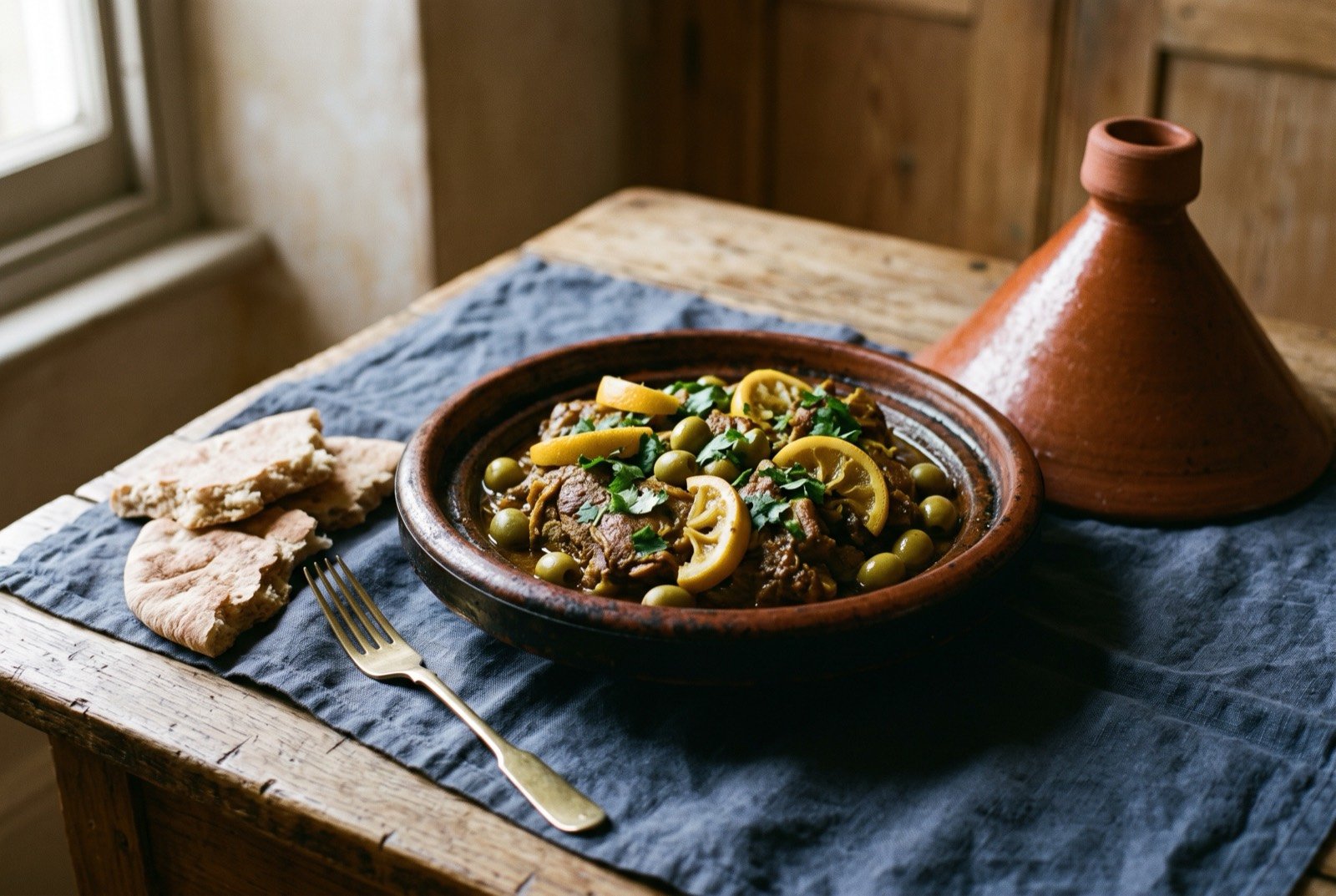
The most familiar cuisine in this atlas to a British reader, and therefore the one where received wisdom needs the hardest checking. Eight regional kitchens rather than one national one, the tagine treated as a machine rather than a dish, and every dish as tradition built it, then what a modern chef would change.
Sources and review · What this chapter does not assert · How we research · Spotted something wrong?
A Sense of Place
Everybody in Britain thinks they know this food, which is the problem. Almost nobody has eaten it.
Start with a warning about the map itself. Anny Gaul, the historian at the University of Maryland who has done more serious work on Moroccan domestic cooking than anyone writing in English, argues that "Moroccan cuisine" as a single national thing is a twentieth century construction, assembled between roughly the 1940s and the 1970s by mobile middle-class women moving village to provincial capital to Rabat and Casablanca, standardising dishes as they went.
That is not a debunking. It is the key to the chapter. The regional map is the real map and the national one is recent. Sort Morocco by fat, thickener, aromatic and starch and eight worlds fall out.
The Fassi imperial interior
Fez, Meknes, Rabat and Salé, and by extension Tetouan. Arabophone urban elites, Andalusi self-identification, a guild city's obsession with correct process.
The fat is smen, aged salted butter. The thickener is daghmira, onion cooked down to a silky paste until the oil breaks out of it, with no flour anywhere near it. The aromatics are saffron, dried ginger, cinnamon and ras el hanout, with sugar and orange flower water used deliberately against meat rather than only in pudding. The starch is fine couscous, warqa pastry and white khobz. The dishes are bastilla, djaj mqualli, mrouzia, seffa medfouna and khlii, the spiced meat confit for which Fez is called the capital.
Gaul records the Fassi register in three words, "saffron, ginger and cinnamon". Fez also has a square given over entirely to fermented butter, Qaat Smen, whose vendors sell grades by intended use: one for couscous, one for tagine, one for bread, one for coffee.
The north, and the Atlantic coast
The northern Rif, Tetouan, Tangier and Chefchaouen were the Spanish zone, 1912 to 1956, and Gaul's interviewees describe those kitchens modernising early through Ceuta and Melilla. Olive oil, heavily. The thickener is tomato and pulses cooked to purée. Cumin, sweet paprika, thyme, and in chermoula more parsley and less coriander than the coast uses. Bread, and dried split fava for bissara.
The north also cooks fish in a tagra, a shallow open earthenware dish, rather than in a coned tagine: the same cuisine choosing different equipment for a different physical problem. And Tetouani bastilla substitutes lemon for sugar, which quietly dismantles the idea that the sweet-savoury thing is essentially Moroccan rather than essentially Fassi.
The Atlantic coast, Casablanca down to Agadir, runs on olive oil, chermoula, tomato and sliced potato, with coriander leaf at roughly three parts to one part flat parsley. Its starch is couscous bidaoui, named from Dar el Beida, Casablanca.
The Amazigh south: Souss, Anti-Atlas, High Atlas
Tachelhit-speaking Ishelhin in the Souss, and argan country. Argan oil (Argania spinosa) is a flavour rather than a cooking medium and is never heated. The thickener is ground almond, and amlou, the paste of roasted almonds, culinary argan and honey, is essentially an emulsion. Taliouine is the saffron centre.
The Souss carries the best evidence in the volume that the Amazigh layer is the oldest layer. A couscous with turnips, turnip greens and argan oil, called awssay or afrass, appears in the medieval Maghrebi manuscripts of the thirteenth century. A written recipe, eight hundred years old, for a dish the Souss still cooks.
In the Tamazight-speaking High and Middle Atlas the fat is smen, the thickener is the barley meal itself, and the aromatics are minimal. The starch is barley above wheat, and the symbolism is explicit: barley carries endurance and humility, wheat carries celebration and ritual elevation. That is the correct frame for the whole Amazigh repertoire and it is the opposite of the way a British reader ranks the two grains. The dishes are tagoula, azkif and berkoukes, hand-rolled large-grain couscous.
Marrakech and the Haouz
Smen and rendered animal fat. And no thickener at all. The tanjia has none: its sauce is meat juice, fat and preserved lemon, and that is the entire architecture. Cumin, preserved lemon, saffron, garlic, and bread as the starch.
The defining technology of this city is not a stove. The ferran is the wood-fired neighbourhood oven, running at 200 to 250°C, sited near the mosque and the hammam, where households bring dough on wooden boards called wasla and the oven workers memorise which loaf belongs to which family. The farnatchi is the man who feeds the furnace heating the hammam, and who for a few coins buries sealed tanjia urns in the residual embers beneath it and returns them cooked. Both were what Hassan Radoine, quoted by the Smithsonian, calls cohesion centres.
This explains an enormous amount about the shape of the canon. Moroccan home kitchens historically had no oven, so the repertoire is overwhelmingly stovetop, steamed, griddled, or sent out to be baked by somebody else. When you wonder why a cuisine this sophisticated has so little roasting in it, that is the answer.
The Sahara, and the mellah
Tafilalet, Rissani, Erfoud, Zagora and the Draa, then Sahrawi territory. Animal fat, smen, cumin and dates. Medfouna is a stuffed bread baked buried in ash or sand, the name meaning "buried". Mreifisa is a meat stew served over unleavened bread cooked in the sand. Camel, goat and camel milk.
And the Jewish quarters in every major city, the Fez mellah dating from 1438, more than fifty years before the Spanish expulsion. Olive oil, beef fat and marrow; wheat berries and chickpeas cooked to collapse as the thickener; more cumin and turmeric and fewer floral notes. Dafina, mofletta at Mimouna, sfenj at Hanukkah. It is now overwhelmingly a diaspora cuisine, cooked in Israel, France and Canada. The dishes have a Moroccan address and a foreign postcode.
The History in Layers
The Amazigh foundation, and the seven-century hole
Couscous was already a staple of Almohad cooking in the twelfth century. Two manuscripts carry almost everything that can be said with confidence about pre-modern Moroccan cooking: Kitab al-Tabikh fi al-Maghrib wa al-Andalus fi 'Asr al-Muwahhidin, anonymous, thirteenth-century Marrakech, and Fidalat al-Khiwan by Ibn Razin al-Tujibi (1227 to 1293), translated by Nawal Nasrallah as Best of Delectable Foods and Dishes from al-Andalus and al-Maghrib (Brill, 2021).
Five couscous recipes survive in them and they demolish the idea that couscous is one dish: couscous al-fityani, Marrakchi, with meat, vegetables and cinnamon; a breadcrumb couscous made from darmak white bread and served with gueddid, dried meat; a bayssar couscous in which fava beans become the broth; the Souss awssay; and a "reversed couscous", a sheep's belly stuffed with couscous, ghee, cinnamon and mastic, and roasted.
Then the record goes dark. Gaul is flat about it: after the thirteenth century "we don't really know of any more cookbooks of Moroccan food until the twentieth century". Everything written about Moroccan food between about 1300 and 1900 is inference from ingredients, palace inventories and travellers' accounts. That six-hundred-year gap is why so many origin claims cannot be settled. There is nothing in the middle to settle them with.
The trade layers, in one spice jar
Arab and Andalusi. Gaul's formulation is the useful one: the salty-sweet contrast and cinnamon in savoury dishes are characteristics of classical Arab cooking, which travelled from Damascus to al-Andalus shortly after the Umayyad caliphate set up there in the eighth century. Morocco receives it as a Mediterranean flow rather than as one migration.
Trans-Saharan. Sijilmasa and the caravan routes brought gold, salt, West African spices and enslaved people north. Grains of paradise and guinea pepper in a Fassi ras el hanout are West African; cubeb, galangal, long pepper and mace in the same jar came the other way, through Egypt from the Indian Ocean.
That single jar is the argument of this chapter. A Fez blend puts West African, Indian Ocean and Mediterranean commodities into one grinder and has done so for centuries. Ras el hanout is not a recipe. It is a trade map.
Sephardi, from 1492, into a mellah system already more than half a century old. Ottoman and Algerian: after the French invasion of Algeria in 1830, Algerians fled to Tetouan, and the historian Idriss Bouhlila's research, cited by Gaul, indicates that both the ouarka technique and the name bastilla arrived by that route rather than by direct Andalusi descent.
The dadas, and the archive
This is the part of Moroccan food history almost nobody writes, and it should anchor everything else. The paper-thin pastry and the elaborate Fassi repertoire were, to a significant degree, the work of dadas: enslaved and formerly enslaved women in aristocratic households who, in Gaul's words, perfected, performed and preserved specialised culinary knowledge.
Her evidence is precise. A document from Sultan Hassan I's royal archives of 1889, cited by the historian Muhammad al-Manuni in a 1992 article on Tetouan industries, lists four enslaved palace cooks by name: Sa'ada, Mabruka, Zayda and Sayla, sent to Tetouan to master local sweets and dishes including multiple bastilla variations. Zette Guinaudeau's 1957 cookbook, the founding text of Fassi cuisine in French, describes such cooks as coming "from Tetouan, from whence emerge the most highly esteemed cooks", without naming what they were.
The corroborating scholarship is Doyle D. Calhoun in African Studies Review 68:1 (2025), who records that dadas were enslaved African women working as wetnurses, nannies and domestic workers, mostly trafficked children from sub-Saharan Africa or dark-skinned girls from southern Morocco; that they endured sexual slavery and lifelong servitude; and that slavery persisted in Morocco through the Protectorate period and ended only decades after independence.
Gaul's question is the one to sit with: "What kinds of footnotes can repay our debts" to women rendered "not quite anonymous, but not exactly citable either"? Note the commercial afterlife: La Maison Arabe in Marrakech publishes a cookbook titled Moroccan Cooking: Our Dadas' Recipes. The word is now a hospitality brand.
The pastilla argument, unresolved on purpose
Three positions and none of them wins. Andalusi descent: Claudia Roden reports the dish is said to have come from al-Andalus to Morocco, Guinaudeau claimed it in 1957, and Gaul notes that at least one authority in Granada claims it went the other way. Levantine: a 1954 British cookbook by John Crichton-Stuart Bute asserted it came from Spain but originally from Damascus. Ottoman and Algerian: Bouhlila via Gaul, arriving in Tetouan after 1830. Gaul's own conclusion is that the dish reflects interconnected Mediterranean and Islamic traditions rather than linear descent, and she flags the evidentiary hole precisely.
The Columbian Exchange, and the argument it hands you
Tomato is now structural: 900 g of it per 450 g of meat in kefta mkaouara, 900 g per pot of harira, and it is the base of zaalouk and taktouka. Sweet paprika is the second half of the coastal cumin-and-paprika pair. Potato, sweet potato, squash and pumpkin all sit in the couscous bidaoui vegetable order.
None of that can be more than a few centuries old. And here is the structural argument: the Fassi sweet-savoury repertoire is conspicuously free of New World ingredients. Mrouzia, bastilla and seffa contain no tomato, no chilli, no potato. That is good evidence they are the older layer, and better evidence than any origin story, because it does not depend on anyone's testimony.
Tea, wheat and the making of a national cuisine
Tea appears in Morocco in the eighteenth century under Sultan Moulay Ismail, with mass adoption in the 1850s, when British merchants left holding surplus tea after the Baltic ports closed during the Crimean War began offloading Chinese gunpowder green at ports including Tangier and Essaouira. The scholarly anchor is Graham H. Cornwell's Georgetown dissertation, "Sweetening the Pot: A History of Tea and Sugar in Morocco, 1850 to 1960". The service matters as much as the drink: gunpowder green, fresh spearmint in quantity, a great deal of sugar, and the pour from a height to aerate and raise the foam.
The French Protectorate ran 1912 to 1956, and the key agricultural study is "In Pursuit of the Granary of Rome: France's Wheat Policy in Morocco, 1915 to 1931". The country was made into a wheat exporter by a power that wanted wheat, and it is now a wheat importer.
Gaul interviewed twenty two middle-class Moroccan women born between 1940 and 1970 and found step-migration, not a single rural-to-urban jump: village to provincial capital to national capital, across generations. Bastilla, originally elite and confined to Fez, Rabat and Tetouan, became standardised as a national celebratory dish through middle-class adoption and mobility. Culinary authority was not textual: printed Moroccan cookbooks were rare and late compared with Egypt and Lebanon, and knowledge moved through mothers, peer networks and telephone calls.
The clearest illustration is rfissa, which does not appear in Moroccan cookbooks until the 1990s. Gaul's explanation is sharp: rfissa is a rural dish, and the people writing cookbooks were for a long time mostly Fassi elites. A dish's absence from the printed record tells you about the printers, not the dish.
Morocco now: drought and the price of bread
Six consecutive drought seasons as of 2025. The cereal harvest fell from 55.1 million quintals in 2022 to 2023 to 31.2 million in 2024, with roughly 35 million projected for 2025. The dam filling rate in February 2025 stood at 28 per cent, rising to 33 after rain. Morocco extended soft wheat import subsidies through 31 December 2025 and allocated $1.34 billion to support basic goods prices in 2026.
A cuisine built on semolina, barley and bread is being cooked in a country that cannot currently grow enough of any of them.
The Flavour Arsenal
If you buy nothing else, buy real preserved lemons, a serious ras el hanout and saffron threads you can trust.
The preserves, which are the spine
Moroccan cooking does not build savour from stock cubes or reduced meat glazes. It builds it from things that have been sitting in salt for months.
| Name | What it is | Timing | Flavour | How to use it |
|---|---|---|---|---|
| Preserved lemon, l'hamd markad | Lemons packed in salt in their own juice | One month for wedges, two for whole fruit | Rounded, floral, salty. Lactic rather than sharp | Pulp into the braise; rind late or raw for aroma |
| Smen | Butter salted and aged anaerobically in earthenware | Three to six months | Blue-cheese adjacent, goaty, pungent | 1 tsp per kilogram of meat. A seasoning, not a fat |
| Khlii | Sun-dried salted meat, confited in fat and olive oil | Weeks, then hours of confit | Intensely savoury, cumin forward | Fried with eggs; the fat base of a bissara or harira |
| Lben | The cultured buttermilk left after churning | Continuous culture | Buttery from diacetyl, sour at pH 4.25 | Marinades, dressings, drunk cold with couscous |
| Meslalla | Cracked green olives pickled with garlic and chilli | Weeks | Bitter, salty, garlicky | Into tagines, and on the table |
The two you cannot buy in Britain are smen and khlii.
The spice cabinet
| Name | Darija | Register | Dose, from the canon |
|---|---|---|---|
| Saffron | za'faran | Hay, honey, faintly medicinal | A pinch for a 1.5 kg chicken; ½ tsp for 1 kg lamb; 1.5 tsp for a rfissa |
| Dried ginger | skinjbir | Warm, dry, resinous | 1 to 1.5 tbsp in a couscous broth; 2 tsp in mrouzia; 1 tsp in a chicken tagine |
| Turmeric | kharkoum | Colour and mineral earth | ½ tsp to 1.5 tsp, and in a mqualli it goes in twice |
| Cassia cinnamon | Hot, bold, coumarin-heavy | A whole stick in mrouzia; ground over bastilla | |
| Cumin | kammoun | The Marrakchi and coastal signature | 1 tbsp per chermoula batch; 1 tsp in kefta |
| Sweet paprika | felfla hlouwa | Post-Columbian, inseparable from chermoula | 1 tbsp per chermoula batch, 2 tsp per zaalouk |
| Fenugreek | helba | Bitter, maple-adjacent | 4 tbsp whole seed, soaked overnight, for one rfissa |
| Mastic | mska | Resinous, piney | A pinch in chebakia dough |
The dried ginger point is the one British cooks get wrong most often. Moroccan tagine cooking uses dried ground ginger, not fresh, at volumes that surprise outsiders. Drying converts gingerol into shogaols, so it loses the raw pungent heat and gains a warm, dry, resinous quality. It is the load-bearing spice in the Fassi register, more so than cinnamon. And use cassia, not Ceylon: sweet Ceylon cinnamon in a lamb tagine is what makes British versions taste like a Christmas candle.
Ras el hanout, and why every fixed recipe for it is wrong
رأس الحانوت, ra's al-hanut, literally "head of the shop": the best the merchant has, and by extension his own signature.
There is no formula, and every claim that there is one is wrong. Every attar guards his own blend. The published counts do not agree and cannot: 10 to 30-plus in one Moroccan source, 26 in Paula Wolfert's analysed sample, "up to 30" in Anissa Helou, and the "exactly 27" or "exactly 35" circulating online is invented. If a jar gives you the canonical number, that is a tell.
What can be given is one documented Fassi blend, from a named Fez vendor. Toast whole: 1 nutmeg; 15 g each of aniseed, fennel seed, cassia cinnamon, cubeb, allspice and (optional) ash berries; 1 star anise; 2 cloves. Then add without toasting: 3 cardamom pods; 15 g each of dried turmeric root, ground ginger, dried rose petals, mace and lavender; ½ tsp saffron threads; 7 g each of galangal, white peppercorn and black peppercorn; 15 g grains of paradise. Read that as geography rather than as a recipe.
Dosing follows one pattern across the canon. Mrouzia takes 1.5 tbsp in the marinade plus 1 tsp later; rfissa 1 tbsp for a chicken; bastilla 1 tsp for two squabs; tanjia a pinch alongside cumin and saffron. In every case it goes in at the start and cooks long, and in every case it is accompanied by a separate hit of single-note ginger and saffron rather than relied on alone.
A safety note that must travel with the story. Historic Fez blends included belladonna berries and cantharides, Spanish fly, as aphrodisiacs, and the vendor above confirms these are no longer used. Belladonna is genuinely toxic. If somebody brings you a hand-blended ras el hanout from a souk with unidentified berries in it, do not cook with it.
Saffron, argan, and the ghost note
The Moroccan saffron centre is Taliouine, which received PDO status in 2010; producer numbers rose 360 per cent between 2010 and 2014, and sun drying preserves colour. Against the Moroccan standard NM 08.1.037/2007, Taliouine samples measured crocin (E440nm) 313.77 to 351.36, picrocrocin (E257nm) 138.06 to 169.39 and safranal (E330nm) 65.93 to 101.63, with crocin correlating to altitude at r = 0.856.
The international standard is ISO 3632, grading on those same three values: crocin for colour, picrocrocin for bitter-sweet flavour, safranal for aroma. Category I requires crocin at 190 or above; Category II is 150 to 189; Category III is 100 to 149. Ask for a certificate with the actual figures rather than accepting the word "premium". Warm the threads and crumble them, or steep them in a little hot water, before they go near the pot.
Argan oil, culinary grade, is pressed from roasted kernels and smells powerfully of toasted hazelnut; cosmetic argan is pressed from unroasted kernels and is a waste of money on food. UNESCO inscribed the argan practices in 2014, and the documented sequence is harvesting, drying, pulping, grinding, sorting, milling and mixing, with the gradual addition of warm water in exact quantities, on a hand mill made by local craftspeople. The knowledge is held and transmitted by women, mother to daughter, by imitation. Never heat it.
Orange flower water, ma zhar, is dosed in half-teaspoons. The commonest failure in a British kitchen is over-dosing it, at which point the dish tastes of soap and there is nothing to be done.
Part Two
The Technique Ladder
First, an honest problem
There is no Michelin Guide in Morocco. As of October 2025 the country had no starred restaurants at all, and the stated reason is coverage rather than quality: the guide has not extended its inspection network there. A specific search for a 2026 launch found none. Treat "no Michelin Guide Morocco as of August 2026" as verified by absence rather than as positive confirmation.
And the one star this cuisine ever held has been extinguished. Mourad Lahlou's Aziza in San Francisco is reported as the first Moroccan restaurant anywhere to achieve a star, and is still open. His downtown restaurant Mourad opened in 2015, held a star until 2022 when the guide removed it, and closed permanently on 26 October 2024.
So this chapter cannot hang its elevations off a starred kitchen cooking this food. What it does instead is better: it builds every elevation from mechanism, and takes its technique from Moroccan chefs cooking at a high level, of whom there are plenty.
MENA's 50 Best Restaurants 2026, published February 2026, has six Moroccan entries, all six in Marrakech.
| Rank | Restaurant | Note |
|---|---|---|
| 19 | La Grande Table Marocaine, Royal Mansour | Art of Hospitality Award 2026 |
| 21 | Le Petit Cornichon | French bistro |
| 24 | Sesamo, Royal Mansour | Italian |
| 31 | +61 | Australian-led, Moroccan produce |
| 46 | Le Golfe La Marsa | |
| 49 | Farmers | Sustainable Restaurant Award 2026 |
Read the shape of that table rather than the ranks. Only one of the six cooks Moroccan food. Two sit inside a single hotel. All six are in one city.
The two chefs this chapter leans on hardest are Karim Ben Baba of La Grande Table Marocaine, Best Chef of Morocco at La Liste's Casablanca gala in September 2025, whose seven-vegetable couscous method is published with timings and weights and is the best documented restaurant Moroccan technique in any language; and Najat Kaanache at Nur in Fez, who staged at El Bulli for its final two seasons and at Noma, The French Laundry, Per Se and Alinea, and who runs a ten-course degustation with no fixed menu, sourced each morning from the medina market.
And Britain has nothing at that level. The reason is structural rather than anyone's fault: the 2011 Census recorded 21,880 Moroccan-born residents in the UK, a fraction of the communities that sustain Britain's Bangladeshi or Punjabi restaurant sectors.
Why the tagine you made from a supermarket packet was bad
You have almost certainly cooked one: a foil sachet of "Moroccan seasoning", diced lamb leg, a tin of chickpeas, dried apricots and flaked almonds. It came out sweet, dusty, watery and vaguely orange. Every one of these faults is fixable.
The blend led with salt and paprika. A seasoning whose first ingredient is salt, or in which paprika or turmeric leads by weight, is a colouring blend: no grains of paradise, no mace, no cubeb, no rose, and a year on a shelf, by which time cuminaldehyde and the terpenes have gone.
There was no acid structure, only a salt cellar, where the Moroccan pantry runs at least four distinct acids. And there was no aged fat: smen supplies short and medium chain free fatty acids sitting at very low odour thresholds, which is why a few grams reach a depth no fresh butter can.
The meat was lean. A tagine's texture comes entirely from collagen converting to gelatin over two to three hours just under boiling, and supermarket casserole dice has no collagen and goes stringy instead.
The dried fruit did the job the onion should have done. Sweetness here comes from onions cooked down for an hour, from tfaya, from honey used deliberately. Apricots dumped in at the start are a British invention and they make the sauce taste like chutney.
Nothing was browned, which is Rung 2 and the single largest sensory gap between a home tagine and a restaurant one. And in a takeaway, the vessel was crockery: the cone arrived containing something braised in a bulk pan hours earlier, so the condensation cycle never ran.
Why restaurant versions fail even when the cook knows better. Moroccan flavour sits disproportionately in volatile terpenes and phenylpropanoids: cinnamaldehyde, cuminaldehyde, geraniol and citral from preserved lemon peel oil, linalool, and safranal from saffron. Those are the first things to leave a pot held at 65 to 75°C through a service, so a tagine cooked at ten in the morning and held until ten at night is left with turmeric, tomato, onion and salt. Add the "spicy" mistranslation: capsaicin activates TRPV1 and suppresses perception of the subtler aromatic layer, so chilli does not add to this architecture, it destroys it.
Rung 1. The tagine is a machine, and the cone is the moving part
Two pieces of earthenware: a shallow circular base with low sides, and a tall cone that sits on it. Traditional cooking tagines are unglazed; glazed and painted ones are usually serving pieces.
The cycle, stated properly. Liquid at the base is held at a bare simmer. Vapour rises into the cone. Because the cone is tall, thin-walled, unglazed and far from the heat source, its inner surface sits appreciably below 100°C, so vapour condenses on it continuously and runs down the sloping inner wall to the rim, dripping back onto the food at the perimeter rather than onto the centre.
Near-total reflux. Almost nothing is lost, so you start with a quarter of a cup of water rather than a litre and the dish concentrates instead of diluting. The classic method begins with 60 ml of water for a 1.5 kg bird. If your recipe told you to cover the meat with stock, it was not a tagine recipe.
Perimeter irrigation. The centre, heaped highest and furthest from the base, stays comparatively drier and roasts, while the edges are continuously basted. A flat lid would drip into the centre and drown it, which is why the classic loading is itself a cone: meat at the bottom in the fat, vegetables leaned up the sides.
Why unglazed clay. Low thermal conductivity and high thermal mass give thermal inertia and a very even, gentle base temperature, so the pot resists the hot spot that would scorch the onions, and the porous body takes up some liquid and gives it back, which damps the boil.
The rules that follow, none of them optional. Always a diffuser, on any hob. Very low heat throughout: if it rattles, the reflux has broken down and you are boiling. Do not lift the lid, because every lift dumps the accumulated vapour. Protect the base where you have a delicate protein, with sliced onions or celery ribs laid like a raft. Season a new clay tagine: soak 2 hours, air dry, oil inside and out, hold at 150°C for 2 hours, cool naturally, wash and re-oil. And the Marrakech tanjia urn is not a tagine.
One honest caveat. No instrumented or peer-reviewed study of tagine thermodynamics could be found. This chapter is explaining physics, not citing a measurement.
Rung 2. Separate the browning from the braising
Because the condensation cycle keeps the interior saturated and at or just under 100°C, Maillard chemistry is effectively suppressed inside the pot. Maillard reactions need surface temperatures well above the boiling point of water, typically 140°C and up, and inside a working tagine that never happens. That is why a good tagine tastes aromatic and layered rather than deeply roasted, and why one cooked entirely in a single vessel tastes clean and slightly one-dimensional however good the ingredients were.
Restaurant practice therefore browns proteins, and some vegetables, hard and separately, then returns them to the sealed vessel. Why it works: you get both the pyrazines, furans and melanoidins from the sear, and the intact volatile terpenes from the aromatics, which have not been driven off by a browning step. A single-pot method cannot deliver both, because the temperature at which one happens destroys the other.
The traditional Fassi method preserves half of this instinctively by browning the chicken at the end, in the residual oil after the sauce has broken, which is a different and also valid solution to the same problem.
Rung 3. Daghmira: body from onion, and the break as the endpoint
The most under-explained technique in Moroccan cooking in English.
For a 1.5 kg chicken, three medium onions, finely chopped. Method I: all three cook with the bird throughout, the chicken is lifted out when tender, and what is left is reduced. Method II: cook the bird with one onion only, lift it out, then add the remaining two to the hot fat and liquor and toss and break them with a spatula until you have a silky paste.
The endpoint is visual and it is not negotiable: the sauce is finished when it starts separating from the oil. That break signals that the free water has gone and what remains is an emulsion of onion pectin, collagen and fat.
Why it works. Long gentle cooking hydrolyses onion cell walls and releases pectin and soluble fibre; reduction concentrates it; agitation with the spatula shears the softened tissue into a purée. Body and gloss with no flour, no cream and no reduced stock.
Every "why is my tagine watery" complaint in the Anglophone world is a failure to do this step. Not a failure to add cornflour. A failure to spend forty minutes on an onion. Method II is the restaurant answer because it separates the two jobs the onion is doing: one cooks with the bird and gives aromatic depth over an hour, two go in late at high concentration into hot fat and give body without an hour of their pectin being boiled apart.
Rung 4. Spice in three applications, three solvents, three timings
Volatility and solubility differ by an order of magnitude across a spice blend. One dump at one moment guarantees that some compounds are destroyed and others never extract at all.
One: a whole-spice, fat-bloomed base at the start. Most of the aroma compounds in cumin, coriander, caraway and cinnamon are lipophilic terpenes and phenylpropanoids, and they dissolve into oil or butter but not into water.
Two: a water-soluble colour and body layer into the braising liquid. Turmeric, ginger, saffron. Crocin is water-soluble and needs liquid and time, which is why steeping saffron in a spoonful of hot water is extraction rather than flourish.
Three: a floral finishing blend off the heat or at the pass. Rose, lavender, mace, grains of paradise. These are the most volatile compounds in the cupboard and are simply boiled away over a two-hour braise.
The move that follows is to own two ras el hanouts, not one: a savoury, cumin-and-pepper-forward blend for the pot, and a floral, rose-and-lavender blend for finishing.
And a corrective. Ben Baba's published couscous broth uses 3 g turmeric, 5 g ground ginger and 12.5 g fresh ginger, with 80 g tomato paste and a herb bouquet. No cinnamon, no chilli, no ras el hanout at all. Its complexity comes from a 40 to 45 minute vegetable trimmings stock, not from a spice avalanche. If your couscous broth is brown and busy, you have added rather than extracted.
Rung 5. Acid, salt and aged fat as dosed ingredients
Home cooking uses one lemon and one salt cellar. Restaurant cooking uses four acids and hits the same dish at three points.
Preserved lemon rind purée gives lactic acid, softened de-bittered peel oil and salt in one measured ingredient, and blitzing rind and pulp to a purée lets you dose acid, salt and aromatics as a single weighable thing rather than as chunks that vary bite to bite. The brine is pure salt and acid with no peel texture. Fresh lemon juice is citric acid, volatile, off the heat at the end or not at all. Lben or vinegar is the fourth lever.
Why the distinction is real. Citric and lactic acid sit at different pH curves and different perceptual speeds: citric hits fast and fades, lactic is rounder and lingers. And fermentation has degraded the peel's pectin and converted or diluted limonin, the bitter limonoid concentrated in citrus pith and seeds, so preserved rind delivers citrus aroma without the delayed bitterness raw pith brings. Squeezing a fresh lemon over a dish that wanted preserved lemon puts the acid on the wrong axis and adds bitterness that was not there before.
Then the aged fat. Smen carries roughly 8 to 10 per cent salt and matures for three to six months in earthenware under anaerobic conditions at ambient temperature, with a surviving microbiota dominated by Bacillus at around 96 per cent. This is not a lactic ferment like a cultured butter. It is a lipolytic, high-salt, low-water-activity age, and the flavour comes from liberated free fatty acids reading as cheesy, goaty and blue-cheese adjacent.
The corollary is absolute: smen is a seasoning, not a cooking fat. The canon agrees with itself across five dishes: 1 tsp per kilogram of lamb in mrouzia, 1 tsp for a 1.5 kg chicken in mqualli, 1.5 tsp for a rfissa, 1 tbsp for a large pot of harira, 1 tsp per kilogram of tanjia meat. At that salt load you must take the rest of your salt down.
Lben is the other half: Lactococcus and Leuconostoc, with the diacetyl-producing Lc. lactis biovar diacetylactis above 10⁹ CFU per millilitre, acidity 0.81 per cent, pH 4.25. Diacetyl is the buttery aroma compound, and milk with lemon juice stirred in has none of it.
Rung 6. Three hydrations, and the texture problem underneath
Couscous is not a starch you boil. It is a grain you build twice, once by rolling and once by steaming, and both halves are skills.
The rolling. The best documented in-tradition method in English is the Arazi family's, from Mogador via Be'er Sheva to Brooklyn: 5.5 cups coarse semolina; 5 cups water carrying 4 to 5 tbsp salt, in a spray bottle; 60 ml neutral oil. Both hands, fingers spread, rubbing and rolling in circular motions, 10 to 15 spritzes over 3 to 4 minutes, then the grain rubbed gently through a sieve without forcing. The mechanism is accretion, not dough-making: you hydrate the outside of a semolina particle just enough to make it tacky, use agitation to accrete other particles onto it, and use the sieve as a size-selection device. Under-water it and nothing binds; over-water it and you have made pasta.
The steaming. The vessel is the kaskas or couscoussier, and the single non-negotiable is that no steam may escape at the seam between pot and basket; the traditional seal is a strip of cotton dipped in flour-and-water batter, a qaffal. The couscous is never covered and never packed down, because a lid drips condensation straight back onto the grain.
Three cycles, and why three. Each steam gelatinises starch progressively from the outside in. Hydrate all at once and the exterior turns to paste before the interior has taken any water, so the grain glues into a mass. Hydrate in three tranches, breaking and rubbing the grain apart with oiled hands while it is hot and swelling, and every particle stays discrete while the interior finally cooks through. The oil is a release agent, and steaming over the aromatic broth means the grain takes up flavour, not just moisture.
The published schedules disagree materially and this chapter gives a range: 20, 20, then 10 to 20 minutes in one source; 10 to 15, then 20 to 25, then 20 to 30 in another; Ben Baba's restaurant 20, 15, 15. Which is exactly why you cannot buy this at £11 a plate, and why a Marrakech local will tell you that eating couscous on a day other than Friday means semolina steamed early that morning to feed visitors.
And the texture problem underneath all of it. Tagine, couscous and tanjia are all soft, which is the honest reason a home tagine can taste correct and still feel monotonous by the fifth mouthful. The traditional contrast points are bread, toasted almonds, the shattering warqa of pastilla and the crisp edge of msemen. Perceived flavour intensity rises with mastication and with the rate of aroma release into the retronasal passage, and a crisp element raises both. But one crisp component, not four. A reviewer of Mourad Lahlou's book criticised its recipes for having "too many elements", and the criticism is fair.
Part Three
The Ferment and Preserve Bench
Four things worth making. Two are the reason this volume is called what it is, and two cannot be bought in Britain at all.
1. Preserved lemons, <em>l'hamd markad</em>
The single defining flavour of Moroccan cooking, and the easiest thing in this chapter to make well. Moroccan cultivars are named as doqq and boussera; Meyer is the best substitute, then Eureka, and ordinary supermarket lemons work but take longer.
Cut each lemon from top to bottom into four wedges left attached at the base; for thin-skinned fruit make one or two deep slits and keep it whole. Pack every crevice generously with coarse salt, roughly a tablespoon per lemon. Choose a jar barely large enough, so the fruit has to be forced in, and press down hard, adding more salted lemons over the following days as the mass subsides. The fruit throws its own juice; top up with fresh lemon juice only to keep everything submerged. An oily-looking film on the brine is normal.
Wedges: one month minimum. Whole fruit: two months minimum. They hold a year and improve across it, becoming more mellow, darker and softer. Rinse before use.
Why it works, on two mechanisms rather than one. Salt at this concentration pushes water activity below what spoilage organisms tolerate while osmotically drawing the fruit's own juice out to make the brine, and it simultaneously permits salt-tolerant lactic acid bacteria to convert the fruit's sugars to lactic acid. Separately and independently, enzymatic action breaks down the pectin and the oils in the peel, so the rind softens, loses its limonin bitterness and gains complexity.
Dosage discipline. In djaj mqualli the correct division of labour is half a preserved lemon's pulp cooked into the sauce, and one whole rind added late as garnish. And keep the brine, which is free seasoning: salt and acid with no peel texture.
2. Smen
Two routes are documented and they are not the same product.
Route A, kneaded and salted. 500 g unsalted butter, 1 tbsp coarse salt, optionally 60 ml of strong oregano tea. Knead the salt thoroughly through the butter, knead the herb tea in, spoon into a clean jar and pack it down hard to expel every air pocket. Seal, keep cool one month. That is roughly 2 to 2.5 per cent salt by weight.
Route B, clarified. Heat the butter, strain out the milk solids, jar the clear fat with salt and herbs, hold it cool and dark. It keeps for years.
And here is the honest problem with both. The peer-reviewed literature describes smen as carrying 8 to 10 per cent salt and maturing three to six months in earthenware pots under anaerobic conditions at ambient temperature, with a microbiota dominated by Bacillus at around 96 per cent. Route A's 2 to 2.5 per cent over one month is a long way from that, and Route B, being clarified, has almost no lactose or protein substrate left, which makes calling it a fermentation hard to sustain.
This chapter's position: make Route A, at the higher salt load if you want to be closer to the documented product, and understand that what you are making is a lipolytic salted age rather than a lactic ferment. The flavour target is a pungent, blue-cheese-like scent, described in soup as adding a parmesan-like layer.
If you are not making it, the honest substitutions in descending order are good ghee with a very small amount of grated aged sheep's milk cheese melted in, which supplies the free fatty acid and salt profile; ghee with a scrape of blue cheese, chemically closer than it sounds because both are lipolysis-driven; or plain ghee, which gives the nutty clarified base and none of the funk. Say which one you used.
3. Khlii and gueddid
Two stages, and English writing constantly collapses them into one.
Stage one, gueddid. Strips of beef, camel, lamb or mutton, salted and sun-dried. Winter drying takes longer and gives better flavour; summer drying is days of intense sun and the strips lose up to 50 per cent of their water. Made in volume after Eid al-Adha.
Stage two, the confit. Quantities as documented, for a large batch: 2.7 kg gueddid; 500 g beef suet, finely ground; 2 to 3 litres water; 1 litre extra virgin olive oil. The seasoning is divided in half and added at two points: 2 tbsp salt; 1.5 tbsp freshly ground cumin; 55 g freshly ground coriander seed; 55 g crushed unpeeled garlic. Season the fat and melt it into simmering water, add the gueddid slowly, and after about an hour on low add the olive oil. Continue several more hours on very low heat until the water has completely evaporated.
The ftila test, which is the best single detail in this volume. A paper wick is dipped in the fat and lit. If it burns, the water is gone. That is a water activity test by proxy, arrived at with a scrap of paper, and it is exactly right: free water quenches the wick, and a wick that sustains a flame tells you the residual moisture has boiled off.
The result keeps for months at room temperature under a solid fat cap and needs no soaking before use. There is no UK retail source for khlii. This is a make-it-yourself project or nothing.
4. Lben
The cultured buttermilk left after churning, and the ingredient that makes marinades and dressings in this cuisine work. Dominated by Lactococcus and Leuconostoc, with the diacetyl-producing Lc. lactis biovar diacetylactis above 10⁹ CFU per millilitre, acidity 0.81 per cent, pH 4.25.
Diacetyl is the point. It is the buttery aroma compound, and it is why lben smells of butter and yoghurt does not.
To make it, culture whole milk with a mesophilic buttermilk culture and hold at room temperature until it sets at roughly pH 4.2. To buy the nearest thing, look for real cultured buttermilk, not "buttermilk-flavoured" or acidified milk, at a Middle Eastern or Turkish grocer. Full-fat kefir thinned with water works. Milk with lemon juice stirred into it does not.
Sourcing in Britain
Verified August 2026. Where a supplier could not be confirmed, that is said rather than smoothed over.
Smen and khlii have no verified UK retail source at all. Both were searched for specifically. If you want either, you are making it or bringing it back. Every other ingredient in this chapter can be bought in Britain today.
Nationwide online, verified trading
- The Spice Shop, 1 Blenheim Crescent, London W11 2EE. Moroccan ras el hanout £4.45 for a 50 g refill, £6.95 in a tin, 22 declared spices including grains of paradise, zedoary, ajowan, mace and Sichuan pepper. The most serious ras el hanout on the UK market.
- Arabica Food & Spice (shop.arabicalondon.com). Ras el hanout £4.50 for 40 g, ten spices, no florals, small-batch roasted: the savoury workhorse blend for the pot. Sous Chef (souschef.co.uk) carries Mill & Mortar organic ras el hanout at £7.40 for 55 g, with rose and lavender: the floral finishing blend, plus the full Belazu range.
- Oasis Market (oasismarket.co.uk). Free over £59.99, every UK postcode claimed. Dari couscous including Al Belboula barley couscous, Sofra pickled lemon 720 g, Bled harissa 370 g, Sultan tea. The best source for actual Moroccan supermarket brands.
- Seasoned Pioneers (seasonedpioneers.com), Liverpool. Ras el hanout £3.50 to £4.50, chermoula mix £3.50, and La Kama £3.50, the gentler Tangier blend, the only UK source found for it.
- Belazu (belazu.com) for Rose Harissa £4.95 and its preserved lemons, the reliable UK premium option; Steenbergs for organic single spices; MyJam Food for Moroccan black olives and halal lamb; LemonSalt for orange blossom and rose water.
- Mansora Ltd, 321 to 323 High Road, Chadwell Heath, Essex RM6 6AX, 0207 078 9081. The importer bringing Dari couscous in, in retail and catering sizes up to one tonne. Worth contacting directly for anything you cannot find at retail. This is the trade route into the good stuff.
Two to treat with caution: Moroccan Bazar (moroccanbazar.co.uk) lists 82 products but the site states it is still in the works, and Moroccan Shop UK (moroccanshop.co.uk) shows a 2025 copyright and leans cosmetic.
Physical shops
London: Golborne Road, W10. This is the answer. Britain's Moroccan high street, at the north end of Portobello. Le Maroc, 94 Golborne Road W10 5PS, 07944 923330, a grocery and halal butcher with oils, olives, seasoned meats, dried fruit, nuts, grains and spices: start here. Fez, 71 Golborne Road, sells tagines and cooking equipment. Also Le Marrakech at 64, L'Etoile Bakery at 79, and butchers at 38 and 83. Bab Mansour, 57 Endell Street WC2H 9AJ, for the meal.
Bristol: Alfu International, 707A Fishponds Road BS16 3UH, and Bristol Sweet Mart, 71 to 82 St Marks Road, Easton BS5 6JH. Manchester: Worldwide Foods, 401 Great Western Street, Rusholme, and Venus Foods, 45 to 49 Anson Road M14 5DE, a possible tagine source.
Elsewhere, market areas named and individual shops not verified within the research budget. Birmingham: Coventry Road and Alum Rock Road. Leeds: Kirkgate Market and Harehills. Glasgow: Pollokshields and Govanhill. Cardiff: City Road and Riverside. Sheffield: London Road and Abbeydale Road. Liverpool: Bold Street and the Lodge Lane corridor. Leicester: Belgrave Road. Newcastle: the Grainger Market. And outside London, Trowbridge in Wiltshire has an unusually high Moroccan concentration, and in 2009 became the first UK town to twin with a city from a Muslim country, Oujda in eastern Morocco.
The ranked list: what decides great from grim
- Preserved lemon. The gap between a lactic-fermented Beldi and a vinegar-pickled imitation is the gap between the dish and a parody of it. Look for two ingredients, lemons and salt, a cloudy brine, and peel soft enough to cut with the side of a spoon.
- Couscous. Instant couscous cannot be steamed three times, so the wrong bag makes the correct technique physically impossible. Uniform, pale straw-gold, free-running, durum semolina stated.
- Saffron. Whole threads only, trumpet-shaped at one end, releasing colour slowly over 10 to 20 minutes in warm water while the threads stay red. Fakes dump colour instantly and go pale.
- Ras el hanout. No legal definition, so read the list and not the name: at least twelve named ingredients, with grains of paradise, mace, cubeb, galangal or rosebud among them.
- Smen, or its honest substitute. The aged, lipolysed depth, and almost nobody in Britain has any.
- The lamb cut. Shoulder on the bone, cut across the bone into thick chunks. Lean supermarket dice has no collagen and cannot make gelatin.
- Whole spice, freshly ground. Cuminaldehyde is volatile, so a year-old jar contributes colour and nothing else.
- Culinary argan oil. The label should say culinary, alimentaire or roasted, and it should hit you with toasted nut on opening. Use within three to six months; rancid argan smells of old crayons.
- Olives. Cracked Moroccan olives in brine bring salt, bitterness and a ferment note. Tinned "ripe black" olives bring ferrous gluconate.
- Almonds. Rancid ground almonds are the commonest silent ruin of a pastilla. Buy whole, store in the freezer, grind to order.
- Cassia against Ceylon cinnamon. Sweet Ceylon in a lamb tagine is what makes British versions taste like a Christmas candle.
Kit
A couscoussier, or a steamer basket lined with muslin over a stockpot. A plain, unpainted cooking tagine and a heat diffuser, bought together. A spice grinder used only for spices. A wide shallow dish (gsaa) for rolling the grain. A heavy mortar for chermoula, because a blender makes a smoothie of it. A microplane for preserved lemon rind. And a digital scale to 0.1 g for saffron, smen and orange blossom water.
A lead warning, and it is not theoretical. Some Moroccan-made glazed tagines contain trace lead in the glaze, and home test kits are inexpensive. Test anything bought abroad, and never cook in a painted decorative tagine. For a lifetime purchase, Emile Henry flameproof ceramic or a Le Creuset cast iron base with a ceramic cone both work on any hob including induction, which a clay tagine will not.
One structural buying note. South Asian grocers sell better and vastly cheaper whole spice than any premium British brand. The blend is Moroccan. The cumin is just cumin.
Voices and Sources
From inside the tradition
- Anny Gaul, University of Maryland. Her argument that Moroccan national cuisine is a twentieth-century construction assembled by mobile middle-class women, her work on the dadas and the 1889 palace archive, and her insistence on the six-century documentary hole, are the spine of this chapter's history.
- Karim Ben Baba, La Grande Table Marocaine, Royal Mansour. Best Chef of Morocco at La Liste's Casablanca gala, September 2025; Art of Hospitality at MENA's 50 Best 2026. His published seven-vegetable couscous method is the best documented restaurant Moroccan technique in any language. His service is deliberately ritualised: milk and dates on arrival, hand washing with orange blossom water, ceremonial tea, a spoken story with each dish. That choreography is why the hospitality award went there.
- Najat Kaanache, Nur, Fez. Born 1980 in San Sebastián to Moroccan parents; staged at El Bulli for its final two seasons, and at Noma, The French Laundry, Per Se and Alinea. Nur opened in the Fez medina in 2016 with no fixed menu, sourced each morning from the medina. Her own line is the useful one: Moroccan is something you carry with you, and it is very personal. The site does not state a 2026 operating status; confirm before you book.
- Meryem Cherkaoui. Born and raised in Rabat, trained at the Institut Paul Bocuse, opened in Casablanca in 2002, now at Dahbi. La Liste's 2025 Game Changer and the reference point for Moroccan women entering professional kitchens. Explicitly rejects "tourist food". Signatures include Marrakchi tanjia and pigeon b'stilla.
- Moha Fedal, Dar Moha, Marrakech, Swiss-trained, who effectively invented the Moroccan tasting menu in Morocco before anyone else. Rachid Agouray, Le Marocain at La Mamounia, is the other palace-hotel benchmark.
- Mourad Lahlou, San Francisco. The most important diaspora figure and the one with the deepest published technique. Aziza is reported as the first Moroccan restaurant anywhere to achieve a Michelin star and is still open; Mourad held a star from 2015 to 2022 and closed permanently on 26 October 2024. His stated philosophy is a corrective: to strip away the clichés about Moroccan food and celebrate its true potential for fine dining. His book opens with Seven Things, a set of house-made foundations you build before you cook anything, which is the shape this chapter's ferment bench takes.
- Nargisse Benkabbou, British-Moroccan, author of Casablanca (Mitchell Beazley, 2018). The most accessible bridge figure for a British audience.
- Christine Benlafquih, Taste of Maroc. American, married into a Moroccan family, resident in Morocco, and by a distance the most method-precise English-language source on this cuisine. Most of the weighed quantities in Part Three come from her.
The gap, named
Britain has no Moroccan restaurant operating at the level of Nur, La Grande Table Marocaine or Aziza. Not one. That is not a criticism of anybody's cooking: the 2011 Census recorded 21,880 Moroccan-born residents in the UK, and there is not the domestic customer base for a competitive quality ladder to form. It also means that if you cook the eleven dishes in this chapter properly, in your own kitchen, you will have eaten better Moroccan food than you can currently buy in this country.
Things this chapter has deliberately not asserted
The section that makes the rest of it trustworthy.
- That anyone has measured what a tagine actually does. The condensation cycle in Rung 1 is sound physics and every source states it qualitatively, but no peer-reviewed or instrumented study of tagine thermodynamics could be found. This chapter explains a mechanism; it does not cite a measurement. Nor does it assert that the tagine was invented to cope with desert water scarcity, which is ubiquitous on blogs and unsupported anywhere serious; the etymology is contested between the Greek tagenon and the Persian tahchin, with Wikipedia carrying both without adjudicating; and Gil Marks's placement of the vessel's origin in the Anti-Atlas reaches this chapter only at second hand.
- That couscous is seven thousand years old, or that couscous vessels were found in ninth-century BC Amazigh tombs. Extremely widely repeated, and no primary archaeology could be located for either. What can be said is that couscous was a staple of Almohad cooking in the twelfth century and appears in five distinct forms in the thirteenth-century manuscripts, which is strong enough without inflating it by five millennia. Nor is a single steaming schedule asserted: the sources disagree materially and the chapter gives the range. And "Friday couscous" is asserted only for urban households, since whether it holds in rural Amazigh communities could not be established, and nor could whether "seven vegetables" carries numerological significance or is a later formalisation.
- That smen is a fermentation. Sources assert lactic fermentation, but no microbiological study establishing it as such was found, and the peer-reviewed work that does exist describes a high-salt, low-water-activity, lipolytic age with a Bacillus-dominated microbiota, which is a different thing. Nor does the chapter assert the burial story, in which Amazigh families bury a jar of smen at a daughter's birth and dig it up for her wedding feast: one serious source frames it explicitly as legend and everyone else repeats it as fact. And the 2 to 2.5 per cent salt figure for the domestic route has no corroborating in-tradition source.
- Any canonical number of spices in ras el hanout. The published counts run 10 to 30-plus, 26, "up to 30", and "10 to 100", and the "exactly 27" and "exactly 35" circulating online are inventions. Nor is a regulatory ban on cantharides asserted: one source says such aphrodisiacs have appeared in Moroccan formulations, another says they are now banned from Moroccan markets, and no Moroccan regulatory citation or date could be found. What is asserted is only that a named Fez vendor confirms they are no longer used.
- A cooking time for tanjia, or any figure at all for mechoui. Tanjia is given as three hours in one Marrakech source and "around four" in another, with other accounts running to five and seven, so the chapter gives the range. Mechoui pit temperature and duration could not be found anywhere credible, which is why mechoui is described in this chapter and not cooked in it. The seventeenth-century attestation of tanjia is repeated without a manuscript title or folio to hang it on.
- Full quantities for lamb with prunes. Lham bel barkouk, the wedding tagine, is one of the best known dishes in the canon and no in-tradition source with complete quantities could be secured. Its architecture is inferable from mrouzia, but inferring an architecture is not the same as having a recipe, and this chapter does not print invented numbers. That is why it is not one of the eleven.
- That the preserved lemon pulp is always discarded. Much Anglophone writing insists on it; the most method-precise Moroccan-resident source uses the pulp in the braise and the rind as garnish, which is what this chapter follows. The sources genuinely conflict. Related: doqq and boussera as the named Moroccan cultivars were found in only one source, and the khlii ratios come from a single detailed English source, given because they are the only weighed figures available, not because they have been corroborated.
- Dates for the Columbian Exchange in Morocco specifically. No dated evidence was found for when tomato, chilli or potato entered Moroccan cooking. The structural argument that the Fassi sweet-savoury repertoire is free of New World ingredients and is therefore likely the older layer does not depend on a date and is offered on that basis alone.
- Two popular stories about tea. That Queen Anne sent Chinese green tea as a diplomatic gift for the release of English prisoners, and that the 1850s adoption was caused by British merchants dumping Crimean War surplus, both circulate without primary citation, and Cornwell's dissertation, which is precisely about this, could not be read directly. And the three-glasses proverb ("the first bitter like life, the second sweet like love, the third soft as death") is documented as Sahrawi rather than generically Moroccan, so attributing it to Moroccan tea culture at large may simply be wrong.
- That Gaul's two statements about bastilla in the medieval sources agree. Her 2018 blog post describes a very close analogue in Ibn Razin: pigeon with cinnamon, almonds, saffron, onion and eggs, with a double-cooking process close to the modern one. Her 2019 Maydan essay states she found no bastila recipe in the Andalusi cookbooks. Those are reconcilable as "an antecedent, not the dish", and this chapter treats them that way, but it will not quote them as though they say the same thing.
- Anything about the current state of several named restaurants, or Michelin's absence as a positive fact. Nur's 2026 operating status is not stated on its own site. Aziza's current Michelin distinction could not be confirmed and is not claimed here. Momo's closure in Mayfair is strongly indicated but the reporting could not be fetched directly, and Zayane on Golborne Road is unconfirmed. Individually named businesses in seven other British cities could not be verified, which is why those cities get streets and market halls rather than shop names. And "no Michelin Guide in Morocco" is verified by absence rather than positively confirmed: re-check at press. The saffron figures used above are 2015 numbers, and the widely repeated claim that Morocco is the world's largest sardine exporter was not verified and does not appear here.
- A note on sources deliberately excluded. This subject area is unusually polluted. A large share of the top-ranking English results for Moroccan food are SEO farms and, increasingly, AI-generated pages carrying recent datelines, several publishing near-identical text under different bylines. Everything traceable only to that class of domain was treated as unusable and cut. That is why this chapter is shorter on colourful anecdote than a search engine would suggest it should be, and it is the right trade.
Volume Fourteen of Not Just Stew. Research briefs: vol14-tradition.md and vol14-modernist-sourcing.md. Sourcing verified August 2026.
The tagine is a machine, and the cone is the moving part
Two pieces of earthenware: a shallow circular base with low sides, and a tall cone that sits on it.
Separate the browning from the braising
Because the condensation cycle keeps the interior saturated and at or just under 100°C, Maillard chemistry is effectively suppressed inside the pot.
Daghmira: body from onion, and the break as the endpoint
The most under-explained technique in Moroccan cooking in English.
Spice in three applications, three solvents, three timings
Volatility and solubility differ by an order of magnitude across a spice blend.
Acid, salt and aged fat as dosed ingredients
Home cooking uses one lemon and one salt cellar.
Three hydrations, and the texture problem underneath
Couscous is not a starch you boil. It is a grain you build twice, once by rolling and once by steaming, and both halves are skills.
The dishes
- Djaj mqualli Fez
- Couscous bidaoui with seven vegetables and tfaya Casablanca
- Tanjia marrakchia Marrakech
- Mrouzia Fez
- Fish tagine with chermoula The Atlantic coast
- Kefta mkaouara National, everyday
- Harira National, and above all Ramadan
- Bastilla Fez and Tetouan
- Rfissa Rural Morocco, and the dish that proves the cookbooks were lying by omission
- Tagoula The High and Middle Atlas
- Dafina The mellah
Sources and review
- Reviewed
- Not yet reviewed from inside the tradition
- Cooked
- Not yet cooked and reported
Where this volume comes from
4 research briefs on file for this volume, researched to the rules on How we research. Published 26 August 2026. Last changed 8 September 2026.