North Africa · Volume 14, The Tagine and the Preserve
Tanjia marrakchia
Marrakech
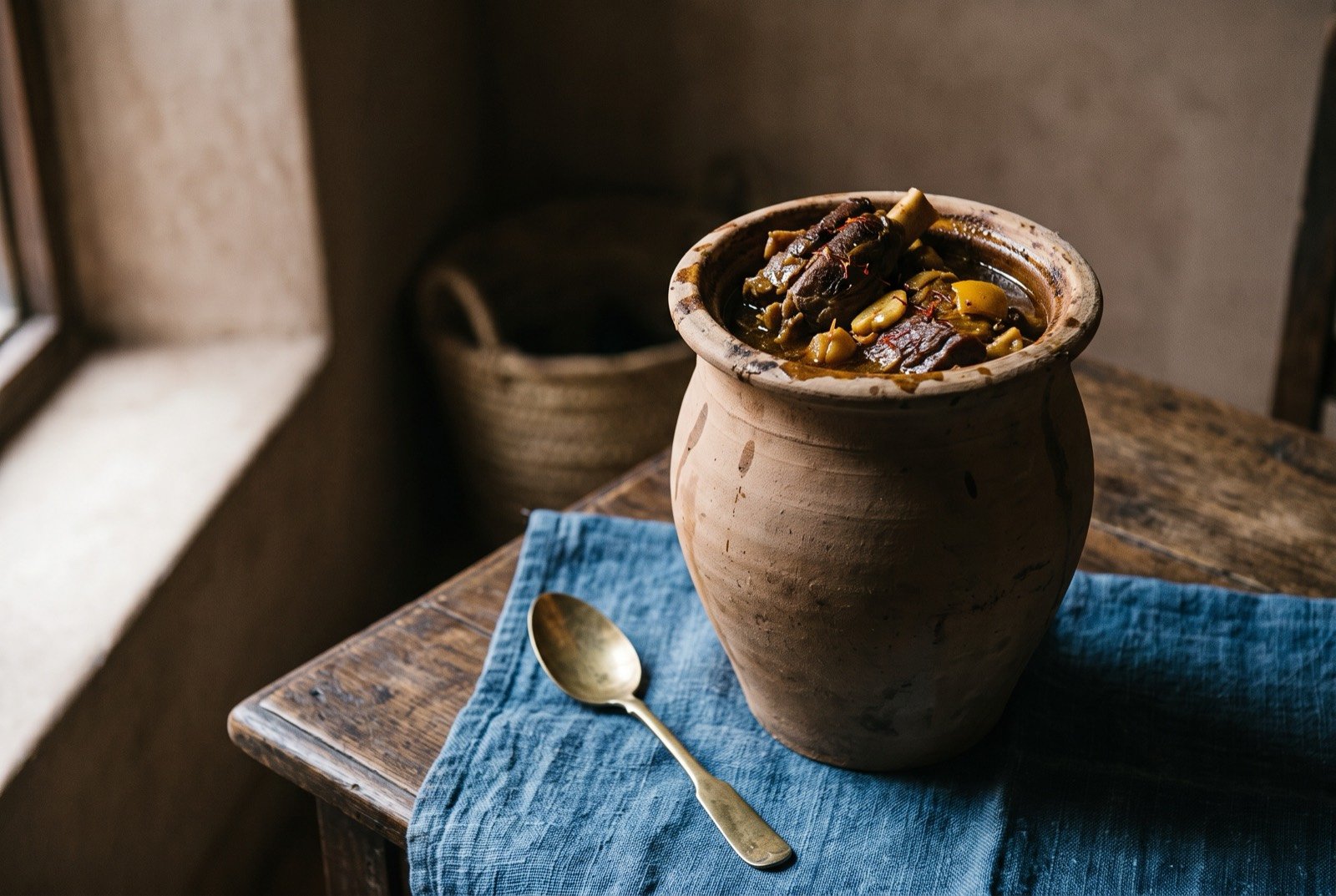
An illustration of the dish, not a photograph of it cooked.
- Time
- 4 hours
- Reviewed
- Not yet reviewed from inside the tradition
- Cooked
- Not yet cooked and reported
A tanjia is not a tagine, and confusing them is the fastest way to show you have not been. The vessel is a tangia, an unglazed clay urn with a long neck, sealed and buried in the residual embers under a hammam furnace by the farnatchi. It is a men's dish, made by souk artisans on their Friday off, with one man collecting contributions from the others, the urn dropped at the furnace in the morning and collected in the afternoon for a gathering with music. No thickener, no browning, no onion base, no vegetables. One chef quoted on the dish says the simplicity is exactly what makes it powerful.
As tradition built it
Serves 4. About 3 to 4 hours.
Ingredients
- 900 g lamb or mutton on the bone, or beef shank, in large pieces
- ½ preserved lemon, rind only, finely chopped
- 2 tbsp crushed garlic
- 1 tsp ground cumin
- a pinch crushed saffron
- 1 tsp smen
- 250 to 500 ml water, barely covering the meat
Method
- Put everything, the lamb or mutton on the bone, or beef shank, in large pieces, the preserved lemon, crushed garlic, ground cumin, crushed saffron and water, in the urn, or in a deep, narrow, heavy pot. No browning. No onion. No oil beyond the smen.
- Seal the mouth. Traditionally with parchment and rope; a double layer of foil under a tight lid does the same job.
- Bury in embers, or hold in an oven at the lowest setting that keeps the contents at a bare simmer. 3 hours in one Marrakech account, "around four" in another. The meat should fall apart and the liquid should be a glossy, unthickened, deeply savoury liquor.
- Open at the table. Serve with bread and nothing else.
Notes
The domestic ratio, scaled for a home kitchen.
The scaled-up souk version runs to 2 kg lamb shank, 8 garlic cloves, 200 ml olive oil, 300 ml water and 2 whole preserved lemons. Note how much more oil that is per kilo: the communal version is deliberately richer.
What a modern chef changes
A held temperature, the lemon split, a finished liquor
Rungs 1, 5 and 2
Method
- Hold the temperature rather than guessing the embers. The ember bed does one thing: an extremely stable, extremely low heat for hours. An oven at 120°C with the pot sealed does the same, and a water bath at 85°C does it better. Rung 1 as a principle rather than a vessel: the technology is stability, not clay.
- Split the preserved lemon across the cook. Half the rind in from the start, where it softens and gives its salt and lactic acid into the fat; the other half chopped fine and stirred in off the heat at the end, where the peel oils survive. Rung 5.
- Finish the liquor rather than serving it as it lies. Pour it off, settle 2 minutes, spoon off and reserve the fat, reduce the liquor by a third, then whisk the fat back in off the heat to a glossy, just-split sauce. You are choosing when the emulsion breaks instead of letting four hours decide.
- Add one crisp thing and nothing more, such as a spoonful of cumin-toasted breadcrumb. Do not add vegetables. Putting them in makes it a tagine.