The Horn · Volume 11, The Indian Ocean Kitchen
Canjeero
Somalia, Somaliland and Djibouti, where it is laxoox
Illustration
- Time
- Hands on 30 minutes · Waiting 8 hours
- Researched
- Researched from 103 sources in the brief
- Reviewed
- Awaiting a reader from inside the tradition
- Cooked
- Awaiting a cook report
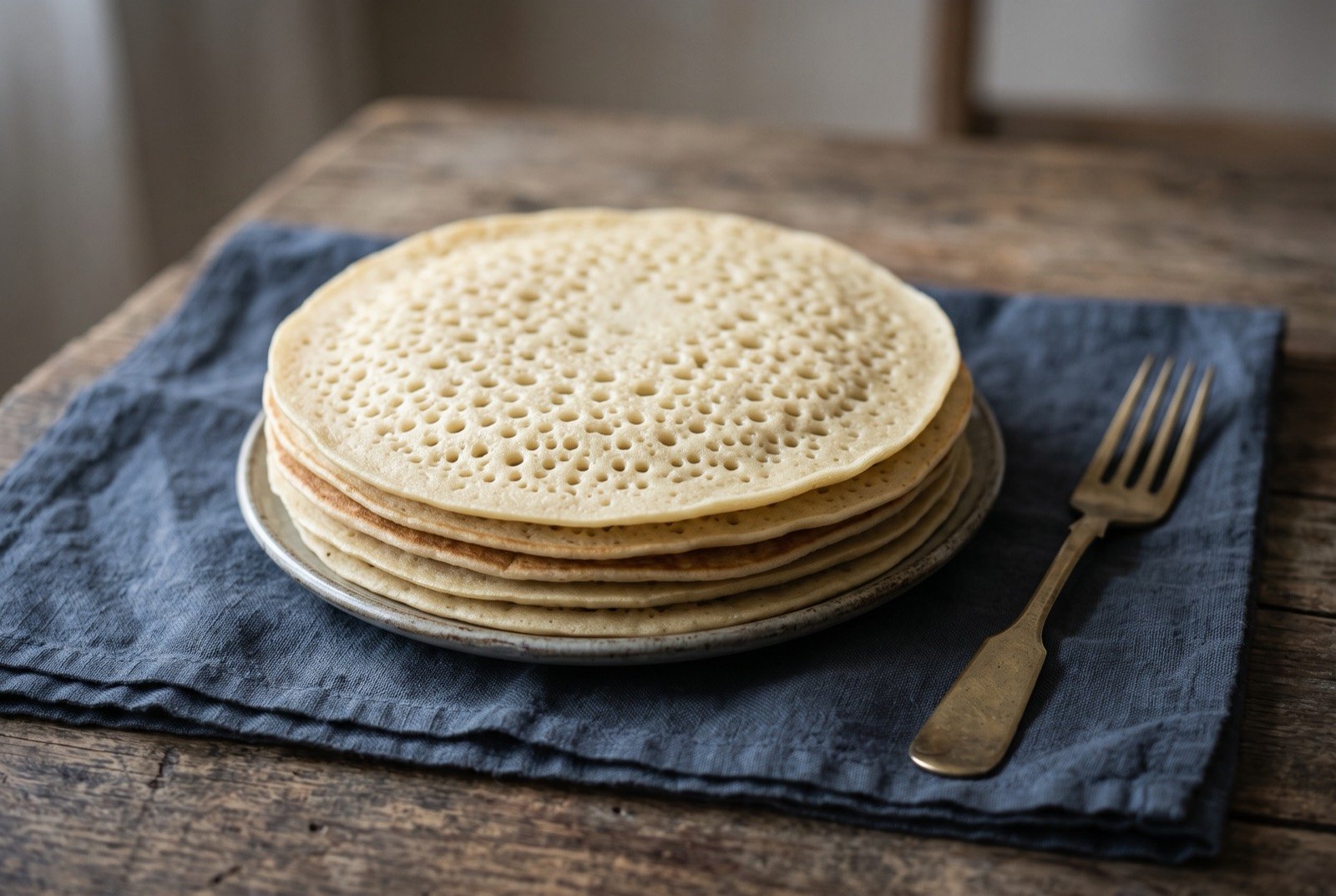
Wheat-led, lactic fermented, 15 to 19 cm across, cooked on one side only. One hundred per cent of surveyed households eat it at breakfast, with sweet tea (86 per cent), suqaar (70 per cent), meat stew (51 per cent) and ghee (40 per cent). Kill the sorghum myth first. The survey found 95 per cent of households using wheat and 30 per cent using wheat alone, with sorghum in 55 per cent as a partner, maize at 32, barley at 18 and teff at 7. The split is sharp: in southern Somalia 68 per cent used wheat alone, while in Somaliland and the Ethiopian Somali Region 100 per cent used two or more grains, in the mix called budo. The claim is not wrong, it is regionally misapplied. And it is not injera.
| Canjeero, laxoox | Injera | |
|---|---|---|
| Ferment | one night | several days |
| Diameter | 15 to 19 cm | about 60 cm |
| Structuring aid | cajiin, south only | absit |
| Grain | wheat led, sorghum or maize partner | teff led |
| The pour | centre outward, concentric rings | spiral from the outside in, and the spiral stays visible |
As tradition built it
Makes about 10. Overnight, plus 30 minutes.
Ingredients
- 750 g plain wheat flour, or 600 g wheat with 150 g sorghum for a northern budo
- 120 g dhanaanis, yesterday's batter, if you have it
- 1.2 L room temperature water, approximately
- 1 tsp salt
- as needed oil, and coarse salt flakes, for the griddle
Method
- Mix the plain wheat flour, room temperature water and dhanaanis, then mix vigorously by hand for 10 to 15 minutes until the batter is bubbly, smooth and velvety. This is aeration and gluten development done before fermentation and it is not optional: 56 per cent of the surveyed cooks see bubbling before the ferment even starts, purely from this step.
- Cover and leave overnight in the warmest room in the house. In a cold British kitchen, extend the time or add more starter, which is what 47 per cent of Somali cooks do in cold weather.
- Stir in the salt in the morning. It should pour like thin double cream, and batch to batch variation is normal.
- Heat a cast iron griddle, the dhaawe, to medium, as 95 per cent do. Oil it, which 100 per cent do, and scatter a few salt flakes on it, which 42 per cent do: it scours, it stops sticking, and it seasons the base.
- Pour from the centre outward in a widening sweep. Cover. Cook 2 to 5 minutes. One side only. Do not flip. The cooks' own doneness cues are light browning (47 per cent), the hiss of condensation (35 per cent) and visible steam (19 per cent).
Notes
Composite, from the Journal of Ethnic Foods survey of 46 households.
What a modern chef changes
A measured culture, a scald, and the eyes as a target
Rungs 1 and 2
Method
- Keep a dhanaanis and weigh it, 120 g into 750 g of flour, fed and used daily, and measure the finish rather than smelling it: take the batter to pH 4.2 to 4.5 with strips or a cheap meter, longer in a cold kitchen and shorter in a warm one. You are formalising the seasonal adjustment 65 per cent of Somali cooks already make by feel.
- Add cajiin. Cook 100 g of the flour with 400 ml of the water to a smooth paste, cool it completely, and beat it into the rest before fermenting. Rung 2. The bread carries more water at the same viscosity, stays foldable for hours rather than cracking on the counter, and ferments faster because gelatinised starch is far more available to amylase.
- Aim at the crumb, because the crumb is measurable. Somali laxoox has been measured at 22.4 to 57.4 cells per square centimetre against 145 for one Yemeni lahoh sample. The eyes are the sauce-holding surface, not decoration, and a canjeero at 25 is a pancake. Push towards 100 with a longer, cooler ferment and a wetter batter.