The Horn · Volume 11, The Indian Ocean Kitchen
Xalwo
The Benadir coast
Illustration
- Time
- 3 hours
- Researched
- Researched from 103 sources in the brief
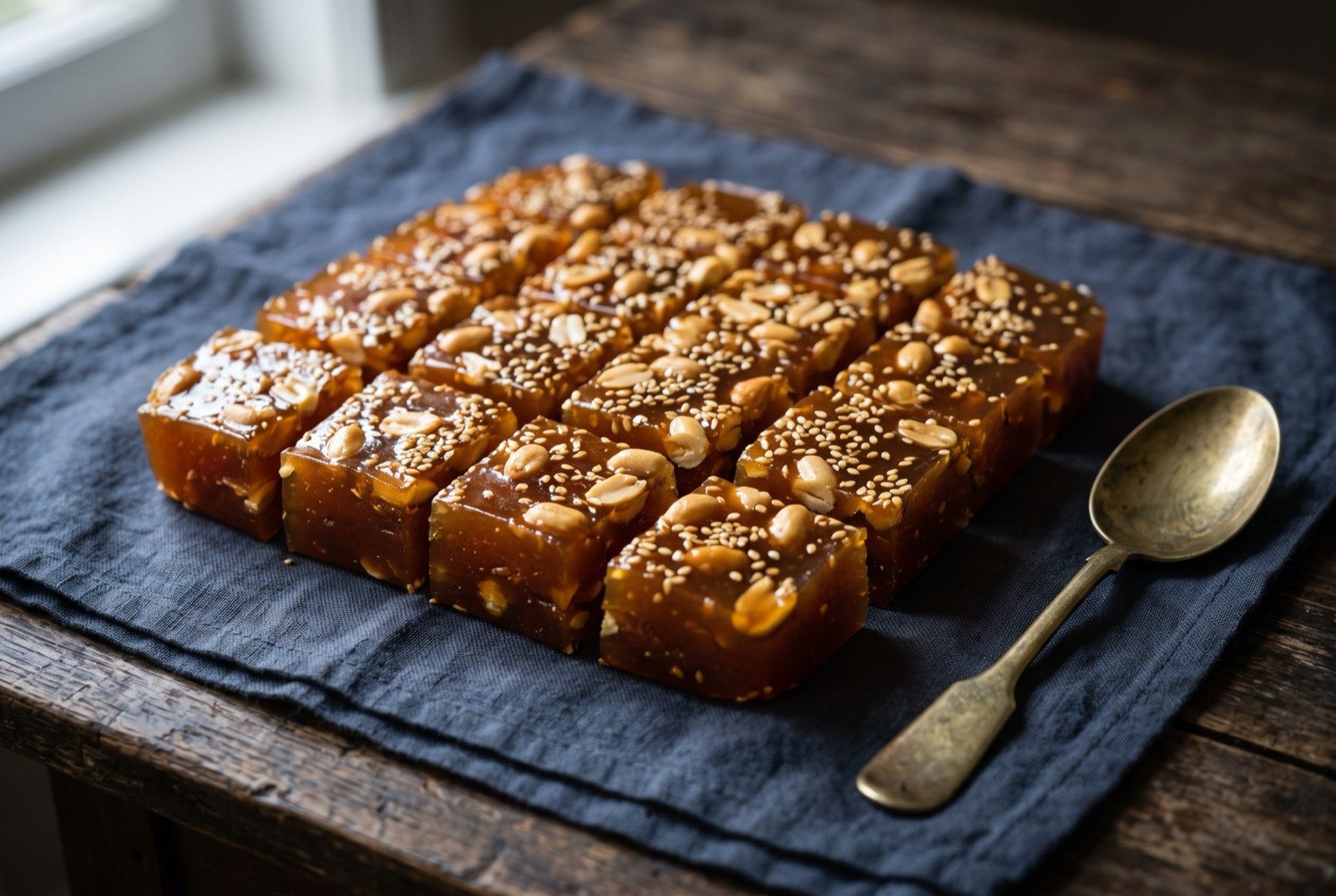
Xalwo is Eid, and weddings, and the Benadiri kitchen's signature. It is also a member of a well documented Indian Ocean family: Omani halwa is sugar, water, corn starch and ghee, and Bahraini halwa is cooked in copper pots over open fire with constant stirring for several hours to a firm, jelly-like texture. This chapter writes the family and not the descent. See the final section. The ratios are the interesting part. Sugar to starch runs about 6.7:1 by weight, water to sugar about 0.875:1, ghee is 15 per cent of sugar weight, and cardamom is 4.5 per cent of sugar weight. That last figure is why xalwo tastes the way it does: it is a cardamom confection, and the sugar is the medium.
As tradition built it
Makes a large tray. About 3 hours.
Ingredients
- 2 kg raw sugar
- 1.5 L water
- 300 g cornflour
- 250 ml water, for the slurry
- 90 g crushed cardamom seeds
- 300 g ghee
- a scatter peanuts and sesame seeds to decorate
Method
- Whisk the cornflour into the 250 ml of water to a smooth paste. Lumps here are permanent.
- Dissolve the raw sugar in the 1.5 litres of water in a large heavy pot. Add the crushed cardamom seeds.
- Gradually add the cornflour slurry, then the ghee.
- Medium heat. Stir continuously with a wooden spoon for the first 20 minutes, then every ten minutes or so.
- About 3 hours in total, until it thickens and the ghee separates out and stands on the surface.
- Pour off the separated ghee, decant into an oiled tray, scatter over the peanuts and sesame seeds to decorate, cool, cut with a wet knife, and wrap.
Notes
The only complete quantitative formula I could obtain, and its provenance is unverified, so treat the ratios as the trustworthy part and taste as you go.
The ghee separation is the doneness signal. The starch gelatinises, the granules fragment, the gel tightens, and as free water boils off the emulsion breaks and the ghee is expelled. Ghee on the surface means the sugar has concentrated far enough to set: a visual hydrometer, which is why the technique can be taught without a thermometer.
What a modern chef changes
A number instead of a signal, invert sugar for texture, and the cardamom protected
Rungs 3 and 6
Method
- Put a probe in it and take it to 110°C, soft ball stage. The ghee separation is a good indicator; a thermometer is better, because it tells you how far past the break you are. Ten degrees either side is the difference between a sweet that slumps and one you could tile a floor with.
- Add a tablespoon of lemon juice with the sugar. It partially hydrolyses sucrose into glucose and fructose, and invert sugar suppresses crystallisation. That is why some xalwo is glossy and some grainy, and it is a two-second intervention.
- Brown the ghee separately and fold it in late, in the last fifteen minutes, so its Maillard and lactone aromatics survive rather than boiling off over three hours. Rung 6: the sweetness here is placed, not defaulted.
- Crush the cardamom immediately before use and put half of it in at the end. Rung 3. At 4.5 per cent of sugar weight this is the loudest flavour in the dish, and three hours over heat strips most of the volatile fraction from cardamom added at the start.
Notes
Part Four