The Horn · Volume 11, The Indian Ocean Kitchen
Bariis iskukaris
Somalia, and the national dish
Illustration
- Time
- 45 minutes
- Researched
- Researched from 103 sources in the brief
- Reviewed
- Awaiting a reader from inside the tradition
- Cooked
- Awaiting a cook report
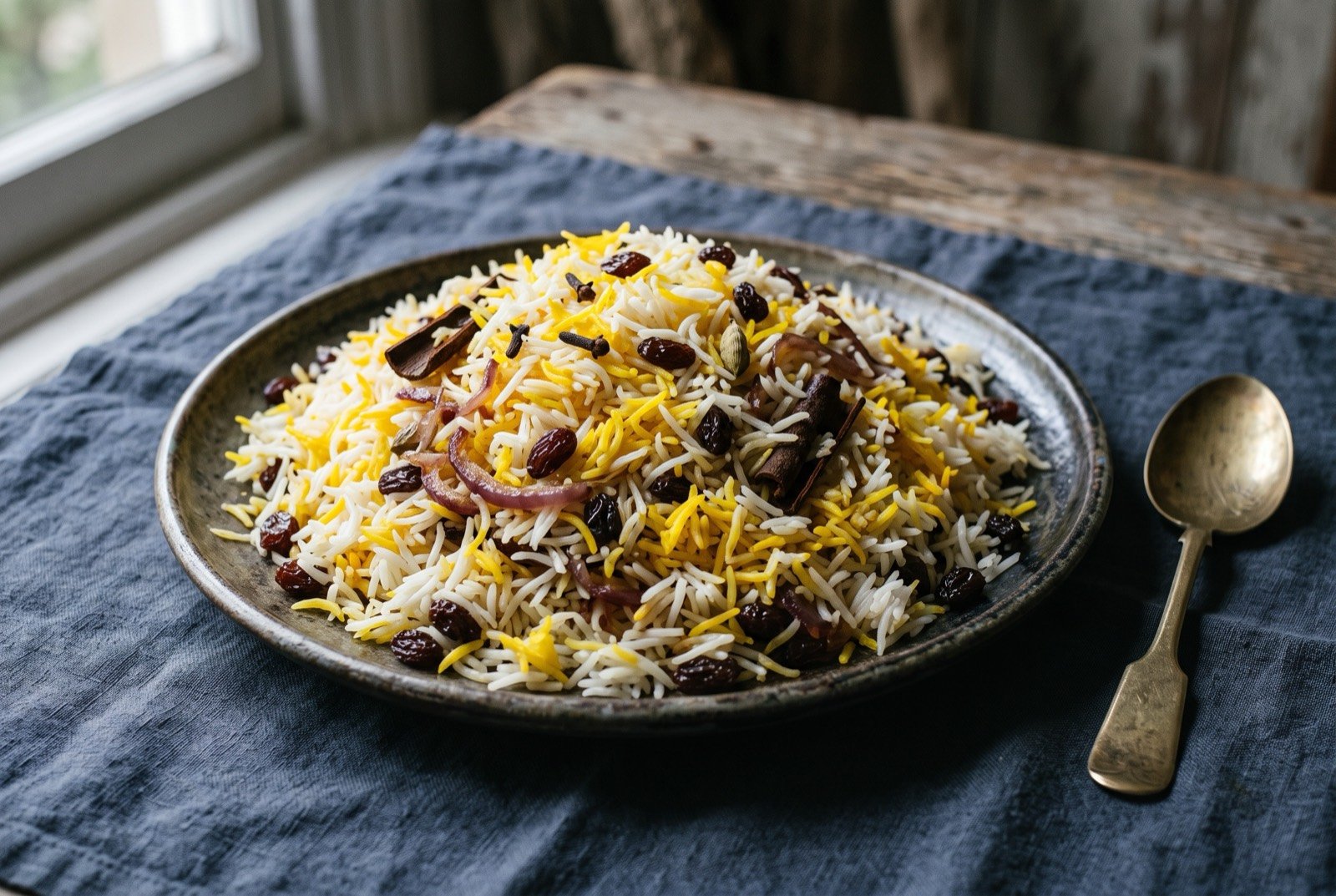
One pan, everything in it. It is at every wedding, every Eid and every restaurant platter in Britain, and it is the dish by which Somali cooking is judged by people who have eaten only one Somali dish. The colour is a signature and it is not uniform. Saffron or colouring goes on after cooking and is forked through to streak rather than mixed in, so uniformly yellow rice reads as wrong. The raisins are verified, in the canon and in Hawa Hassan's published recipe, and they read as a Gulf machboos or Yemeni zurbian inheritance arriving through the northern ports; treating sweetened rice as a wedding register rather than an everyday one is defensible, and claiming that authentic bariis has no raisins is not. On the widely repeated caramelised sugar step, see the final section.
As tradition built it
Serves 4. About 45 minutes.
Ingredients
- 2 cups basmati rice
- 1/4 cup olive oil
- 1 red onion, sliced
- 1 cinnamon stick
- 4 whole cloves
- 3 garlic cloves
- 1/4 tsp ground cardamom
- 1 tomato, chopped
- 2 tbsp xawaash
- 1/4 cup raisins
- 4 cups water
- to taste salt
Method
- Rinse the basmati rice until the water runs clear, then soak in cold water 10 to 30 minutes. Drain.
- Soften the red onion in the olive oil with the cinnamon stick, whole cloves and garlic cloves.
- Add the tomato and cook it down until most of its water has gone and it is a jammy paste. This is the only caramelisation in the dish and it does all the work.
- Stir in the xawaash and the ground cardamom, then the rice, raisins, salt and water. The ratio is 2:1 by volume.
- Boil, then cover and simmer about 20 minutes until the liquid is absorbed.
- Colour it if you are colouring it, then fork through so it streaks. Rest before serving.
Notes
After Hawa Hassan.
What a modern chef changes
The braise liquid becomes the rice liquid, and the cook becomes two phases
Rungs 4 and 3
Method
- Make the meat and the rice one dish, not two. Braise 800 g of bone-in lamb shoulder or goat at 71 to 82°C for 75 minutes (goat 90 to 100), strain through muslin, defat in a separator jug, reduce, and use 650 ml per 400 g of soaked rice instead of water. Rung 4. Every grain is now seasoned from the inside and carries gelatin, which is precisely the body a takeaway bariis lacks.
- Caramelise the onions properly, and time it. Eighteen to twenty two minutes to dark caramel before anything else goes in. It is the first thing a rushed kitchen skips and it is not recoverable later with more spice.
- Two-phase the rice. 8 to 10 minutes uncovered on high, folded every 2 minutes; then 18 minutes covered on the lowest heat, with a tea towel under the lid to absorb condensate that would otherwise claggy the top layer; then 12 minutes rest, lid undisturbed. This is the logic of Persian chelow and Yemeni mandi rice.
- Sequence the xawaash. Bloom the cumin, coriander and pepper fraction in ghee for 30 to 45 seconds at the start, add cassia and clove with the liquid, and grind the cardamom in with the turmeric for the last five minutes. Rung 3.