Africa · Volume 11
Somalia & Djibouti
The Indian Ocean Kitchen
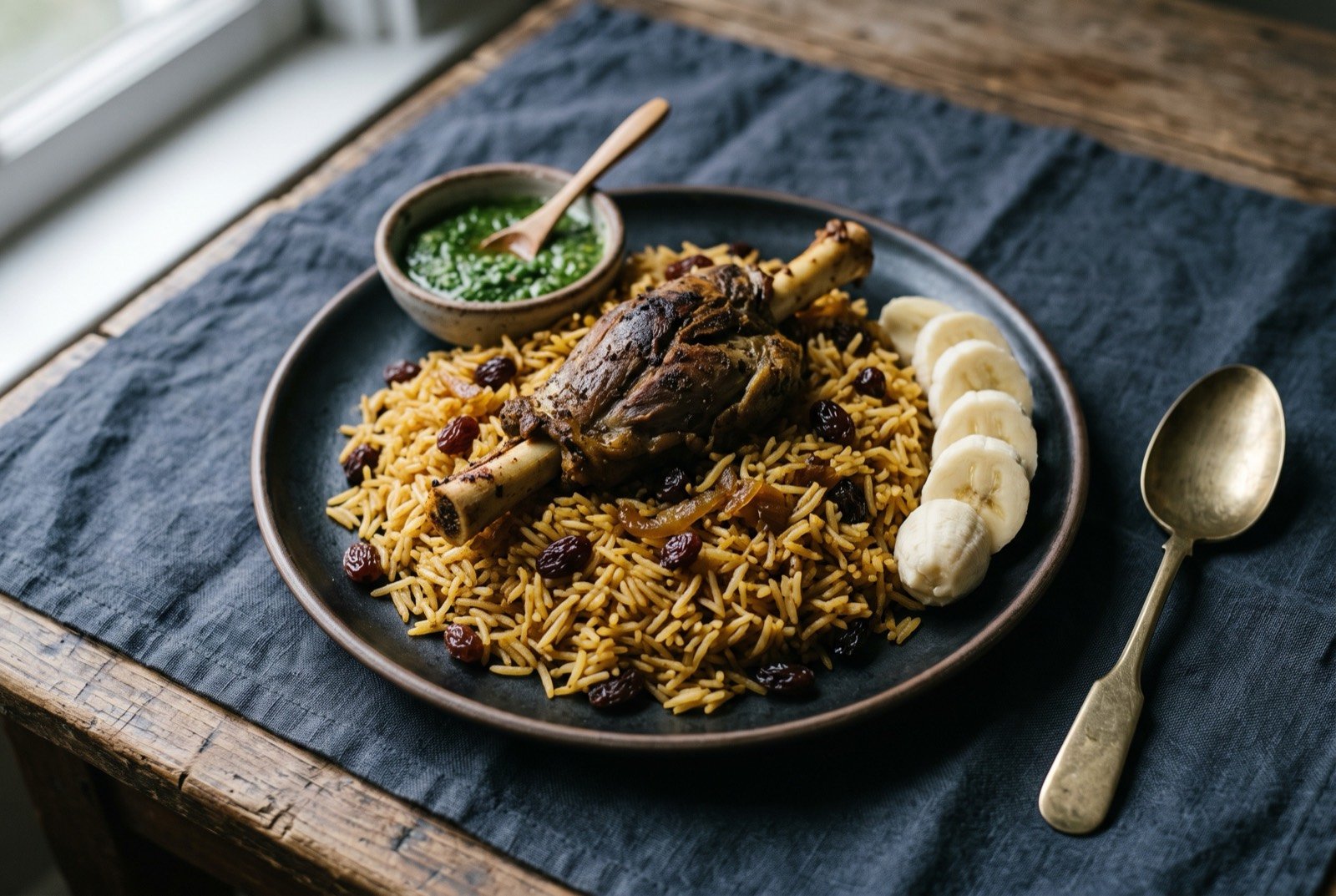
Somalia, Somaliland, Puntland and Djibouti, taken seriously. Four inheritances legible on one plate: African pastoralism, Arabian trade, Indian spice and an Italian empire. The traditional canon as it is actually cooked, a technique ladder built from inside the tradition rather than borrowed, and every dish as tradition built it, then what a modern chef would change.
Sources and review · What this chapter does not assert · How we research · Know this better? Tell us
A Sense of Place
Not two countries. Six culinary worlds, sorted by fat, starch, thickener and aromatic, and the political borders cut across all of them.
Somalia, Somaliland, Puntland, Djibouti and the Somali Region of Ethiopia are the units on the map, not the units in the kitchen. Ask instead whether the fat is ghee or sesame oil or coconut, whether the starch is a flatbread or a rice or a stiff maize porridge, and whether the spice cupboard was stocked by a dhow.
The pastoral interior: the milk and ghee world
Darod, Isaaq, Dir and Hawiye pastoralists across the semi-arid rangeland, and Afar and Issa in Djibouti's hinterland. Livestock raising generates roughly three fifths of Somalia's foreign exchange and exceeds crop production fourfold in value. This is not a farming country with herds attached. It is a herding country with farms in one corner.
The fat is subag, ghee, and camel hump fat. The starch is minimal and largely arrives from elsewhere. And there is no thickener. Broths stay thin, which matters more than it sounds, because thickening is a farming idea: a pastoral kitchen has no surplus starch to spend on body.
Everything runs on four seasons. Gu, the main rains, April to June. Xagaa, dry, July to September, replaced by the karan rains in the northwest. Deyr, the short rains, October to November. Jilaal, the main dry season, December to March. Milk floods in during gu. Jilaal is why muqmad exists.
The inter-riverine grain belt: the sorghum and sesame world
The Rahanweyn and Digil-Mirifle, and the Somali Bantu and Jareer farming communities of the Shabelle and Jubba valleys, growing rain-fed sorghum and irrigated maize, sesame, cowpeas and vegetables.
The fat is sesame oil, sisin as the seed and macsaro as the oil, with ghee second. The starch is soor, stiff cornmeal, and muufo, baked against the wall of a clay oven. The legume is digir, the small red bean under cambuulo. The aromatic register is restrained almost to austerity: sesame oil and sugar do most of the work.
This is the world that gets erased. A diaspora menu in London is coastal and pastoral: rice, goat, pasta, sambusa. The grain belt does not appear on it, and it is the least written-about cuisine in this volume by a wide margin.
The Benadir coast: the coconut and tamarind world
The Reer Hamar of Mogadishu, the Reer Merca, the Bravanese of Barawa, whose language Chimini is a dialect of Kiswahili rather than of Somali, and the Bajuni fishers of Kismayo and the islands. These communities descend from mercantile migration out of what is now Saudi Arabia, Yemen, Oman, Iran and India, some strands as much as 1,500 years old.
Coconut and sesame for fat, rice for starch, tamarind for sour. And this is where the sweets live: xalwo, and gashaato, the coconut, sugar, oil and cardamom bar.
Then the rupture. These were communities with commercial wealth and no militia. After 1991 the Reer Hamar were attacked, women and girls raped, businesses looted, and the community displaced to Kenya and then abroad. Somali cooking's most refined register left the country at gunpoint, and several London Somali kitchens are, in effect, Benadiri kitchens in exile.
The Gulf of Aden corridor: the Yemeni world
Zeila, Berbera, Bosaso, Aden and Djibouti City, and thirty kilometres of water at Bab el-Mandeb. Yemenis are Djibouti's third community after the Issa and the Afar.
The defining technology is the tinaar or tanoor, an upright clay oven and a direct cousin of the tandoor: bread is slapped on the wall, fish is speared on a rod and dropped into the fire. Down this corridor travel laxoox, which is Yemeni lahoh, plus haneeth, mandi, maraq and shaah. And the spice blend: xawaash comes from the Arabic hawa'ij, حوائج, essentials, and Somali xawaash is closest to the Adeni soup blend with turmeric and cinnamon added. Aden is the hinge, not Sana'a.
The Italian layer, and Djibouti's own crossroads
Pasta, tomato paste, sponge cake (doolsho), steak (busteeki), and above all the banana, concentrated in Mogadishu and the plantation valleys at Jenaale, Genale, Merca and Jowhar. It gets its own section below, because it is the best documented layer in the volume and because it is routinely treated as a joke.
Djibouti is Afar plus Issa plus Yemeni plus French plus a heavy Ethiopian trade: fah-fah, also soupe djiboutienne; skoudehkaris; lahoh, sambusa, bajiyos, and garoobey, oats soaked in milk with cumin. The French layer is real, from baguette next to canjeero to a technical inheritance of stock and reduction that most Somali home cooking does not have. Djibouti is also where this chapter's sourcing is thinnest, and I say so in full at the end rather than dress up an encyclopedia entry as fieldwork.
The diaspora plate
The federation: rice and spaghetti in equal halves on one plate, with stewed meat, vegetables, salad and a banana. It is named after the 1960 union of British Somaliland and Italian Somalia. The Indian Ocean and the Italian empire, side by side, named after a political act.
The History in Layers
The indigenous foundation
Pastoralism first, and it structures everything downstream. The fat is ghee. The protein is milk and meat. The preservation is drying plus fat exclusion. The calendar is jilaal, gu, xagaa, deyr.
The coast behaves oddly. Somalia has the longest coastline in mainland Africa at 3,330 km and a per capita fish consumption of about 2.4 kg a year, usually explained as a fish taboo. The FAO and FSNAU study of 25 locations in 2011 says the opposite: fish is religiously and culturally acceptable and considered halal, and low consumption comes from pastoral preference for red meat and from access. Print preference and access. Do not print taboo.
The Indian Ocean, and 1331
Ibn Battuta reached Mogadishu in 1331 and was fed three times a day for three days as the Sultan's guest. The account records rice topped with ghee with a sauce of meat, chicken, fish and vegetables; unripe banana cooked in milk; soured milk with a pickled lemon; pickled chillies in vinegar and salt; green ginger; and mangoes.
Rice under ghee is still bariis. Soured milk with a preserved citrus is still the pastoral larder. Green ginger and pickled chilli is the ancestor of basbaas, except that the chillies cannot have been Capsicum in 1331, because Capsicum was still in the Americas. Something has been retrofitted by a translator, and this chapter does not claim to know what the Arabic says. The one dish on that table that has vanished is the unripe banana cooked in milk, and it is the strongest single argument that bananas in Somali cooking are far older than the Italians.
The Columbian Exchange
Maize, chilli, tomato, potato and papaya all arrive after 1492. Maize reorganised the farming belt and gave it soor, muufo and the maize in a third of canjeero batters; chilli renamed heat itself, since basbaas is now the word for chilli and for the sauce; tomato made suugo possible and potato made nafaqo possible. So a great deal of what reads as ancient Somali food is at most four centuries old, which is the observation this atlas made about maize on the Ewe coast in Volume Four. The Americas supplied the plants and the Horn supplied the cooking.
The Italian colonial economy, in detail
The scholarship to read is Diana Garvin's work on bananas and Italian Somaliland. Her argument is that Italian banana growing in Somalia was a modernist colonial project rather than agriculture as such, tying Fascist imperial ambition to food autarky at home.
- 1911. Law 820 gives Italian farmers leases on Somali land. 1920: Prince Luigi Amedeo founds Villaggio Duca degli Abruzzi near Jowhar, 25,000 hectares at 24 million lire, run by SAIS, which switches to bananas exclusively in 1925 after flood and plague. By 1926 it has absorbed sixteen townships, employs 3,000 Somali and 200 Italian workers, and is linked to Mogadishu by a 114 km railway.
- Labour. SAIS first paid 3.5 lire a day for men, 2.5 for women and 2 for children, then from 1925 shifted to corvée. A hut tax pushed farmers off their own plots into wage labour, and an advance payment system created legal liability for breaking a contract. Wages became conscription.
- 1933. 115 concessions over more than 30,000 hectares, Jenaale alone exporting 126,500 quintals a year. The export curve: 1926, 45 hectares and zero quintals to Italy; 1931, 16,884; 1937, 226,525; 1939, 320,000.
- 1936. Shipping and marketing consolidate into RAMB, a state monopoly running the chain from soil to shop, with Genale and Merca supplying 90 per cent of exports. The technology is a cold chain: refrigerated ship chambers at 13.5 to 15°C to suspend ripening, and ethylene gas chambers on Italian docks to force uniform yellowing on arrival. 1938: Mussolini authorises a price cut to make bananas popular at home and Case della Banana kiosks open across Italy. 1963: the Banana Scandal, and RAMB is abolished. 1969: Siad Barre nationalises the plantations.
- 1987 to 1990. Peak: over 120,000 workers and 96 million US dollars of export value. By 1997 the industry was at a standstill, killed by war and then by El Niño flooding.
Garvin's closing point should not be softened: the same RAMB propaganda that made the banana an emblem of Italian empire is why bananas are still thrown at Black Italian politicians and footballers.
Now the pasta. Italy's presence in southern Somalia ran from the late nineteenth century into the 1940s and included massacre, subjugation and segregation. Hawa Hassan's own headnote says plainly that the colonisation had a lasting impact on Somali cooking, and Hannah Giorgis has framed the adoption of Italian dishes as a culinary rebellion. This chapter's position: Somali pasta is not a curiosity and it is not a punchline. The dosage settles it. Hassan's published suugo suqaar puts three tablespoons of xawaash into one pound of beef, and no Italian ragù has ever been seasoned like that. The technique came in with an empire, the seasoning stayed Somali, and the result is a third thing.
Djibouti, and the twentieth century rupture
French Somaliland, then the French Territory of the Afars and the Issas, independent in 1977. One Djibouti City restaurant was founded by Omar Hamdani's grandfather, who emigrated from Yemen in the 1920s, and a Djiboutian diner, Abubakar Moussa, describes the Yemeni fish as a recipe imported from Yemen that Djiboutians have made their own. That is what a crossroads cuisine looks like from the inside: not fusion, but a hundred years of ownership. For Somalia, 1960 brought union and 1991 brought collapse, and everything in the sourcing section below exists because of that year.
Britain, and how old this actually is
Cardiff is the origin point and it is far older than almost anyone realises. The Suez Canal opens in 1869; the first Somalis arrive in Cardiff in 1894, as skilled sailors on merchant ships, alongside Yemeni settlers; Masjid Noor El-Islam opens in Butetown in 1947, the first purpose-built mosque in Wales, founded by Somali and Yemeni seamen. The civil war brings women and children from the late 1980s, and the 2021 census records about 10,000 Somali residents, reported to be the highest number of British-born people of Somali heritage anywhere in the country. Bristol has about 20,000 people of Somali heritage, and Somali is the third most spoken language in the city.
Leicester is a different kind of community, and the difference is the story. The 2011 census recorded 3,209 residents born in Somalia, up 268 per cent from 872 in 2001, concentrated in Spinney Hills, Stoneygate, Charnwood and Beaumont Leys, which together hold 68 per cent of the city's Somali speakers. And then the number that changes how you read a Leicester cafe: in one study, 56 of 127 research participants had previously lived in the Netherlands. This is a twice migrant community, arriving via the Netherlands and Scandinavia rather than direct from the Horn. So a Leicester Somali cafe is often a Dutch-Somali cafe, run by people who cooked in Rotterdam or Tilburg before they cooked in Highfields. Nobody writes about this, and it is the best unwritten angle in the volume.
London held 65,333 Somali-born residents at the 2011 census, and the essential piece of writing on the food is Halimo Hussain's Vittles essay of 21 March 2025, which names the current map: the strip of maqayaads near Streatham station, plus Sabiib, Al-Kahf, Brothers and Rayaan. And Hussain asks the question this book has to answer. Confronted with the framing of Somali restaurants as undiscovered hidden gems, she asks: "Hidden to who?" The honest answer is that nothing here is hidden from Somalis. What is thin, verifiably and measurably thin, is the documentation: the recipe literature, the technique writing, the criticism, the food science. Two of the most important Somali food resources ever built online are dead domains as I write. That is a gap in the record rather than a gap in the culture, and it is the one this volume is trying to fill.
The Flavour Arsenal
If you buy nothing else, buy whole cardamom, whole cumin, whole coriander and real butter ghee. Those four decide more of the plate than everything else combined.
The spice cupboard, which is an Indian Ocean map
| Somali | English | Botanical | Character and use |
|---|---|---|---|
| heyl | green cardamom | Elettaria cardamomum | Eucalyptus, camphor, citrus peel. The defining Somali aromatic and the most fragile. Dosed hard: 10 pods to 4 cups of tea, 4.5 per cent of sugar weight in xalwo |
| kamuun | cumin | Cuminum cyminum | Earthy, resinous, faintly bitter. Co-equal with coriander and jointly the base of xawaash. Toasted 2 minutes, no more |
| kabsaro | coriander seed and leaf | Coriandrum sativum | Seed citric and floral; leaf the finishing herb of almost every dish and half the mass of basbaas. Chemically unrelated, never interchangeable |
| qarfo | cinnamon or cassia | Cinnamomum spp. | Sticks bruised into rice and tea, broken and toasted into xawaash. Cassia is the right choice; whether Somali cooks historically used true cinnamon is unresolved |
| dhagayare | cloves | Syzygium aromaticum | Penetrating, medicinal, stable. 1 tsp whole in a batch of xawaash. The spice most likely to bully the blend |
| huruud | turmeric | Curcuma longa | Colour and earth. Never toasted, added after grinding. The one raw ingredient in the blend |
| filfil | black pepper | Piper nigrum | 2 tbsp per xawaash batch. Contested in tea, see the final section |
| basbaas | chilli | Capsicum spp. | The Columbian arrival that renamed heat. Diner controlled, never cook controlled |
| sinjibiil | ginger | Zingiber officinale | In tea, and in the second stage of a goat braise as ginger and garlic paste |
| hilbeh | fenugreek | Trigonella foenum-graecum | One of the canjeero flavourings, with garlic and black cumin |
The fats, which are not interchangeable
Subag, ghee, is the keystone: the preservation medium for muqmad, the doneness indicator for xalwo, and the finishing drizzle 40 per cent of surveyed households put on their canjeero.
The single most damaging substitution in diaspora Somali cooking is "vegetable ghee". It sits in an identical tin at a fraction of the price and it is hydrogenated palm or rapeseed fat: no butterfat, no butyric acid, no lactones, none of the browned milk solid notes that make subag taste of anything. Real ghee is granular and pale gold at room temperature, smells nutty when warmed, and clears to a bright transparent liquid; vegetable ghee is waxy, smells of almost nothing, and stays cloudy.
Macsaro, sesame oil, is the farming belt's fat and a separate register. It is still pressed on grindstones turned by a blindfolded camel walking in circles, and Somalis pay a premium for it over factory oil. It sits between a cold-pressed light sesame oil and a lightly toasted one, and it is nothing like dark Chinese toasted sesame oil. The reporting does not confirm whether the seed is roasted before pressing, so this chapter does not claim it is. Qumbe, coconut, belongs to the Benadir coast only.
The sour and the sweet, which are structural
Tamarind, raqey, is the coastal souring agent and a cordial in its own right; lime and lemon carry the acid elsewhere, and the rule is that they arrive off the heat.
Sweetness here is not decoration and not a Western softening. Sugar is in the basbaas. Raisins are in the rice. A banana sits beside the plate. All of it does one job: fructose and glucose suppress the perception of capsaicin heat and of salt, so removing the sweetness does not make the plate more serious, it makes it read harsh. That is the argument for the banana, and it is better than "Somalis like bananas".
Shaah, and how it is actually built
Shaah is the general word; shaah bigays is spiced tea without milk; shaah cadeeys is spiced tea with milk added after brewing.
A documented shaah bigays: 4 cups water, 10 cardamom pods, 1 cinnamon stick broken in half, 3 cloves, 3 peppercorns, 2 tea bags, sugar to taste. Crush the spices, bring the water and the sugar to the boil together, add the spices and steep 5 minutes, add the tea and steep 2 minutes only, strain. The sugar goes in at the start, so the tea is brewed into a syrup rather than sweetened afterwards, which is why Somali tea reads round rather than sugary; and the spices get a five minute head start while the leaf gets two, so you extract the aromatics fully and the tannin barely at all. That two minute leaf steep is the most commonly botched step in the cuisine.
And the meal does not end with the plates. Luubaan is frankincense, uunsi the prepared incense, and the dabqaad the soapstone burner it goes on over charcoal. It burns about ten minutes and scents a room for hours. It is not food and it is not smoked into the food. It is the closing move of Somali hospitality, and any account of eating in a Somali house that stops when the plates are cleared has stopped too early.
Part Two
The Technique Ladder
First, an honest problem
There is no Michelin starred Somali or Djiboutian restaurant anywhere in the world, and no Somali heritage chef holds a star for Somali cooking. Michelin publishes no guide covering either country. That is the state of the world, not a hole in the research.
What exists instead is named in full in Voices and Sources below: a London scene that went mainstream in the last eighteen months, led by Sabiib, Al Kahf and Damal; Ahmed Jama, who took a London career back to Mogadishu and kept reopening a bombed restaurant, though all the coverage I have of him is a decade old; an announced but unopened American tasting-menu project; and a body of published authors, chiefly Hawa Hassan and Ifrah F. Ahmed, who are doing the technical work the restaurants are not.
So the six rungs below are not copied off anyone's tasting menu. Each is a Somali or Djiboutian technique done deliberately and measured, and two come out of a peer-reviewed survey of forty six Somali women's kitchens.
Rung 1. Treat canjeero as a maintained live culture and measure it
The best evidenced technique in this volume comes from a 2022 field survey in the Journal of Ethnic Foods, which interviewed 46 Somali women aged 17 to 70, mean age 34, across nine locations in Somalia, Puntland, Somaliland and Ethiopia's Somali Region, between July 2020 and February 2021.
Seventy seven per cent ferment spontaneously. Twenty three per cent backslop with dhanaanis, the previous day's batter, at 120 g of dhanaanis to 750 g of flour. A further 23 per cent deliberately leave the fermentation container unwashed to speed the next batch, which makes it a resident-culture vessel exactly as a sourdough crock is. Eighty six per cent ferment overnight in the kitchen, chosen as the warmest room. Sixty five per cent extend the ferment in cold seasons and thirty per cent shorten it in hot ones. Not one respondent used commercial yeast routinely. The culture is the dish.
Why it works. Wild lactic acid bacteria produce lactic and acetic acid and drop the batter pH. The acid partially hydrolyses and weakens the gluten network, which is what gives canjeero its tender, lacy, non-elastic crumb, where a chemically leavened batter keeps its gluten intact and cooks up rubbery. The bacteria and wild yeasts generate esters, diacetyl and higher alcohols that no chemical leavener produces, and that is the entire flavour difference between canjeero and a pancake. And the acid drop suppresses spoilage organisms, which is why the tradition works without refrigeration.
Keep a dhanaanis, feed it, weigh it at 120 to 750 rather than spooning it, and buy pH strips in the 3.0 to 6.0 range. You are not importing sourdough science into a Somali kitchen. You are measuring what forty six Somali cooks already do by feel.
Rung 2. Adopt cajiin, the pre-gelatinised scald
The highest leverage single change available here, and also the sharpest regional divide in the cuisine. One hundred per cent of southern Somalia respondents used cajiin. Zero per cent in Somaliland and zero per cent in the Ethiopian Somali Region did. Cajiin is a portion of flour cooked with water into a paste, cooled, and folded into the main batter; commercially it is machine kneaded for 25 to 60 minutes and sold as single batch balls in evening markets, for the buyer to ferment overnight at home.
Why it works. Heating starch in excess water above its gelatinisation range bursts the granules and lets them absorb several times their own weight in water, water that is then held rather than free. The finished bread carries more water at the same batter viscosity, so it stays soft and foldable for hours instead of drying and cracking, which is the precise failure mode of diaspora canjeero sitting on a counter. And gelatinised starch is far more accessible to amylase than a raw granule, so the scald feeds the ferment and accelerates acid production.
This is the mechanism of Japanese yudane and Chinese tangzhong, and the job done by Ethiopian absit and Yemeni sharaba. It was arrived at independently in southern Somalia, and it is the technical bridge between three breads usually discussed as rivals. It also settles the Hargeisa question: a northern canjeero is a multi-grain bread with no scald, a Mogadishu canjeero is a wheat-led bread with one, and a restaurant claiming both cities is claiming two different doughs.
Rung 3. Treat xawaash as a sequence, not a recipe
Every household has its own xawaash and every Somali cook will say so. True, and a distraction, because at restaurant level the difference is not the proportions. It is three sequencing decisions: what gets dry toasted and for how long, what gets bloomed in fat rather than added to liquid, and what gets held back and added late.
Cumin and coriander want early toasting and early blooming. They run 4:1 over everything else by volume in the published formula, and their aromatics are fat soluble, so blooming for 30 to 45 seconds does more than five minutes of simmering. Turmeric is never toasted, because heating an already ground spice in a dry pan bitters it and dulls the colour. Clove bullies the blend, because eugenol is potent, stable and does not fade with cooking. Cardamom is the most fragile, must be ground last and added latest, and is the reason a good bariis smells expensive.
And here is the failure this rung exists to prevent. Xawaash bought pre-ground in kilo bags and kept in an open tub in a hot kitchen loses its volatile fraction within weeks. The heavy, stable, bitter components survive: cassia's cinnamaldehyde polymers, clove's eugenol, turmeric's turmerone. Cooks then correctly perceive the blend as weak and add more, which increases the bitter and medicinal register rather than the aromatic one. This is the most common flavour failure in British Somali cooking, and it is a storage problem masquerading as a seasoning problem.
Rung 4. Build one stock, use it twice, and treat rice as controlled hydration
Two techniques that are really one, because they meet in the same pot.
The stock half. At home and in a takeaway, meat is stewed in water, rice is cooked separately, and the two meet on the plate. At restaurant level the goat or lamb is braised in an aromatic liquid, and that liquid is strained through muslin, defatted, reduced, and used as the exact hydration liquid for the rice. Collagen converting to gelatin during the braise puts hydrolysed protein into the liquid, and gelatin coats the palate and reads as body, which is exactly what thin diaspora bariis lacks. Reduction concentrates glutamates, nucleotides and Maillard products. Defatting matters mechanically: free fat coats rice grains and blocks even water uptake, giving greasy exteriors over hard cores. And cooking the rice in that liquid seasons every grain from the inside instead of saucing it from the outside.
The rice half. Aged basmati, rinsed until the water runs clear, soaked 30 minutes, drained. Roughly 650 ml of defatted reduced broth per 400 g of soaked rice. A high heat uncovered phase of 8 to 10 minutes, then covered on the lowest heat for about 18 minutes finishing on trapped steam, then 12 minutes rest.
Basmati is a high amylose rice, which is why it cooks separate rather than sticky, and why aged basmati elongates instead of splitting. Rinsing removes surface starch that would gelatinise into glue. Soaking pre-hydrates the grain so the core reaches gelatinisation temperature at roughly the same moment as the surface; without it the exterior swells and ruptures while the centre is still chalky. The uncovered phase drives rapid absorption, the covered phase finishes on steam, and the rest lets moisture equalise between grains for the same reason you rest a steak.
One honest caveat. The 650 ml to 400 g figure and the two-phase timings come from a technically literate but self-published source, not from peer review, so treat them as a starting point to calibrate against your own pan.
Rung 5. Manage collagen deliberately, and refuse dry high heat on goat and camel
The research is unusually emphatic, and it comes from a study comparing four cooking methods on camel meat.
| Method | Hardness, grams, lower is more tender | Cooking loss |
|---|---|---|
| Boiled | 1,923.5 | Highest moisture retained |
| Grilled | 2,122.4 | 44.98 per cent, the lowest loss |
| Fried | 2,327.3 | |
| Microwaved | 2,716.5 | 52.61 per cent, the highest loss |
Boiling also gave maximum collagen solubility at 26.6 per cent, the greatest protein degradation, and the lowest lipid oxidation. The authors concluded that boiling is the more appropriate method because it reduces both lipid oxidation and toughness.
Why. Goat and camel are lean, with a high ratio of connective tissue to intramuscular fat and, in older animals, heavily crosslinked collagen. Conversion to gelatin begins meaningfully above roughly 60 to 65°C but is a function of time as much as temperature, so the win comes from long holds at modest temperature rather than hard boiling, which contracts and wrings out the fibre at the same moment it is trying to soften. Hold the braise at 71 to 82°C and never let it roll.
The lipid oxidation finding is the part most cooks miss. Camel and goat fat is comparatively unsaturated and prone to oxidative rancidity under dry high heat, so the cardboard and tallow off-notes people attribute to the animal are usually attributable to the cooking. Wet, low and long, and then, if you want surface Maillard, a fast dry sear at the very end and for that purpose only. That is not a French finishing trick imported into a Somali kitchen. It is exactly the structure of hilib ari, which has always been a stock first and an aggressive second cook, in that order.
Rung 6. Engineer contrast: acid late, sweetness deliberate, texture stacked
A default Somali platter is meat, rice, a wedge of banana and a squeeze bottle, everything soft at the same temperature. Three deliberate moves fix it, none of them imported.
Acid goes on at service, off the heat. Coriander leaf's character is volatile aldehydes destroyed by heat and lost within minutes of blending, and citric acid degrades on standing, so a basbaas made in the morning and left under a heat lamp tastes of nothing but heat by evening. Made to order it keeps its aroma, and the acid cuts the gelatin and ghee coating the palate, resetting the mouth between mouthfuls. It is a fifteen minute sauce with a two hour peak and a six hour half life.
Sweetness is placed, not defaulted. Banana, raisin and the caramelised onion base are three separate sugar sources and each should be a decision, because sugars suppress the perception of capsaicin and salt. Take the banana away and the plate reads harsher, not cleaner.
Texture is stacked on purpose. Crisp against soft is the most reliable perceived-quality lever in any cuisine, because contrast forces attention, and a uniformly soft plate reads as one flavour however well seasoned. This cuisine owns the perfect crisp component and mostly leaves it in the cupboard: muqmad.
Why the takeaway version disappoints, which is not a cooking problem
Vittles reported a lamb and rice platter at £14, designed for two and comfortably feeding four, and that generosity, genuine and rooted in hospitality values, is the constraint that determines everything else: at three to seven pounds a head there is no margin for freshly ground spice, single-portion cooking or aged basmati. Almost all Somali restaurants in Britain are also alcohol free, so food margin carries the whole business where a licensed restaurant leans on wine at 70 to 75 per cent. That is a structural disadvantage with nothing to do with cooking ability, and it is almost never acknowledged in reviews.
Then add hot holding at 63°C for four to six hours, which surface-dries and retrogrades the rice into something simultaneously mushy and chalky, steam-strips the cardamom out of the xawaash so the plate smells of turmeric and clove rather than perfume, and leaches the gelatin out of the meat. The safety pressure behind that holding is real, since Bacillus cereus spores survive boiling and produce a heat stable emetic toxin. The requirement is legitimate; the texture cost is collateral damage, caused by economics rather than judgement. Somali diaspora commentary is blunt about the result, calling London today a downgrade on 2006 to 2020. Nobody is saying the food is inauthentic. They are saying the standard slipped as the format scaled.
Part Three
The Ferment and Preserve Bench
Four things worth keeping on a shelf, all of them methods this cuisine already runs on.
1. Dhanaanis, the maintained canjeero culture
The highest-value object in this chapter, and it costs nothing. Mix 100 g of plain flour with 120 ml of water, cover loosely, leave in the warmest room, and feed daily with the same again, discarding down to about 100 g before each feed. Within four to six days it should be actively bubbling and smell of yoghurt and cider. Then use it at the documented ratio: 120 g of dhanaanis to 750 g of flour. Commercial yeast gives you carbon dioxide and little else; a lactic culture gives acid, which weakens the gluten network into that tender, lacy crumb, plus the esters and diacetyl that are the entire flavour difference between canjeero and a pancake.
And it dies of neglect, which is why takeaways lose it. A dhanaanis needs daily feeding and institutional memory. A kitchen with staff turnover cannot keep one alive, so the bread moves to yeast, then to baking powder, then to bought-in frozen. When the bread stops being sour, the rich sweet spiced stew beside it has nothing to lean against, and everybody reaches for more chilli.
2. Subag, and the larder it makes possible
Clarify 500 g of good unsalted butter: melt slowly, skim the foam, hold at a bare heat until the milk solids turn light brown and the liquid clears, and strain through muslin while hot. Take the solids to a proper nutty brown before straining and you have the browned version, which is better for finishing. Keeps for months in a sealed jar.
Then use it as the tradition uses it: as a preservation medium rather than a cooking fat. Ghee has almost no water and almost no milk solids, so it will not spoil and it excludes oxygen from anything set into it, which is the mechanism behind muqmad and works equally for confit shallots or dried chillies. Never buy "vegetable ghee" for any of this. It will preserve your muqmad perfectly while making it taste of nothing.
3. Basbaas cagaar, and the preservation problem it poses
Included precisely because it is the one thing on this bench that will not keep.
Hawa Hassan's published version, about a cup, five minutes: 120 ml full-fat unsweetened coconut milk, 3 tbsp lime juice, 2 tbsp white wine vinegar, a well-packed 120 ml of coriander leaves, 2 jalapeños, 2 large garlic cloves, 2 tsp sugar, 1 tsp salt, blended smooth. A British diaspora version drops the coconut and adds half an onion, half a tomato and 6 to 8 green chillies, with vinegar and lemon for the acid.
The structural constant across every version is green chilli, coriander leaf, garlic, an acid and sugar, and the sugar is not a Western softening: it is in both. The coconut milk is a coastal Benadiri fork, legitimate and not the default.
Two things matter more than the recipe. It arrives on the side and each diner spikes their own plate, so a kitchen that seasons the heat into the dish has taken that decision away from the table. And it does not keep, because coriander aldehydes are lost within minutes of blending and citric acid degrades on standing; use a mortar rather than a blender, which aerates, warms and oxidises. Which is why a shelf-stable basbaas is a hard modernist problem, and why the person who took it on is a Somali woman with a sauce company rather than anyone with a restaurant.
4. Suusac, soured camel milk
The Somali dairy tradition is a souring and fermenting tradition, not a cheesemaking one, and the protein chemistry is the reason. Camel milk carries kappa-casein at 3.5 per cent of total casein against 13 per cent in cow milk, micelles around 380 nm against 150, fat globules averaging 2.99 micrometres against 3.95, and no beta-lactoglobulin at all. Kappa-casein stabilises the micelle and lets rennet coagulate milk into a clean curd, so camel milk will not make good cheese: the curd is weak and fragmentary. It also creams slowly and needs 20 to 25°C to churn against 8 to 12°C for cow milk, and the missing beta-lactoglobulin, the protein that gives boiled cow milk its skin and cooked flavour, is why camel milk tastes cleaner when heated and tolerates being boiled into tea. So a culture that had camel milk and no rennet did not fail to invent cheese. It correctly declined to.
To make suusac, hold raw or gently pasteurised camel milk at 25 to 30°C in a covered jar and let it sour over 24 to 48 hours, or backslop with a spoonful of the last batch. It will not set to a firm gel: expect a drinkable, tart, slightly effervescent soured milk. Raw milk is not for pregnant women, young children, the elderly or the immunocompromised. And honestly, the review supplying the chemistry concedes that systematic documentation of traditional Somali practice is limited, so read the method as a British reconstruction of a tradition nobody has properly recorded.
Sourcing in Britain
Verified August 2026. One correction matters more than anything else here: Cabrito Goat Meat Ltd, for years the highest-profile British kid goat supplier and still listed by cookbooks and blogs, passed a special resolution for voluntary winding-up on 12 October 2023 (company number 10270956, liquidators FRP Advisory), and its domain now redirects to a gambling affiliate page. Any guide still listing Cabrito is three years out of date.
The suppliers that decide everything
- Chestnut Meats, Longfields Farm, Long Lane, Brindley, Nantwich CW5 8NF, 01270 524750. Adult goat on and off the bone, kid goat, mutton, whole goat butchered for shipping. Next-day nationwide by temperature-controlled courier, vacuum packed, full British traceability, free delivery over £150. This is your primary goat source now that Cabrito is gone.
- Sous Chef (free delivery over £60) and Steenbergs of Ripon, between them the best mail-order whole spice in Britain. Buy Wholefoods Online and Shipton Mill for sorghum flour, Tobia Teff UK for teff.
- Hooyos House (hooyoshouse.com), Somali-run, selling xawaash, Arabic coffee and Somali tea blends. The only Somali-specific UK spice brand I could find, and only partially verified: no ingredient breakdown or prices on the pages checked, so order small and taste before relying on it.
- Camel milk: UK Camel Milk Ltd (raw frozen and powder) and Desert Farms UK, whose delivery terms were not stated on the pages checked, so confirm at checkout. Raw milk warnings apply.
- Camel meat: do not go looking. I could not verify a single UK retailer selling camel meat to consumers. Use mutton or adult goat on the bone, cooked by the wet, low, long method the camel research validates, and treat camel as a passage of the story rather than a shopping list.
Where the cuisine actually lives
London held 65,333 Somali-born residents at the 2011 census. Al Kahf at 91 Whitechapel High Street E1 7RA is verified trading, and Whitechapel Market sells green chilli, coriander by the bunch, bananas and limes at market prices; Sabiib has two verified sites, in Acton and on Green Lanes; Damas Gate on Uxbridge Road is one of the best places in Britain for whole spices, ghee, bulk rice and dates; and Southall is where you buy basmati by the sack and whole spices by the kilo on the highest turnover in London. Maida in Streatham is closed.
Cardiff is the most historically important Somali city in Britain outside London: Bute Street in Butetown for Togayo Cafe and Masjid Noor El-Islam, City Road and Clifton Street for halal butchers. Bristol runs along Easton and Stapleton Road, with Malik Foodstore and The Best Supermarket & Halal Butchers at BS5 0PU; Karamel Cafe on Stapleton Road is the Somali cafe currently being documented, though only by food reviewers, and its trading status is unverified. Leicester is the best pure spice-buying city in Britain, on Belgrave Road, where very high turnover is the best guarantee of freshness, though the July 2025 counterfeit basmati arrests were partly there, so buy sealed branded bags from a busy shop.
Elsewhere: Birmingham on Alum Rock Road and Ladypool Road, plus the Bullring Indoor Market for goat, mutton and offal; Manchester at Cheetham Hill and Rusholme; Leeds at Harehills; Sheffield at Burngreave; Liverpool on Granby Street and Lodge Lane; Glasgow in Govanhill. I could not verify a named Somali restaurant currently trading in Leeds, Glasgow or Newcastle. Phone ahead everywhere outside London.
The ranked list: what decides great from grim
- A live dhanaanis. Without acidity in the bread, the whole meal has nothing to lean against.
- Whole spices ground to order for xawaash. Pre-ground blends leave you with clove, cassia and turmeric, which is what dusty and medicinal tastes like.
- Real butter ghee, never vegetable ghee. Butterfat lactones and browned milk solids are the flavour; hydrogenated palm fat is a texture with no aroma.
- Aged basmati from a sealed branded bag, for separate elongated grains, and because UK basmati fraud is an active enforcement matter.
- Bone-in goat, kid or mutton, fresh not frozen. The bone is where the gelatin comes from, and gelatin is what makes bariis taste rich rather than merely spiced.
- Green cardamom, whole pods, ground last. Its absence is why held rice smells of turmeric instead of perfume.
- Coriander leaf and lime bought the same day, for basbaas made to order.
- Whole cumin seed, which also sidesteps the ground-cumin allergen risk documented in 2014 and 2015, when ground cumin was found contaminated with undeclared peanut and almond protein.
- A defatted, reduced braise liquid used as the rice water, which functions as an ingredient and is the largest single flavour gap between home and restaurant bariis.
- Cold-pressed light sesame oil, fresh, a whole flavour register that vanishes when someone substitutes vegetable oil.
- Red sorghum flour in the budo, for a canjeero with character rather than a pancake.
Quality markers, and two real risks
Cardamom pods should be plump and pale green with sticky black seeds inside; khaki, shrivelled or rattling pods have dried out, and black cardamom is not a substitute and will ruin a bariis. Cumin and coriander seed should smell distinctly of themselves when crushed between your fingers. Use cassia, not Ceylon cinnamon, for xawaash. Cloves should be oily enough to mark under a fingernail, with the head intact, because the head holds most of the eugenol. Sesame oil goes rancid fast, so buy small, buy dark glass and smell it every time.
Turmeric is the one genuine safety risk here. It is among the most commonly lead-adulterated spices in world trade, with lead chromate added to intensify the yellow, documented across South Asia, and the UK Committee on Toxicity published an overarching statement on turmeric in December 2024. Genuine turmeric is a muted mustard-ochre, not a screaming lemon-yellow, and whole dried fingers are far harder to adulterate than powder. Basmati is the other. The UK Code of Practice permits no more than 7 per cent of another rice variety in a basmati pack, DNA authentication is run by Bangor University, the FSA and public analysts, and the July 2025 investigation led to four arrests in Leicester and London. Red flags are poorly printed labels, misspellings, broken seals and unusual pricing.
Two things this chapter will not send you to buy: Yemeni Sidr honey, because every UK seller I looked at was unverifiable in a category with a very high fraud rate, and electric injera griddles, because almost every 16 inch mitad listed online is a US 120 V unit.
The kit that matters is short: a 28 to 30 cm carbon steel or cast iron griddle with a tight domed lid for canjeero, digital scales to 1 g, pH strips reading 3.0 to 6.0, a probe thermometer to 200°C, a dedicated spice grinder, a chinois and a fat separator jug, a stone mortar for basbaas, a dehydrator for muqmad, and a genuinely sharp knife, because suqaar is a knife dish.
Voices and Sources
From inside the tradition
- Hawa Hassan, born Mogadishu in 1985 or 1986, out of the country at four, a camp in Mombasa, then Seattle alone at seven, reunited with her mother in Oslo fifteen years later. She founded Basbaas Somali Foods in 2014 after learning her mother's sauce recipes on that reunion trip, and In Bibi's Kitchen (Ten Speed, 2020, with Julia Turshen) won the 2022 James Beard Foundation Award for Best International Cookbook. Be precise about what she is: an author, product founder and broadcaster, not a restaurant chef, holding no Michelin recognition. Her published xawaash, bariis, suqaar, suugo suqaar and basbaas cagaar are the backbone of the recipes here, and the book is in print in Britain. Buy it first.
- Ifrah F. Ahmed, author of Soomaaliya: Food, Memory, and Migration (Hardie Grant). Her malawax is the version used here, and her insistence that malawax is a crepe and canjeero a bread is the kind of distinction that only comes from inside a tradition.
- Halimo Hussain, London-based Somali cook and writer, whose Vittles essay of 21 March 2025 is the essential piece of writing on Somali food in Britain, and whose question, "Hidden to who?", this chapter has tried to answer rather than deflect.
- Leila Adde and Abdullahi Kassim, who started the Xawaash blog in Kitchener, Ontario in 2011 after realising the older generation's recipes were about to be lost. It became the reference text for a generation of diaspora children and closed around 2015 when they opened a Toronto restaurant. The site is now offline and returns a redirect loop, and this is a real loss.
- Ahmed Jama, The Village, Mogadishu, who took a London career home around 2008, was bombed repeatedly, lost staff and customers in a September 2013 attack, and kept reopening. All the coverage I have is 2012 to 2013, so he is here in the past tense. Maymun Abukar, Toronto, gave the cambuulo method above; Abdirahman Kahin of Afro Deli was US National Small Business Person of the Year in 2023 and is behind the unopened Martiya; Margaret Wanjiru of the Eastleigh Voice wrote the only account I found documenting a Somali bread losing its oven in the present tense.
- Sabiib (Acton and Haringey), Al Kahf (91 Whitechapel High Street), Damal (east London), Brothers and Rayaan. Sabiib was named London's best East African restaurant by Time Out on 4 December 2025, and its hummus oodkac is the single smartest piece of restaurant thinking in this cuisine.
The peer-reviewed spine
Wolgamuth and Yusuf's 2022 survey of laxoox and canjeero production in the Journal of Ethnic Foods, built on interviews with 46 Somali women across nine locations, is the best piece of Somali food research in existence and is the source for every percentage in Rungs 1 and 2. A 2023 characterisation in Foods supplies the crumb cell densities and the red sorghum finding. Add a study of camel meat cooking methods and a 2023 review of camel milk chemistry, and that is almost everything technical here that is not a cook's own testimony.
The gap, named
I could not verify a single named restaurant in Djibouti City from a credible dated source, nor obtain a credible method for skoudehkaris, Djibouti's own one-pot rice and meat dish. The entire Djibouti half of this volume is under-sourced, and it is a structural problem rather than a search-budget one. The material exists in French, in Djiboutian press, and in the heads of Djiboutian cooks, and none of it has been brought into the English-language food record. This chapter treats Djibouti as cuisine and geography rather than as a restaurant guide, and it is a first pass that a French-language research trip and a named Djiboutian contributor would substantially improve.
Things this chapter has deliberately not asserted
The section that makes the rest of it trustworthy.
- That bariis iskukaris contains a caramelised sugar step. Very widely repeated, and I could not verify it from a single credible in-tradition source. Hawa Hassan's published bariis has no sugar at all, and its only caramelisation is the tomato reduced to a jammy paste; the canonical reference gives saffron or food colouring for the hue. The one source describing dark caramelisation is of doubtful provenance and is caramelising onions, not sugar. My working hypothesis, which is a hypothesis and not a finding: the technique is real but belongs to the Gulf and Yemeni machboos and zurbian register that reached the northern ports. Until a Somali cook says otherwise, it is not in this chapter.
- That xalwo descends from Omani halwa. The Gulf family is documented: Qatari halwa is described as a direct descendant of the Omani version, Bahraini halwa is dated to the mid-nineteenth century and attributed to Iraq or possibly Oman, and Omani halwa is starch, sugar, water and ghee, exactly as xalwo is. But I found no source tracing Somali xalwo specifically to Oman. The Somali sources call it a Benadiri speciality and stop. This chapter writes an Indian Ocean family with Oman at its centre, not a descent.
- That canjeero is a sorghum bread. Widely stated and wrong as a general claim. The only field survey found 95 per cent of 46 households using wheat and 30 per cent using wheat alone, with sorghum in 55 per cent as a partner rather than a base. It is regionally misapplied: much truer in Somaliland and the Ethiopian Somali Region, where 100 per cent used more than one grain, than in the south, where 68 per cent used wheat alone.
- That traditional muufo is fermented. General accounts imply a fermented dough; the one worked modern recipe I could obtain uses baking powder and explicitly documents an urban adaptation for kitchens with no clay oven. I cannot reconcile them from the sources available, so the fermented version in dish three is labelled in the text as a modern choice made on flavour grounds.
- That Somalia was the largest banana exporter in Africa. Repeated everywhere, including on Somali sites. What is documented is 96 million US dollars of export value and over 120,000 workers between 1987 and 1990, plus the colonial-era quintal figures above. A continental ranking is in neither source.
- Where banana with rice comes from. There is no documented origin, only folk explanations: banana abundance plus imported rice, or a north and south story in which rice came via British India and bananas from the south. Against a purely twentieth-century origin stands Ibn Battuta being served unripe banana cooked in milk in Mogadishu in 1331. What the Italians changed was scale, variety and year-round supply, not the presence of the fruit. The tension is written and not resolved.
- The Ibn Battuta menu, at one remove. I have that account through a secondary source rather than a scholarly translation, so this chapter describes the meal and quotes none of it; anyone building on it should go to the Hakluyt Society translation. There is also a substantive problem in the text: the pickled chillies cannot have been Capsicum in 1331. Something has been retrofitted by a translator, most likely a Piper.
- The Somali camel milk production figure. A peer-reviewed review gives production as approximately 0.956 million litres a year while also stating that camel milk was 40 per cent of Somalia's total milk output in 2017. Under a million litres at that livestock scale is implausible and is almost certainly a units error, so this chapter uses the share and not the absolute figure.
- That Somalis have a fish taboo. The FAO and FSNAU study says the opposite: fish is religiously and culturally acceptable and considered halal, and low consumption at 2.4 kg per capita a year reflects pastoral preference for red meat, access, monsoon-season beliefs about digestion and worry about bones. Preference and access, not prohibition.
- Any method for skoudehkaris, and most of what circulates about fah-fah. Even the relationship of skoudehkaris to isku-dheh karis is an inference rather than a sourced etymology, and the canonical entry for fah-fah gives no etymology and no variants and calls it a beef soup while the recipe tradition is overwhelmingly goat. The Djibouti gap is named rather than papered over with a plausible-sounding recipe.
- Anything currently attributed to the Xawaash blog. xawaash.com is offline and serves a redirect loop, yet its URLs still populate search results for xawaash spice mix, oodkac, hilib ari la gaduudiyay, muufo, bun and toor, xalwo and nafaqo. Any current article claiming to quote Xawaash is quoting a cache, not the source, and the same is true of somalikitchen.com. This chapter names the recipes those pages carried, because the titles are recoverable, and does not reproduce their methods, because they are not. Recovering that archive is the single most valuable outstanding piece of research for this volume.
- That there is a Michelin star anywhere in this cuisine. There is not, for Somali or Djiboutian cooking, anywhere in the world. Every elevation here is built from mechanism and from the named cooks and researchers above, not from a starred template. That constraint made this a better chapter rather than a thinner one, because it forced each rung to justify itself against a measurement instead of against somebody's tasting menu.
- The Somali spellings, which a Somali reader will check. Kabsaro for coriander rests on a single ingredient list; dhagayare and qaranfuul both appear for cloves; whether qarfo denotes true cinnamon or cassia is unresolved; and canjeero, anjero, laxoox and lahoh are used by different communities in ways this chapter has not established. These proofs should be read by a Somali speaker before they are trusted.
Volume Eleven of Not Just Stew. Research briefs: vol11-tradition.md and vol11-modernist-sourcing.md. Sourcing verified August 2026.
Treat canjeero as a maintained live culture and measure it
The best evidenced technique in this volume comes from a 2022 field survey in the Journal of Ethnic Foods, which interviewed 46 Somali women aged 17 to 70...
Adopt cajiin, the pre-gelatinised scald
The highest leverage single change available here, and also the sharpest regional divide in the cuisine.
Treat xawaash as a sequence, not a recipe
Every household has its own xawaash and every Somali cook will say so.
Build one stock, use it twice, and treat rice as controlled hydration
Two techniques that are really one, because they meet in the same pot.
Manage collagen deliberately, and refuse dry high heat on goat and camel
The research is unusually emphatic, and it comes from a study comparing four cooking methods on camel meat.
Engineer contrast: acid late, sweetness deliberate, texture stacked
A default Somali platter is meat, rice, a wedge of banana and a squeeze bottle, everything soft at the same temperature.
The dishes
- Xawaash Somalia and Djibouti, by way of Aden
- Canjeero Somalia, Somaliland and Djibouti, where it is laxoox
- Muufo The Somali grain belt, between the Shabelle and the Jubba
- Bariis iskukaris Somalia, and the national dish
- Suqaar Somalia and the diaspora
- Hilib ari Somalia
- Muqmad The Somali pastoral interior, where it is also oodkac
- Baasto iyo suugo suqaar Mogadishu and everywhere the diaspora went
- Maraq fah-fah Somalia and Djibouti, where it is soupe djiboutienne
- Poisson yéménite Djibouti City
- Xalwo The Benadir coast
Sources and review
- Researched
- Researched from 103 sources in the brief
- Reviewed
- Awaiting a reader from inside the tradition
- Cooked
- Awaiting a cook report
Where this volume comes from
4 research briefs on file for this volume, researched to the rules on How we research. Published 26 August 2026. Last changed 8 September 2026.