North Africa · Volume 15, Harissa and the Ottoman Line
Bazeen
Tripolitania and the Libyan interior
Illustration
- Time
- 2 hours
- Researched
- Researched from 123 sources in the brief
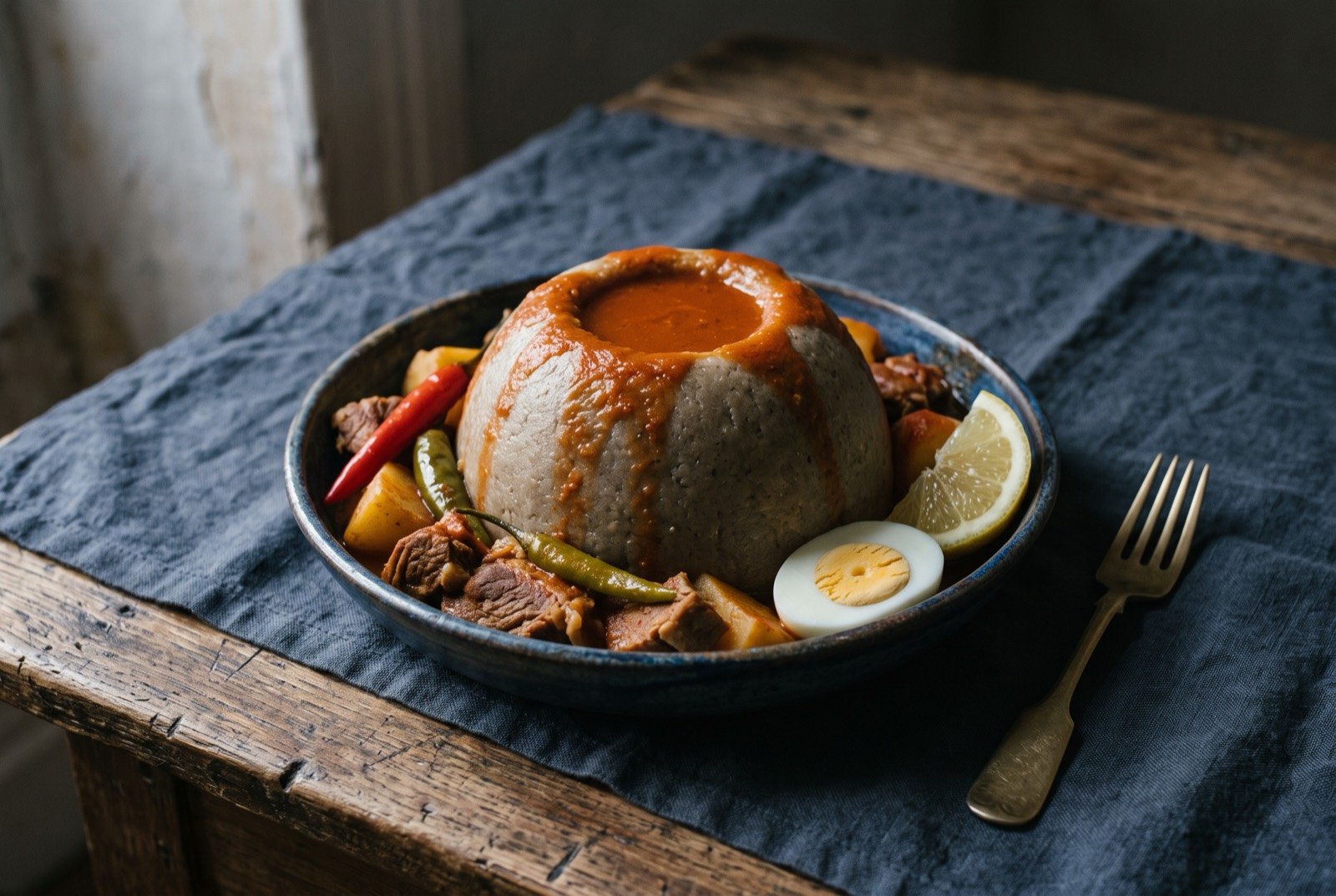
The oldest technique in this volume and the least forgiving. Sifted barley flour goes by handfuls into boiling water, never the other way round, stirred continuously with a wooden paddle, cooked half an hour, then kneaded by hand into a dome, the cook dipping their hands in cold water to keep working the near-boiling mass. Adding flour to boiling water gelatinises the starch instantly at the surface of each handful, which prevents lumps and makes the mass cohesive enough to stand up. Barley has very little gluten, so the structure is entirely starch gel, and that is why it must be worked hot. What is not specified. Neither Libyan source gives a barley-to-wheat ratio or a water-to-flour ratio: both specify flour by the number of guests. The paddle is given variously as mughrif, magraf and mahrat. This chapter invents no numbers to fill those gaps.
As tradition built it
Serves 6. About 2 hours.
Ingredients
- 1 kg; 2 to 3 L, as needed sifted barley flour, by the number of guests, and boiling water
- 1 large onion, fried
- 3 tbsp tomato purée
- to taste ground coriander, ground cumin, black pepper, salt
- to taste, where used fenugreek, in some regions
- 1 kg, if using lamb large pieces of lamb, or boiled broad beans
- 500 g; to taste potatoes, and fresh hot chillies
- 1 hard-boiled egg per person; halved lemons
Method
- The sauce first. Fry the onion, add the tomato purée and cook it out, then the coriander, cumin, pepper, salt and, in some regions, fenugreek.
- For the meat version, add large pieces of lamb and enough water and cook until tender, adding potatoes 20 minutes before the end with the whole chillies. For the broad bean version, add boiled broad beans with 3 to 4 cups of water and simmer at least an hour.
- The dome. Bring water to a hard boil in a wide pot and add the sifted barley flour by handfuls, stirring continuously so no lump ever forms.
- Cook 30 minutes on low heat, still stirring.
- Knead the mass by hand, dipping your hands in cold water, and shape it into a dome in a bowl. Simplified route, from the same source: mix flour with water to consistency, form patties about half an inch thick, arrange them overlapping in a fan, and cook 30 to 45 minutes.
- Serve with an indentation pressed into the dome, sauce poured in, meat around it, one hard-boiled egg per person, chillies over, with halved lemons.
Notes
There are no side dishes. Halved lemons and fresh chillies, nothing else. That is not austerity: starch, sauce, protein, fat, acid and heat are all present and all separately adjustable by the eater.
What a modern chef changes
A ratio you record, a dough hook instead of scalded hands, and the tomato fried out
Rungs 2, 6 and 3
Method
- Establish your own ratio and write it down, because nobody will give you one. Weigh the water into the pot and the flour into a bowl, add by handfuls as instructed, stop when the mass pulls cleanly from the sides and holds a shape, then weigh what is left and subtract. That is not a modification of the technique, it is a record of it, and it is the most useful thing a modern kitchen can do to an undocumented traditional dish.
- Use a stand mixer with a dough hook, never a blade. The structure is a starch gel, and a blade shears it into a slack sticky mass. A dough hook is high torque and low shear, the same folding and stretching action as the paddle. Warm the bowl, work on low, and you get the correct elastic mass without cooking your fingers.
- Fry the tomato purée out for four minutes, and serve on warmed plates. Rung 2 matters more here than elsewhere, because this sauce is thin and short and has nowhere to hide a raw note. And barley starch retrogrades as it cools, going from soft to firm and slightly grainy, so a dome that sits on a cold plate for five minutes is a noticeably worse dish.