The Levant and Anatolia · Volume 05, The Kibbutz, the Camp and the Contested Table
Cholent and hamin, of all the worlds
Sephardi Iberia and Ashkenazi Europe, one shared root
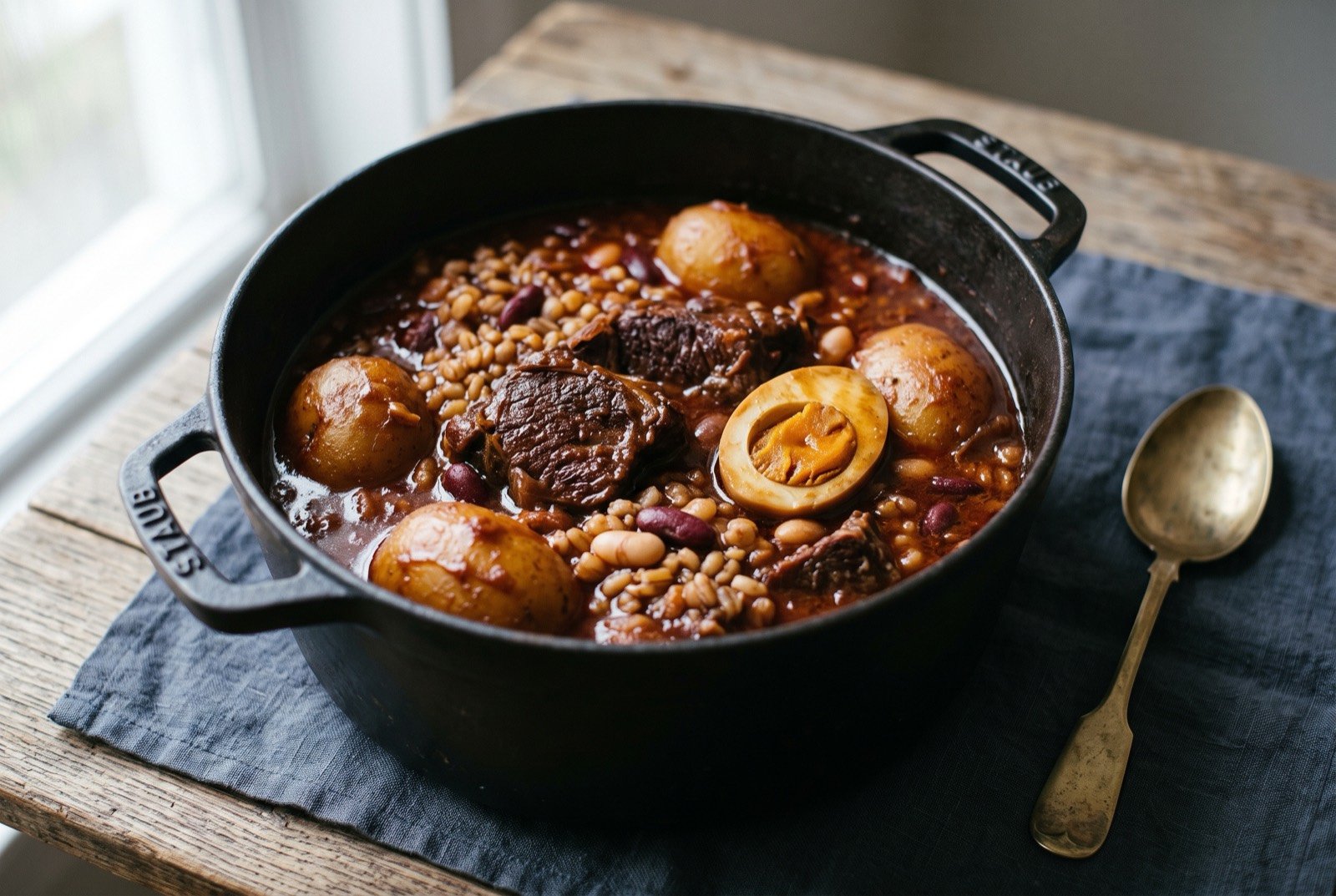
An illustration of the dish, not a photograph of it cooked.
- Time
- 16 hours
- Researched
- No outside sources linked
- Reviewed
- Not yet reviewed from inside the tradition
- Cooked
- Not yet cooked and reported
Cholent and hamin are usually told as two separate traditions, Ashkenazi and Sephardi, that happened to converge in Israel. The more accurate account, per the food historian Gil Marks, is that they share a single root: hamin (חמין), Hebrew for "hot," is a Sephardi dish already implied in the Mishnah; dafina or adafina, "buried," is the name that emerged after the Reconquista, when Iberian Jews reportedly buried their pots under embers to hide that they were keeping Sabbath; and cholent developed when Jews from Spain migrated to Provence in the late twelfth or thirteenth century carrying a Sabbath dish of lamb, fava beans and Mediterranean spice, which then travelled east into Germany and Eastern Europe, picking up potatoes and barley along the way. One tradition diverging and then reconverging in Israel, not two independent inventions meeting by coincidence. The whole mechanism, in both branches, exists because of the Shabbat prohibition on kindling fire: a pot brought to the boil before Shabbat begins is kept hot without further active cooking, historically on a blech, a metal sheet over a low flame, and in modern Israeli homes typically an electric hotplate, the plata.
As tradition built it
Serves 6 to 8. 30 minutes active, 13 to 16 hours cooking.
Ingredients
- 4 tbsp olive oil
- 2 white onions, sliced
- 10 garlic cloves
- 1 carrot, sliced
- 1kg beef shank, cubed
- 2 marrow bones (optional)
- ¾ cup pearl barley, soaked
- ½ cup red beans, soaked
- 1 cup white beans, soaked
- 6 to 8 potatoes, whole
- 6 to 8 eggs
- 2 tbsp paprika
- 2 tbsp salt
- ½ tsp black pepper
- 2 tbsp honey or maple syrup
- 1 cup Optional: 1 cup chickpeas and 1 cup round rice, soaked separately, packed into a sealed, pierced bag with 1 tbsp paprika, 1 tbsp salt, ½ tsp baharat and 1 tbsp syrup, laid on top
Method
- Soak the barley and beans together at least 6 hours; soak the chickpeas and rice separately if using.
- Sauté the onion, carrot and garlic in the oil in a large ovenproof pot until soft. Boil the eggs 10 minutes, cool and peel.
- Brown the beef and bones in the pot, 10 minutes. Add the drained barley and beans.
- Arrange the potatoes and peeled eggs around the meat. Mix the paprika, salt, pepper and honey with 1 cup boiling water, pour in, then top up with boiling water to just cover the potatoes and eggs.
- If using, lay the sealed rice-and-chickpea bag on top.
- Bring to the boil, covered, over high heat for 20 minutes, then transfer to a 110°C oven, covered, for 13 to 16 hours. It loves salt and is always slightly short of it; taste and correct before serving, and don't mistake normal liquid reduction on standing for dryness.
What a modern chef changes
The Shabbat hotplate's own logic, mapped onto a precision water bath
Not one of the six numbered rungs directly; extends Rung 5's low-and-slow discipline from the Yemenite bread family onto the Shabbat hotplate mechanism
Method
- The Shabbat mechanism, bring to temperature, then hold low and slow for many hours without touching it, maps directly onto a modern precision tool: cook the beef shank separately, sous vide at 82°C for 18 hours, which extracts the same long, gentle collagen breakdown a plata achieves by accident over a much less controlled overnight hold, then finish it in the main pot for the final two hours so it still takes on the paprika and onion base.
- Cook the barley, beans and potatoes together as written, since their texture genuinely benefits from the traditional long, wet braise rather than a separate precision treatment.
- Crisp the finished potatoes briefly under a hot grill or on a Big Green Egg run hot before serving, for a textural contrast the traditional all-day braise never gives them.