The Levant and Anatolia · Volume 05, The Kibbutz, the Camp and the Contested Table
Malabi
The Ottoman and Levantine world
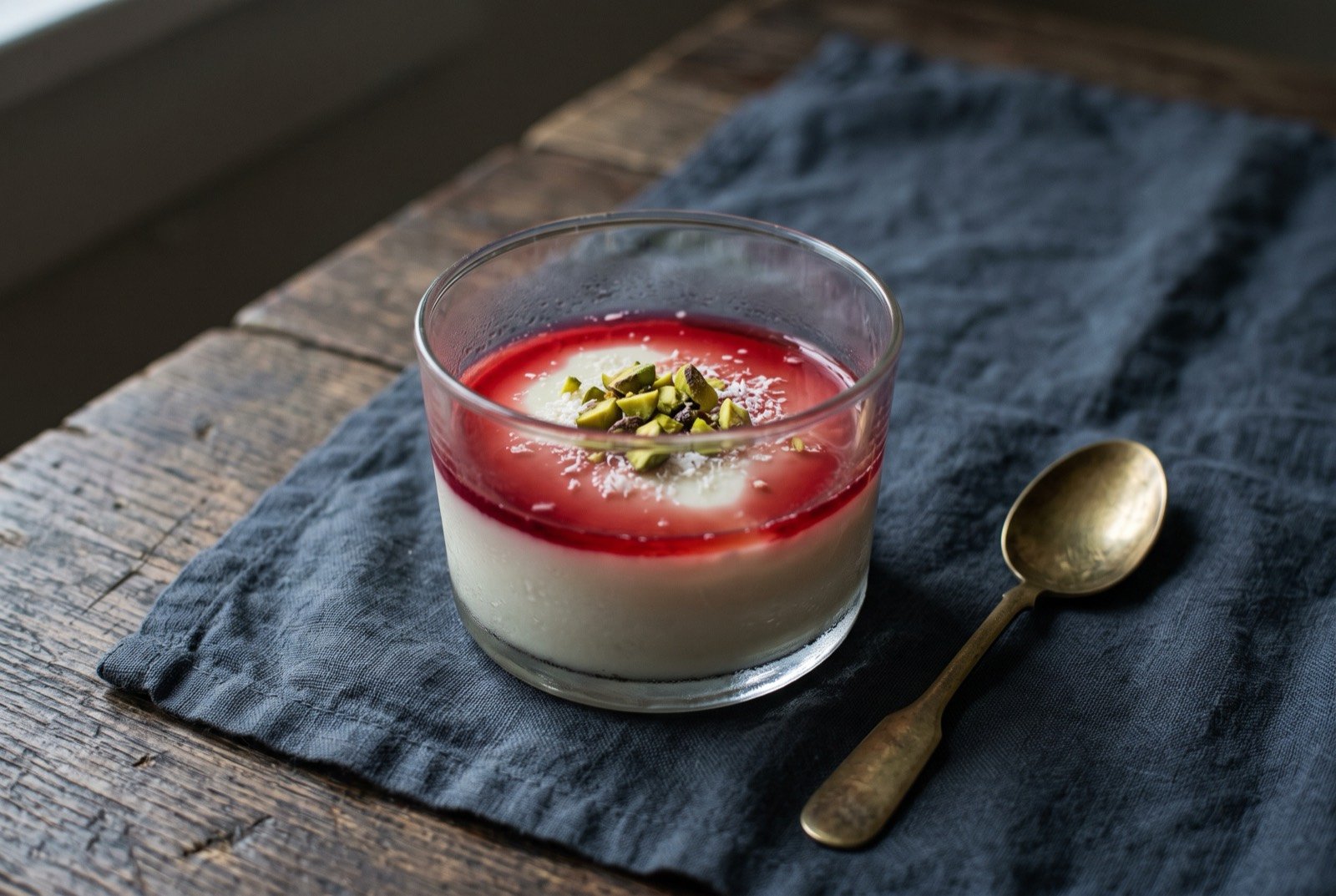
An illustration of the dish, not a photograph of it cooked.
- Time
- 3 hours
- Researched
- No outside sources linked
- Reviewed
- Not yet reviewed from inside the tradition
- Cooked
- Not yet cooked and reported
Malabi is a rosewater-scented milk pudding carried across the Ottoman and Levantine world, and Israeli versions split genuinely, not just stylistically, between two traditional thickeners. Rice flour gives more body and a faint graininess; cornstarch gives a silkier, lighter set. The mechanism worth knowing precisely: full gelatinisation for a cornstarch-thickened malabi, the point at which the starch reaches its maximum thickening power, happens at roughly 82 to 96°C (180 to 205°F); below that range the pudding will not set properly no matter how long it simmers.
As tradition built it
Serves 6. 15 minutes active, 3 hours to set.
Ingredients
- 1 litre whole milk
- 100g caster sugar
- 60g cornstarch
- 1 tsp rosewater
- to taste Rosewater syrup, chopped pistachio and desiccated coconut, to serve
Method
- Whisk the cornstarch into a little of the cold milk to a smooth slurry.
- Bring the remaining milk and sugar to a simmer, whisk in the slurry, and cook, stirring constantly, until the mixture thickens and holds a ribbon, keeping it at a genuine simmer, 82°C or above, for the full gelatinisation the starch needs, not just until it looks thick off the heat.
- Stir in the rosewater, pour into individual glasses or bowls, and chill at least 3 hours until set.
- Serve topped with rosewater syrup, pistachio and coconut.
What a modern chef changes
Confirming the gelatinisation point by thermometer, and a coconut-and-agar vegan version
Not a numbered rung; the chapter's own precision-cooking extrapolation onto malabi's starch gelatinisation point
Method
- Confirm the set with a thermometer rather than by eye, holding the mixture at 90°C or above for a full two minutes once it thickens, which removes the single most common home failure, an under-set pudding from a cook who trusted a visual cue rather than the actual gelatinisation point.
- Build a vegan version with full-fat coconut cream in place of milk and agar-agar in place of cornstarch, which sets by a different mechanism entirely, gelling on cooling rather than needing sustained heat, and pipe rather than pour it, dividing the same base between a coconut-forward vegan glass and a traditional dairy one from a single kitchen session, in the spirit of this chapter's msabbaha-and-hummus principle, that the same base can read as two different dishes depending only on how it's finished.