Asia · Volume 05
Israel
The Kibbutz, the Camp and the Contested Table
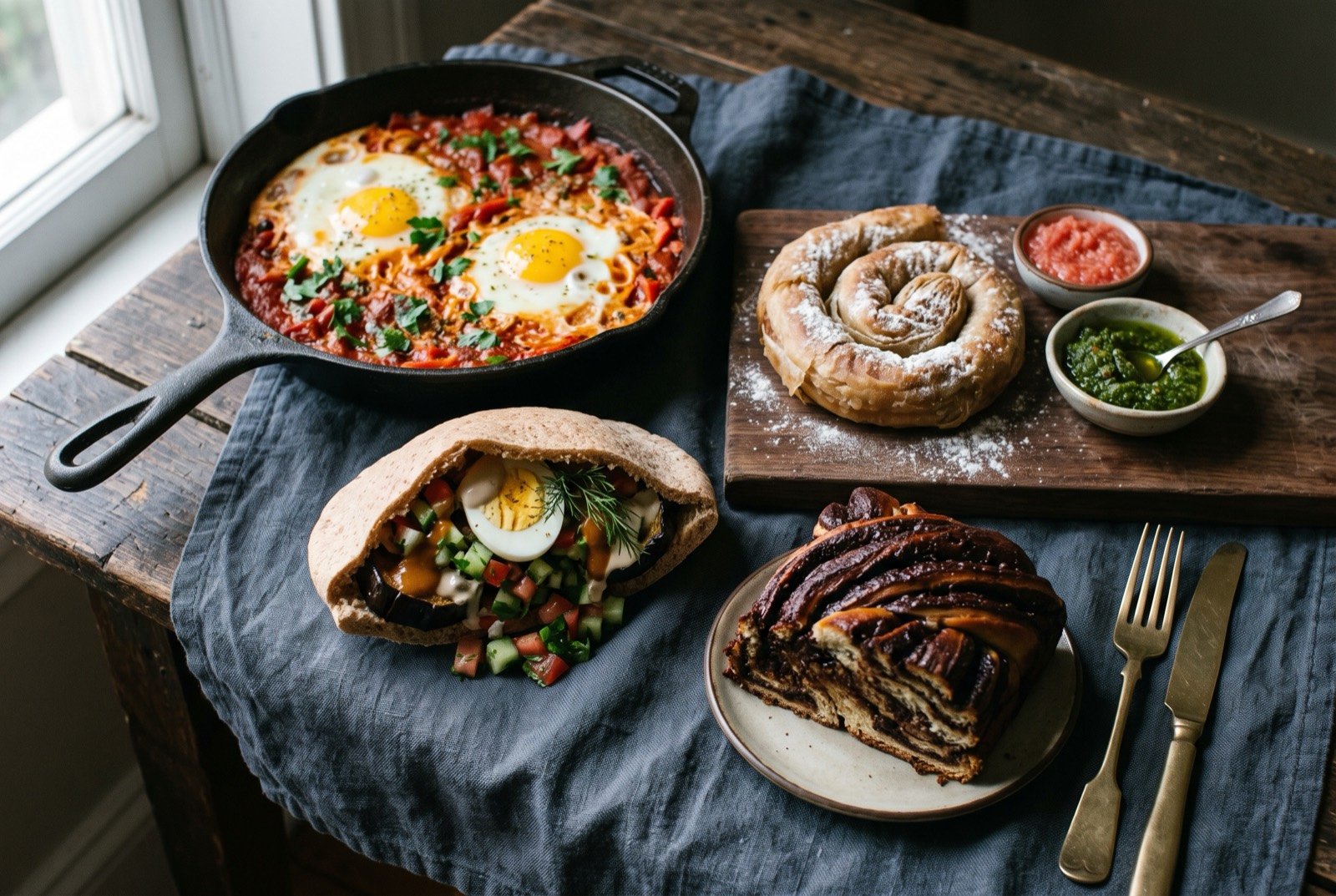
Kashrut and twentieth century mass immigration converged Ashkenazi, Mizrahi, Yemenite, Sephardi and Palestinian-Arab cooking into one new table in a single lifetime, a genuinely different formation from the agrarian Levant next door. This chapter follows four distinct threads rather than one: the Ashkenazi institutional default that schools, camps and the army made everyone eat regardless of where they were actually from; the Mizrahi and Sephardi mass immigration that brought the largest population and arrived into a documented social hierarchy; the Yemenite thread, preserved and mainstreamed on its own, unusual terms; and the Palestinian-Arab-Israeli presence, roughly a fifth of the country, whose food and whose grievance about who gets credit for it are both real and both covered here. Every dish as tradition built it, then what a modern chef would change.
Sources and review · What this chapter does not assert · How we research · Spotted something wrong?
A Sense of Place
Israel's food does not sit on the same map as the rest of the Levant, and the reason is not ecology, which it mostly shares with Lebanon, Syria and Palestine next door, olive, wheat, sesame, chickpea, citrus. The reason is that two forces, kashrut and a compressed twentieth century mass immigration, built something structurally new on top of that shared ecology in less than a hundred years, and this chapter's job is to keep the four communities that did the building distinct rather than folding them into one flattering national story.
Kashrut as architecture, not constraint
The clearest way to understand how Israeli food is actually organised is that kashrut, the separation of meat and dairy and the exclusion of pork and shellfish, works as architecture running underneath the whole table, not a set of occasional restrictions bolted on afterwards. Because meat and dairy cannot be served together, a meal built to be automatically, unthinkingly kosher defaults to dairy and vegetable, which is the direct mechanism behind the "Israeli breakfast," the heavy buffet of cheeses, chopped salad, eggs and olives that traces to the kibbutz dining hall rather than to any single ethnic tradition. The same logic runs through the restaurant landscape: an establishment serving both meat and dairy dishes needs entirely separate kitchens and service areas under rabbinic supervision, which is why the overwhelming majority of Israeli restaurants simply commit to being either dairy (מסעדה חלבית, fish, cheese, vegetable-led, often Italian or café-style) or meat (מסעדה בשרית, grills and steakhouses), rather than mixing both. Per Maimonides, roughly six hours should separate eating meat from eating dairy, one reason a Friday night meat meal and a Saturday dairy-leaning brunch sit naturally apart in the traditional weekly rhythm.
The kibbutz dining hall
Kibbutz dining halls began as workers' shared kitchens introduced by Second Aliyah settlers; in most kibbutz members' homes there was no kitchen at all, food prepared institutionally and served by rotating kitchen duty. The now-famous Israeli breakfast is directly traceable to this: members ate a light early snack, worked the fields for several hours, then returned for a hearty mid-morning buffet, effectively a brunch. By the 1950s Israeli hotels were marketing an "Israeli breakfast" modelled on the kibbutz meal, and when hotel associations tried to cut it back to a Continental-style breakfast in 1979 to save money, tourist demand forced them to reinstate it. Israel's dairy sector still runs on this cooperative base: roughly 60 per cent of national milk output comes from more than 180 cooperative kibbutzim and moshavim, average herds around 300 milking cows each. Tnuva, the dominant dairy cooperative, was founded in 1926 by representatives of thirteen farming settlements and grew into Israel's largest food conglomerate.
Four threads, one table
Ashkenazi (Eastern European) cooking became the state's early institutional default, served to every immigrant regardless of origin in the ma'abarot transit camps, in school meals, in the army, which is the direct mechanism by which schnitzel, chicken soup and gefilte fish read as generically "Israeli" today despite Ashkenazim never being the demographic majority of post-1948 immigrants. Mizrahi and Sephardi aliyah, overwhelmingly 1948 to the mid-1960s from Iraq, Yemen, Libya, Bulgaria, Morocco, Iran, Turkey and Kurdistan, brought the largest single population and the widest range of dishes, arriving into a social hierarchy that initially devalued this cooking as low-status "ethnic" food. Yemenite food gets its own thread rather than being folded into "Mizrahi" generally, because its preservation, its real internal regional variation, and its specific mainstreaming story are distinct enough to deserve separate treatment. Palestinian-Arab citizens of Israel, roughly a fifth of the population, 2.1 million as of 2024 to 2025 per Israel's Central Bureau of Statistics, carry a food culture concentrated in Nazareth, Haifa, Jaffa, the Galilee, the Triangle and the Negev, distinct from West Bank and Gaza Palestinian cuisine, which belongs to a separate, not yet written volume of this atlas, AS-04, Jordan and Palestine.
A table of peoples, logic and dishes
| Community | Defining logic | The dishes that carry it |
|---|---|---|
| Ashkenazi | institutional default, Shabbat slow-cook, dairy restaurant culture | schnitzel, cholent, gefilte fish, babka |
| Mizrahi and Sephardi | North African, Iraqi and Balkan aliyah, mid-century social hierarchy | shakshuka, sabich, matbucha, bourekas |
| Yemenite | preserved, internally varied, mainstreamed past its own community | jachnun, kubaneh, malawach, schug, hilbeh |
| Palestinian-Arab-Israeli | fifth of the population, Nazareth and Galilee, Haifa, Jaffa, Druze and Bedouin | knafeh, waraq inab, Druze siniya, the shared claim on hummus and falafel |
The History in Layers
The formative document: a cookbook that told immigrants how to unlearn themselves
Erna Meyer, born Erna Pollack in Berlin in 1890, a German-Jewish domestic-economy expert, wrote How to Cook in Palestine with cooking teacher Milka Saphir for the Women's International Zionist Organisation in 1936, published in German, Hebrew and English and widely considered the first Jewish cookbook printed in Mandate Palestine. Its target audience was newly arrived women from Nazi Germany, most of whom had never cooked, they had employed servants at home, and its explicit aim was to move them from heavy, preserved, meat-centred European habits toward a simpler, vegetable-forward diet built on local produce, framed as Zionist nation-building through diet. The National Library of Israel's own account of the book's mission is blunt about the less flattering half of that project: the authors set out to unlearn the poor dietary habits of "European and Arab origin immigrants" and establish proper modern nutrition as part of nation-building. That is the direct institutional root of the "correct," Ashkenazi-coded diet that the transit camps then imposed on everyone else, and it is worth stating plainly rather than treating the Ashkenazi default as a neutral accident of demographics.
The waves, country by country
Iraq: Operation Ezra and Nehemiah, April 1950 to May 1951, airlifted roughly 120,000 to 125,000 of Iraq's approximately 130,000 Jews on chartered American aircraft with special Iraqi government permission. So many settled in Ramat Gan that it became known as "Little Baghdad." Iraqi and Kurdish Jews brought kubbeh, sabich, amba and t'bit, the overnight Iraqi Sabbath hamin of chicken and rice. Yemen: Operation Magic Carpet, running from the second half of 1949 to September 1950, brought approximately 47,000 to 50,000 immigrants, nearly the entire community, treated in full below. Libya: over 30 per cent of Libya's roughly 38,000 Jews had left for Israel by October 1949, roughly 32,000 arriving by direct sailing from Tripoli to Haifa between April 1949 and late 1952, following anti-Jewish riots after which Libyan authorities allowed priority departure. Bulgaria: about 35,000 Jews, close to the entire community, left for Israel between May 1948 and December 1949, mostly settling in Jaffa and becoming the community most associated with bourekas culture. Morocco: the clear timing outlier. Only around 3,000 Moroccan Jews reached Israel in 1953 out of a pre-state community of roughly 300,000; mass Moroccan aliyah did not happen until Operation Yachin, 1961 to 1964, following independence in 1956. Moroccan Jews brought matbucha, couscous as a Sabbath and festival dish, and the largest single Sephardi and Mizrahi population contribution to the modern Israeli table. Iran: Persian Jewish emigration predates the mass wave, beginning around 1884 alongside the First Aliyah. Turkey: no reliable aggregate figure for the immediate post-1948 wave could be verified; do not assert one. Kurdistan: largely overlapping with the Iraq operation, settling heavily around Jerusalem's Mahane Yehuda market, whose Iraqi and Kurdish quarter dates to 1931.
The camp, the ration, and a documented hierarchy
This is real, quantified social history, and the chapter treats it that way rather than as background colour. In 1951 there were 127 ma'abarot, transit camps, housing 250,000 people, 75 per cent of them Mizrahi Jews; 58 per cent of Mizrahi immigrants who had arrived by that point were sent to a camp, against 18 per cent of European immigrants. That is a quantified disparity, not an impression. Through the tzena austerity years, 1949 to 1959, citizens could receive oil, sugar, margarine and rice; meat perhaps once a week, fish perhaps twice a month, occasional eggs, 100g of cheese and dried fruit; immigrants preserved core recipes but adapted them to what was actually available, spices in particular used to keep dishes recognisable.
The government's own admission policy toward Moroccan and Tunisian Jews in 1952 to 1956 has an academic name, "selective aliyah" (עלייה סלקטיבית): only families judged able to support themselves were admitted, motivated explicitly by elite fear of "Levantinisation," that mass Middle Eastern immigration would turn the young state into "a backward Levantine state." Moroccan immigrants specifically were described in Israeli-published historical accounts as "second-class immigrants," carrying negative stereotypes about education and culture that produced real demoralisation on arrival. The "bourekas film" genre of the 1960s and 1970s, commercial melodrama-comedy built on stereotyped Mizrahi characters staged against a "modern," Hebrew-Ashkenazi Israeliness, is itself a documented artefact of this hierarchy, its very name borrowed from the Sephardi and Balkan pastry, which tells you how "ethnic" food and "ethnic" people were being flattened together at the time. The Black Panthers, founded January 1971 by second-generation Mizrahi youth in Jerusalem's Musrara neighbourhood, are the clearest organised political expression of the same grievance; no source found for this chapter connects their platform directly to food, and it should not be implied.
The clearest single food-world articulation of the devaluation comes from Rafram Hadad, a Djerba-born Tunisian-Jewish visual artist writing from inside the tradition: Israeli culinary culture elevated European cuisines while dismissing North African Jewish traditions, "escaping from its Jewish roots," even as it later claimed shakshuka as purely Israeli. One nuance worth keeping distinct from this: the mid-twentieth-century Sephardi and Balkan community, Ladino-speaking Jews descended from the 1492 expulsion, was, before the twentieth century, the old elite of the Yishuv. It is specifically the mass twentieth-century Mizrahi immigration from Muslim-majority states that was socially devalued on arrival, not "Sephardi" identity as a whole, and the two should not be conflated.
The Yemenite airlift, and a real preservation-versus-assimilation tension
Operation On Wings of Eagles, universally known in English as Operation Magic Carpet, ran from the second half of 1949 to September 1950. Numbers converge on a range rather than one precise figure, roughly 47,000 to 50,000 airlifted, in a secret operation only made public months after it concluded. Yemenite Jewish tradition "tends to preserve ancient and unique customs" more than most other Jewish communities, per Hebrew Wikipedia, with a dedicated body working specifically on preservation. But food specifically shows a genuine, documented transmission gap, not a clean story of unbroken continuity. The Jewish Food Society tells the story of Sara Karavany, who fled Yemen for Israel around age twelve, settled in Ramat Gan, and possessed deep Yemenite cooking knowledge she deliberately did not pass to her own children, the kitchen was her private domain, and her children "never bothered learning how to replicate it." Her granddaughter, Alana Zeitchik, filmed her cooking lachuch, Yemenite beef soup, red schug and a yoghurt-schug dip in the summer of 2016, a month before Sara suffered a stroke; she died about a year later. This is a specific, named example of nearly lost transmission rescued at the last possible moment, not a generic claim.
1948, and who was already here
Falafel was a popular Tel Aviv street food by the late 1930s, well before 1948 statehood, and Palestinian dishes had already penetrated Jewish kitchens by the 1940s, a load-bearing historical fact for the question of who ate what first, in this specific place, and one this chapter returns to below. After 1948, roughly a fifth of Israel's population remained Arab citizens, concentrated in Nazareth, Haifa, Jaffa, the Galilee and the Negev. 1967, the Six Day War and the contact with West Bank and Gaza Palestinian food culture that followed, is named as a further inflection point in how far Palestinian dishes spread into general Israeli eating.
The kitchens change, then the movement gets a name
Dating "modern Israeli cuisine" as a culinary movement is genuinely contested, and this chapter keeps both credible accounts rather than flattening them into one decade. Ronit Vered, Haaretz's long-running food columnist, dates the actual turn to the 1980s: economic liberalisation and a government-driven effort to rehabilitate the standing of Mizrahi and Sephardi culinary heritage created space for it in upmarket kitchens, chefs of mostly Mizrahi origin training abroad and returning to build a modern Israeli haute cuisine using those techniques on ancestral recipes. She names Moshe Basson, whose Jerusalem restaurant Eucalyptus closed in March 2026 after nearly four decades, reportedly driven by the post-October 2023 collapse in tourism, as opening one of the first restaurants built on this move, and Ezra Kedem as gaining recognition for modernising traditional dishes. Janna Gur, editor-in-chief of Al Hashulchan, founded 1991, and author of The Book of New Israeli Food (2008), is generally credited with putting a name and public face to the movement, the 1990s the institutional starting point where Vered names the 1980s kitchen one. Read together: the kitchens changed first, driven by chefs; the naming and international packaging of it followed a decade later, driven by food writers and a second wave of Israeli chefs trained abroad. Claudia Roden's framing is the clearest working definition of what actually distinguishes the style: Turkish, Lebanese and other Middle Eastern restaurants tend to serve "the same traditional standard menus," whereas Israeli chefs "feel free to pick elements from all the cuisines" and produce "a personal take on tradition" rather than a fixed repertoire, while she states plainly that "there is heated discussion about what it is exactly and whether it exists at all."
The Flavour Arsenal
Tahina, the connective tissue
Tahina (sesame paste) runs across all four threads of this table, from Ashkenazi-adjacent tehina sauce on a schnitzel wrap to the Yemenite hilbeh table to the Palestinian-Arab hummus counter, and the single biggest quality lever in the whole cuisine. Seed variety is the main variable: the best sesame seeds grow in the Humera region of Ethiopia, and several of the best Israeli brands, Al Arz, Baracke, Sesame Kingdom, are built specifically on Humera seed. Processing and roast, not just seed, decide claggy from smooth; traditional stone-grinding and careful roasting produce a nutty, pourable result, over-roasting tips it into bitterness. Hulled tahina is milder, unhulled darker, more bitter and more mineral, most well-regarded eating brands are hulled. The test worth teaching a reader: taste it raw, off the spoon, before building anything on top of it; if it is bitter neat, it stays bitter cooked.
Za'atar, checked for what it actually contains
Genuine za'atar is built on three things: the herb, properly Origanum syriacum, wild Levantine hyssop or oregano, not a substitute of ordinary dried thyme; sumac for tang; and toasted sesame for texture, plus salt. The wild herb is scarcer than it looks, over-harvested in parts of the Levant and legally protected in Israel since the 1970s, and is often farmed rather than wild-gathered even at source, which means many mass-market tins substitute ordinary dried thyme or oregano without saying so. The test of a real blend is whether it names the herb and reads herb-forward rather than sesame-heavy filler.
The Yemenite bench: schug, hilbeh, hawaij
Schug/zhug comes in two distinct types: schug adom (red), from dried or red chillies, and schug yarok (green), from fresh green chillies and fresh herbs, mainly cilantro, with garlic, cumin and salt as the near-universal spicing. Precise, authoritative ratios genuinely do not exist; Hebrew home-cook sourcing gives loose, by-eye proportions rather than one canonical recipe, and this chapter treats that honestly rather than inventing false precision. Hilbeh is a whipped, frothy fenugreek condiment: ground fenugreek seed soaked in water for at least three hours until it forms a soft paste, the soaking water poured off, the paste whipped, traditionally by hand, with a little cold water added gradually until frothy and custard-like, then finished with lemon juice, grated tomato, salt and often schug. Hawaij is not one blend but two, a savoury version for soup and cooking (cumin, turmeric, black pepper, coriander, cardamom, cloves, often fenugreek and bay leaf) and a separate coffee version, and the savoury blend is what carries marak temani, the clear Yemenite meat soup made into an Israeli institution specifically by Yemenite Jews after immigration.
The Ashkenazi and Mizrahi pantry
Amba, a pickled and fermented green mango condiment, Iraqi-Jewish in origin, is now everywhere in sabich and shawarma culture. Silan, date syrup, sweetens without the floral note of honey and threads through both Ashkenazi and Mizrahi sweet cooking. Matbucha, a cooked tomato, roasted pepper, garlic and oil relish whose name means simply "cooked" in Arabic, is specifically Moroccan Jewish and is now a standard Israeli table component. Israel's own distinctive cheeses, Tzfat (a semi-hard, slightly salty cheese from Safed, now often cow's rather than the original sheep's milk) and Bulgarit (a brined white cheese Bulgarian immigrants improvised locally, close in spirit to feta), have no confirmed UK importer and should be treated as genuinely unavailable in Britain, not a gap to paper over.
The Galilee and Druze table
Waraq inab (stuffed vine leaves), a Druze-style collective kubbeh made from cooked potato, bulgur, sautéed onion and dried red pepper rather than meat, mansaf (lamb in yoghurt sauce), siniya (kebab in tahini sauce), and a large, paper-thin Druze pita baked in a wide gas-fired dome oven and sold from roadside kiosks in Druze villages, all carry the Galilee and Carmel table that this chapter's research could source honestly for named dishes and named cooks but not, in most cases, for the fully quantified technique a "Dishes, Twice" recipe needs. That gap is named rather than smoothed over, and the voices themselves are given full space below.
The Technique Ladder
The argument, from inside
Kashrut and mass immigration did not just add dishes to a shared Levantine ecology, they rebuilt the kitchen's own logic: what gets served together, what a "correct" Shabbat dinner looks like, which pot goes into the ground or under embers and why. The rungs below are the mechanisms a technically capable home cook can actually take from that rebuilding, not a list of ingredients.
Rung 1. Let kashrut's dairy/meat split organise the meal, not just the plate
Because meat and dairy genuinely cannot share a pot, a kosher household plans two separate flavour architectures rather than one, which is why the Israeli breakfast is unapologetically dairy-forward and a Friday night dinner unapologetically meat-forward. A home cook without kashrut's constraint can still use the discipline: build a whole meal, not just a dish, around one fat, one protein register, dairy-rich and vegetable-led, or meat-rich and grill-led, rather than mixing registers within a single sitting.
Rung 2. Treat the whole vegetable as the protagonist, cooked in two stages
Eyal Shani's whole roasted cauliflower is the clearest modern example of a wider move: a whole head, leaves left on, plunged into well-salted boiling water and cooked only until it just begins to turn tender, then finished by roasting so the outer leaves and florets char and crisp while the core stays moist from the poach. The mechanism, moist-cook the core first, then dry-char the exterior, transfers directly to other whole vegetables using the same logic.
Rung 3. Build tahini as an aerated emulsion, not a paste you dump ingredients into
Lemon juice and garlic blended first, left to sit around ten minutes, then strained through a chinois to remove the fibrous garlic solids while keeping their flavour in the acid. Ice water added gradually with the motor running takes the tahini-lemon-garlic base from paste to pale, thick, aerated cream before anything solid goes in; cold water incorporates more air than room-temperature water. Dumping everything into the processor at once, the single most common home mistake named by the chefs who do this professionally, produces a dense, peanut-butter-like paste rather than an aerated cream.
Rung 4. Respect chickpea starch chemistry, for hummus and for falafel alike
Dried chickpeas, soaked with baking soda to raise the soak water's pH and soften the skins, then simmered roughly an hour, well past normal "tender," until just shy of total mush, is what lets a purée go silky rather than grainy however long it's blended afterwards. For falafel, the opposite state matters: dried chickpeas soaked but never cooked keep their starch structurally intact through grinding, which is what lets the mixture hold together and fry to a light, structured interior. Canned or pre-cooked chickpeas have already had their starch heat-set by industrial canning, which is the wrong starting material for either dish, and no technique rescues it afterwards.
Rung 5. Bake low, slow and sealed for the Yemenite bread family
Jachnun, baked under 100°C for eight to twelve hours overnight, and kubaneh, sealed in a greased tin and baked in a very low oven overnight, both work by the same mechanism: very low, moist heat over many hours, trapped rather than vented, caramelises a buttery dough slowly instead of browning it fast. A Big Green Egg run at a stable low dome temperature, or a slow cooker on low, gets closer to this than a domestic oven's lowest setting alone, and a dehydrator, hypothesised as a substitute, genuinely does not work here: it runs too dry to replicate the trapped-steam caramelisation these breads depend on.
Rung 6. Laminate for babka, the way you would for a croissant
Uri Scheft's specific, well-documented innovation is treating babka dough as laminated and butter-enriched, repeated folding and turning to build alternating butter and dough layers, rather than a plain enriched yeast dough, which is what gives modern babka its flaky, croissant-like structure instead of a dense, brioche-like crumb. His second innovation is distributional: rather than roll the filled dough into one log and coil it, which leaves some bites bare of filling, slice the rolled log lengthwise into two ropes with the filling exposed, then twist the two ropes together, so filling sits at every cross-section of the finished loaf.
The Ferment and Preserve Bench
1. Schug (red and green)
Fresh green chillies and a full bunch of cilantro, or dried red chillies, blitzed coarse with garlic, cumin and salt, kept under a slick of oil in the fridge or freezer. No single authoritative ratio exists in the tradition itself, and this chapter does not invent one: build it by taste, adjusting chilli, garlic and salt until it reads right, the way Yemenite home cooks actually do.
2. Hilbeh
Ground fenugreek soaked in water at least three hours to a soft paste, the soaking water poured off, then whipped with a little cold water to a frothy, custard-like texture, finished with lemon juice, grated tomato and salt.
3. Matbucha
Tomatoes and hot peppers, roasted or simmered until soft, then cooked down slowly with garlic and oil until thick and jammy, seasoned simply with salt and a little paprika. Keeps well under a layer of oil, a genuinely useful pantry item for a British kitchen once made in bulk.
4. Amba
Unripe mango, fenugreek, mustard seed, turmeric and chilli, fermented in brine 5 to 7 days before blending to a thick, tangy sauce, the pickled mango condiment that carries Iraqi-Jewish flavour into sabich and shawarma culture across the whole table.
Sourcing in Britain
Verified September 2026.
The ranked list: what decides great from grim
- Tahina quality, by a wide margin. This is the ingredient where the gap between good and bad is largest and touches the most dishes, hummus, baba ghanoush, halva, tehina sauce and dozens of Mizrahi and Yemenite dips all live or die on it. Buy Al Arz (Israeli, Nazareth-based, made from Ethiopian Humera sesame, Ottolenghi's own house tahina) direct from ottolenghi.co.uk, or Belazu's Har Bracha tahini, made by a Samaritan-run factory at Mount Gerizim using traditional stone-grinding, from belazu.com, Waitrose or souschef.co.uk. Avoid supermarket own-label tahini in the health-food aisle, which is consistently over-roasted, claggy and prone to separation.
- Za'atar that actually contains the herb. Because it goes on bread, labneh, eggs and roast vegetables constantly, a version cut with ordinary dried thyme rather than true wild hyssop reads flat rather than resinous, and the failure is invisible unless you already know what the real thing tastes like. Zaytoun (zaytoun.uk), the UK non-profit marketing Palestinian farmer cooperative produce, is the most ethically and provenance-clear source, alongside its olive oil, sumac and dates.
- Fresh herbs used generously, not as garnish. Parsley, mint, dill and coriander in the volumes an Israeli salad, a hummus plate or a Yemenite soup actually wants are not a UK availability problem, London's Turkish and Middle Eastern greengrocers, Ridley Road Market in Dalston, the Green Lanes shops around Harringay, sell them in large, cheap bunches for exactly this reason, but a habit gap: British home cooking treats fresh herbs as a small handful, this table treats them as a vegetable in their own right.
Physical shops
London, Golders Green and Hendon: Kosher Kingdom and B Kosher for a strong Israeli and Mediterranean range; Bracha London for eating the food rather than sourcing it raw. London, central and west: Green Valley, Upper Berkeley Street, W1H 5QF, established 1986, the single best general stop for produce and pantry; Damas Gate, Shepherd's Bush; Phoenicia Mediterranean Food Hall, Kentish Town Road, which already stocks Zaytoun olive oil on shelf. Sarit Packer and Itamar Srulovich's Honey & Spice deli on Warren Street closed its physical shop on 28 March 2026 after a ten-year lease; check honeyandco.co.uk directly before relying on it. Manchester, Prestwich: Kosher City, Windsor Road, confirmed actively trading and offering nationwide online delivery; Ta'am Deli & Grill, Bury New Road, a genuine deli counter for prepared and imported goods.
Kit substitution, honestly
A real taboon or saj has no UK retail equivalent and is not realistically buildable at home. A Big Green Egg with a preheated baking stone genuinely does the job for taboon-style bread, the Egg's own guidance markets it explicitly for fire-brick-oven-style pizza and bread baking, and at high, direct heat it is a legitimate substitute for the open-flame grilling this table's skewer and mixed-grill tradition actually uses. A dehydrator does not work for jachnun: the dish depends on trapped, moist heat over many hours, and a dehydrator runs too dry even at its top setting; use a very low domestic oven or a slow cooker on low instead. Tzfat and Bulgarit cheese are genuinely unavailable in Britain; a good UK-made brined ewe's cheese or feta is the honest substitute, not a compromise to apologise for.
Voices and Sources
From inside the tradition
Rafram Hadad, Tunisian-Jewish visual artist, on shakshuka's real North African history and the erasure of it, Local Call, 13 April 2014. Sami Tamimi, Jerusalem-born Palestinian chef, Falastin with Tara Wigley, and interviewed by The Globe and Mail, 2024. Reem Kassis, The Palestinian Table, and her 2020 Washington Post op-ed on the term "Israeli cuisine." Fadi Kattan, Bethlehem-based Palestinian chef, interviewed by Trippin.world. Nof Atamna-Ismaeel, the first Arab citizen of Israel to win MasterChef Israel, on the A-Sham Festival and on media exclusion. Michael Solomonov, Zahav: A World of Israeli Cooking (2015). Uri Scheft, Breaking Breads. Adeena Sussman, Sababa (2019) and Zariz (2026). Janna Gur, The Book of New Israeli Food (2008) and Al Hashulchan. Ronit Vered's Haaretz food writing. Gil Marks, Encyclopedia of Jewish Food, cited at second hand via press coverage.
The UK diaspora
Yotam Ottolenghi and Sami Tamimi, Jerusalem (2012), and Ottolenghi's own restaurants and shop. Sarit Packer and Itamar Srulovich, Honey & Co.
The contested table, attributed, not adjudicated
This chapter takes the hummus and falafel dispute seriously rather than smoothing it into a footnote, because the people who cook this food take it seriously. Gil Hovav, Israeli culinary journalist, told the BBC plainly, "we sort of robbed them," of hummus and falafel both, one of the most direct acknowledgements from a mainstream Israeli food voice found anywhere in this research. Ottolenghi has said much the same from the other side of the counter, "hummus is definitely an Arab dish" that also became Israel's national one, while noting "there's always a scramble over ownership: who invented hummus? Who invented falafel? Who makes it better? Who owns it?" Reem Kassis's position is sharper: "presenting dishes of Palestinian provenance as 'Israeli' not only denies the Palestinian contribution to Israeli cuisine, but it erases our very history and existence." Sami Tamimi's is more measured on the dishes themselves even as he is angrier about the framing: "these recipes have been there for hundreds, thousands of years, and Israel is the youngest state." Salah Kurdi, a Palestinian-Israeli former chef at Jaffa's Al-Ashi restaurant, complicates any clean binary from a different angle entirely, "hummus is my Israeli identity," a Palestinian citizen of Israel claiming the dish as part of his own Israeli identity, not only his Arab one. Historically, falafel was documented Tel Aviv street food by the late 1930s, before the state existed to claim it, and Israeli-manufactured hummus dates specifically to 1958. This chapter names all five positions and does not choose between them. Full recipes for hummus itself belong to AS-03, Syria and Lebanon, not yet written in this atlas; falafel's origin dispute with Egyptian ta'ameya is cross-referenced to this atlas's African volume on Egypt, where ta'ameya is given its own full tradition-and-elevation treatment.
The gaps, named
The Anu Museum's own FOODISH Jewish-food dictionary and Kan, Israel's public broadcaster, both returned access errors throughout this research and could only be used via search snippet rather than direct reading; either is likely one of the single best sources for this whole chapter and should be revisited directly if the chance arises. Bedouin food in the Negev is the weakest-sourced thread in the whole research effort: no named, currently-operating Bedouin-run public restaurant could be found, a likely research gap rather than evidence none exists. Precise figures for Turkish Jewish aliyah in 1948 to 1949 could not be verified and are not asserted.
Things this chapter has deliberately not asserted
- That "Tzion Sasson" invented sabich in Ramat Gan in the 1960s. The sourced record names Sabich Tzvi Halabi as originator in 1961, with Yaakov Sasson as his later business partner.
- That shakshuka's path into Israel is Tunisian alone. Libyan and Tripolitanian Jewish immigration is at least as directly implicated, per the most detailed in-tradition source found.
- Any single settled origin for Israeli salad. This is a live, unresolved dispute between named commentators, Gil Marks's Ottoman and horticultural lineage on one side, Gil Hovav and Joseph Massad's appropriation argument on the other, and this chapter attributes rather than adjudicates it.
- That cholent and hamin are separate Ashkenazi and Sephardi inventions. Per Gil Marks, they share one root, diverging and then reconverging, rather than developing independently and meeting by coincidence.
- That sufganiyot are an unbroken ancient Hanukkah practice. There is a genuine centuries-old textual thread for fried Hanukkah pastries, but the doughnut-as-standard practice displaced an older Ashkenazi levivot custom and was actively promoted by the Zionist movement in the 1930s.
- That jachnun is simply "the" pan-Yemenite Shabbat dish. It is specifically an Adeni dish that most Yemenite Jews outside Aden did not know before immigrating; its status as the tradition's metonym is a post-immigration Israeli development, not an ancient, universal one.
- A single canonical schug ratio. The tradition itself works by eye, not by one authoritative recipe, and this chapter does not invent a precision that does not exist.
- Who "really" invented hummus or falafel, or that either question has a settled answer. The Voices section above names five real, named positions and does not choose between them.
- Any direct link between the Black Panthers' 1971 political platform and food or culinary grievance specifically. The general social hierarchy behind their protest is well documented; a food-specific plank of it is not, and this chapter does not imply one.
- A named, currently-operating Bedouin-run public restaurant in the Negev, or a fully developed account of distinctly Negev Bedouin cuisine as against the wider pan-Bedouin and Gulf repertoire. This is named as a real research gap, not smoothed over.
- Whether Israel's domestic Michelin Guide has actually launched as of September 2026, as against still being assessed. The Tourism Ministry has approved pursuing one; this chapter does not claim it exists.
Let kashrut's dairy/meat split organise the meal, not just the plate
Because meat and dairy genuinely cannot share a pot, a kosher household plans two separate flavour architectures rather than one, which is why the Israeli...
Treat the whole vegetable as the protagonist, cooked in two stages
Eyal Shani's whole roasted cauliflower is the clearest modern example of a wider move: a whole head, leaves left on, plunged into well-salted boiling water and...
Build tahini as an aerated emulsion, not a paste you dump ingredients into
Lemon juice and garlic blended first, left to sit around ten minutes, then strained through a chinois to remove the fibrous garlic solids while keeping their...
Respect chickpea starch chemistry, for hummus and for falafel alike
Dried chickpeas, soaked with baking soda to raise the soak water's pH and soften the skins, then simmered roughly an hour, well past normal "tender," until...
Bake low, slow and sealed for the Yemenite bread family
Jachnun, baked under 100°C for eight to twelve hours overnight, and kubaneh, sealed in a greased tin and baked in a very low oven overnight, both work by the...
Laminate for babka, the way you would for a croissant
Uri Scheft's specific, well-documented innovation is treating babka dough as laminated and butter-enriched, repeated folding and turning to build alternating...
The dishes
- Shakshuka Southern Tunisia and Tripolitanian Libya
- Sabich Ramat Gan, 1961
- Falafel Tel Aviv
- Jachnun with grated tomato, egg and zhug Aden, Yemen
- Kubaneh Yemen
- Cholent and hamin, of all the worlds Sephardi Iberia and Ashkenazi Europe, one shared root
- Malabi The Ottoman and Levantine world
- Babka Ashkenazi Eastern Europe, reinvented in Tel Aviv and New York
Sources and review
- Researched
- No outside sources linked
- Reviewed
- Not yet reviewed from inside the tradition
- Cooked
- Not yet cooked and reported
Where this volume comes from
3 research briefs on file for this volume, researched to the rules on How we research. Published 3 September 2026. Last changed 8 September 2026.
The brief's own account of its sources
Overall balance: roughly 105 to 110 searches were run across the two passes that built this brief, of which approximately 40 were in Hebrew script and approximately 10 in Arabic script, the remainder in English, used both for cross-checking Hebrew and Arabic findings and for material genuinely conducted in English by its own participants (Reem Kassis writing for the Washington Post, Sami Tamimi interviewed by a Canadian paper).