Asia · Volume 02
Central and Southeastern Anatolia
The Steppe, the Fire and a Divided Table
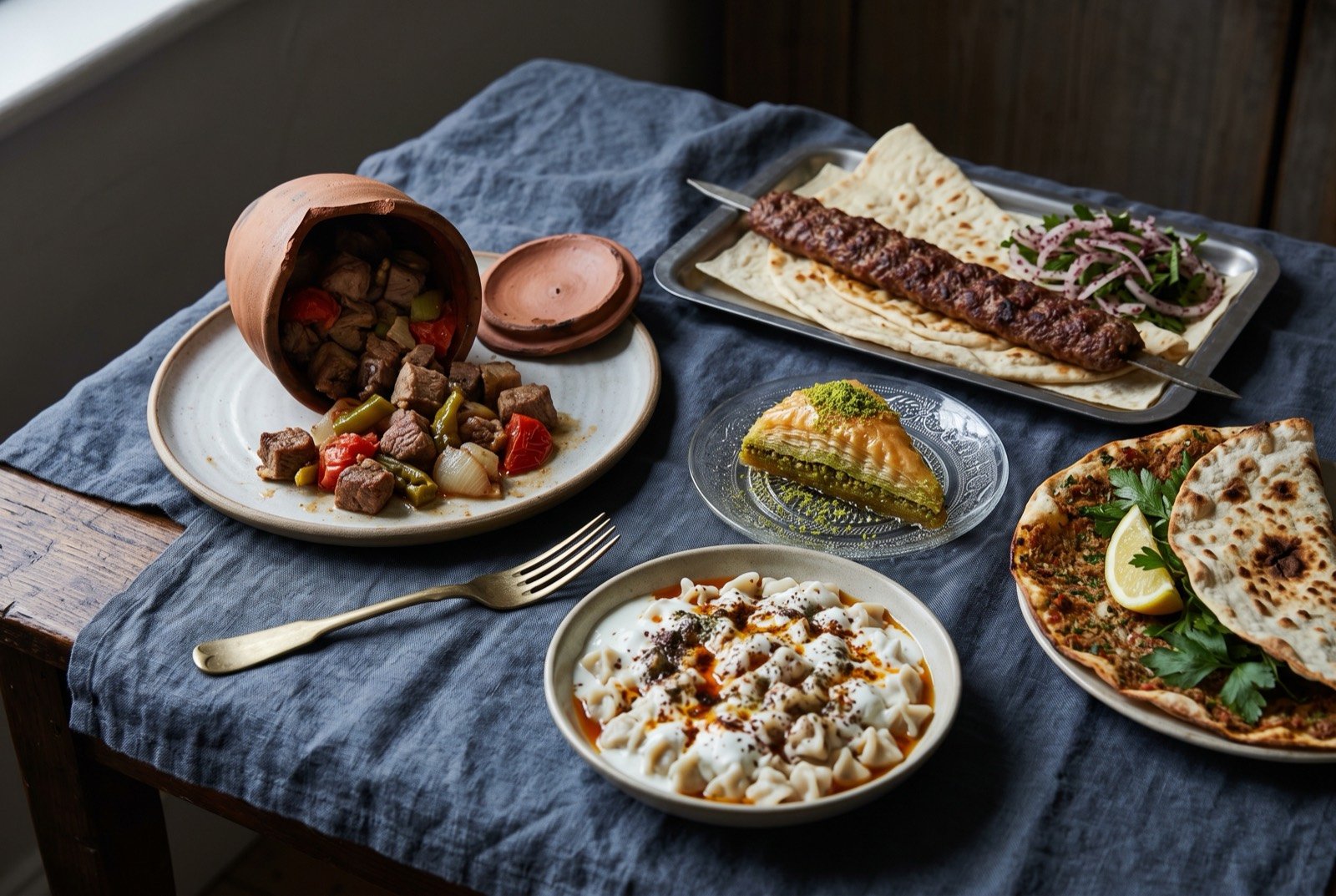
Two food worlds inside one Turkish interior: a continental wheat and sheep steppe running from Konya through Kayseri to the cave kitchens of Cappadocia, and, further south, a kebab and baklava belt built on hand-minced meat, chilli and pistachio, running through Gaziantep, Urfa and Adana. The second of those two worlds is also a genuinely divided table, claimed in real, sourced, sometimes bitter ways by Turkish, Kurdish and Armenian voices at once, the last of them a community largely destroyed or displaced from these specific cities in 1915 and still, this chapter found, arguing for its place in the region's food from published memoirs and community newspapers rather than from a kitchen of its own. Every dish as tradition built it, then what a modern chef would change.
Sources and review · What this chapter does not assert · How we research · Spotted something wrong?
A Sense of Place
Draw a line roughly along the Toros mountains and Anatolia splits into two different kitchens, and this volume covers the interior on both sides of that line rather than the coast. North of it, the Anatolian plateau: a semi-arid steppe averaging around 320mm of rain a year, too dry and too cold in winter for anything but rain-fed grain and grazing sheep, its two reference cities Konya, a wheat-and-livestock capital since the Seljuks made it one, and Kayseri, a merchant city built on Silk Road trade rather than on its own soil. South of it, where the plateau drops toward the Fertile Crescent and the Syrian border, a warmer, chilli-and-pistachio kebab belt centred on Gaziantep, Urfa and Adana, ecologically closer to the Levant than to the steppe above it, and carrying, on top of its Turkish table, a substantial Kurdish population and the living memory of a substantial Armenian one.
Central Anatolia: the wheat storehouse and the merchant city
Konya's own agricultural authorities call the province Turkey's "tahıl ambarı," its grain storehouse, and the description holds: a semi-arid steppe climate, hot dry summers, harsh snowy winters, makes dry, rain-fed wheat, barley and sugar-beet farming the norm rather than irrigation, with sheep grazing historically the region's second livelihood, integrated with grain farming rather than separate from it. This is not a new arrangement. Çatalhöyük, in Konya province, is one of the type sites for Anatolian Neolithic grain cultivation, wheat, barley, lentils, chickpeas and peas already under cultivation there millennia before the Seljuks arrived. Konya became the Anatolian Seljuk capital after Turkish migration into Anatolia from 1071 onward, and its food culture deepened further under Mevlevi, Sufi, Rumi-following, influence from the 13th century: novices in Mevlevi practice underwent a 1001-day trial centred on kitchen service, on the stated principle that "the kitchen is where a person is cooked," matured, and the kitchen's own patron figure, Âteşbâz-ı Velî, said to have been Rumi's own cook, is recorded as the first cook in world history to have a dedicated shrine built for him, still standing southeast of central Konya.
Kayseri's identity, by contrast, is commercial rather than agrarian, and unusually well evidenced for it. The city sits on Kültepe, ancient Kaniš, the site of an Old Assyrian trading colony dated to roughly 1950 to 1650 BC, described in Turkish sources as the world's first organised, documented long-distance trade network, the Kültepe tablets Anatolia's earliest written texts. Kayseri stayed on the map through the Seljuk period as a caravan node on the busiest overland route in Anatolia, the road from Iran via Erzurum and Sivas to Kayseri, Aksaray and Konya, and this trading identity is given, in local sources, as the direct explanation for Kayseri's mastery of long-haul food preservation: drying and salting pastırma, sun-drying mantı for winter storage and travel, both explicitly linked to a merchant city's need to move food, not just eat it.
Cappadocia's volcanic tuff shapes both its architecture and its cooking. The soft rock makes cave-cutting possible, and Avanos sits on riverbed clay that has supplied its pottery tradition since at least the Hittite period, the same clay that becomes the sealed testi pot below. The region's own framing of its food is "toprağı toprakta pişirme," cooking what comes from the earth, in the earth: viticulture, pit-oven cooking, grape molasses, dried clotted cream and pot dishes, and its underground cities, built partly as wine-production and storage space, twin stone troughs for treading and fermenting grapes on levels close to the surface, some associated with early Christian communities sheltering there. Until the 1923 Greek-Turkish population exchange, the town of Mustafapaşa near Ürgüp was home to Karamanlı Greeks, Turkish-speaking Orthodox Christians, living alongside Turks, one more layer in a region whose food culture is older and more mixed than its postcard image of fairy chimneys suggests.
Southeastern Anatolia: the kebab belt, and the layer beneath it
Gaziantep, Urfa and Adana sit where the Anatolian steppe gives way to the Fertile Crescent, hotter, closer to Aleppo than to Konya both geographically and culinarily, and this is reflected directly in what grows and what is eaten: pistachio rather than wheat as the signature crop, chilli grown and cured with real regional technique rather than bought as a spice, wheat present but as bulgur and flatbread rather than as the plateau's grain-storehouse identity. Gaziantep's seriousness about its own food is institutionally real: the city was the first in Turkey inducted into UNESCO's Creative Cities Network in the Gastronomy category, in December 2015, and a 2017 academic survey of working Turkish chefs ranked it first among Turkish cities for gastronomy, ahead of Istanbul. Urfa and Adana each carry their own, more specific identity again: Urfa's isot pepper and its ciğer kebabı and mantı-adjacent breakfast culture, Adana's fiercer chilli line and its şalgam fermented-turnip drink.
What this ecological description leaves out, and what the rest of this chapter tries to put back, is who actually lives here. Southeastern Anatolia holds a large Kurdish population, part of the wider Kurdish-inhabited region spanning Turkey, Iraq, Syria and Iran, and cities including Diyarbakır, Urfa and Adana were, before 1915, home to substantial Armenian communities whose culinary influence this chapter's research found still traceable, sometimes only in a handful of memoirs and a community newspaper, even though the community itself was destroyed or displaced from these specific streets. A Kurdish-language source used directly in this chapter's research, Bernamegeh, states plainly that Diyarbakır "has a very special cuisine, built over thousands of years by Kurdish, Armenian, Syriac, Jewish and Arab peoples," and separately protests that Turkey has registered "numerous Kurdish-Arab dishes" as Turkish geographical property. This chapter reports that claim, and the Armenian material below, as this atlas reports every contested claim: attributed to who makes it, not adjudicated by the person writing it up.
A table of peoples, logic and dishes
| Region | Defining logic | The dishes that carry it |
|---|---|---|
| Konya and the plateau | rain-fed wheat, integrated sheep grazing, Mevlevi formation | etli ekmek, fırın kebabı, bulgur pilavı |
| Kayseri | Silk Road trade, long-haul preservation skill | pastırma, sucuk, Kayseri mantı |
| Cappadocia | volcanic clay, pit and pot cooking | testi kebabı, tarhana, kaymak |
| Gaziantep | pistachio, chilli craft, UNESCO gastronomy status | baklava, katmer, Adana-style hand-mincing |
| Urfa (Şanlıurfa) | isot curing, a fiery breakfast culture | Urfa kebabı, beyran çorbası, çiğ köfte |
| Adana | acı biber heat, fermented drink culture | Adana kebabı, şalgam |
| Southeastern Kurdish table | shared Mesopotamian pantry, Diyarbakır and Mardin | kaburga dolması, ciğer kebabı, elînazîk |
| Pre-1915 Armenian Southeast, in memory and diaspora | community-documented Ottoman-territory cooking | herisa, Kabourgha, Marash's raw köfte family |
The History in Layers
Hittite bread, and a thin Phrygian record
Hittite cuneiform tablets record a genuinely large number of named breads and flour-based products, one academic source giving a figure of over 180 distinct bread and flour-product names, evidence that flour-based food was central to Hittite diet by the second millennium BC, with bread-making in Anatolia attested more broadly from around 2000 BC. This figure is carried here with a flag rather than full confidence: the paper behind it returned a 403 error on direct fetch in this chapter's research, and the "180 breads" number rests on a secondary summary of it rather than the text itself. Phrygian food culture is thinner still in what this chapter's research could reach: a located academic chapter on Phrygian culinary archaeology could not be fetched at all, and the secondary material available states only, in general terms, that Phrygians were known for wheat and barley bread with a sacred, ritual place in religious practice, alongside wine and dairy. Both layers are named here as real but under-verified, rather than treated as established fact.
The Seljuk migration, and a kitchen built around Konya
Turks began migrating west into Anatolia from 1071, founding the Anatolian Seljuk state with its capital at Konya, and the clearest documented account of what that meant for food comes from Rumi's own 13th-century Mesnevi, which an academic source reading the text credits with naming yufka, etli ekmek, tandır bread, börek, tutmaç (a wheat, lentil and yoghurt dish), oven-cooked head, bulgur, soup, pickled aubergine, sugar, kadayıf and rose-petal jam as foods offered in Mevlevi hospitality, a genuinely rich list for the 13th century, though this chapter reports it as the academic paper's own reading of the Mesnevi rather than as this chapter's direct reading of Rumi's text. Seljuk sultans, despite ruling the wealthiest era in Anatolian Turkish history to that point, are recorded as showing comparatively little personal interest in lavish court banqueting compared to what came later under the Ottomans; the region's poorer soil and climate, relative to Central Asia, pushed the Seljuks to keep livestock husbandry alongside settled agriculture, sustaining the mutton-heavy table this chapter still finds on the plateau. By the 11th century, soured and fermented yoghurt-based foods, recorded by Kaşgarlı Mahmud, had become a distinctive, newly prominent feature of Turkish cuisine specifically after the move into Anatolia, a detail directly relevant to tarhana and to the yoghurt sauce that finishes Kayseri mantı below. This chapter deliberately does not treat Ottoman palace cuisine in any depth: that belongs to Istanbul and the Aegean, this atlas's not-yet-written AS-01 volume, and what survives here is the interior wheat-and-livestock economy the Ottomans inherited rather than the court kitchen they built in Istanbul.
Two Turkish towns arguing over one clay pot
Not every dispute in this chapter runs along an ethnic line. Nevşehir Testi Kebabı received Turkish geographical-indication registration on 9 August 2021; Yozgat's competing "Yozgat Desti Kebabı" received its own registration on 19 September 2023. Yozgat's trade representatives argue the recipe and identity are theirs even though the clay pot itself is made in Nevşehir's Avanos; Nevşehir's representatives argue both the pot and the dish are natively theirs, with Yozgat's version derivative. This chapter names both registrations and takes neither side, though it notes the dispute sits entirely inside Central Anatolia, between two towns of the same steppe tradition, unlike the deeper contest below.
Southeastern Anatolia's divided table: Kurdish, Armenian and Turkish claims on the same dishes
This is the chapter's real subject, and it deserves to be read in full rather than skimmed. Southeastern Anatolia's food is genuinely, richly shared, and genuinely, actively contested, and the two facts sit together rather than cancelling out.
The Kurdish claim. Bernamegeh, an independent Kurmancî-language cultural publication, and ÇandName, a Kurdish-focused publication writing in Turkish, both document a real, named Kurdish culinary repertoire in this region: ciğer kebabı as claimed particularly by Diyarbakır (Amed in Kurdish) though also cooked in Urfa and Gaziantep; kaburga dolması as Diyarbakır's; büryan as contested between Bitlis and Siirt; kavurma varieties as Van's. Bernamegeh states directly that Turkey has registered "numerous Kurdish-Arab dishes" as Turkish geographical-indication property, all of the registrations this chapter has cited above, Adana kebabı, Antep fıstığı, Antep baklavası, filed by Turkish Chambers of Commerce, none by Kurdish civic institutions, and frames this as a form of appropriation. This chapter reports that claim as a real, sourced Kurdish position rather than either endorsing or dismissing it.
The Armenian claim, and the reason it has to be told differently. Before the Genocide of 1915, Urfa, Adana, Maraş and Diyarbakır (Dikranagerd or Diyarbekir in Armenian sources) held substantial Armenian populations, and that population's cooking is now documented almost entirely from outside a living kitchen, through published memoirs, compatriotic-union yearbooks and one extraordinary research project. Houshamadyan, a Berlin-based non-profit founded in 2010 specifically to reconstruct Ottoman Armenian town life region by region, has produced detailed, source-cited cuisine documentation for Urfa, Diyarbekir and the Sandjak of Marash, drawing on named Armenian chroniclers (Mrs Aznig Hagopian-Balian and Mrs Roza Yessayan-Kilejian for Urfa; Dikran Mgount's Echoes of Amida and Anahid Haneyan's The Dialect of Dikranagerd for Diyarbekir; Krikor Kalusdian's Marash or Kermanig and Heroic Zeytun for Marash). It documents, among dozens of named dishes: Kabourgha, stuffed sheep's flank with rice, the direct Armenian-sourced parallel to Diyarbakır's Kurdish-claimed kaburga dolması; Herisa, a pounded wheat and meat dish traditionally made with rooster, the direct parallel to keşkek below; and, in Marash specifically, a named repertoire of raw and semi-raw köfte and patty dishes explicitly including "çiğ köfte" itself, alongside mechev kufdo, takhalokh kufdo, ttvela kufdo and geshgur. This is, on the evidence this chapter's research could reach, the single best-documented Armenian-authored account of pre-1915 Anatolian regional cuisine available.
The Istanbul Armenian community newspaper Agos carried an interview with researcher Sidar Ergen on Ottoman-era Turkish-language cookbooks written in Armenian script, arguing many Ottoman-era dishes belong equally to Armenian and Turkish culinary tradition today, and that the shared textual record has simply been under-translated, not that it doesn't exist. Its late food columnist Levon Bağış is quoted insisting Armenian food is defined by geography, not ethnicity alone, "the cuisine of an Armenian from Adana differs greatly from that of one from Yozgat," and connecting the Genocide directly to his own family's relationship with food: inherited stories of hunger, and a father's maxim that "if Armenians are discussing the food while eating, they're Armenian." A book found in this research, Amida'nın Sofrası (The Table of Amida) by Silva Özyerli, documents the lost cuisine of Diyarbakır's historic Armenian quarter, compiled over forty years of interviews following the author's own mother's death, written explicitly as an act of resistance against the demolition of the Sur district, and containing a line worth carrying whole into this chapter: "cuisine has geography, not nationality."
How this layer is remembered, or not, in the region's own official record, was itself found as a small, telling contrast in this chapter's research. A separate Anadolu Agency piece covers a genuine and worthwhile project, the Diyarbakır Maturation Institute interviewing elderly residents to record roughly twelve disappearing traditional dishes. It makes no mention whatsoever of Armenian, Kurdish or Syriac heritage, despite covering exactly the same ground as Özyerli's explicitly Armenian-community book. This chapter names that silence directly rather than only asserting erasure in the abstract: it is one institutional account of Diyarbakır's disappearing food, published without the ethnic specificity an Armenian-authored, community-published account insists on, sitting right next to it in the same city's press.
Keşkek and herisa, the clearest single case of the pattern. Ceremonial Keşkek Tradition was inscribed on UNESCO's Representative List of the Intangible Cultural Heritage of Humanity in 2011, credited to Turkey, practised, per Turkish institutional sources, across many provinces including Konya, Gaziantep, Çorum and Adana: hulled wheat cooked overnight in the open air with bone-in meat, then pounded the next day in a stone mortar by the village's strongest young men, to drums and music, in front of a crowd, traditionally for weddings and circumcisions. The listing provoked public objection from Armenian cultural bodies: Sedrak Mamulyan, head of an Armenian culinary-heritage association, argues Armenian cuisine holds a related dish, "kaşika," cooked specifically in underground clay tonir ovens he says are found only in Armenia. A more measured linguistic account, citing the Armenian Etymological Dictionary, traces "herisa" as entering Armenian via Assyrian intermediaries, root meaning "to mix," suggesting a shared regional rather than exclusively Turkish or Armenian ancient origin for the technique itself. Houshamadyan's Diyarbekir and Marash documentation independently and extensively describes essentially the same dish under the Armenian name herisa, and a Turkish-Kurdish-Armenian sociological essay in the independent Turkish outlet bianet, by sociologist Arslan Özdemir, argues the two communities' cuisines are historically and sociologically intertwined, sharing named dishes including keşkek and helva-type foods prepared communally for weddings and funerals across both. Özdemir states plainly that the Genocide, and separately the Turkish state's Kurdish assimilation policies, created historical trauma for both communities, and that food culture became, in his words, "a quiet space of cultural resistance and existence." This chapter reports that Turkish institutional heritage-listing credits this dish to "Turkey" without ethnic specificity, while Kurdish and Armenian sources independently describe the same dish as a living or historic tradition of their own communities in exactly this region, and adjudicates none of it.
The Flavour Arsenal
Central Anatolia: wheat, dairy and long preservation
| Ingredient | What it is, and why it matters |
|---|---|
| Bulgur | Wheat cleaned, parboiled at around 95°C for one to two hours, gelatinising the starch, then dried, dehulled and cracked into coarse (pilavlık, for pilaf) and fine (köftelik, for kısır and köfte) grades. A genuinely different process from rice, a preservation technique as much as a cooking method, and the reason the dry steppe favours it over paddy-grown rice. |
| Tarhana | Wheat flour or bulgur mixed with yoghurt, onion, tomato, salt, red pepper and herbs, kneaded and left to ferment through lactic-acid bacteria, then dried and crumbled for storage. A Central Asian Turkic import, the term traced to the Divan-ı Lügati't-Türk. |
| Kaymak | Clotted cream from slow-simmered full-fat buffalo or cow's milk, denser, more mineral and faintly savoury than British clotted cream, traditionally rolled into a spiral rather than left as a flat crust. |
| Pastırma | Salted, pressed, air-dried beef coated in çemen, a paste of ground fenugreek, garlic, cumin and red pepper, Kayseri's own specialism, its production credited locally to the city's particular day-warm, night-cool wind pattern. |
| Sucuk | Fermented beef or lamb sausage in natural casing, its name recorded as far back as Kâşgarlı Mahmud's 11th-century dictionary, one of the older named Turkic food terms with a textual source. |
Southeastern Anatolia: chilli, pistachio and sour
| Ingredient | What it is, and why it matters |
|---|---|
| Urfa biber / isot | Capsicum annuum, sun-dried by day and wrapped to "sweat" by night over roughly a week, the cycle deepening the colour from red toward near-black and building a raisiny, smoky depth no other Turkish chilli carries. Interchangeable names for the same pepper. |
| Antep biber | Gaziantep's own pul biber, milder and fruitier than both Urfa's isot and Kahramanmaraş's registered Maraş biber, the third major regional flake and, arguably, what most serious Turkish cooks mean by "pul biber" unqualified. |
| Antep fıstığı | Gaziantep pistachio, Turkish geographical-indication registered since 2000, a slow-bearing tree living up to 300 years. By tree count and raw production Şanlıurfa has actually overtaken Gaziantep since 2014, a real and ongoing dispute over a crop named for one city and increasingly grown in another. |
| Nar ekşisi | Pomegranate molasses, the sour backbone of Southeastern cooking; much bottled UK product is cut with sugar and glucose to as little as 40 percent pomegranate content, worth checking the label for. |
| Menengiç | Wild terebinth pistachio, roasted and prepared as a caffeine-free "coffee," menengiç kahvesi, described in some sourcing as historically associated with Kurdish communities across Diyarbakır, Adıyaman, Mardin, Batman and Gaziantep, though this chapter could not independently verify that framing in full. |
| Mırra | Bitter, Arabic-derived coffee tradition of Adana, Urfa and Mardin: coarsely ground green beans boiled repeatedly over several hours in a gümgüm vessel, always unsweetened, foamless and intensely bitter, the opposite register from Turkish coffee's soft, sweetened foam. |
The Technique Ladder
The argument, from inside
Gaziantep's own claim to seriousness rests on more than a UNESCO plaque. İmam Çağdaş, a Gaziantep kebap-and-baklava house founded in 1887 and now in its sixth generation under descendants including Burhan and Talat Çağdaş, states on its own site that its yufka uses hard wheat flour grown specifically on the Harran Plain, because harder wheat opens thinner and faster without tearing, and that a mere 100 grams of dough is stretched to a sheet two metres long by 1.4 metres wide. Musa Dağdeviren, not a Gaziantep chef but apprenticed as a child under a baker uncle in Nizip, Gaziantep province, and later a kebab chef and bakery master in Gaziantep and Birecik before founding Istanbul's Çiya in 1987, has spent decades compiling regional recipes with an explicit food-atlas ambition, and remains, on the evidence this chapter's research could reach, the single most serious documentarist this region's food has produced. At Gaziantep's own Rayiha restaurant, chef Doğa Çitçi plates a fine-dining reworking of sini köfte, a dish traditionally made to use up leftover içli köfte dough, with smoked buffalo yoghurt, tahini and a butter sauce, real evidence a modernist tier is beginning to exist inside the region rather than only in diaspora. In London, where this chapter's research found no elevated fine-dining tier for this specific region's food, Ferhat and Sertaç Dirik, second-generation owners of Dalston's Mangal 2, put the argument most bluntly: "Turkish cuisine is so developed, so vast, so rich. We don't owe you anything."
Rung 1. Hand-mince coarse, and keep the fat distinct
The zırh, a large, curved, double-handled rocking blade, produces a genuinely coarser, more textured mince than a machine grinder, and Turkish sources are consistent that this texture is what kebab and köfte specifically need. Adana kebabı is built from lamb hand-minced with roughly 15 to 20 percent tail fat worked through it, seasoned with salt and pul biber directly in the mix; Urfa kebabı uses the same hand-mincing but salt only, no chilli at all in the meat, its heat coming entirely from isot served as a table condiment. What a cook does with this rung. A food processor's pulse function, used briefly and in small batches rather than run to a paste, gets closer to a zırh's texture than a continuous grind; tail fat, or a well-marbled lamb shoulder with the fat left deliberately visible rather than trimmed away, should be cut by hand into distinct pieces and worked through rather than minced in with the lean meat, so it renders as discrete pockets of fat as it cooks rather than disappearing into an even paste. A UK reader should also be alert to the 2024 Kismet Kebabs case, a British doner manufacturer fined £500,000 for products labelled 87 percent lamb that tested at under 10 percent sheep DNA, built instead from goat, beef fat and chicken drumsticks: hand-mincing your own whole-muscle meat is not just technique, it is the only reliable way to know what you are actually eating.
Rung 2. Seal the vessel, and let it cook in its own steam
Cappadocia's testi kebabı packs cubed meat and vegetables into a small, unglazed clay pot, seals the mouth with a stiff dough plug rather than a lid, and sets it into hot embers or a wood oven for around two hours, never opened, so the contents cook entirely in their own released liquid and steam, an oxygen-free, self-basting mechanism that turns tough cuts, in the words of the sources behind this chapter, "soft as Turkish delight." What a cook does with this rung. A vacuum-sealed sous vide bag is mechanically the same idea, oxygen excluded, the meat cooking in its own juices at a precise, held temperature, and gives a home cook control the sealed clay pot never offered a Cappadocian cook working by ember heat alone. Run the meat and vegetables sous vide first, for even, controlled doneness, then transfer the finished contents into a preheated clay testi pot, seal with a dough plug in the traditional way, and finish briefly in a very hot oven or on the embers of a Big Green Egg, so the dish still arrives at the table sealed and gets broken open in front of the diner: precision from the bag, theatre and aroma from the pot.
Rung 3. Stretch the dough thin enough to read through, on hard wheat
İmam Çağdaş's own account of Gaziantep baklava starts with the flour: hard wheat specifically, because it lets the dough be opened thinner and faster without tearing, an insistence independently corroborated by multiple other Turkish sources on baklava flour generally. Yufka is hand-stretched from small dough portions using cornstarch to prevent sticking until nearly translucent, and the same stretching motion, worked in the air rather than only on the table, produces katmer's paper-thin wrapping sheet. What a cook does with this rung. A hard, high-protein bread flour, or a blend cut with a little strong Canadian flour, gets closer to Harran-plain durum than a standard UK plain flour will; a pasta roller, run down through its settings in stages with a rest between each, gives a home cook without a lifetime's hand-stretching practice a genuinely even, consistently thin sheet, thinner and more reliable than most home attempts at hand-opening, even if it loses some of the hand-stretch's characteristic slight unevenness.
Rung 4. Dry by day, sweat by night, and let the colour tell you when to stop
Isot's defining step is not drying alone but a repeated day-dry, night-sweat cycle over roughly a week: peppers sun-dried during the day, then bundled and covered overnight so the still-humid parts pick up moisture and flavour from each other, a controlled, near-fermentation process that deepens the colour from bright red toward dark, near-black bordeaux with each cycle, and is what separates isot from an ordinary dried chilli. What a cook does with this rung. A dehydrator, the reader's own kit list already assumes one, replicates the day phase with far more consistency than open sun ever offers a UK kitchen, run at a low, controlled temperature to dry without cooking the pepper; for the night "sweat," stack the partially dried peppers in a sealed container or wrapped tightly in cloth overnight between dehydrator sessions, repeating the cycle for five to seven days and judging readiness by colour, not a clock, stopping only once the peppers have genuinely darkened toward black-purple rather than staying at a bright, unconvincing red.
Rung 5. Push the oven past where it wants to go
Genuine Gaziantep and Urfa lahmacun depends on a wood or stone oven reaching 350 to 400°C, baked for one to two minutes: hot enough that the base blisters and chars while the thin topping cooks through without drying out. A standard UK domestic oven, electric or gas, rarely exceeds around 250°C, and at that lower temperature the same dough thickness either needs a much longer bake, toughening the base and drying the topping before it properly chars, or is pulled underbaked and doughy to avoid that. This is not a recipe failure; it is oven physics, and it is the single most defensible technical explanation this chapter's research found for why diaspora lahmacun so often disappoints. What a cook does with this rung. A Big Green Egg with a preheated pizza or baking stone, run as hot as the setup allows, comfortably reaches and holds temperatures a domestic oven cannot, and gets a home cook meaningfully closer to a taş fırın's heat than any oven-only method will; roll the dough thinner than instinct suggests, since a too-thick base simply cannot cook through in the one to two minutes the true high heat allows before it burns.
The Ferment and Preserve Bench
1. Pastırma
Salted, pressed, air-dried whole-muscle beef coated in çemen, a paste of ground fenugreek, garlic, cumin and red pepper: covered in full at Rung 1 and Dish 3 above, a preservation technique developed specifically for Kayseri's caravan-trade economy.
2. Sucuk
Fermented beef or lamb sausage, minced with salt, garlic and spices, stuffed into natural casing, rested to begin lactic-acid fermentation, then air-dried for two to four weeks. Kayseri Sucuğu carries its own registered geographical indication, distinct from sucuk made elsewhere in Turkey.
3. Tarhana
Wheat flour or bulgur mixed with yoghurt, onion, tomato and red pepper, fermented through lactic-acid bacteria, then dried and crumbled for storage, a Central Asian import that became Central Anatolia's own winter staple. No source consulted for this chapter gave an exact fermentation duration in days for the dough stage before drying; recipe sources suggest roughly a week, but this chapter treats that figure as indicative rather than confirmed.
4. Şalgam
Fermented black carrot and turnip juice, an Adana speciality shared across the wider southern Turkish table. Black carrots are washed but deliberately not peeled, since the skin carries much of the fermenting bacteria, halved or quartered rather than finely sliced, and left with salt and a bread-crust or sourdough starter in a cool, dark place for 10 to 15 days depending on temperature; excess salt slows the ferment, and hygiene through the process matters as much as timing.
Sourcing in Britain
The honest headline finding: London's Turkish and Kurdish food scene has real depth, but the serious "elevated" fine-dining tier the way Ikoyi, Chishuru and Akoko exist for West African food does not exist for this specific region. London's genuine Turkish fine dining, Yeni, Leydi, Firin, The Counter, is built on Istanbul and Aegean reference points, not Gaziantep, Urfa or Adana ones. Where this region's food actually lives in Britain is the ocakbaşı grill-house and neighbourhood-restaurant tier, technically serious and, per the working London food people this chapter's research quotes, more reliably real than the fine-dining tier above it.
The ranked list: what decides great from grim
- Urfa biber, correctly sourced. No other cuisine's pantry has this particular raisiny, smoky, near-black depth, and it cannot be faked with paprika, chilli flakes or even Aleppo pepper. A genuine, oily, near-black flake from a specialist Turkish grocer, rather than a bright-red mislabelled substitute, is the difference between a dish that tastes specifically of Southeastern Anatolia and one that reads as generically Middle Eastern.
- Pistachio, sized and oiled correctly, not just labelled "Turkish." True documented Gaziantep-origin stock is genuinely hard to verify even from specialist UK retailers; Anthap UK, a Companies House-registered business trading since 2017, makes an explicit Gaziantep-origin claim, though none of the UK retailers found publish a certificate or named grower. Where budget or availability fails, a good Iranian pistachio, closer in oil content and flavour, is the more honest fallback than Californian stock, which is drier, larger and blander.
- Nar ekşisi and çemen-adjacent spicing, as a pair. Real, minimally cut pomegranate molasses, not the roughly 40 percent-strength diluted supermarket version, for the sour register; a properly balanced fenugreek, cumin and paprika mix, whether bought pre-cured on pastırma or built at home, for the warm, faintly bitter depth that distinguishes Kayseri-style curing from generic "pastrami."
Ingredients, shop by shop
Genuinely graded Turkish bulgur, both pilavlık and köftelik, is well served, and notably easy to find: Gama brand coarse bulgur is stocked directly by Tesco and Sainsbury's, meaning a reader can buy properly graded bulgur in an ordinary supermarket rather than only from a specialist. Turkish-grade Duru bulgur, both grades, is available via The Turkish Shop and similar specialists. Fresh, springy yufka, closer to the region's own dough than dried filo, is stocked by Continental Food Store and Turkish Porter; a reader making baklava or katmer should specifically seek out fresh yufka rather than a frozen filo-branded substitute. Real, Kayseri-style pastırma is genuinely hard to find as a fresh-cured, whole-muscle product; what is available is imported, industrially produced Turkish brand, via Turkish Porter and Bodrum Foods among others. No UK-based producer curing pastırma domestically from scratch was found; a reader with a dehydrator and a beef eye of round, and the çemen spices, all straightforwardly available from Steenbergs or Bart Ingredients, is better placed to make something genuinely excellent than to buy the imported product.
Physical shops. Green Lanes and Harringay, north London, remain the strongest concentration of Turkish, Kurdish and Southeastern Anatolian grocers in the country, over 20 restaurants and takeaways in a short stretch alongside dense grocers and bakeries; Yasar Halim is repeatedly cited as a serious Turkish bakery, particularly for baklava. Dalston and Ridley Road hold the second major concentration, older and more established, anchored by TFC (Turkish Food Centre). Outside London, Kurdistan Supermarket, 402 to 404 Dudley Road, Birmingham, is verified via Companies House and a "Good" Food Standards Agency rating, stocking Halabja olive oil, Akre rice and Kurdish cheese and bread; Manchester's Istanbul Supermarket, Cheetham Hill, has an active hygiene listing and social presence, though its corporate registration could not be independently matched.
Restaurants. Mangal 2, Dalston, carries the clearest broadsheet recognition of this whole scene: Jay Rayner, reviewing for the Observer and Guardian, called the cooking "serious and inventive," the transformation "brave and compelling." Leydi, chef Selin Kiazim's Istanbul-inspired charcoal kitchen, was reviewed by Grace Dent for the Guardian; Istanbul-inflected rather than strictly Southeastern, but the clearest current example of a critically serious Turkish kitchen in London, and Kiazim herself specifically praises Diyarbakır (Green Lanes) for its kebabs, worth naming as one professional chef's endorsement of the neighbourhood tier over her own fine-dining one. Antepliler (Green Lanes), open since 1993 and named specifically for Gaziantep-style cooking, is consistently named across specialist food guides though it lacks a confirmed national broadsheet review. Hanar, Peckham, a Kurdish restaurant with strong specialist press but similarly no confirmed broadsheet review. No Michelin Bib Gourmand or starred entry exists for any Turkish, Kurdish or Southeastern Anatolian restaurant in London; Michelin's Turkish recognition is concentrated in Istanbul itself, an honest gap rather than one this chapter papers over.
Kit. A Big Green Egg is a genuine, well-designed grill, but it is not a like-for-like substitute for a mangal's open, direct, close-range charcoal geometry, built for skewers to sit right over glowing coals with fat dripping and flaring rather than being contained; used open, lid off, skewers close to the coals, it produces good char-grilled kebabs, but a reader who wants the real geometry is better served by an actual imported Turkish mangal, sold into the UK by catering suppliers including A & I Catering Equipment and Pimak UK. Testi kebab clay pots are genuinely buyable, mostly as imported artisan stock via Etsy UK rather than from a dedicated UK producer.
Voices and Sources
From inside the tradition
- Musa Dağdeviren, Çiya, Kadıköy, Istanbul: apprenticed as a child in Nizip, Gaziantep province, decades spent compiling regional recipes with an explicit food-atlas ambition, the closest thing this region's food has to a serious documentarist.
- İmam Çağdaş family, Burhan and Talat Çağdaş among them, six generations running Gaziantep's reference baklava house since 1887.
- Doğa Çitçi, Rayiha, Gaziantep: real, if still thin, evidence of a modernist fine-dining tier beginning inside the region itself.
- Sidar Ergen, researcher, and the late Levon Bağış, food columnist, both published by Agos, the Istanbul Armenian community newspaper, on Ottoman-era Armenian-script cookbooks and on Armenian food as defined by geography rather than ethnicity alone.
- Silva Özyerli, author of Amida'nın Sofrası, forty years of interviews reconstructing Diyarbakır's lost Armenian cuisine, and the source of this chapter's guiding line: cuisine has geography, not nationality.
- Bernamegeh and ÇandName, Kurdish-perspective publications, one partly in Kurmancî, the two clearest Kurdish-voiced sources this chapter's research reached.
The UK diaspora
- Ferhat and Sertaç Dirik, Mangal 2, Dalston, the second generation of a restaurant founded by their father Ali in 1994, pushing back directly against being treated as cheap eats.
- Selin Kiazim, Leydi, London's clearest current fine-dining Turkish chef, who names Diyarbakır and Bebek Baklava, both neighbourhood specialists, as the real thing.
- Ibrahim Dogus, a Turkish Kurd who arrived in Britain as a refugee in the early 1990s and founded the British Kebab Awards, real, structural evidence that Kurdish restaurateurs sit at the centre of the UK kebab trade rather than its margin.
The gap, named
This chapter's research found no direct, primary Kurdish-language ethnographic or academic source on Southeastern Anatolian Kurdish cuisine comparable in depth to Houshamadyan's Armenian documentation. Bernamegeh's Kurmancî article on Diyarbakır's food is real and valuable, but it is one article, not a research programme; a fuller Kurdish-voiced account of this region's own food remains, on the evidence gathered here, an unmet need in the available literature, not simply a gap in this chapter's own search.
Things this chapter has deliberately not asserted
- Which community, Turkish, Kurdish or Armenian, originated lahmacun, keşkek/herisa, kaburga dolması or Ali Nazik kebabı. Each claim is attributed to who makes it above. None is adjudicated, and none should be.
- The precise Adana kebabı tail-fat ratio, or the exact çemen paste ratio for pastırma, as settled figures rather than well-corroborated estimates. Both rest on secondary summaries of primary documents this chapter's research located but could not extract as readable text.
- Çiğ köfte's claimed 4,000-year history or its attribution to the Prophet Abraham. These are folk legend, repeated across low-quality sources, with no credible academic or archival backing found, and are reported here as legend, not history.
- The claim that Maraş pepper's earliest cultivars descend from Armenian pepper varieties "claimed by the Turks" after 1915. This rests on a single, weak, commercial Western source and could not be corroborated; it is not asserted as fact.
- "Ecîn" as the confirmed Kurdish word for çiğ köfte. It surfaced once in aggregated search results and could not be traced to a checkable Kurdish-language source.
- That Gaziantep is objectively the reference standard against Aegean or Syrian baklava. A very widely and confidently held local opinion, including a running, many-page online debate as evidence of how seriously it is argued locally, but not found adjudicated by any named critical or scholarly authority.
- That İskender kebap belongs to this volume's territory at all. Every source this chapter's research reached places its 1867 origin firmly in Bursa, northwestern Anatolia; it is not included among the ten dishes above for exactly that reason.
- A firm regulatory date and cause for Turkey's çiğ köfte meatless transition. An often-repeated 2004 İzmir incident rests only on forum-level sourcing; a better-sourced 2013 Official Gazette regulation covers the meatless product's specific food-additive standard, and the two were not reconciled into one clean timeline here.
- Whether the "historically Kurdish" framing given to menengiç coffee in some sourcing is fully established. It rests on citations this chapter's research could not independently retrieve and verify in full.
- A dedicated Kurdish-language ethnographic source for this region's food, comparable to Houshamadyan's Armenian material. Actively sought and not found; named above as a real gap in the available literature.
Volume AS-02, the second volume of the Levant and Anatolia, Not Just Stew. Research briefs: AS-02-tradition.md and AS-02-modernist-sourcing.md. Sourcing verified September 2026.
Hand-mince coarse, and keep the fat distinct
The zırh, a large, curved, double-handled rocking blade, produces a genuinely coarser, more textured mince than a machine grinder, and Turkish sources are...
Seal the vessel, and let it cook in its own steam
Cappadocia's testi kebabı packs cubed meat and vegetables into a small, unglazed clay pot, seals the mouth with a stiff dough plug rather than a lid, and sets...
Stretch the dough thin enough to read through, on hard wheat
İmam Çağdaş's own account of Gaziantep baklava starts with the flour: hard wheat specifically, because it lets the dough be opened thinner and faster without...
Dry by day, sweat by night, and let the colour tell you when to stop
Isot's defining step is not drying alone but a repeated day-dry, night-sweat cycle over roughly a week: peppers sun-dried during the day, then bundled and...
Push the oven past where it wants to go
Genuine Gaziantep and Urfa lahmacun depends on a wood or stone oven reaching 350 to 400°C, baked for one to two minutes: hot enough that the base blisters and...
The dishes
- Testi kebabı Cappadocia
- Kayseri mantı Kayseri
- Adana kebabı Adana
- Urfa kebabı Şanlıurfa
- Gaziantep baklava Gaziantep
- Lahmacun Gaziantep and Urfa
- Çiğ köfte Şanlıurfa and Adıyaman
- Kaburga dolması Diyarbakır and Mardin
- Ali Nazik kebabı Gaziantep and the wider southeast
- Katmer Gaziantep
Sources and review
- Researched
- 1 source cited
- Reviewed
- Not yet reviewed from inside the tradition
- Cooked
- Not yet cooked and reported
Where this volume comes from
3 research briefs on file for this volume, researched to the rules on How we research. Published 3 September 2026. Last changed 12 September 2026.
The brief's own account of its sources
Of the sources cited above with a specific claim attached, roughly 55 to 60% are Turkish-language, in-tradition or institutional sources (municipal sites, Türk Patent geographic-indication registrations, DergiPark academic papers, Turkish national press, İmam Çağdaş's own site, Turkish food-culture encyclopaedias). A further roughly 20 to 25% are Turkish-language generalist recipe or aggregator sites (yemek.com, lezzet.com.tr, nefisyemektarifleri.com, karaca.