Asia · Volume 01
Istanbul, the Aegean and the Black Sea
The Oil Coast, the Anchovy Coast and the Court Between Them
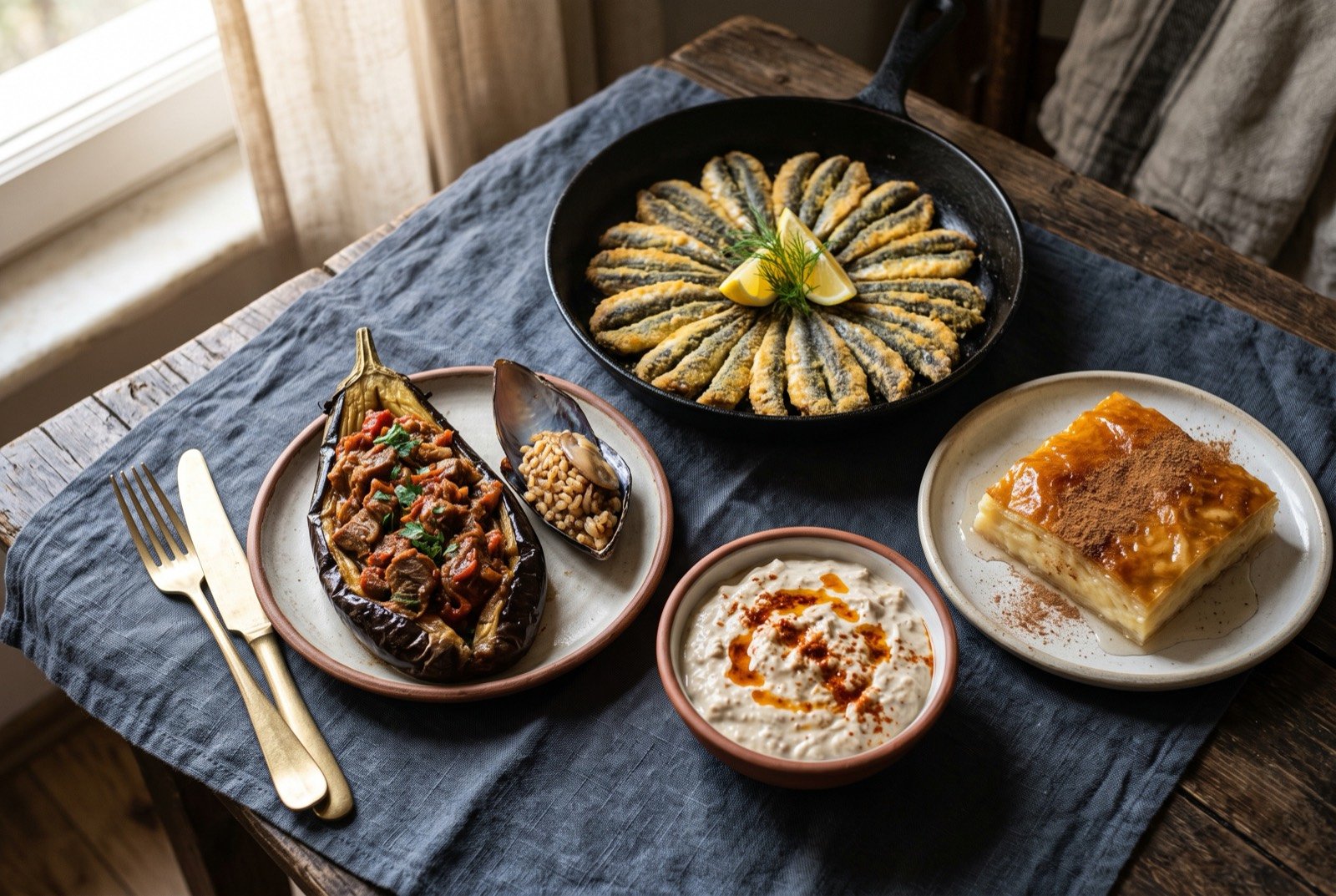
Turkey's maritime and imperial capital table: the Aegean's olive oil and wild greens, the Black Sea's anchovy and cornmeal, and the palace kitchens of Istanbul that sat between them and drew on both. Every dish as tradition built it, then what a modern chef would change.
Sources and review · What this chapter does not assert · How we research · Spotted something wrong?
A Sense of Place
Turkey is split into two volumes in this atlas, not one, and the split is not administrative, it is ecological. This volume covers the coast: Istanbul, the Aegean's olive groves and fishing villages, and the Black Sea's wet, mountainous anchovy and cornmeal world. A second volume, not yet written, will cover the continental interior, Central and Southeastern Anatolia, wheat, bulgur, grazing and the kebab tradition that most people outside Turkey mistake for the whole cuisine. The two are at least as different from each other as Italy's north and south, and this chapter keeps to its own half deliberately: a reader looking for Adana kebabı, mantı, pastırma or baklava from Gaziantep will find them properly treated when that volume exists, not thinly copied in here.
What unites this volume's own three parts is not a shared larder. Istanbul, the Aegean coast and the Black Sea coast run on genuinely different fats, starches and social structures, and the chapter's argument is that the imperial capital sits between two coastal food worlds and drew from both rather than generating a single unified cuisine of its own.
The Aegean: olive oil as the defining fat
South of Macedonia and all along the Aegean shore, olive oil is not a cooking medium, it is the dish's primary flavour component, used in a quantity a calorie-conscious Western recipe would find alarming and finished with a further raw drizzle at the table [Tr, aggregated food-culture sourcing]. Turkish food regulation actually formalises what counts as a real claim here: natürel sızma zeytinyağı (extra virgin, acidity under 0.8g/100g, mechanically produced, no additives) and natürel birinci zeytinyağı (virgin, up to 2.0g/100g) are the honest grades; rafine and riviera zeytinyağı are chemically processed or blended oils with vitamin E added back after refining strips it out, and a dish built on either of the latter two is not honestly zeytinyağlı, whatever the label says [Tr-Gov, Türk Gıda Kodeksi]. Regional character matters too: north Aegean oil from Ayvalık and Edremit reads balanced and low-acid; south Aegean Memecik, grown from İzmir down to Kahramanmaraş, is bold, high in polyphenols, and carries a peppery, throat-catching bitterness that Turkish tasting vocabulary treats as a quality marker, not a flaw.
Aegean village cooking runs on wild greens as much as cultivated vegetables. A 2020 ethnobotanical survey names the working larder directly: arapsaçı, şevketi bostan, radika, labada (dock), ebegümeci (mallow), deniz börülcesi (samphire), kuşkonmaz (wild asparagus), turp otu, hardalotu, roka and tere, boiled and dressed with oil and lemon, sautéed, or worked into a sauce [Tr-Acad, Kök, Kurnaz, Kurnaz and Karahan, 2020]. The technique that carries all of this, zeytinyağlı, cooking vegetables low and slow largely in their own moisture plus a fixed ratio of oil to water or lemon until fully tender, then cooling the dish completely in its own pot before serving, gets a full technical treatment below, because getting the cooling step right or wrong is the difference between a dish that tastes finished and one that tastes like an unfinished vegetable side.
Istanbul: the crossroads that drew on both coasts
Istanbul's own food history is framed by Prof. Dr. Artun Ünsal, writing for the city's own cultural authority, as a roughly 8,500-year unbroken layering, Ancient Greek, Roman, Byzantine and Ottoman, each adding to what came before rather than replacing it [Tr-Gov]. The Byzantine contribution, on this account, was establishing food as an instrument of imperial hierarchy and display, a role the Ottoman court then inherited at Topkapı and elaborated into a genuine institution rather than a kitchen: the Matbah-ı Amire, with an aşçıbaşı over all the cooks and a kilercibaşı, third in the whole palace's hierarchy, who personally tasted the sultan's food before it reached him. This chapter treats that institution properly in the history section below, because its scale (staff numbers running from around 260 in the sixteenth century to over 1,500 by the mid-seventeenth) is a genuine argument for why Ottoman court cooking became a technique tradition in its own right rather than just very good home cooking scaled up.
The city's table was never built by one community alone. Rum (Greek), Armenian and Jewish cooking left direct, nameable marks, seafood dolmas, the mezze staple topik, papaz yahnisi, that this chapter names properly rather than folding into a vague "Ottoman" label, and nineteenth-century Caucasian and Rumelian migration left a real, if imperfectly documented, trace on dishes still cooked today. Istanbul's meyhane, the tavern that houses the rakı table, is itself understood locally as an institution descended from the city's Greek population, its owners once called "Barba" and trusted as informal judges of character.
The rakı table's actual structure
The rakı table has a name of its own, çilingir sofrası, "locksmith's table," reputedly because it could be assembled from whatever was on hand the way a locksmith works with whatever tools he has. Academic work on the institution is explicit that its point is muhabbet, conversation and sociability, not eating as the primary purpose, with white cheese and yoghurt-based mezes the most consistently reached-for category [Tr-Acad]. The sequencing has real rules: cold, shareable mezes open the table and sit out through the meal; hot small plates, ara sıcak, are deliberately not brought all at once but timed to arrive once conversation has properly started, one by one; a main course, if any, comes last. This is not incidental colour, it is the structural logic behind why several of this chapter's dishes are built to be served cold and rested rather than hot from the pan.
The Black Sea: a genuinely different ecology, not just a different region
The eastern Black Sea coast, Trabzon through Rize to Artvin, sits under the wettest climate in Turkey. Steep, forested mountains rise almost directly from a narrow, humid coastal shelf, and under that rainfall wheat and the olive, the twin foundations of everything above, simply do not do well. Maize and dairy take their place: an official regional source states plainly that before tea displaced it, "every village garden was covered in maize" [W-Tr]. Rize is Turkey's tea capital in a measurable sense, not a reputational one: the region produces 67 per cent of the country's fresh tea leaf from roughly 201,000 producers, and 119 of Turkey's 207 tea factories sit in Rize alone [Gov-Tr, Rize Trade Board]. Ordu produces around a quarter of the entire world's hazelnut crop [Gov-Tr, Anadolu Ajansı]. And from 1 November to 1 April, this coast organises itself around hamsi, the Black Sea anchovy, described in regional sources not as a fishery but as "a basic livelihood" fused with the population's whole way of life in a way true of nowhere else in the country.
The Laz people, the coast's most distinct community, trace their own name back through Kolhi, attested in a source from 764 BCE naming a "Kolha country" on this coast, the same Colchis this atlas's Georgia volume already covers from its own side of the modern border. Lazca is a genuine Kartvelian language, related to Georgian, Mingrelian and Svan, but Laz-community sources are emphatic it is not a Georgian dialect, and this chapter respects that rather than flattening it. The Hemşin people, further along the coast, carry a genuinely contested Armenian-origin question that this chapter does not adjudicate, for the same reason it does not adjudicate any other community's account of its own history: it is live and contested inside Turkey itself, and the honest thing to do is attribute each account to who makes it.
A table of the coast's own logic
| Zone | Defining fat and starch | The dishes that carry it |
|---|---|---|
| Istanbul | Olive oil and wheat, palace technique layered over both | Çerkez tavuğu, hünkar beğendi, balık ekmek, midye dolma, midye tava |
| The Aegean coast | Olive oil, wild greens, cold-served vegetables | Imam bayıldı, karnıyarık |
| The Black Sea coast | Maize and dairy, hamsi anchovy | Hamsi tava, hamsili pilav, kuymak, karalahana çorbası, Laz böreği |
The History in Layers
The Topkapı kitchens as an institution, not a room
The Matbah-ı Amire was established under Mehmed II and rebuilt after a fire in 1574 by Mimar Sinan into the closed-courtyard complex that survives today: kitchen halls, staff dormitories, storage cellars, an oil workshop and dedicated kitchenware storage, run as an integrated institution [Tr-Acad, Aydın Gastronomy Dergisi, citing Bilgin's Osmanlı Saray Mutfağı 1453 to 1650]. In the sixteenth century the kitchen staff proper numbered around 60 specialist cooks, bakers, simit-makers, pilav cooks, kebab cooks, poultry cooks, vegetable cooks and confectioners, supported by roughly 200 assistants; by the end of Süleyman the Magnificent's reign this had grown to 629, and by the mid-seventeenth century kitchen and household staff together exceeded 1,500. This chapter treats the broad structure and the escalating numbers as well sourced, but a dedicated academic study of the seventeenth-century kitchens specifically could not be obtained in this research, and finer detail from that period should be treated as a gap rather than filled in with confidence it does not have.
Rum, Armenian and Jewish Istanbul
Rum, Armenian and Jewish communities contributed directly to the city's dolma repertoire specifically, seafood dolmas among them, and their broader technique persisted wherever it did not conflict with Islamic dietary restriction on pork and wine [Tr-Gov, Ünsal]. The strongest single Armenian example is topik, a cold, entirely vegan meze of chickpea-and-potato purée wrapped around a filling of tahini, onion, spice, walnut and currant, documented as sold in nineteenth-century Istanbul meyhanes "regardless of rich or poor." It carried real domestic weight beyond the plate: an Armenian bride's dowry cloth was traditionally called a topik bezi, and being able to make topik competently was locally understood as a marker that a young woman was ready for marriage. Papaz yahnisi, a Rum fish and onion stew, and a Jewish leek-and-meat croquette are both named in Turkish sources as documented ethnic contributions to the shared table, though this chapter could not trace either to a single primary academic text rather than aggregated corroboration.
Circassian migration and Çerkez tavuğu, honestly separated
The 1864 Caucasian expulsion is extremely well documented: following decades of resistance beginning with the Kabardey Circassians' 1764 decision to fight and continuing under Imam Shamil, Russian imperial campaigns forced the mass expulsion of Circassian and Abkhaz peoples to Ottoman territory, culminating on 21 May 1864, commemorated in Circassian communities today as Sürgün Günü. What is weaker is the specific claim that Çerkez tavuğu itself travelled with this migration. The dish appears in Ayşe Fahriye's cookbook Ev Kadını, which sources disagree on dating between 1883 and 1894, a discrepancy this chapter's research could not resolve against a library catalogue, associated there with dishes said to have "come with Caucasian and Rumelian immigrants." This chapter treats the migration as settled history and the dish's specific transmission story as plausible and widely believed, not as a rigorously documented causal chain.
The strongest single piece of evidence for migration reshaping the city's food in this period is Rumelian rather than Circassian: refugees from Thessaloniki, resettled across Anatolia, are the subject of a dedicated 2023 ethnographic study built on twelve months of fieldwork and 97 interviews, documenting nohutlu ekmek (chickpea bread), muhacir ekmeği ("migrant bread") and a fermented soup base called muhacir tarhana, and framing food practice explicitly as a mechanism of trauma memory nearly a century after the exchange [Tr-Acad, Örnek, Milli Folklor, 2023].
1923 and the Aegean coast
Academic sources treat the 1923 population exchange's culinary effect as a live, actively researched question rather than settled fact. A dedicated study of Thessaloniki-origin exchange migrants found they maintained their own pre-exchange eating patterns after resettlement, their culinary culture changing in content and technique over time while retaining its identity and memory function [Tr-Acad, Güncel Turizm Araştırmaları Dergisi, 2020]. On the Aegean coast itself, İzmir's herb-forward, olive-oil-forward character is widely credited to Cretan and Rumelian migrant cuisine arriving with the exchange. What this chapter does not claim is that any single named zeytinyağlı dish was introduced, rather than reinforced, by the exchange specifically, since Rum communities had been cooking on this coast continuously until the exchange itself removed them; the honest claim is that 1923 concentrated and intensified an already-present tradition, not that it invented one. Boyoz, İzmir's laminated pastry, is widely credited to the city's Sephardic Jewish community, a claim repeated everywhere this chapter's research looked but not traced to a primary community source.
A correction worth making plainly: hünkar beğendi and the Eugenie legend
The story told about this dish almost everywhere, that it was invented in 1869 at Dolmabahçe by French Empress Eugénie's own chef, using béchamel, to win Sultan Abdülaziz's favour during a state visit, does not survive checking, and this chapter does not repeat it as fact. The earliest written recipe, in Urbain Dubois's French cookbook Cuisine de tous les pays (1872), under a French transliteration of the dish's name, contains no béchamel, and tas kebab, the lamb stew served over it today, was added to the recipe only later. Drawing on Mihran Arabacıyan's 1876 Armenian-script Turkish cookbook, the 1880 Ottoman cookbook Yeni Yemek Kitabı, and Priscilla Mary Işın's respected Osmanlı Mutfak Sözlüğü (2017), the better-supported account is that Sultan Abdülaziz, a genuine food enthusiast, simply enjoyed an aubergine dish made by one of his enslaved African cooks and named it after himself, the dish's real origin lying in Ottoman cooks adapting French purée technique rather than in a romantic royal encounter. A parallel, weaker legend attaches to imam bayıldı, that an imam fainted, bayıldı, either from the dish's flavour or from shock at how much oil his wife had used. This chapter treats that story the same way: repeated everywhere, confirmed nowhere, and not asserted as history.
The Laz, Kolchis, and a language question worth stating carefully
The Laz trace their own name through Kolhi, attested in a source dated to 764 BCE naming a "Kolha country" on this coast, the same Colchis this atlas's Georgia volume treats from the other side of a modern border that did not exist when the name was first used. Lazca sits within the South Caucasian, or Kartvelian, language family alongside Georgian, Mingrelian and Svan, a genuine structural relationship. But Laz-community sources are emphatic that Laz and Georgian are not mutually intelligible, and that the closer relationship is between Laz and Mingrelian, sharing a common ancestral Zan language with a reported 70 to 80 per cent mutual intelligibility, far higher than between Laz and Georgian. This chapter's framing follows that community's own account: Laz is a genuine Kartvelian language, related to Georgian, but a distinct language and people, not a Georgian dialect or subset of Georgian identity.
Pontic Greek heritage, and a 2026 dispute worth naming rather than avoiding
Pontic Greeks inhabited this coast for close to three thousand years, by their own historical tradition, before the 1923 population exchange relocated the great majority to Greece. A specific, concrete piece of food-culture continuity survives the displacement: tiroklosti, a Pontic-language cheese-heavy, cornmeal-light breakfast dish, is still made today in Çaykara and Beşköy, inland districts of Trabzon, and is identified as the Greek-named sibling of this chapter's kuymak and muhlama family below. This is exactly this atlas's own argument about shared ecology outrunning national border, showing up on the Black Sea rather than only in Africa or the Mediterranean.
In 2026, Turkish press reported a fresh dispute after Greek media presented galaktoboureko as straightforwardly Greek, prompting Turkish outlets to point out this is the same dessert known in Turkish as Laz böreği and in Lazca as paponi, a dispute that reportedly reached the Turkish parliament's own agenda. The name itself is a compound of Greek galakto (milk) and boureko, a Turkish and Ottoman loanword, börek, a detail Turkish commentary points out is routinely left out of the Greek framing. Given more than four centuries of Ottoman rule over Greek-speaking populations and a genuinely shared Pontic Black Sea food culture before 1923, this chapter treats the dish as a shared regional dessert with parallel names in three languages, not a case of either side stealing from the other, and names the contemporary nationalist framing on both sides as exactly that rather than adopting it.
A related dispute worth naming for its method, not its verdict: kokoreç
Kokoreç, seasoned lamb or goat intestine grilled slowly over charcoal, chopped and served in bread, carries its own live, genuinely instructive origin argument. The commonly repeated claim traces Turkish kokoreç to early twentieth-century contact with Greek-run Istanbul restaurants, via Ömer Seyfettin's 1920 short story "Lokanta Esrarı." A named historian, Zülfer Erdem, argues against this directly: a full kokoreç recipe already appears in the kebab section of Ayşe Fahriye's Ev Kadını, decades before Seyfettin's story, and Kâşgarlı Mahmud's eleventh-century Dîvânu Lugâti't-Türk describes a dish called yörgemeç, fried or cooked tripe and intestines, which Erdem reads as evidence the underlying technique is at least a thousand years old in Turkish cooking. There is also a genuine technical difference behind the naming dispute: the Greek method wraps intestine directly around liver; the Turkish method first wraps a layer of intestinal fat, çöz, and only then wraps intestine around that. This chapter names both accounts and does not adjudicate a winner, in keeping with its own house rule that a shared or disputed dish is presented as attributed argument, not a verdict this book is entitled to hand down.
The Flavour Arsenal
Olive oil, graded and placed
Covered technically above: the four-tier Turkish classification, natürel sızma and natürel birinci as the honest grades, riviera and rafine as processed oils a genuine zeytinyağlı dish should never be built on; the north Aegean's balanced Ayvalık and Edremit oil against south Aegean Memecik's bold, peppery, high-polyphenol character.
Hamsi, and what "kırk türlü" actually names
The claim that hamsi is cooked "kırk türlü," forty ways, is a genuinely old idiom, widely attributed to the seventeenth-century traveller Evliya Çelebi, though this chapter's research could not pin that attribution to a specific page of his Seyahatname and treats it as a real, old figure of speech about the fish's versatility rather than a literal, checkable inventory. What the phrase names in practice includes hamsi tava (pan-fried), hamsili pilav (layered into rice), hamsi buğulama (steamed), hamsi kuşu ("anchovy bird," fried balls), hamsi dolması (stuffed), and hapsikoli, an anchovy flatbread with greens worked into the dough. Fresh hamsi is judged by clean sea smell, clear bright eyes, bright silver skin and flesh that springs back immediately when pressed; a fingerprint that stays is the first sign of spoilage. It is explicitly a cold-months fish, at its best in January and February, and hamsi caught out of season or long transported from landing is, structurally, a different product from the one these dishes were built around.
Karalahana, correctly placed
Karalahana, "black cabbage," is a non-heading cabbage relative, its dark green leaves growing upright and open along the stem rather than folding into a compact head, essentially the same plant known in Britain as cavolo nero or black kale, not the headed cabbage its English gloss suggests. It is the defining vegetable of Black Sea cooking, grown through autumn and winter, and used above all as a soup vegetable.
Mısır unu and the etymology worth holding lightly
Maize is called lazut in eastern Black Sea dialect, not just mısır, and its etymology is a small, genuine example of a claim this chapter holds carefully rather than repeating as settled. A popular folk etymology derives it from "Laz otu," Laz grass, on the theory that Laz sailors spread maize along the coast. A more cautious linguistic source, the Nişanyan etymological dictionary, treats the word's true origin as genuinely uncertain, and suggests Lazca's own term may itself have been borrowed from Turkish rather than the reverse. What is not in dispute: maize's arrival on this coast is a post-Columbian, early-modern development, not an ancient one, the same pattern this atlas has already traced for New World crops across its African volumes.
Nar ekşisi, pomegranate molasses
Made by halving pomegranates, separating seeds and juice from the bitter white pith, which must be fully removed or it turns the reduction bitter, then reducing the juice at the lowest possible heat in a stainless steel pot (the fruit's high acidity reacts with other metals), skimming scum repeatedly, until the volume has fallen sharply, the colour has darkened, and large, slow bubbles appear. Working yield: roughly 15kg of whole fruit for a litre of finished molasses.
Ezine peyniri
Carries formal Protected Designation of Origin status (Turkish Patent Institute registration no. 86, 2006), made from a blend of sheep, goat and cattle milk from animals grazing the northern and western slopes of Kaz Dağı, Mount Ida, around Ezine, Bayramiç and Ayvacık.
The Black Sea dairy belt: minci, and kaymak held honestly
Vakfıkebir and Tonya, both in Trabzon province, are named specifically as the region's butter centres. Minci, a fresh whey curd cheese, appears at nearly every meal and is the defining cheese in this chapter's kuymak family below. This chapter went looking for kaymak as a distinctively Black Sea product and could not find it treated that way in any source consulted; kaymak is real and good here, but it is not a Black Sea-specific claim the way minci and karalahana clearly are, and this chapter does not overstate it.
The Technique Ladder
The argument, from inside
Mehmet Gürs, who is widely credited with starting contemporary Istanbul fine dining, describes Mikla's method directly: the restaurant employs a full-time anthropologist who conducts fieldwork across Anatolia, building a network of producers, village cooks and grandmothers whose technique and product knowledge feed the kitchen's research. Gürs listens to what generations have preserved but does not accept it unmodified, applying his own experimentation to bring tradition and technical understanding together. Fatih Tutak, whose Istanbul restaurant TURK holds two Michelin stars, gives the most direct diagnosis of what goes wrong when this cuisine travels badly: diaspora restaurants abroad are, in his own words, "just kebab shops, döner places," and the ingredient base itself has often already drifted, since "even our vegetables' seeds are foreign, hybrid seeds." This chapter's technique ladder follows the same principle as every other volume in this atlas: elevate the traditional mechanism, do not import a foreign one.
Rung 1. Char the aubergine over direct flame, not in an oven
Köz patlıcan, smoked aubergine, the base of hünkar beğendi, is made by charring whole aubergines directly over open flame until the skin blisters black and the flesh inside collapses to a smoky, custardy pulp. Turkish sources are explicit that direct flame, not oven-roasting, is what produces the correct füme character the dish depends on, because contact pyrolysis of the skin creates smoke compounds, guaiacol among them, that penetrate the collapsing flesh, a genuinely different chemical result from the Maillard browning an oven grill produces on the surface alone. What a cook does with this rung. Run a Big Green Egg hot and open, coals exposed rather than banked, which reproduces the direct-flame contact a domestic oven grill cannot manage, while the ceramic's very high, stable radiant heat chars the skin fast enough that the dense flesh underneath has time to steam-cook through before the outside burns to ash.
Rung 2. Blend hard, then strain: the walnut and tahini sauce family
Çerkez tavuğu's walnut sauce, tarator, and every other sauce in this cuisine's walnut-and-tahini family is traditionally pounded to a fine paste, and the texture every good source describes is silky and emulsified, never grainy. A high-power blender achieves in seconds what a pestle and mortar achieves through real labour, but the blender alone is not enough: walnut skins carry tannins that read as bitter grit in the mouth if left in, and a chinois pass afterward removes that particulate without stripping the emulsified oil-and-nut-protein base that actually carries the flavour. What a cook does with this rung. Blend the sauce properly smooth, then always pass it through a chinois before serving; the difference between a home version that tastes chalky and a restaurant version that tastes clean is almost entirely this second step, not a better blender.
Rung 3. Double-ferment yoghurt low and slow for depth
Civan Er, whose Yeni Lokanta in Istanbul and Yeni in London both build on this, describes his method directly: "we get the yoghurt, and we double-ferment it in the oven at a low temperature for eight to nine hours at 80 degrees, to give it depth, and make it tangier and more intense." This is well above the temperature live yoghurt cultures survive at, so it is not further fermentation in the biological sense, it is a controlled, very slow reduction and flavour concentration of an already-fermented base, driving off water gradually while enabling slow non-enzymatic browning in the milk's own proteins and residual lactose. What a cook does with this rung. Use a sous vide bath rather than a domestic oven to hold 80°C for the full eight to nine hours, since a home oven will drift over that length of time and a circulator will not; the result is a tarator or yoghurt sauce base with real depth rather than a plain strained yoghurt with garlic stirred in.
Rung 4. Rest zeytinyağlı dishes properly, and bring them back to room temperature deliberately
Turkish sources are consistent and specific that dishes in the zeytinyağlı family are cooked, then rested, ideally overnight, and served at room temperature, never straight from the heat and never fridge-cold. The stated mechanism, plausible but not independently checked against a food-science source in this chapter's own research, is that sugar naturally present in the vegetables and olive oil bind chemically as the dish cools, forming a light coating that has simply not happened yet in a hot dish, while a fridge-cold dish mutes the oil's own aroma before the vegetables have drawn the sauce in. What a cook does with this rung. Cook the dish, rest it covered overnight in the fridge, then bring it back to room temperature before serving, a sous vide bath set to 20 to 22°C is, unusually, a genuinely useful precise tool for exactly this step, since "room temperature" otherwise varies by kitchen and season. Finish with a second, more peppery cold-pressed oil at the table, different from the one used in cooking.
Rung 5. Toast the cornmeal properly, and read doneness by the fat, not the clock
Kuymak and muhlama's cornmeal is roasted in butter before any liquid goes in, and the colour change during that toasting is a genuine technique marker, not just a timing instruction: an under-toasted cornmeal stays gritty and raw-tasting however long the dish then simmers. The finished dish's doneness cue is visual and textural rather than timed: the fat rises to the surface as a distinct glossy layer once the cheese has properly melted through, and that is the signal to serve, not a fixed number of minutes. What a cook does with this rung. Toast the cornmeal in butter until its colour visibly deepens before adding any liquid, and judge the finish by watching for that glossy fat layer to separate out on top rather than by the clock; a kuymak pulled too early looks finished but tastes of raw cornmeal underneath.
The Ferment and Preserve Bench
1. Tarhana
A fermented soup base found across Anatolia and the Black Sea alike: yoghurt, wheat flour, raw or cooked vegetables, tomato, pepper, onion, and herbs are combined into a dough and left to ferment at room temperature for 3 to 10 days. Turkish sources are explicit that the drying stage that follows should not be done in direct, harsh sun, since this degrades the B-vitamin content the yoghurt and vegetables contribute; the traditional method spreads the dough thinly on woven mats and dries it in indirect light and moving air over at least two days. A dehydrator, set low at 40 to 45°C with good airflow, reproduces that indirect, controlled drying far more reliably than either sun or a domestic oven, and compresses the multi-day process to under 24 hours without the vitamin loss the traditional method is explicitly protecting against.
2. Turşu
Cold-brine pickling, applied across this coast to whatever the season offers, cabbage, cucumber, pepper, green tomato, in salted water with vinegar, left to ferment at cool room temperature for one to several weeks. Its brine, turşu suyu, is itself a genuine sauce ingredient in contemporary Istanbul kitchens; Neolokal is credited with building sauces directly from traditional home pickle brine rather than treating it as a byproduct to discard once the vegetables are gone.
3. Nar Ekşisi
Covered in full in the Flavour Arsenal above: pomegranate juice, freed of its bitter pith, reduced slowly in a stainless steel pot until dark and syrupy. A preserve rather than a ferment, but the bench this cuisine's souring agent belongs on.
Sourcing in Britain
Verified September 2026. London's Turkish and Kurdish retail geography is one of the largest and oldest in Europe, and this chapter treats it that way rather than as a token diaspora presence.
The ranked list: what decides great from grim
- Fresh hamsi, honestly graded as unavailable, and what to do instead. Genuine Black Sea hamsi is not sold fresh in Britain at any verified retailer; what is sold as "hamsi" is either preserved or, where frozen, very likely Mediterranean or Atlantic anchovy rather than the Black Sea fish. The honest substitute is fresh Cornish anchovy in season, from merchants listed via the Cornwall Good Seafood Guide, or, failing that, whole sprat, closer in size and oil content to hamsi than any other UK-landed fish. Hamsi's defining textural point, eating the whole small fish bones and all straight from a hot pan, transfers to either; the specific Black Sea fat content does not, and no sourcing effort currently closes that gap.
- Real Aegean olive oil, bought as a single-origin Turkish oil, not a generic Mediterranean blend. LUVIA Olive, UK-registered, sells single-origin Ayvalık and Memecik oil from small Anatolian farms, lab-tested to 0.40% acidity. Marmarabirlik, Turkey's oldest and largest olive cooperative, is the safe, widely available everyday choice via Amazon UK and Turkish Porter.
- Nar ekşisi, genuinely easy in Britain now, even in the mainstream. Waitrose's own Cooks' Ingredients pomegranate molasses, via Ocado, is a real option. For Turkish grocery strength, Anthap (100% pomegranate, no added sugar) is verified and current. Check the label for added sugar: several Western-market bottles are considerably sweeter and thinner than the product these recipes assume.
- Pul biber, thoroughly available, including from serious UK spice houses. Sous Chef and The Spice Shop both stock it well, alongside every Green Lanes grocer. This is genuinely the third most reached-for seasoning in a Turkish kitchen after salt and pepper; a stale bag from a generic chilli-flake tub is not the same product.
- Biber salçası. Genuine salça is sun-dried for six to seven days to a thick, savoury paste, not simmered purée in a jar. Tat and Öncü are both verified and importable. Buy the glass jar over the metal tube where possible.
- Beyaz peynir. Sütaş and Pınar, Turkey's two largest dairy producers, both ship into the UK. A genuinely different product from Greek feta, softer and less sharply salted, worth insisting on the named Turkish brand.
- Kaymak, the one dairy item worth ordering ahead rather than expecting on a shelf visit. Grocina and Altin Grocery both list genuine Turkish kaymak; order for a specific date. Where it cannot be sourced in time, thick clotted cream is the honest stand-in, noted rather than dressed up as equivalent.
- Yufka, fresh where it can be had, frozen as the realistic default. Turkish Porter sells it handmade and freezer-suitable. Continental Food Store carries the frozen Suntat and Yayla brands. Genuine yufka, fresh or defrosted, is worth the extra step over a filo substitute for Laz böreği.
- Rakı, a specialist order rather than a shelf grab. Yeni Rakı is available through Beers of Europe and Fine Wine Sellers, generally within a few days; not found stocked as standard in a typical high-street off-licence.
- Çay, genuinely well covered, loose leaf included. Çaykur, the dominant Rize producer, is stocked loose leaf by Nutz4Nuts in several of its named blends.
- Karalahana, genuinely and specifically substitutable, with a UK precedent already cooking it that way. Cavolo nero, grown widely in Britain and in season through autumn and winter, is the close working substitute; see Wooptonight's own Turkish kale soup built on "allotment cavolo nero".
Physical shops
Green Lanes, Harringay, Turnpike Lane and Palmers Green, is the spine of Turkish and Kurdish London and the area this chapter goes deepest on. Yaşar Halim, 386 to 390 Green Lanes, opened 1981, remains the single best one-stop shop this chapter could verify for both pantry goods and fresh bakery in one visit: in-store bakery, butcher counter, an extensive olive selection, fresh breads and baklava. TFC / Turkish Food Centre trades from several Green Lanes and North London branches; this chapter's research found what appear to be two distinct trading entities sharing the TFC name (one tracing to a 1980 Dalston shop, one to a 1995 Edmonton opening), could not resolve whether they are related, and says so rather than guessing. Dalston and Hackney: TFC's original 1980 branch on Ridley Road, flying in fresh produce weekly from Greece, Cyprus and Turkey; Ridley Road Market alongside it; Mangal 1 and Mangal II, long-running ocakbaşı restaurants worth eating at before attempting live-fire grilling at home. Walthamstow: Akdeniz Super Market on Hoe Street, trading since 2005, with a bakery producing fresh Turkish bread and baklava. Edmonton and Enfield: TFC Supermarkets on Fore Street.
The Kurdish side of this, named specifically. Green Lanes and wider Haringey is repeatedly described as home to London's largest Kurdish community, not a Turkish community with a Kurdish minority attached, and several shopfronts along the street are explicitly Kurdish in reference. This chapter could not verify individual named Kurdish grocers to the same street-address confidence as the Turkish shops above, and says so rather than inventing names.
The gap, named honestly. No dedicated Black Sea (Karadeniz) Turkish grocery or restaurant was found and verified anywhere in London. Every general Turkish supermarket above stocks some Black Sea goods, tea, hazelnuts, cornmeal, but nothing this chapter found is built specifically around Black Sea regional cooking.
Kit substitution, honestly
A Big Green Egg run at a controlled, moderate-hot temperature over a genuine bed of lump charcoal is the closest achievable domestic equivalent to the slow charcoal cook kokoreç depends on; this chapter treats kokoreç as a dish worth eating on Green Lanes or in Istanbul rather than one to attempt from scratch at home. A dehydrator, not an oven, is the right tool for tarhana; pastırma's çemen-cured curing belongs to this cuisine's interior sibling volume, not here. A high-power blender paired with a chinois, per Rung 2, is the genuinely transferable technique in this chapter's whole kit, not an imported modernist trope. Sous vide has the weakest direct mapping onto this cuisine's core repertoire beyond the two specific uses above, low, held-temperature yoghurt fermentation and precise room-temperature holding for zeytinyağlı dishes; this cuisine's defining techniques are live coals, a hot pan for whole small fish, and long slow braises, not precision protein cookery, and this chapter does not force an application where none exists.
Voices and Sources
From inside the tradition
- Musa Dağdeviren, Çiya Sofrası, Kadıköy. Not a modernist chef but a food anthropologist who also cooks, and arguably the deepest well the other names below draw from: eighteen months of fieldwork across forty villages, a food atlas and dictionary of regional Anatolian dishes, many themselves forgotten in their region of origin, and the founder of Yemek ve Kültür (Food and Culture) magazine in 2005.
- Mehmet Gürs, Mikla, Istanbul. Widely credited with starting contemporary Istanbul fine dining under "New Anatolian Cuisine," running the only restaurant in the world known to employ a full-time anthropologist for producer and technique research.
- Maksut Aşkar, Neolokal, Istanbul. One Michelin star and, in the same year, the first Turkish restaurant to hold the Michelin Green Star, built on fermentation-forward technique reviving disappearing Anatolian preparations.
- Fatih Tutak, TURK Fatih Tutak, Istanbul. Two Michelin stars, and the sharpest named diagnosis this chapter found of why Turkish food travels badly: diaspora restaurants reduced to "just kebab shops," and Turkey's own agriculture already drifting from the seed varieties this cuisine was built around.
- Civan Er, Yeni Lokanta, Istanbul, and Yeni, London. The clearest transferable technique in this chapter, the double-fermented yoghurt sauce, comes directly from his own words.
- Priscilla Mary Işın, author of Osmanlı Mutfak Sözlüğü (2017), the serious reference work this chapter relies on to correct the hünkar beğendi legend.
- Zülfer Erdem, the named historian whose counter-evidence on kokoreç's Turkish rather than borrowed origin this chapter presents alongside, not instead of, the commonly repeated Greek-contact account.
The UK diaspora
- Selin Kiazim, Leydi, Farringdon. British-born, of Turkish Cypriot heritage; her own tradition is specifically Turkish Cypriot, not mainland Anatolian, a distinction this chapter keeps visible rather than flattening.
- Esra Muslu, Zahter, Carnaby. Built deliberately on Greek, Armenian, Persian, Ottoman and Levantine layers rather than a single national narrative.
- Tas, Borough, Bloomsbury and The Cut, trading since the late 1990s. Not chasing Michelin recognition, but the reliable, consistent presence that built London's appetite for Turkish dining before any of the current fine-dining wave existed.
- Green Lanes, Harringay. London's historical Turkish, Kurdish and Turkish Cypriot food epicentre, home to the ocakbaşı grill and pide-oven tradition that predates and underpins every restaurant named above.
The gaps, named
No Turkish-language primary interview with Maksut Aşkar going into technical depth could be reached in the research behind this chapter; of the four named Istanbul chefs, his own voice is the one least represented here. No named contemporary chef working Black Sea coastal technique, hamsi above all, at a comparable fine-dining tier to the Bosphorus and Aegean names above was found, a real gap if this coast is ever to have its own equivalent representation. A dedicated academic study of the seventeenth-century Topkapı kitchens specifically could not be obtained.
Things this chapter has deliberately not asserted
- That hünkar beğendi was invented by Empress Eugénie's chef in 1869. The earliest documented recipe, 1872, contains no béchamel, and the better-supported account credits Sultan Abdülaziz's own enslaved cook.
- That an imam actually fainted from imam bayıldı's flavour or its cost. Repeated everywhere, confirmed nowhere.
- That Çerkez tavuğu's transmission via the 1864 Circassian migration is documented rather than plausible. The migration is settled history; the dish's specific journey into Ottoman cuisine is widely believed, not rigorously traced to a primary text.
- A publication year for Ayşe Fahriye's Ev Kadını. Sources give both 1883 and 1894 for the same book.
- That any single named Aegean zeytinyağlı dish was introduced, rather than reinforced, by the 1923 population exchange. The more defensible claim is that the exchange intensified an already-present Rum-influenced tradition.
- Boyoz's attribution to İzmir's Sephardic Jewish community as independently verified fact. Widely repeated, not traced to a primary community source.
- Which side, Greek or Turkish, "owns" Laz böreği and galaktoboureko. Presented as a shared regional dessert with parallel names in Greek, Turkish and Lazca, per this chapter's own house rule against letting one community's writers adjudicate another's food.
- That the Laz language is a Georgian dialect. Laz-community sources are emphatic it is a distinct Kartvelian language and people; that framing is respected.
- A single settled origin for the Hemşin people. The Armenian-descent, later-Islamised account is the most widely repeated academic theory, and this chapter states it as such, not as adjudicated fact, since the question remains genuinely contested inside Turkey itself.
- That kaymak is a distinctively Black Sea product. It is real and good on this coast, but no source consulted treats it as regionally distinctive the way karalahana or minci clearly are.
- The precise regional boundaries of muhlama, kuymak and yağlaş (Rize/Artvin against Trabzon/Gümüşhane against Ordu/Giresun) as fully settled fact rather than a strong, well-corroborated lead; the source behind the distinction could not be re-fetched in full during this chapter's research.
- That the "kırk türlü hamsi" (forty ways with anchovy) idiom traces to a specific, citable passage of Evliya Çelebi's Seyahatname. The attribution is widely repeated and treated here as a real, old figure of speech, not a checkable inventory.
- A resolution to who exactly runs the two TFC-branded shop chains in North London. Both are real, long-established Turkish supermarkets; this chapter could not establish whether they are related and does not guess.
Char the aubergine over direct flame, not in an oven
Köz patlıcan, smoked aubergine, the base of hünkar beğendi, is made by charring whole aubergines directly over open flame until the skin blisters black and the...
Blend hard, then strain: the walnut and tahini sauce family
Çerkez tavuğu's walnut sauce, tarator, and every other sauce in this cuisine's walnut-and-tahini family is traditionally pounded to a fine paste, and the...
Double-ferment yoghurt low and slow for depth
Civan Er, whose Yeni Lokanta in Istanbul and Yeni in London both build on this, describes his method directly: "we get the yoghurt, and we double-ferment it in...
Rest zeytinyağlı dishes properly, and bring them back to room temperature deliberately
Turkish sources are consistent and specific that dishes in the zeytinyağlı family are cooked, then rested, ideally overnight, and served at room temperature...
Toast the cornmeal properly, and read doneness by the fat, not the clock
Kuymak and muhlama's cornmeal is roasted in butter before any liquid goes in, and the colour change during that toasting is a genuine technique marker, not...
The dishes
- Midye Dolma Istanbul and the Aegean coast
- Imam Bayıldı The Aegean coast
- Karnıyarık Pan-Ottoman, but at home on this coast
- Çerkez Tavuğu Istanbul, palace and public table alike
- Hünkar Beğendi Istanbul, palace-descended
- Balık Ekmek Istanbul, Eminönü
- Hamsi Tava The Black Sea coast
- Hamsili Pilav The Black Sea coast
- Kuymak (Muhlama) The Black Sea coast, Trabzon and Gümüşhane specifically
- Karalahana Çorbası The Black Sea coast, Rize
- Laz Böreği The Black Sea coast, and, in Lazca, paponi
Sources and review
- Researched
- 20 sources cited
- Reviewed
- Not yet reviewed from inside the tradition
- Cooked
- Not yet cooked and reported
Where this volume comes from
3 research briefs on file for this volume, researched to the rules on How we research. Published 3 September 2026. Last changed 8 September 2026.
The brief's own account of its sources
Part A. Of roughly 30 distinct sources consulted, roughly 20 are Turkish-language (Hürriyet, lezzet.com.tr, gzt.com, yemek.com, karaca.com, kayserianadoluhaber.com.tr, foodinlife.com, turkiyeturizmansiklopedisi.com, themagger.com, kadikoytarihicarsi.com, arti49.com, dudomeyhane.com.tr, gurmerehberi.com, nefisyemektarifleri.com, artigercek.com, dergipark.org.tr, gidaturk.com.tr, platinonline.com, gazeteoksijen.com, onedio.