Asia · Volume 04
Jordan and Palestine
The Jameed, the Taboon and the Zarb Pit
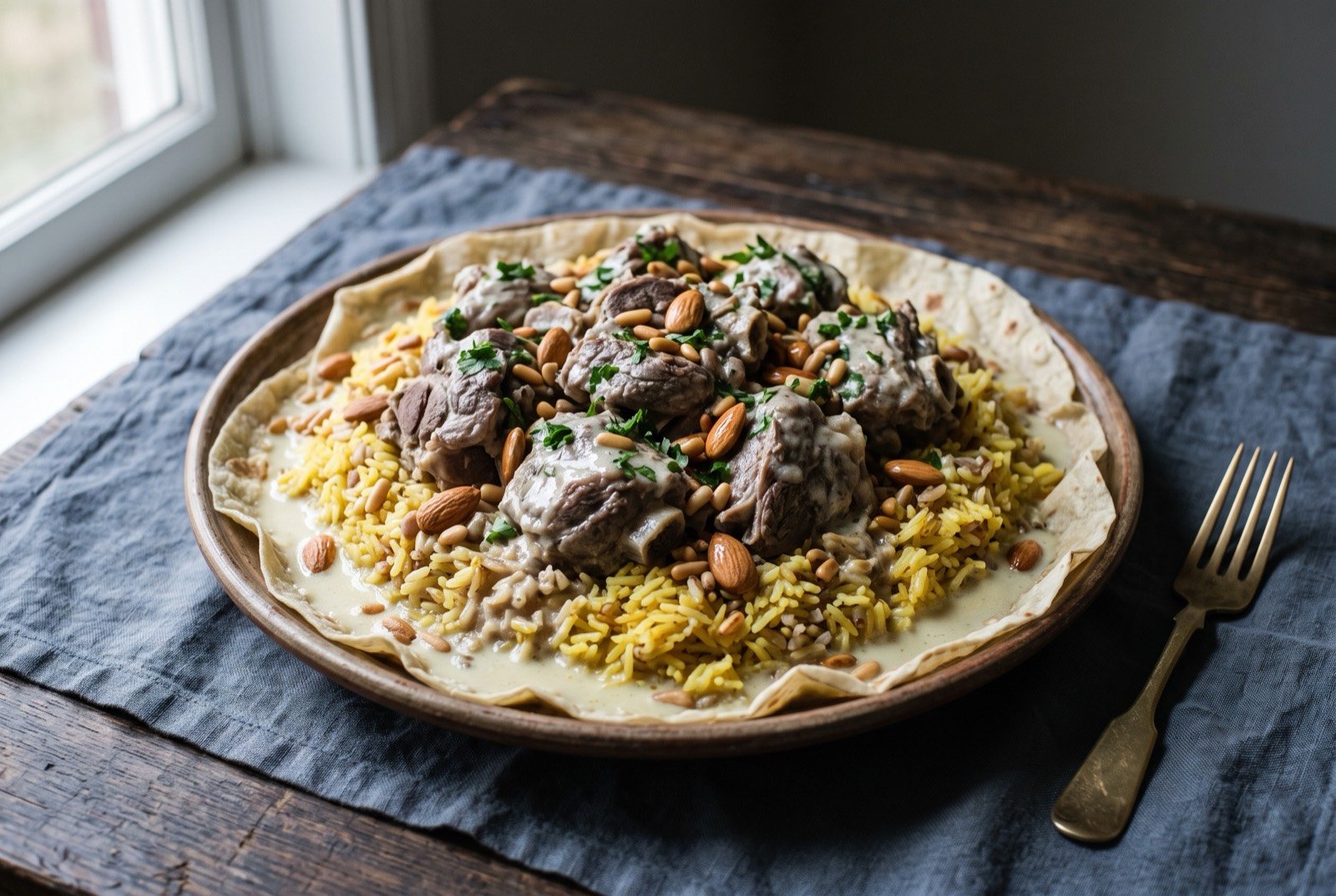
Jordan and Palestine share one food world cut in half by a border drawn only in the twentieth century: a Bedouin table built on jameed, sun-dried fermented yoghurt carrying a herding economy's dairy through a season with no refrigeration, and a fellahin table of olive oil, wheat and hill-village terracing, with Gaza keeping its own coastal register again. Every dish as tradition built it, then what a modern chef would change.
Sources and review · What this chapter does not assert · How we research · Spotted something wrong?
A Sense of Place
Jordan and Palestine sit either side of the Jordan Rift Valley, the same geological scar that carries the Jordan River down through the Dead Sea, the lowest point on the earth's land surface. West of the river, the hill country running from Jenin through Nablus and Ramallah to Hebron is fellahin country: terraced, olive-planted, wheat-farmed, watered by winter rain caught on stepped hillsides that have been worked the same way for centuries. East of it, the land dries fast into steppe and then desert, and Jordan's own population divides in a way this chapter treats honestly rather than smoothing over: East Bank Bedouin and settled fellahin families, and, since 1948 and again since 1967, a Palestinian population that is Jordan's actual demographic majority, refugees and their descendants from the wars that split this one food world into two, then three, political territories.
Gaza is its own case again, a narrow Mediterranean strip whose food culture reads as Palestinian but with a real coastal, more heavily spiced accent of its own: chilli, dill and a "red tahini" made from more heavily toasted sesame appear in Gazan cooking in a way they do not in Nablus or Ramallah. This chapter treats Gaza's dishes on their own terms rather than folding them into a generic Palestinian voice, and says plainly, in its final section, where the current disruption to daily life there has made this research genuinely unable to confirm what it would otherwise want to confirm.
The defining logic, by thread
| Element | Jordan, East Bank Bedouin | Jordan and Palestine, fellahin hill country | Gaza, the coastal strip |
|---|---|---|---|
| Fat | Samneh (clarified butter), rendered from the flock's own milk | Olive oil, the hill economy's actual currency | Olive oil, with more tahini used as a cooking medium than elsewhere |
| Dairy preservation | Jameed, sun-dried salted fermented yoghurt, the herding economy's answer to a lack of refrigeration | Fresh laban and Nabulsi cheese, made and eaten within days rather than stored | Less central; dairy plays a smaller role than in Jordan's Bedouin table |
| Starch | Rice (a 19th-century arrival) over the older jareesh, cracked wheat, and shrak flatbread | Wheat: taboon bread, bulgur, freekeh, maftoul (hand-rolled bulgur pearls) | Wheat and rice both, plus chickpeas and broad beans as a genuine bulk starch in stews |
| Defining aromatic | Cardamom and turmeric in the jameed sauce itself | Sumac and caramelised onion, musakhan's whole logic | Sumac again, but paired with dill seed, chilli and garlic in a heavier, hotter register |
| Everyday protein | Sheep and goat, the flock itself | Chicken over red meat for everyday cooking; lamb for feast dishes | Beef and lamb, with fish a genuine coastal protein this chapter has not had room to treat in full |
| Defining cooking technology | The zarb, an underground sand-sealed pit, and the taboon, later shared with the fellahin table | The taboon, a stone-lined clay dome oven | The qidra, a communal clay or brass pot taken to a shared oven |
The History in Layers
One fellahin and Bedouin world, before the twentieth century drew a line through it
Carol Palmer's 2002 ethnographic fieldwork across northern and southern Jordan, published in the journal Levant, found something this chapter treats as its real starting point: settled farmers, semi-nomadic farmers and goat-herding Bedouin across the same territory used overlapping raw ingredients, wheat and milk chief among them, but diverged sharply in how they prepared and stored them, and that divergence was not incidental. It actively marked who was who. A Bedouin household turned its milk into jameed because a herding economy that moves with the seasons cannot keep fresh dairy; a fellahin household turned its wheat into taboon bread and its olives into oil because a settled, terraced hillside economy could. This chapter's whole spine, mansaf and zarb on one side, musakhan, maqluba and knafeh on the other, is this same ecological and economic split, not a difference of national character.
Jameed: a preservation technology built for a life that moves
Jordan's own Ministry of Culture heritage register, which classifies jameed production under Mafraq governorate's food traditions, describes a real, exacting process: fresh sheep or goat milk is boiled, cooled, then set with a sour-milk starter and left one to two hours to curdle. The curd goes into a cotton drainage bag, rotated daily and weighted with stones to press out whey, for at least a week, until it reaches a cheese-like consistency. It is then salted heavily on the outside, both to prevent spoilage and to draw out the last of its moisture, and sun-dried, anywhere from three or four days by one account to a full two weeks with twice-daily turning by another, depending on region and household, until it is genuinely hard. Production runs roughly March to August, tied to the flock's own lambing and milking season, and the dried balls are stored through the rest of the year, reconstituted by hand-rubbing in warm water into the milk-like liquid mansaf's sauce is built from.
This is real food chemistry doing real work, not folklore. Jameed is what food scientists call a hurdle-technology product: low moisture, low pH from lactic fermentation, and high salt content combine to make the environment genuinely hostile to spoilage organisms, the same principle behind a country ham or a hard cheese, applied here to a sun-dried, salted, fermented yoghurt ball that can sit through a Jordanian summer with no refrigeration at all. Karak governorate's own jameed carries the strongest reputation in Jordan today, alongside Balqa's own clarified butter, both branded by region the way a Parmesan or a Comté carries its own place name; one Karak producer, Muhammad Muslih Al-Udayla, put it to Al Jazeera in 2026 in terms that carry real weight: jameed, he said, "is not merely a food product, but part of Jordanian national identity." A parallel claim, made by several Jordanian sources and independently by Arabic Wikipedia's own citation trail, holds that the specific jameed-making tradition now most associated with Karak actually arrived there with Hebron families, carrying a Palestinian hill-country dairy practice east into Bedouin Jordan. This chapter states that claim as it found it, attributed rather than adjudicated, because no source settles it either way and the honest answer is that jameed's own history, like so much else in this volume, does not respect the modern border.
Mansaf becomes Jordan's national dish, and why that timing matters
The popular explanation for mansaf's status, a legend involving the ninth-century-BCE Moabite king Mesha deliberately cooking meat in milk to defy Israelite dietary law before battle, appears across a great deal of Jordanian and Arabic media, including some Jordanian press. It should not be believed. Even the more careful Jordanian coverage hedges it explicitly as legend, no source ties it to any actual archaeological or textual evidence beyond the real ninth-century-BCE Mesha Stele itself, whose actual inscribed content is a war narrative dedicated to the god Chemosh and says nothing about food, and at least one Arabic tabloid piece frames the story in openly hostile, "the dish that defeated the Jews" terms that mark it as a modern nationalist elaboration rather than an inherited memory. This chapter leaves it out of its history and names it here only so a reader who encounters it elsewhere knows what they are looking at.
The far better evidenced account is scholarly rather than legendary, and considerably more interesting. Sarah Howell's 2003 study "Modernizing Mansaf" argues that mansaf, originally a dish eaten across a much wider Bedouin world spanning Syria, Iraq, Lebanon, Palestine and the Hejaz, was deliberately promoted as Jordan's own official national dish starting in the 1980s. That timing is not incidental: it follows the 1967 loss of the West Bank, the resulting influx of Palestinian refugees, and the 1970 Black September conflict between Jordanian government forces and Palestinian fedayeen groups, a period after which Palestinians of West Bank origin made up the demographic majority within Jordan's own borders. Howell's own words carry the argument directly: mansaf, she writes, "has come to stand for a Jordanian nation-state in which Palestinians of non-Bedouin, West Bank origins are the majority population." This chapter states that argument as Howell's, and names the competing claims other writers have made about the dish's own origin without adjudicating between them: food writer Anissa Helou traces mansaf to Bedouin West Bank and Hebron roots; chef Fadi Kattan connects it to Palestinian collective memory rather than treating it as purely East Bank; Jordanian scholar A. Alobiedat has written on its socio-cultural evolution specifically within northern Jordan. Mansaf was inscribed on UNESCO's Representative List of the Intangible Cultural Heritage of Humanity on 30 November 2022, described there as a festive banquet with real social and cultural meaning, at the same Rabat session that also inscribed the French baguette.
Musakhan, olive oil and a fellahin calendar built around the harvest
Musakhan's own history reads differently again, because it belongs to the hill-village half of this world rather than the herding half. Most Arabic-language sourcing places its roots in the Tulkarm and Jenin area of the northern West Bank, and it travelled outward from there: it is eaten across Palestine and Jordan and, distinctly, by Druze communities in the Galilee, particularly around Iksal and Sandala. Sami Tamimi and Tara Wigley's cookbook Falastin records the dish's own seasonal logic directly: musakhan was traditionally made in October and November, the olive-pressing season, partly to celebrate the harvest and partly to taste the new oil, a genuinely practical piece of food culture built around the single most important economic event in the fellahin year. Palestinian olive cultivation is not a minor detail here: an estimated ten million olive trees grow across the West Bank, olive oil accounts for roughly a quarter of agricultural income from Palestinian-held land, and a good season has historically injected something close to two hundred million dollars into the Palestinian economy, supporting, by varying estimates, close to a hundred thousand families.
What this chapter found, and states plainly, is that this economy is currently in real crisis, for reasons that belong in a food-history chapter precisely because they explain why a reader researching this dish today will find conflicting or dated information. Al Jazeera reported in December 2025 that the West Bank had just recorded its worst olive harvest in years, production down to roughly seven to eight thousand tonnes against a twenty-two-thousand-tonne annual average, itself a real and reported fact rather than an assumption this chapter is making about the wider situation. Separately, and on a different axis entirely, wild za'atar and sage foraging, historically a normal part of the same hill-village food economy musakhan and knafeh both draw on, was formally banned by Israeli authorities in 1977, extended to wild akkoub (gundelia, a thistle-like green) in 2005, with foraged za'atar reported confiscated and fined at West Bank checkpoints since 2006. This chapter names both facts because they are directly, factually relevant to understanding why some of the raw materials this chapter's own dishes depend on are harder to gather freely today than they were a generation ago, not as commentary on anything beyond that.
Musakhan, maqluba and the question of who cooked it first
Maqluba's own history is genuinely contested, and this chapter follows the atlas's own house rule of attributing rather than adjudicating. It is eaten, under recognisably the same name and the same inverted-pot technique, across Palestine, Jordan, Syria, Lebanon and Iraq, and most general sources describe its precise origin as impossible to pin to one place or moment, a dish that plausibly spread gradually across neighbouring communities rather than being invented once. Reem Kassis, the Palestinian writer and author of The Palestinian Table, makes the narrower, more defensible claim: while many Levantine dishes are genuinely shared across this whole region because the geography itself is shared, the specific way maqluba is built and inverted, she argues, "is made that way only in Palestine," a claim about technique rather than about ingredients or the name. One claim about maqluba that circulates widely, that it dates to a thirteenth-century Arabic cookery text, does not survive checking: the actual thirteenth-century reference, in Muhammad al-Baghdadi's Kitab al-Tabikh, describes an egg dish, not the rice, meat and vegetable pilaf eaten today. The earliest documented reference to the dish in anything like its modern form comes from 1921, from the American missionary-scholar Elihu Grant, who lived in Palestine and described "Maklubeh" precisely: rice and aubergine cooked in a deep dish and turned out upside down, whence the name. Grant was a Western observer rather than an in-tradition voice, so this chapter treats his account as the earliest documentary evidence of the dish's modern form, not as a source on what it meant to the people who made it, and states clearly that the thirteenth-century framing belongs in this chapter's own "deliberately not asserted" list.
Gaza's own table, and what current disruption means for researching it
Sumaqiyeh and qidreh, Gaza's two most distinctive dishes, both carry real, well-documented histories that predate the current crisis by centuries in one case and generations in the other. Sumaqiyeh's own name appears in the medieval Arabic culinary record: a "sumaqiyat" section is documented in the tenth-century cookery collection Kitab al-Tabikh by Ibn Sayyar al-Warraq, mentioned again by the eleventh-century writer Abu al-Mutahhar al-Azdi, and a thirteenth-century Syrian version and a fifteenth-century instructional version both survive. This medieval "sumaqiyat" was a wider Arab category rather than proof the specific modern Gazan stew is that exact age in this exact form, and this chapter treats the deep-antiquity framing as a claim the tradition makes about itself, loosely rather than firmly corroborated by the textual record. What is firmly documented is the dish as it is cooked today: Al Jazeera Arabic's 2019 reporting recorded named women, Bushra Abu Fadl, seventy-two, of Shati refugee camp, with fifty years' experience making it, and Samira al-Ajla, sixty, of al-Shuja'iya, describing the dish's real method and timing, a genuinely rare thing for this atlas to be able to cite, an oral-history record with named speakers rather than an anonymous recipe. Saadia, eighty, born in Beit Duras before her family's 1948 displacement, told the same reporters that the dish's modern form is itself a blend, original Gazan families' recipes merging with those the 1948 refugee families brought with them, each contributing their own variant to what is cooked today.
Qidreh's history is genuinely, honestly contested between two cities, and this chapter names both claims rather than choosing between them. The Hebron account, reported in detail by Al Jazeera Arabic in 2015, holds that the dish emerged when the Jordanian army, which administered Hebron before 1967, brought meat and rice to the ovens of a local baker, the late Hajj Atta Fanoun al-Tamimi, during Ramadan; his grandson Jalal al-Tamimi says his grandfather developed the dish from there, and the family reportedly still runs several branches across Hebron today. The Gaza account, documented by Palestinian-American journalist Laila El-Haddad in her book The Gaza Kitchen, treats qidra as an established southern Palestinian festive dish in its own right, cooked in unglazed clay pots taken to a communal oven for weddings, births, Fridays, Ramadan and both Eids, typically more heavily spiced with chickpeas, onion and whole garlic than the plainer Hebron version. This chapter attributes the Hebron narrative to the al-Tamimi family and Hebron's own press coverage, and the Gaza tradition to El-Haddad and other Gazan sources, and states plainly that it has not adjudicated which city's claim is prior.
What this chapter cannot responsibly do, and says so directly rather than working around it, is confirm the current, present-day status of any of this. Every named individual source behind sumaqiyeh and qidreh above, Bushra Abu Fadl, Samira al-Ajla, Saadia, the al-Tamimi family, was documented in journalism published in 2015 and 2019, well before the war that began in October 2023, and this chapter has no way of knowing, and does not claim to know, whether any of them are still cooking, still living where they were, or whether the communal ovens and multi-day cooking practices described above remain physically possible today. What is independently and extensively documented, through the World Health Organization and the World Food Programme, is that Gaza entered famine conditions during 2025, with the WFP reporting its own food stocks exhausted by April of that year and the bakeries it had supported closing for lack of flour and fuel. Wikipedia's own citation trail, drawing on a piece by Laila El-Haddad herself and a 2024 UN Special Rapporteur report, records that sumaqiyeh in particular has in some households been cooked with foraged wild plants substituted for the chard it traditionally uses, and with meat, tahina and dill omitted where they could not be found; this chapter could not independently verify that specific substitution claim beyond that single citation trail, and states that limitation honestly rather than either asserting or ignoring it. Gaza's food culture, and the dishes named in this chapter, are centuries old and are not defined by the present crisis. What this chapter genuinely does not know, and will not pretend to, is who is cooking them, and how, today.
The dish and the flag: Palestinian food and the question of who gets to claim it
One more piece of this history belongs here rather than being left unsaid, because it shapes how a British reader is likely to have first encountered several of this chapter's dishes, hummus and falafel especially, neither of which is this volume's dish to treat in full (falafel's own contested history belongs to Egypt's ta'ameya, told in AF-13; hummus belongs properly to AS-03, not yet written). Al Jazeera Arabic's own detailed 2023 reporting names a specific, documented history: Israeli chefs including Eyal Shani, whose restaurant group now runs more than fifty locations from Paris to Melbourne, and Mike Solomonov in the United States, built international reputations cooking dishes with deep roots in Palestinian and wider Levantine kitchens, and the Israeli government ran a formal culinary cultural-diplomacy programme sending chefs abroad from 2011 onward. Reem Kassis has spoken publicly about a British publisher pushing back on her using the word "Palestinian" in a book title at all, telling her, in her own account, that "Palestine doesn't exist without Israel." This chapter is a food-history chapter, not a political one, and it treats this the way it treats every other contested claim in this atlas: attributed to who says it and from where they speak. What it will say plainly is that the Palestinian chefs, writers and cooks named throughout this chapter, Reem Kassis, Sami Tamimi, Fadi Kattan, Joudie Kalla, Rawia Bishara and the named Gazan and Hebroni home cooks above, are this chapter's own primary sources for what these dishes are and where they come from, and that is a deliberate choice, not an incidental one.
The Flavour Arsenal
Ferments and preserved dairy
| Ingredient | What it is | What it does |
|---|---|---|
| Jameed | Sun-dried, salted, fermented sheep or goat yoghurt, pressed into hard balls or discs | Mansaf's entire sauce; a genuine hurdle-technology preservation, low moisture, low pH and high salt keeping it stable for months with no refrigeration |
| Samneh (or samn baladi) | Clarified butter, traditionally rendered from a household's own flock | The everyday cooking fat across both Jordan's Bedouin and fellahin tables; carries a stronger, more animal flavour than a supermarket ghee |
| Nabulsi cheese | A salty, semi-hard, brined cheese from Nablus, related in character to halloumi or akkawi | Knafeh Nablusiyeh's base layer; traditionally soaked several hours in water before use to leach out enough salt to eat as a sweet dish |
| Shatta | A fermented fresh chilli paste, increasingly used by Jordan's own younger chefs | A modern-restaurant fixture (Ali Ghzawi's burnt-onion hummus, Sara Aqel's sujuk pizza dough both lean on it) rather than a household staple this chapter found deep historical roots for |
Spices, seeds and pastes
| Ingredient | What it is | What it does |
|---|---|---|
| Za'atar | Both a wild hillside thyme and the blend made from it, dried thyme, sumac and toasted sesame | The single most identity-carrying flavour in the fellahin half of this chapter; a good blend is thyme-forward, not oregano stretched to bulk it out |
| Sumac | The dried, ground berry of a wild Levantine shrub | Musakhan's whole colour and tang; a genuine souring agent doing the job a Western kitchen might reach for lemon to do, but with a fruitier, less acidic edge |
| Tahina | Ground hulled sesame paste | Maqluba's yoghurt side, sumaqiyeh's thickener (Gaza's "red tahina" is made from more heavily toasted sesame than the paler tahina found elsewhere in the Levant) |
| Cardamom and turmeric | Whole and ground spice | Mansaf's own sauce; the aromatic backbone that marks the Bedouin table apart from the fellahin one's reliance on sumac |
Starches and staples
| Ingredient | What it is | What it does |
|---|---|---|
| Freekeh | Durum wheat harvested young and green, then fire-roasted and rubbed to remove the husk | A genuinely smoky grain, historically the older starch behind mansaf before rice arrived in the nineteenth century, and still WAFA's own named soup course alongside musakhan |
| Maftoul | Hand-rolled pearls of bulgur folded into wheat flour | Genuinely distinct from Moroccan couscous, which is finer steamed semolina, and from Israeli pearl couscous, which is toasted pasta; larger, nubblier, chewier |
| Bulgur and jareesh | Cracked wheat, in two different grinds | Jareesh, the coarser grind, was mansaf's own starch before rice; bulgur remains everyday staple across both this chapter's traditions |
| Shrak and taboon bread | Two related but distinct flatbreads: shrak, paper-thin and stretched by hand over a domed metal saj; taboon, thicker and baked directly on hot stones in a clay dome oven | Shrak lines mansaf's own platter; taboon bread is musakhan's whole base, its dimpled underside and lack of a pita-style pocket both direct results of baking on stone rather than in an enclosed oven |
The Technique Ladder
Five techniques, each explained by why it works, not only what it does.
Rung 1. Jameed's hurdle-technology fermentation
Sun-drying, heavy salting and lactic fermentation together do a genuine piece of food chemistry: low moisture starves spoilage bacteria of the water they need to grow, salt draws out what moisture remains and adds its own hostile environment, and the lactic acid the fermentation itself produces drops the pH low enough that most pathogens simply cannot establish themselves. This is the same principle behind a dry-cured ham or a hard cheese, applied here to a sun-dried, salted yoghurt ball a Bedouin household could carry for months with no refrigeration at all, and understanding it changes how a home cook should think about reconstituting it: warm water and time rehydrate the protein structure, but nothing recovers the moisture and salt balance faster or more evenly than gentle, patient warmth.
Rung 2. Zarb and the sealed earth oven's indirect heat
A zarb pit works by trapping heat rather than applying it directly: embers burned down at the base of a metre-deep pit hold and radiate heat long after any visible flame is gone, and meat and vegetables suspended above them on a rack, sealed under sand, cook in an enclosed, steam-rich environment rather than over open fire. This is why zarb-cooked meat comes out both tender and genuinely browned rather than merely steamed: experimental archaeology on earth ovens generally confirms that Maillard browning still occurs even in this indirect, moisture-retaining environment, given enough time and high enough residual heat, the reason this cooking method produces real colour and crust despite never touching an open flame.
Rung 3. Taboon baking and the stone bed that prevents a pocket forming
Bread baked directly on a bed of small, very hot stones inside a clay dome, rather than on a flat surface inside an enclosed domestic oven, behaves differently in a specific, explicable way: the uneven, high-thermal-mass stone surface transfers heat unevenly into the dough's underside, which is exactly what stops the even steam-pocket formation that gives a pita its characteristic hollow centre, and gives taboon bread its dimpled, blistered, structurally different crumb instead.
Rung 4. Maqluba's inversion and its own controlled moisture
The dish's whole logic depends on the pot never being opened during its final cooking stage: rice cooked with a genuinely lower liquid ratio than a plain pilaf, because the meat and vegetables beneath it release their own moisture as they cook, steams itself firm enough to hold its shape the moment the pot is turned. Rinsing and briefly soaking the rice beforehand removes enough surface starch that the grains separate cleanly on the plate rather than clumping into paste, the difference between a maqluba that inverts as a clean, layered structure and one that collapses.
Rung 5. Knafeh's cold syrup over hot pastry
Qatir, the plain sugar-and-water syrup poured over Nablus's own knafeh, is always made and cooled well ahead, then poured over the pastry the moment it comes out of the oven, hot. This ordering is not incidental: a hot syrup poured onto hot pastry keeps working its way into the dough long after both should have set, leaving the finished knafeh soggy rather than crisp, while a cold syrup meeting hot pastry seizes almost immediately on contact, sealing the crust's structure at the exact moment it is at its most fragile.
Ferment or Preserve Bench
This cuisine's preserve bench is built almost entirely around one project, jameed, with two smaller supporting ones alongside it.
1. House jameed
Follow the Jordanian government heritage register's own method: set fresh full-fat yoghurt with a live culture, strain it in a cloth bag under a weighted stone for at least a week to press out the whey, salt the resulting curd heavily on the outside, shape into discs or balls, and dry them, either in genuine summer sun over several days or, more reliably in a British kitchen, in the dehydrator at a low, steady temperature over a longer period, until genuinely hard through. Store in a cool, dry place; reconstitute by soaking and gently warming before blending into mansaf's own sauce.
2. Kashk or yoghurt-based substitute, where jameed itself is not available
Persian kashk, sold through UK Iranian grocers, is the closest ready substitute this chapter's research found, genuinely fermented, sour and salty in a way plain yoghurt is not. Where even that is not to hand, strain full-fat Greek yoghurt further and ferment it briefly at room temperature before use, or cut it with a little buttermilk and simmer it slowly with a spoon of cornflour to prevent it splitting; none of these reproduces jameed's own fermented punch, and this chapter says so plainly rather than presenting any of them as equivalent.
3. House qatir
Dissolve equal parts sugar and water over gentle heat until clear, simmer a further few minutes to a light syrup consistency, then cool completely before use, exactly as knafeh's own technique above depends on. Keeps well refrigerated for several weeks and is worth making in a larger batch than one knafeh needs.
Sourcing in Britain
Verified September 2026. Where a supplier could not be confirmed, this chapter says so rather than smoothing over it.
The one genuinely hard ingredient
Jameed, in its traditional dried block form, has no confirmed reliable UK retail source; this chapter states that plainly rather than working around it. Liquid or reconstituted jameed, sold as a soup starter, is more reliably available: Durra's Liquid Jameed Yogurt Soup was in stock at Oasis Market UK (oasismarket.co.uk) at the time of research, and the same brand's canned version is listed on Amazon UK with a genuine, years-long history of UK customer reviews, though stock cycles in and out. MyJam Food (myjam.co.uk) lists jameed products from Nazila but stock was unconfirmed at the time of checking. Solid block jameed is sold by US-based importers on Etsy, but shipping a fermented dairy product internationally is not a route this chapter recommends. Where none of the above is available, the honest fallback is Persian kashk from a UK Iranian grocer, or a home-fermented yoghurt substitute along the lines set out on the preserve bench above; budget for ordering the real thing well in advance rather than expecting a same-week supermarket solution.
Well served
Maftoul is genuinely easy to find: Zaytoun's own Palestinian Hand-Rolled Maftoul, made by Palestinian women's cooperatives, is stocked by Zaytoun direct, Sous Chef, Ethical Superstore, Real Foods and Amnesty UK's own shop. Freekeh is equally straightforward, with Zaytoun's own Green Wheat Smoky Freekeh, a Great Taste Award winner, alongside Waitrose's own-brand version; note that Merchant Gourmet's freekeh is a pre-cooked convenience pouch rather than the traditional dried grain, worth distinguishing when buying. Sumac, tahina and pomegranate molasses are all reliably stocked by Sous Chef and similar specialist retailers; Cortas is a safe, widely available choice for both tahina and pomegranate molasses, though it is the more workaday Lebanese standard rather than a specifically Palestinian or Jordanian brand.
Worth seeking out
Za'atar quality varies enormously; Zaytoun's own blend, sourced from a women's cooperative in Jenin, carries real provenance and is stocked through Zaytoun direct and the One World Shop. A good za'atar should be visibly dominated by dried thyme rather than oregano, with a genuine sumac tang and toasted, not raw, sesame. Nabulsi cheese was found listed by Melbury and Appleton but not confirmed as reliably in stock; where it cannot be found, fresh mozzarella packed in water, combined with ricotta or akkawi cheese and soaked to desalinate if salted, is the credible substitute this chapter's research found repeated across diaspora recipe sources. Samneh or ghee is available through Oasis Market and YallaCook, both stocking Egyptian-style baladi ghee, functionally the same category as Jordanian or Palestinian samneh though worth naming honestly as a related rather than identical product.
Physical shops
London. Green Valley, just off Edgware Road near Marble Arch, is the single most substantial physical destination found, a large Lebanese and Middle Eastern food hall with its own deli counter and butcher. Edgware Road more broadly is a genuine Arab high street built up in waves since the Lebanese civil war, and Green Lanes is cited as a cheaper alternative, though this research could not confirm a specific shop there strongly enough to name with confidence. Manchester. Jafra Restaurant serves musakhan, maqluba and mansaf, and Baity, run by Palestinian chef Ali Yousef, serves maqluba among other Palestinian dishes. Birmingham. Stratford Road carries Middle Eastern and halal groceries generally, though this research could not confirm a single named shop with confidence, and a reader in the city is better served asking locally than trusting a name printed here without that confirmation.
Kit: a taboon and a zarb pit, without either
The reader's own Big Green Egg is, in real and useful ways, closer to both traditional technologies than a domestic oven. For taboon bread, load it with a pizza stone or unglazed quarry tiles and run it at its full ceramic-retained heat, dome shut, dimpling the dough by hand first, the closest approximation this chapter's research could reason out to a genuine stone-fired dome oven. For zarb, set the Egg up for fully indirect cooking, heat deflector plate in, meat raised well above it, dome shut, and run it low and slow for several hours, reproducing the sealed, radiant-heat logic of a sand-buried pit about as closely as any single piece of home equipment can. Neither substitution has been tested by this chapter's research against the genuine article; both are reasoned from documented mechanism, stated as such, and offered as the honest, practical answer for a British kitchen that has neither a taboon oven nor a stretch of open desert to dig into.
Voices and Sources
Books
- Sami Tamimi and Tara Wigley, Falastin: A Cookbook (2020).
- Reem Kassis, The Palestinian Table (Phaidon, 2017) and The Arabesque Table (2021).
- Joudie Kalla, Palestine on a Plate (2016) and Baladi (2018).
- Laila El-Haddad and Maggie Schmitt, The Gaza Kitchen (2013).
- Rawia Bishara, Tanoreen: Palestinian Home Cooking in Diaspora (Interlink).
- Christiane Dabdoub Nasser, Classic Palestinian Cookery (Saqi, 2000).
- Fadi Kattan, Bethlehem: A Celebration of Palestinian Food (2024).
Chefs and restaurants
- Sami Tamimi (Ottolenghi, NOPI, ROVI, London).
- Fadi Kattan (Fawda, Bethlehem; Akub, London, with Rasha Khouri).
- Ali Ghzawi (Alee, Amman).
- Sara Aqel (Dara Dining, Amman).
- Sufra and Rumman Collective (Amman).
- Beit Sitti, Amman, a cook-and-dine house rather than a restaurant, teaching visitors directly.
- Rawia Bishara (Tanoreen, Brooklyn).
- Jafra and Baity (Manchester), Green Valley (London), among the UK's own venues for eating this food properly.
Scholarship
- Carol Palmer, "Milk and Cereals: Identifying Food and Food Identity among Fallahin and Bedouin in Jordan," Levant 34.1 (2002).
- Sarah Howell, "Modernizing Mansaf: The Consuming Contexts of Jordan's National Dish" (2003).
- Anny Gaul, Graham Auman Pitts and Vicki Valosik, editors, Making Levantine Cuisine: Modern Foodways of the Eastern Mediterranean (University of Texas Press, 2021).
Institutions
- Jordan's Ministry of Culture intangible heritage register (ich.gov.jo).
- UNESCO's Representative List of the Intangible Cultural Heritage of Humanity, for Al-Mansaf (inscribed 2022).
- The Slow Food Foundation's Ark of Taste, for Laban Jameed.
- WAFA, the Palestinian official news agency.
- Zaytoun, the UK-based Palestinian farmer cooperative and fair-trade importer.
Things this chapter has deliberately not asserted
- That King Mesha of Moab invented mansaf as a deliberate act of religious defiance. This legend circulates widely, including in some Jordanian press, but rests on no archaeological or textual evidence beyond the real Mesha Stele, whose actual inscribed content has nothing to do with food, and at least one source repeating it does so in openly anti-Jewish terms this chapter will not launder into neutral prose.
- That maqluba dates to a thirteenth-century cookery text. The actual thirteenth-century reference describes an egg dish, not the rice, meat and vegetable pilaf eaten today; the earliest documented reference to the modern dish is from 1921.
- That mansaf or jameed originated purely within Jordan's East Bank. Several sources hold that the specific tradition now most associated with Karak arrived there with Hebron families; this chapter names the claim without adjudicating it.
- A single, settled, exactly quantified recipe for mansaf, maqluba or qidreh. In each case, this chapter found a credible, commercially or diaspora-published version rather than a single text every source agrees on, and says so at the point each recipe appears.
- That the specific mechanics of maqluba's inversion, musakhan's onion caramelisation, or knafeh Nablusiyeh's technique are explained by any named Palestinian or Jordanian voice on the record. The chemical and technical explanations offered in the technique ladder above are this chapter's own informed reasoning from documented mechanism and general food science, not a claim any named cook or scholar has made in those terms.
- A clean distinction between an authentic and a tourist-spectacle version of zarb. This chapter's research found no Jordanian or Bedouin voice drawing that line, only commercial Wadi Rum tourism material on one side and academic silence on the other.
- That awarma, preserved fried lamb fat, is a specifically Jordanian Bedouin practice. No Jordan-specific source documenting it as such was found; if it belongs anywhere in this atlas's Levant coverage, the sourcing more plausibly points toward Palestine or further north, not Jordan.
- Anything at all about who is currently cooking sumaqiyeh, qidreh or any other Gazan dish, where, or how, today. Every named source behind this chapter's Gaza material was documented before October 2023. This chapter knows that Gaza's food culture is centuries old and is not defined by the present crisis; it does not know, and will not pretend to know, its present day-to-day reality, and states that limitation as plainly as it can.
- That the Big Green Egg substitutions offered for taboon baking and zarb pit-roasting have been tested against the genuine technique. They are reasoned from documented mechanism and offered in good faith as the honest, practical answer for a British kitchen, not as a verified equivalent.
Jameed's hurdle-technology fermentation
Sun-drying, heavy salting and lactic fermentation together do a genuine piece of food chemistry: low moisture starves spoilage bacteria of the water they need...
Zarb and the sealed earth oven's indirect heat
A zarb pit works by trapping heat rather than applying it directly: embers burned down at the base of a metre-deep pit hold and radiate heat long after any...
Taboon baking and the stone bed that prevents a pocket forming
Bread baked directly on a bed of small, very hot stones inside a clay dome, rather than on a flat surface inside an enclosed domestic oven, behaves differently...
Maqluba's inversion and its own controlled moisture
The dish's whole logic depends on the pot never being opened during its final cooking stage: rice cooked with a genuinely lower liquid ratio than a plain...
Knafeh's cold syrup over hot pastry
Qatir, the plain sugar-and-water syrup poured over Nablus's own knafeh, is always made and cooled well ahead, then poured over the pastry the moment it comes...
The dishes
- Mansaf Bedouin Jordan, East Bank
- Zarb Bedouin Jordan, the desert pit oven
- Musakhan Tulkarm and Jenin, northern West Bank
- Maqluba Palestine, Jordan, Syria, Lebanon and Iraq
- Knafeh Nablusiyeh Nablus
- Sumaqiyeh Gaza
- Qidreh Hebron and Gaza
- Rummaniyeh The wider Palestinian coast, Jaffa and Lydd
Sources and review
- Reviewed
- Not yet reviewed from inside the tradition
- Cooked
- Not yet cooked and reported
Where this volume comes from
3 research briefs on file for this volume, researched to the rules on How we research. Published 3 September 2026. Last changed 8 September 2026.
The brief's own account of its sources
Jordan section. Approximately 30 distinct sources were consulted across roughly 34 search and fetch operations. The majority were local and in-tradition, genuinely Arabic-language: two official Jordanian government heritage pages (jameed production, Arabic coffee, both classified by governorate), Jordan Times and Jordan News (English-language but Jordanian outlets), Ammon News, Al Ghad, Al Dustour and Al Rai (Jordanian newspapers), Al Jazeera Arabic (two substantial, well-reported pieces with named producers), and Arabic Wikipedia articles cross-checked against their own citation lists