The Levant and Anatolia · Volume 05, The Kibbutz, the Camp and the Contested Table
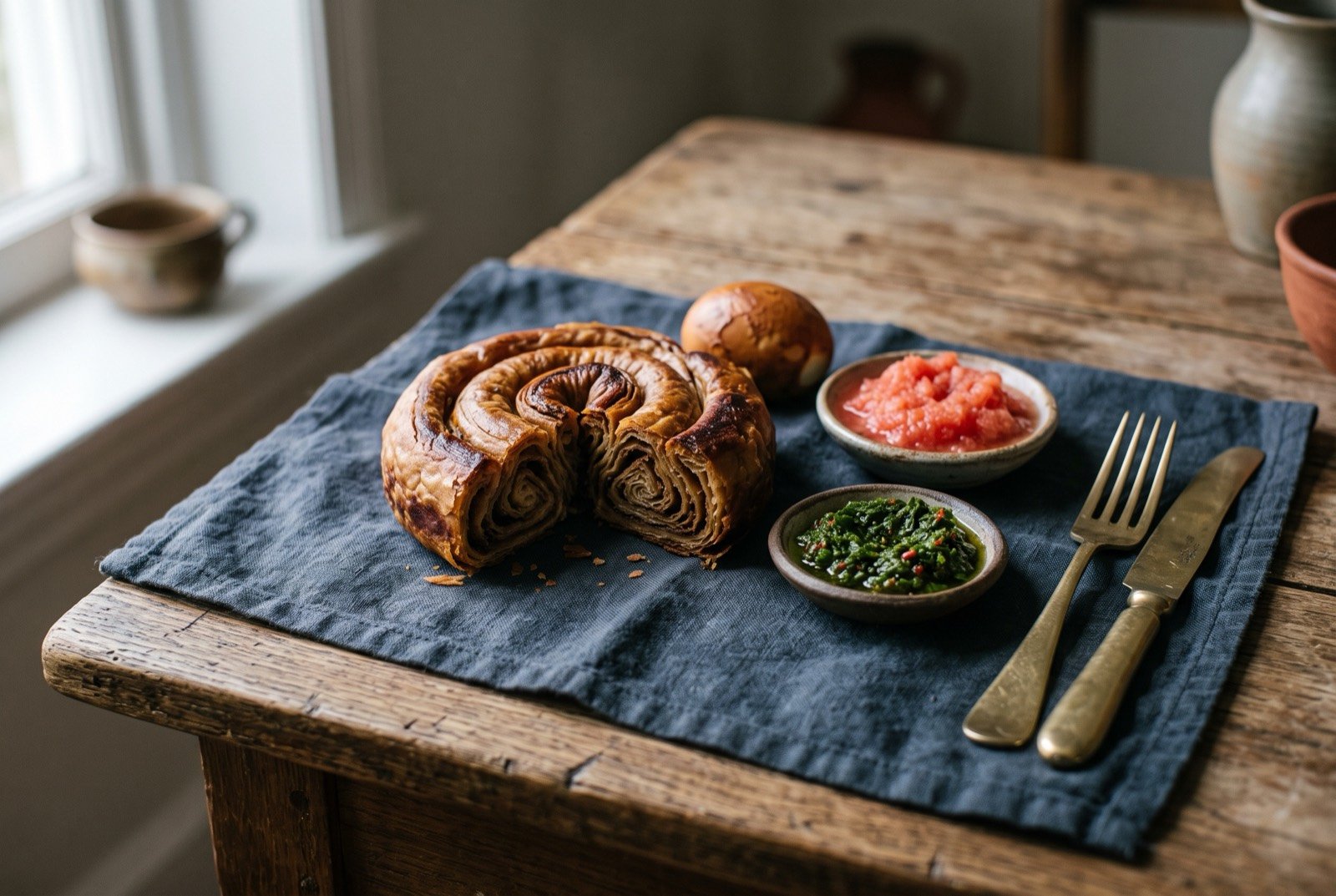
Jachnun with grated tomato, egg and zhug
Aden, Yemen
Illustration
- Time
- 12 hours
Jachnun's origin is genuinely contested and this chapter presents it that way rather than picking a winner: Hebrew sources name three competing theories, descent from Ottoman-era Anatolian settlers, Spanish and Portuguese Jewish refugees, or Indian Jews who settled in Aden. What is better documented is that jachnun is specifically an Adeni dish, not a pan-Yemenite one: it did not appear on the menus of Sana'a Jews or northern Yemenite Jews at all, who had their own distinct Shabbat-morning dishes, lachuch and kubaneh among them. It became the metonym for the whole Yemenite tradition only after arrival in Israel, where it is now sold frozen in every supermarket freezer aisle and at kiosks nationwide on weekends, described in Hebrew food writing as "a national treasure," its ethnic origin "long forgotten," roadside signs simply announcing "there's jachnun on Saturday" outside communities with no Yemenite connection at all.
As tradition built it
Makes 6 to 8 rolls. 20 minutes active, 8 to 12 hours baking.
Ingredients
- 500g strong white flour
- 1 tsp salt
- 250ml warm water
- 200g samneh (clarified butter) or unsalted butter, very soft
- 6 to 8 eggs, whole, in their shells
- to taste grated fresh tomato and zhug, to serve
Method
- Mix the flour, salt and water to a smooth, elastic dough; knead 8 minutes. Rest 30 minutes.
- Divide into 6 to 8 balls. Working one at a time on an oiled surface, stretch each ball by hand as thin as it will go without tearing, spread with softened samneh, and roll into a tight cylinder, then coil the cylinder into a spiral.
- Pack the spirals tightly into a heavy, lidded pot, tucking the whole eggs into the gaps between them.
- Cover tightly and bake at under 100°C for 8 to 12 hours, or overnight, until deep golden brown and the eggs inside have browned and taken on flavour from the long bake.
- Serve with grated fresh tomato and zhug alongside.
What a modern chef changes
A Big Green Egg held stable overnight, and eggs cooked separately and precisely
Rung 5
Method
- The mechanism that matters here is trapped, moist, very low heat over a long time, not a domestic oven's usual dry roast, so protect it rather than fight it: bake in a Big Green Egg held at a stable 95 to 100°C dome temperature overnight using the convEGGtor as a heat buffer, which holds a steadier low temperature over eight-plus hours than most domestic ovens manage.
- Cook the eggs separately and precisely, sous vide at 75°C for 90 minutes, which gives a set white and a fudgy, not chalky, yolk more consistent than anything achieved by burying them in a pot for twelve hours, then char the shells briefly over direct flame before peeling, for the toasted aroma the traditional method gives by accident.
- Make zhug fresh rather than from a jar, since no reliable UK-stocked version currently exists: fresh green chillies, a full bunch of cilantro, garlic, cumin and salt, blitzed coarse, kept under a slick of oil.