Europe · Volume 03
Greece & Cyprus
The Aegean and the Contested Table
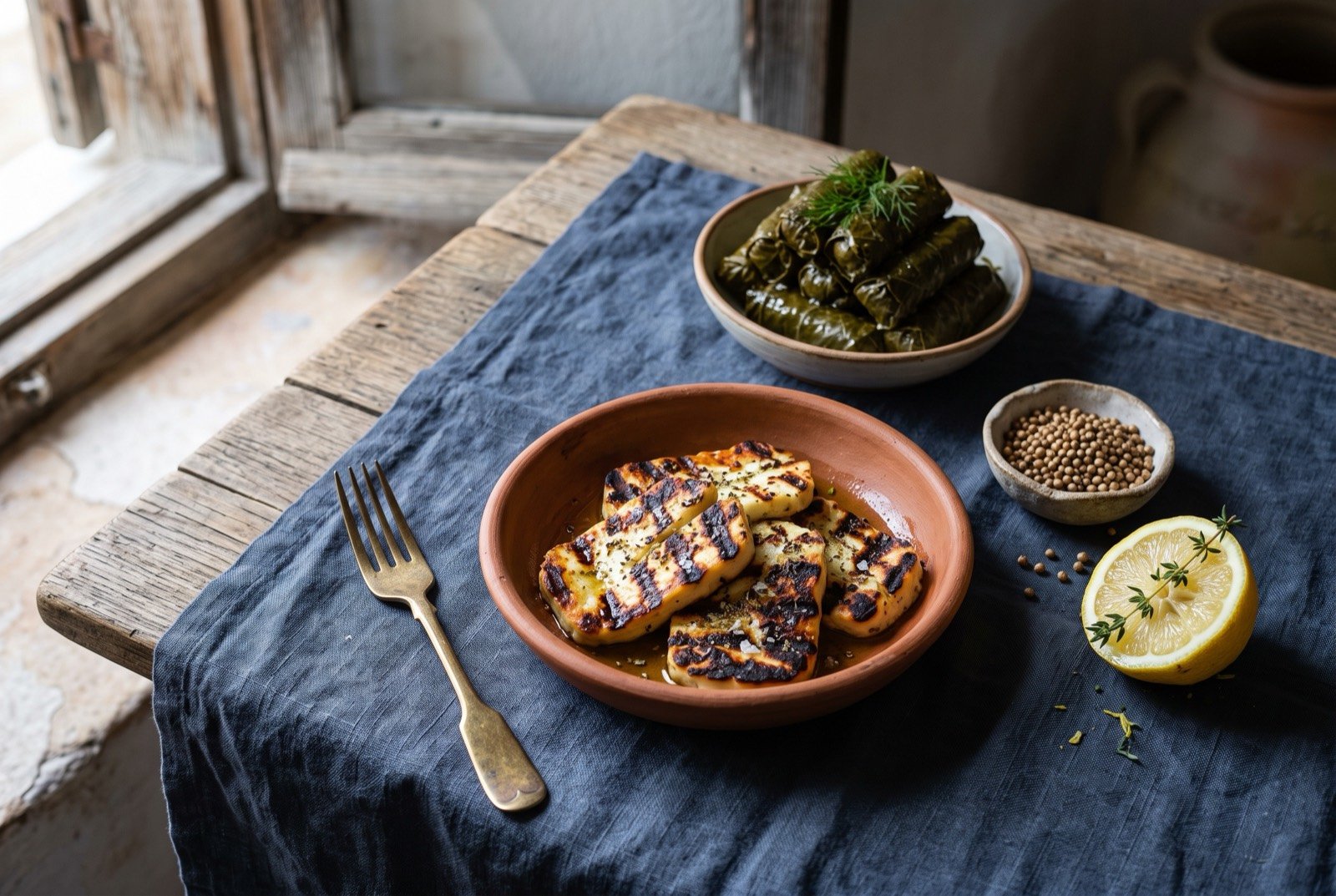
Mainland and island Greece, and Cyprus, treated as a genuinely shared, contested inheritance between Greek Cypriot and Turkish Cypriot traditions rather than one adjudicated by the other. Every dish as tradition built it, then what a modern chef would change.
Sources and review · What this chapter does not assert · How we research · Spotted something wrong?
A Sense of Place
Greece and Cyprus are related but genuinely distinct food worlds: a shared Eastern Mediterranean grammar, olive oil, wheat, legumes, lamb and goat, fresh and cured fish, wild greens, an Orthodox fasting calendar that structures the year, expressed through two different ecologies, two different colonial histories, and, in Cyprus's case, a divided modern politics that the food itself mostly does not honour.
Greece, region by region
Olive oil is the fat of Greece everywhere south of Macedonia. Further north, in Epirus and the Pindus, dairy fat shares the role because of a genuinely pastoral economy: Epirus is explicitly built on dairy, the most important component of Epirotic cuisine, on land that is only around 10 per cent arable. Starch is bread first, then a strong regional hand-made pasta tradition, trahanas, fermented, dried cracked-wheat-and-milk-or-yoghurt granules, and chylopites, dried egg noodles, still made village to village and dried for hours, keeping at least two years. Aromatically, Greece runs on wild oregano, wild greens, lemon, dill and mint, with Crete carrying the widest wild-herb larder of any region. Protein logic follows ecology directly: lamb and goat in the pastoral highlands, pork in Macedonia and Thrace and in winter dishes generally, tied historically to the December pig slaughter, fish and shellfish on the islands. Legumes are a structural protein source, not a marginal one, heavily reinforced by the Orthodox fasting calendar, see below.
Greek regional identity is genuinely plural, not a single national cuisine with local variations. Crete carries the strongest independent identity of any Greek region, wild-herb-and-greens-driven, pastoral, high olive oil use, and the specific subject of the Cretan-diet research literature discussed below. The Peloponnese, Mani, Lakonia, Arkadia, is pastoral and olive-oil-centred, with its own hand-made pasta shapes and local cured pork. Epirus is dairy- and pie-centred, shaped historically by Vlach and Sarakatsani transhumant herding; one scholar of Epirotic gastronomy recorded 178 distinct pie recipes from the region, pie described there as functioning as bread and food and meal and appetiser at once for nomadic herding communities. Macedonia and Thrace are explicitly layered by Ottoman-era coexistence and twentieth-century population movement, with Armenian, Thracian, Asia Minor refugee, Vlach, Pontic Greek, Slavic and Sephardic Jewish culinary threads each individually traceable. The Ionian islands, Corfu, Cephalonia, Lefkada, Zakynthos, are genuinely distinct because of extended Venetian rule, which left real, lasting Italian influence layered onto Greek roots. The Dodecanese, Rhodes and others, is flagged honestly as the thinnest-covered region in the sourcing behind this chapter. It carries a genuinely distinctive double colonial layer, Ottoman rule from 1522 followed by Italian rule from 1912 to 1943, unlike the rest of Greece, plus Asia Minor proximity, but its culinary specifics were not found with strong dedicated sourcing, and this chapter names that gap rather than filling it with guesswork.
Cyprus, its own ecological logic
Cyprus is a Mediterranean island whose food culture follows its own material logic rather than a scaled-down version of Greece's: dry-farmed grain and legumes on the central plain, the Mesaoria; sheep and goat pastoralism on the hill and mountain margins, the base of both halloumi and the island's cured meats; carob and olive on marginal limestone slopes unsuited to irrigation; vines on the southern Troodos foothills, the Commandaria belt; and a citrus, vegetable and early-potato belt wherever irrigation reaches the coast.
Halloumi and anari, a whey cheese, are the island's central dairy pair, made from sheep and or goat milk, sometimes cut with cow, specifically because sheep and goats, not cattle, are what the island's dry hill grazing supports. Carob was historically a major crop on land too poor for much else, see below. Meze functions as a structural way of eating, not a category of small dishes tacked onto a menu: it lets a smallholding household present what it actually has, in small quantity, across many dishes, rather than one large single-protein plate, a shape that maps directly onto mixed smallholder agriculture rather than specialist ranching.
The History in Layers
What survives from antiquity, and what is myth
Classical-period Greeks ate two meals a day, a light ariston late morning and a fuller deipnon in the evening, sometimes followed by a symposion. This is established by Andrew Dalby, a genuinely rigorous classical food-history scholar, and should anchor any claim about what actually survives from antiquity, rather than the Western pop-science "ancient Greek diet was basically the Mediterranean diet" framing, which elides how much of the current arsenal, aubergine, tomato, the whole Ottoman-derived dish repertoire, postdates antiquity by well over a millennium in several cases.
One specific, checkable ancient-to-modern thread: thria, an Athenian dish attested by the Byzantine encyclopedia Souda and the ancient commentator Didymus of Alexandria, pork fat, goat meat, flour, milk and broth wrapped in fig leaves and baked. This is a real classical antecedent of the wrapped-leaf-parcel idea, but it used fig leaves, not vine leaves, and exactly when vine leaves replaced fig leaves is genuinely unclear. The word "dolma," itself, is Turkish. There is real continuity of the idea across three millennia; "dolmades are an ancient Greek dish" as currently made and named is not accurate, it is an Ottoman-era dish built on an older Greek concept.
The Byzantine layer
Byzantine diet centred on cereals, legumes and fish, with bread, wine and olives central; soldiers ate twice-baked dried bread, the ancestor of modern paximadi. Byzantine cuisine was itself a crossroads shaped by contact with Arabs, Syrians, Jews, Latins, Armenians and Slavs, further reshaped by Western influence after the Fourth Crusade's 1204 sack of Constantinople. Byzantine food practices are said to have survived longest, into the nineteenth and twentieth centuries, in remoter areas, Crete, Cyprus, the Aegean islands and parts of northern Greece, a claim that gives real structural weight to treating Cyprus and Crete as carrying an unusually deep Byzantine inheritance. Natural-leaven bread-making is documented as far back as the Geoponika, a tenth-century Byzantine agricultural compilation, real continuity for the wild-fermentation bread tradition still practised in villages today.
The Ottoman layer, real and substantial in both Greece and Cyprus
This is the most important honesty test in this whole chapter, and Greek-language and Greek Cypriot sources are candid about it themselves. On the Greek side, a large part of Greek cuisine belongs to a wider Ottoman-era culinary tradition, and the dish names themselves give it away: moussaka, tzatziki, giouvarlakia, keftedes and dolmades all have Arabic, Persian or Turkish roots. Moussaka specifically is not ancient or even old: the dish as currently known is a twentieth-century creation, see below. Eggplant, the headline vegetable of what is often called the quintessential Greek dish, is not ancient Greek at all: native to India, cultivated in China and Central Asia in antiquity, the Greek name derives from the Arabic bāḏinjān, and it reached Byzantium via the Arabs around the eleventh to thirteenth century, treated for a long stretch as ornamental rather than edible. Greek coffee came to Greece in the sixteenth century from the Ottoman Empire and was for decades openly called Turkish coffee in Greece itself; the name Greek coffee only became established gradually after the Turkish invasion of Cyprus in 1974, a directly political renaming that the Greek sources themselves are candid about.
On the Cyprus side, the Cyprus Mail, Republic of Cyprus press, states this directly: Cypriot culinary culture has a strong eastern Mediterranean character, sharing numerous ingredients, recipes and food-related practices with other regions that were also part of the Ottoman empire, naming koupes, keftedes, poumpari, mahallepi, baklava, shamali, salep and sherbet as shared Ottoman-period heritage, and crediting the period specifically with introducing the kafenio, the coffeehouse, an enduring social institution that lives on today. Cyprus passed to Ottoman control in 1571, remaining so until 1878. Mete Hatay, a Turkish Cypriot-affiliated scholar at PRIO Cyprus Centre, argues in his academic work, available to this chapter's sourcing only as abstract and secondary summary, that many dishes popularly claimed as typically Turkish, Greek or Cypriot, his cited examples including molokhia, kolokasi and moussaka, are actually of Semitic, Persian or Arabic origin, and that the island's multi-ethnic population historically shared food practices across communal lines.
Molokhia, a jute-mallow leaf stew, and kolokasi, taro, are a strong, concrete illustration of this shared inheritance, predating and cutting across the modern communal division: both are eaten across the island by both communities, molokhia's name is Arabic and the dish is shared across Egypt, the Levant and Cyprus, already known in the medieval Arab world; kolokasi's cultivation on Cyprus is specifically traced to the Karpasia peninsula, transplanted to the village of Sotira in the early twentieth century.
The Asia Minor refugee influx, 1922 to 1923, and mainland Greece
The 1922 Asia Minor Catastrophe and the resulting refugee wave from Smyrna and Constantinople had a major, well-documented effect on mainland Greek cuisine, bringing a more dynamic, colourful, aromatic and hedonistic approach to flavour that left a permanent mark on modern Greek cooking. This produced a specific vocabulary, politiki kouzina, Constantinopolitan cuisine: yoghurt-based dishes, Smyrna-style meatballs in a cumin-spiced tomato sauce, hünkar beğendi, smoky aubergine purée with braised beef, and Pontic-style meatballs with rice pilaf. Yoghurt as a savoury cooking ingredient, not just a table condiment, is specifically identified as a defining feature of this refugee-brought cuisine.
Cyprus: the British colonial period, 1878 to 1960
This is honestly the thinnest of the historical layers found in the sourcing behind this chapter, and it is said so rather than padded. The Cyprus Mail states that culinary traditions rooted in the Ottoman period continued to thrive during British colonial rule, particularly in rural communities, and separately that urban Cypriots began integrating Western culinary aspirations, blending them with enduring Ottoman and eastern Mediterranean flavours during this period, meaning British rule mainly affected urban and middle-class food modernisation rather than the rural, traditional base this atlas is concerned with. No specific surviving British-derived dish, ingredient or technique was found and verified in the sourcing for this chapter; general summaries mention only vague "odd remnants of British culinary sensibility" without naming any.
1974 and its effect on food culture and naming
The general framing across the Cyprus sourcing behind this chapter, corroborated by an aggregated search rather than one strong single source, is that the cuisine of north Cyprus is very similar to that of the south, both communities sharing a history before 1974, with meze culture cited as the clearest example of continuity. The clearest concrete, well-evidenced example of contested naming that survives scrutiny is coffee itself, the same finely ground brew sometimes labelled Cypriot coffee, Greek coffee, or Turkish coffee depending on community and political perspective. The same source that makes this point explicitly argues against treating most Cypriot dishes as contested, stating recipes often differ only in name, subtle seasoning or preparation, revealing common roots that predate the island's division. Neither the Greek nor the Cyprus sourcing behind this chapter found good evidence of any change in food availability or practice directly caused by the 1974 division and subsequent separation, beyond the carob industry's collapse, below, a genuine, well-sourced material effect of the war on a specific crop economy.
The Cretan diet research thread
This strand is genuinely well sourced and deserves its own clear treatment, distinct from the wellness-media version of the same claim. Scientific interest in the Cretan diet dates to 1948, when the Rockefeller Foundation was invited by the Greek government to assess and improve postwar living conditions on Crete. Their detailed nutritional evaluation found the traditional diet nutritionally adequate, with deficiencies limited mainly to the very poorest areas, and the Foundation concluded as early as 1948 that Cretans' longevity is largely due to their diet.
The Seven Countries Study, led by Ancel Keys with Italian colleague Flaminio Fidanza in the early 1960s, was the first major scientific study linking diet and lifestyle to cardiovascular disease across seven countries including Crete. The Cretan pattern recorded then: olive oil, vegetables, fruit, legumes, unprocessed grains, fish and dairy, red meat no more than roughly twice a month, sweets rare. The WHO stated in 1999 that the traditional Cretan diet contributes to maintaining good health and increasing longevity.
A genuine, substantive methodological criticism exists and this chapter does not smooth it over. A peer-reviewed critique by Christos Lionis and colleagues, published via Public Health Nutrition, notes that one of the key Cretan dietary surveys used by the Seven Countries Study was conducted during the 48-day Orthodox Lent fast, when meat, eggs, cheese and other animal products are forbidden by religious observance. This means the study may have significantly underestimated habitual, non-Lenten, saturated fat and animal food intake in the Cretan diet as actually lived year-round. This is a legitimate scholarly point about survey timing, not diet-fad contrarianism: the "Cretan diet equals what Cretans always ate" framing understates how much the observed pattern reflects a specific fasting-season snapshot.
That fasting calendar is itself the structural engine behind much of the wider pattern. Orthodox fasting totals roughly 180 to 200 days a year; Lenten rules exclude meat, dairy, eggs and, on stricter days, oil and wine. This is the direct explanation for Greece's enormous repertoire of ladera, oil-based vegetable and legume mains cooked without meat, and for the routine, non-exotic status of legumes and vegetables in Greek home cooking. It is a structural fact of religious practice, not a diet trend.
The halloumi and hellim dispute
This is the one clearly documented, current, adjudicable dispute found in the sourcing behind this chapter, and this chapter takes no side. What follows is what each community's own sources say, cross-corroborated on the timeline where possible.
Naming. Greek Cypriot "χαλλούμι," halloumi; Turkish Cypriot "hellim." Both names are used together in the actual 2021 EU PDO registration, Χαλλούμι/Halloumi/Hellim, a rare and notable case of an EU legal instrument formally naming a product in both communities' languages side by side. Worth stating plainly: at the level of the final legal outcome, the dispute is not about which name wins, both names won.
A shared historical root, not a point of communal dispute. Halloumi is first attested in writing in 1554 by the Venetian-period chronicler Florio Bustron, spelled "caloumi," made from sheep and goat milk in springtime. Niyazi Kızılyürek, a Turkish Cypriot academic writing in the Turkish Cypriot daily Yeniduzen, independently cites the same 1554 record to make essentially the same historical claim as the Greek Cypriot press. The deep history is not contested between the communities; only the modern legal ownership of the name is.
Timeline, cross-corroborated across Greek Cypriot, Turkish Cypriot and EU institutional sources: the Republic of Cyprus joined the EU on 1 May 2004. The Cyprus Cheesemakers Association filed to register halloumi as a PDO product ten days later. A commercial trademark dispute intervened first, a Spanish and German-owned company's 2006 application to register "halloumi" as its own commercial trademark, rejected by the EU General Court in 2012. The Republic's Cyprus Greek Cheese Producers Union and Ministry of Agriculture filed the formal PDO application in July 2014. On 16 July 2015, Turkish Cypriot leader Mustafa Akıncı and Republic of Cyprus president Nicos Anastasiades reached agreement on independent inspection arrangements, intended to reassure Turkish Cypriot producers the process would not simply hand control to the Republic. On 12 April 2021, the European Commission formally registered Χαλλούμι/Halloumi/Hellim as a PDO, applicable to production anywhere on the island. In March 2023, the first Turkish Cypriot-produced halloumi and hellim cheese was formally certified under the PDO scheme.
Turkish Cypriot grievances, in their own sources' words. T-VINE, the UK-based Turkish Cypriot diaspora publication, reports that Turkish Cypriot trade bodies raised concern that the designated PDO inspector had strong commercial links with the Greek Cypriot Republic of Cyprus, that their objections were not properly heeded, and that practical trade barriers exist at the Green Line, including the refusal by the Greek Cypriot authorities to allow the crossing of Turkish Cypriot commercial vehicles. Under the EU's Green Line Regulation, Turkish Cypriot hellim producers cannot sell directly into the wider EU market the way Republic producers can; all exports from the north must route through the south, adding extra time and costs. Hellim's share of north Cyprus's exports is reported at figures ranging from 25 to 37.5 per cent depending on year and source; this chapter treats it as a large and economically central share, not a single fixed statistic.
Dr Anna Maria Beylunioğlu, a mainland Turkish academic at Istanbul MEF University writing about Turkish Cypriot politics rather than as a Turkish Cypriot voice herself, frames the underlying grievance as one of international non-recognition: the Turkish Republic of Northern Cyprus is recognised only by Turkey, so hellim could not previously be sold internationally under a "KKTC" designation. She cites the 2021 protest slogan "Hellim Türk'tür Türk Kalacak," hellim is Turkish, will remain Turkish, as evidence of real anxiety in the north that the process was being read locally as a loss of ownership. She frames the episode analytically as "gastro-nationalism" and concludes, writing after nationalist politicians took power in north Cyprus following the 2021 registration, that she is pessimistic the shared PDO will meaningfully advance reunification.
Niyazi Kızılyürek takes a notably more positive line than Beylunioğlu. Writing in Yeniduzen as a direct participant defending Turkish Cypriot interests through the negotiation process, he frames the 2021 registration as a genuinely historic and beneficial outcome for Turkish Cypriot producers across generations, and explicitly pushes back against what he calls deliberate misinformation and attempts by others to politicise the process. This is a real, direct disagreement in emphasis between two Turkish Cypriot-adjacent sources, Kızılyürek writing as a Turkish Cypriot insider and process participant, Beylunioğlu as a mainland Turkish academic observer, and this chapter preserves it as a genuine internal difference of view rather than flattening it into one "Turkish Cypriot position."
Greek Cypriot framing of the same events, for balance: Greek Cypriot press covers the 2021 registration primarily as an economic-protection and branding win for Cyprus generally, and separately as a matter of ongoing concern about counterfeit halloumi sold elsewhere in the EU. No Greek Cypriot press source consulted for this chapter was found directly engaging with or rebutting the Turkish Cypriot Green Line or inspector grievances above; this may be because those grievances are aimed at EU process rather than at the Republic directly, or it may be a genuine gap in what this chapter's sourcing could reach. Either way, it is named rather than papered over.
The Flavour Arsenal
Greek olive oil, and Greece's actual cheese range
Greece has PDO and PGI olive oils tied to specific varieties and regions. The flagship is Kalamata PDO, required to be at least 97 per cent Koroneiki-variety fruit, from the Messinia regional unit specifically. Koroneiki itself is the flagship Greek variety, small-fruited, native to the area around Koroni, drought and wind tolerant, thriving on poor dry soils, picked while still green, widely described as the queen of Greek olive varieties. Feta is a Greek PDO cheese, made from sheep's milk and or goat's milk in a mandated ratio of at least 70 per cent sheep to up to 30 per cent goat, stored in brine or whey-brine for roughly three months; its PDO status is a real, litigated legal fact, Greece winning the legal fight at the EU Court of Justice in 2002 and definitively in 2005. Alongside feta, so it does not stand in for "Greek cheese" generally: kefalotyri, hard, salty, sheep's-milk; kefalograviera, PDO, western Macedonia, Epirus, Aitoloakarnania and Evrytania; kopanisti, a Cyclades PDO, pungent, peppery, spreadable; and the whey-cheese family, manouri, xinomyzithra and mizithra itself, fresh or dry.
Greek oregano, mastic, honey
Greek wild oregano, Origanum vulgare subsp. hirtum, is widely held to be among the best in the world for its unusually high carvacrol content, commanding a premium over Italian, Moroccan or Tunisian oregano. Mastic, the resin of Pistacia lentiscus var. chia, has, despite repeated historical attempts to grow the same tree elsewhere, only ever produced usable resin in the Mastihochoria of southern Chios, attributed to the specific microclimate and soil; see the ferment and preserve bench below for the tapping technique. Greece has a genuine multi-PDO honey landscape, not one generic "Greek honey": pine honey, a honeydew rather than nectar honey, darker, less sweet, more mineral, accounts for around 65 per cent of total Greek honey production; thyme honey is strongly aromatic and pale.
Cyprus: halloumi's method, coriander, carob, Commandaria
Fresh sheep and or goat milk, sometimes cut with cow, is gently heated with stirring until curds form and rise to the surface of the whey; the curds are lifted into a basket or mould to drain; the resulting fresh cheese is then simmered again in the reserved hot whey for at least 30 minutes, with the pieces left floating a further 15 to 20 minutes once they rise, to firm up and develop the characteristic elastic, high-melting-point texture; each piece is salted, with dried mint folded in or scattered on at the salting stage. Multiple Turkish-language sources independently confirm the defining technical property, that hellim does not melt easily even at high heat, and attribute this to the whey pre-cooking described above rather than to any additive, corroborating the Greek Cypriot method description independently.
Ground or dried coriander seed is repeatedly named, alongside oregano and thyme, as a characteristic aromatic of Cypriot cooking, specifically of the island's traditional cured pork, where it is used together with red wine as the defining flavour and preservation combination. Carob is described in multiple Greek Cypriot sources as historically "Cyprus's black gold," for a long period the island's leading agricultural export; around 1960 Cyprus is stated to have been the third largest carob producer or exporter in the world. The industry's real, material collapse is tied directly to the 1974 war, this thriving industry stopped abruptly with the Turkish invasion of 1974, significant areas of carob trees lost and production significantly reduced, one of the few places in this chapter's sourcing where the 1974 division has a directly documented material effect on a specific supply chain.
Commandaria is repeatedly described, across multiple Greek-language sources, as one of the oldest named wines in continuous production in the world, with production on Cyprus dated by some accounts to as much as 5,000 to 6,500 years. This chapter does not assert that figure as fact; it reads as popular or promotional rounding built on Homeric references to "the sweet wine of Cyprus" rather than dated archaeology. The name itself is medieval, not ancient, deriving from "La Grande Commanderie," the Knights Hospitaller's administrative headquarters on Cyprus from the twelfth century.
Part Two
The Technique Ladder
The argument, from inside
Panagiotis Maganas, at Peskesi in Heraklion, Crete, left the city and returned to his village to build what Greek food press describes as a restaurant of high aesthetics built entirely on researched, near-forgotten Cretan technique. He gathered recipes that survived mainly in the accounts of older people, planted a farm outside Heraklion to grow old grain and vegetable varieties and preserve forgotten seeds, and the restaurant still cooks in wood-fired ovens using what Maganas identifies, from his own research, as Minoan-lineage method. This is the clearest Greek parallel to this whole series' animating idea: elevating the food by doing the traditional thing properly rather than importing outside method. Lefteris Lazarou, at Varoulko, won Greece's first ever Michelin star, in 2002, for a fish and seafood cuisine credited in Greek food press with starting "new Greek fish cookery," taking humble, previously unfashionable fish and treating them with high technique.
The honest gap sits, once again, with the smaller of this volume's two subjects. No source consulted for this chapter found an equivalent depth of researched material on a leading contemporary restaurant-level Cypriot chef working in Cyprus itself, doing for Cypriot food what Maganas does for Cretan food. Greek Cypriot press names a chef, Giannakis Agapiou, who returned to his village after working at significant restaurants abroad and built what the piece calls a model restaurant in mountain Cyprus, but gives no technical detail on what he actually does differently. This is a real thinness in this chapter's sourcing, not a finding that no such figure exists.
Rung 1. Stretch the dough, don't roll it
Traditional village filo is made from flour, water, salt and olive oil, kneaded, rested, then stretched by hand, not rolled, into a sheet thin enough to see through. The dough is worked out from the centre with the backs of the hands or over a floured cloth, turned and stretched repeatedly rather than compressed with a pin, because rolling compresses and toughens the gluten network in one direction while hand-stretching pulls it evenly in every direction and lets it relax between pulls. This is why a genuinely hand-stretched sheet shatters into fine, dry layers when baked and a rolled or machine-laminated sheet, however thin, tends to bake denser and chewier: the machine sheet's gluten has been extended under tension in a single pass rather than relaxed and re-stretched.
What a cook does with this rung. A well-hydrated, well-rested dough, at least 30 minutes covered before stretching, worked over the backs of floured hands or a floured cloth rather than rolled, is achievable at home with no special equipment beyond patience, and it is the single highest-leverage traditional technique in this chapter for a cook who wants to taste the actual difference tradition makes.
Rung 2. Seal the vessel and let time do the cooking
Kleftiko's name comes from the klephtes, irregular fighters against Ottoman rule who needed to cook stolen lamb without giving away their position with smoke or visible fire. The traditional method: dig a pit, build a fire down to embers, place the meat, wrapped, on the embers, cover it, and let it cook slowly and invisibly for hours, with bay, wild carob leaves, oregano, thyme, lemon and wild garlic. The modern domestic descendant is the clay gastra, a lidded earthenware vessel fired at around 1,100°C; the sealed lid traps moisture so the meat effectively steams and roasts at once at a comparatively low, even temperature, which is the entire mechanism kleftiko depends on.
No source consulted for this chapter gave a specific cooking time or internal temperature target for kleftiko, only "many hours" or similar. This chapter does not invent a number to fill that gap.
What a cook does with this rung. The Big Green Egg is close to an ideal domestic gastra: sealed lid, indirect low heat, wood or lump charcoal smoke standing in for the pit's embers and aromatic leaves. Do not substitute a fast hot roast. The entire point of kleftiko is time and seal, not heat.
Rung 3. Drain by gravity, not by machine
The genuinely traditional method for strained yoghurt: set yoghurt is poured into a clean linen cloth or muslin, tied and hung above a bowl, or laid in a colander, so the whey drains under gravity alone, not under pressure, for four to six hours or longer, in a cool place. Greek food-science press is explicit that industrially labelled "strained" yoghurt often is not actually strained by this method at all, since natural gravity straining is rarely applied in industry; much commercial Greek yoghurt is thickened by other means, added milk proteins, centrifugal separation, rather than genuinely hung and drained.
What a cook does with this rung. A muslin-lined chinois set over a bowl is, functionally, exactly the traditional cloth-over-a-pot setup. Full-fat sheep or goat yoghurt, if it can be sourced, strained overnight in the fridge, gives a genuinely different result from supermarket "Greek style" yoghurt, which is usually not strained at all.
Rung 4. Understand why a cheese resists the grill before you cook it that way
Halloumi's defining trick, that it can be grilled or fried without collapsing into a puddle the way most fresh cheeses do, comes from how the curd is made, not from any additive. The curd is heated in its own whey to close to boiling, which denatures and sets the whey proteins into the curd matrix well before the cheese is shaped; that heat-set protein structure is what stays intact under a second, high, dry heat on the grill. This is a good working explanation rather than a precisely cited dairy-science fact, and this chapter treats it that way.
What a cook does with this rung. Cut slices roughly finger-thick, since the cheese softens as it cooks and a slice cut too thin loses its structure. Serve it the moment it comes off the heat, because halloumi firms and toughens again rapidly as it cools; a slice grilled ahead and held under a lamp is already past its best.
Rung 5. Bank the coals, don't spread them
Traditional charcoal technique, per Greek grilling press: bank the coals into a mound rather than an even spread, which creates a small, intensely hot zone at the centre for direct grilling and cooler zones around it for indirect heat or holding, all on the same fire. Sources are explicit in warning against pre-packaged industrial briquettes, made from recycled or compressed material, on the grounds that they do not impart the flavour genuine lump charcoal does. For whole-animal spit roasting, the same logic runs larger: coals are banked at the sides of the spit rather than directly underneath, specifically to avoid open flame scorching the meat, with more intense heat concentrated at the animal's thinner ends than at its thicker centre.
What a cook does with this rung. This maps directly onto Big Green Egg technique, mounding lump charcoal for a direct centre and indirect edge, or, for a rotisserie setup, heat placed at the sides rather than underneath. Continuous basting with oil or marinade while turning is described as essential wherever this technique is used.
Rung 6. Grind and marinate whole spice fresh, and give it time
Afelia, a specifically Cypriot pork dish, is built on pork cut into roughly 4cm cubes, marinated overnight in the fridge in red wine, salt, pepper and whole coriander seed, then drained, the marinade reserved, and pan-fried in hot oil until coloured, traditionally served with pourgouri, cracked bulgur wheat. The coriander seed and red wine combination is what distinguishes it from mainland Greek pork preparations, and the same combination, coriander seed and red wine, recurs across Cyprus's cured pork tradition below.
What a cook does with this rung. A dedicated spice grinder is genuinely useful here: grind coriander seed fresh rather than using pre-ground, which loses aromatic oil quickly, and toast the whole seed lightly before grinding for a sharper result, a modern refinement rather than a traditional step described in any source consulted, but one that does not betray the dish. Give the marinade its full overnight rest; this is a flavour-penetration technique, not a quick seasoning.
Part Three
The Ferment and Preserve Bench
1. Trahana
Cracked wheat, konari in Cypriot dialect, mixed with fermented milk or yoghurt, worked into small cylindrical pieces roughly under a centimetre across, and sun-dried. A genuine preservation technique, turning a dairy-and-grain mixture into a shelf-stable dried product, used later reconstituted into soup. Made village to village across Greece too, in a related but not identical form, and kept, once dried, for at least two years.
2. Kalamata and Kalamon Olive Curing
Traditional Kalamon-olive processing is whole olives naturally cured by slow curing in brine, often with fresh lemon, olive oil and wild oregano, without chemical de-bittering agents, methods varying village to village. No single canonical ratio or curing timeline was found in the sourcing behind this chapter, a real gap this chapter names rather than filling with an invented figure.
3. Lountza and Hiromeri
Two named Cypriot cured meats, both historically tied to the cooler, higher-altitude Pitsilia region, where the climate suited meat preservation and rural families traditionally kept one or two pigs specifically for Christmas slaughter and curing. Lountza: pork loin, cured with salt and red wine, then smoked over thyme wood for a minimum of around fifteen days. Hiromeri: a whole leg, cured in wine and smoked in a proper oven, then aged three to four months. Both are now made mainly by certified commercial producers, with home curing largely confined to particular communities, chiefly in Pitsilia itself.
4. Mastic Tapping
Chios mastic has, despite repeated historical attempts to grow the same tree elsewhere, only ever produced usable resin in the Mastihochoria of southern Chios. Cultivation and harvest occupy the whole year; the tapping technique involves incisions, kentima, made in the bark, not the wood, early in the morning, each tree incised roughly 10 to 12 times per season. A genuinely place-bound craft, not reproducible technique, and worth knowing before treating any non-Chios "mastic" product as equivalent.
Sourcing in Britain
Verified August 2026. Where a supplier could not be fully confirmed, that is said rather than smoothed over.
The ranked list: what decides great from grim
- PDO halloumi, checked for the mark specifically. The UK is described in specialist cheese trade press as the world's largest importer of halloumi. Tarago Cheese's Cypriota Halloumi PDO and Pathos Foods are both credible UK stockists; Charalambides Christis, a major Cypriot dairy, exports its own traditional line directly.
- Genuine spit or charcoal-cooked gyros over frozen reformed cones. The distinction is structural, not snobbery: industrially produced, pre-formed frozen gyro cones are a live quality concern even within Greece, distinct from meat genuinely layered with fat and slow-roasted on a real spit.
- PDO Kalamata olive oil. Odysea's Kalamata PDO oil is stocked at mainstream UK supermarkets, an easy entry point; Agora Greek Delicacies and Borough Olives carry it too.
- Genuine Chios mastic, from a specialist rather than an unverified marketplace listing. Oliveology and Arabica London both carry credible PDO stock; the Athenian Grocery in Bayswater, trading over seventy years, stocks it directly in person.
- PDO Commandaria. KEO St John's Commandaria is a widely available entry point at roughly £17 a bottle; Tsiakkas Commandaria, via Gourmet Groceries, is a more artisanal, estate-specific option.
- Genuinely wild Greek oregano, bought from a specialist deli rather than a supermarket jar. Greek trade press itself flags that quality within the "Greek oregano" category has become inconsistent even in Greece as cheaper imported oregano enters the market; a supermarket jar carries no real guarantee, and a specialist deli where the sourcing can be asked about is the safer route.
- Filo, with an honest note on substitution. Jus-Rol's chilled filo, widely available at UK supermarkets, is a legitimate functional substitute for everyday use, though the brand began in 1954 in Coldstream, Scotland, not Greece or Cyprus. For a better bought sheet, the Athenian Grocery and Demos Continental in Palmers Green, established 1965, are credible stockists. The genuinely elevated move, given this reader's evident seriousness, is to hand-stretch it, per Rung 1, rather than search for a better bought sheet.
Lountza and hiromeri, honestly
No credible UK importer or specialist supplier stocking genuine Cypriot lountza or hiromeri specifically, as distinct from generic Mediterranean cured pork, was found in the sourcing behind this chapter. This is worth a direct enquiry to a Cypriot deli such as Demos Continental or the Athenian Grocery before assuming availability that has not actually been verified.
Voices and Sources
From inside the tradition
- Panagiotis Maganas, Peskesi, Heraklion, Crete. Built a restaurant entirely on researched, near-forgotten Cretan technique, planting a farm to preserve old grain and vegetable varieties. The clearest Greek parallel to this whole series' animating idea.
- Lefteris Lazarou, Varoulko, Piraeus and Athens. Won Greece's first ever Michelin star, in 2002, credited with starting "new Greek fish cookery."
- Andrew Dalby, classical food-history scholar. The anchor for any claim about what genuinely survives from Greek antiquity, used in preference to Western pop-science framings.
- Christos Lionis and colleagues, whose peer-reviewed Public Health Nutrition critique of the Seven Countries Study's Cretan survey timing is the strongest single piece of methodological scholarship behind this chapter.
- Niyazi Kızılyürek, Turkish Cypriot academic and former AKEL MEP, writing in Yeniduzen as a direct participant in the hellim PDO negotiations, the single most substantial Turkish Cypriot first-person voice in this chapter's sourcing.
- The Cyprus Food Museum, a real, non-commercial Cypriot food heritage archive with sourced traditional recipes, used repeatedly, with no equivalent north-Cyprus institution found.
The UK diaspora
- Oma, Borough Market, London. The UK's first ever Michelin-starred Greek restaurant, awarded February 2025. Michelin's own inspector note calls the food "Greek in spirit" rather than strictly Greek in makeup, since it happily takes in Levantine influence; this chapter could not confirm head chef Jorge Paredes's own heritage, and does not assert it.
- Georgina Hayden, food writer. Greek Cypriot; her grandparents moved from Cyprus to England in the 1950s. Her book Taverna is presented as recipes drawn from direct family transmission rather than research.
- Theo Michaels, chef and MasterChef UK alumnus, born in London to a large Greek Cypriot family.
- Green Lanes, running through Harringay and up into Palmers Green, described as the "spinal cord" of Cypriot London, with Greek and Turkish Cypriot cafés, restaurants and grocers trading side by side. Real loss is worth naming alongside the history: Vrisaki on Myddleton Road, a long-standing reference point for Greek Cypriot cooking in London, closed at Easter 2025, as did Uncle Tony's Taverna in Finchley.
The gap, named
No source consulted for this chapter found an equivalent depth of researched material on a leading contemporary restaurant-level Cypriot chef working in Cyprus itself, doing for Cypriot food what Maganas does for Cretan food. This reflects what Cypriot feature press, rather than trade or chef-profile press, surfaces, not a finding that no such figure exists.
Things this chapter has deliberately not asserted
- That fasolada is settled, uncontested Greek national dish. Both the national-dish framing and its supposed establishment under the Metaxas dictatorship are repeated in Greek sources but are also directly questioned by other Greek sources, including doubt about whether it was ever a documented policy act at all.
- Kleftiko's mainland-Greece-versus-Cyprus origin priority. The Cyprus sourcing behind this chapter does not discuss kleftiko at all; it treats sheftalia in depth, a related but genuinely distinct dish, a caul-fat-wrapped grilled sausage, not a pit-roasted joint. This remains a genuinely open question, and the two should not be conflated as the same dish under different names.
- The halloumi and hellim dispute's rights and wrongs. The legal and economic facts of the PDO process are stated as far as they were verifiable. The competing framings, Greek Cypriot, Turkish Cypriot insider, and mainland Turkish academic, are each attributed to who makes them and are not adjudicated against one another.
- "Two thousand years of feta technique." The regulatory and legal facts about feta's PDO status are solid and dated, 2002 and 2005; the "more than two millennia" production-continuity claim found in commercial-facing copy is not repeated here as verified dairy history.
- Commandaria's "6,500 years," or "5,000 years," of continuous production. These figures read as popular or promotional rounding built on Homeric references rather than dated archaeology.
- Precise souvlaki marinade ratios beyond the single Cypriot-sourced timing given, canonical fasolada bean-to-liquid ratio and cook time, or a canonical Kalamata-olive curing timeline. Not found with the specificity this chapter's house style requires; real gaps, not filled with invented plausible numbers.
- "Ancient Greek diet was basically the modern Mediterranean diet." A frequently repeated claim that elides how much of the current arsenal, aubergine, tomato, the whole Ottoman-derived dish repertoire, postdates antiquity by well over a millennium in several cases.
- Any specific British colonial-era dish, ingredient or technique surviving in Cypriot cooking today. The sourcing behind this chapter only gestures vaguely at "odd remnants" without naming one.
- The exact PDO milk-ratio percentages for halloumi as verified against the primary EU regulation or Cyprus government specification text. That primary document could not be retrieved directly in the research behind this chapter.
- That Jorge Paredes, head chef of Oma, has Greek heritage. Not confirmed by any source consulted.
Volume Three of the Mediterranean, Not Just Stew. Research briefs: EU-03-tradition.md and EU-03-modernist-sourcing.md. Sourcing verified August 2026.
Stretch the dough, don't roll it
Traditional village filo is made from flour, water, salt and olive oil, kneaded, rested, then stretched by hand, not rolled, into a sheet thin enough to see...
Seal the vessel and let time do the cooking
Kleftiko's name comes from the klephtes, irregular fighters against Ottoman rule who needed to cook stolen lamb without giving away their position with smoke...
Drain by gravity, not by machine
The genuinely traditional method for strained yoghurt: set yoghurt is poured into a clean linen cloth or muslin, tied and hung above a bowl, or laid in a...
Understand why a cheese resists the grill before you cook it that way
Halloumi's defining trick, that it can be grilled or fried without collapsing into a puddle the way most fresh cheeses do, comes from how the curd is made, not...
Bank the coals, don't spread them
Traditional charcoal technique, per Greek grilling press: bank the coals into a mound rather than an even spread, which creates a small, intensely hot zone at...
Grind and marinate whole spice fresh, and give it time
Afelia, a specifically Cypriot pork dish, is built on pork cut into roughly 4cm cubes, marinated overnight in the fridge in red wine, salt, pepper and whole...
The dishes
- Moussaka Greece
- Dolmades Greece
- Spanakopita Greece
- Kleftiko Greece, with a Cypriot parallel neither research pass could fully reconcile with the other, see below
- Fasolada Greece
- Halloumi, Grilled Cyprus
- Sheftalia Cyprus
- Afelia Cyprus
- Koupepia Cyprus
- Flaounes and Pilavuna Cyprus
- Souvlaki Shared, across Greece and Cyprus alike
Sources and review
- Researched
- 11 sources cited
- Reviewed
- Not yet reviewed from inside the tradition
- Cooked
- Not yet cooked and reported
Where this volume comes from
3 research briefs on file for this volume, researched to the rules on How we research. Published 28 August 2026. Last changed 8 September 2026.
The brief's own account of its sources
Roughly 45 sources were consulted across this research pass (a mix of live web searches and direct page fetches), the large majority in Modern Greek and published in Greece or Cyprus. Greek-published, Greek-language: the largest single bloc. Greek food and lifestyle press (cantinamag.gr/Protothema, Athinorama, Athens Voice, oneman.gr, Cibum, Newsbeast, Tasty Cooking, viofil.gr, Cretan Gastronomy, kouziniko.gr, kati-oikisimo.gr, PotteryLab, kouzinika.tips), Greek trade and grilling press (unionbbq.gr, thefoukouproject.gr, ilovebbq.gr, kreas-kreas.