The Mediterranean · Volume 03, The Aegean and the Contested Table
Souvlaki
Shared, across Greece and Cyprus alike
Illustration
- Time
- 2 hours 15
- Researched
- 11 sources cited
The skewer concept is genuinely ancient Greek. The classical words obelós and obelískos, skewer and small skewer, are the root of the Latin subula and ultimately "souvlaki," with records of offal souvlaki and, later, Constantinople street vendors selling souvlaki with pita. The rotating vertical gyros spit is not ancient at all: a patent for a vertical skewer roaster was filed by George Amanatides in New York in 1949, enabled by the shift from charcoal to electric heating with a motorised spit. So the skewer is ancient and Greek; the rotating vertical gyros spit is a twentieth-century invention, and its electrification and naming history is partly American-diaspora.
As tradition built it
Serves 4. Marinate at least 2 hours, then 15 minutes.
Ingredients
The method as the tradition gives it, with the ingredients named. Quantities follow as we verify them, lead dishes first.
- 800 g pork shoulder, cubed
- olive oil, lemon juice, oregano, garlic
- to taste salt and pepper
Method
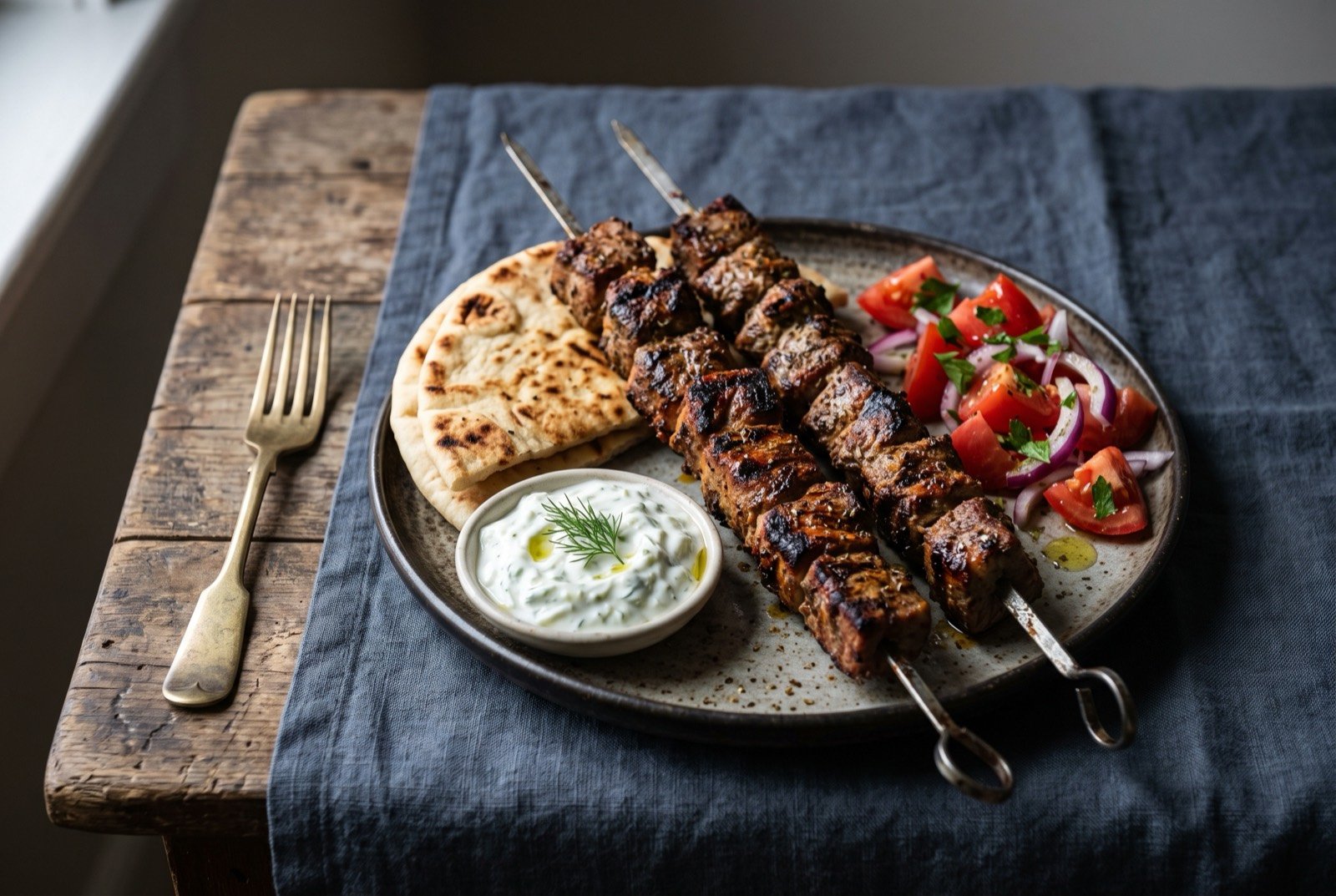
- Combine the pork with oil, lemon juice, oregano, garlic, salt and pepper.
- Marinate at least 2 hours, longer if convenient.
- Thread onto metal skewers.
- Grill over charcoal, roughly 3 to 4 minutes a side, 12 to 15 minutes total, turning regularly and basting with any remaining marinade.
- Serve with pitta, tomato, onion and tzatziki.
What a modern chef changes
The charcoal bed treated as a single fire with two zones, and the fat rendered deliberately
Rung 5
Method
- Bank the coals for a hot centre and a cooler edge, so you can sear the cubes hard at first and finish them gently without drying out, rather than one uniform heat throughout the cook.
- Baste continuously while turning, as the sourcing behind this chapter specifies as essential, rather than once at the start; this is what actually bastes and renders the fat rather than leaving it to drip away unused.
- Rest briefly off the heat before serving, a short pause that lets the juices settle, the same principle any grilled meat benefits from, even a fast-cooked cube this size.
Notes
Part Four