The Mediterranean · Volume 03, The Aegean and the Contested Table
Sheftalia
Cyprus
Illustration
- Time
- 2 hours 20
- Researched
- 11 sources cited
Greek Cypriot "σεφταλιά," sheftalia; Turkish Cypriot "şeftali kebabı." A Turkish-language source gives the popular folk etymology that the name derives from a cook called "Chef Ali," worth including as colour but explicitly flagged as folk etymology, not verified history, and importantly not a rival community claim of invention.
As tradition built it
Serves 4. About 20 minutes, plus 2 hours' rest.
Ingredients
- 500 g minced pork and or lamb
- 1 onion, finely chopped
- a small bunch fresh parsley, chopped
- a pinch ground cinnamon
- to taste salt and black pepper
- about 300g caul fat, rinsed well
Method
- Mix the mince with the onion, parsley, cinnamon, salt and pepper.
- Rest the mixture, covered, roughly 2 hours, so the flavours settle through the meat.
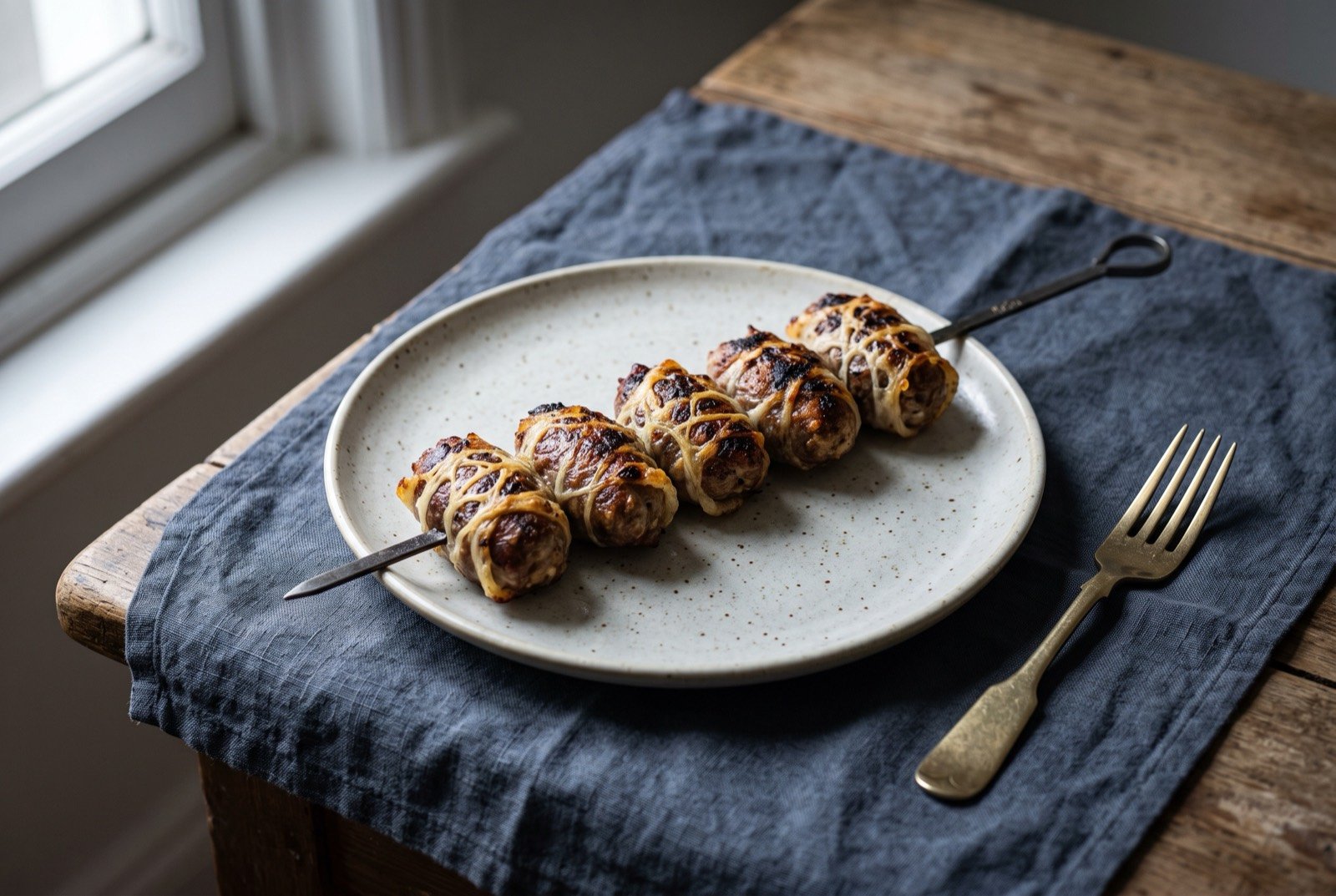
- Divide into portions, and wrap each in a piece of rinsed caul fat.
- Traditionally thread onto long iron skewers.
- Grill over charcoal, turning regularly, until the caul fat renders and crisps and the meat is cooked through.
- Serve with a lemon wedge.
Notes
Cinnamon in a savoury grilled-meat preparation is a genuinely distinctive Cypriot signature, also present in koupepia filling below, worth treating as a real flavour-arsenal marker rather than a one-off.
What a modern chef changes
The charcoal banked properly, and the caul fat's rendering timed rather than guessed
Rung 5
Method
- Bank the coals into a mound, not an even spread, for an intensely hot centre zone and a cooler holding zone at the edges on the same fire, exactly the traditional charcoal discipline.
- Use real lump charcoal, not briquettes. The sourcing behind this chapter is explicit that briquettes do not impart the same flavour, and this is one of the more checkable, structural reasons a gas-grilled version tastes flattened.
- Watch the caul fat, not a clock. It should render to a lace-like, crisp wrapper; pull the skewers the moment that happens rather than cooking to a fixed time, since caul fat thickness varies piece to piece.