West Africa · Volume 06, The Atlantic Islands
Cachupa rica
Cape Verde, the national dish
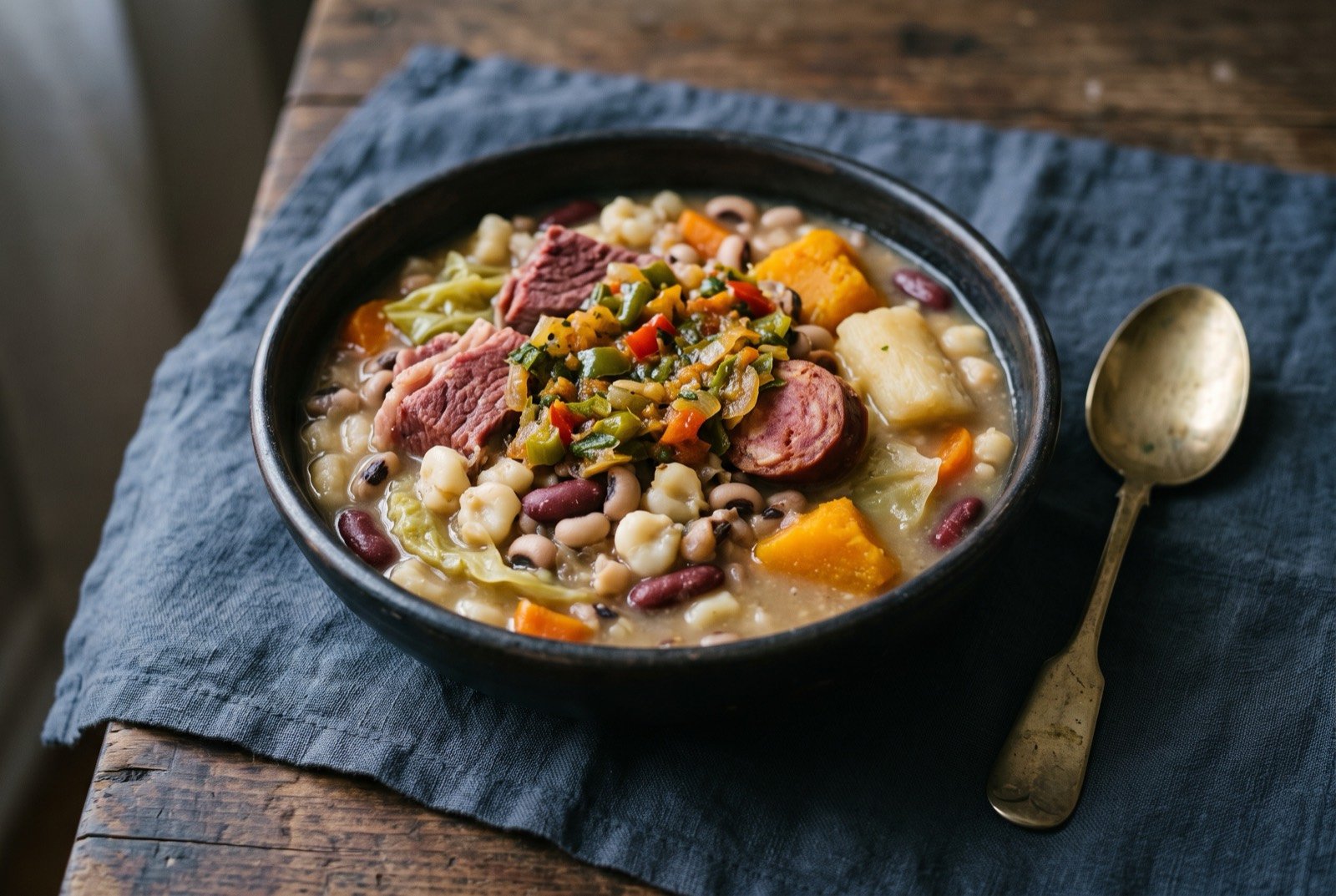
Illustration
- Time
- Hands on 6 hours · Waiting 8 hours
- Researched
- Researched from 115 sources in the brief
- Reviewed
- Awaiting a reader from inside the tradition
- Cooked
- Awaiting a cook report
Cachupa has no added thickener. Its body comes entirely from two starch sources held just below a rolling boil for hours: the amylopectin leaching out of whole hulled maize kernels, and the starch shedding from dried beans. Crystal DaCruz states it exactly: dried beans are a must, because the starch that comes off them is what thickens the stew. A Cape Verdean home cook gives the other half in five words: do not drain the cooking water. One accuracy point almost every English-language source gets wrong. Milho para cachupa is not nixtamalised. It is stamped or pearled to remove the pericarp, not cooked in lime, and canned or Mexican hominy carries an alkaline pozole note that does not belong here. Rica and pobre are a spectrum rather than a fixed pair.
As tradition built it
Serves 8 to 12. About 6 hours, plus overnight soaking.
Ingredients
- 680 g dried yellow hominy corn or samp, whole kernel
- 100 g feijão pedra or navy beans, dry
- 100 g cranberry beans, dry
- 130 g large white lima or butter beans, dry
- 700 g corned beef brisket
- 450 g salt pork
- 450 g linguiça or chouriço
- 1 pork trotter, optional but correct
- 2 onions, in large pieces
- 5 garlic cloves
- 4 carrots, in large pieces
- 1 cassava root, in large pieces
- 1 savoy cabbage, in large pieces
- 300 g squash, in large pieces
- 3 tomatoes
- to taste bay
- to taste sweet paprika
- to taste olive oil
- to taste malagueta
- to taste salt
- to taste white pepper
- 4.3 L water, topped up from a kettle kept boiling alongside
Method
- Soak the corn and each bean separately overnight. Marinate the meats overnight in vinegar, tomatoes, bay, paprika, olive oil, malagueta, salt, pepper and garlic.
- Corn alone, 60 minutes, in its soaking water plus boiling water to cover well.
- Add the beans, the corned beef, the salt pork and the pork trotter. 60 minutes.
- Add the cassava, the greens, the onions, the garlic and the carrots. 45 minutes.
- Add the chouriço. 20 minutes.
- Final simmer, 10 to 15 minutes, with the squash going in for the last of it.
- Rest, covered, off the heat, 20 to 30 minutes. Not optional, and not resting in the English sense. It is a diffusion step.
- Finish with a refogado and do not skip it. Tomato, onion, parsley and coriander softened in oil, stirred through or spooned over. The Cape Verdean press calls it an indispensable element of good finishing, and it is the difference between a good cachupa and a beige one.
Notes
After the diaspora build recorded by Crumb-Snatched, cross-checked against the island version at Criola Cozinha.
Top up only with boiling water: cold water drops the pot below gelatinisation and the corn stalls.
What a modern chef changes
Every component to its own endpoint, the fats split in time, and Chantre's plating from 1979
Rungs 1, 2 and 5
Method
- Cook the corn and each bean in a separate pan. Pressure cook the corn alone, which takes it from four hours to about forty-five minutes, and cook each bean only to the point where its cell walls separate cleanly. Marry everything for the last twenty minutes. Rung 1, and the biggest single improvement available to this dish.
- Render the salt pork separately and hold its fat. Build the refogado in that fat, hot and early. Rung 2 for the Portuguese half: the pork goes back in with the corn and beans, and the fat goes where you decide.
- Plate it as Chantre did, and salt in layers on the way there. Corn, beans and sausage as the base, vegetables cut in strips over the top, parsley to finish. Rung 5 achieved by geometry rather than by frying, and Rung 4's discipline applied pan by pan rather than by correcting an eight-litre pot at the end.